Where the FDA Regulations End and ICH GCP Begins The Differences & Similarities Between the Two   Paul Below, CCRA GCP Trainer Medical Research Management, Inc. SoCRA 16 th  Annual Conference  Adams Mark Hotel, Denver, CO September 29, 2007
This presentation was inspired by Norman Goldfarb, Managing Director of First Clinical Research. At the 2006 SoCRA Annual Meeting, he asked the question during a session on monitoring,  “How many in the audience know at least three differences between the FDA regulations and the ICH GCP Guidelines?”
Define what ICH is and what role the ICH guidelines play in clinical research  Review the ICH Guidelines for Good Clinical Practice (GCP) and how they differ from the FDA regulations Discuss the impact of ICH GCPs on Investigator sites Learning Objectives
International Conference on Harmonization of Technical Requirements for Registration of Pharmaceuticals for Human Use Working group of pharmaceutical industry experts and regulatory authorities from the European Union, Japan, and the United States What is ICH?
Aim to produce a single set of technical requirements for the registration of new drug drug products to streamline development Reduce or obviate duplicate testing More economical use of human, animal and material resources Eliminate unnecessary delays in the availability of new medicines  ICH Purpose
Reduced development time and cost Easier simultaneous new drug submission in many countries Facilitates intra-company globalization Importance of ICH to Industry
European Union began to successfully harmonize member country regulatory requirements in the 1980's WHO Conference of Drug Regulatory Authorities (Paris, 1989) was start of the harmonization process between Europe, U.S. and Japan First meeting held in 1990 (Brussels) with biennial meetings held since 37 guidelines produced to date ICH History
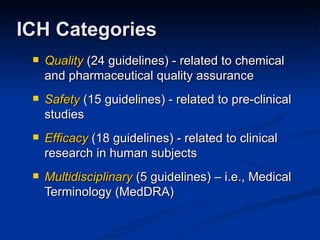
Quality  (24 guidelines) - related to chemical and pharmaceutical quality assurance Safety  (15 guidelines) - related to pre-clinical studies Efficacy  (18 guidelines) - related to clinical research in human subjects Multidisciplinary  (5 guidelines) – i.e., Medical Terminology (MedDRA) ICH Categories
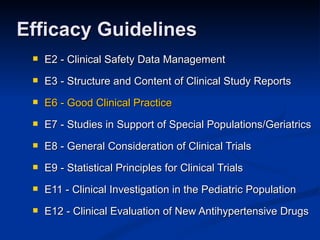
E2 - Clinical Safety Data Management E3 - Structure and Content of Clinical Study Reports E6 - Good Clinical Practice E7 - Studies in Support of Special Populations/Geriatrics E8 - General Consideration of Clinical Trials E9 - Statistical Principles for Clinical Trials E11 - Clinical Investigation in the Pediatric Population E12 - Clinical Evaluation of New Antihypertensive Drugs Efficacy Guidelines
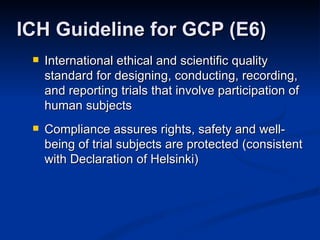
International ethical and scientific quality standard for designing, conducting, recording, and reporting trials that involve participation of human subjects Compliance assures rights, safety and well-being of trial subjects are protected (consistent with Declaration of Helsinki) ICH Guideline for GCP (E6)
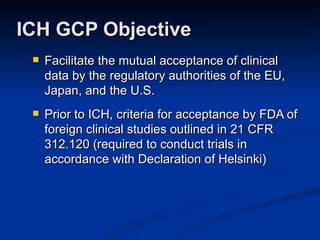
Facilitate the mutual acceptance of clinical data by the regulatory authorities of the EU, Japan, and the U.S.  Prior to ICH, criteria for acceptance by FDA of foreign clinical studies outlined in 21 CFR 312.120 (required to conduct trials in accordance with Declaration of Helsinki) ICH GCP Objective
Published as “guidance document” in the  Federal Register , Vol. 62,  May 9, 1997 ICH GCP Implementation in US
Represents FDA's “current thinking” on ways to comply with regulations Not legally binding Non-compliance should not be cited in a FDA Form 483 FDA Guidance Documents
E2A Guideline - Requirements and procedures for expedited pre- and post-marketing safety reporting.  “ Expedited Safety Reporting Requirements for Human Drug and Biological Products” published  Federal Register , October 7, 1997. Incorporated into CFR 21 part 312.32 on  April 6, 1998. ICH as FDA Regulation
Specific Differences Between ICH GCP and the FDA Regulations
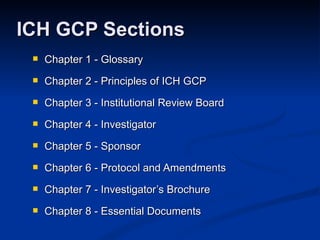
Chapter 1 - Glossary Chapter 2 - Principles of ICH GCP Chapter 3 - Institutional Review Board Chapter 4 - Investigator  Chapter 5 - Sponsor Chapter 6 - Protocol and Amendments Chapter 7 - Investigator’s Brochure Chapter 8 - Essential Documents ICH GCP Sections
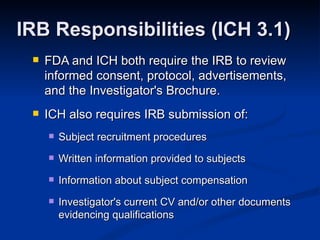
FDA and ICH both require the IRB to review informed consent, protocol, advertisements, and the Investigator's Brochure. ICH also requires IRB submission of: Subject recruitment procedures Written information provided to subjects Information about subject compensation Investigator's current CV and/or other documents evidencing qualifications IRB Responsibilities (ICH 3.1)
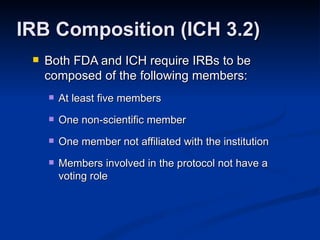
Both FDA and ICH require IRBs to be composed of the following members: At least five members One non-scientific member One member not affiliated with the institution Members involved in the protocol not have a voting role IRB Composition (ICH 3.2)
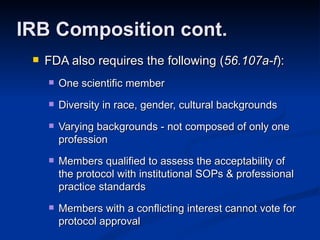
FDA also requires the following ( 56.107a-f ): One scientific member Diversity in race, gender, cultural backgrounds Varying backgrounds - not composed of only one profession Members qualified to assess the acceptability of the protocol with institutional SOPs & professional practice standards Members with a conflicting interest cannot vote for protocol approval IRB Composition cont.
ICH requires Investigators to maintain a list of appropriately qualified persons to whom significant trial-related duties have been delegated. Investigator Agreements (ICH 4.1)
ICH requires Investigators to demonstrate potential for recruiting the required number of patients within the agreed recruitment period.  Retrospective data  Patient database analysis Investigator Resources (ICH 4.2)
ICH requires Investigators to inform subjects when medical care is needed for an intercurrent illness. ICH recommends that Investigators inform the subject’s primary physician of trial participation (with the subject’s permission). ICH requires Investigators to make every reasonable effort to ascertain the reason(s) for subject early withdrawal (although the subject is not obliged to give a reason). Subject Medical Care (ICH 4.3)
ICH requires Investigators (or their designees) to document and explain any deviation from the approved protocol.  Protocol Compliance (ICH 4.5)
ICH allows the delegation of study drug dispensing, patient counselling, and drug accountability to a designee. FDA has no regulations or guidance concerning delegation of these duties. Investigational Product (ICH 4.6)
ICH allows the delegation of the informed consent process to a designee. FDA has no regulations concerning delegation of this duty although it is discussed in the FDA Information Sheets. Informed Consent (ICH 4.8)
ICH requires the person conducting the informed consent process to sign and date the consent form. ICH requires that the subject receive a  signed and dated  copy of the consent form.  FDA only requires that a copy be provided. Informed Consent cont.
ICH requires the following informed consent elements not required by the FDA: Discussion of trial treatments and probability of random assignment Subject responsibilities Anticipated payment, if any, to the subject Important potential risks and benefits of alternative treatment Authorization to access medical records by regulatory authorities (FDA and foreign) Informed Consent cont.
ICH requires Investigators (or designees) to: Document explanations for discrepancies between data in the CRFs and the source documents. Initial, date and explain (if necessary) all CRF changes/corrections.  CRF designees must be documented. Endorse & retain records of all CRF changes made by the Sponsor. Records and Reports (ICH 4.9)
ICH requires the retention of “essential documents” for at least two years after the approval of a marketing application in an  ICH region  or until there is no pending or contemplated applications in an  ICH region  or development is formally discontinued.  ICH compliance generally requires a longer retention time than FDA regulations. Records and Reports (ICH 4.9)
ICH requires Sponsors to secure agreement from all involved parties to ensure direct access of study records to foreign regulatory authorities. Sponsor QA/QC (ICH 5.1)
ICH requires Sponsors to inform Investigators in writing of: Study record retention requirements Notification of when records are no longer needed Record Keeping (ICH 5.5)
ICH requires Sponsors to provide insurance or indemnify the investigator against claims arising from the trial. Compensation (ICH 5.8)
FDA requires extensive disclosure of the Investigator’s financial relationship with the Sponsor (21 CFR 54). ICH has no comparable guideline and only requires that financial aspects of the trial be documented in an agreement between the Sponsor and Investigator. Financing (ICH 5.9)
ICH requires Sponsors to obtain a statement from Investigators that their local IRB is organized and operates according to GCP and applicable laws and regulations. IRB Review (ICH 5.11)
ICH requires Sponsors to obtain documentation of IRB approval prior to shipping investigational product to an Investigator. Supplying IP (ICH 5.14)
FDA specifies that Sponsors shall monitor the progress of all clinical investigations (21 CFR 312.56) and that monitors be qualified by training and experience (21 CFR 312.53). FDA has a guidance document on the topic, “Guideline for the Monitoring Clinical Investigations” (January 1988). Monitoring (ICH 5.18)
ICH includes the following items not addressed in the FDA guidance: Monitor qualifications must be documented Monitors must verify that trial functions have not been delegated to unauthorized individuals Sponsors must document review and follow-up of the monitoring report Monitoring cont.
ICH has more detailed outline of contents of the protocol and Investigator Brochure than the FDA regulations [21 CFR 312.23(a)(5-6)] ICH requires that the protocol identify any data to be recorded directly on the CRFs and to be considered source data (ICH 6.4.9) Protocol and IB (ICH 6 & 7)
ICH requires the following documents not specified by the FDA: Subject Screening Log  (to document subjects who enter trial screening)  Subject Identification Code List  (confidential list of subject names in case identity must be revealed for follow-up) Signature Sheet  (to document signatures/initials of persons authorized to make CRF entries and corrections) Essential Documents (ICH 8)
ICH requires the following documents be filed at the site: Trial Initiation Monitoring Report (to document that trial procedures were reviewed with the Investigator and staff)  Relevant Communications (letters, meeting notes, notes of telephone calls) Essential Documents cont.
This presentation and related references are posted on my corporate website at: www.pbelow-consulting.com/ich-fda.html
Office: (952) 882-4083 E-mail: [email_address] Contact Information

Ich Fda Socra 09 2007

  • 1.
    Where the FDARegulations End and ICH GCP Begins The Differences & Similarities Between the Two Paul Below, CCRA GCP Trainer Medical Research Management, Inc. SoCRA 16 th Annual Conference Adams Mark Hotel, Denver, CO September 29, 2007
  • 2.
    This presentation wasinspired by Norman Goldfarb, Managing Director of First Clinical Research. At the 2006 SoCRA Annual Meeting, he asked the question during a session on monitoring, “How many in the audience know at least three differences between the FDA regulations and the ICH GCP Guidelines?”
  • 3.
    Define what ICHis and what role the ICH guidelines play in clinical research Review the ICH Guidelines for Good Clinical Practice (GCP) and how they differ from the FDA regulations Discuss the impact of ICH GCPs on Investigator sites Learning Objectives
  • 4.
    International Conference onHarmonization of Technical Requirements for Registration of Pharmaceuticals for Human Use Working group of pharmaceutical industry experts and regulatory authorities from the European Union, Japan, and the United States What is ICH?
  • 5.
    Aim to producea single set of technical requirements for the registration of new drug drug products to streamline development Reduce or obviate duplicate testing More economical use of human, animal and material resources Eliminate unnecessary delays in the availability of new medicines ICH Purpose
  • 6.
    Reduced development timeand cost Easier simultaneous new drug submission in many countries Facilitates intra-company globalization Importance of ICH to Industry
  • 7.
    European Union beganto successfully harmonize member country regulatory requirements in the 1980's WHO Conference of Drug Regulatory Authorities (Paris, 1989) was start of the harmonization process between Europe, U.S. and Japan First meeting held in 1990 (Brussels) with biennial meetings held since 37 guidelines produced to date ICH History
  • 8.
    Quality (24guidelines) - related to chemical and pharmaceutical quality assurance Safety (15 guidelines) - related to pre-clinical studies Efficacy (18 guidelines) - related to clinical research in human subjects Multidisciplinary (5 guidelines) – i.e., Medical Terminology (MedDRA) ICH Categories
  • 9.
    E2 - ClinicalSafety Data Management E3 - Structure and Content of Clinical Study Reports E6 - Good Clinical Practice E7 - Studies in Support of Special Populations/Geriatrics E8 - General Consideration of Clinical Trials E9 - Statistical Principles for Clinical Trials E11 - Clinical Investigation in the Pediatric Population E12 - Clinical Evaluation of New Antihypertensive Drugs Efficacy Guidelines
  • 10.
    International ethical andscientific quality standard for designing, conducting, recording, and reporting trials that involve participation of human subjects Compliance assures rights, safety and well-being of trial subjects are protected (consistent with Declaration of Helsinki) ICH Guideline for GCP (E6)
  • 11.
    Facilitate the mutualacceptance of clinical data by the regulatory authorities of the EU, Japan, and the U.S. Prior to ICH, criteria for acceptance by FDA of foreign clinical studies outlined in 21 CFR 312.120 (required to conduct trials in accordance with Declaration of Helsinki) ICH GCP Objective
  • 12.
    Published as “guidancedocument” in the Federal Register , Vol. 62, May 9, 1997 ICH GCP Implementation in US
  • 13.
    Represents FDA's “currentthinking” on ways to comply with regulations Not legally binding Non-compliance should not be cited in a FDA Form 483 FDA Guidance Documents
  • 14.
    E2A Guideline -Requirements and procedures for expedited pre- and post-marketing safety reporting. “ Expedited Safety Reporting Requirements for Human Drug and Biological Products” published Federal Register , October 7, 1997. Incorporated into CFR 21 part 312.32 on April 6, 1998. ICH as FDA Regulation
  • 15.
    Specific Differences BetweenICH GCP and the FDA Regulations
  • 16.
    Chapter 1 -Glossary Chapter 2 - Principles of ICH GCP Chapter 3 - Institutional Review Board Chapter 4 - Investigator Chapter 5 - Sponsor Chapter 6 - Protocol and Amendments Chapter 7 - Investigator’s Brochure Chapter 8 - Essential Documents ICH GCP Sections
  • 17.
    FDA and ICHboth require the IRB to review informed consent, protocol, advertisements, and the Investigator's Brochure. ICH also requires IRB submission of: Subject recruitment procedures Written information provided to subjects Information about subject compensation Investigator's current CV and/or other documents evidencing qualifications IRB Responsibilities (ICH 3.1)
  • 18.
    Both FDA andICH require IRBs to be composed of the following members: At least five members One non-scientific member One member not affiliated with the institution Members involved in the protocol not have a voting role IRB Composition (ICH 3.2)
  • 19.
    FDA also requiresthe following ( 56.107a-f ): One scientific member Diversity in race, gender, cultural backgrounds Varying backgrounds - not composed of only one profession Members qualified to assess the acceptability of the protocol with institutional SOPs & professional practice standards Members with a conflicting interest cannot vote for protocol approval IRB Composition cont.
  • 20.
    ICH requires Investigatorsto maintain a list of appropriately qualified persons to whom significant trial-related duties have been delegated. Investigator Agreements (ICH 4.1)
  • 21.
    ICH requires Investigatorsto demonstrate potential for recruiting the required number of patients within the agreed recruitment period. Retrospective data Patient database analysis Investigator Resources (ICH 4.2)
  • 22.
    ICH requires Investigatorsto inform subjects when medical care is needed for an intercurrent illness. ICH recommends that Investigators inform the subject’s primary physician of trial participation (with the subject’s permission). ICH requires Investigators to make every reasonable effort to ascertain the reason(s) for subject early withdrawal (although the subject is not obliged to give a reason). Subject Medical Care (ICH 4.3)
  • 23.
    ICH requires Investigators(or their designees) to document and explain any deviation from the approved protocol. Protocol Compliance (ICH 4.5)
  • 24.
    ICH allows thedelegation of study drug dispensing, patient counselling, and drug accountability to a designee. FDA has no regulations or guidance concerning delegation of these duties. Investigational Product (ICH 4.6)
  • 25.
    ICH allows thedelegation of the informed consent process to a designee. FDA has no regulations concerning delegation of this duty although it is discussed in the FDA Information Sheets. Informed Consent (ICH 4.8)
  • 26.
    ICH requires theperson conducting the informed consent process to sign and date the consent form. ICH requires that the subject receive a signed and dated copy of the consent form. FDA only requires that a copy be provided. Informed Consent cont.
  • 27.
    ICH requires thefollowing informed consent elements not required by the FDA: Discussion of trial treatments and probability of random assignment Subject responsibilities Anticipated payment, if any, to the subject Important potential risks and benefits of alternative treatment Authorization to access medical records by regulatory authorities (FDA and foreign) Informed Consent cont.
  • 28.
    ICH requires Investigators(or designees) to: Document explanations for discrepancies between data in the CRFs and the source documents. Initial, date and explain (if necessary) all CRF changes/corrections. CRF designees must be documented. Endorse & retain records of all CRF changes made by the Sponsor. Records and Reports (ICH 4.9)
  • 29.
    ICH requires theretention of “essential documents” for at least two years after the approval of a marketing application in an ICH region or until there is no pending or contemplated applications in an ICH region or development is formally discontinued. ICH compliance generally requires a longer retention time than FDA regulations. Records and Reports (ICH 4.9)
  • 30.
    ICH requires Sponsorsto secure agreement from all involved parties to ensure direct access of study records to foreign regulatory authorities. Sponsor QA/QC (ICH 5.1)
  • 31.
    ICH requires Sponsorsto inform Investigators in writing of: Study record retention requirements Notification of when records are no longer needed Record Keeping (ICH 5.5)
  • 32.
    ICH requires Sponsorsto provide insurance or indemnify the investigator against claims arising from the trial. Compensation (ICH 5.8)
  • 33.
    FDA requires extensivedisclosure of the Investigator’s financial relationship with the Sponsor (21 CFR 54). ICH has no comparable guideline and only requires that financial aspects of the trial be documented in an agreement between the Sponsor and Investigator. Financing (ICH 5.9)
  • 34.
    ICH requires Sponsorsto obtain a statement from Investigators that their local IRB is organized and operates according to GCP and applicable laws and regulations. IRB Review (ICH 5.11)
  • 35.
    ICH requires Sponsorsto obtain documentation of IRB approval prior to shipping investigational product to an Investigator. Supplying IP (ICH 5.14)
  • 36.
    FDA specifies thatSponsors shall monitor the progress of all clinical investigations (21 CFR 312.56) and that monitors be qualified by training and experience (21 CFR 312.53). FDA has a guidance document on the topic, “Guideline for the Monitoring Clinical Investigations” (January 1988). Monitoring (ICH 5.18)
  • 37.
    ICH includes thefollowing items not addressed in the FDA guidance: Monitor qualifications must be documented Monitors must verify that trial functions have not been delegated to unauthorized individuals Sponsors must document review and follow-up of the monitoring report Monitoring cont.
  • 38.
    ICH has moredetailed outline of contents of the protocol and Investigator Brochure than the FDA regulations [21 CFR 312.23(a)(5-6)] ICH requires that the protocol identify any data to be recorded directly on the CRFs and to be considered source data (ICH 6.4.9) Protocol and IB (ICH 6 & 7)
  • 39.
    ICH requires thefollowing documents not specified by the FDA: Subject Screening Log (to document subjects who enter trial screening) Subject Identification Code List (confidential list of subject names in case identity must be revealed for follow-up) Signature Sheet (to document signatures/initials of persons authorized to make CRF entries and corrections) Essential Documents (ICH 8)
  • 40.
    ICH requires thefollowing documents be filed at the site: Trial Initiation Monitoring Report (to document that trial procedures were reviewed with the Investigator and staff) Relevant Communications (letters, meeting notes, notes of telephone calls) Essential Documents cont.
  • 41.
    This presentation andrelated references are posted on my corporate website at: www.pbelow-consulting.com/ich-fda.html
  • 42.
    Office: (952) 882-4083E-mail: [email_address] Contact Information