1
TOPIC- ARCHIVING OF CLINICAL STUDY RECORDS
CLINICAL RESEARCH SEMINAR
BY-MASTER RISHI MAHESHWARI
ROLL NO. - 31
INDEX
Archiving of clinical study records 2
S.NO TOPIC SLIDE NUMBER
1) Introduction 3
2) What Is Archiving? 5
3) Why is archiving important ? 6
4) Reasons why document archiving is important 7
5) Types Of Archiving 8
6) Documents To Be Archived 9
7) Archival Strategy- 10-18
8) Archiving by the ethics committee(s) 19
9) Archiving by the investigator 20
10) How long must clinical research records should be kept? 21
11) Software's used . 22
12) References 24
INTRODUCTION (1)(2)
◦ As per the New Drugs and Clinical Trial Rules (2019) and Good Clinical Practice
Guidelines by CDSCO, all essential documents pertaining to a clinical trial must be
archived.
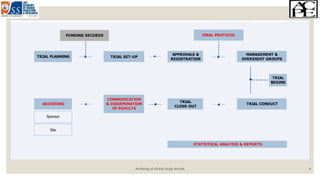
◦ It is the responsibility of the sponsor to ensure that the documents and trial supplies are
archived for at least three years after the completion of the trial, or submission to
the regulatory agency; whichever is later. In addition to essential documents, and trial
supplies, the sponsor may have specific policies pertaining to archiving for a clinical trial.
◦ The archival plan must incorporate these specifications as well. For instance, the sponsor
may retain the documents for a longer duration.
◦ Archiving is a key requisite to ensure post-trial monitoring, evaluation and to
facilitate further research.
Archiving of clinical study records 3
Archiving of clinical study records 4
WHAT IS ARCHIVING? (1,3,4)
◦ Document archiving means putting information you no longer use regularly into
secure storage for extended periods of time.
◦ It is the long-term storage of all essential documents which individually and
collectively permit the evaluation of the conduct of a clinical trial and the quality of the
data produced.
• Essential documents must be archived for sufficient periods to allow for audit and
inspection by regulatory authorities.
Archiving of clinical study records 5
WHY IS ARCHIVING IMPORTANT ?(1,3)
◦ Archiving is a key requisite to ensure post-trial monitoring, and evaluation and to
facilitate further research.
◦ Document archiving is securely storing information (both digital and paper format) that are
not used regularly.
It’s important because it:
-stops from losing data.
-ensures only the right people can access the right documents.
-keeps documents organized and easy to access.
-saves valuable storage space in office and on server.
-helps business meet legal requirements for auditing.
6
REASONS FOR ARCHIVING DOCUMENTS
◦ Data is well organized so it’s easier to find the right documents when needed.
◦ Records can be easily audited and retrieved for legal reasons.
◦ Improves security—only the right people can access the right documents.
◦ Saves space in office and organizations.
◦ Prevents from data loss.
Archiving of clinical study records 7
TYPES OF ARCHIVING(2)
◦ There are two types of archiving
Onsite – It is the archiving of the data , at the site or the server of the organization
within the premises of the Research institute, CRO’s , or the institute.
Offsite - It is the archiving of the data , at the site or server which is not in the
organization and is archived by other institutes or companies . It is based on a legal agreement
and documentation.
Archiving of clinical study records 8
DOCUMENTS TO BE ARCHIVED
Some examples are:
◦ source documents,
◦ case record forms,
◦ informed consent documents,
◦ investigator site file,
◦ biological samples,
◦ trial supplies, etc.
Archiving of clinical study records 9
ARCHIVAL STRATEGY-
◦ Prior to initiation of a trial, an archival strategy must be developed, which
addresses the regulatory requirements .It should include the following elements:
◦ Personnel responsible for implementing the archival plan.
Archiving of clinical study records 10
Period Of Archiving
◦ The plan must indicate for how long the documents will be archived in compliance with the
regulatory guidelines.
Archiving of clinical study records 11
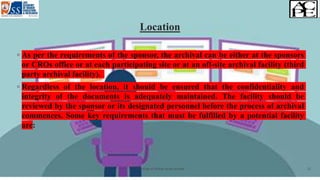
Location
◦ As per the requirements of the sponsor, the archival can be either at the sponsors
or CROs office or at each participating site or at an off-site archival facility (third
party archival facility).
◦ Regardless of the location, it should be ensured that the confidentiality and
integrity of the documents is adequately maintained. The facility should be
reviewed by the sponsor or its designated personnel before the process of archival
commences. Some key requirements that must be fulfilled by a potential facility
are:
Archiving of clinical study records 12
• Provision of adequate space, staff and equipment
• Provision of stable environmental conditions to ensure that the documents, and other
material are not affected (controlled temperature and humidity). Care must be taken when
magnetic media or images are archived.
• Security of the premises: it must be ensured that the facility has provisions for restricted
access, locked cabinets and intruder alarms.
• Hazard management
Archiving of clinical study records 13
Retrieval or access of archived documents
◦ The plan must specify that the documents will have a restricted access. It is advisable to
identify the details of personnel that can access the archival facility. However, it should be
clarified that the regulatory authority or ethics committees may request access to these
documents.
Archiving of clinical study records 14
Disaster recovery
◦ The archival plan should include a disaster management plan, to recover the
documents in case of an emergency. For example, electronic copies can be made of
all documents and data that are archived. However, these electronic copies must be
stored at a location other than the archival facility, and comply with confidentiality
requirements.
Archiving of clinical study records 15
Procedure
It should be specified that the process of archival should only be commenced after:
• The final visit has been completed by the last trial participant.
• Trial Master File and Investigator Site File, are complete
• The data has been verified for accuracy
• All queries pertaining to data have been resolved, database is locked, and the data has been
analyzed.
• Final report has been submitted
• Any other pre-requisite specified by the sponsor, regulatory authority, ethics committee,
etc.
Archiving of clinical study records 16
Clinical data archiving
To successfully reconstruct a trial, one must be able to view the clinical data accompanied with the
manner in which it was obtained and managed. The following list summarizes the type of data that
should be archived:
• Clinical data: includes all the data collected during the trial, i.e. data from the CRFs, electronically
submitted laboratory reports, imaging, etc.
• External data: if a Clinical Data Management System (CDMS) is used for a trial, then, the archive
must include all files loaded in the CDMS including quality control documents.
• Laboratory reference ranges
• Lists of edit checks, derived data and change controls
• Data handling guidelines and discrepancy management logs
• Data Management Plan
Archiving of clinical study records 17
Most common formats that are used for clinical trial archives are:
◦ Comma Separated Values (CSV),
◦ Extensible Markup Language (XML),
◦ SAS transport files,
◦ Adobe PDF, etc.
However, in most trails the sponsor will specify the format for archiving clinical data, and
in multiple formats.
Archiving of clinical study records 18
ARCHIVING BY THE ETHICS COMMITTEE(S)
◦ Documents submitted to an Ethics Committee (EC) for approval, must be kept confidential,
and stored as per their written SOPs.
◦ The EC(s) must archive all documents and records for a period of at least five years after the
completion or termination of a clinical trial.
Archiving of clinical study records 19
ARCHIVING BY THE INVESTIGATOR
The investigator must maintain and archive essential documents pertaining to a clinical trial.
These documents should be archived for:
• for a period of at least two years, after the last approval of a marketing application
• or, for a period of two years until there are no pending or contemplated applications
• or, for at least two years after the formal discontinuation of clinical development of the
investigational product.
Archiving of clinical study records 20
HOW LONG MUST CLINICAL RESEARCH RECORDS
SHOULD BE KEPT?
◦ As per ICH GCP, the essential documents should be retained until at least 2 years after
the last approval of a marketing application in an ICH region and until there are no
pending or contemplated marketing applications in an ICH region or at least 2 years
have elapsed since the formal discontinuation of clinical development of the
investigational product. These documents should be retained for a longer period
however if required by the applicable regulatory requirements or by an agreement with
the sponsor.
Archiving of clinical study records 21
SOFTWARES USED IN ARCHIVING OF RECORDS -
◦ Commvault Complete Backup & Recovery,
◦ Stillio,
◦ DocuWiz,
◦ Archive Manager, and
◦ Exclaimer Mail Archiver.
Archiving of clinical study records 22
◦ As per the growing technology , it is possible to archive Terabytes of data on
single server , devices , or hubs.
◦ After archiving of data with software's this data can even be uploaded on the
cloud storage which is an online computing model that stores that on internet
through cloud computing provider and this data can be managed and used as
per requirement.
Archiving of clinical study records 23
REFERENCES
◦ 1)https://cdsatoolkit.thsti.in/archiving/
◦ 2)https://www.ncbi.nlm.nih.gov/pmc/articles/PMC2605592/
◦ 3)https://www.thieme-
connect.com/products/ejournals/abstract/10.3414/ME9236
◦ 4)http://www.pharmabiz.com/NewsDetails.aspx?aid=97174&sid=16
Archiving of clinical study records 24
ANY QUESTIONS?
Archiving of clinical study records 25
Archiving of clinical study records 26

Archiving of clincial study records.pptx

  • 1.
    1 TOPIC- ARCHIVING OFCLINICAL STUDY RECORDS CLINICAL RESEARCH SEMINAR BY-MASTER RISHI MAHESHWARI ROLL NO. - 31
  • 2.
    INDEX Archiving of clinicalstudy records 2 S.NO TOPIC SLIDE NUMBER 1) Introduction 3 2) What Is Archiving? 5 3) Why is archiving important ? 6 4) Reasons why document archiving is important 7 5) Types Of Archiving 8 6) Documents To Be Archived 9 7) Archival Strategy- 10-18 8) Archiving by the ethics committee(s) 19 9) Archiving by the investigator 20 10) How long must clinical research records should be kept? 21 11) Software's used . 22 12) References 24
  • 3.
    INTRODUCTION (1)(2) ◦ Asper the New Drugs and Clinical Trial Rules (2019) and Good Clinical Practice Guidelines by CDSCO, all essential documents pertaining to a clinical trial must be archived. ◦ It is the responsibility of the sponsor to ensure that the documents and trial supplies are archived for at least three years after the completion of the trial, or submission to the regulatory agency; whichever is later. In addition to essential documents, and trial supplies, the sponsor may have specific policies pertaining to archiving for a clinical trial. ◦ The archival plan must incorporate these specifications as well. For instance, the sponsor may retain the documents for a longer duration. ◦ Archiving is a key requisite to ensure post-trial monitoring, evaluation and to facilitate further research. Archiving of clinical study records 3
  • 4.
    Archiving of clinicalstudy records 4
  • 5.
    WHAT IS ARCHIVING?(1,3,4) ◦ Document archiving means putting information you no longer use regularly into secure storage for extended periods of time. ◦ It is the long-term storage of all essential documents which individually and collectively permit the evaluation of the conduct of a clinical trial and the quality of the data produced. • Essential documents must be archived for sufficient periods to allow for audit and inspection by regulatory authorities. Archiving of clinical study records 5
  • 6.
    WHY IS ARCHIVINGIMPORTANT ?(1,3) ◦ Archiving is a key requisite to ensure post-trial monitoring, and evaluation and to facilitate further research. ◦ Document archiving is securely storing information (both digital and paper format) that are not used regularly. It’s important because it: -stops from losing data. -ensures only the right people can access the right documents. -keeps documents organized and easy to access. -saves valuable storage space in office and on server. -helps business meet legal requirements for auditing. 6
  • 7.
    REASONS FOR ARCHIVINGDOCUMENTS ◦ Data is well organized so it’s easier to find the right documents when needed. ◦ Records can be easily audited and retrieved for legal reasons. ◦ Improves security—only the right people can access the right documents. ◦ Saves space in office and organizations. ◦ Prevents from data loss. Archiving of clinical study records 7
  • 8.
    TYPES OF ARCHIVING(2) ◦There are two types of archiving Onsite – It is the archiving of the data , at the site or the server of the organization within the premises of the Research institute, CRO’s , or the institute. Offsite - It is the archiving of the data , at the site or server which is not in the organization and is archived by other institutes or companies . It is based on a legal agreement and documentation. Archiving of clinical study records 8
  • 9.
    DOCUMENTS TO BEARCHIVED Some examples are: ◦ source documents, ◦ case record forms, ◦ informed consent documents, ◦ investigator site file, ◦ biological samples, ◦ trial supplies, etc. Archiving of clinical study records 9
  • 10.
    ARCHIVAL STRATEGY- ◦ Priorto initiation of a trial, an archival strategy must be developed, which addresses the regulatory requirements .It should include the following elements: ◦ Personnel responsible for implementing the archival plan. Archiving of clinical study records 10
  • 11.
    Period Of Archiving ◦The plan must indicate for how long the documents will be archived in compliance with the regulatory guidelines. Archiving of clinical study records 11
  • 12.
    Location ◦ As perthe requirements of the sponsor, the archival can be either at the sponsors or CROs office or at each participating site or at an off-site archival facility (third party archival facility). ◦ Regardless of the location, it should be ensured that the confidentiality and integrity of the documents is adequately maintained. The facility should be reviewed by the sponsor or its designated personnel before the process of archival commences. Some key requirements that must be fulfilled by a potential facility are: Archiving of clinical study records 12
  • 13.
    • Provision ofadequate space, staff and equipment • Provision of stable environmental conditions to ensure that the documents, and other material are not affected (controlled temperature and humidity). Care must be taken when magnetic media or images are archived. • Security of the premises: it must be ensured that the facility has provisions for restricted access, locked cabinets and intruder alarms. • Hazard management Archiving of clinical study records 13
  • 14.
    Retrieval or accessof archived documents ◦ The plan must specify that the documents will have a restricted access. It is advisable to identify the details of personnel that can access the archival facility. However, it should be clarified that the regulatory authority or ethics committees may request access to these documents. Archiving of clinical study records 14
  • 15.
    Disaster recovery ◦ Thearchival plan should include a disaster management plan, to recover the documents in case of an emergency. For example, electronic copies can be made of all documents and data that are archived. However, these electronic copies must be stored at a location other than the archival facility, and comply with confidentiality requirements. Archiving of clinical study records 15
  • 16.
    Procedure It should bespecified that the process of archival should only be commenced after: • The final visit has been completed by the last trial participant. • Trial Master File and Investigator Site File, are complete • The data has been verified for accuracy • All queries pertaining to data have been resolved, database is locked, and the data has been analyzed. • Final report has been submitted • Any other pre-requisite specified by the sponsor, regulatory authority, ethics committee, etc. Archiving of clinical study records 16
  • 17.
    Clinical data archiving Tosuccessfully reconstruct a trial, one must be able to view the clinical data accompanied with the manner in which it was obtained and managed. The following list summarizes the type of data that should be archived: • Clinical data: includes all the data collected during the trial, i.e. data from the CRFs, electronically submitted laboratory reports, imaging, etc. • External data: if a Clinical Data Management System (CDMS) is used for a trial, then, the archive must include all files loaded in the CDMS including quality control documents. • Laboratory reference ranges • Lists of edit checks, derived data and change controls • Data handling guidelines and discrepancy management logs • Data Management Plan Archiving of clinical study records 17
  • 18.
    Most common formatsthat are used for clinical trial archives are: ◦ Comma Separated Values (CSV), ◦ Extensible Markup Language (XML), ◦ SAS transport files, ◦ Adobe PDF, etc. However, in most trails the sponsor will specify the format for archiving clinical data, and in multiple formats. Archiving of clinical study records 18
  • 19.
    ARCHIVING BY THEETHICS COMMITTEE(S) ◦ Documents submitted to an Ethics Committee (EC) for approval, must be kept confidential, and stored as per their written SOPs. ◦ The EC(s) must archive all documents and records for a period of at least five years after the completion or termination of a clinical trial. Archiving of clinical study records 19
  • 20.
    ARCHIVING BY THEINVESTIGATOR The investigator must maintain and archive essential documents pertaining to a clinical trial. These documents should be archived for: • for a period of at least two years, after the last approval of a marketing application • or, for a period of two years until there are no pending or contemplated applications • or, for at least two years after the formal discontinuation of clinical development of the investigational product. Archiving of clinical study records 20
  • 21.
    HOW LONG MUSTCLINICAL RESEARCH RECORDS SHOULD BE KEPT? ◦ As per ICH GCP, the essential documents should be retained until at least 2 years after the last approval of a marketing application in an ICH region and until there are no pending or contemplated marketing applications in an ICH region or at least 2 years have elapsed since the formal discontinuation of clinical development of the investigational product. These documents should be retained for a longer period however if required by the applicable regulatory requirements or by an agreement with the sponsor. Archiving of clinical study records 21
  • 22.
    SOFTWARES USED INARCHIVING OF RECORDS - ◦ Commvault Complete Backup & Recovery, ◦ Stillio, ◦ DocuWiz, ◦ Archive Manager, and ◦ Exclaimer Mail Archiver. Archiving of clinical study records 22
  • 23.
    ◦ As perthe growing technology , it is possible to archive Terabytes of data on single server , devices , or hubs. ◦ After archiving of data with software's this data can even be uploaded on the cloud storage which is an online computing model that stores that on internet through cloud computing provider and this data can be managed and used as per requirement. Archiving of clinical study records 23
  • 24.
    REFERENCES ◦ 1)https://cdsatoolkit.thsti.in/archiving/ ◦ 2)https://www.ncbi.nlm.nih.gov/pmc/articles/PMC2605592/ ◦3)https://www.thieme- connect.com/products/ejournals/abstract/10.3414/ME9236 ◦ 4)http://www.pharmabiz.com/NewsDetails.aspx?aid=97174&sid=16 Archiving of clinical study records 24
  • 25.
    ANY QUESTIONS? Archiving ofclinical study records 25
  • 26.
    Archiving of clinicalstudy records 26