Case
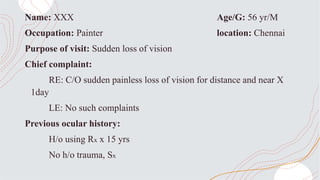
Name: XXX Age/G: 56 yr/M
Occupation: Painter location: Chennai
Purpose of visit: Sudden loss of vision
Chief complaint:
RE: C/O sudden painless loss of vision for distance and near X
1day
LE: No such complaints
Previous ocular history:
H/o using Rx x 15 yrs
No h/o trauma, Sx
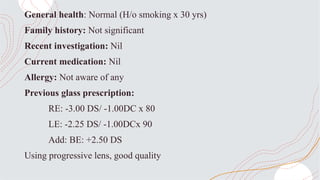
General health: Normal (H/o smoking x 30 yrs)
Family history: Not significant
Recent investigation: Nil
Current medication: Nil
Allergy: Not aware of any
Previous glass prescription:
RE: -3.00 DS/ -1.00DC x 80
LE: -2.25 DS/ -1.00DCx 90
Add: BE: +2.50 DS
Using progressive lens, good quality
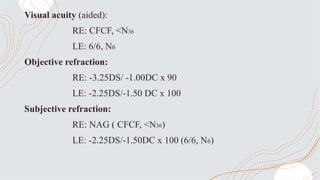
Visual acuity (aided):
RE: CFCF, <N36
LE: 6/6, N6
Objective refraction:
RE: -3.25DS/ -1.00DC x 90
LE: -2.25DS/-1.50 DC x 100
Subjective refraction:
RE: NAG ( CFCF, <N36)
LE: -2.25DS/-1.50DC x 100 (6/6, N6)
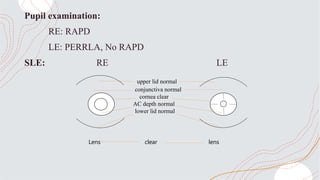
Pupil examination:
RE: RAPD
LE: PERRLA, No RAPD
SLE: RE LE
upper lid normal
conjunctiva normal
cornea clear
AC depth normal
lower lid normal
Lens clear lens
IOP:
RE: 17mm Hg
LE: 16mm Hg
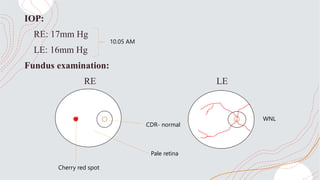
Fundus examination:
RE LE
10.05 AM
WNL
CDR- normal
Pale retina
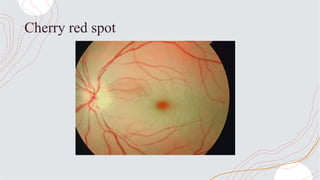
Cherry red spot
Diagnosis:
?
RE: Central retinal artery occlusion
Central Retinal
Artery Occlusion
By,
DHINESH M
Introduction
Central retinal artery occlusion (CRAO) is the sudden
blockage of the central retinal artery
 retinal hypoperfusion
 rapidly progressive cellular damage
 vision loss
Etiology
Embolism : blockage of artery caused by any foreign body
Thrombosis . Thrombi may be due to atherosclerotic disease,
collagen-vascular disease, inflammatory states, and/or
hypercoagulable states
Epidemology
Incidence - 1: 100,000 ( less than 2% with bilateral presentation)
Early 60s
Male>female
RISK FACTORS:
hypertension,
smoking,
hyperlipidemia,
diabetes,
hypercoagulable states
Clinical features
Symptoms
Monocular vision loss
Sudden loss of vision (occurs acutely, possibly over a span of few
seconds)
Painless
In some cases, premonitory episodes of amaurosis fugax may be
reported
Signs
1. Visual acuity at the time of initial presentation ranges from counting
fingers to light perception.
Central visual acuity may be near normal in patients who have transient
CRAO or a cilioretinal artery providing sufficient vascular supply to the
fovea.
The absence of light perception is rare; therefore in such cases, concomitant
choroidal circulation deficit or optic nerve involvement should be
considered.
Visual acuity tends only to improve within the first week of onset with
minimal chance for appreciable improvement subsequently
2. RAPD
3. Intra ocular pressure is often normal at presentation but may become
elevated in the setting of rubeosis iridis
4. Fundus changes
 Cherry red spot (90%)
 Posterior pole retinal opacity or whitening (58%)
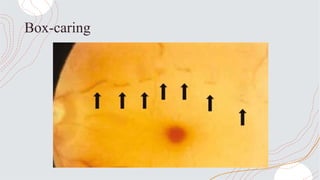
 Box-caring/ Cattle trucking of retinal arteries and veins (19 and 20%)
 At later stages, funduscopic findings showed optic atrophy (91%),
retinal arterial attenuation (58%), cilioretinal collaterals (18%), and
macular retinal pigment epithelial changes (11%).
Cherry red spot
Box-caring
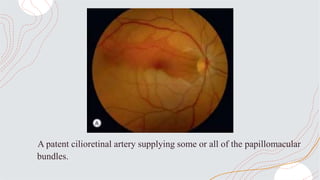
A patent cilioretinal artery supplying some or all of the papillomacular
bundles.
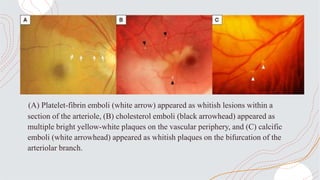
Retinal emboli
Retinal emboli are visible in 20 to 40 % of eyes with CRAO
1. Cholesterol emboli- golden to yellow orange crystal often located at
arteriolar bifurcation. They rarely cause significant obstruction to retinal
arteries and are frequently asymptomatic
2. Calcific emboli- single, white often close to disc, they may be easily
overlooked as they tend to merge with disc. They cause permanent
occlusion.
3. Fibrin-platelet emboli- dull grey, elongated particles. They may cause
retinal transient ischemic attack.
(A) Platelet-fibrin emboli (white arrow) appeared as whitish lesions within a
section of the arteriole, (B) cholesterol emboli (black arrowhead) appeared as
multiple bright yellow-white plaques on the vascular periphery, and (C) calcific
emboli (white arrowhead) appeared as whitish plaques on the bifurcation of the
arteriolar branch.
Diagnosis
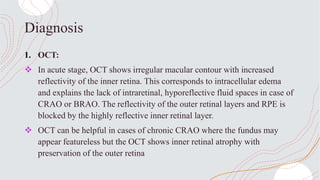
1. OCT:
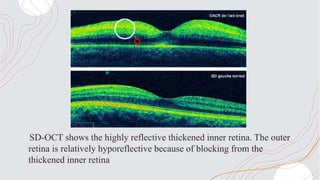
 In acute stage, OCT shows irregular macular contour with increased
reflectivity of the inner retina. This corresponds to intracellular edema
and explains the lack of intraretinal, hyporeflective fluid spaces in case of
CRAO or BRAO. The reflectivity of the outer retinal layers and RPE is
blocked by the highly reflective inner retinal layer.
 OCT can be helpful in cases of chronic CRAO where the fundus may
appear featureless but the OCT shows inner retinal atrophy with
preservation of the outer retina
SD-OCT shows the highly reflective thickened inner retina. The outer
retina is relatively hyporeflective because of blocking from the
thickened inner retina
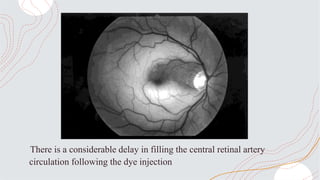
2. FFA:
 Initially shows some variable residual retinal circulation with
delayed and sluggish filling of the retinal vasculature. Complete
absence of retinal filling is rare
There is a considerable delay in filling the central retinal artery
circulation following the dye injection
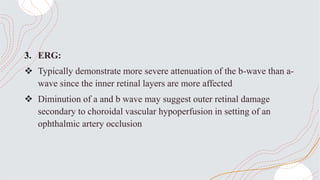
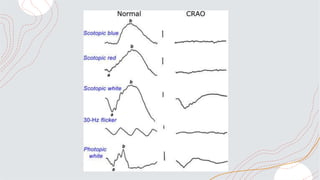
3. ERG:
 Typically demonstrate more severe attenuation of the b-wave than a-
wave since the inner retinal layers are more affected
 Diminution of a and b wave may suggest outer retinal damage
secondary to choroidal vascular hypoperfusion in setting of an
ophthalmic artery occlusion
Treatment
Adoption to supine posture might improve ocular perfusion pressure
Ocular massage
Hyperbaric oxygen
Vasodilating medications- pentoxifyline, nitroglycerin and isosorbide
dinitrate
Nd- YAG laser
References
Varma DD, Cugati S, Lee AW, Chen CS (June 2013). "A review of central
retinal artery occlusion: clinical presentation and management". Eye. 27 (6):
688-97. doi:10.1038/eye.2013.25. PMC 3682348. PMID 23470793
Central and branch retinal artery occlusion. Uptodate.com. Mar 14, 2012.
Kunimoto, Dr., Lecture, Vascular diseases of the retina, AT Still University
SOMA, October 2012
Hayreh SS (December 2018). "Central retinal artery occlusion". Indian
Journal of Ophthalmology. 66 (12): 1684–1694
Kanski’s clinical ophthalmology
Thank you

Central retinal artery occlusion

  • 1.
  • 2.
    Name: XXX Age/G:56 yr/M Occupation: Painter location: Chennai Purpose of visit: Sudden loss of vision Chief complaint: RE: C/O sudden painless loss of vision for distance and near X 1day LE: No such complaints Previous ocular history: H/o using Rx x 15 yrs No h/o trauma, Sx
  • 3.
    General health: Normal(H/o smoking x 30 yrs) Family history: Not significant Recent investigation: Nil Current medication: Nil Allergy: Not aware of any Previous glass prescription: RE: -3.00 DS/ -1.00DC x 80 LE: -2.25 DS/ -1.00DCx 90 Add: BE: +2.50 DS Using progressive lens, good quality
  • 4.
    Visual acuity (aided): RE:CFCF, <N36 LE: 6/6, N6 Objective refraction: RE: -3.25DS/ -1.00DC x 90 LE: -2.25DS/-1.50 DC x 100 Subjective refraction: RE: NAG ( CFCF, <N36) LE: -2.25DS/-1.50DC x 100 (6/6, N6)
  • 5.
    Pupil examination: RE: RAPD LE:PERRLA, No RAPD SLE: RE LE upper lid normal conjunctiva normal cornea clear AC depth normal lower lid normal Lens clear lens
  • 6.
    IOP: RE: 17mm Hg LE:16mm Hg Fundus examination: RE LE 10.05 AM WNL CDR- normal Pale retina Cherry red spot
  • 7.
  • 8.
  • 9.
    Introduction Central retinal arteryocclusion (CRAO) is the sudden blockage of the central retinal artery  retinal hypoperfusion  rapidly progressive cellular damage  vision loss
  • 10.
    Etiology Embolism : blockageof artery caused by any foreign body Thrombosis . Thrombi may be due to atherosclerotic disease, collagen-vascular disease, inflammatory states, and/or hypercoagulable states
  • 11.
    Epidemology Incidence - 1:100,000 ( less than 2% with bilateral presentation) Early 60s Male>female RISK FACTORS: hypertension, smoking, hyperlipidemia, diabetes, hypercoagulable states
  • 12.
    Clinical features Symptoms Monocular visionloss Sudden loss of vision (occurs acutely, possibly over a span of few seconds) Painless In some cases, premonitory episodes of amaurosis fugax may be reported
  • 13.
    Signs 1. Visual acuityat the time of initial presentation ranges from counting fingers to light perception. Central visual acuity may be near normal in patients who have transient CRAO or a cilioretinal artery providing sufficient vascular supply to the fovea. The absence of light perception is rare; therefore in such cases, concomitant choroidal circulation deficit or optic nerve involvement should be considered. Visual acuity tends only to improve within the first week of onset with minimal chance for appreciable improvement subsequently
  • 14.
    2. RAPD 3. Intraocular pressure is often normal at presentation but may become elevated in the setting of rubeosis iridis 4. Fundus changes  Cherry red spot (90%)  Posterior pole retinal opacity or whitening (58%)  Box-caring/ Cattle trucking of retinal arteries and veins (19 and 20%)  At later stages, funduscopic findings showed optic atrophy (91%), retinal arterial attenuation (58%), cilioretinal collaterals (18%), and macular retinal pigment epithelial changes (11%).
  • 15.
  • 16.
  • 17.
    A patent cilioretinalartery supplying some or all of the papillomacular bundles.
  • 18.
    Retinal emboli Retinal emboliare visible in 20 to 40 % of eyes with CRAO 1. Cholesterol emboli- golden to yellow orange crystal often located at arteriolar bifurcation. They rarely cause significant obstruction to retinal arteries and are frequently asymptomatic 2. Calcific emboli- single, white often close to disc, they may be easily overlooked as they tend to merge with disc. They cause permanent occlusion. 3. Fibrin-platelet emboli- dull grey, elongated particles. They may cause retinal transient ischemic attack.
  • 19.
    (A) Platelet-fibrin emboli(white arrow) appeared as whitish lesions within a section of the arteriole, (B) cholesterol emboli (black arrowhead) appeared as multiple bright yellow-white plaques on the vascular periphery, and (C) calcific emboli (white arrowhead) appeared as whitish plaques on the bifurcation of the arteriolar branch.
  • 20.
    Diagnosis 1. OCT:  Inacute stage, OCT shows irregular macular contour with increased reflectivity of the inner retina. This corresponds to intracellular edema and explains the lack of intraretinal, hyporeflective fluid spaces in case of CRAO or BRAO. The reflectivity of the outer retinal layers and RPE is blocked by the highly reflective inner retinal layer.  OCT can be helpful in cases of chronic CRAO where the fundus may appear featureless but the OCT shows inner retinal atrophy with preservation of the outer retina
  • 21.
    SD-OCT shows thehighly reflective thickened inner retina. The outer retina is relatively hyporeflective because of blocking from the thickened inner retina
  • 22.
    2. FFA:  Initiallyshows some variable residual retinal circulation with delayed and sluggish filling of the retinal vasculature. Complete absence of retinal filling is rare
  • 23.
    There is aconsiderable delay in filling the central retinal artery circulation following the dye injection
  • 24.
    3. ERG:  Typicallydemonstrate more severe attenuation of the b-wave than a- wave since the inner retinal layers are more affected  Diminution of a and b wave may suggest outer retinal damage secondary to choroidal vascular hypoperfusion in setting of an ophthalmic artery occlusion
  • 26.
    Treatment Adoption to supineposture might improve ocular perfusion pressure Ocular massage Hyperbaric oxygen Vasodilating medications- pentoxifyline, nitroglycerin and isosorbide dinitrate Nd- YAG laser
  • 27.
    References Varma DD, CugatiS, Lee AW, Chen CS (June 2013). "A review of central retinal artery occlusion: clinical presentation and management". Eye. 27 (6): 688-97. doi:10.1038/eye.2013.25. PMC 3682348. PMID 23470793 Central and branch retinal artery occlusion. Uptodate.com. Mar 14, 2012. Kunimoto, Dr., Lecture, Vascular diseases of the retina, AT Still University SOMA, October 2012 Hayreh SS (December 2018). "Central retinal artery occlusion". Indian Journal of Ophthalmology. 66 (12): 1684–1694 Kanski’s clinical ophthalmology
  • 28.

Editor's Notes

  • #3 Pt delieverd the complaint as his vision was like fused bulb
  • #10 As you all know, The central retinal artery is the  intraorbital branch of the ophthalmic artery which supplies the retina
  • #11 On fundoscopy, calcium emboli appear white, cholesterol emboli (Hollenhorst plaques) appear orange, and platelet-fibrin emboli appear dull white. Emboli- substance which block the artery Thrombosis -formation of a blood clot  inside one of your blood vessels
  • #13 Amaurosis fugax – temporary loss of vision due to loss of blood supply  Typically suggest an embolic source of occlusion
  • #15 RI- blood vessels develop on the anterior surface of the iris in response to retinal ischemia These vessels are coarse and irregular, and can cover the trabecular meshwork
  • #16 The macula is darker because the pigment epithelial cells are taller and contain more pigment Cilio retinal branches from short ciliary artery which gives  additional supply to macula from the choroidal circulation This is due to the occlusion of artery where the retinal arterial supply is blocked
  • #17 Segmentation of vessels- Box carring of veins or artery occurs secondary to separation of the blood serum from the erythrocyte in the rouleaux formation
  • #18 Seen in 1/3 rd of cases
  • #21 Inner retina got edematous because of lack of blood supply
  • #22 Red circle- differentiation of the outer limiting layer
  • #24 You can see the black arteries against the normal background choroidal flurescence which is unaffected by occlusion
  • #26 B wave- mainly for the inner retina
  • #27 Opp- pressure at which the blood enters the eye, Opp=IOP-mean arterial pressure Massage – goldmann contact lens to apply ocular pressure (produce arterial dilation) – dislodge a possibly obstructing emboli Hyperbaric o2- increase the oxygen pressure leading to vasodilation Yag- pulses are given directly to emboli- photofragmentation of emboli with in artery