A quick guide to Ophthalmic
Ultrasound / B-Scan Interpretation
Amit K Singh
Consultant optometrist
Mechi Eye Hospital ,Birtamode-3 Jhapa
Terminology
• Audible Range : 10-20,000 Hz
• Ultrasound : > 20,000 Hz
• Pulse echo system: piezoelectric transducer to generate
ultrasonic wave, a receiver which processes returning waves
and a display screen
• Acoustic impedance: Difference b/w strength of returning
echoes from tissue boundaries
• Angle of incidence: angle of sound beam relative to area of
interest
Terminology(contd)

• Resolution: ability to distinguish b/w adjacent echoes, both
axial & lateral
• Amplification: signal processing before echoes is displayed on
monitor
• Gain: procedure of increasing or decreasing amplitude of
echoes that are displayed on screen
• Time gain compensation(TGC) : technique used to enhance
returning echoes from deeper structures by reducing those
from structures closer to surface
Principle of B-scan
Electrical energy sound energy electronic energy
(Display)
• Abdominal ultrasound : 1-2 MHz
• Ophthalmic Ultrasound : 8-12 MHz
• Ultrasound Biomicroscopy : 35-100 MHz
• Frequency α 1/penetration α Resolution
PiezoelectricPiezoelectric
Indications of ocular B-scan
• Opaque media
1. Corneal opacity
2. A/c hyphema or hypopyon
3. Miosis
4. pupillary membrane
5. Cataract
6. Vitreous haemorrhage
• Clear media
1. Iris lesion
2. ciliary body lesion
3. Tumours & masses;detection & differentiation
4. RD :Rhegmatogenous vs exudative
5. IOFB detection and localization
6. OD abnormalities
Indications of orbital B-scan
• Enophthalmos
• Globe displacement
• Lid abnormalities
• Palpable or visible mass
• Chemosis
• Motility disturbance
• Pain
Technique of Evaluation
• Clinical correlation
Ocular scans
• Probe positions
• Transverse : on sclera (@ TS)
• Longitudinal :at Limbus (@ LL)
• Axial : on cornea (@ AC)
• [NOTE: Markers aims nasally while screening superior &
Inferior and Superiorly for nasal & temporal]
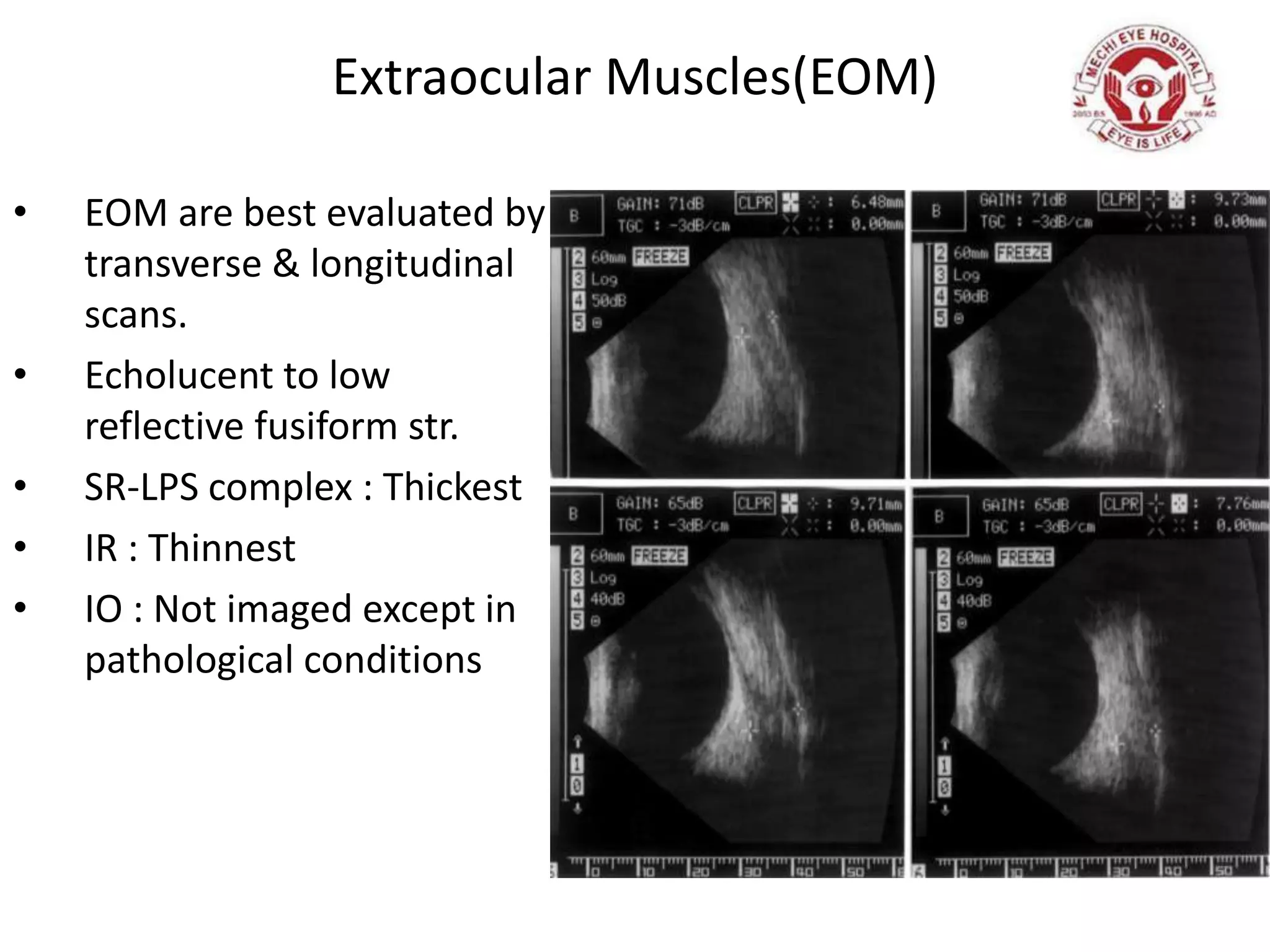
Normal appearance of ocular & orbital
Structures
1. Lens
• Immersion/ stand off technique
• None to highly reflective intralesional
echoes depending on amount of cataract
2. Vitreous : Echo free , low to medium ref.
In vitreous degeneration.
3. Retina, choroid & sclera : seen as single
until/unless pathological conditions e.g.
RD,CD, scleritis
4. Optic Nerve: Wedge shaped acoustic void in
retrobulbar region
Vitreous Optic Nerve
Orbital Scans
• Probe placement
1. Transocular : lesions of mid & posterior orbit i.e. structures
within muscular cone (Opposite side )
2. Paraocular : lesions of lids & anterior orbit i.e. structures
beyond muscular cone (same side)
Transocular Scan Paraocular Scan
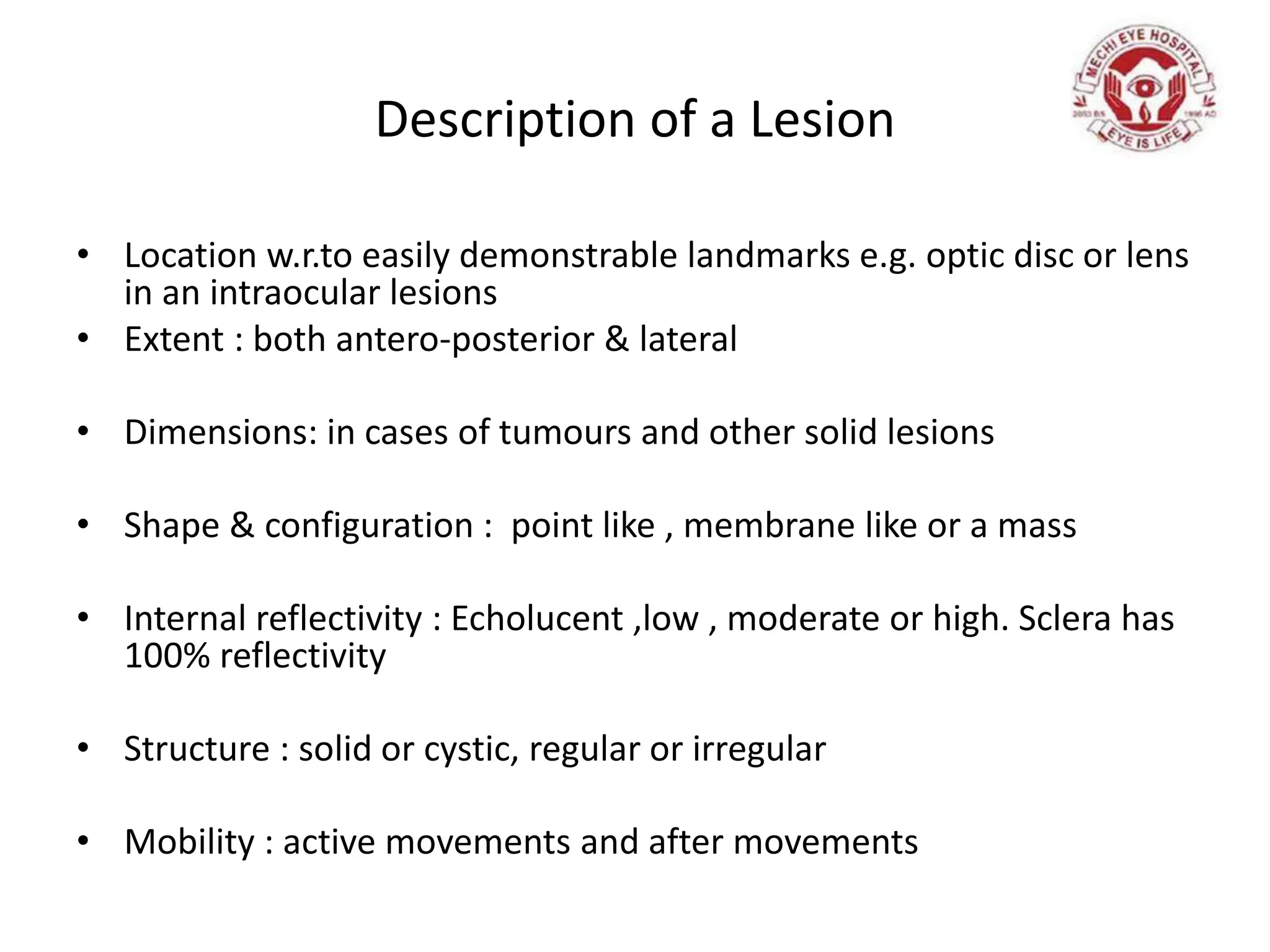
Extraocular Muscles(EOM)
• EOM are best evaluated by
transverse & longitudinal
scans.
• Echolucent to low
reflective fusiform str.
• SR-LPS complex : Thickest
• IR : Thinnest
• IO : Not imaged except in
pathological conditions
Description of a Lesion
• Location w.r.to easily demonstrable landmarks e.g. optic disc or lens
in an intraocular lesions
• Extent : both antero-posterior & lateral
• Dimensions: in cases of tumours and other solid lesions
• Shape & configuration : point like , membrane like or a mass
• Internal reflectivity : Echolucent ,low , moderate or high. Sclera has
100% reflectivity
• Structure : solid or cystic, regular or irregular
• Mobility : active movements and after movements
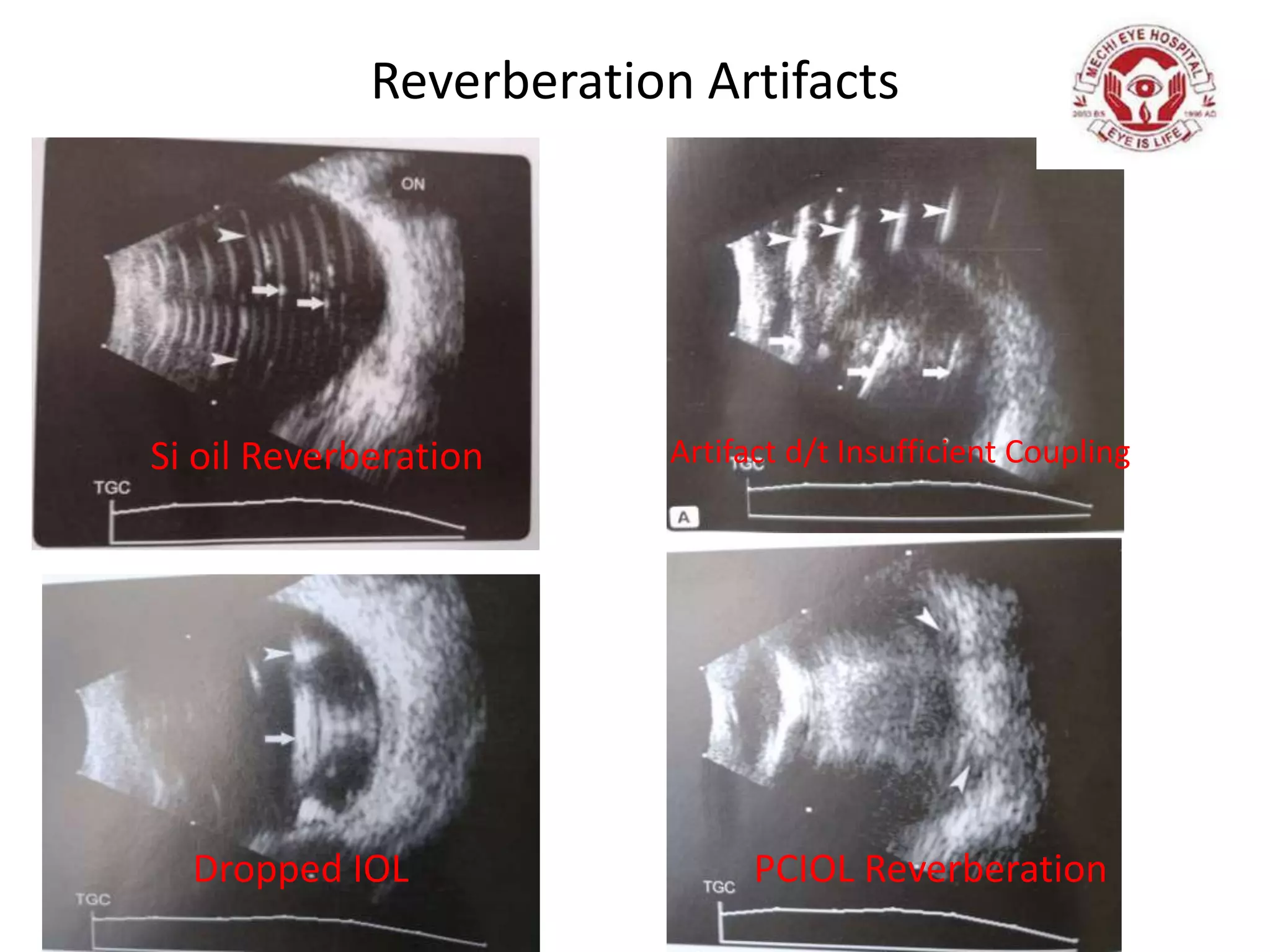
Reverberation Artifacts
Dropped IOL
Si oil Reverberation
PCIOL Reverberation
Artifact d/t Insufficient Coupling
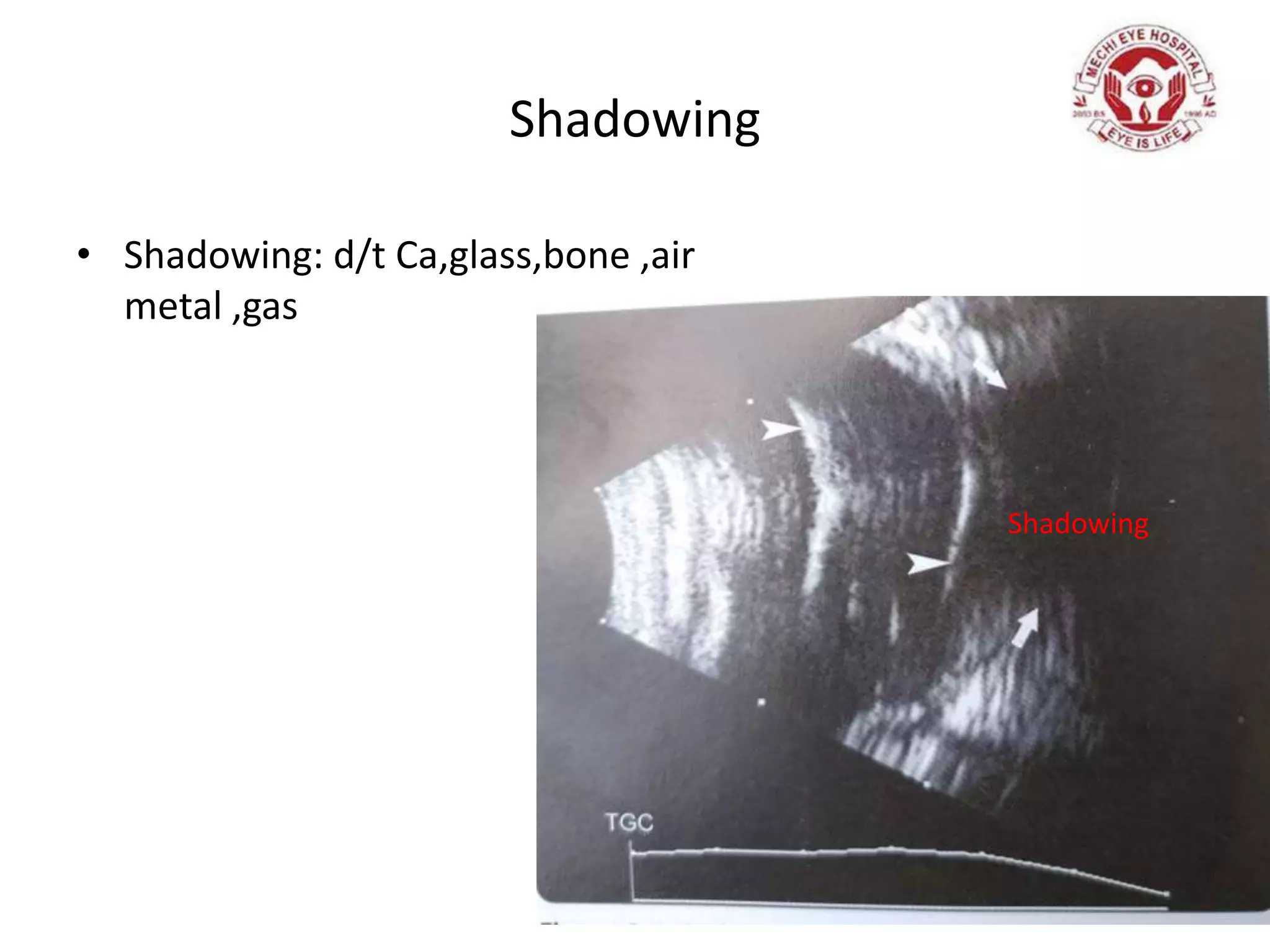
Shadowing
• Shadowing: d/t Ca,glass,bone ,air
metal ,gas
Shadowing
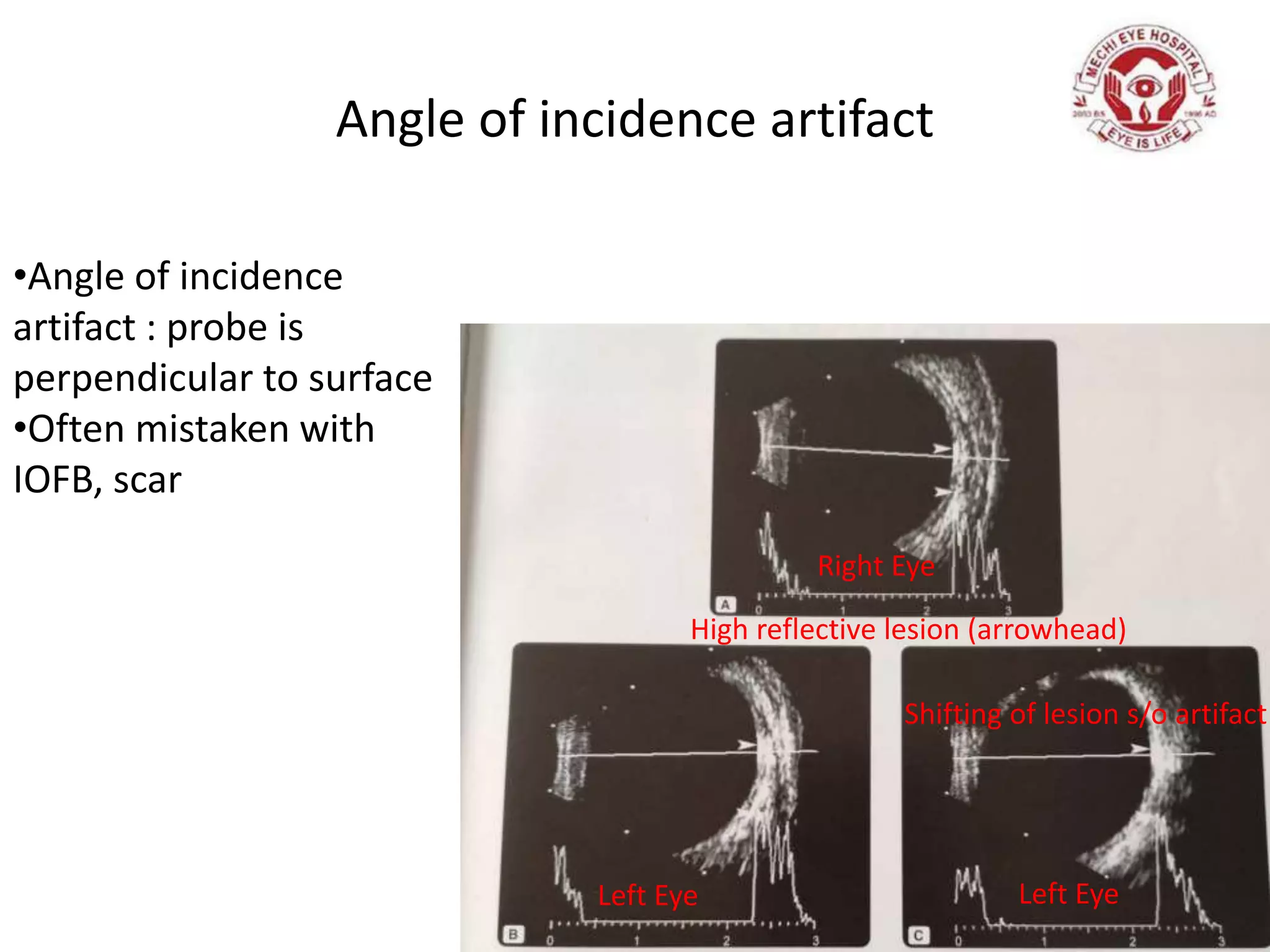
Angle of incidence artifact
Right Eye
Left Eye Left Eye
High reflective lesion (arrowhead)
Shifting of lesion s/o artifact
•Angle of incidence
artifact : probe is
perpendicular to surface
•Often mistaken with
IOFB, scar
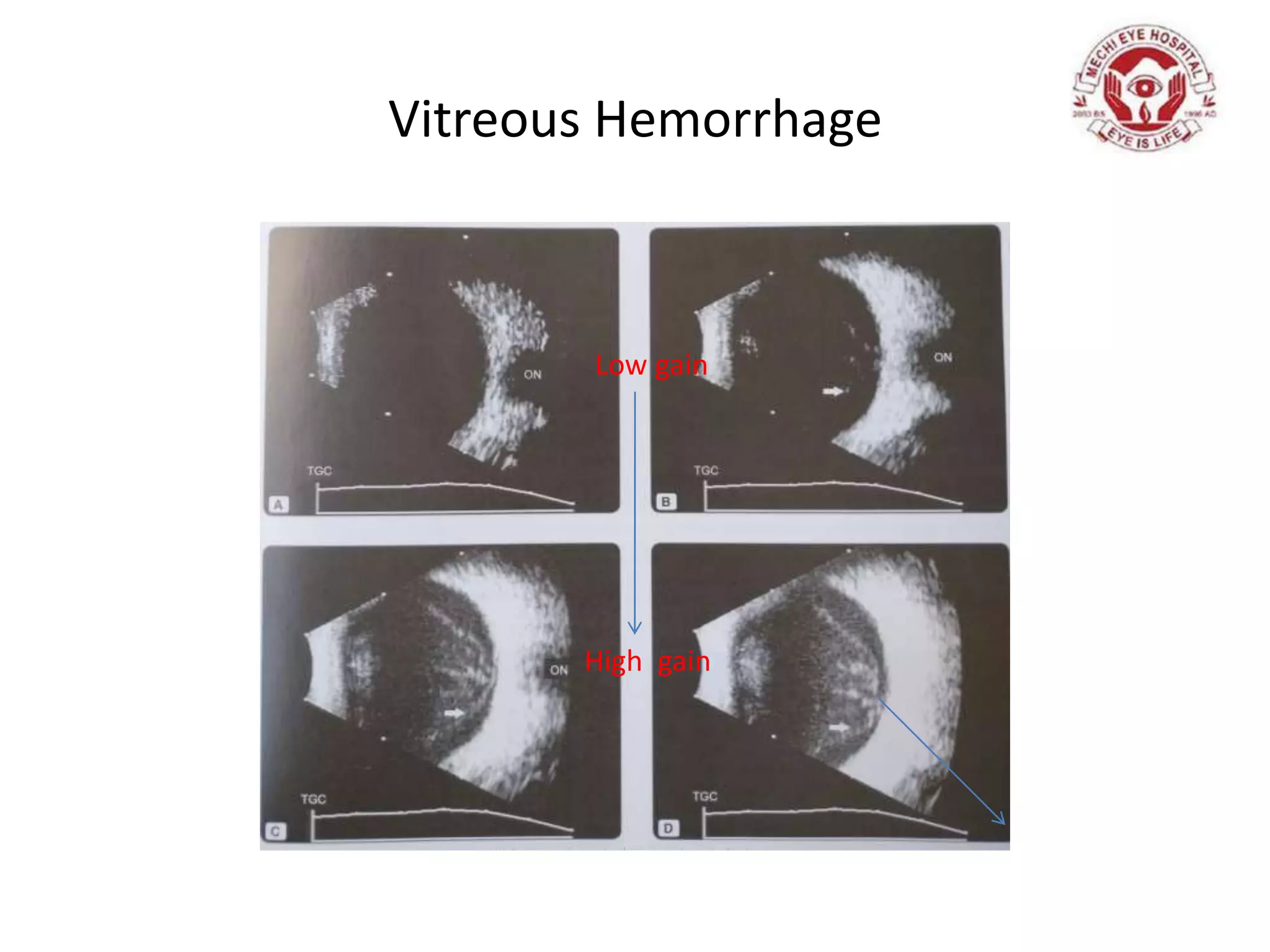
Vitreous Hemorrhage
Low gain
High gain
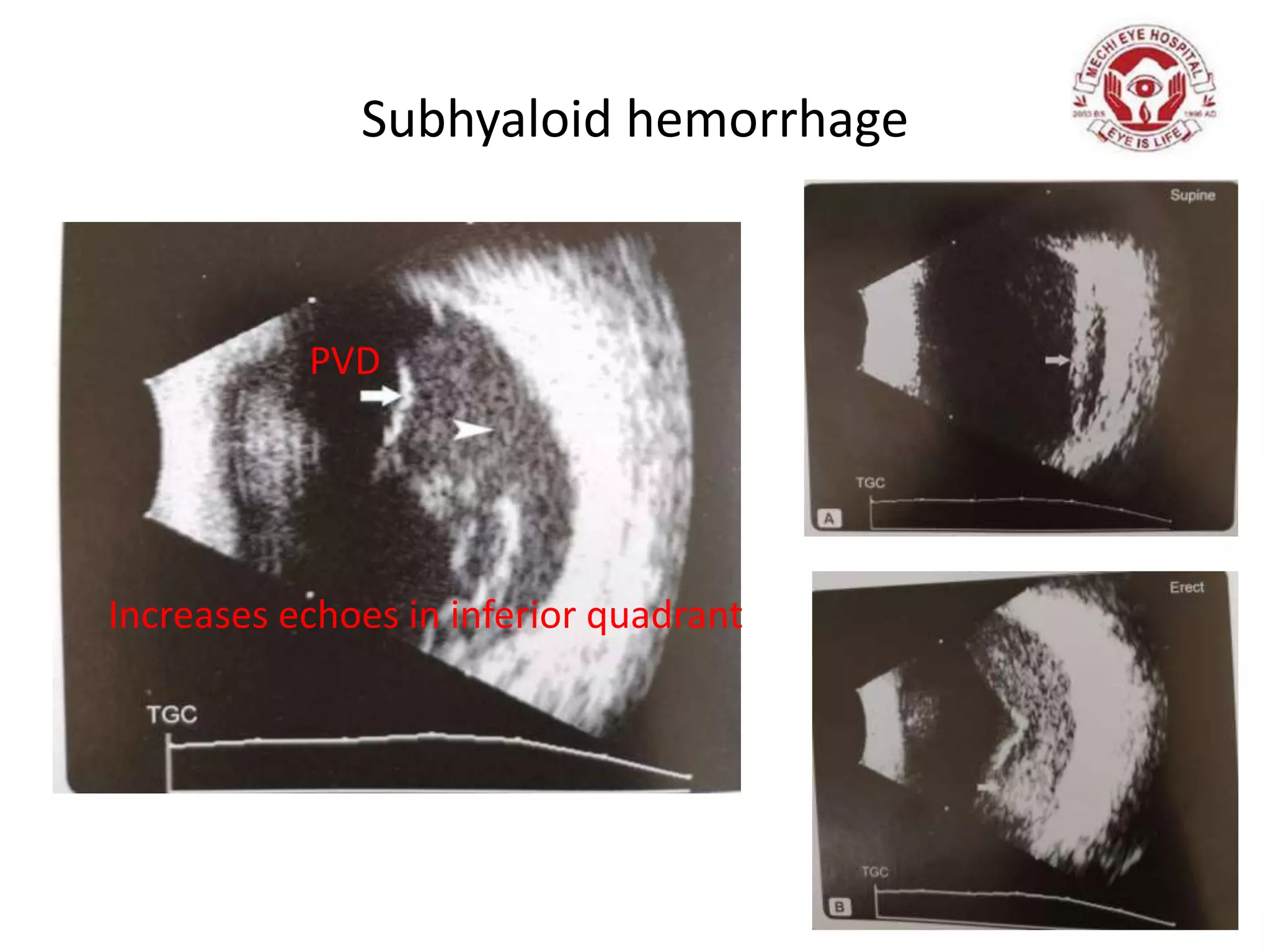
Subhyaloid hemorrhage
Increases echoes in inferior quadrant
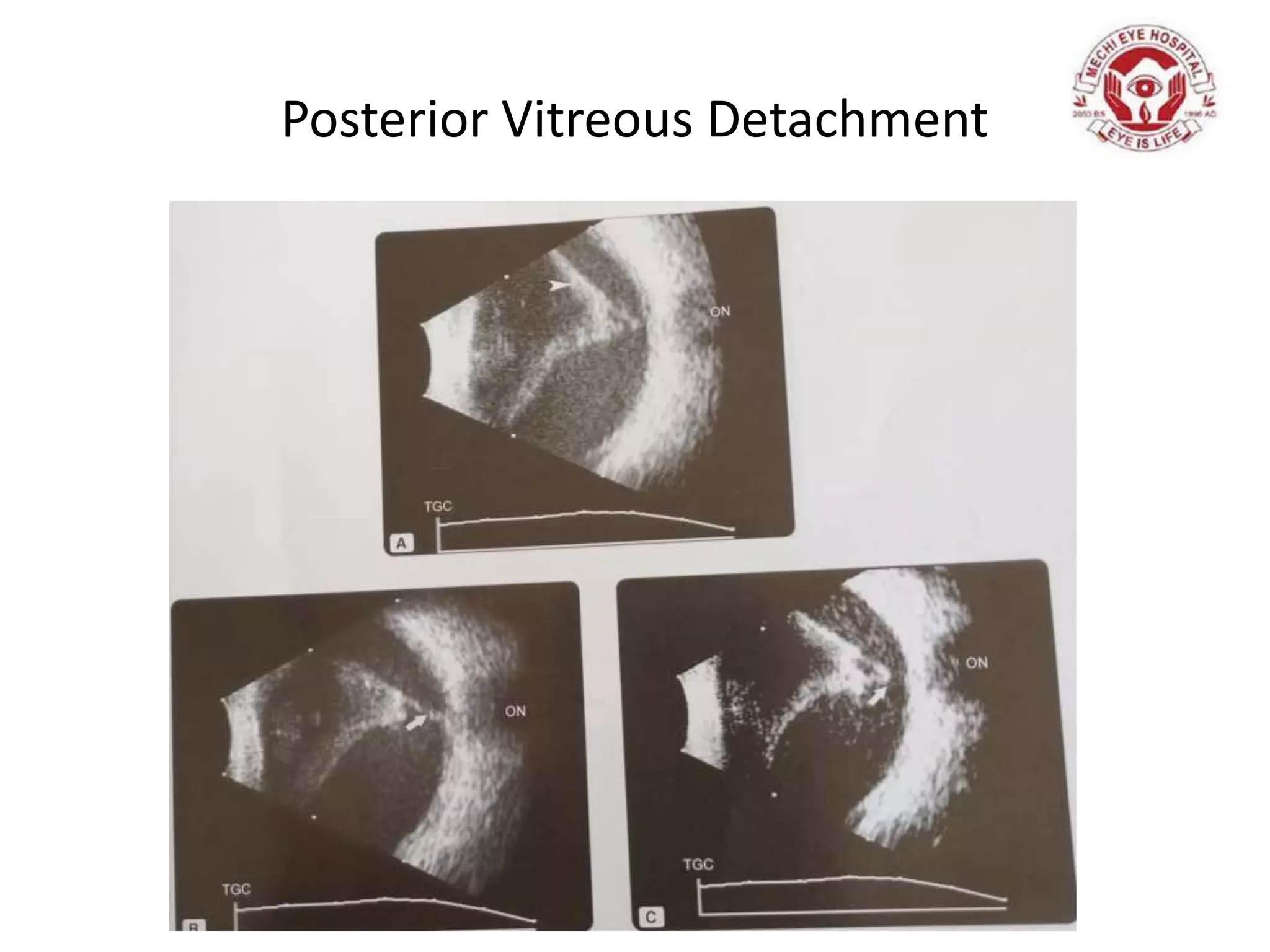
PVD
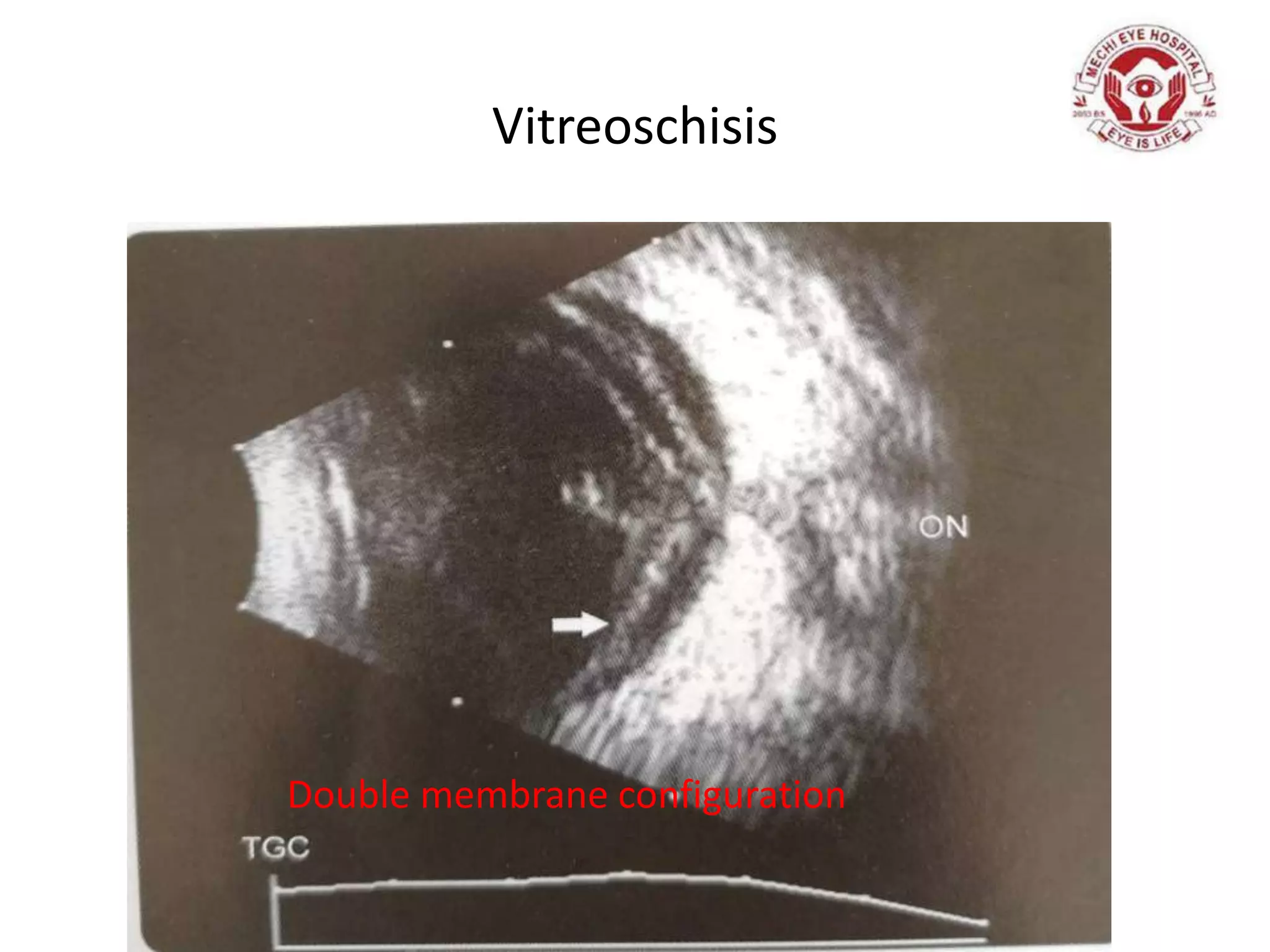
Vitreoschisis
Double membrane configuration
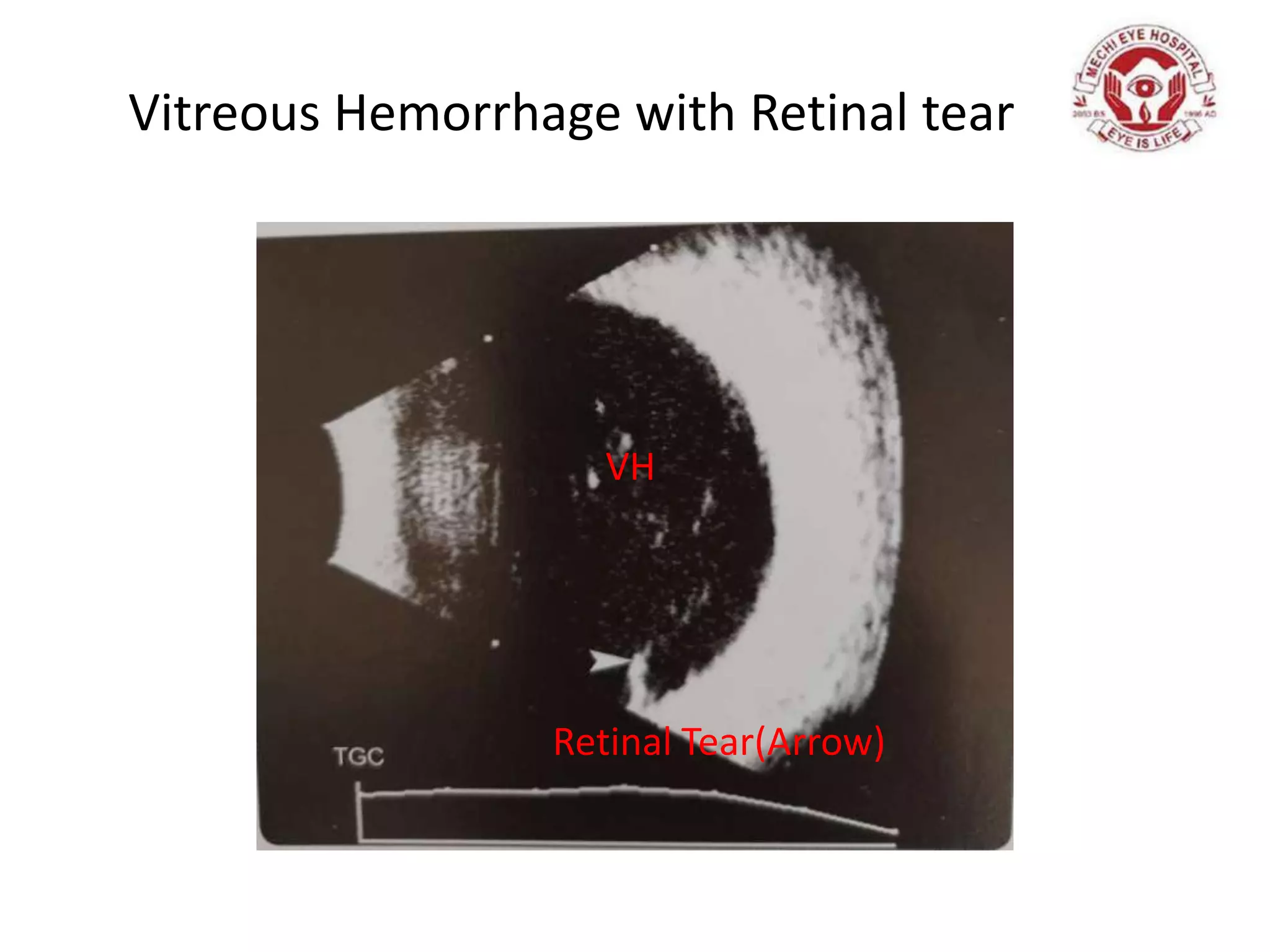
Vitreous Hemorrhage with Retinal tear
Retinal Tear(Arrow)
VH
Posterior Vitreous Detachment
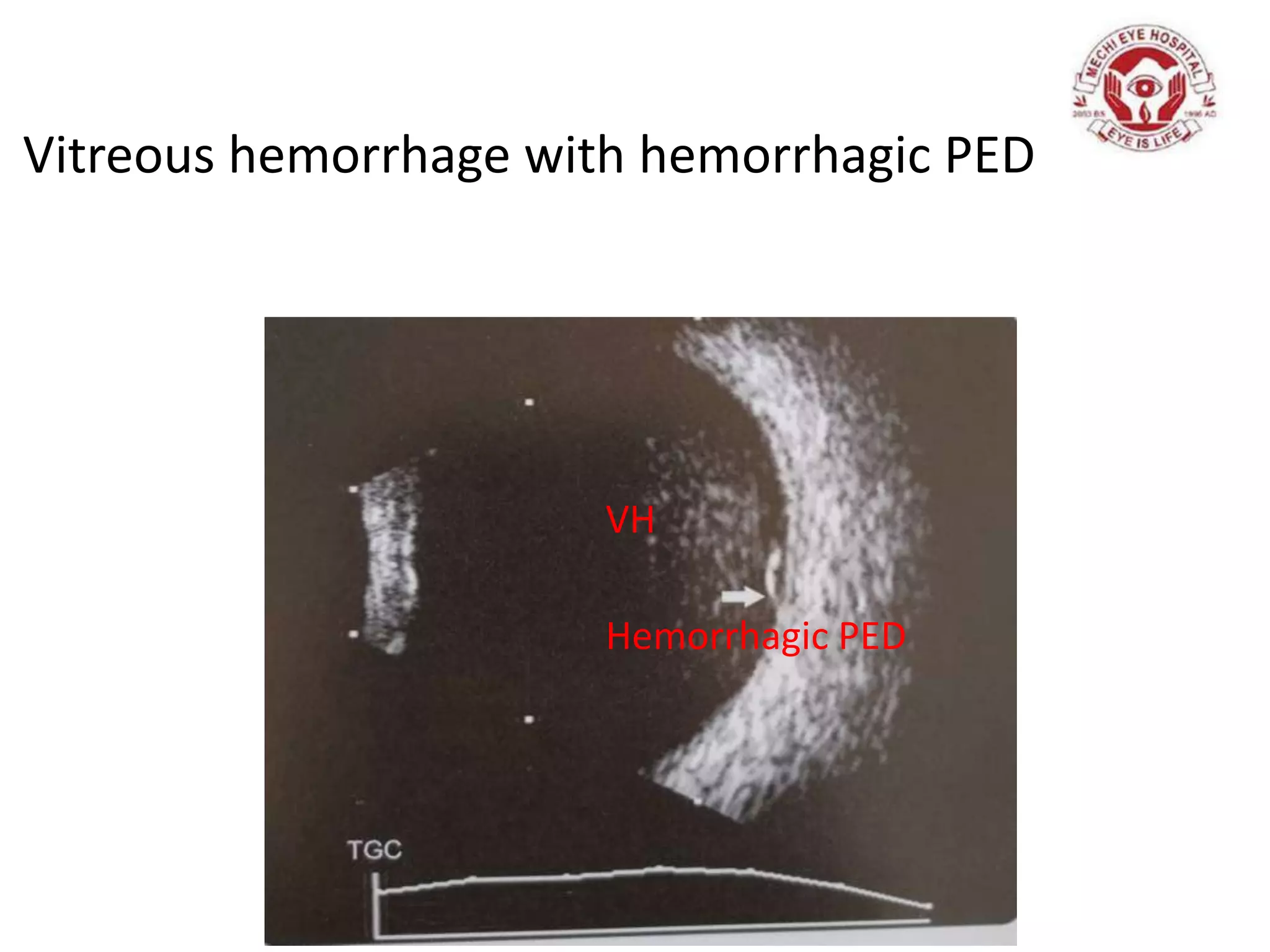
Vitreous hemorrhage with hemorrhagic PED
VH
Hemorrhagic PED
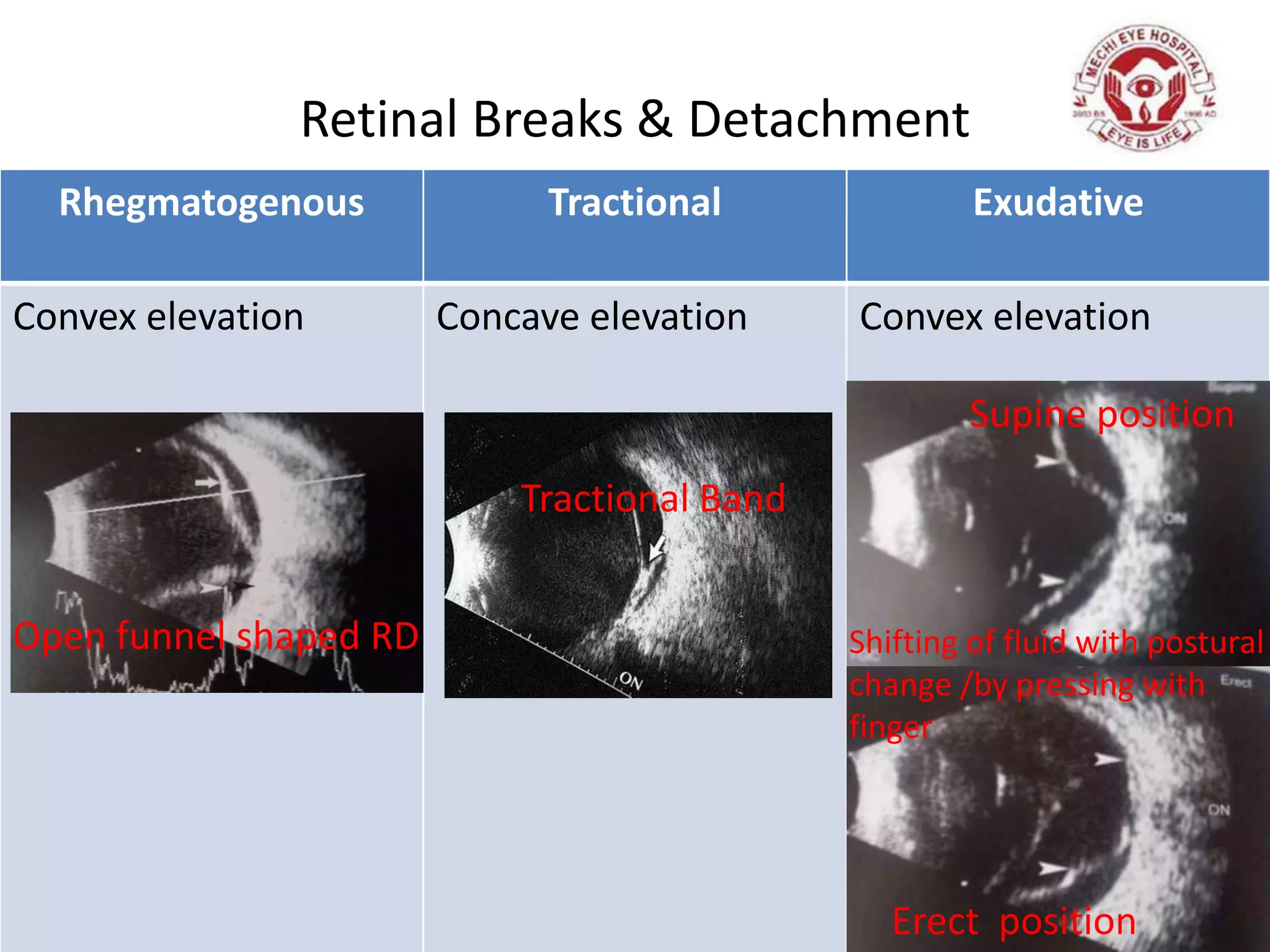
Retinal Breaks & Detachment
Rhegmatogenous Tractional Exudative
Convex elevation Concave elevation Convex elevation
Tractional Band
Shifting of fluid with postural
change /by pressing with
finger
Supine position
Erect position
Open funnel shaped RD
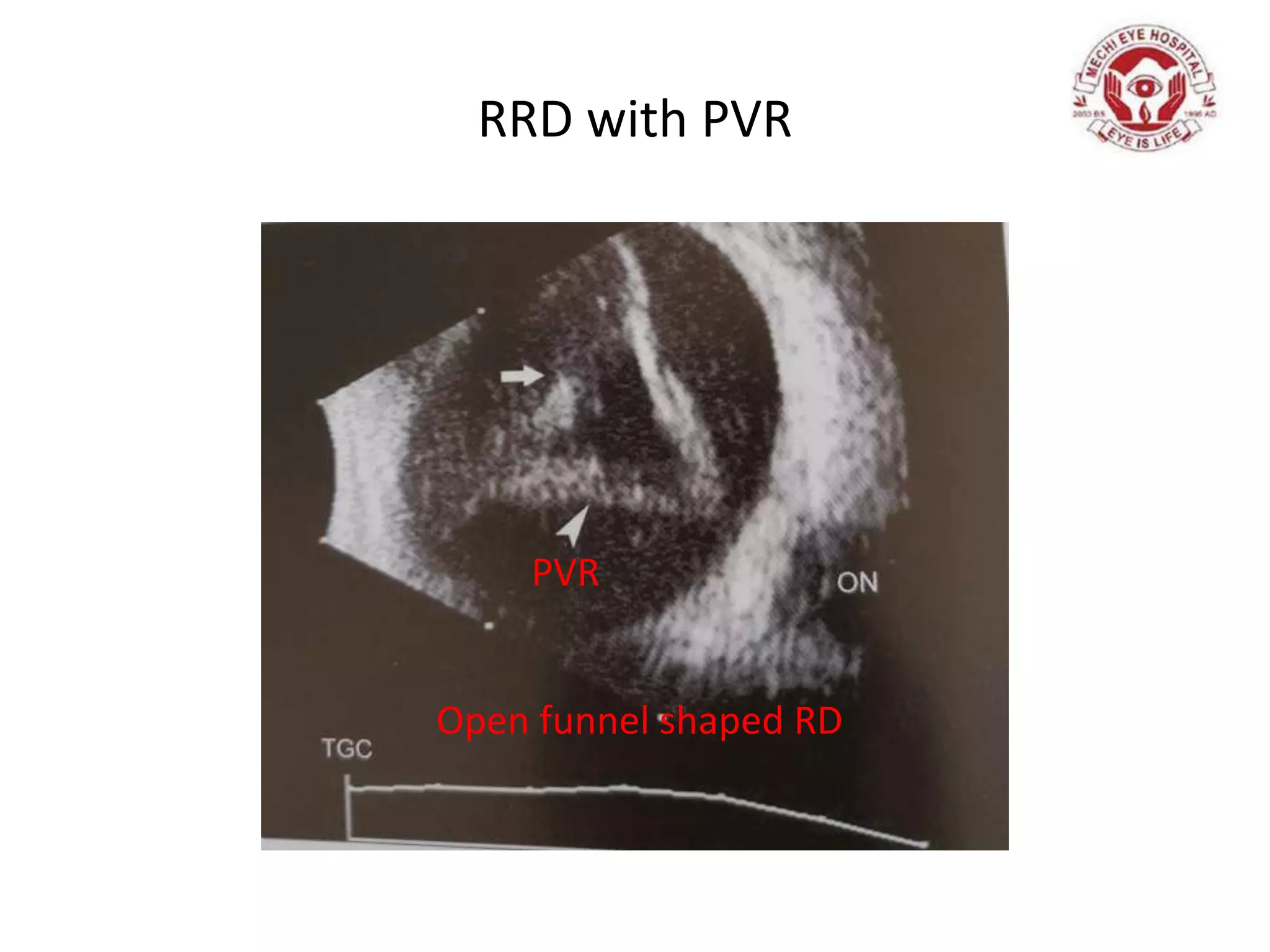
RRD with PVR
PVR
Open funnel shaped RD
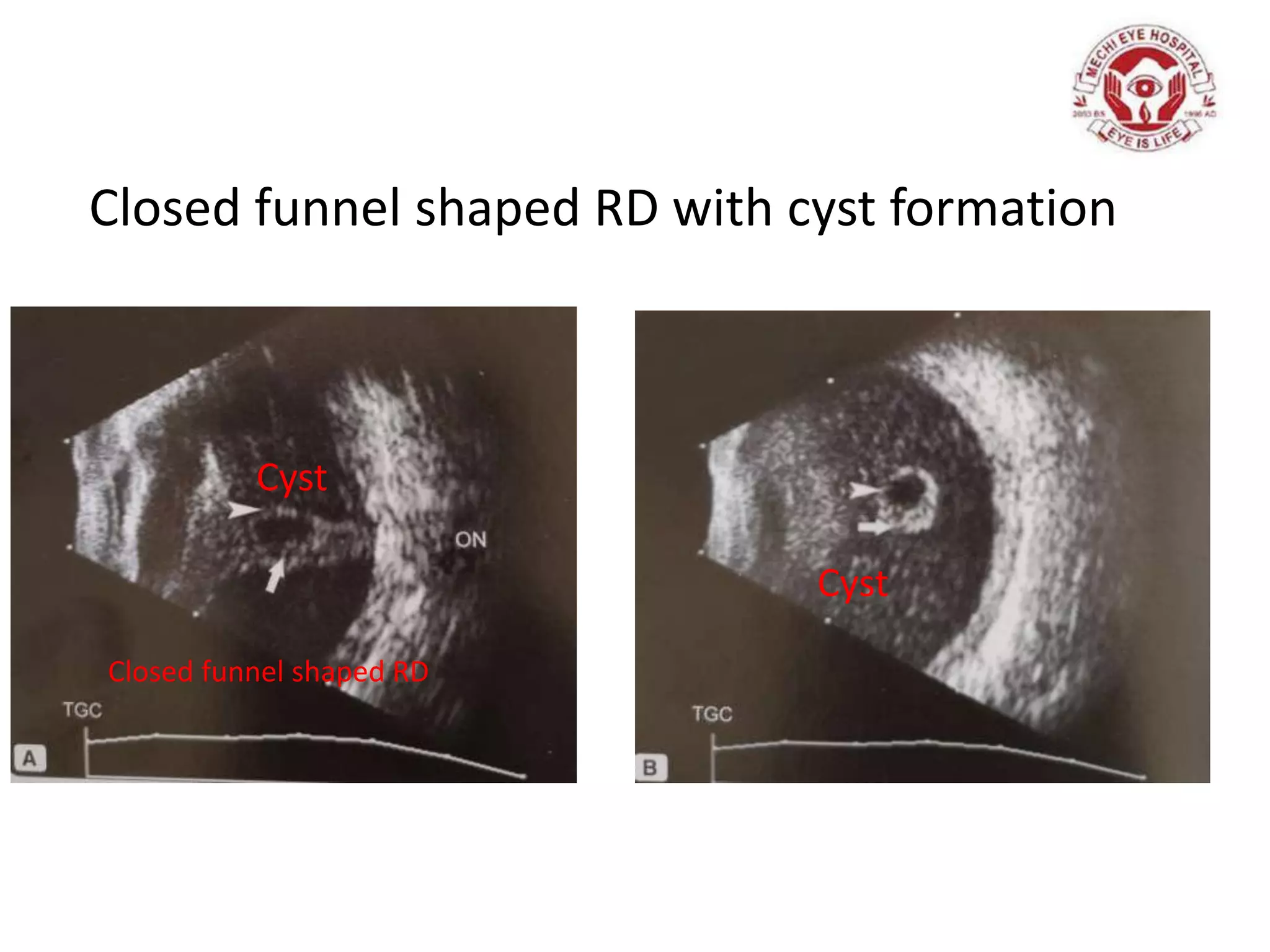
Closed funnel shaped RD with cyst formation
Cyst
Closed funnel shaped RD
Cyst
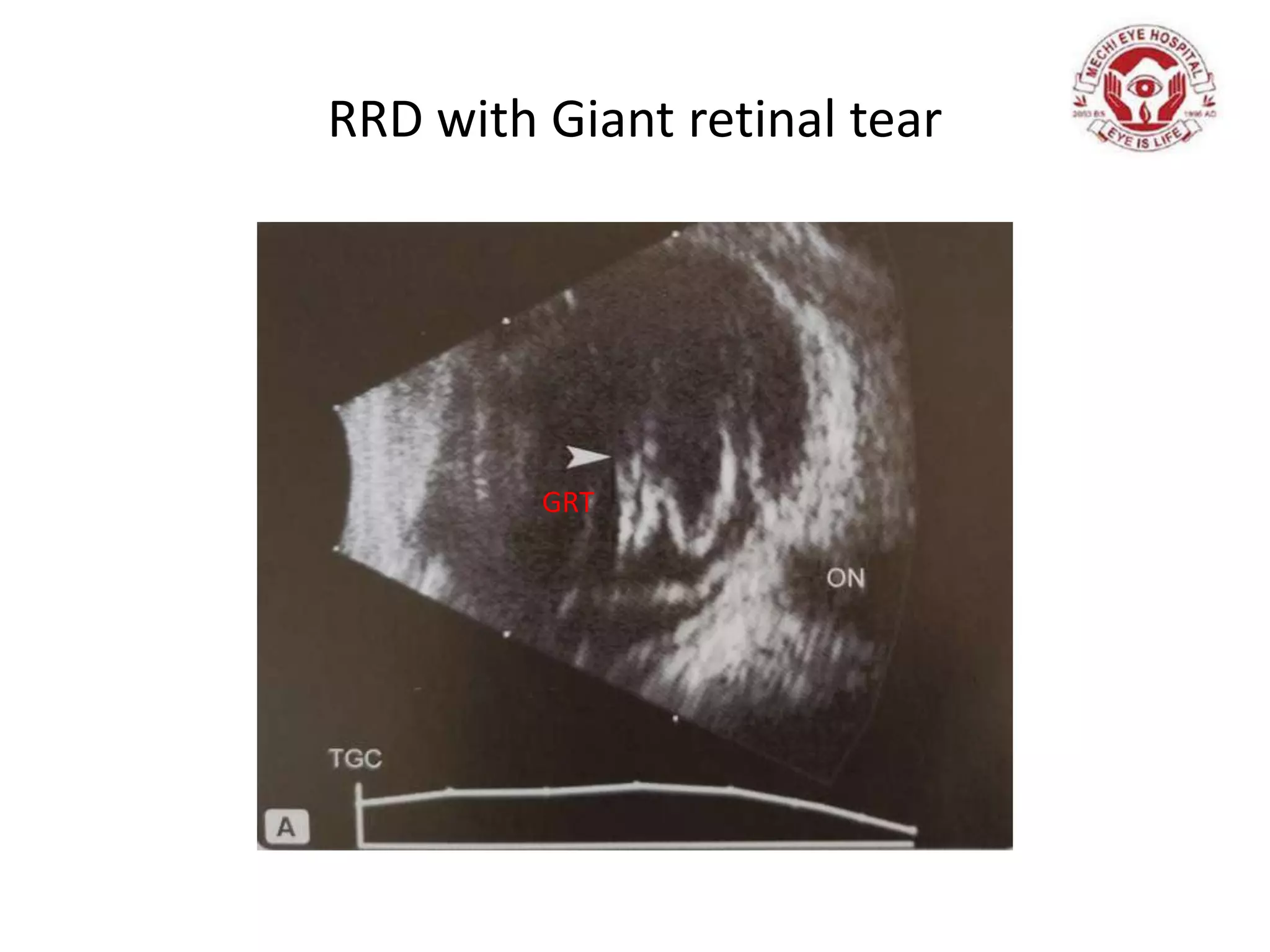
RRD with Giant retinal tear
GRT
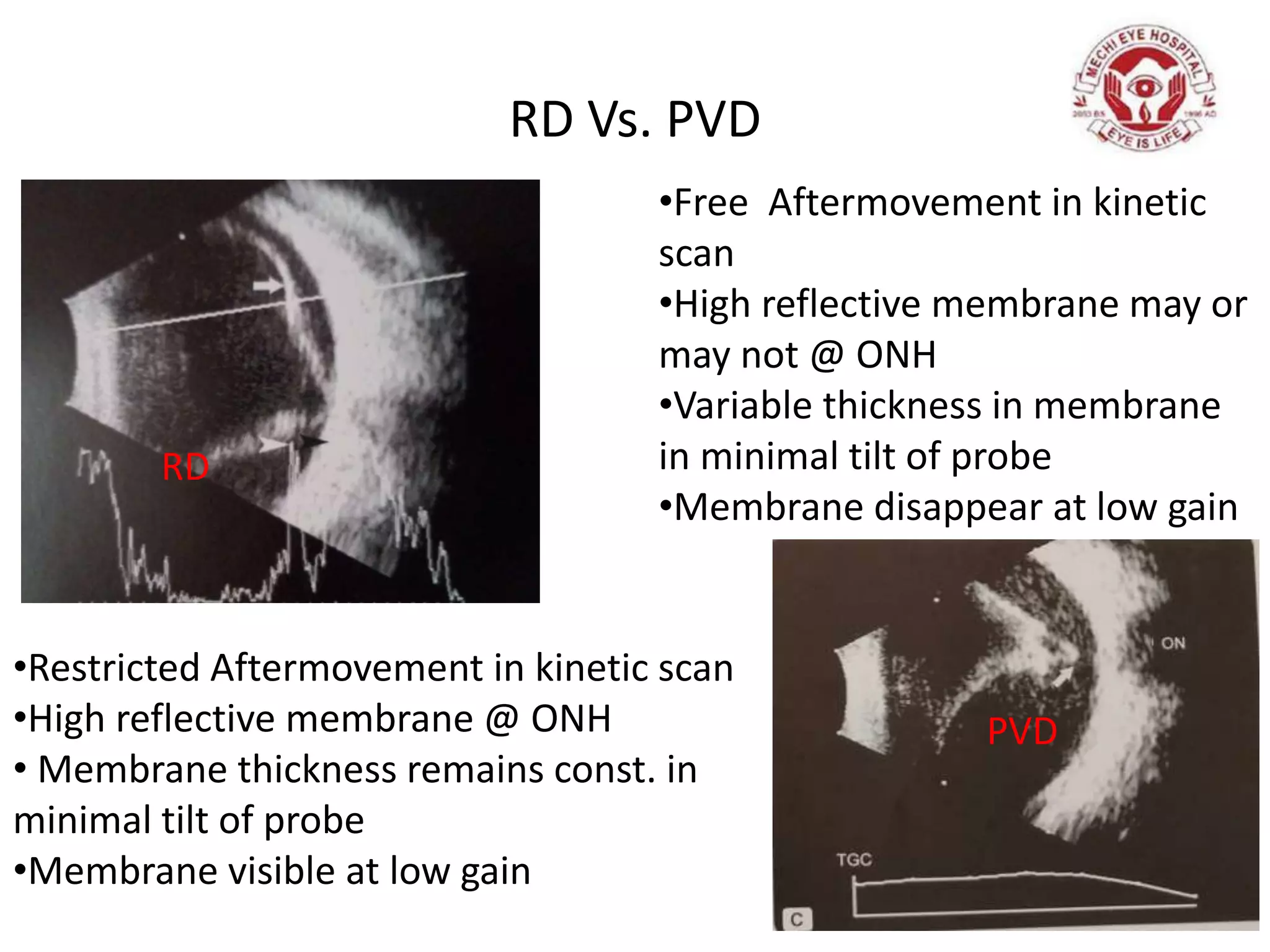
RD Vs. PVD
•Restricted Aftermovement in kinetic scan
•High reflective membrane @ ONH
• Membrane thickness remains const. in
minimal tilt of probe
•Membrane visible at low gain
RD
•Free Aftermovement in kinetic
scan
•High reflective membrane may or
may not @ ONH
•Variable thickness in membrane
in minimal tilt of probe
•Membrane disappear at low gain
PVD
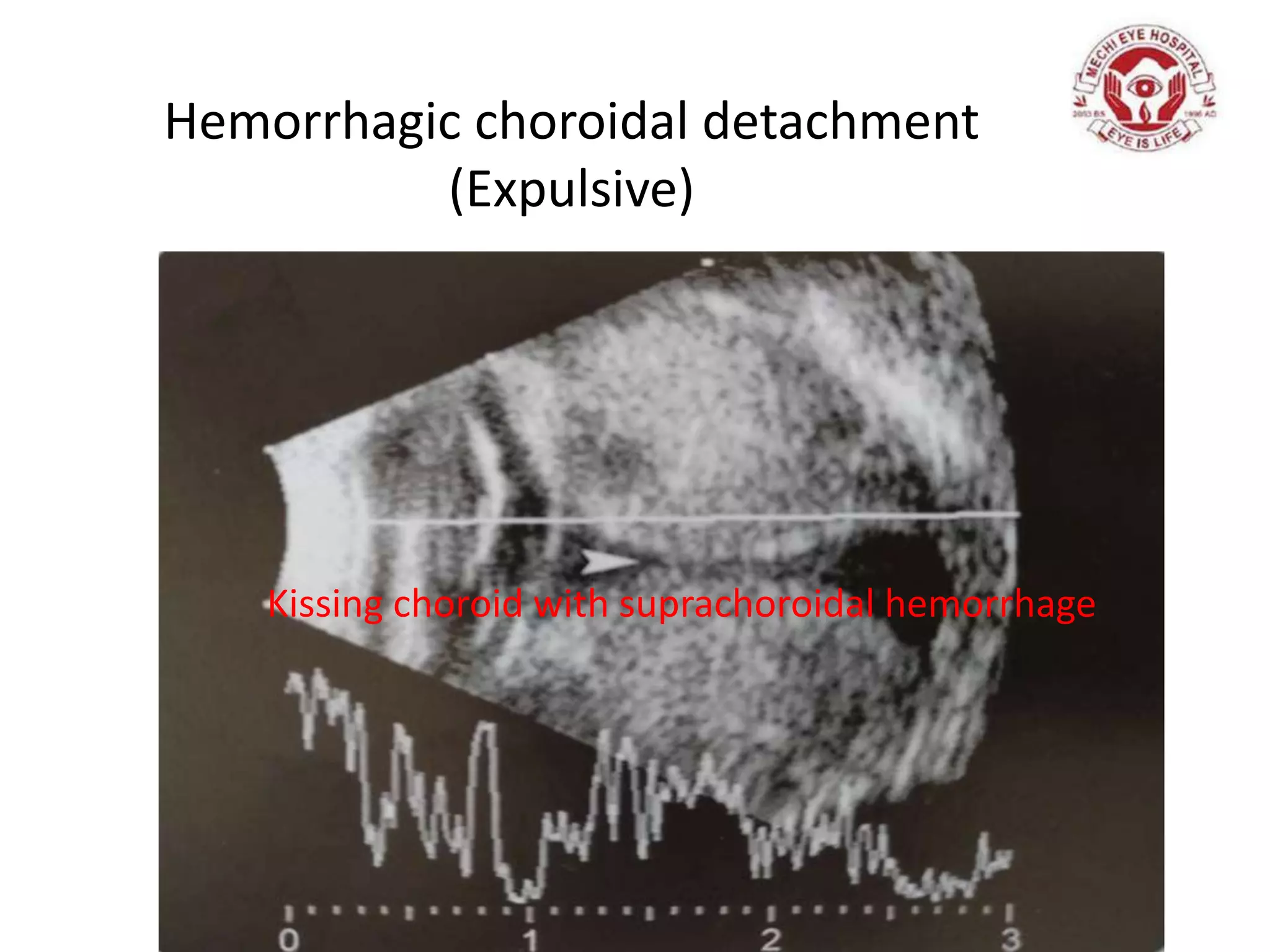
Hemorrhagic choroidal detachment
(Expulsive)
Kissing choroid with suprachoroidal hemorrhage
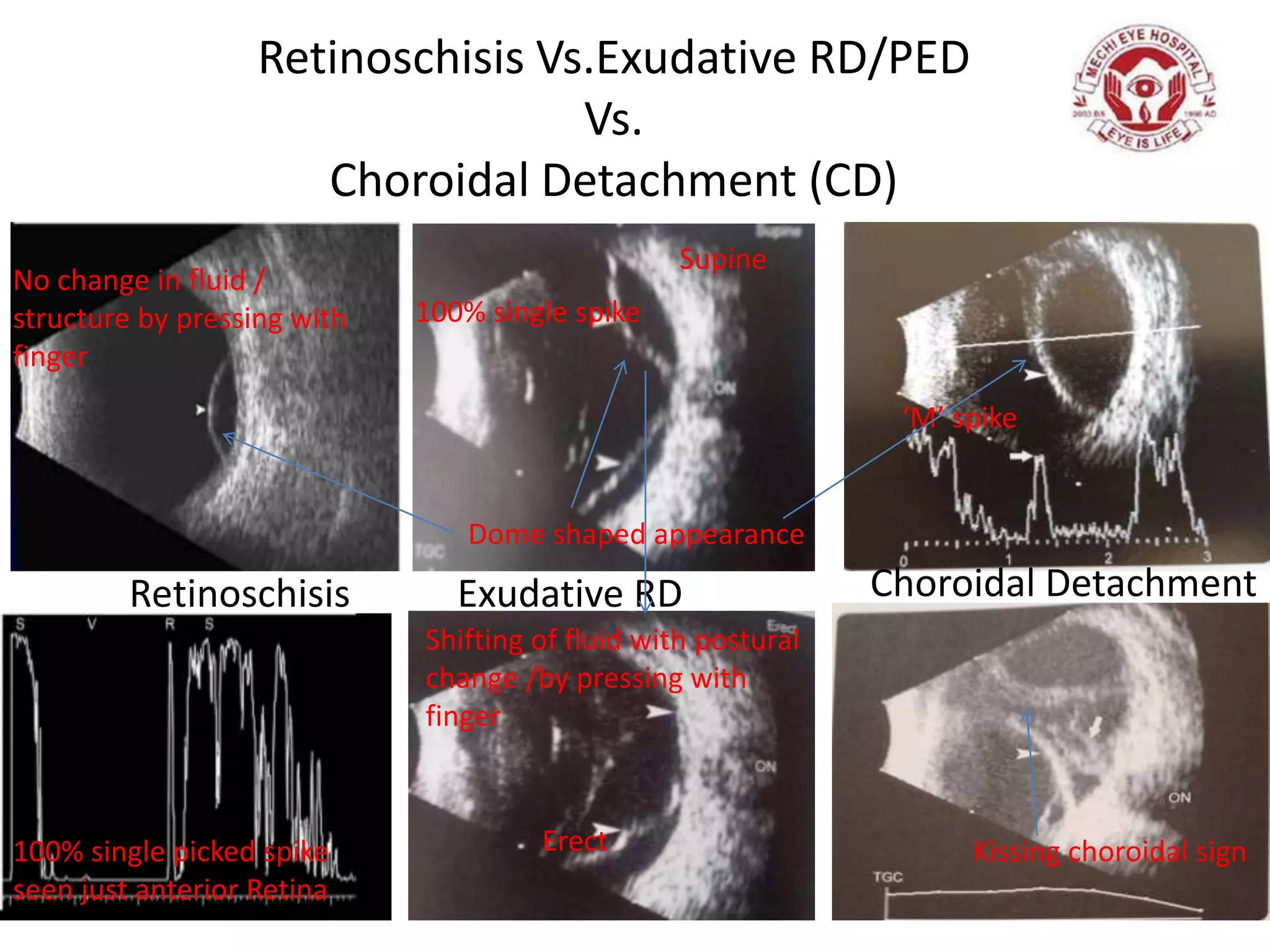
Retinoschisis Vs.Exudative RD/PED
Vs.
Choroidal Detachment (CD)
Retinoschisis Exudative RD Choroidal Detachment
Kissing choroidal sign
‘M’ spike
Dome shaped appearance
Shifting of fluid with postural
change /by pressing with
finger
No change in fluid /
structure by pressing with
finger
Supine
Erect100% single picked spike
seen just anterior Retina
100% single spike
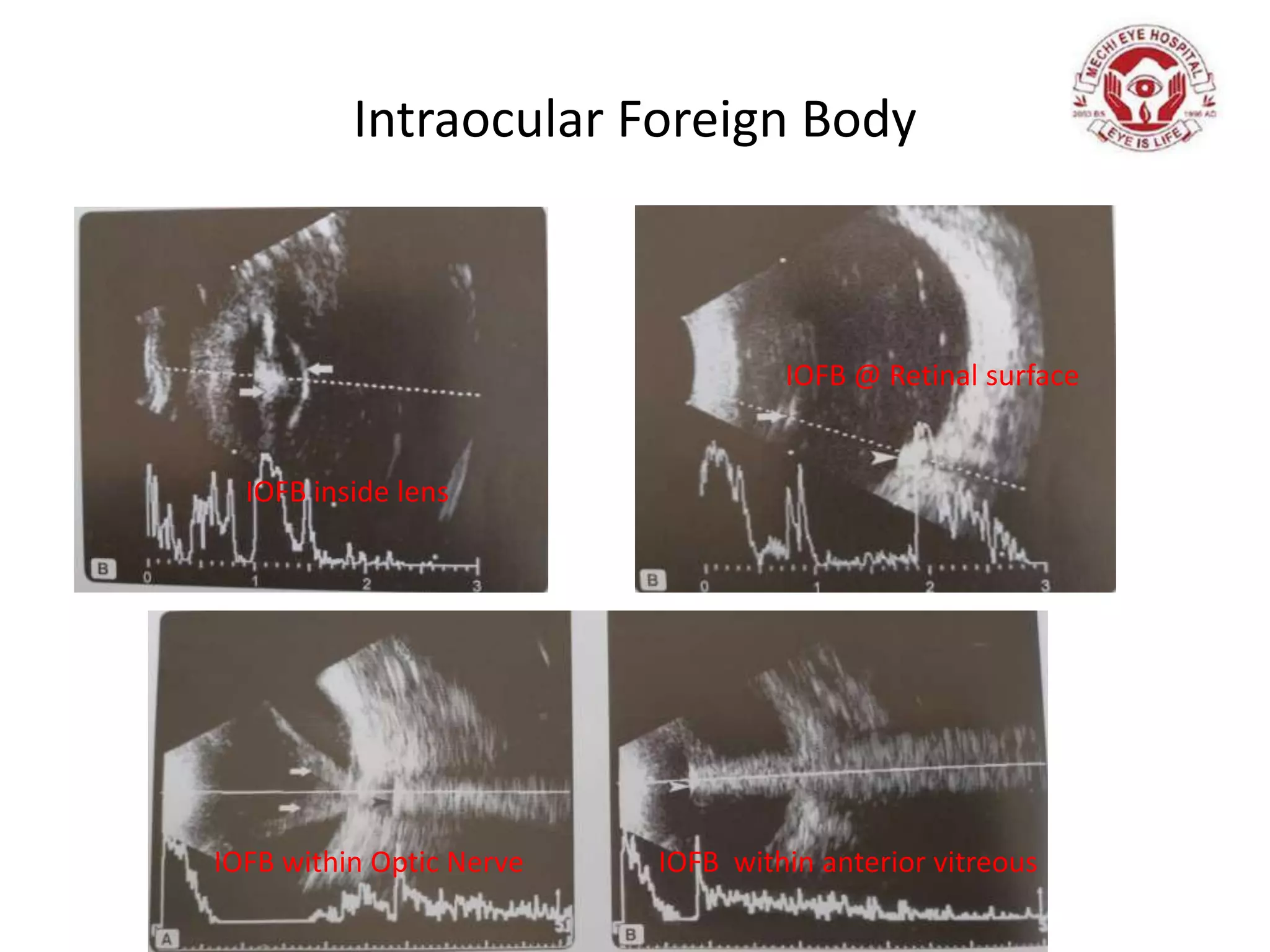
Intraocular Foreign Body
IOFB inside lens
IOFB @ Retinal surface
IOFB within Optic Nerve IOFB within anterior vitreous
Endophthalmitis Vs. VKH syndrome
VKH SYNDROME
ENDOPHTHALMITIS
•U/L
•H/o Sx, Trauma
•PVD may or may not
present and develop
TRD
•Vitreous cells
•B/L
•Serous RD
• No PVD
•Few vitreous
opacities
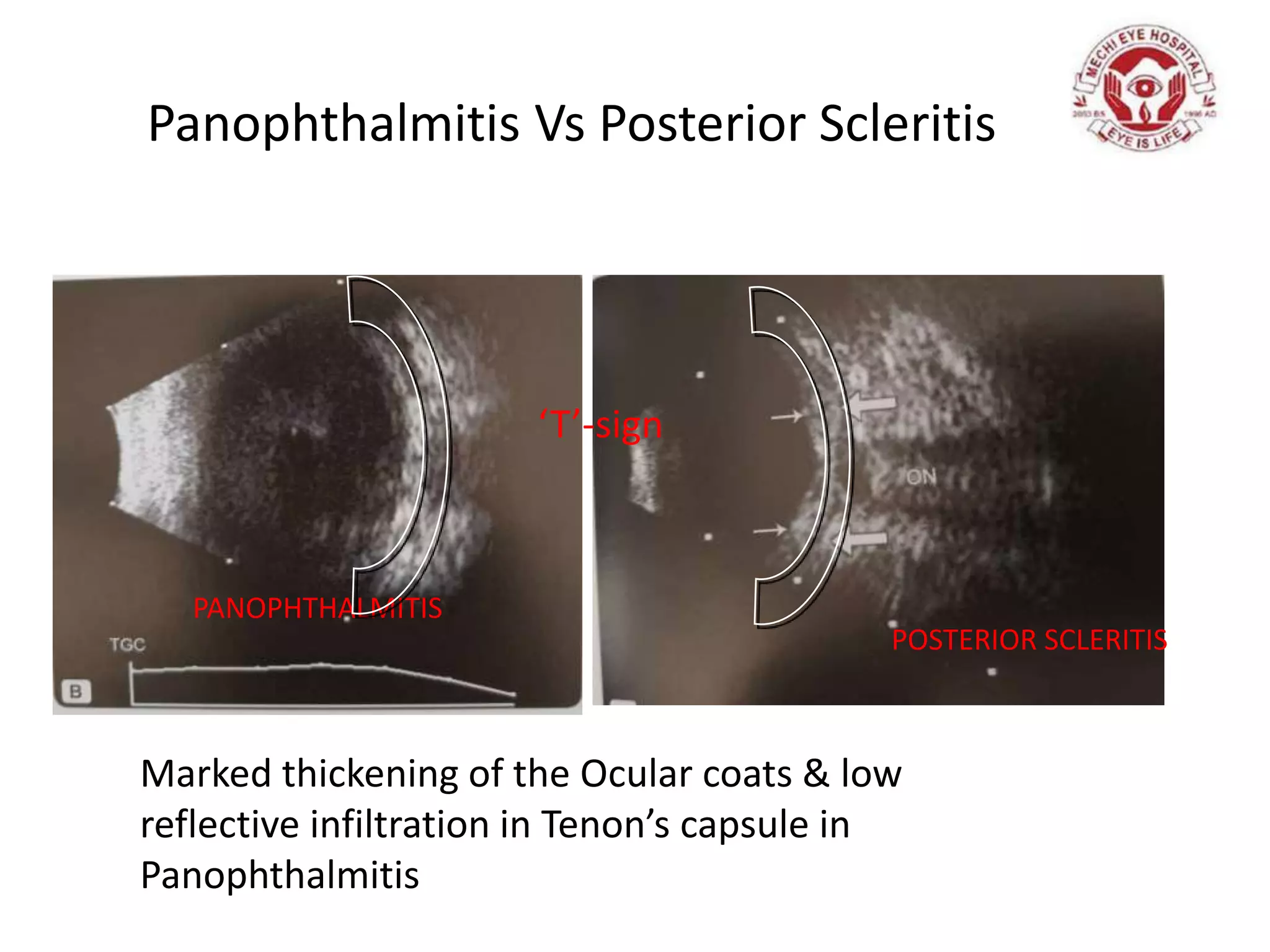
Panophthalmitis Vs Posterior Scleritis
PANOPHTHALMITIS
POSTERIOR SCLERITIS
Marked thickening of the Ocular coats & low
reflective infiltration in Tenon’s capsule in
Panophthalmitis
‘T’-sign
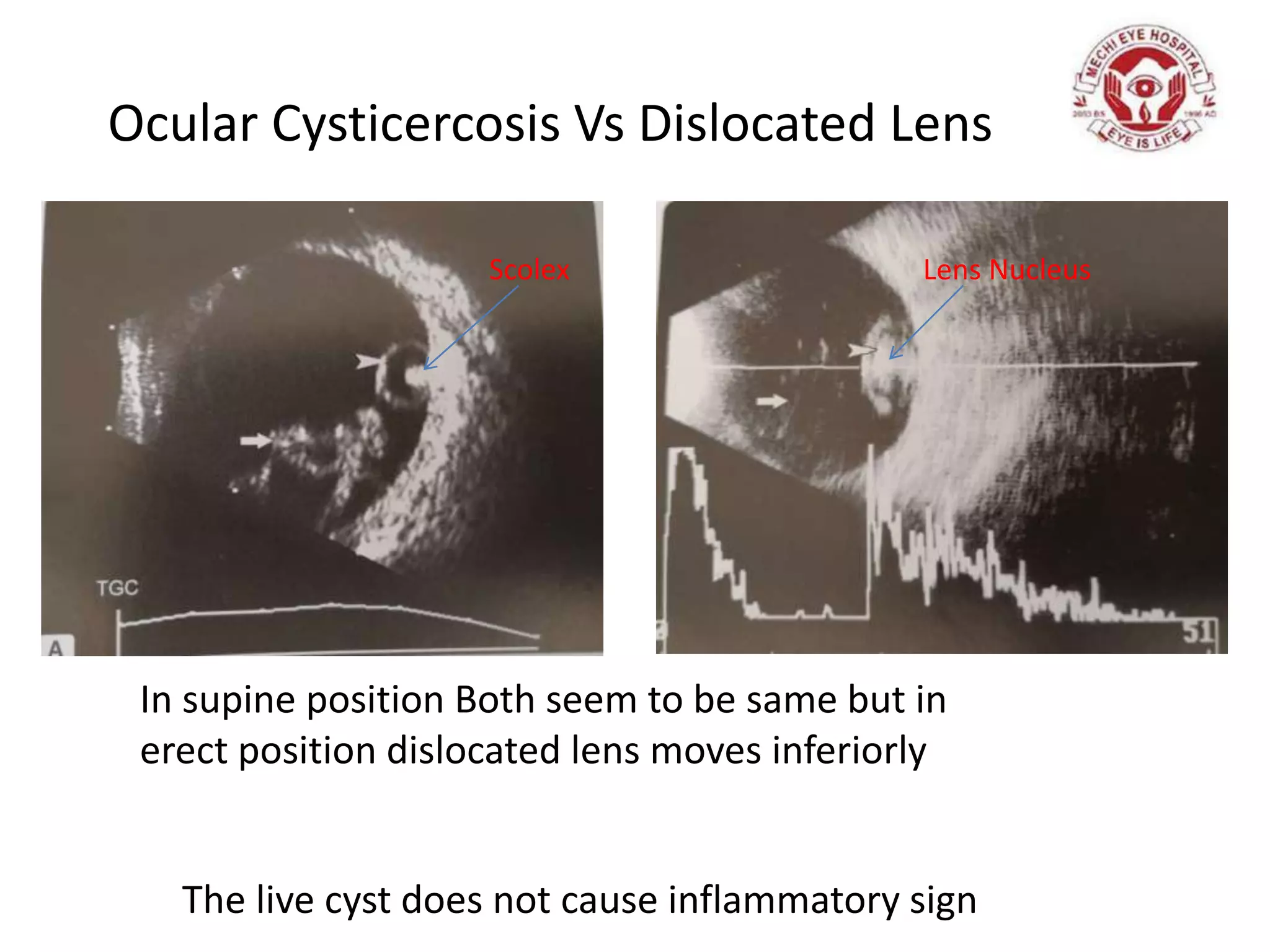
Ocular Cysticercosis Vs Dislocated Lens
Scolex Lens Nucleus
In supine position Both seem to be same but in
erect position dislocated lens moves inferiorly
The live cyst does not cause inflammatory sign
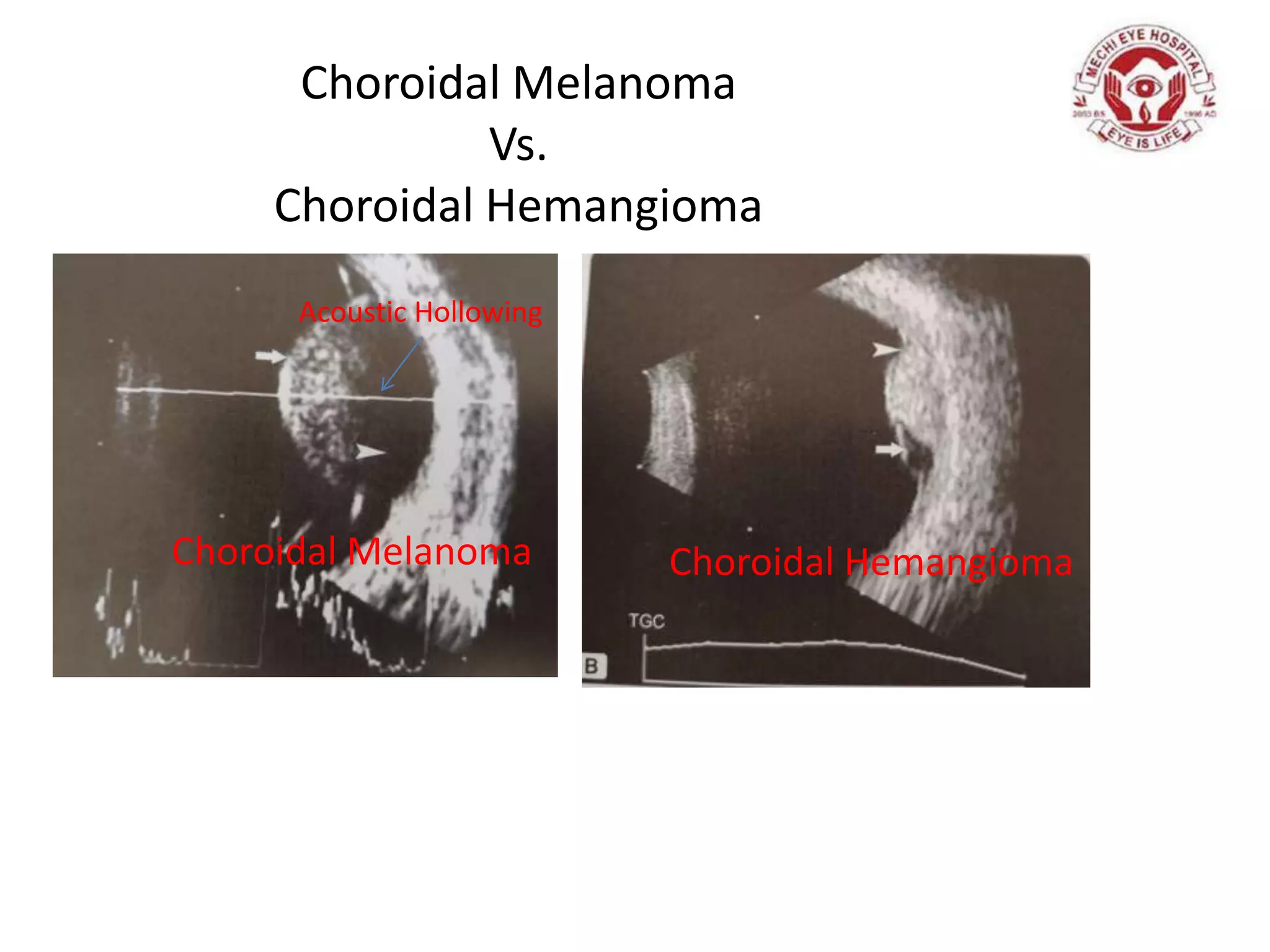
Choroidal Melanoma
Vs.
Choroidal Hemangioma
Acoustic Hollowing
Choroidal Melanoma Choroidal Hemangioma
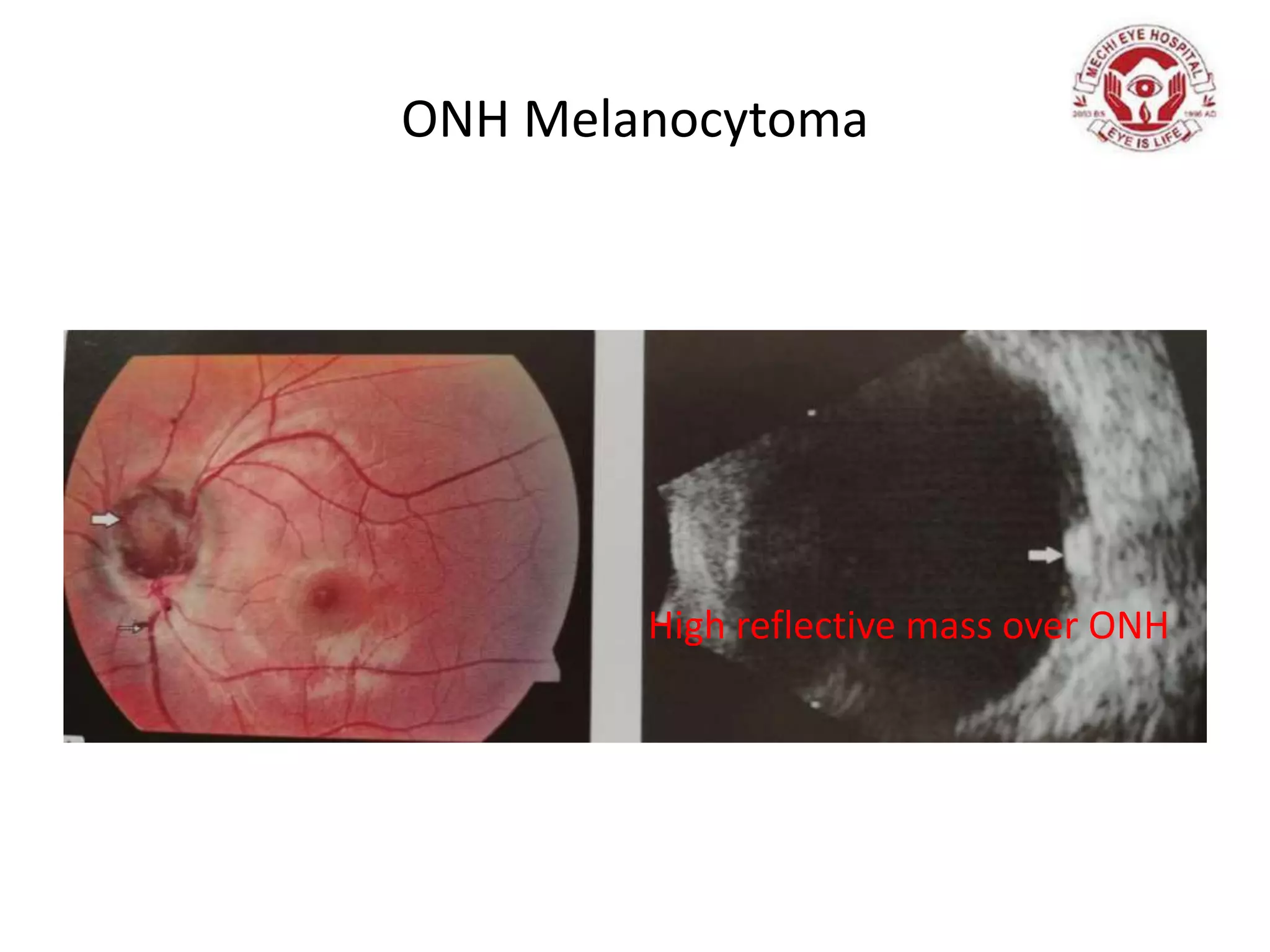
ONH Melanocytoma
High reflective mass over ONH
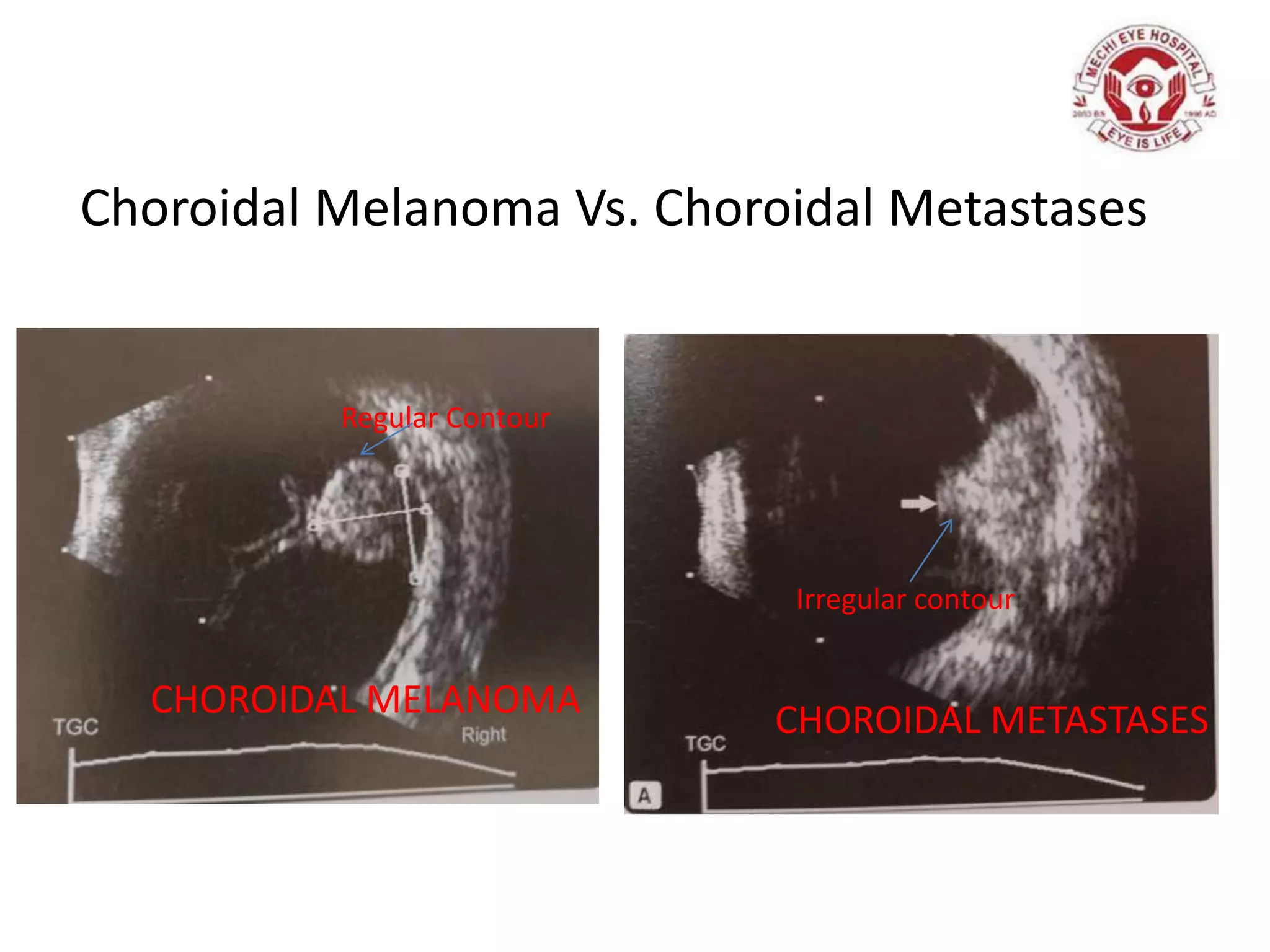
Choroidal Melanoma Vs. Choroidal Metastases
CHOROIDAL MELANOMA CHOROIDAL METASTASES
Regular Contour
Irregular contour
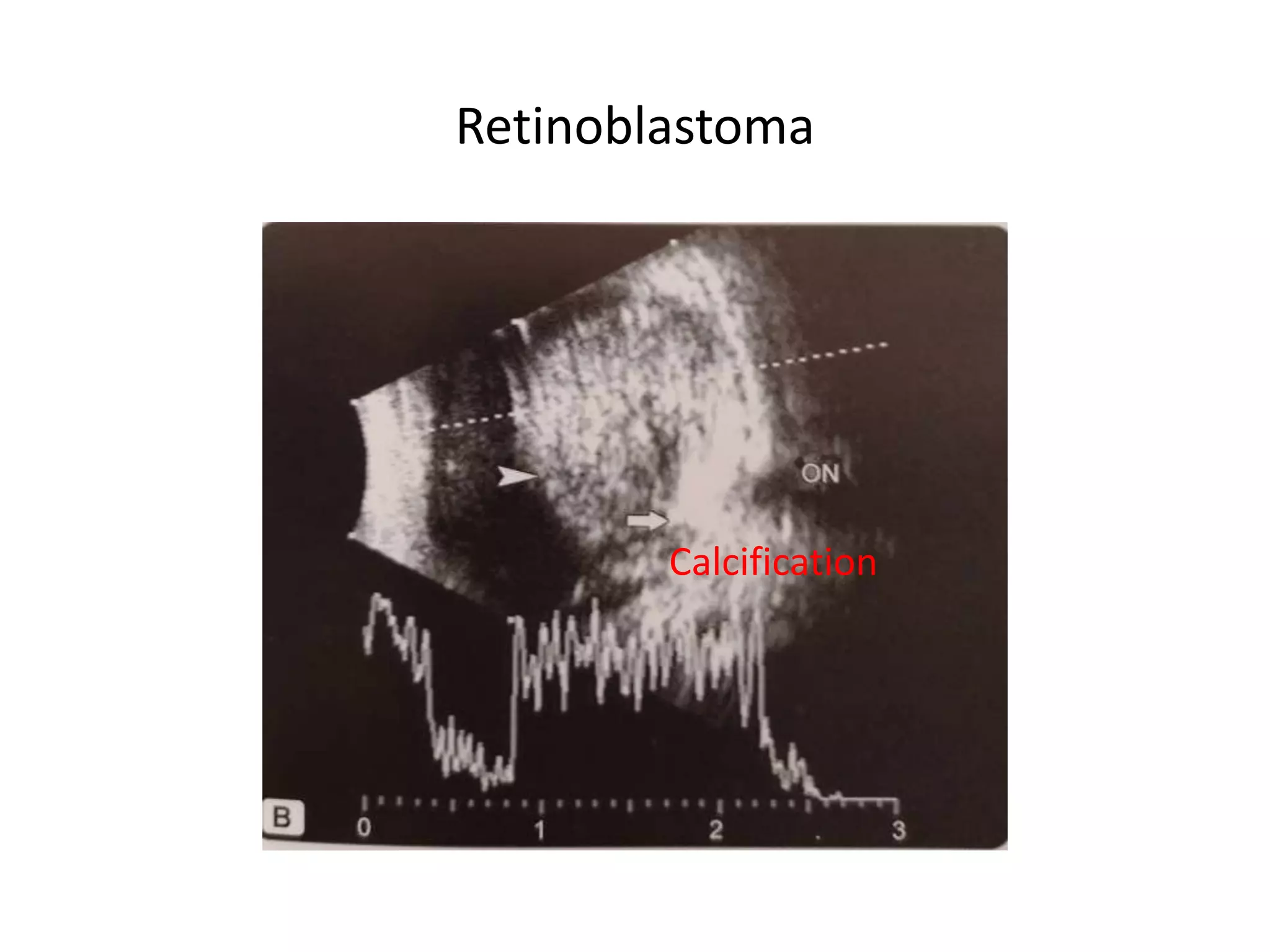
Retinoblastoma
Calcification
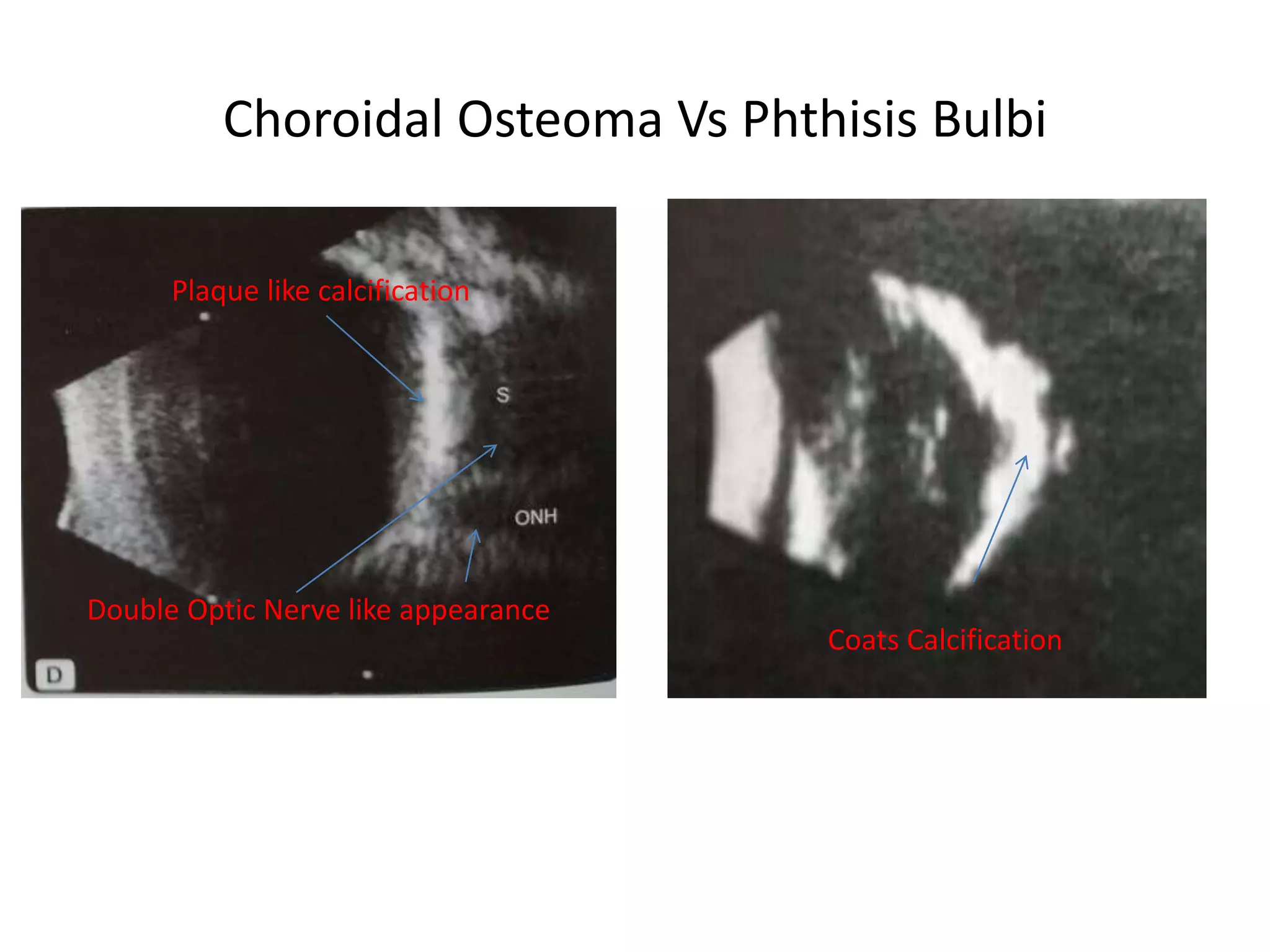
Choroidal Osteoma Vs Phthisis Bulbi
Double Optic Nerve like appearance
Plaque like calcification
Coats Calcification
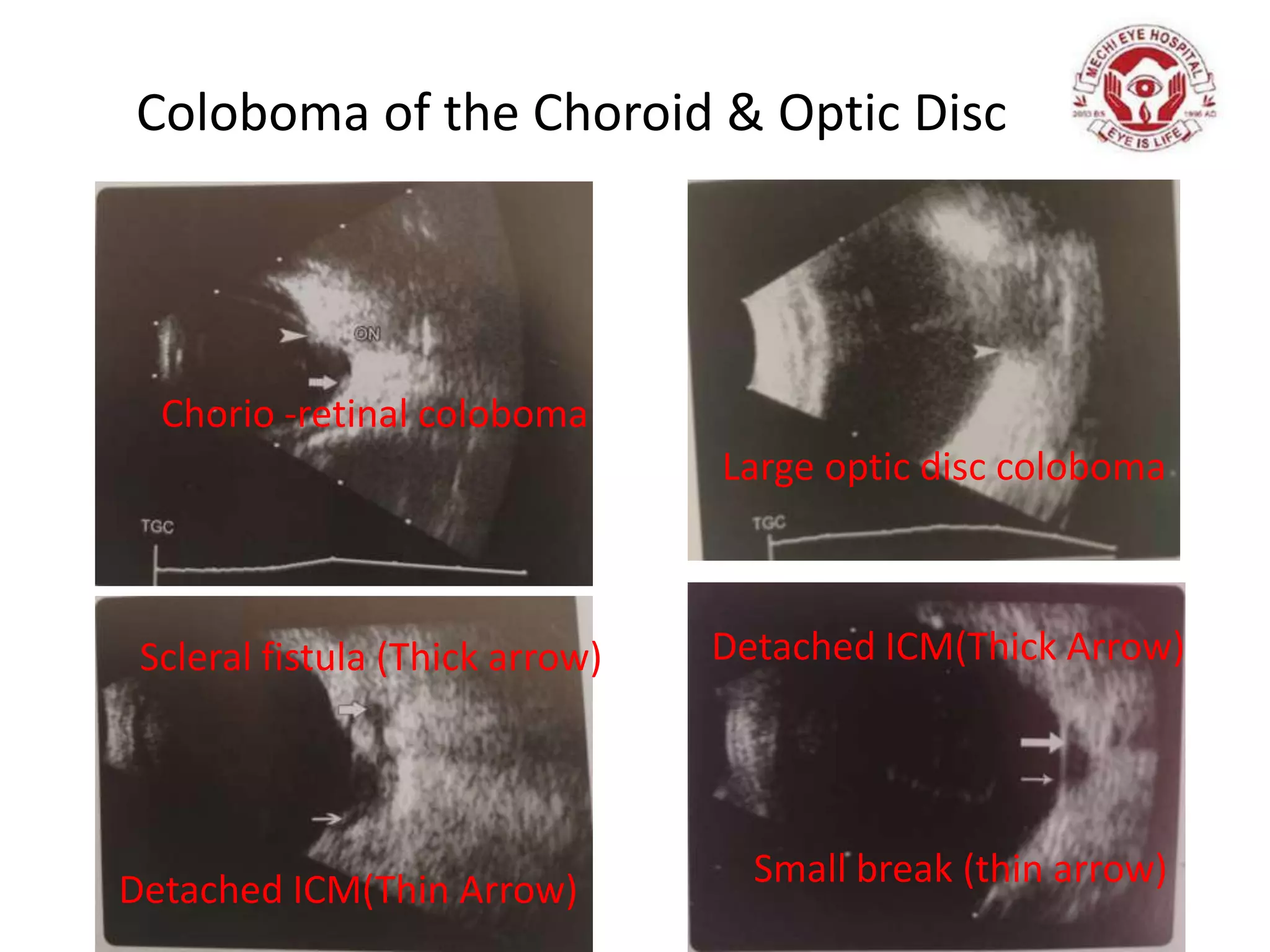
Coloboma of the Choroid & Optic Disc
Detached ICM(Thick Arrow)
Large optic disc coloboma
Chorio -retinal coloboma
Scleral fistula (Thick arrow)
Small break (thin arrow)Detached ICM(Thin Arrow)
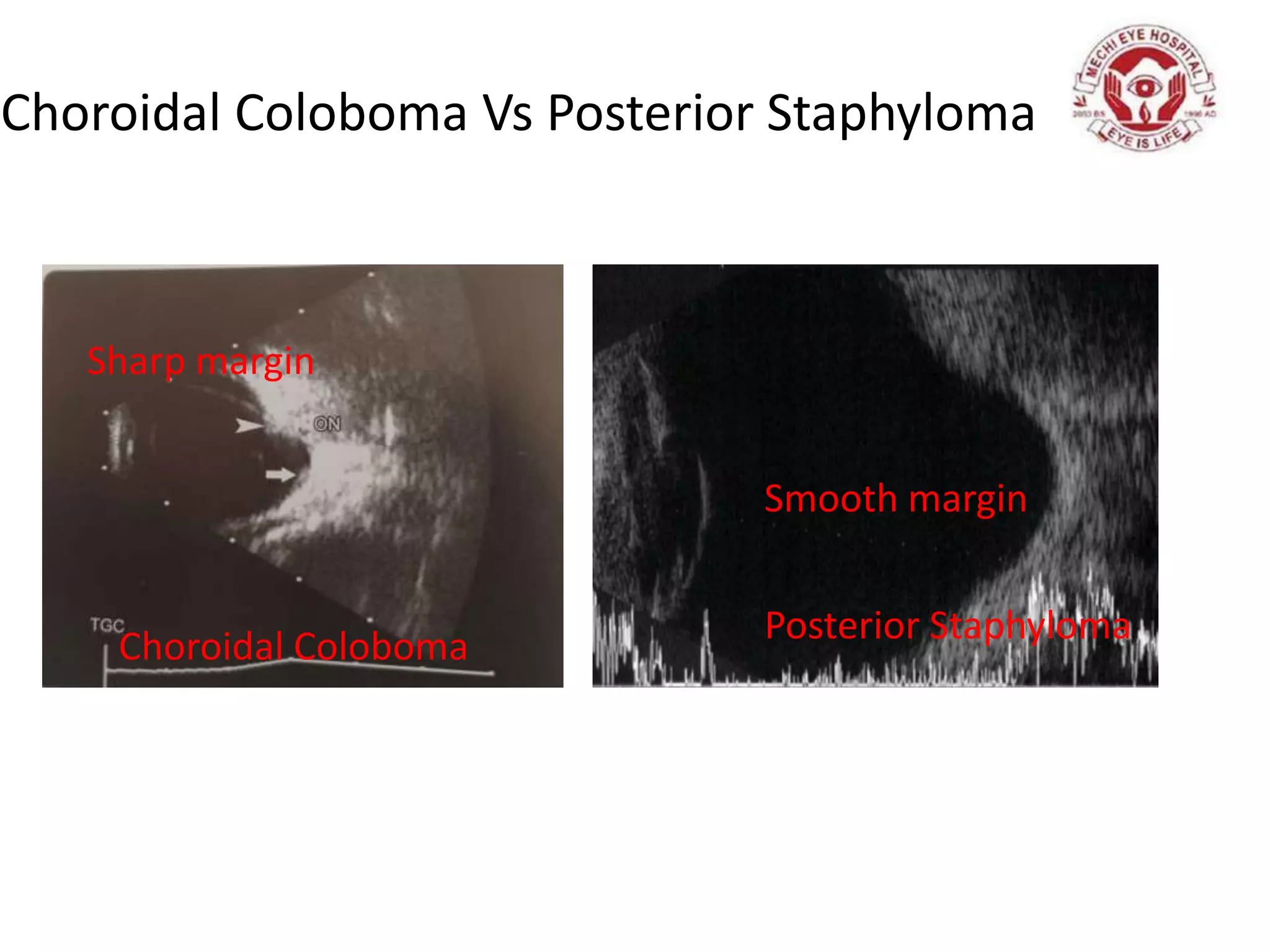
Choroidal Coloboma Vs Posterior Staphyloma
Posterior Staphyloma
Choroidal Coloboma
Smooth margin
Sharp margin
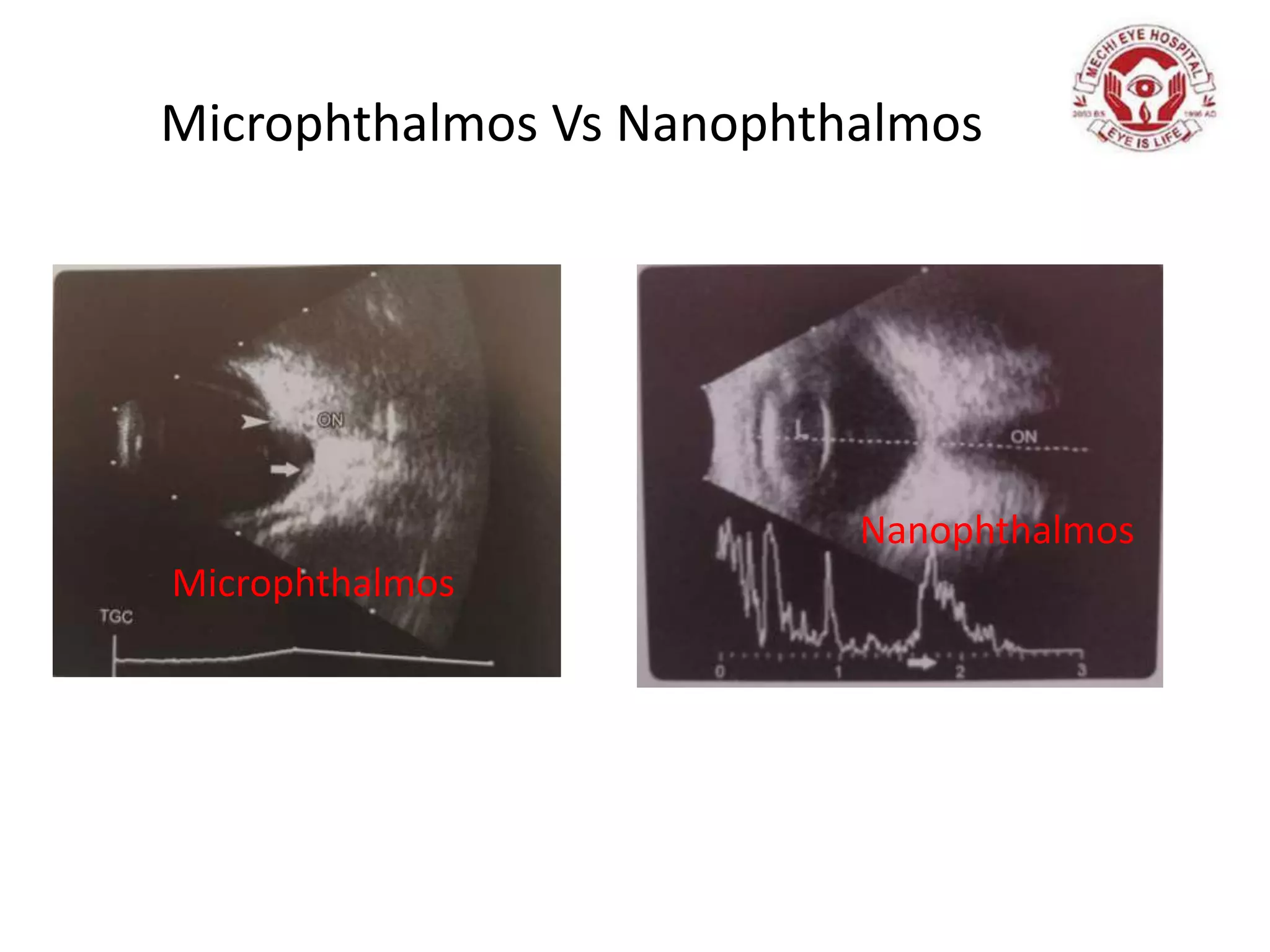
Microphthalmos Vs Nanophthalmos
Microphthalmos
Nanophthalmos
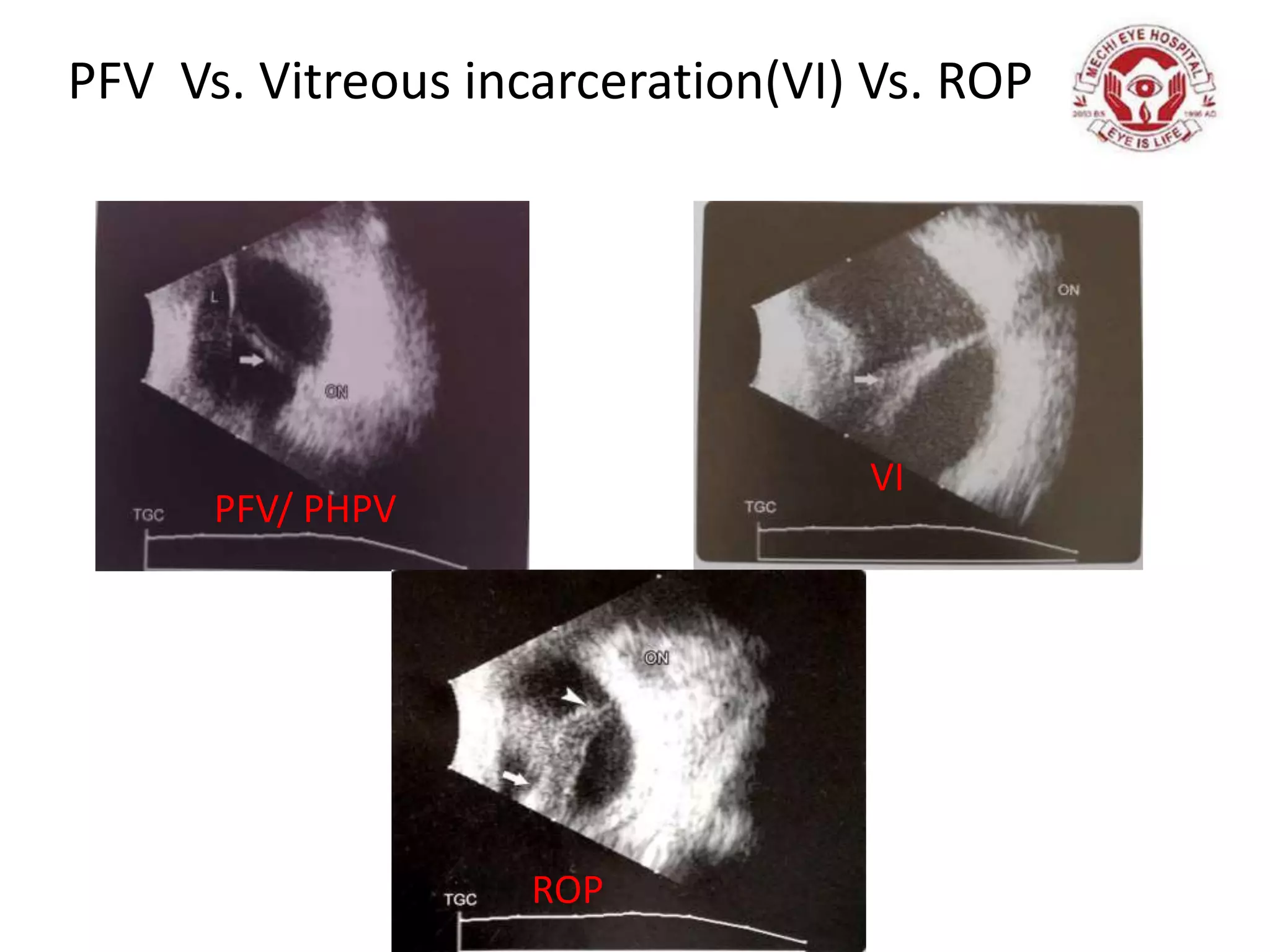
PFV Vs. Vitreous incarceration(VI) Vs. ROP
PFV/ PHPV
ROP
VI
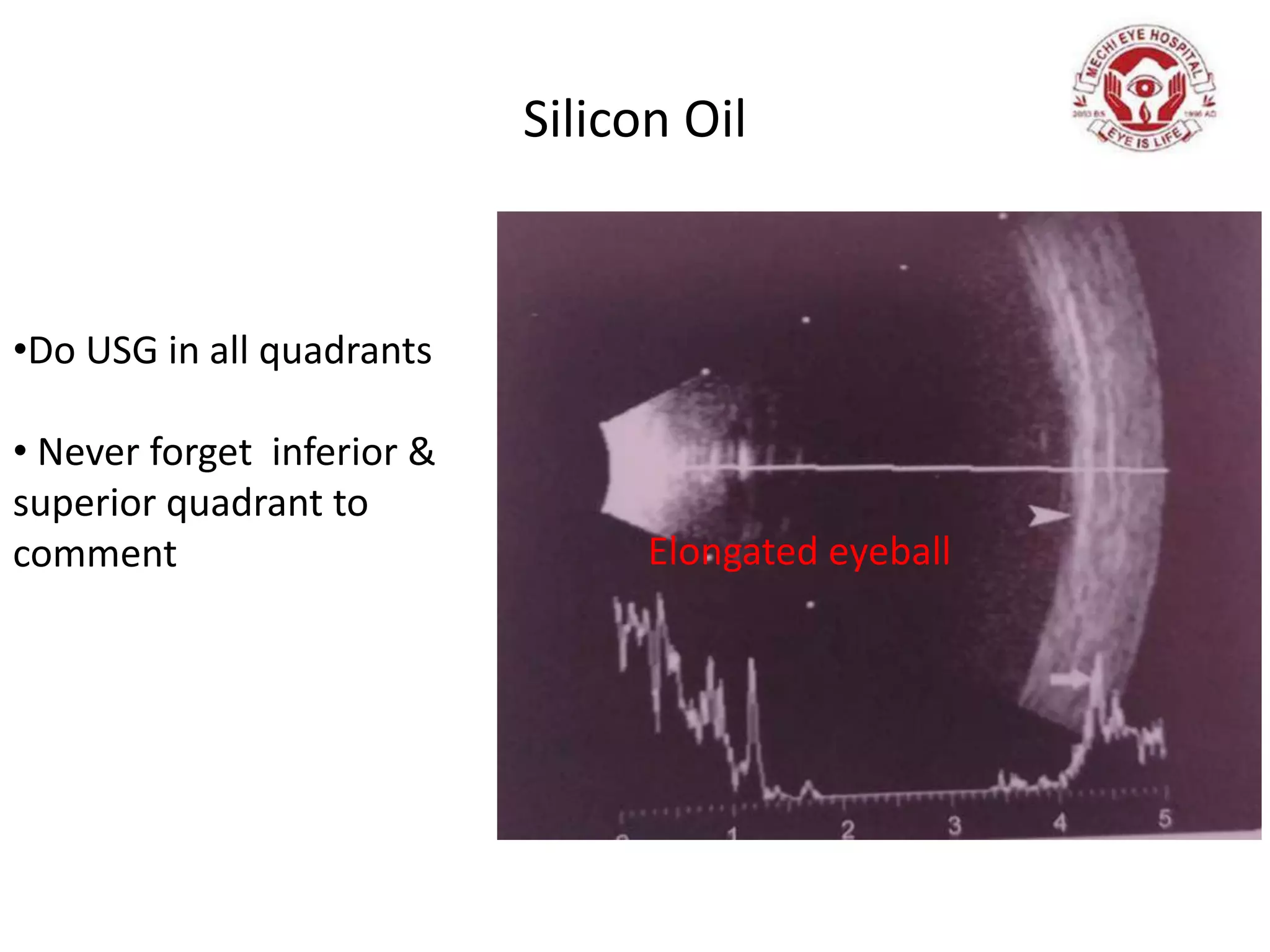
Silicon Oil
Elongated eyeball
•Do USG in all quadrants
• Never forget inferior &
superior quadrant to
comment
Emulsified Si oil (ESO) Vs. Asteroid Hyalosis(AH)
Vs. Vitreous Hemorrhage(VH) Vs. Vitreous
Cells(VC)
ESO AH
VH
VC
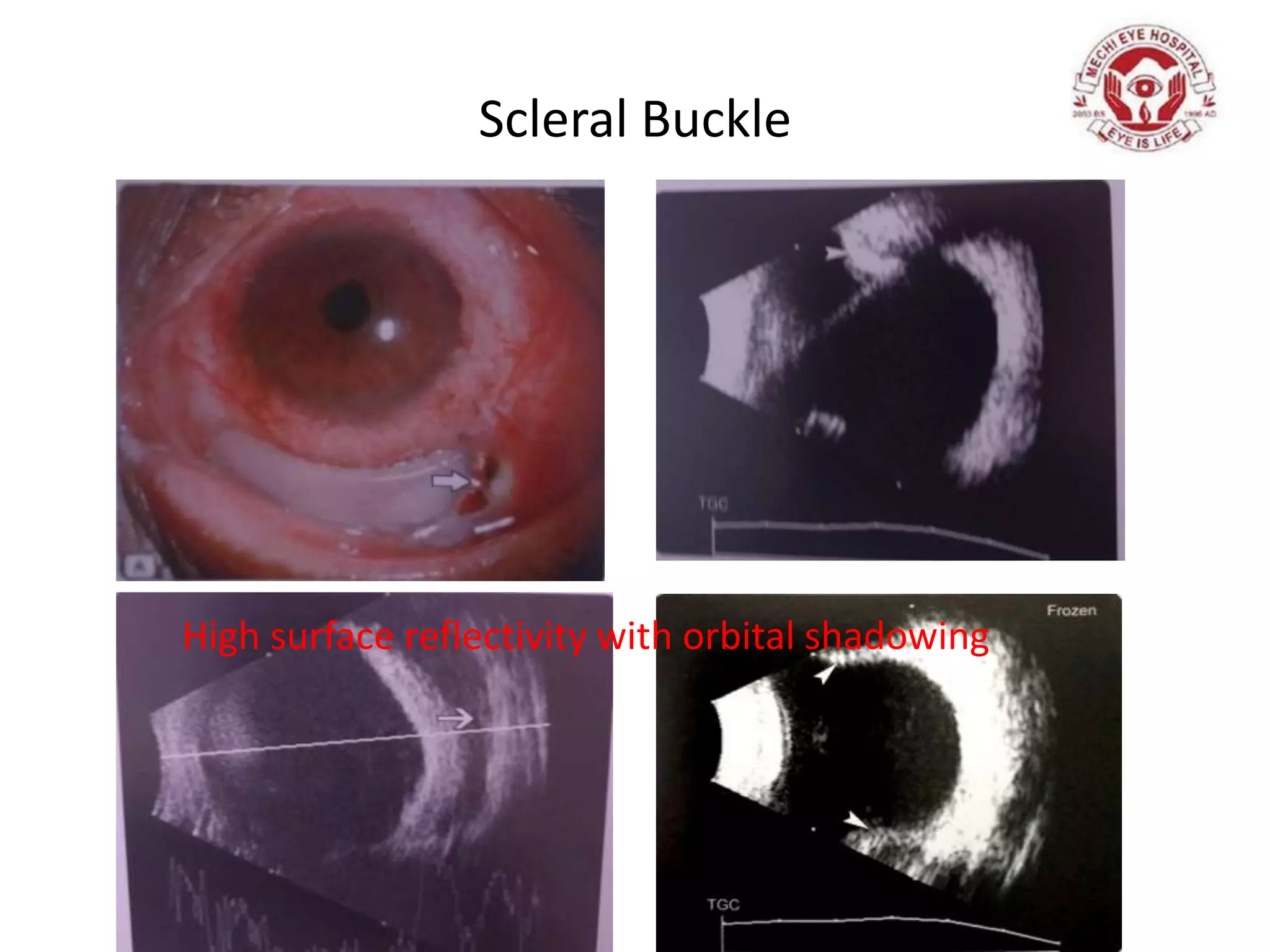
Scleral Buckle
High surface reflectivity with orbital shadowing
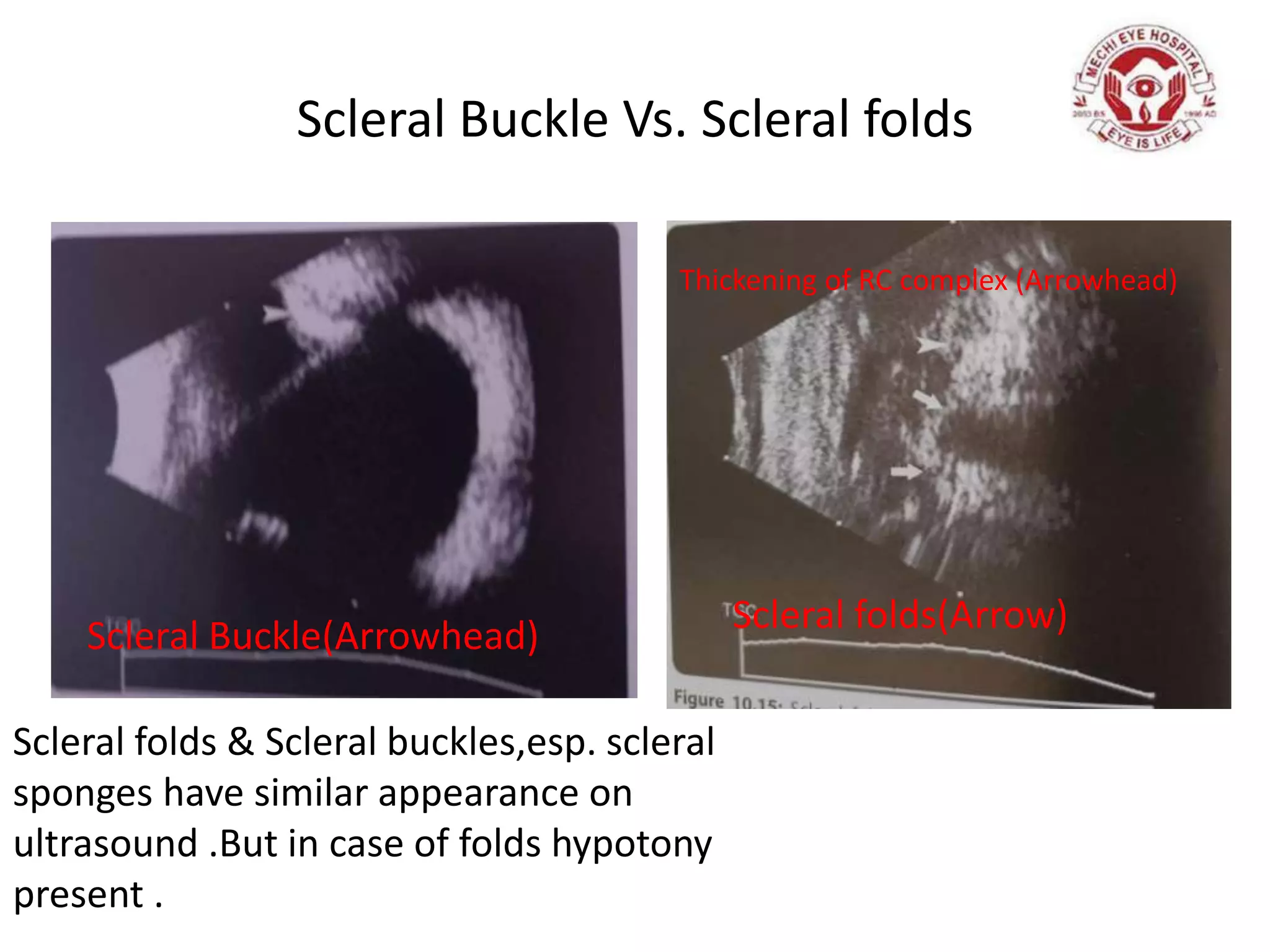
Scleral Buckle Vs. Scleral folds
Thickening of RC complex (Arrowhead)
Scleral folds(Arrow)
Scleral Buckle(Arrowhead)
Scleral folds & Scleral buckles,esp. scleral
sponges have similar appearance on
ultrasound .But in case of folds hypotony
present .
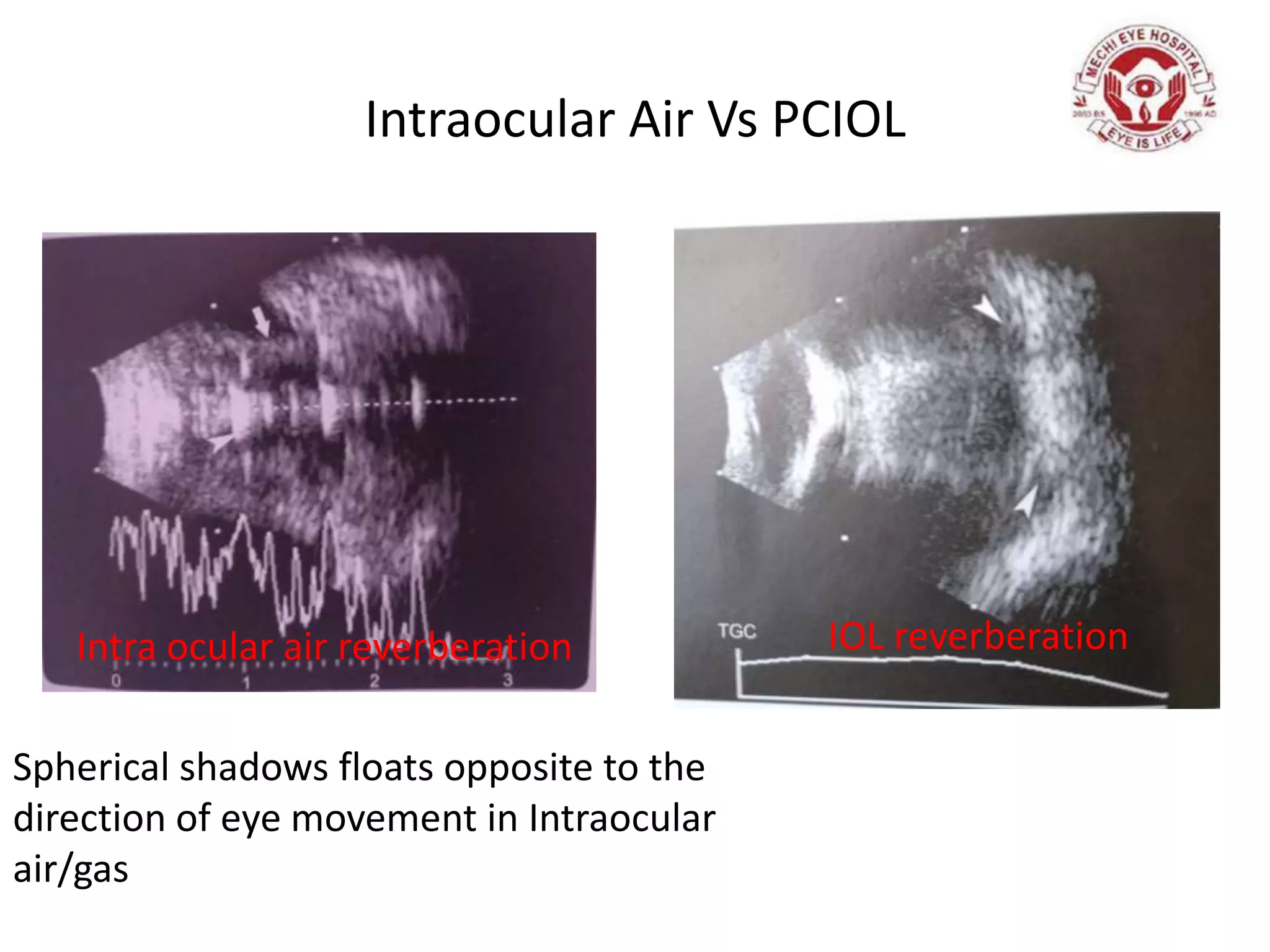
Intraocular Air Vs PCIOL
IOL reverberationIntra ocular air reverberation
Spherical shadows floats opposite to the
direction of eye movement in Intraocular
air/gas
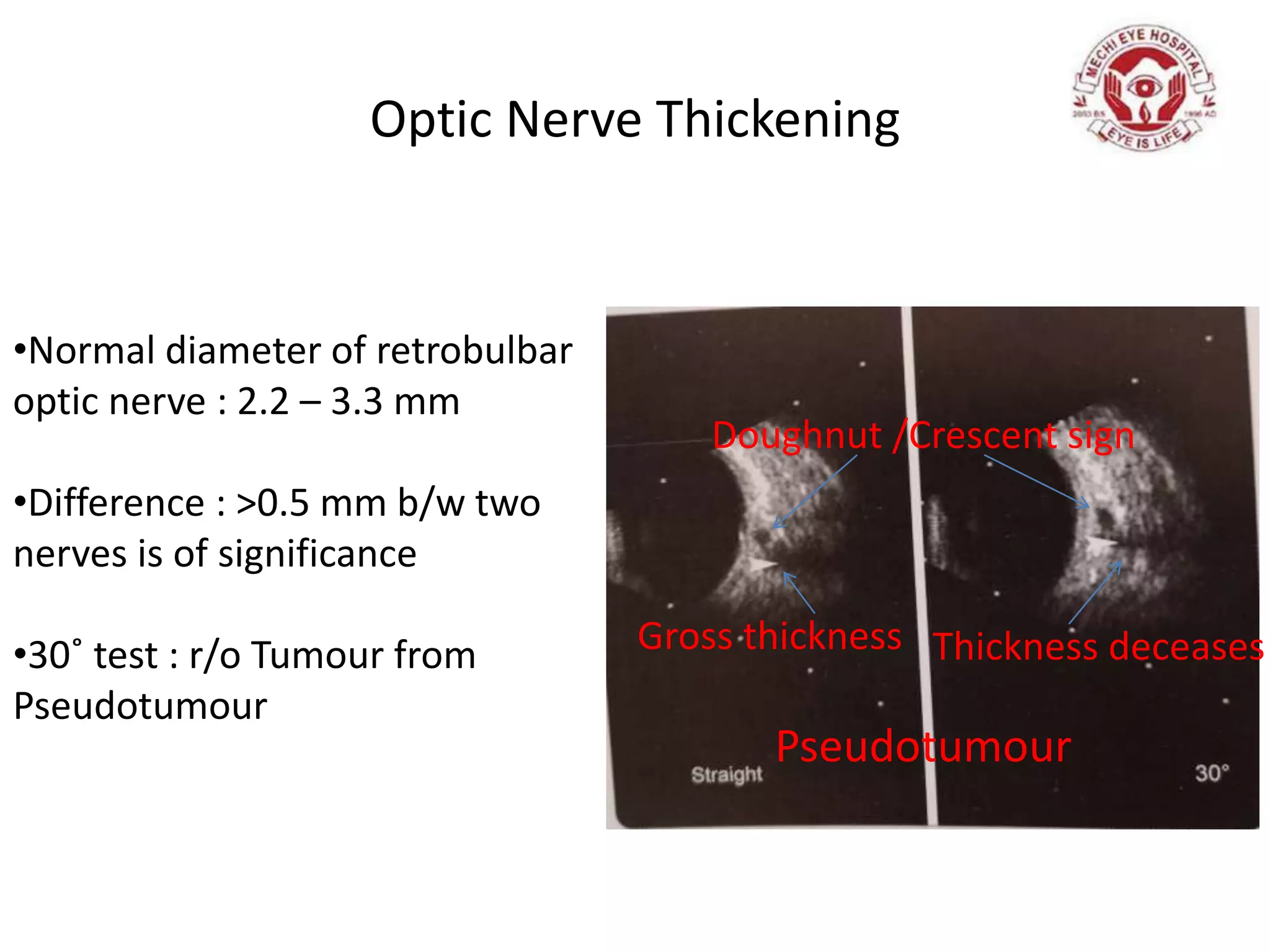
Optic Nerve Thickening
•Normal diameter of retrobulbar
optic nerve : 2.2 – 3.3 mm
•Difference : ˃0.5 mm b/w two
nerves is of significance
•30˚ test : r/o Tumour from
Pseudotumour
Gross thickness Thickness deceases
Pseudotumour
Doughnut /Crescent sign
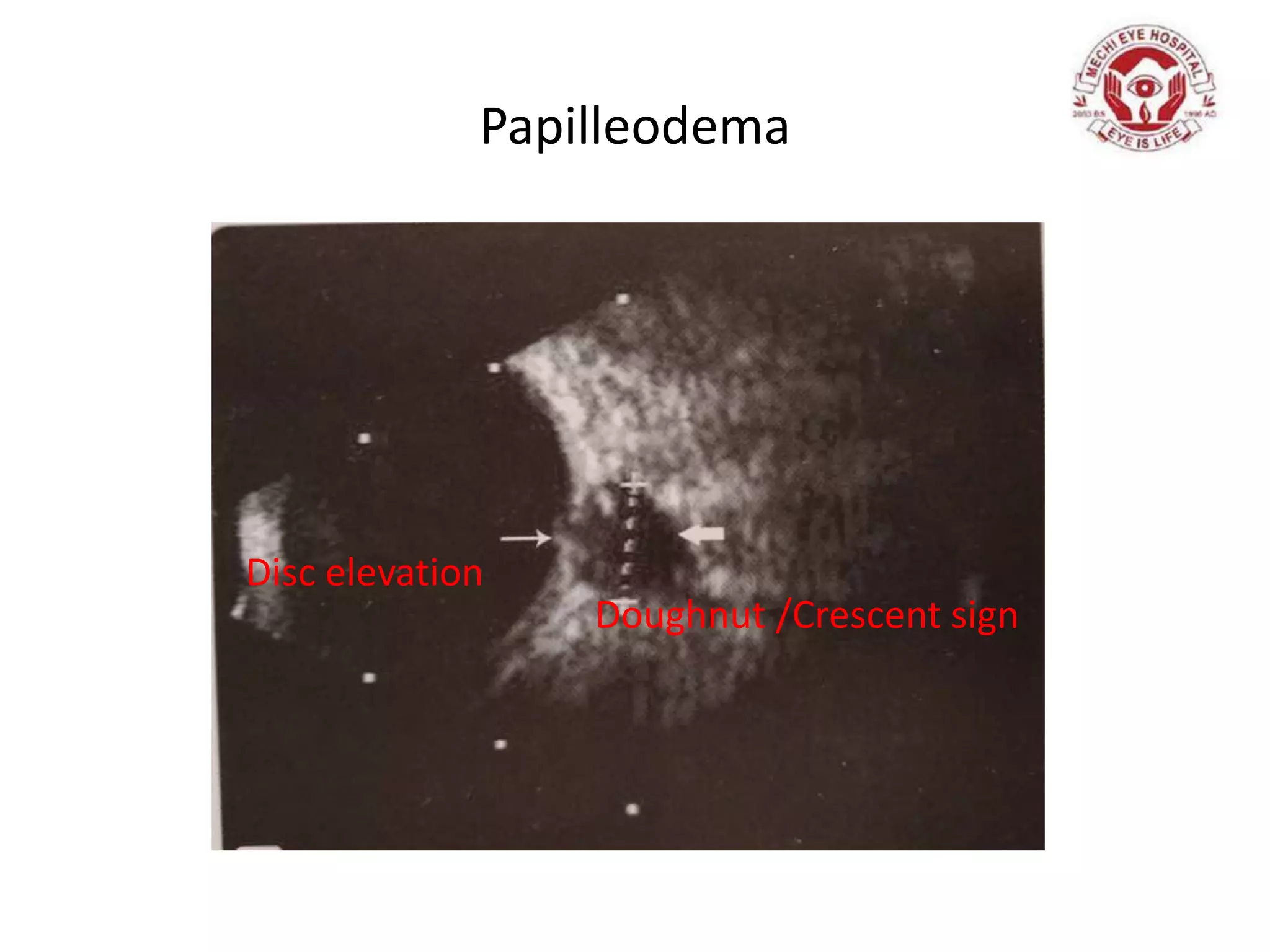
Papilleodema
Doughnut /Crescent sign
Disc elevation
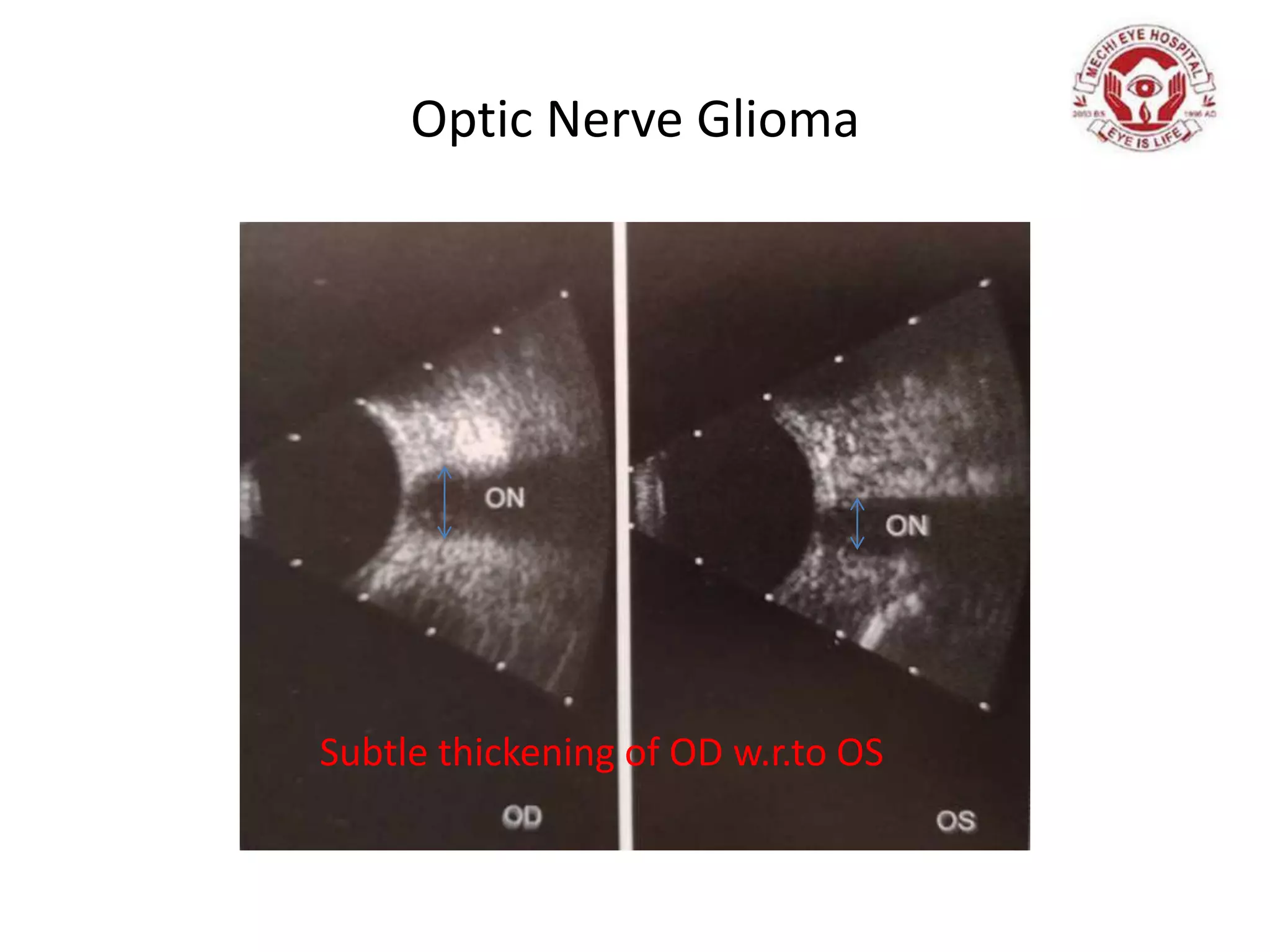
Optic Nerve Glioma
Subtle thickening of OD w.r.to OS
Optic Disc Abnormalities
High gain
Low gain
Optic Disc Drusen
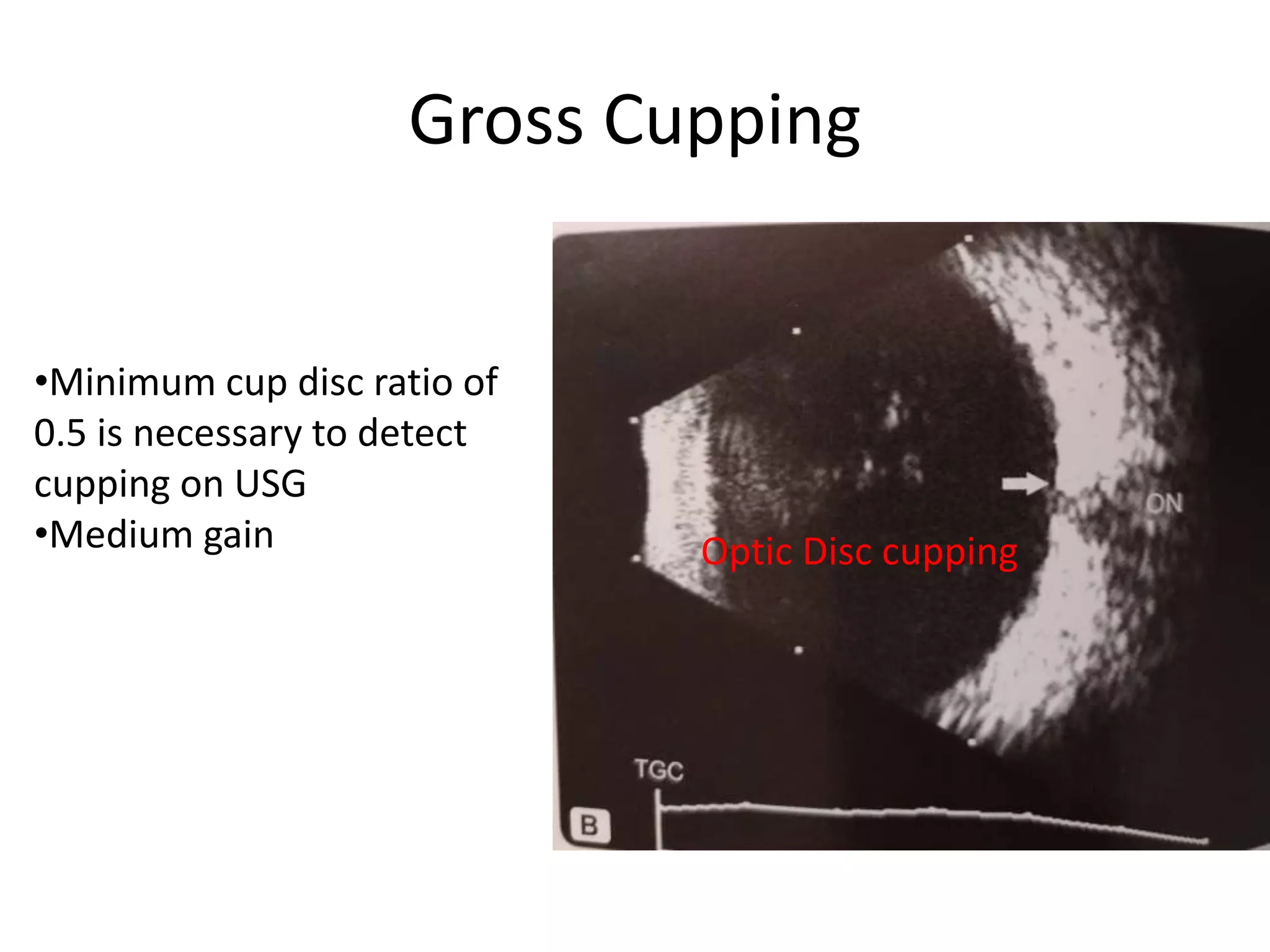
Gross Cupping
Optic Disc cupping
•Minimum cup disc ratio of
0.5 is necessary to detect
cupping on USG
•Medium gain
Reference
• Bhende M et al .(2013). Atlas of Ophthalmic Ultrasound and Ultrasound
Biomicroscopy. Jaypee Brothers Medical Publishers(P) Ltd, 2nd Edition
,ISBN 978-93-5090-535-7.
• Contact :amitasopto@gmail.com
• (+977-9819617489)

A quick guide to Ophthalmic Ultrasound/ B-Scan interpretation

  • 1.
    A quick guideto Ophthalmic Ultrasound / B-Scan Interpretation Amit K Singh Consultant optometrist Mechi Eye Hospital ,Birtamode-3 Jhapa
  • 3.
    Terminology • Audible Range: 10-20,000 Hz • Ultrasound : > 20,000 Hz • Pulse echo system: piezoelectric transducer to generate ultrasonic wave, a receiver which processes returning waves and a display screen • Acoustic impedance: Difference b/w strength of returning echoes from tissue boundaries • Angle of incidence: angle of sound beam relative to area of interest
  • 4.
    Terminology(contd) • Resolution: abilityto distinguish b/w adjacent echoes, both axial & lateral • Amplification: signal processing before echoes is displayed on monitor • Gain: procedure of increasing or decreasing amplitude of echoes that are displayed on screen • Time gain compensation(TGC) : technique used to enhance returning echoes from deeper structures by reducing those from structures closer to surface
  • 5.
    Principle of B-scan Electricalenergy sound energy electronic energy (Display) • Abdominal ultrasound : 1-2 MHz • Ophthalmic Ultrasound : 8-12 MHz • Ultrasound Biomicroscopy : 35-100 MHz • Frequency α 1/penetration α Resolution PiezoelectricPiezoelectric
  • 6.
    Indications of ocularB-scan • Opaque media 1. Corneal opacity 2. A/c hyphema or hypopyon 3. Miosis 4. pupillary membrane 5. Cataract 6. Vitreous haemorrhage
  • 7.
    • Clear media 1.Iris lesion 2. ciliary body lesion 3. Tumours & masses;detection & differentiation 4. RD :Rhegmatogenous vs exudative 5. IOFB detection and localization 6. OD abnormalities
  • 8.
    Indications of orbitalB-scan • Enophthalmos • Globe displacement • Lid abnormalities • Palpable or visible mass • Chemosis • Motility disturbance • Pain
  • 9.
    Technique of Evaluation •Clinical correlation
  • 10.
    Ocular scans • Probepositions • Transverse : on sclera (@ TS) • Longitudinal :at Limbus (@ LL) • Axial : on cornea (@ AC) • [NOTE: Markers aims nasally while screening superior & Inferior and Superiorly for nasal & temporal]
  • 11.
    Normal appearance ofocular & orbital Structures 1. Lens • Immersion/ stand off technique • None to highly reflective intralesional echoes depending on amount of cataract 2. Vitreous : Echo free , low to medium ref. In vitreous degeneration. 3. Retina, choroid & sclera : seen as single until/unless pathological conditions e.g. RD,CD, scleritis 4. Optic Nerve: Wedge shaped acoustic void in retrobulbar region Vitreous Optic Nerve
  • 12.
    Orbital Scans • Probeplacement 1. Transocular : lesions of mid & posterior orbit i.e. structures within muscular cone (Opposite side ) 2. Paraocular : lesions of lids & anterior orbit i.e. structures beyond muscular cone (same side) Transocular Scan Paraocular Scan
  • 13.
    Extraocular Muscles(EOM) • EOMare best evaluated by transverse & longitudinal scans. • Echolucent to low reflective fusiform str. • SR-LPS complex : Thickest • IR : Thinnest • IO : Not imaged except in pathological conditions
  • 14.
    Description of aLesion • Location w.r.to easily demonstrable landmarks e.g. optic disc or lens in an intraocular lesions • Extent : both antero-posterior & lateral • Dimensions: in cases of tumours and other solid lesions • Shape & configuration : point like , membrane like or a mass • Internal reflectivity : Echolucent ,low , moderate or high. Sclera has 100% reflectivity • Structure : solid or cystic, regular or irregular • Mobility : active movements and after movements
  • 16.
    Reverberation Artifacts Dropped IOL Sioil Reverberation PCIOL Reverberation Artifact d/t Insufficient Coupling
  • 17.
    Shadowing • Shadowing: d/tCa,glass,bone ,air metal ,gas Shadowing
  • 18.
    Angle of incidenceartifact Right Eye Left Eye Left Eye High reflective lesion (arrowhead) Shifting of lesion s/o artifact •Angle of incidence artifact : probe is perpendicular to surface •Often mistaken with IOFB, scar
  • 19.
  • 20.
  • 21.
  • 22.
    Vitreous Hemorrhage withRetinal tear Retinal Tear(Arrow) VH
  • 23.
  • 24.
    Vitreous hemorrhage withhemorrhagic PED VH Hemorrhagic PED
  • 25.
    Retinal Breaks &Detachment Rhegmatogenous Tractional Exudative Convex elevation Concave elevation Convex elevation Tractional Band Shifting of fluid with postural change /by pressing with finger Supine position Erect position Open funnel shaped RD
  • 26.
    RRD with PVR PVR Openfunnel shaped RD
  • 27.
    Closed funnel shapedRD with cyst formation Cyst Closed funnel shaped RD Cyst
  • 28.
    RRD with Giantretinal tear GRT
  • 29.
    RD Vs. PVD •RestrictedAftermovement in kinetic scan •High reflective membrane @ ONH • Membrane thickness remains const. in minimal tilt of probe •Membrane visible at low gain RD •Free Aftermovement in kinetic scan •High reflective membrane may or may not @ ONH •Variable thickness in membrane in minimal tilt of probe •Membrane disappear at low gain PVD
  • 30.
    Hemorrhagic choroidal detachment (Expulsive) Kissingchoroid with suprachoroidal hemorrhage
  • 31.
    Retinoschisis Vs.Exudative RD/PED Vs. ChoroidalDetachment (CD) Retinoschisis Exudative RD Choroidal Detachment Kissing choroidal sign ‘M’ spike Dome shaped appearance Shifting of fluid with postural change /by pressing with finger No change in fluid / structure by pressing with finger Supine Erect100% single picked spike seen just anterior Retina 100% single spike
  • 33.
    Intraocular Foreign Body IOFBinside lens IOFB @ Retinal surface IOFB within Optic Nerve IOFB within anterior vitreous
  • 35.
    Endophthalmitis Vs. VKHsyndrome VKH SYNDROME ENDOPHTHALMITIS •U/L •H/o Sx, Trauma •PVD may or may not present and develop TRD •Vitreous cells •B/L •Serous RD • No PVD •Few vitreous opacities
  • 36.
    Panophthalmitis Vs PosteriorScleritis PANOPHTHALMITIS POSTERIOR SCLERITIS Marked thickening of the Ocular coats & low reflective infiltration in Tenon’s capsule in Panophthalmitis ‘T’-sign
  • 37.
    Ocular Cysticercosis VsDislocated Lens Scolex Lens Nucleus In supine position Both seem to be same but in erect position dislocated lens moves inferiorly The live cyst does not cause inflammatory sign
  • 39.
    Choroidal Melanoma Vs. Choroidal Hemangioma AcousticHollowing Choroidal Melanoma Choroidal Hemangioma
  • 40.
  • 41.
    Choroidal Melanoma Vs.Choroidal Metastases CHOROIDAL MELANOMA CHOROIDAL METASTASES Regular Contour Irregular contour
  • 42.
  • 43.
    Choroidal Osteoma VsPhthisis Bulbi Double Optic Nerve like appearance Plaque like calcification Coats Calcification
  • 45.
    Coloboma of theChoroid & Optic Disc Detached ICM(Thick Arrow) Large optic disc coloboma Chorio -retinal coloboma Scleral fistula (Thick arrow) Small break (thin arrow)Detached ICM(Thin Arrow)
  • 46.
    Choroidal Coloboma VsPosterior Staphyloma Posterior Staphyloma Choroidal Coloboma Smooth margin Sharp margin
  • 47.
  • 48.
    PFV Vs. Vitreousincarceration(VI) Vs. ROP PFV/ PHPV ROP VI
  • 50.
    Silicon Oil Elongated eyeball •DoUSG in all quadrants • Never forget inferior & superior quadrant to comment
  • 51.
    Emulsified Si oil(ESO) Vs. Asteroid Hyalosis(AH) Vs. Vitreous Hemorrhage(VH) Vs. Vitreous Cells(VC) ESO AH VH VC
  • 52.
    Scleral Buckle High surfacereflectivity with orbital shadowing
  • 53.
    Scleral Buckle Vs.Scleral folds Thickening of RC complex (Arrowhead) Scleral folds(Arrow) Scleral Buckle(Arrowhead) Scleral folds & Scleral buckles,esp. scleral sponges have similar appearance on ultrasound .But in case of folds hypotony present .
  • 54.
    Intraocular Air VsPCIOL IOL reverberationIntra ocular air reverberation Spherical shadows floats opposite to the direction of eye movement in Intraocular air/gas
  • 56.
    Optic Nerve Thickening •Normaldiameter of retrobulbar optic nerve : 2.2 – 3.3 mm •Difference : ˃0.5 mm b/w two nerves is of significance •30˚ test : r/o Tumour from Pseudotumour Gross thickness Thickness deceases Pseudotumour Doughnut /Crescent sign
  • 57.
  • 58.
    Optic Nerve Glioma Subtlethickening of OD w.r.to OS
  • 59.
    Optic Disc Abnormalities Highgain Low gain Optic Disc Drusen
  • 60.
    Gross Cupping Optic Disccupping •Minimum cup disc ratio of 0.5 is necessary to detect cupping on USG •Medium gain
  • 61.
    Reference • Bhende Met al .(2013). Atlas of Ophthalmic Ultrasound and Ultrasound Biomicroscopy. Jaypee Brothers Medical Publishers(P) Ltd, 2nd Edition ,ISBN 978-93-5090-535-7. • Contact :amitasopto@gmail.com • (+977-9819617489)

Editor's Notes

  • #17 Reverberation artifacts : d/t insufficient coupling gel b/w eye & probe and due to IOLs & air gun pellets
  • #22 Double membrane configuration
  • #25 d/t polypoidal choroidal vasculopathy
  • #32 shifting fluid changes with postural change
  • #46 ICM :The neural retina continues as ICM in the area of the coloboma.
  • #49 Persistence of Fetal Vasculature ,Persistent hyperplastic primary vitreous (PHPV),Retinopathy of Prematurity (ROP)
  • #57 30˚ test positive means pseudo thickening