Lecture No. 04
Subject: Properties of Cement
Prepared by Dr. Salah Al-Dulaijan
Objectives of Lecture
• To explain briefly the properties of Portland
cement.
• The quality of a Portland cement is
assessed in terms of different physical
properties determined through the
laboratory tests on the cement samples
collected in accordance with ASTM C 183.
1. Fineness
• 95% of cement particles are smaller than 45 micrometer,
with the average particle around 15 micrometer.
• Fineness of cement affects heat released and the rate of
hydration.
• More is the fineness of cement more will be the rate of
hydration.
• Thus the fineness accelerates strength development
principally during the first seven days.
Continue on Fineness
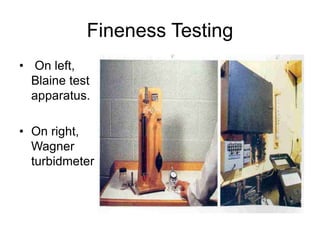
• Fineness tests indirectly measures the
surface area of the cement particles per
unit mass :
– Wagner turbidimeter test
(ASTM C 115)
– Blaine air-permeability test
(ASTM C 204)
– Sieving using No. 325 (45 μm) sieve (ASTM C
430)
Fineness Testing
• On left,
Blaine test
apparatus.
• On right,
Wagner
turbidmeter
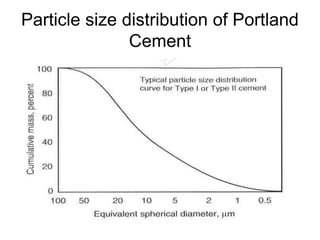
Particle size distribution of Portland
Cement
2. Soundness
• Soundness is the ability of a hardened paste to
retain its volume after setting.
• A cement is said to be unsound (i.e. having lack
of soundness) if it is subjected to delayed
destructive expansion.
• Unsoundness of cement is due to presence of
excessive amount of hard-burned free lime or
magnesia
Cont. on Soundness
• Unsoundness of a cement is determined
by the following tests:
–Le-Chatelier accelerated test
(BS 4550: Part 3)
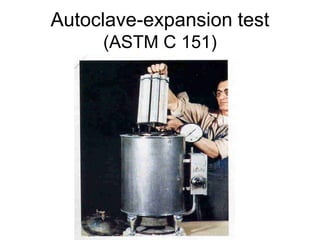
–Autoclave-expansion test
(ASTM C 151)
Autoclave-expansion test
(ASTM C 151)
3. Consistency
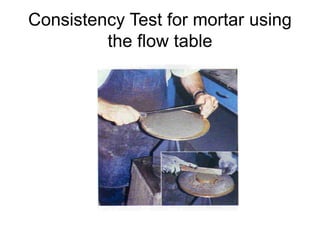
• Consistency refers to the relative mobility of a
freshly mixed cement paste or mortar or its
ability to flow.
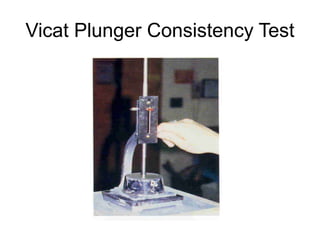
• Normal or Standard consistency of cement is
determined using the Vicat’s Apparatus. It is
defined as that percentage of water added to
form the paste which allows a penetration of 10
 1 mm of the Vicat plunger.
Vicat Plunger Consistency Test
Consistency Test for mortar using
the flow table
4. Setting Time
• This is the term used to describe the stiffening of the
cement paste.
• Setting time is to determine if a cement sets according to
the time limits specified in ASTM C 150.
• Setting time is determined using either the Vicat
apparatus (ASTM C 191) or a Gillmore needle (ASTM C
266).
• “Initial setting time” is the time from the instant at which
water is added to the cement until the paste ceases to
be fluid and plastic which corresponds to the time at
which the Vicat’s initial set needle penetrate to a point 5
mm from the bottom of a special mould.
Cont. on Setting Time
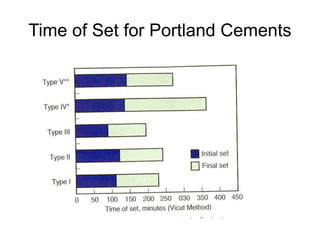
• ASTM C 150 prescribes a minimum initial setting time of
60 minutes for Portland cements.
• “Final setting time” the time required for the paste to
acquire certain degree of hardness. This corresponds to
the time at which the Viact’s final set needle makes an
impression on the paste surface but the cutting edge
fails to do so.
• ASTM C 150 prescribes a maximum final setting time of
10 hours for Portland cements.
• Gypsum in the cement regulates setting time. Setting
time is also affected by cement fineness, w/c ratio, and
admixtures.
Vicat Needle
Time of Set for Portland Cements
5. Early Stiffening (False Set and
Flash Set)
• Early stiffening is the early development of
stiffening in the working plasticity of
cement paste, mortar or concrete. This
includes both false set and flash set.
False Set
• False set is evidenced by a significant loss of plasticity,
i.e. stiffening, without the evolution of much heat shortly
after mixing.
• Stiffening caused by rapid crystallization of interlocking
needle-like secondary gypsum.
• False set cause no difficulty in placing and handling of
concrete if the concrete is mixed for a longer time than
usual or if it is remixed without additional water before it
is transported or placed.
Flash Set (quick set)
• Evidence by a quick and early loss of workability
and it is usually accompanied by evolution of
considerable heat from the hydration of
aluminates.
• The workability can not be regained without the
addition of water.
6. Compressive Strength
• Compressive strength of cement is the most important
property.
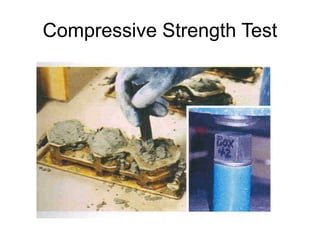
• It is determined by conducting compression tests on
standard 50 mm mortar cubes in accordance with ASTM
C 109.
• In general, cement strength (based on mortar-cube
tests) can not be used to predict concrete compressive
strength with great degree of accuracy because of many
variables in aggregate characteristics, concrete mixtures,
construction procedures, and environmental conditions
in the field.
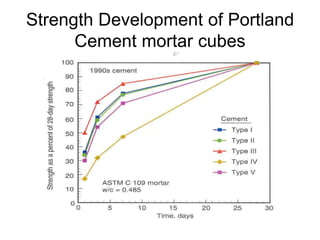
• Rates of compressive strength development for
concrete, made with various types of cement, are shown
in Fig. 2-42.
Compressive Strength Test
Strength Development of Portland
Cement mortar cubes
7. Heat of Hydration
• It is the quantity of heat (in joules) per gram of un-
hydrated cement evolved upon complete hydration
at a given temperature.
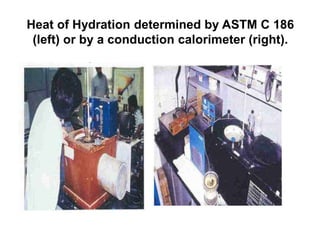
• The heat of hydration can be determined by ASTM C
186 or by a conduction calorimeter.
• The temperature at which hydration occurs greatly
affects the rate of heat development.
• Fineness of cement also affects the rate of heat
development but not the total amount of heat
librated.
Heat of Hydration determined by ASTM C 186
(left) or by a conduction calorimeter (right).
Cont. on Heat of Hydration
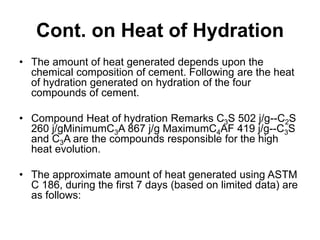
• The amount of heat generated depends upon the
chemical composition of cement. Following are the heat
of hydration generated on hydration of the four
compounds of cement.
• Compound Heat of hydration Remarks C3S 502 j/g--C2S
260 j/gMinimumC3A 867 j/g MaximumC4AF 419 j/g--C3S
and C3A are the compounds responsible for the high
heat evolution.
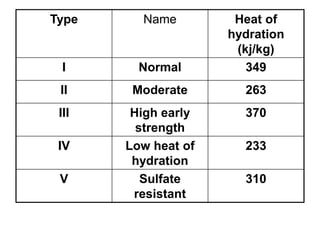
• The approximate amount of heat generated using ASTM
C 186, during the first 7 days (based on limited data) are
as follows:
Type Name Heat of
hydration
(kj/kg)
I Normal 349
II Moderate 263
III High early
strength
370
IV Low heat of
hydration
233
V Sulfate
resistant
310
Cont. on Heat of Hydration
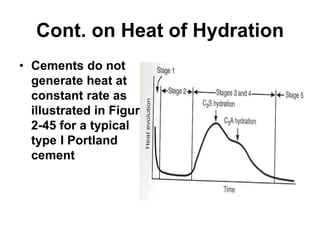
• Cements do not
generate heat at
constant rate as
illustrated in Figure
2-45 for a typical
type I Portland
cement
Stage 1:heat of wetting or initial hydrolysis
C3A and C3S Hydration. 7 min after mixing.
Stage 2: dormant period related to initial set.
Stage 3. accelerated reaction of the hydration products.
That determine the rate of hardening and final set.
Stage 4: decelerates formation of hydration products and
determines the rate of early strength gain.
Stage 5: is a slow, steady formation of hydration products.
8. Loss on Ignition (LOI)
• The test for loss on ignition is performed in
accordance with ASTM C 114.
• A high weight loss on ignition of a cement
sample (between 900 to 1000ºC) is an indication
of pre-hydration and carbonation, which may be
caused by:
– Improper and prolonged storage
– Adulteration during transport and transfer
• Loss on ignition values range between 0 to 3%
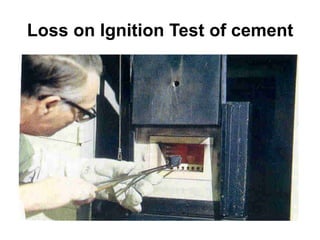
Loss on Ignition Test of cement
9. Density and Specific Gravity
(ASTM C 188)
• Density is the mass of a unit volume of the solids or
particles, excluding air between particles. The particle
density of Portland cement ranges from 3.10 to 3.25
Mg/m3, averaging 3.15 Mg/ m3.
• It is used in concrete mixture proportioning calculations.
• For mixture proportioning, it may be more useful to
express the density as relative density (specific gravity).
On an average the specific gravity of cement is 3.15.
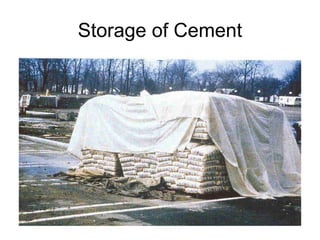
Storage of Cement
• Cement is moisture-sensitive material; if
kept dry it will retain its quality indefinitely.
• When exposed to moisture, cement will
set more slowly and will have less strength
compared to cement that kept dray.
• At the time of use cement should be free-
flowing and free of lumps.
Storage of Cement

CE-303-Lec-4.ppt

  • 1.
    Lecture No. 04 Subject:Properties of Cement Prepared by Dr. Salah Al-Dulaijan
  • 2.
    Objectives of Lecture •To explain briefly the properties of Portland cement. • The quality of a Portland cement is assessed in terms of different physical properties determined through the laboratory tests on the cement samples collected in accordance with ASTM C 183.
  • 3.
    1. Fineness • 95%of cement particles are smaller than 45 micrometer, with the average particle around 15 micrometer. • Fineness of cement affects heat released and the rate of hydration. • More is the fineness of cement more will be the rate of hydration. • Thus the fineness accelerates strength development principally during the first seven days.
  • 4.
    Continue on Fineness •Fineness tests indirectly measures the surface area of the cement particles per unit mass : – Wagner turbidimeter test (ASTM C 115) – Blaine air-permeability test (ASTM C 204) – Sieving using No. 325 (45 μm) sieve (ASTM C 430)
  • 5.
    Fineness Testing • Onleft, Blaine test apparatus. • On right, Wagner turbidmeter
  • 6.
    Particle size distributionof Portland Cement
  • 7.
    2. Soundness • Soundnessis the ability of a hardened paste to retain its volume after setting. • A cement is said to be unsound (i.e. having lack of soundness) if it is subjected to delayed destructive expansion. • Unsoundness of cement is due to presence of excessive amount of hard-burned free lime or magnesia
  • 8.
    Cont. on Soundness •Unsoundness of a cement is determined by the following tests: –Le-Chatelier accelerated test (BS 4550: Part 3) –Autoclave-expansion test (ASTM C 151)
  • 9.
  • 10.
    3. Consistency • Consistencyrefers to the relative mobility of a freshly mixed cement paste or mortar or its ability to flow. • Normal or Standard consistency of cement is determined using the Vicat’s Apparatus. It is defined as that percentage of water added to form the paste which allows a penetration of 10  1 mm of the Vicat plunger.
  • 11.
  • 12.
    Consistency Test formortar using the flow table
  • 13.
    4. Setting Time •This is the term used to describe the stiffening of the cement paste. • Setting time is to determine if a cement sets according to the time limits specified in ASTM C 150. • Setting time is determined using either the Vicat apparatus (ASTM C 191) or a Gillmore needle (ASTM C 266). • “Initial setting time” is the time from the instant at which water is added to the cement until the paste ceases to be fluid and plastic which corresponds to the time at which the Vicat’s initial set needle penetrate to a point 5 mm from the bottom of a special mould.
  • 14.
    Cont. on SettingTime • ASTM C 150 prescribes a minimum initial setting time of 60 minutes for Portland cements. • “Final setting time” the time required for the paste to acquire certain degree of hardness. This corresponds to the time at which the Viact’s final set needle makes an impression on the paste surface but the cutting edge fails to do so. • ASTM C 150 prescribes a maximum final setting time of 10 hours for Portland cements. • Gypsum in the cement regulates setting time. Setting time is also affected by cement fineness, w/c ratio, and admixtures.
  • 15.
  • 16.
    Time of Setfor Portland Cements
  • 17.
    5. Early Stiffening(False Set and Flash Set) • Early stiffening is the early development of stiffening in the working plasticity of cement paste, mortar or concrete. This includes both false set and flash set.
  • 18.
    False Set • Falseset is evidenced by a significant loss of plasticity, i.e. stiffening, without the evolution of much heat shortly after mixing. • Stiffening caused by rapid crystallization of interlocking needle-like secondary gypsum. • False set cause no difficulty in placing and handling of concrete if the concrete is mixed for a longer time than usual or if it is remixed without additional water before it is transported or placed.
  • 19.
    Flash Set (quickset) • Evidence by a quick and early loss of workability and it is usually accompanied by evolution of considerable heat from the hydration of aluminates. • The workability can not be regained without the addition of water.
  • 20.
    6. Compressive Strength •Compressive strength of cement is the most important property. • It is determined by conducting compression tests on standard 50 mm mortar cubes in accordance with ASTM C 109. • In general, cement strength (based on mortar-cube tests) can not be used to predict concrete compressive strength with great degree of accuracy because of many variables in aggregate characteristics, concrete mixtures, construction procedures, and environmental conditions in the field. • Rates of compressive strength development for concrete, made with various types of cement, are shown in Fig. 2-42.
  • 21.
  • 22.
    Strength Development ofPortland Cement mortar cubes
  • 23.
    7. Heat ofHydration • It is the quantity of heat (in joules) per gram of un- hydrated cement evolved upon complete hydration at a given temperature. • The heat of hydration can be determined by ASTM C 186 or by a conduction calorimeter. • The temperature at which hydration occurs greatly affects the rate of heat development. • Fineness of cement also affects the rate of heat development but not the total amount of heat librated.
  • 24.
    Heat of Hydrationdetermined by ASTM C 186 (left) or by a conduction calorimeter (right).
  • 25.
    Cont. on Heatof Hydration • The amount of heat generated depends upon the chemical composition of cement. Following are the heat of hydration generated on hydration of the four compounds of cement. • Compound Heat of hydration Remarks C3S 502 j/g--C2S 260 j/gMinimumC3A 867 j/g MaximumC4AF 419 j/g--C3S and C3A are the compounds responsible for the high heat evolution. • The approximate amount of heat generated using ASTM C 186, during the first 7 days (based on limited data) are as follows:
  • 26.
    Type Name Heatof hydration (kj/kg) I Normal 349 II Moderate 263 III High early strength 370 IV Low heat of hydration 233 V Sulfate resistant 310
  • 27.
    Cont. on Heatof Hydration • Cements do not generate heat at constant rate as illustrated in Figure 2-45 for a typical type I Portland cement
  • 28.
    Stage 1:heat ofwetting or initial hydrolysis C3A and C3S Hydration. 7 min after mixing. Stage 2: dormant period related to initial set. Stage 3. accelerated reaction of the hydration products. That determine the rate of hardening and final set. Stage 4: decelerates formation of hydration products and determines the rate of early strength gain. Stage 5: is a slow, steady formation of hydration products.
  • 29.
    8. Loss onIgnition (LOI) • The test for loss on ignition is performed in accordance with ASTM C 114. • A high weight loss on ignition of a cement sample (between 900 to 1000ºC) is an indication of pre-hydration and carbonation, which may be caused by: – Improper and prolonged storage – Adulteration during transport and transfer • Loss on ignition values range between 0 to 3%
  • 30.
    Loss on IgnitionTest of cement
  • 31.
    9. Density andSpecific Gravity (ASTM C 188) • Density is the mass of a unit volume of the solids or particles, excluding air between particles. The particle density of Portland cement ranges from 3.10 to 3.25 Mg/m3, averaging 3.15 Mg/ m3. • It is used in concrete mixture proportioning calculations. • For mixture proportioning, it may be more useful to express the density as relative density (specific gravity). On an average the specific gravity of cement is 3.15.
  • 32.
    Storage of Cement •Cement is moisture-sensitive material; if kept dry it will retain its quality indefinitely. • When exposed to moisture, cement will set more slowly and will have less strength compared to cement that kept dray. • At the time of use cement should be free- flowing and free of lumps.
  • 33.