University of Duhok
College of Engineering
Civil Department
Concrete Technology – Practical
Concrete Laboratory
A Report About :
Time of Setting of Hydraulic Cement by
Vicat Needle
Submitted By : Jameel Masoud Jameel
Lab. No. : 2
Group Name : B1
Testing Date : 29 / 10 / 2017
Submitting Date : 5 / 11 / 2017
Supervised By : Youkhanna
2017 – 2018
References :
1) ASTM C191-04
2) ASTM C305-99
Introduction :
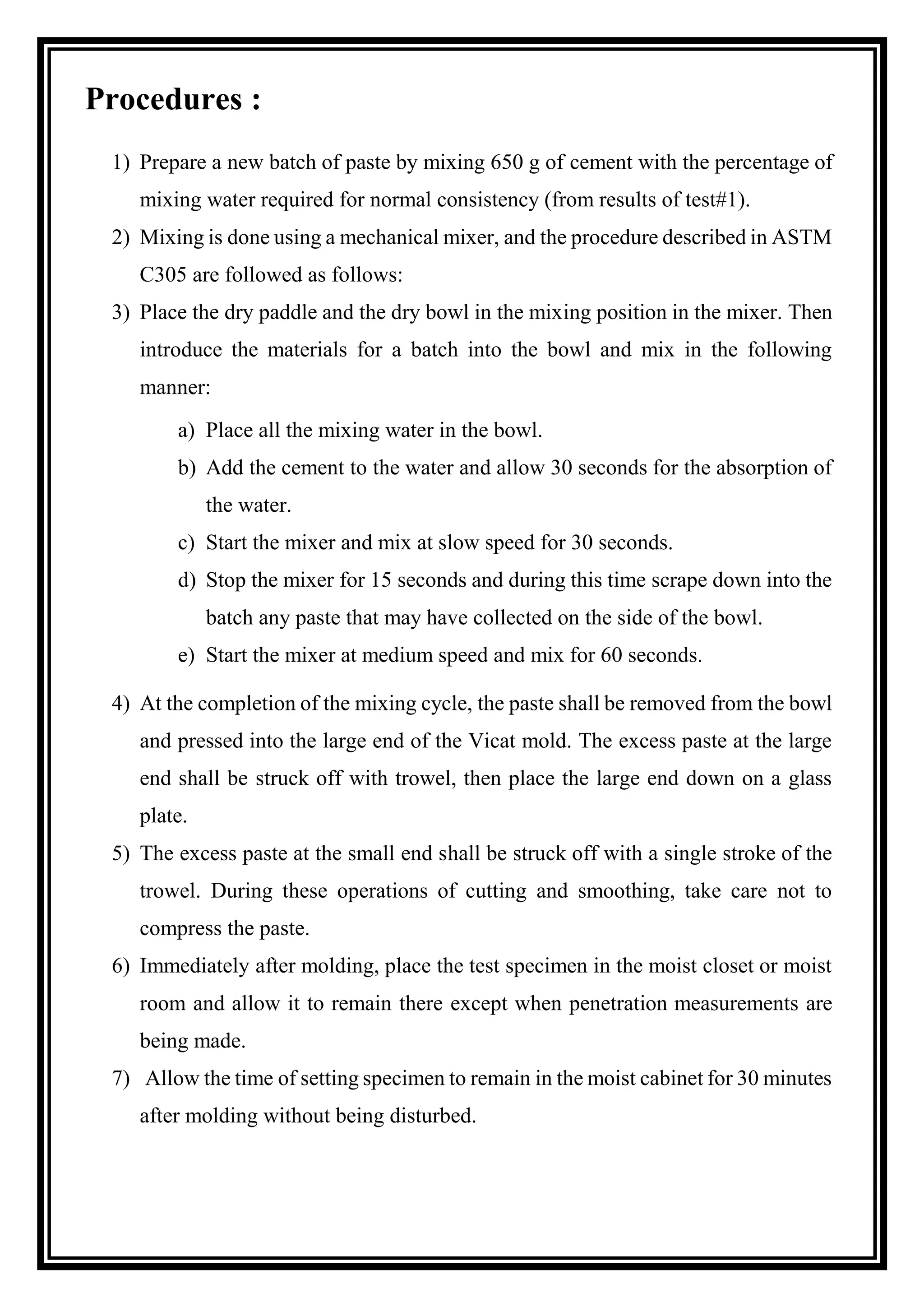
Initial setting time is that time period between the time water is added to
cement and time at which 1 mm square section needle fails to penetrate the
cement paste, placed in the Vicat’s mould 5 mm to 7 mm from the bottom
of the mould. and Final setting time is that time period between the time
water is added to cement and the time at which 1 mm needle makes an
impression on the paste in the mould but 5 mm attachment does not make
any impression. This test is carried out to find whether a cement sets at a
rate suitable for a particular work.
Purpose :
This test method provides a means of determining compliance with a
specification limit for Vicat time of setting.
Materials :
1) Potable water.
2) Ordinary Portland cement (OPC).
Equipment :
1) Sensitive balance .
2) Graduate cylinder .
3) Vicat apparatus (with a plunger of 300gm as a total weight and a
needle of 1 mm dia.) .
4) Vicat mold .
5) Mechanical Mixer.
6) Trowel .
7) Glass plate .
8) Stop Watch,
9) Hand covers (plastic gloves) .
Sketches :
Mixer Sensitive balance
Graduate Cylinder Vicat Apparatus and Vicat mold
G and Glass Plate
`
hand Cover Trowel Stop Watch
(Plastic Gloves)
Procedures :
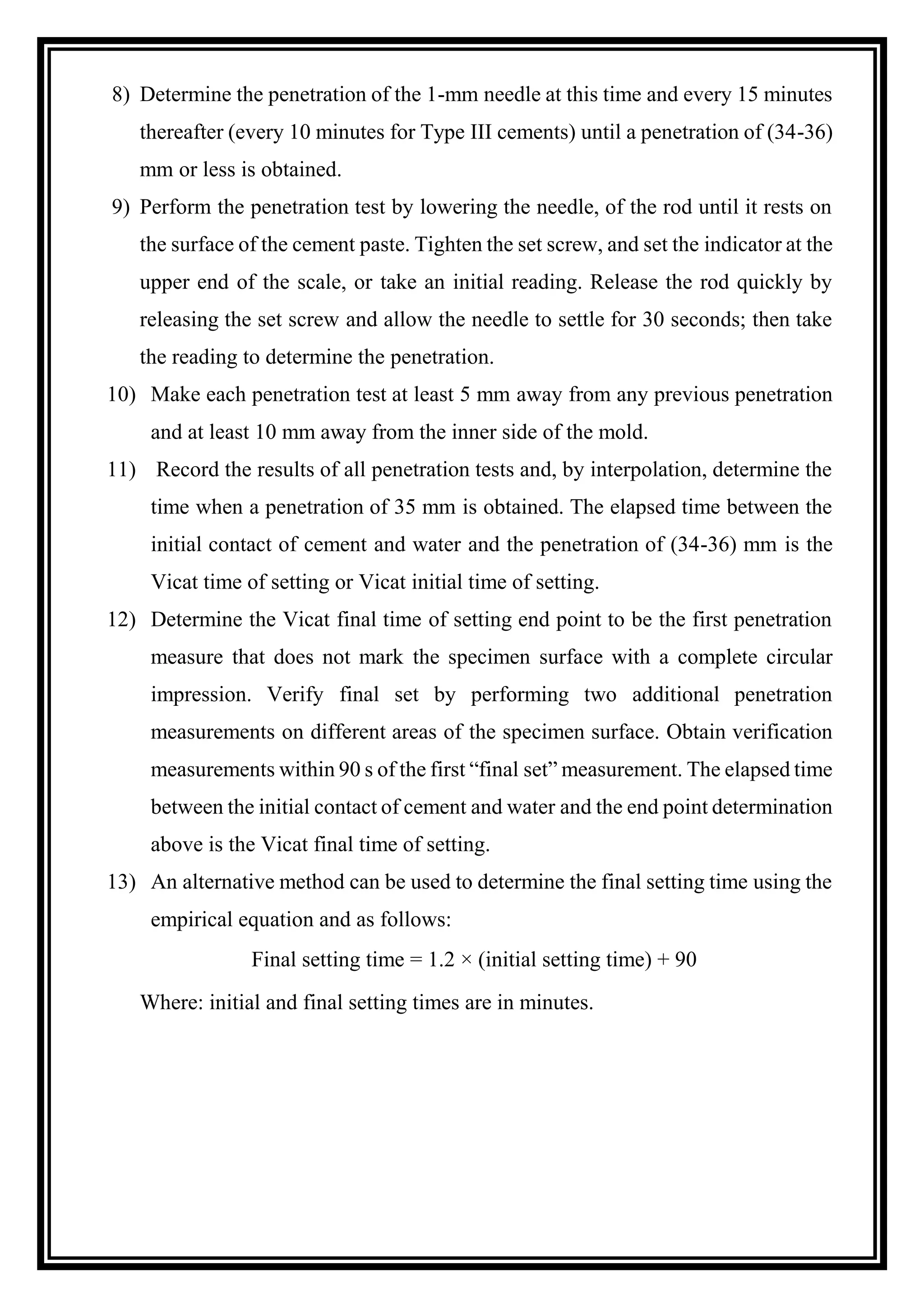
1) Prepare a new batch of paste by mixing 650 g of cement with the percentage of
mixing water required for normal consistency (from results of test#1).
2) Mixing is done using a mechanical mixer, and the procedure described in ASTM
C305 are followed as follows:
3) Place the dry paddle and the dry bowl in the mixing position in the mixer. Then
introduce the materials for a batch into the bowl and mix in the following
manner:
a) Place all the mixing water in the bowl.
b) Add the cement to the water and allow 30 seconds for the absorption of
the water.
c) Start the mixer and mix at slow speed for 30 seconds.
d) Stop the mixer for 15 seconds and during this time scrape down into the
batch any paste that may have collected on the side of the bowl.
e) Start the mixer at medium speed and mix for 60 seconds.
4) At the completion of the mixing cycle, the paste shall be removed from the bowl
and pressed into the large end of the Vicat mold. The excess paste at the large
end shall be struck off with trowel, then place the large end down on a glass
plate.
5) The excess paste at the small end shall be struck off with a single stroke of the
trowel. During these operations of cutting and smoothing, take care not to
compress the paste.
6) Immediately after molding, place the test specimen in the moist closet or moist
room and allow it to remain there except when penetration measurements are
being made.
7) Allow the time of setting specimen to remain in the moist cabinet for 30 minutes
after molding without being disturbed.
8) Determine the penetration of the 1-mm needle at this time and every 15 minutes
thereafter (every 10 minutes for Type III cements) until a penetration of (34-36)
mm or less is obtained.
9) Perform the penetration test by lowering the needle, of the rod until it rests on
the surface of the cement paste. Tighten the set screw, and set the indicator at the
upper end of the scale, or take an initial reading. Release the rod quickly by
releasing the set screw and allow the needle to settle for 30 seconds; then take
the reading to determine the penetration.
10) Make each penetration test at least 5 mm away from any previous penetration
and at least 10 mm away from the inner side of the mold.
11) Record the results of all penetration tests and, by interpolation, determine the
time when a penetration of 35 mm is obtained. The elapsed time between the
initial contact of cement and water and the penetration of (34-36) mm is the
Vicat time of setting or Vicat initial time of setting.
12) Determine the Vicat final time of setting end point to be the first penetration
measure that does not mark the specimen surface with a complete circular
impression. Verify final set by performing two additional penetration
measurements on different areas of the specimen surface. Obtain verification
measurements within 90 s of the first “final set” measurement. The elapsed time
between the initial contact of cement and water and the end point determination
above is the Vicat final time of setting.
13) An alternative method can be used to determine the final setting time using the
empirical equation and as follows:
Final setting time = 1.2 × (initial setting time) + 90
Where: initial and final setting times are in minutes.
Calculations and Results :
We can determine the initial setting time by using this formula :
Initial Setting time = Last time – First time
Where :
First time = Time at which water is first added to cement.
Last time = Time when needle fails to penetrate 5 mm to 7 mm
from bottom of the mould.
And final setting time can be calculated by using this formula :
Final setting time = 1.2 × (Initial setting time) + 90
Where : initial and final setting time in minutes.
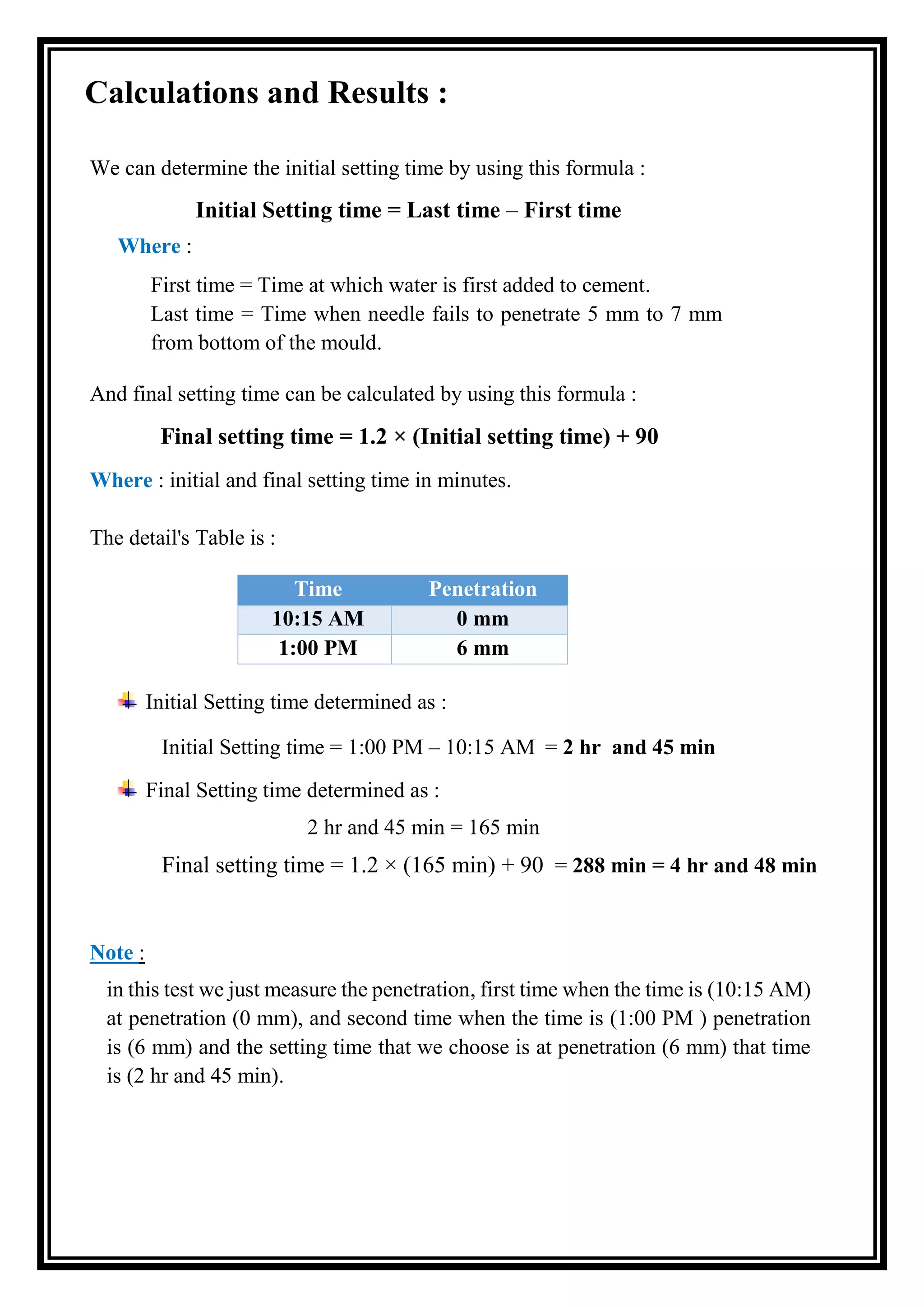
The detail's Table is :
Initial Setting time determined as :
Initial Setting time = 1:00 PM – 10:15 AM = 2 hr and 45 min
Final Setting time determined as :
2 hr and 45 min = 165 min
Final setting time = 1.2 × (165 min) + 90 = 288 min = 4 hr and 48 min
Note :
in this test we just measure the penetration, first time when the time is (10:15 AM)
at penetration (0 mm), and second time when the time is (1:00 PM ) penetration
is (6 mm) and the setting time that we choose is at penetration (6 mm) that time
is (2 hr and 45 min).
Time Penetration
10:15 AM 0 mm
1:00 PM 6 mm
Discussion and Conclusion :
In this test we determine the Initial and Final setting time for a sample
amount of Cement Paste, and finally we will get a result after doing all
procedure accurate which is two different penetrations in (mm), our
result are two penetration with different period time, when penetration is
(0 mm) at (10:15 AM) and when it is (6 mm) at (1:00 PM) and this result
show us the setting time which is ( 2 hr and 45 min) that we know by the
differences between two penetration's period time, in this test we just
measure two penetration which is (0 mm) and (6 mm ) it will be better
and accuracy if we measure some different penetration at another time
but we don’t have enough time to measure more penetration in
laboratory, if we have some errors in initial setting time then in final
setting time we will have some errors too, because we measure the final
setting time by using empirical equation which is related to initial setting
time, this result show us that our cement paste can be used in
construction without facing any problems when we work with it, if we
compare our result with Iraqi standard which is said " the initial siting
time doesn’t be less than ( 1 hour )" as show in our result which is greater
than the standard and it will be acceptable for using it, in this test we
have some errors one of them is we just use two penetration in
calculation and measure it, and another one is we didn’t measure
penetration after 30 second when the needle go down through the cement
paste in (Vicat mold) according to Iraqi Standard , we know that if we
do many tests of another amount of cement paste then the result will be
very accuracy.
In conclusion the purpose of this test is to determine the initial and final
setting time and compare the result with standard. then we measure the
penetration and get a best initial and final setting time of cement paste
and finally in this test we will know when the cement become hardened
or be able to resist whether condition in construction work.

Setting Time of Hydraulic Cement By Vicat Needle | Jameel Academy

  • 1.
    University of Duhok Collegeof Engineering Civil Department Concrete Technology – Practical Concrete Laboratory A Report About : Time of Setting of Hydraulic Cement by Vicat Needle Submitted By : Jameel Masoud Jameel Lab. No. : 2 Group Name : B1 Testing Date : 29 / 10 / 2017 Submitting Date : 5 / 11 / 2017 Supervised By : Youkhanna 2017 – 2018
  • 2.
    References : 1) ASTMC191-04 2) ASTM C305-99 Introduction : Initial setting time is that time period between the time water is added to cement and time at which 1 mm square section needle fails to penetrate the cement paste, placed in the Vicat’s mould 5 mm to 7 mm from the bottom of the mould. and Final setting time is that time period between the time water is added to cement and the time at which 1 mm needle makes an impression on the paste in the mould but 5 mm attachment does not make any impression. This test is carried out to find whether a cement sets at a rate suitable for a particular work.
  • 3.
    Purpose : This testmethod provides a means of determining compliance with a specification limit for Vicat time of setting. Materials : 1) Potable water. 2) Ordinary Portland cement (OPC). Equipment : 1) Sensitive balance . 2) Graduate cylinder . 3) Vicat apparatus (with a plunger of 300gm as a total weight and a needle of 1 mm dia.) . 4) Vicat mold . 5) Mechanical Mixer. 6) Trowel . 7) Glass plate . 8) Stop Watch, 9) Hand covers (plastic gloves) .
  • 4.
    Sketches : Mixer Sensitivebalance Graduate Cylinder Vicat Apparatus and Vicat mold G and Glass Plate ` hand Cover Trowel Stop Watch (Plastic Gloves)
  • 5.
    Procedures : 1) Preparea new batch of paste by mixing 650 g of cement with the percentage of mixing water required for normal consistency (from results of test#1). 2) Mixing is done using a mechanical mixer, and the procedure described in ASTM C305 are followed as follows: 3) Place the dry paddle and the dry bowl in the mixing position in the mixer. Then introduce the materials for a batch into the bowl and mix in the following manner: a) Place all the mixing water in the bowl. b) Add the cement to the water and allow 30 seconds for the absorption of the water. c) Start the mixer and mix at slow speed for 30 seconds. d) Stop the mixer for 15 seconds and during this time scrape down into the batch any paste that may have collected on the side of the bowl. e) Start the mixer at medium speed and mix for 60 seconds. 4) At the completion of the mixing cycle, the paste shall be removed from the bowl and pressed into the large end of the Vicat mold. The excess paste at the large end shall be struck off with trowel, then place the large end down on a glass plate. 5) The excess paste at the small end shall be struck off with a single stroke of the trowel. During these operations of cutting and smoothing, take care not to compress the paste. 6) Immediately after molding, place the test specimen in the moist closet or moist room and allow it to remain there except when penetration measurements are being made. 7) Allow the time of setting specimen to remain in the moist cabinet for 30 minutes after molding without being disturbed.
  • 6.
    8) Determine thepenetration of the 1-mm needle at this time and every 15 minutes thereafter (every 10 minutes for Type III cements) until a penetration of (34-36) mm or less is obtained. 9) Perform the penetration test by lowering the needle, of the rod until it rests on the surface of the cement paste. Tighten the set screw, and set the indicator at the upper end of the scale, or take an initial reading. Release the rod quickly by releasing the set screw and allow the needle to settle for 30 seconds; then take the reading to determine the penetration. 10) Make each penetration test at least 5 mm away from any previous penetration and at least 10 mm away from the inner side of the mold. 11) Record the results of all penetration tests and, by interpolation, determine the time when a penetration of 35 mm is obtained. The elapsed time between the initial contact of cement and water and the penetration of (34-36) mm is the Vicat time of setting or Vicat initial time of setting. 12) Determine the Vicat final time of setting end point to be the first penetration measure that does not mark the specimen surface with a complete circular impression. Verify final set by performing two additional penetration measurements on different areas of the specimen surface. Obtain verification measurements within 90 s of the first “final set” measurement. The elapsed time between the initial contact of cement and water and the end point determination above is the Vicat final time of setting. 13) An alternative method can be used to determine the final setting time using the empirical equation and as follows: Final setting time = 1.2 × (initial setting time) + 90 Where: initial and final setting times are in minutes.
  • 7.
    Calculations and Results: We can determine the initial setting time by using this formula : Initial Setting time = Last time – First time Where : First time = Time at which water is first added to cement. Last time = Time when needle fails to penetrate 5 mm to 7 mm from bottom of the mould. And final setting time can be calculated by using this formula : Final setting time = 1.2 × (Initial setting time) + 90 Where : initial and final setting time in minutes. The detail's Table is : Initial Setting time determined as : Initial Setting time = 1:00 PM – 10:15 AM = 2 hr and 45 min Final Setting time determined as : 2 hr and 45 min = 165 min Final setting time = 1.2 × (165 min) + 90 = 288 min = 4 hr and 48 min Note : in this test we just measure the penetration, first time when the time is (10:15 AM) at penetration (0 mm), and second time when the time is (1:00 PM ) penetration is (6 mm) and the setting time that we choose is at penetration (6 mm) that time is (2 hr and 45 min). Time Penetration 10:15 AM 0 mm 1:00 PM 6 mm
  • 8.
    Discussion and Conclusion: In this test we determine the Initial and Final setting time for a sample amount of Cement Paste, and finally we will get a result after doing all procedure accurate which is two different penetrations in (mm), our result are two penetration with different period time, when penetration is (0 mm) at (10:15 AM) and when it is (6 mm) at (1:00 PM) and this result show us the setting time which is ( 2 hr and 45 min) that we know by the differences between two penetration's period time, in this test we just measure two penetration which is (0 mm) and (6 mm ) it will be better and accuracy if we measure some different penetration at another time but we don’t have enough time to measure more penetration in laboratory, if we have some errors in initial setting time then in final setting time we will have some errors too, because we measure the final setting time by using empirical equation which is related to initial setting time, this result show us that our cement paste can be used in construction without facing any problems when we work with it, if we compare our result with Iraqi standard which is said " the initial siting time doesn’t be less than ( 1 hour )" as show in our result which is greater than the standard and it will be acceptable for using it, in this test we have some errors one of them is we just use two penetration in calculation and measure it, and another one is we didn’t measure penetration after 30 second when the needle go down through the cement paste in (Vicat mold) according to Iraqi Standard , we know that if we do many tests of another amount of cement paste then the result will be very accuracy. In conclusion the purpose of this test is to determine the initial and final setting time and compare the result with standard. then we measure the penetration and get a best initial and final setting time of cement paste and finally in this test we will know when the cement become hardened or be able to resist whether condition in construction work.