CONSTRUCTION
MATERIALS and
CONCRETE
BARAN ARSLAN - 20519522
AYÇA ŞEKER - 20772831
SERKAN KOÇ - 20519814
T.GİZEM AKSOY - 20519497
A.DİLEK SAYINTA- 20519981
Outline
 CONCRETE
1-What is concrete?
2-Composition of concrete
a) Water
b) Aggregates
c) Reinforcement
d) Chemical admixtures
e) Cement
3-Concrete production
a) Mixing Concrete
b) Workability
c) Curing
4-Properties of Concrete
5-Types of Concrete
6-Concrete Testing
7-Concrete Recycling
 CONSTRUCTION MATERIALS
a) Asphalt
b) Aggregate
c) Brick
d) Gypsum
 References
Outline continued
CONCRETE
WHAT IS CONCRETE?
 Construction material
 Mixture of portland cement, water, aggregates,
and in some cases, admixtures.
 The cement and water form a paste that hardens
and bonds the aggregates together.
 Often looked upon as “man made rock”.
 Versatile construction material, adaptable to a wide variety of
agricultural and residential uses.
 Strong, durable, versatile, and economical.
http://www.inlandcanada.com/NR/rdonlyres/F0EBC912-01A0-4D58-AE7D-
6F9FD7DE0FF7/0/ConcreteRecycler3.jpg
CONCRETE
 Can be placed or molded into virtually any shape and
reproduce any surface texture.
 The most widely used construction material in the world.
 In the United States almost twice as much concrete is used as
all other construction materials combined.
 The ready-mix concrete producer has made concrete an
appropriate construction material for many applications.
Composition of concrete
 Water
 Aggregates
 Chemical admixtures
 Cement
http://www.bu.edu/sjmag/scimag2008/images/Texture__Concrete
_Cracked_by_ivelt_resources.jpg
WATER
 Good water is essential for quality concrete.
 Should be good enough to drink--free
of trash, organic matter and excessive
chemicals and/or minerals.
 The strength and other properties of
concrete are highly dependent on the
amount of water and the water-cement ratio.
http://pure-perfection.net/custom/Water-Droplet-1039X761.jpg
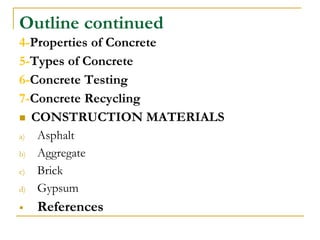
AGGREGATES
 Aggregates occupy 60 to 80 percent of the
volume of concrete.
 Sand, gravel and crushed stone are the
primary aggregates used.
 All aggregates must be essentially free
of silt and/or organic matter.
http://www.bondedaggregate.co.uk/images/select-aggregate-
driveway.jpg
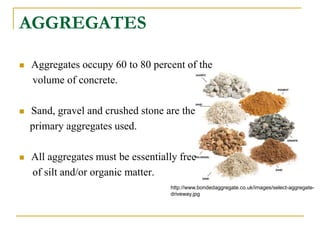
CHEMİCAL ADMİXTURES
 Materials in the form of powder or fluids that are added to the
concrete to give it certain characteristics not obtainable with
plain concrete mixes.
 In normal use, admixture dosages
are less than 5% by mass of cement,
and are added to the concrete at the
time of batching/mixing. http://www.cca.org.nz/images/admixtures1.jpg
CHEMİCAL ADMİXTURES
The most common types of admixtures are:
 Accelerators :
- Speed up the hydration (hardening) of the concrete.
- Typical materials used are CaCl2 and NaCl.
 Acrylic retarders :
-Slow the hydration of concrete, and are used in large or
difficult pours.
- Typical retarder is table sugar, or sucrose (C12H22O11).
CHEMICAL ADMIXTURES
 Air Entraining agents:
-The most commonly used admixtures for agricultural
concrete.
-Produce microscopic air bubbles throughout the concrete.
-Entrained air bubbles:
 Improve the durability of concrete exposed to
moisture and freeze/thaw action.
 Improve resistance to scaling from deicers and
corrosive agents such as manure or silage.
CHEMICAL ADMIXTURES
 Water-reducing admixtures
-Increase the workability of plastic or "fresh" concrete,
allowing it be placed more easily, with less consolidating
effort.
-High-range water-reducing admixtures are a class of
water-reducing admixtures
 Increase workability
 Reduce the water content of a concrete.
 Improves its strength and durability characteristics.
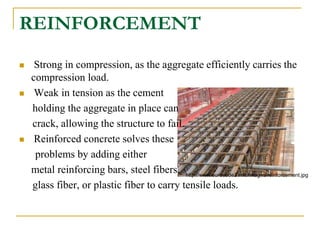
REINFORCEMENT
 Strong in compression, as the aggregate efficiently carries the
compression load.
 Weak in tension as the cement
holding the aggregate in place can
crack, allowing the structure to fail.
 Reinforced concrete solves these
problems by adding either
metal reinforcing bars, steel fibers,
glass fiber, or plastic fiber to carry tensile loads.
http://www.eurocode2.info/images/reinforcement.jpg
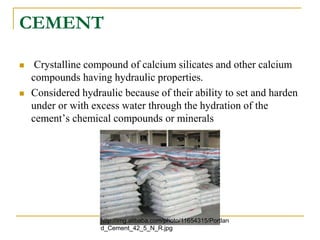
CEMENT
 Crystalline compound of calcium silicates and other calcium
compounds having hydraulic properties.
 Considered hydraulic because of their ability to set and harden
under or with excess water through the hydration of the
cement’s chemical compounds or minerals
http://img.alibaba.com/photo/11654315/Portlan
d_Cement_42_5_N_R.jpg
CEMENT
 Uses
Main use is in the fabrication of concrete and mortars
 Modern uses
-Building (floors, beams, columns, roofing, piles, bricks,
mortar, panels, plaster)
-Transport (roads, pathways, crossings, bridges, viaducts,
tunnels, parking, etc.)
-Water (pipes, drains, canals, dams, tanks, pools, etc.)
-Civil (piers, docks, retaining walls, silos, warehousing,
poles, pylons, fencing)
-Agriculture (buildings, processing, housing, irrigation)
CEMENT
 HYDRAULIC CEMENTS:
 Hydraulic lime: Only used in specialized mortars. Made
from calcination of clay-rich limestones.
 Natural cements: Misleadingly called Roman. It is made
from argillaceous limestones or interbedded limestone and
clay or shale, with few raw materials. Because they were
found to be inferior to portland, most plants switched.
 Portland cement: Artificial cement. Made by the mixing
clinker with gypsum in a 95:5 ratio.
CEMENT
 Portland-limestone cements: Large amounts (6% to
35%) of ground limestone have been added as a filler to a
portland cement base.
 Blended cements: Mix of portland cement with one or
more SCM (supplementary cemetitious materials) like
pozzolanic additives.
 Pozzolan-lime cements: Original Roman cements. Only a
small quantity is manufactured in the U.S. Mix of pozzolans
with lime.
CEMENT
 Masonry cements: Portland cement where other
materials have been added primarily to impart plasticity.
 Aluminous cements: Limestones and bauxite are the
main raw materials. Used for refractory applications (such as
cementing furnace bricks) and certain applications where rapid
hardening is required. It is more expensive than portland.
There is only one producing facility in the U.S.
PORTLAND CEMENT
 Most active component of concrete
 The greatest unit cost in concrete,
 Its selection and proper use are
important in obtaining most
economically the balance of properties
desired for any particular concrete mixture.
http://www.cement.org/decorative/images/overview2.jpg
PORTLAND CEMENT
 The production process for portland cement first involves
grinding limestone or chalk and alumina and silica from shale
or clay.
 Type I/II portland cements are the most popular cements used
by concrete producers
-Type I cement is the general purpose cement and most
common type. Unless an alternative is specified, Type I is
usually used.
-Type II cement releases less heat during hardening. It is
more suitable for projects involving large masses of concrete--
heavy retaining walls
Types of Portland cement
Cement
type
Use
I1 General purpose cement, when there are no extenuating
conditions
II2 Aids in providing moderate resistance to sulfate attack
III When high-early strength is required
IV3 When a low heat of hydration is desired (in massive
structures)
V4 When high sulfate resistance is required
IA4 A type I cement containing an integral air-entraining agent
IIA4 A type II cement containing an integral air-entraining agent
IIIA4 A type III cement containing an integral air-entraining agent
PORTLAND CEMENT
Physical Properties of Portland Cements
1) Fineness,
2) Soundness
3) Consistency
4) Setting time
5) Compressive strength
6) Heat of hydration
7) Loss of ignition
Concrete production
 This process develops physical and chemical properties like
mechanical strength, low moisture permeability, and chemical
and volumetric stability.
A properly proportioned concrete mix will provide
 Mixing concrete
 Workability
 Curing
Mixing concrete
 Essential for
I. The production of uniform concrete,
II. High quality concrete.
 Equipment and methods should be capable
of effectively mixing
http://en.yujianjx.com/upload/Concrete-Mixing-Plants-HZS50.jpg
Workability
 The ease with which freshly mixed concrete can be placed and
finished without segregation.
 Difficult to measure but ready-mix companies usually have
experience in determining the proper mix.
 Important to accurately describe what the concrete is to be
used for, and how it will be placed.
Curing
 Concrete that has been specified, batched, mixed, placed, and
finished "letter-perfect" can still be a failure if improperly or
inadequately cured.
 Usually the last step in a concrete
project and, unfortunately,
is often neglected even by professionals.
http://www.eagleind.com/piclib/324.jpg
Curing
 Curing has a major influence on the properties of hardened
concrete such as durability, strength, water-tightness, wear
resistance, volume stability, and resistance to freezing and
thawing.
 Proper concrete curing for agricultural and residential
applications involves keeping newly placed concrete moist and
avoiding temperature extremes (above 90°F or below 50°F)
for at least three days.
 A seven-day (or longer) curing time is recommended.
Curing
 The best curing method depends on:
 Cost,
 Application equipment required,
 Materials available,
 Size and shape of the concrete surface.
 Prevent the loss of the mixing water from concrete by sealing
the surface.
 Can be done by:
 Covering the concrete with impervious paper or plastic
sheets,
 Applying membrane-forming curing compounds.
Curing
 Begin the curing as soon as the concrete has hardened
sufficiently to avoid erosion or other damage to the freshly
finished surface.
 Usually within one to two hours after placement and finishing.
http://epg.modot.mo.gov/files/thumb/b/b2/1055.jpg/400px-
1055.jpg
Properties of concrete
 Strength
 Elasticity
 Cracking
 Shrinkage cracking
 Tension cracking
Strength
Concrete has relatively
 High compressive strength,
 Low tensile strength
 Fair to assume that a concrete sample's tensile strength is about
10%-15% of its compressive strength
 The ultimate strength of concrete is influenced by
- water-cementitious ratio
-the design constituents
- the mixing
-placement
-curing methods
Elasticity
 Function of the modulus of elasticity of the aggregates and the
cement matrix and their relative proportions
 The American Concrete Institute allows the modulus of
elasticity to be calculated using the following equation:
where
wc = weight of concrete (pounds per cubic foot) and where
f'c = compressive strength of concrete at 28 days (psi)
Cracking
 All concrete structures will crack to some extent.
 Cracks due to tensile stress induced by shrinkage or stresses
occurring during setting or use
http://www.hughpearman.com/2007/illustrat
ions/shibboleth01.jpg
Shrinkage cracking
 Occur when concrete members undergo restrained volumetric
changes (shrinkage) as a result of either drying, autogenous
shrinkage or thermal effects.
 The number and width of shrinkage
cracks that develop are influenced by
-the amount of shrinkage that occurs
-the amount of restraint present
-the amount and spacing of reinforcement provided.
http://epg.modot.org/files/thumb/3/39/216_Removal_of_existing_expan
sion_joint.jpg/550px-216_Removal_of_existing_expansion_joint.jpg
Tension cracking
 Most common in concrete beams where a transversely applied
load will put one surface into compression and the opposite
surface into tension due to induced bending.
 The size and length of cracks is dependent on
- The magnitude of the bending moment
- The design of the reinforcing in the beam at the point
under consideration.
Types of concrete
 Regular concrete
 High-strength concrete
 Stamped concrete
 High-performance concrete
 Self-consolidating concretes
 Vacuum concretes
 Shotcrete
 Pervious concrete
 Cellular concrete,
 Cork-cement composites
 Roller-compacted concrete
 Glass concrete
 Asphalt concrete
 Rapid strength concrete
 Rubberized concrete
 Polymer concrete
 Geopolymer or green concrete
 Limecrete
 Refractory Cement
 Concrete cloth
 Innovative mixtures
 Gypsum concrete
Concrete testing
Compression testing of a concrete cylinder
Same cylinder after failure
http://www.antouncivil.com.au/vca/Images/testing.jpg
http://www.concrete-curb.com/wp-
content/uploads/BreakageCylinder.jpg
General test methods
 Compaction Factor Test (Compacting Factor Test, Glanville)
 Compaction Test
 Free Orifice Test (Orimet Test)
 K-Slump Tester
 Free Flow Test Methods
 Slump Test
 Modified Slump Test
 Slump Rate Machine
 Kelly Ball Test
 Ring Penetration Test
 Cone Penetration Test
 Moving Sphere Viscometer
 Flow Trough Test
 Delivery-Chute Torque Meter
 Delivery-Chute Depth Meter
 Surface Settlement Test
Concrete recycling
 increasingly common method of disposing of concrete
structures
 recycling is increasing due to
-improved environmental awareness
- governmental laws
-economic benefits
 Recycling concrete provides
-environmental benefits
-conserving landfill space

ConstructionMaterials.ppt

  • 1.
    CONSTRUCTION MATERIALS and CONCRETE BARAN ARSLAN- 20519522 AYÇA ŞEKER - 20772831 SERKAN KOÇ - 20519814 T.GİZEM AKSOY - 20519497 A.DİLEK SAYINTA- 20519981
  • 2.
    Outline  CONCRETE 1-What isconcrete? 2-Composition of concrete a) Water b) Aggregates c) Reinforcement d) Chemical admixtures e) Cement 3-Concrete production a) Mixing Concrete b) Workability c) Curing
  • 3.
    4-Properties of Concrete 5-Typesof Concrete 6-Concrete Testing 7-Concrete Recycling  CONSTRUCTION MATERIALS a) Asphalt b) Aggregate c) Brick d) Gypsum  References Outline continued
  • 4.
    CONCRETE WHAT IS CONCRETE? Construction material  Mixture of portland cement, water, aggregates, and in some cases, admixtures.  The cement and water form a paste that hardens and bonds the aggregates together.  Often looked upon as “man made rock”.  Versatile construction material, adaptable to a wide variety of agricultural and residential uses.  Strong, durable, versatile, and economical. http://www.inlandcanada.com/NR/rdonlyres/F0EBC912-01A0-4D58-AE7D- 6F9FD7DE0FF7/0/ConcreteRecycler3.jpg
  • 5.
    CONCRETE  Can beplaced or molded into virtually any shape and reproduce any surface texture.  The most widely used construction material in the world.  In the United States almost twice as much concrete is used as all other construction materials combined.  The ready-mix concrete producer has made concrete an appropriate construction material for many applications.
  • 6.
    Composition of concrete Water  Aggregates  Chemical admixtures  Cement http://www.bu.edu/sjmag/scimag2008/images/Texture__Concrete _Cracked_by_ivelt_resources.jpg
  • 7.
    WATER  Good wateris essential for quality concrete.  Should be good enough to drink--free of trash, organic matter and excessive chemicals and/or minerals.  The strength and other properties of concrete are highly dependent on the amount of water and the water-cement ratio. http://pure-perfection.net/custom/Water-Droplet-1039X761.jpg
  • 8.
    AGGREGATES  Aggregates occupy60 to 80 percent of the volume of concrete.  Sand, gravel and crushed stone are the primary aggregates used.  All aggregates must be essentially free of silt and/or organic matter. http://www.bondedaggregate.co.uk/images/select-aggregate- driveway.jpg
  • 9.
    CHEMİCAL ADMİXTURES  Materialsin the form of powder or fluids that are added to the concrete to give it certain characteristics not obtainable with plain concrete mixes.  In normal use, admixture dosages are less than 5% by mass of cement, and are added to the concrete at the time of batching/mixing. http://www.cca.org.nz/images/admixtures1.jpg
  • 10.
    CHEMİCAL ADMİXTURES The mostcommon types of admixtures are:  Accelerators : - Speed up the hydration (hardening) of the concrete. - Typical materials used are CaCl2 and NaCl.  Acrylic retarders : -Slow the hydration of concrete, and are used in large or difficult pours. - Typical retarder is table sugar, or sucrose (C12H22O11).
  • 11.
    CHEMICAL ADMIXTURES  AirEntraining agents: -The most commonly used admixtures for agricultural concrete. -Produce microscopic air bubbles throughout the concrete. -Entrained air bubbles:  Improve the durability of concrete exposed to moisture and freeze/thaw action.  Improve resistance to scaling from deicers and corrosive agents such as manure or silage.
  • 12.
    CHEMICAL ADMIXTURES  Water-reducingadmixtures -Increase the workability of plastic or "fresh" concrete, allowing it be placed more easily, with less consolidating effort. -High-range water-reducing admixtures are a class of water-reducing admixtures  Increase workability  Reduce the water content of a concrete.  Improves its strength and durability characteristics.
  • 13.
    REINFORCEMENT  Strong incompression, as the aggregate efficiently carries the compression load.  Weak in tension as the cement holding the aggregate in place can crack, allowing the structure to fail.  Reinforced concrete solves these problems by adding either metal reinforcing bars, steel fibers, glass fiber, or plastic fiber to carry tensile loads. http://www.eurocode2.info/images/reinforcement.jpg
  • 14.
    CEMENT  Crystalline compoundof calcium silicates and other calcium compounds having hydraulic properties.  Considered hydraulic because of their ability to set and harden under or with excess water through the hydration of the cement’s chemical compounds or minerals http://img.alibaba.com/photo/11654315/Portlan d_Cement_42_5_N_R.jpg
  • 15.
    CEMENT  Uses Main useis in the fabrication of concrete and mortars  Modern uses -Building (floors, beams, columns, roofing, piles, bricks, mortar, panels, plaster) -Transport (roads, pathways, crossings, bridges, viaducts, tunnels, parking, etc.) -Water (pipes, drains, canals, dams, tanks, pools, etc.) -Civil (piers, docks, retaining walls, silos, warehousing, poles, pylons, fencing) -Agriculture (buildings, processing, housing, irrigation)
  • 16.
    CEMENT  HYDRAULIC CEMENTS: Hydraulic lime: Only used in specialized mortars. Made from calcination of clay-rich limestones.  Natural cements: Misleadingly called Roman. It is made from argillaceous limestones or interbedded limestone and clay or shale, with few raw materials. Because they were found to be inferior to portland, most plants switched.  Portland cement: Artificial cement. Made by the mixing clinker with gypsum in a 95:5 ratio.
  • 17.
    CEMENT  Portland-limestone cements:Large amounts (6% to 35%) of ground limestone have been added as a filler to a portland cement base.  Blended cements: Mix of portland cement with one or more SCM (supplementary cemetitious materials) like pozzolanic additives.  Pozzolan-lime cements: Original Roman cements. Only a small quantity is manufactured in the U.S. Mix of pozzolans with lime.
  • 18.
    CEMENT  Masonry cements:Portland cement where other materials have been added primarily to impart plasticity.  Aluminous cements: Limestones and bauxite are the main raw materials. Used for refractory applications (such as cementing furnace bricks) and certain applications where rapid hardening is required. It is more expensive than portland. There is only one producing facility in the U.S.
  • 19.
    PORTLAND CEMENT  Mostactive component of concrete  The greatest unit cost in concrete,  Its selection and proper use are important in obtaining most economically the balance of properties desired for any particular concrete mixture. http://www.cement.org/decorative/images/overview2.jpg
  • 20.
    PORTLAND CEMENT  Theproduction process for portland cement first involves grinding limestone or chalk and alumina and silica from shale or clay.  Type I/II portland cements are the most popular cements used by concrete producers -Type I cement is the general purpose cement and most common type. Unless an alternative is specified, Type I is usually used. -Type II cement releases less heat during hardening. It is more suitable for projects involving large masses of concrete-- heavy retaining walls
  • 21.
    Types of Portlandcement Cement type Use I1 General purpose cement, when there are no extenuating conditions II2 Aids in providing moderate resistance to sulfate attack III When high-early strength is required IV3 When a low heat of hydration is desired (in massive structures) V4 When high sulfate resistance is required IA4 A type I cement containing an integral air-entraining agent IIA4 A type II cement containing an integral air-entraining agent IIIA4 A type III cement containing an integral air-entraining agent
  • 22.
    PORTLAND CEMENT Physical Propertiesof Portland Cements 1) Fineness, 2) Soundness 3) Consistency 4) Setting time 5) Compressive strength 6) Heat of hydration 7) Loss of ignition
  • 23.
    Concrete production  Thisprocess develops physical and chemical properties like mechanical strength, low moisture permeability, and chemical and volumetric stability. A properly proportioned concrete mix will provide  Mixing concrete  Workability  Curing
  • 24.
    Mixing concrete  Essentialfor I. The production of uniform concrete, II. High quality concrete.  Equipment and methods should be capable of effectively mixing http://en.yujianjx.com/upload/Concrete-Mixing-Plants-HZS50.jpg
  • 25.
    Workability  The easewith which freshly mixed concrete can be placed and finished without segregation.  Difficult to measure but ready-mix companies usually have experience in determining the proper mix.  Important to accurately describe what the concrete is to be used for, and how it will be placed.
  • 26.
    Curing  Concrete thathas been specified, batched, mixed, placed, and finished "letter-perfect" can still be a failure if improperly or inadequately cured.  Usually the last step in a concrete project and, unfortunately, is often neglected even by professionals. http://www.eagleind.com/piclib/324.jpg
  • 27.
    Curing  Curing hasa major influence on the properties of hardened concrete such as durability, strength, water-tightness, wear resistance, volume stability, and resistance to freezing and thawing.  Proper concrete curing for agricultural and residential applications involves keeping newly placed concrete moist and avoiding temperature extremes (above 90°F or below 50°F) for at least three days.  A seven-day (or longer) curing time is recommended.
  • 28.
    Curing  The bestcuring method depends on:  Cost,  Application equipment required,  Materials available,  Size and shape of the concrete surface.  Prevent the loss of the mixing water from concrete by sealing the surface.  Can be done by:  Covering the concrete with impervious paper or plastic sheets,  Applying membrane-forming curing compounds.
  • 29.
    Curing  Begin thecuring as soon as the concrete has hardened sufficiently to avoid erosion or other damage to the freshly finished surface.  Usually within one to two hours after placement and finishing. http://epg.modot.mo.gov/files/thumb/b/b2/1055.jpg/400px- 1055.jpg
  • 30.
    Properties of concrete Strength  Elasticity  Cracking  Shrinkage cracking  Tension cracking
  • 31.
    Strength Concrete has relatively High compressive strength,  Low tensile strength  Fair to assume that a concrete sample's tensile strength is about 10%-15% of its compressive strength  The ultimate strength of concrete is influenced by - water-cementitious ratio -the design constituents - the mixing -placement -curing methods
  • 32.
    Elasticity  Function ofthe modulus of elasticity of the aggregates and the cement matrix and their relative proportions  The American Concrete Institute allows the modulus of elasticity to be calculated using the following equation: where wc = weight of concrete (pounds per cubic foot) and where f'c = compressive strength of concrete at 28 days (psi)
  • 33.
    Cracking  All concretestructures will crack to some extent.  Cracks due to tensile stress induced by shrinkage or stresses occurring during setting or use http://www.hughpearman.com/2007/illustrat ions/shibboleth01.jpg
  • 34.
    Shrinkage cracking  Occurwhen concrete members undergo restrained volumetric changes (shrinkage) as a result of either drying, autogenous shrinkage or thermal effects.  The number and width of shrinkage cracks that develop are influenced by -the amount of shrinkage that occurs -the amount of restraint present -the amount and spacing of reinforcement provided. http://epg.modot.org/files/thumb/3/39/216_Removal_of_existing_expan sion_joint.jpg/550px-216_Removal_of_existing_expansion_joint.jpg
  • 35.
    Tension cracking  Mostcommon in concrete beams where a transversely applied load will put one surface into compression and the opposite surface into tension due to induced bending.  The size and length of cracks is dependent on - The magnitude of the bending moment - The design of the reinforcing in the beam at the point under consideration.
  • 36.
    Types of concrete Regular concrete  High-strength concrete  Stamped concrete  High-performance concrete  Self-consolidating concretes  Vacuum concretes  Shotcrete  Pervious concrete  Cellular concrete,  Cork-cement composites  Roller-compacted concrete  Glass concrete  Asphalt concrete  Rapid strength concrete  Rubberized concrete  Polymer concrete  Geopolymer or green concrete  Limecrete  Refractory Cement  Concrete cloth  Innovative mixtures  Gypsum concrete
  • 37.
    Concrete testing Compression testingof a concrete cylinder Same cylinder after failure http://www.antouncivil.com.au/vca/Images/testing.jpg http://www.concrete-curb.com/wp- content/uploads/BreakageCylinder.jpg
  • 38.
    General test methods Compaction Factor Test (Compacting Factor Test, Glanville)  Compaction Test  Free Orifice Test (Orimet Test)  K-Slump Tester  Free Flow Test Methods  Slump Test  Modified Slump Test  Slump Rate Machine  Kelly Ball Test  Ring Penetration Test  Cone Penetration Test  Moving Sphere Viscometer  Flow Trough Test  Delivery-Chute Torque Meter  Delivery-Chute Depth Meter  Surface Settlement Test
  • 39.
    Concrete recycling  increasinglycommon method of disposing of concrete structures  recycling is increasing due to -improved environmental awareness - governmental laws -economic benefits  Recycling concrete provides -environmental benefits -conserving landfill space