16 February 2024
Unit Operation –
Cement Technology
GIRISH KUMAR
Content
 Cement manufacture at a glance
 Quarrying raw materials
 Crushing
 Prehomogenization and raw meal grinding
 Preheating
 Precalcining
 Clinker production in the rotary kiln
 Cooling and storing
 Blending
 Cement grinding
 Storing in the cement silo
 Cement Dispatch
Cement manufacture at a glance
Cement is a man-made powder that, when mixed with
water and
aggregates, produces concrete.
The cement-making process can be divided into two basic
steps:
1. Clinker is made in the kiln at temperatures of
1,4SO”C.
2. Clinker is then ground with other minerals to produce
the powder we know as cement
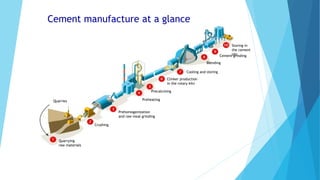
Cement manufacture at a glance
Quarries
Quarrying
raw materials
Crushing
Prehomogenization
and raw meal grinding
Preheating
Precalcining
Clinker production
in the rotary kiln
Cooling and storing
Blending
Cement grinding
Storing in
the cement
silo
Quarrying raw materials
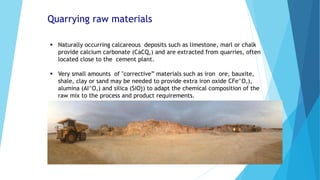
 Naturally occurring calcareous deposits such as limestone, marl or chalk
provide calcium carbonate (CaCQ,) and are extracted from quarries, often
located close to the cement plant.
 Very small amounts of "corrective” materials such as iron ore, bauxite,
shale, clay or sand may be needed to provide extra iron oxide CFe^O,),
alumina (AI^O,) and silica (SiOj) to adapt the chemical composition of the
raw mix to the process and product requirements.
Crushing
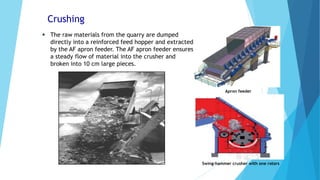
 The raw materials from the quarry are dumped
directly into a reinforced feed hopper and extracted
by the AF apron feeder. The AF apron feeder ensures
a steady flow of material into the crusher and
broken into 10 cm large pieces.
Swing-hammer crusher with one rotors
Apron feeder
Prehomogenization and raw meal grinding
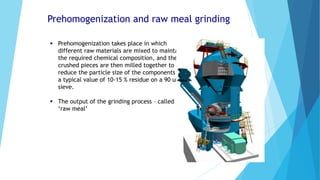
 Prehomogenization takes place in which
different raw materials are mixed to maintain
the required chemical composition, and the
crushed pieces are then milled together to
reduce the particle size of the components to
a typical value of 10-15 % residue on a 90 um
sieve.
 The output of the grinding process – called
‘raw meal’
Preheating
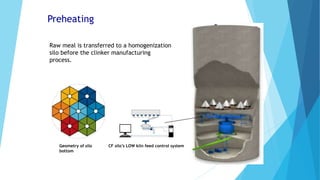
Raw meal is transferred to a homogenization
silo before the clinker manufacturing
process.
Geometry of silo
bottom
CF silo’s LOW kiln feed control system
Preheating
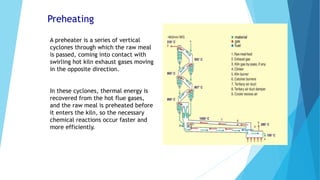
A preheater is a series of vertical
cyclones through which the raw meal
is passed, coming into contact with
swirling hot kiln exhaust gases moving
in the opposite direction.
In these cyclones, thermal energy is
recovered from the hot flue gases,
and the raw meal is preheated before
it enters the kiln, so the necessary
chemical reactions occur faster and
more efficiently.
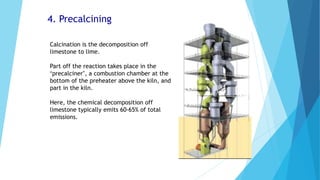
4. Precalcining
Calcination is the decomposition off
limestone to lime.
Part off the reaction takes place in the
‘precalciner", a combustion chamber at the
bottom of the preheater above the kiln, and
part in the kiln.
Here, the chemical decomposition off
limestone typically emits 60-65% of total
emissions.
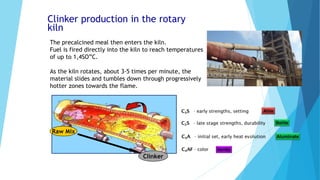
Clinker production in the rotary
kiln
The precalcined meal then enters the kiln.
Fuel is fired directly into the kiln to reach temperatures
of up to 1,4SO”C.
As the kiln rotates, about 3-5 times per minute, the
material slides and tumbles down through progressively
hotter zones towards the flame.
Raw Mix
Clinker
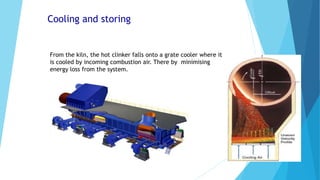
Cooling and storing
From the kiln, the hot clinker falls onto a grate cooler where it
is cooled by incoming combustion air. There by minimising
energy loss from the system.
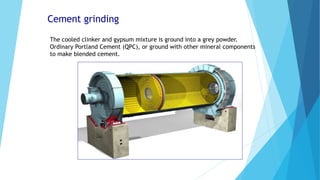
Cement grinding
The cooled clinker and gypsum mixture is ground into a grey powder.
Ordinary Portland Cement (QPC), or ground with other mineral components
to make blended cement.
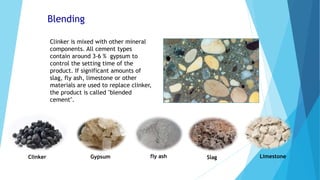
Blending
Clinker is mixed with other mineral
components. All cement types
contain around 3-6 % gypsum to
control the setting time of the
product. If significant amounts of
slag, fly ash, limestone or other
materials are used to replace clinker,
the product is called "blended
cement".
Gypsum
Clinker fly ash Limestone
Slag
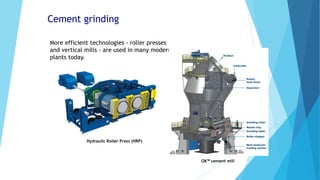
Cement grinding
More efficient technologies - roller presses
and vertical mills - are used in many modern
plants today.
Hydraulic Roller Press (HRP)
OK™ cement mill
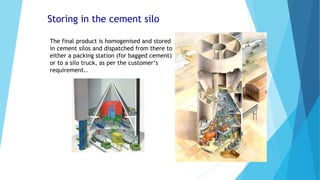
Storing in the cement silo
The final product is homogenised and stored
in cement silos and dispatched from there to
either a packing station (for bagged cement)
or to a silo truck, as per the customer‘s
requirement..
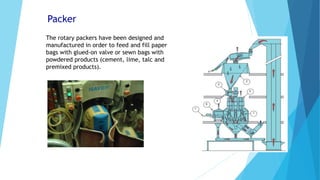
Packer
The rotary packers have been designed and
manufactured in order to feed and fill paper
bags with glued-on valve or sewn bags with
powdered products (cement, lime, talc and
premixed products).
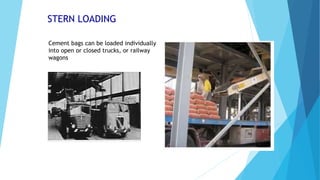
STERN LOADING
Cement bags can be loaded individually
into open or closed trucks, or railway
wagons
Cement Bags
 Cement has a limited storage life when packed in bags. Bags are vulnerable
to water vapour and will absorb moisture if exposed to rain and
water. Portland cement is designed to react chemically with water and any
exposure to moisture will cause it to set and harden. If cement starts to
harden in the bags it should be discarded. The following building tips will help
to prolong the shelf life of cement:
 Store on pallets off the floor, preferably on top of plastic sheets
 Stack close together to minimise air circulation
 Keep the cement store doors and windows closed
 Stack away from walls
 Cover stacks with plastic sheet
 Handle bags carefully and, in order to reduce breakages and dust nuisance,
do not walk on bags. In the event of problems with damp cement or excessive
bag breakages, contact your sales consultant immediately.
16 February
2024
20
QUESTIONS ???
THANKYOU
GIRISH KUMAR

Training - Cement manufacturing Unit operation.pptx

  • 1.
    16 February 2024 UnitOperation – Cement Technology GIRISH KUMAR
  • 2.
    Content  Cement manufactureat a glance  Quarrying raw materials  Crushing  Prehomogenization and raw meal grinding  Preheating  Precalcining  Clinker production in the rotary kiln  Cooling and storing  Blending  Cement grinding  Storing in the cement silo  Cement Dispatch
  • 3.
    Cement manufacture ata glance Cement is a man-made powder that, when mixed with water and aggregates, produces concrete. The cement-making process can be divided into two basic steps: 1. Clinker is made in the kiln at temperatures of 1,4SO”C. 2. Clinker is then ground with other minerals to produce the powder we know as cement
  • 4.
    Cement manufacture ata glance Quarries Quarrying raw materials Crushing Prehomogenization and raw meal grinding Preheating Precalcining Clinker production in the rotary kiln Cooling and storing Blending Cement grinding Storing in the cement silo
  • 5.
    Quarrying raw materials Naturally occurring calcareous deposits such as limestone, marl or chalk provide calcium carbonate (CaCQ,) and are extracted from quarries, often located close to the cement plant.  Very small amounts of "corrective” materials such as iron ore, bauxite, shale, clay or sand may be needed to provide extra iron oxide CFe^O,), alumina (AI^O,) and silica (SiOj) to adapt the chemical composition of the raw mix to the process and product requirements.
  • 6.
    Crushing  The rawmaterials from the quarry are dumped directly into a reinforced feed hopper and extracted by the AF apron feeder. The AF apron feeder ensures a steady flow of material into the crusher and broken into 10 cm large pieces. Swing-hammer crusher with one rotors Apron feeder
  • 7.
    Prehomogenization and rawmeal grinding  Prehomogenization takes place in which different raw materials are mixed to maintain the required chemical composition, and the crushed pieces are then milled together to reduce the particle size of the components to a typical value of 10-15 % residue on a 90 um sieve.  The output of the grinding process – called ‘raw meal’
  • 8.
    Preheating Raw meal istransferred to a homogenization silo before the clinker manufacturing process. Geometry of silo bottom CF silo’s LOW kiln feed control system
  • 9.
    Preheating A preheater isa series of vertical cyclones through which the raw meal is passed, coming into contact with swirling hot kiln exhaust gases moving in the opposite direction. In these cyclones, thermal energy is recovered from the hot flue gases, and the raw meal is preheated before it enters the kiln, so the necessary chemical reactions occur faster and more efficiently.
  • 10.
    4. Precalcining Calcination isthe decomposition off limestone to lime. Part off the reaction takes place in the ‘precalciner", a combustion chamber at the bottom of the preheater above the kiln, and part in the kiln. Here, the chemical decomposition off limestone typically emits 60-65% of total emissions.
  • 11.
    Clinker production inthe rotary kiln The precalcined meal then enters the kiln. Fuel is fired directly into the kiln to reach temperatures of up to 1,4SO”C. As the kiln rotates, about 3-5 times per minute, the material slides and tumbles down through progressively hotter zones towards the flame. Raw Mix Clinker
  • 12.
    Cooling and storing Fromthe kiln, the hot clinker falls onto a grate cooler where it is cooled by incoming combustion air. There by minimising energy loss from the system.
  • 13.
    Cement grinding The cooledclinker and gypsum mixture is ground into a grey powder. Ordinary Portland Cement (QPC), or ground with other mineral components to make blended cement.
  • 14.
    Blending Clinker is mixedwith other mineral components. All cement types contain around 3-6 % gypsum to control the setting time of the product. If significant amounts of slag, fly ash, limestone or other materials are used to replace clinker, the product is called "blended cement". Gypsum Clinker fly ash Limestone Slag
  • 15.
    Cement grinding More efficienttechnologies - roller presses and vertical mills - are used in many modern plants today. Hydraulic Roller Press (HRP) OK™ cement mill
  • 16.
    Storing in thecement silo The final product is homogenised and stored in cement silos and dispatched from there to either a packing station (for bagged cement) or to a silo truck, as per the customer‘s requirement..
  • 17.
    Packer The rotary packershave been designed and manufactured in order to feed and fill paper bags with glued-on valve or sewn bags with powdered products (cement, lime, talc and premixed products).
  • 18.
    STERN LOADING Cement bagscan be loaded individually into open or closed trucks, or railway wagons
  • 19.
    Cement Bags  Cementhas a limited storage life when packed in bags. Bags are vulnerable to water vapour and will absorb moisture if exposed to rain and water. Portland cement is designed to react chemically with water and any exposure to moisture will cause it to set and harden. If cement starts to harden in the bags it should be discarded. The following building tips will help to prolong the shelf life of cement:  Store on pallets off the floor, preferably on top of plastic sheets  Stack close together to minimise air circulation  Keep the cement store doors and windows closed  Stack away from walls  Cover stacks with plastic sheet  Handle bags carefully and, in order to reduce breakages and dust nuisance, do not walk on bags. In the event of problems with damp cement or excessive bag breakages, contact your sales consultant immediately.
  • 20.
  • 21.

Editor's Notes

  • #9 To ensure high cement quality, the chemistry off the raw materials and raw meal is very carefully monitored and controlled, via a locally installed programmable control unit or by a central programmable control unit
  • #10 Depending on the raw material moisture content, a kiln may have up to six stages of cyclones with increasing heat recovery with each extra stage
  • #11 Fuel combustion generates the rest, 65% off which occur in the precalciner.
  • #12 Series of transformations occurring in the kiln: chemical reactions & physical transformation
  • #13 Atypical cement plant will have clinker storage between clinker production and grinding.
  • #14 Traditionally, ball mills have been used for grinding
  • #15 a soft white or grey mineral consisting of hydrated calcium sulphate. stony waste matter separated from metals during the smelting or refining of ore.