Hotel Design/Construction
CEM 350
Class Lecture
Neil Opfer
Construction Management Program
University of Nevada, Las Vegas
Managerial
Styles
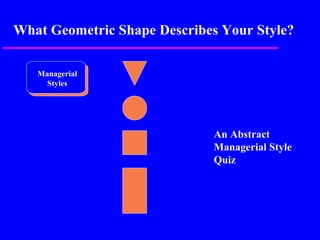
An Abstract
Managerial Style
Quiz
What Geometric Shape Describes Your Style?
HOSPITALITY MISSION:
Buying or making a product or service at
a lower cost and selling it at a higher
price to produce a difference called
profit.
If we can not sell at a higher price than
its cost structure then the endeavor is
totally unnecessary.
In Las Vegas We Need
Cost - Competitive With Market
Time - On Time Project Delivery
Quality - Superior To Meet Las Vegas
And World-Class Standards
Cost & Quality Are Specific To Our
Market Niche (Mandalay Bay vs. Circus
Circus and Alexis Park vs. Motel 6)
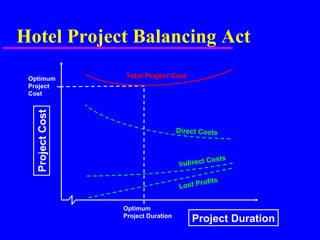
Hotel Project Balancing ActProjectCost
Project Duration
Lost Profits
Indirect Costs
Direct Costs
Total Project CostOptimum
Project
Cost
Optimum
Project Duration
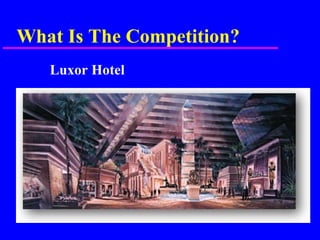
What Is The Competition?
Luxor Hotel
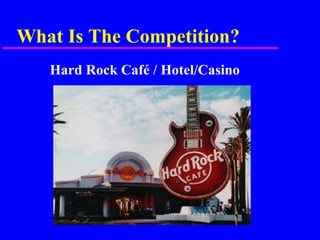
What Is The Competition?
Hard Rock Café / Hotel/Casino
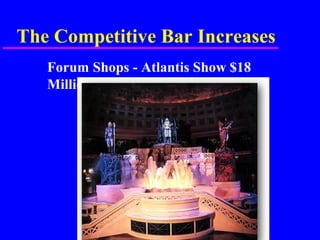
The Competitive Bar Increases
Forum Shops - Atlantis Show $18
Million
Competitive Re-Theming Work
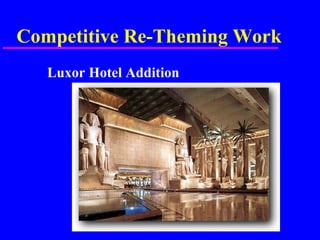
Luxor Hotel Addition
Competitive Re-Theming Work
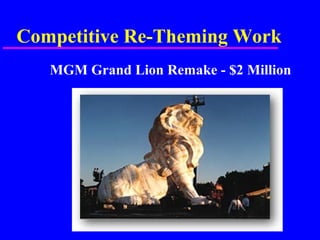
MGM Grand Lion Remake - $2 Million
Competitive Re-Theming Work
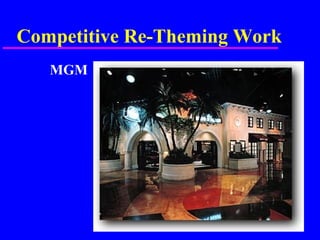
MGM
Competitive Re-Theming Work
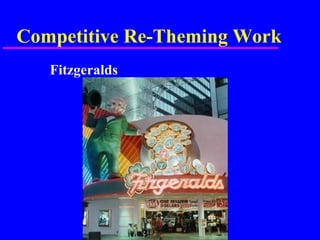
Fitzgeralds
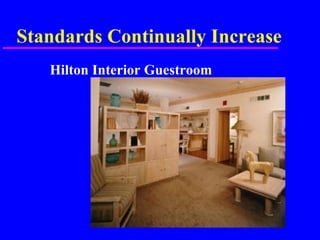
Standards Continually Increase
Hilton Interior Guestroom
Beginning To Begin
Developing Your Strategies
Feasibility … Supply And Demand
Evaluating The Competition (Can You
Find A Niche @ High End, Low End??)
Balance Market, Capacity/Design, Cash
Flow And Capitalization
Have A Plan … Any Plan!!!!!
Implementation Plan
Capitalization
Design And Development
Construction
Organization, Staffing, Training
Operations
Marketing
Budget
Conceptualizing The “Product”
Premise: The PRODUCT of Hospitality
-- What Customers Come to “Buy” and
Hotels “Sell” -- Is an EXPERIENCE.
A Guest Visit or Trip Experience Is the
Sum of the SPACE-TIME-CONTACT
the Customer Has With the SERVICES,
AMENITIES AND GOODS Offered by
the Property.
Conceptualizing The “Product”
Create A Product That ….
Satisfies A Customer Need, Want, Or
Expectation At A Price That Creates A Value
… And
Creates A Competitive Niche Which Allows
The Property To Capture A Fair Share Or
More Of Market Demand … And
Is Produced At A Price-Volume-Cost
Relationship That Yields Target Returns
Design & Operations Conflicts
Operations wants trouble-free operation
and maintenance with low cost
Designers want to create a sense of
wonderment and amazement (The
WOW Factor!!)
Eventual product/service must strike a
balance between these two extremes
Goals And Expectations
Explicitly State And Define Corporate
Mission Statement
Product Goals
Customer Goals
Employee Goals
Marketing Goals
Bottom Line Goals
Community Goals
Focus On The Total Experience
SITE Access/Egress And Design
BUILDING DESIGN Exterior/Interior
SERVICES Mix, Concept, And Quality
DELIVERY Operations
PRICE/VALUE Quantity, Quality,
And Fun Factor
“X” FACTOR Is There An Edge??
Multi-Dimensional Elements
Tangible “Hard” Elements (Building,
Ingredients (e.g. Food))
Intangible “Soft” Elements (Delivery
(courtesy, professionalism) Ambiance)
“Background” (Comfort, Cleanliness,
Safety (As You Get Older You Take Less
Risks) Do People “Feel” Safe??
Property Design Objectives
Build A “Box” Whose Exterior Projects
a “Come See Me, This Is Interesting or
There Is Fun Inside”
Design the Interior That Develops and
Supports the Production of
Entertainment Value: (1) User Friendly
(2) Promotes Traffic Flow (3)
Merchandises the Goods and Services
and (4) Is FUN!!
Property Design Objectives cont.
Design Facilitates Efficiency and
Productivity
Design Makes This a Great Place to
Work
Product Concept - Summary
Develop the Product WITH THE
CUSTOMER IN MIND
Think MULTI-DIMENSIONALLY
Think in Terms of TOTAL TRIP/VISIT
Be Prepared to Continually REVIEW,
MODIFY, And/or DELETE As
Customers, Competition and Financial
Conditions Change
Location, Location, Location
Be the FIRST PROPERTY in the Path of
Your Feeder Market and TURN RIGHT
If Not, Be Visible To On-Coming Traffic
If Not, Be Well-Located Within A
Critical Mass
If Not, Have A “Hook”… A Must See, A
View, Other Amenities, Bigger Or
Unique
Location, Location, Location cont.
If Not, Build At Low Cost
If Not, Don’t Build (SOMETIMES THIS
IS THE BEST DECISION!!!!!)
Locating The “Box”
Look For:
Ease of Access
Sufficient Room for the “Box,” Parking
and EXPANSION
Zoning, Utilities And Other Necessities
… Current and Future
Tourism Infrastructure: Employee
Housing, Airport, and Other Recreation
Design Methodology
Identify the … Services and Outlets
Determine Functional Relationships
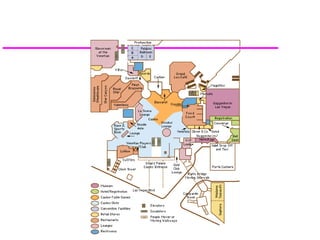
Bubble Diagram Layout
Operations, Then Support
Amenities
Building, Then Exterior/External
Independently First, Then Iterate
BALANCE. BALANCE. BALANCE.
Design Methodology (cont.)
Finalize the Location and Footprint of
Each Element
Design Each Outlet and Public Area
Cost the Proposed Development
Validate the Relationship of
– € Capital Cost to Operating Cost and Profit
–  Capital Cost to Debt = Risk
Design for Full Expansion and Build
Out!
The Design Process
Schematic Design
Design Development
Working Drawings Or Contract
Documents
Construction Bidding & Award
Design/Contract Administration & RFI
(Requests For Information) And Change
Order Process
The Design Process
Schematic Design is the 1st phase of the
architects’ basic services. Architect
consults with the owner to ascertain the
requirements of the project and prepares
schematic design studies consisting of
drawings and other documents
illustrating the scale and relationship of
project components for owner approval.
The Design Process
Design Development is the 2nd phase of
the architect’s basic services. Architect
prepares from approved schematics the
design development documents
consisting of drawings and other
elements that fix structural, mechanical,
and electrical systems along with
materials choices for owner approval.
The Design Process
Working Drawings Or Contract
Documents is the 3rd phase of the
architect’s basic services wherein
drawings and specifications developed to
their final form so that whatever is
shown can be built without any other
instructions or details.
The Design Process
Plans Show the Physical Form and
Dimensions of the Design
Specifications Detail the Quality
Parameters of the Design
Between Plans and Specifications There
Should Be No Gaps and No Overlaps
Codes Are Essential Such As Uniform
Building Code (new IBC) and National
Electrical Code
Select Quality A/E &
Consultants
Architect Is the Space Planner and
Editor of the Process
Architectural Firms Such As Bergman
Walls, Leo Daly, Etc.
Select Firm That “Sweats the Details”
and Has Good Conceptual Designs
Check Track Record With Past Clients
Select Quality A/E &
Consultants (cont.)
Mechanical/Electrical Engineering
Consultant (e.g. JBA Engineers)
Structural Engineering Consultant (e.g.
Martin & Peltyn)
Interior Design Consultant (e.g. Yates
Silverman)
Food Service/Kitchen Consultants
Casino Consultants, etc., etc.
Select Quality A/E &
Consultants (cont.)
As Always Check Track Records and
Client References
Who Will Work on YOUR PROJECT??
Write Names of Project Architects and
Project Engineers Into the Design
Contract Documents
Hire an Outside Plan Check Firm for
Peer Reviews
Do Your People UNDERSTAND PLANS
The Design Process
Do You “Fast Track” The Design
Process?
If 30% of the plans are done can we start
on the foundations and structure while
the owner is deciding on the looks of the
interior millwork?
Are slow plans the excuse to accelerate
the process??
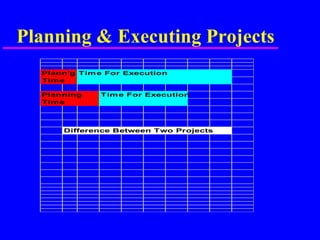
Planning & Executing Projects
Plann'g Time For Execution
Time
Planning Time For Execution
Time
Difference Between Two Projects
The Construction Process
Lump Sum General Contracting (May
Be Guaranteed Maximum Price or
GMP)
Construction Manager
Design-Build
Mix Of The Above Types
Should Always Have Independent Owner
Representation
The Construction Process
Whether GC, Construction Manager or
Design-Build, all approaches have
advantages and disadvantages
As Always Check Track Records and
Client References
Who Will Work on YOUR PROJECT??
Write Names of Key Contractor
Personnel Into the Const. Contract
Documents
The Construction Process
Must Have Independent Quality Control
on Jobsite
Can Hire CM To Monitor Both Design
Process And Construction Process
Ideally Hire Construction In Tandem
With Design - Have Constructability
Checkpoints on Cost and Schedule
Liquidated Damages - Pros and Cons
The Construction Process
Contractor Can Provide Costing Review
On Design
Value Engineering By Contractor -
Should Be On A Life Cycle Basis And
Not A Cheapening Basis
For Schedule, Owner Typically Has
Opening Date And We Must Back
Schedule
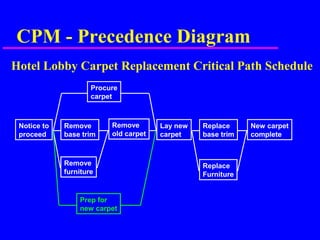
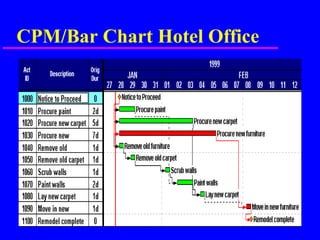
CPM - Precedence Diagram
Notice to
proceed
Procure
carpet
Remove
old carpet
Lay new
carpet
Replace
base trim
Remove
base trim
Remove
furniture
Replace
Furniture
New carpet
complete
Prep for
new carpet
Hotel Lobby Carpet Replacement Critical Path Schedule
CPM/Bar Chart Hotel Office
The Design Process Revisited
What Do We Need In Terms Of Room
Size And Amenities??
Mauna Kea Hotel Built In Hawaii in
1965 at $80,000 Per 350 Square Foot
Room Or $228 Per Square Foot
Mauna Kea Had 614 Employees For A
300-Room Property
Mauna Kea Turned 1st Profit In 1974
Three Main Hotel Areas
Public Areas (Lobby, Restaurants,
Lounges)
Service Areas (Back Of The House)
Guest Rooms
Rule Of Thumb: Hotel Area = Number
Of Rooms x Average Room Size x 2
Room Size - International Stds
1 Star = 150 Sq Feet (Bed, shower, and
toilet)
2 Star = 200 Sq Feet
3 Star = 250 Sq Feet (Major Chain)
4 Star = 300 Sq Feet (Average City
Chain)
5 Star = 350 Sq Feet (Deluxe Hotel)
Room Dimensions
10 Foot Minimum Width
Average = 12 Foot - 14 Foot Width
Luxury = 15 Foot Width
Length Of Room = 24-30 Foot Including
Bath
Length Of Room = 14-17 Foot Without
Bath
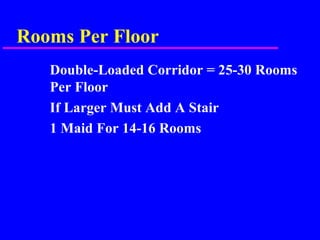
Rooms Per Floor
Double-Loaded Corridor = 25-30 Rooms
Per Floor
If Larger Must Add A Stair
1 Maid For 14-16 Rooms
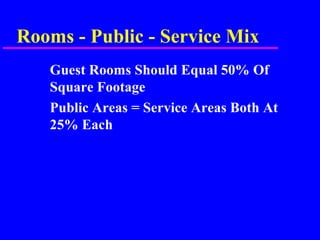
Rooms - Public - Service Mix
Guest Rooms Should Equal 50% Of
Square Footage
Public Areas = Service Areas Both At
25% Each
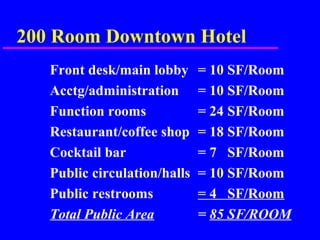
200 Room Downtown Hotel
Front desk/main lobby = 10 SF/Room
Acctg/administration = 10 SF/Room
Function rooms = 24 SF/Room
Restaurant/coffee shop = 18 SF/Room
Cocktail bar = 7 SF/Room
Public circulation/halls = 10 SF/Room
Public restrooms = 4 SF/Room
Total Public Area = 85 SF/ROOM
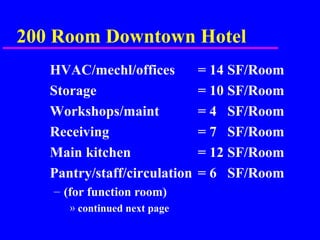
200 Room Downtown Hotel
HVAC/mechl/offices = 14 SF/Room
Storage = 10 SF/Room
Workshops/maint = 4 SF/Room
Receiving = 7 SF/Room
Main kitchen = 12 SF/Room
Pantry/staff/circulation = 6 SF/Room
– (for function room)
» continued next page
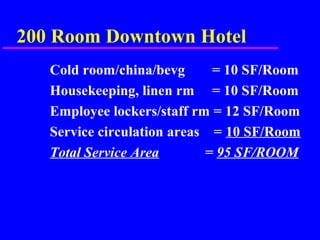
200 Room Downtown Hotel
Cold room/china/bevg = 10 SF/Room
Housekeeping, linen rm = 10 SF/Room
Employee lockers/staff rm = 12 SF/Room
Service circulation areas = 10 SF/Room
Total Service Area = 95 SF/ROOM
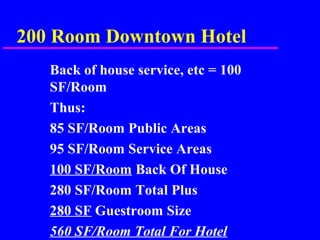
200 Room Downtown Hotel
Back of house service, etc = 100
SF/Room
Thus:
85 SF/Room Public Areas
95 SF/Room Service Areas
100 SF/Room Back Of House
280 SF/Room Total Plus
280 SF Guestroom Size
560 SF/Room Total For Hotel
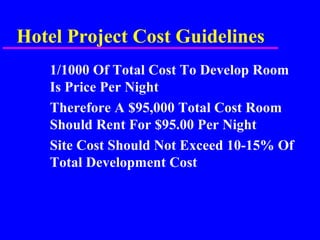
Hotel Project Cost Guidelines
1/1000 Of Total Cost To Develop Room
Is Price Per Night
Therefore A $95,000 Total Cost Room
Should Rent For $95.00 Per Night
Site Cost Should Not Exceed 10-15% Of
Total Development Cost
For The CEM 350 Class
We Hope You Enjoyed
This Presentation

Cem 350 hotel design construction fall 2016

  • 1.
    Hotel Design/Construction CEM 350 ClassLecture Neil Opfer Construction Management Program University of Nevada, Las Vegas
  • 2.
    Managerial Styles An Abstract Managerial Style Quiz WhatGeometric Shape Describes Your Style?
  • 3.
    HOSPITALITY MISSION: Buying ormaking a product or service at a lower cost and selling it at a higher price to produce a difference called profit. If we can not sell at a higher price than its cost structure then the endeavor is totally unnecessary.
  • 4.
    In Las VegasWe Need Cost - Competitive With Market Time - On Time Project Delivery Quality - Superior To Meet Las Vegas And World-Class Standards Cost & Quality Are Specific To Our Market Niche (Mandalay Bay vs. Circus Circus and Alexis Park vs. Motel 6)
  • 5.
    Hotel Project BalancingActProjectCost Project Duration Lost Profits Indirect Costs Direct Costs Total Project CostOptimum Project Cost Optimum Project Duration
  • 6.
    What Is TheCompetition? Luxor Hotel
  • 7.
    What Is TheCompetition? Hard Rock Café / Hotel/Casino
  • 8.
    The Competitive BarIncreases Forum Shops - Atlantis Show $18 Million
  • 9.
  • 10.
    Competitive Re-Theming Work MGMGrand Lion Remake - $2 Million
  • 11.
  • 12.
  • 13.
  • 14.
    Beginning To Begin DevelopingYour Strategies Feasibility … Supply And Demand Evaluating The Competition (Can You Find A Niche @ High End, Low End??) Balance Market, Capacity/Design, Cash Flow And Capitalization Have A Plan … Any Plan!!!!!
  • 15.
    Implementation Plan Capitalization Design AndDevelopment Construction Organization, Staffing, Training Operations Marketing Budget
  • 16.
    Conceptualizing The “Product” Premise:The PRODUCT of Hospitality -- What Customers Come to “Buy” and Hotels “Sell” -- Is an EXPERIENCE. A Guest Visit or Trip Experience Is the Sum of the SPACE-TIME-CONTACT the Customer Has With the SERVICES, AMENITIES AND GOODS Offered by the Property.
  • 17.
    Conceptualizing The “Product” CreateA Product That …. Satisfies A Customer Need, Want, Or Expectation At A Price That Creates A Value … And Creates A Competitive Niche Which Allows The Property To Capture A Fair Share Or More Of Market Demand … And Is Produced At A Price-Volume-Cost Relationship That Yields Target Returns
  • 18.
    Design & OperationsConflicts Operations wants trouble-free operation and maintenance with low cost Designers want to create a sense of wonderment and amazement (The WOW Factor!!) Eventual product/service must strike a balance between these two extremes
  • 19.
    Goals And Expectations ExplicitlyState And Define Corporate Mission Statement Product Goals Customer Goals Employee Goals Marketing Goals Bottom Line Goals Community Goals
  • 20.
    Focus On TheTotal Experience SITE Access/Egress And Design BUILDING DESIGN Exterior/Interior SERVICES Mix, Concept, And Quality DELIVERY Operations PRICE/VALUE Quantity, Quality, And Fun Factor “X” FACTOR Is There An Edge??
  • 21.
    Multi-Dimensional Elements Tangible “Hard”Elements (Building, Ingredients (e.g. Food)) Intangible “Soft” Elements (Delivery (courtesy, professionalism) Ambiance) “Background” (Comfort, Cleanliness, Safety (As You Get Older You Take Less Risks) Do People “Feel” Safe??
  • 22.
    Property Design Objectives BuildA “Box” Whose Exterior Projects a “Come See Me, This Is Interesting or There Is Fun Inside” Design the Interior That Develops and Supports the Production of Entertainment Value: (1) User Friendly (2) Promotes Traffic Flow (3) Merchandises the Goods and Services and (4) Is FUN!!
  • 23.
    Property Design Objectivescont. Design Facilitates Efficiency and Productivity Design Makes This a Great Place to Work
  • 24.
    Product Concept -Summary Develop the Product WITH THE CUSTOMER IN MIND Think MULTI-DIMENSIONALLY Think in Terms of TOTAL TRIP/VISIT Be Prepared to Continually REVIEW, MODIFY, And/or DELETE As Customers, Competition and Financial Conditions Change
  • 25.
    Location, Location, Location Bethe FIRST PROPERTY in the Path of Your Feeder Market and TURN RIGHT If Not, Be Visible To On-Coming Traffic If Not, Be Well-Located Within A Critical Mass If Not, Have A “Hook”… A Must See, A View, Other Amenities, Bigger Or Unique
  • 26.
    Location, Location, Locationcont. If Not, Build At Low Cost If Not, Don’t Build (SOMETIMES THIS IS THE BEST DECISION!!!!!)
  • 27.
    Locating The “Box” LookFor: Ease of Access Sufficient Room for the “Box,” Parking and EXPANSION Zoning, Utilities And Other Necessities … Current and Future Tourism Infrastructure: Employee Housing, Airport, and Other Recreation
  • 28.
    Design Methodology Identify the… Services and Outlets Determine Functional Relationships Bubble Diagram Layout Operations, Then Support Amenities Building, Then Exterior/External Independently First, Then Iterate BALANCE. BALANCE. BALANCE.
  • 30.
    Design Methodology (cont.) Finalizethe Location and Footprint of Each Element Design Each Outlet and Public Area Cost the Proposed Development Validate the Relationship of – € Capital Cost to Operating Cost and Profit –  Capital Cost to Debt = Risk Design for Full Expansion and Build Out!
  • 31.
    The Design Process SchematicDesign Design Development Working Drawings Or Contract Documents Construction Bidding & Award Design/Contract Administration & RFI (Requests For Information) And Change Order Process
  • 32.
    The Design Process SchematicDesign is the 1st phase of the architects’ basic services. Architect consults with the owner to ascertain the requirements of the project and prepares schematic design studies consisting of drawings and other documents illustrating the scale and relationship of project components for owner approval.
  • 33.
    The Design Process DesignDevelopment is the 2nd phase of the architect’s basic services. Architect prepares from approved schematics the design development documents consisting of drawings and other elements that fix structural, mechanical, and electrical systems along with materials choices for owner approval.
  • 34.
    The Design Process WorkingDrawings Or Contract Documents is the 3rd phase of the architect’s basic services wherein drawings and specifications developed to their final form so that whatever is shown can be built without any other instructions or details.
  • 35.
    The Design Process PlansShow the Physical Form and Dimensions of the Design Specifications Detail the Quality Parameters of the Design Between Plans and Specifications There Should Be No Gaps and No Overlaps Codes Are Essential Such As Uniform Building Code (new IBC) and National Electrical Code
  • 36.
    Select Quality A/E& Consultants Architect Is the Space Planner and Editor of the Process Architectural Firms Such As Bergman Walls, Leo Daly, Etc. Select Firm That “Sweats the Details” and Has Good Conceptual Designs Check Track Record With Past Clients
  • 37.
    Select Quality A/E& Consultants (cont.) Mechanical/Electrical Engineering Consultant (e.g. JBA Engineers) Structural Engineering Consultant (e.g. Martin & Peltyn) Interior Design Consultant (e.g. Yates Silverman) Food Service/Kitchen Consultants Casino Consultants, etc., etc.
  • 38.
    Select Quality A/E& Consultants (cont.) As Always Check Track Records and Client References Who Will Work on YOUR PROJECT?? Write Names of Project Architects and Project Engineers Into the Design Contract Documents Hire an Outside Plan Check Firm for Peer Reviews Do Your People UNDERSTAND PLANS
  • 39.
    The Design Process DoYou “Fast Track” The Design Process? If 30% of the plans are done can we start on the foundations and structure while the owner is deciding on the looks of the interior millwork? Are slow plans the excuse to accelerate the process??
  • 40.
    Planning & ExecutingProjects Plann'g Time For Execution Time Planning Time For Execution Time Difference Between Two Projects
  • 41.
    The Construction Process LumpSum General Contracting (May Be Guaranteed Maximum Price or GMP) Construction Manager Design-Build Mix Of The Above Types Should Always Have Independent Owner Representation
  • 42.
    The Construction Process WhetherGC, Construction Manager or Design-Build, all approaches have advantages and disadvantages As Always Check Track Records and Client References Who Will Work on YOUR PROJECT?? Write Names of Key Contractor Personnel Into the Const. Contract Documents
  • 43.
    The Construction Process MustHave Independent Quality Control on Jobsite Can Hire CM To Monitor Both Design Process And Construction Process Ideally Hire Construction In Tandem With Design - Have Constructability Checkpoints on Cost and Schedule Liquidated Damages - Pros and Cons
  • 44.
    The Construction Process ContractorCan Provide Costing Review On Design Value Engineering By Contractor - Should Be On A Life Cycle Basis And Not A Cheapening Basis For Schedule, Owner Typically Has Opening Date And We Must Back Schedule
  • 45.
    CPM - PrecedenceDiagram Notice to proceed Procure carpet Remove old carpet Lay new carpet Replace base trim Remove base trim Remove furniture Replace Furniture New carpet complete Prep for new carpet Hotel Lobby Carpet Replacement Critical Path Schedule
  • 46.
  • 47.
    The Design ProcessRevisited What Do We Need In Terms Of Room Size And Amenities?? Mauna Kea Hotel Built In Hawaii in 1965 at $80,000 Per 350 Square Foot Room Or $228 Per Square Foot Mauna Kea Had 614 Employees For A 300-Room Property Mauna Kea Turned 1st Profit In 1974
  • 48.
    Three Main HotelAreas Public Areas (Lobby, Restaurants, Lounges) Service Areas (Back Of The House) Guest Rooms Rule Of Thumb: Hotel Area = Number Of Rooms x Average Room Size x 2
  • 49.
    Room Size -International Stds 1 Star = 150 Sq Feet (Bed, shower, and toilet) 2 Star = 200 Sq Feet 3 Star = 250 Sq Feet (Major Chain) 4 Star = 300 Sq Feet (Average City Chain) 5 Star = 350 Sq Feet (Deluxe Hotel)
  • 50.
    Room Dimensions 10 FootMinimum Width Average = 12 Foot - 14 Foot Width Luxury = 15 Foot Width Length Of Room = 24-30 Foot Including Bath Length Of Room = 14-17 Foot Without Bath
  • 51.
    Rooms Per Floor Double-LoadedCorridor = 25-30 Rooms Per Floor If Larger Must Add A Stair 1 Maid For 14-16 Rooms
  • 52.
    Rooms - Public- Service Mix Guest Rooms Should Equal 50% Of Square Footage Public Areas = Service Areas Both At 25% Each
  • 53.
    200 Room DowntownHotel Front desk/main lobby = 10 SF/Room Acctg/administration = 10 SF/Room Function rooms = 24 SF/Room Restaurant/coffee shop = 18 SF/Room Cocktail bar = 7 SF/Room Public circulation/halls = 10 SF/Room Public restrooms = 4 SF/Room Total Public Area = 85 SF/ROOM
  • 54.
    200 Room DowntownHotel HVAC/mechl/offices = 14 SF/Room Storage = 10 SF/Room Workshops/maint = 4 SF/Room Receiving = 7 SF/Room Main kitchen = 12 SF/Room Pantry/staff/circulation = 6 SF/Room – (for function room) » continued next page
  • 55.
    200 Room DowntownHotel Cold room/china/bevg = 10 SF/Room Housekeeping, linen rm = 10 SF/Room Employee lockers/staff rm = 12 SF/Room Service circulation areas = 10 SF/Room Total Service Area = 95 SF/ROOM
  • 56.
    200 Room DowntownHotel Back of house service, etc = 100 SF/Room Thus: 85 SF/Room Public Areas 95 SF/Room Service Areas 100 SF/Room Back Of House 280 SF/Room Total Plus 280 SF Guestroom Size 560 SF/Room Total For Hotel
  • 57.
    Hotel Project CostGuidelines 1/1000 Of Total Cost To Develop Room Is Price Per Night Therefore A $95,000 Total Cost Room Should Rent For $95.00 Per Night Site Cost Should Not Exceed 10-15% Of Total Development Cost
  • 58.
    For The CEM350 Class We Hope You Enjoyed This Presentation