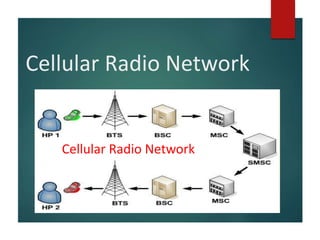
Cellular Radio Network
Introduction
 A cellular network is a radio network
distributed over land through cells where
each cell includes a fixed location
transceiver known as base station.
Cellular Radio Network
Architecture
 Mobile Station (MS)
 Base Station Subsystem (BSS)
 Network Switching Subsystem(NSS)
31-05-2015
4
System Architecture
Mobile Station (MS)
The Mobile Station is made up of two entities:
1.Mobile Equipment (ME)
-Portable,hand held device .
-Uniquely identified by an IMEI (International Mobile Equipment Identity)
-Voice and data transmission
-Monitoring power and signal quality of surrounding cells for optimum handover.
2.Subscriber Identity Module (SIM)
1. SIM Card carries the user's identity for accessing the network and
receiving calls.
2. All calls are charged against SIM card account.
3. It is equipped with a memory to store telephone numbers along with
names.
4. It also enables to send and receive short messages ( SMS)..
5
System Architecture
Base Station Subsystem (BSS)
Base Station Subsystem is composed of two parts
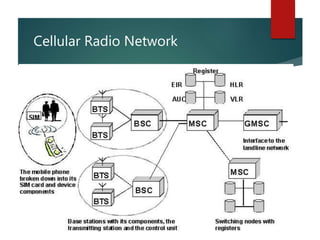
1. Base Transceiver Station (BTS)
- Amplifiers, Antennas that relay radio messages,
transceivers (TRX).
2. Base Station Controller (BSC)
- allocation of radio channels.
-controls handovers from BTS to BTS
31-May-2015
6
System Architecture
Network Switching Subsystem(NSS)
Mobile Switching Center (MSC)
 Heart of the network
 Manages communication between GSM and other networks
 Call setup function and basic switching
 Call routing
 Billing information and collection
 Mobility management
- Registration
- Location Updating
- Inter BSS and inter MSC call handoff
31-May-2015
7
System Architecture
Network Switching Subsystem
 Home Location Registers (HLR)
- permanent database about mobile subscribers in a large service
area(generally one per GSM network operator)
- database contains IMSI, prepaid/postpaid,roaming
restrictions,supplementary services.
 Visitor Location Registers (VLR)
- Temporary database which updates whenever new MS enters its
area, by HLR database
- Controls those mobiles roaming in its area
- Reduces number of queries to HLR
31-May-2015
8
o Equipment Identity Register (EIR)
-Equipment Identity Register is a database that
contains a list of all valid mobile equipment on the
network.
o Authentication Center (AuC)
-Each network SIM card is assigned an individual
authentication key for security to ensure that third
parties are unable to use network subscriber
services.
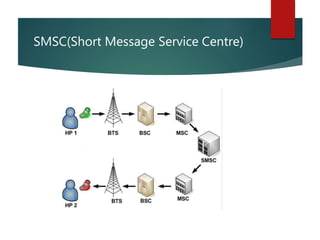
SMSC(Short Message Service Centre)
Thanks !
31-May-2015
11

Cellular radio network

  • 1.
  • 2.
    Introduction  A cellularnetwork is a radio network distributed over land through cells where each cell includes a fixed location transceiver known as base station.
  • 3.
  • 4.
    Cellular Radio Network Architecture Mobile Station (MS)  Base Station Subsystem (BSS)  Network Switching Subsystem(NSS) 31-05-2015 4
  • 5.
    System Architecture Mobile Station(MS) The Mobile Station is made up of two entities: 1.Mobile Equipment (ME) -Portable,hand held device . -Uniquely identified by an IMEI (International Mobile Equipment Identity) -Voice and data transmission -Monitoring power and signal quality of surrounding cells for optimum handover. 2.Subscriber Identity Module (SIM) 1. SIM Card carries the user's identity for accessing the network and receiving calls. 2. All calls are charged against SIM card account. 3. It is equipped with a memory to store telephone numbers along with names. 4. It also enables to send and receive short messages ( SMS).. 5
  • 6.
    System Architecture Base StationSubsystem (BSS) Base Station Subsystem is composed of two parts 1. Base Transceiver Station (BTS) - Amplifiers, Antennas that relay radio messages, transceivers (TRX). 2. Base Station Controller (BSC) - allocation of radio channels. -controls handovers from BTS to BTS 31-May-2015 6
  • 7.
    System Architecture Network SwitchingSubsystem(NSS) Mobile Switching Center (MSC)  Heart of the network  Manages communication between GSM and other networks  Call setup function and basic switching  Call routing  Billing information and collection  Mobility management - Registration - Location Updating - Inter BSS and inter MSC call handoff 31-May-2015 7
  • 8.
    System Architecture Network SwitchingSubsystem  Home Location Registers (HLR) - permanent database about mobile subscribers in a large service area(generally one per GSM network operator) - database contains IMSI, prepaid/postpaid,roaming restrictions,supplementary services.  Visitor Location Registers (VLR) - Temporary database which updates whenever new MS enters its area, by HLR database - Controls those mobiles roaming in its area - Reduces number of queries to HLR 31-May-2015 8
  • 9.
    o Equipment IdentityRegister (EIR) -Equipment Identity Register is a database that contains a list of all valid mobile equipment on the network. o Authentication Center (AuC) -Each network SIM card is assigned an individual authentication key for security to ensure that third parties are unable to use network subscriber services.
  • 10.
  • 11.