BIOLOGY CELL - THE STRUCTURAL AND FUNCTIONAL UNIT OF LIFE
www.topperlearning.com 2
Cell – The Structural and Functional Unit of Life
 The cell is the structural and functional unit of the body.
 All living beings develop from pre-existing cells.
 Robert Hooke (1665) discovered the cell. He observed cork cells of a tree bark.
 Cell Theory: All organisms start their life with a single cell. Each cell is capable of carrying out various
metabolic processes.
 Cell Number:
Unicellular Organisms Made of a single cell.
Example: Amoeba
Multi-cellular Organisms Consists of many cells adapted to perform
different functions.
Examples: Plants, human beings
 Cell Size
The size of cells ranges from 1/10th
to 1/1000th
mm.
Largest cell in the world Egg of an ostrich
Smallest cell Mycoplasma gallisepticum
Largest human cell Female ovum
Smallest human cell Red blood cell
Longest cell Nerve cell
 Cell Shape: Shapes of cells are often related to their functions.
o Human red blood cells are circular and biconcave for easy passage through blood capillaries and
to transport oxygen.
o White blood cells are amoeboid bearing pseudopodia so that they can squeeze through blood
capillaries and destroy pathogens.
o Nerve cells are slender and long to carry impulses.
o Guard cells are bean-shaped so that they can control the opening and closing of the stoma.
 Microscope: A microscope is an instrument used to magnify objects to be studied.
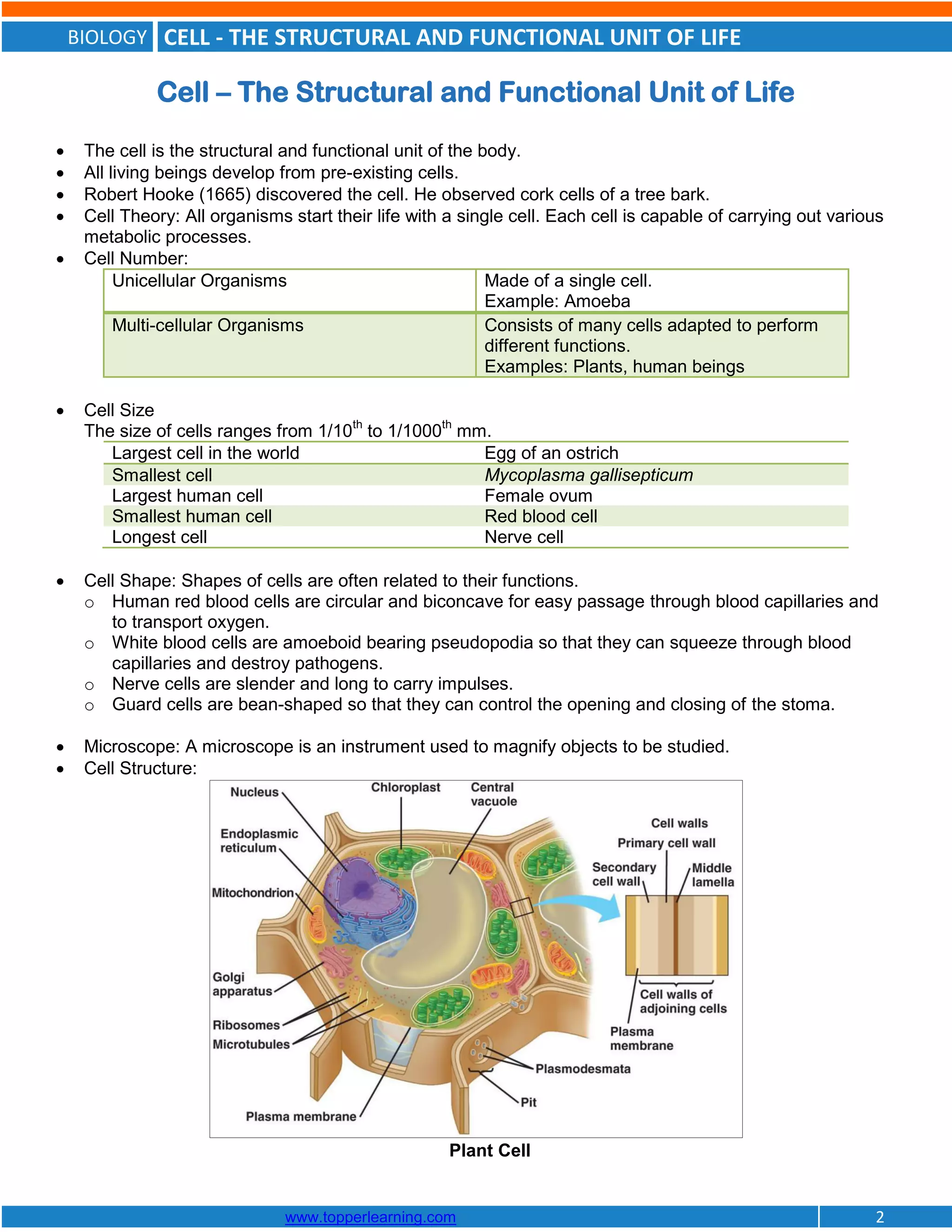
 Cell Structure:
Plant Cell
BIOLOGY CELL - THE STRUCTURAL AND FUNCTIONAL UNIT OF LIFE
www.topperlearning.com 3
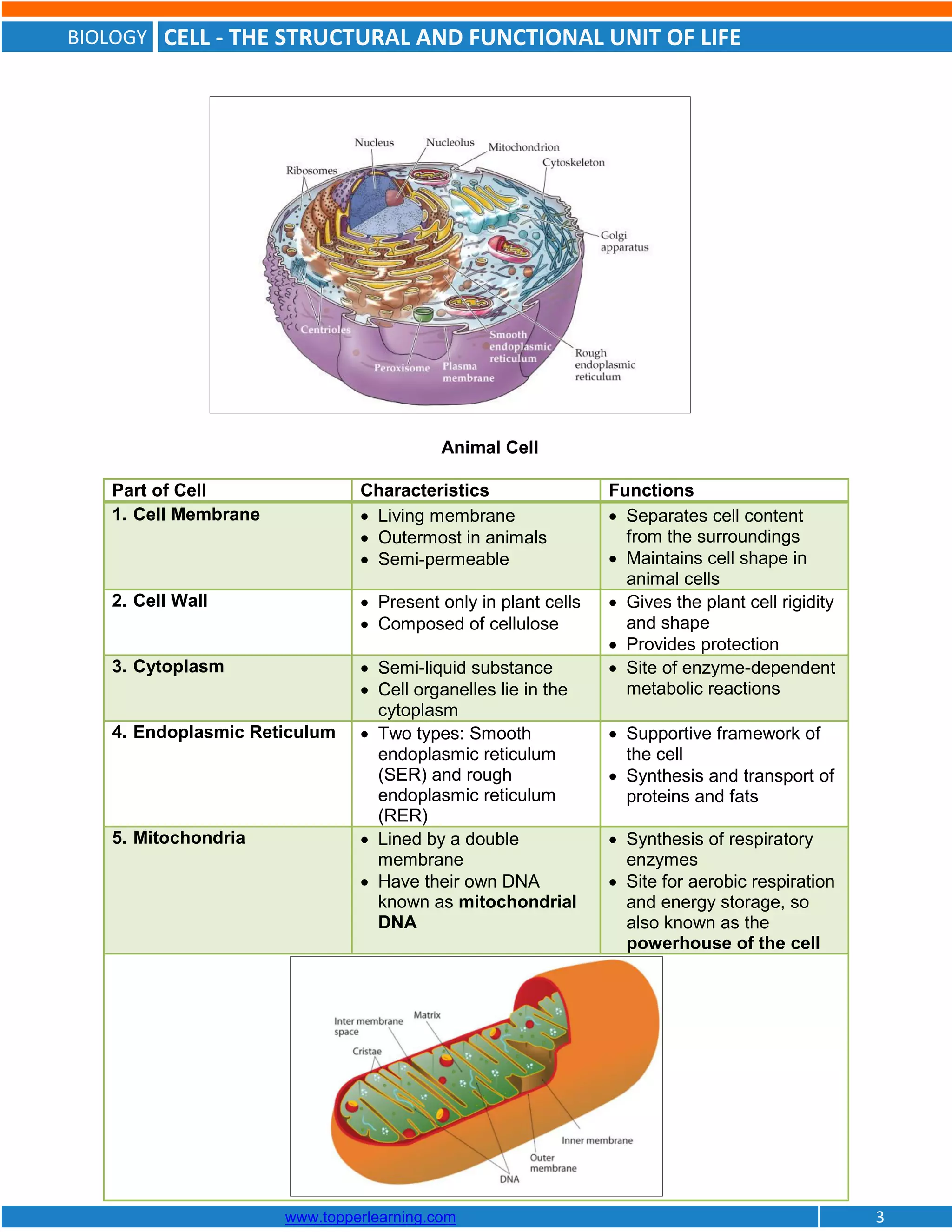
Animal Cell
Part of Cell Characteristics Functions
1. Cell Membrane  Living membrane
 Outermost in animals
 Semi-permeable
 Separates cell content
from the surroundings
 Maintains cell shape in
animal cells
2. Cell Wall  Present only in plant cells
 Composed of cellulose
 Gives the plant cell rigidity
and shape
 Provides protection
3. Cytoplasm  Semi-liquid substance
 Cell organelles lie in the
cytoplasm
 Site of enzyme-dependent
metabolic reactions
4. Endoplasmic Reticulum  Two types: Smooth
endoplasmic reticulum
(SER) and rough
endoplasmic reticulum
(RER)
 Supportive framework of
the cell
 Synthesis and transport of
proteins and fats
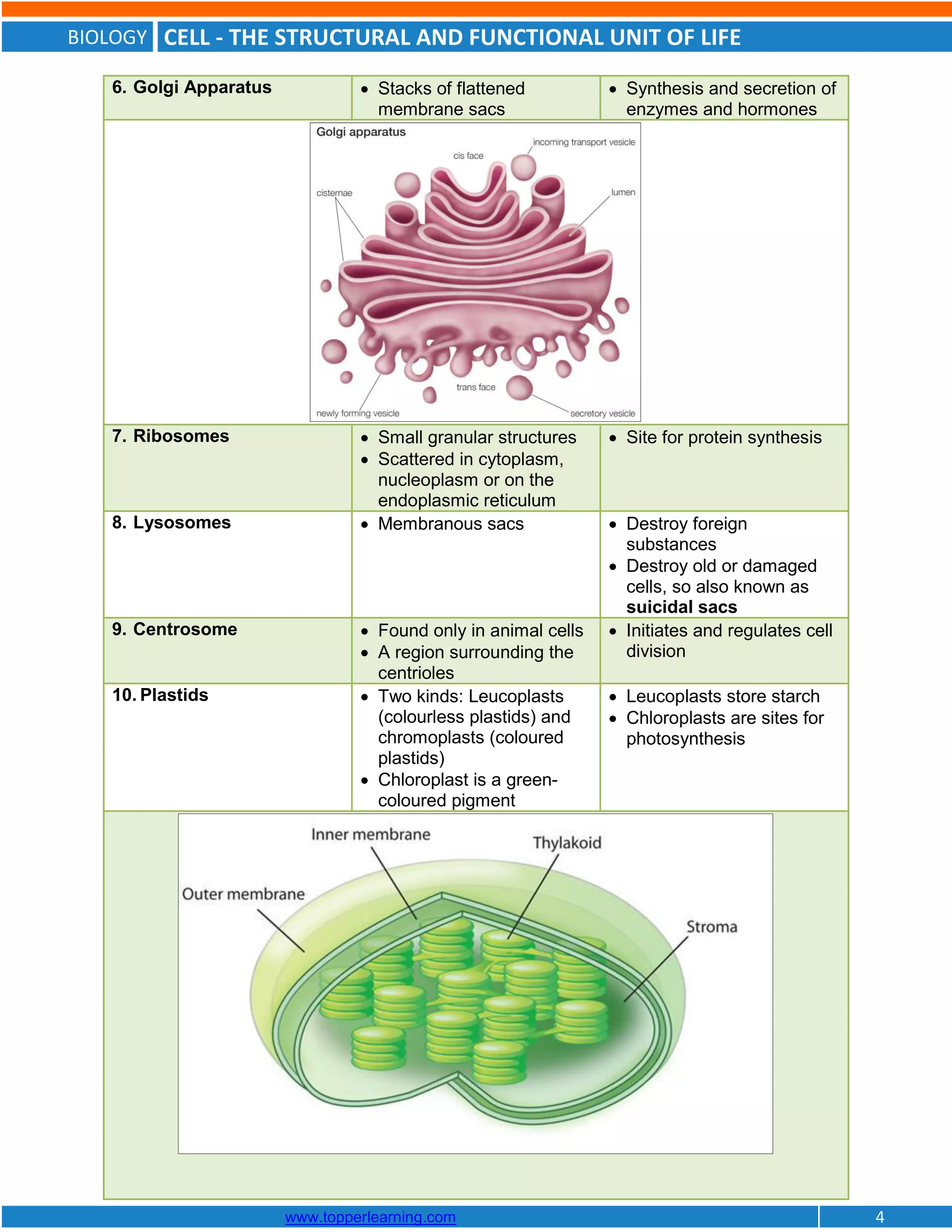
5. Mitochondria  Lined by a double
membrane
 Have their own DNA
known as mitochondrial
DNA
 Synthesis of respiratory
enzymes
 Site for aerobic respiration
and energy storage, so
also known as the
powerhouse of the cell
BIOLOGY CELL - THE STRUCTURAL AND FUNCTIONAL UNIT OF LIFE
www.topperlearning.com 4
6. Golgi Apparatus  Stacks of flattened
membrane sacs
 Synthesis and secretion of
enzymes and hormones
7. Ribosomes  Small granular structures
 Scattered in cytoplasm,
nucleoplasm or on the
endoplasmic reticulum
 Site for protein synthesis
8. Lysosomes  Membranous sacs  Destroy foreign
substances
 Destroy old or damaged
cells, so also known as
suicidal sacs
9. Centrosome  Found only in animal cells
 A region surrounding the
centrioles
 Initiates and regulates cell
division
10. Plastids  Two kinds: Leucoplasts
(colourless plastids) and
chromoplasts (coloured
plastids)
 Chloroplast is a green-
coloured pigment
 Leucoplasts store starch
 Chloroplasts are sites for
photosynthesis
BIOLOGY CELL - THE STRUCTURAL AND FUNCTIONAL UNIT OF LIFE
www.topperlearning.com 5
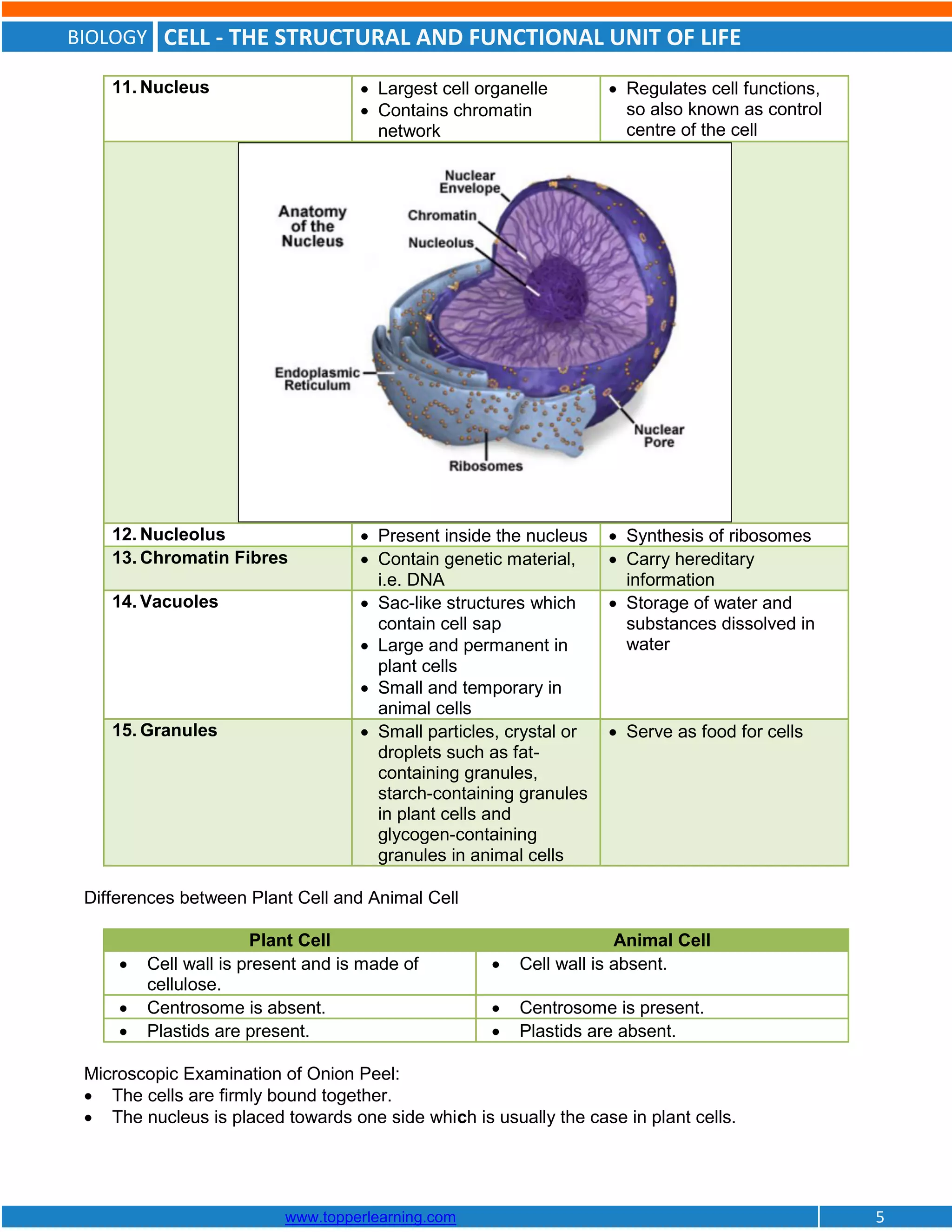
11. Nucleus  Largest cell organelle
 Contains chromatin
network
 Regulates cell functions,
so also known as control
centre of the cell
12. Nucleolus  Present inside the nucleus  Synthesis of ribosomes
13. Chromatin Fibres  Contain genetic material,
i.e. DNA
 Carry hereditary
information
14. Vacuoles  Sac-like structures which
contain cell sap
 Large and permanent in
plant cells
 Small and temporary in
animal cells
 Storage of water and
substances dissolved in
water
15. Granules  Small particles, crystal or
droplets such as fat-
containing granules,
starch-containing granules
in plant cells and
glycogen-containing
granules in animal cells
 Serve as food for cells
Differences between Plant Cell and Animal Cell
Plant Cell Animal Cell
 Cell wall is present and is made of
cellulose.
 Cell wall is absent.
 Centrosome is absent.  Centrosome is present.
 Plastids are present.  Plastids are absent.
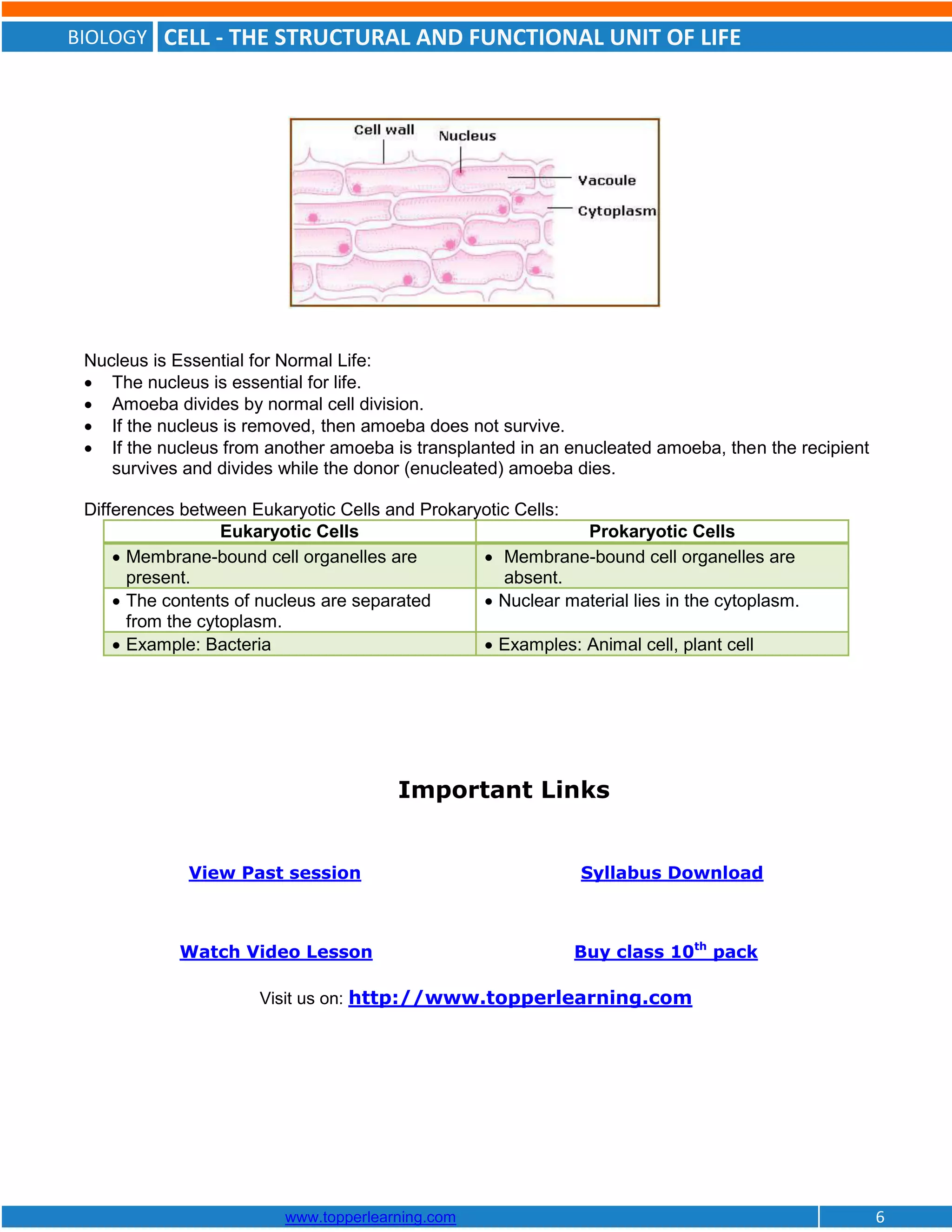
Microscopic Examination of Onion Peel:
 The cells are firmly bound together.
 The nucleus is placed towards one side which is usually the case in plant cells.
BIOLOGY CELL - THE STRUCTURAL AND FUNCTIONAL UNIT OF LIFE
www.topperlearning.com 6
Nucleus is Essential for Normal Life:
 The nucleus is essential for life.
 Amoeba divides by normal cell division.
 If the nucleus is removed, then amoeba does not survive.
 If the nucleus from another amoeba is transplanted in an enucleated amoeba, then the recipient
survives and divides while the donor (enucleated) amoeba dies.
Differences between Eukaryotic Cells and Prokaryotic Cells:
Eukaryotic Cells Prokaryotic Cells
 Membrane-bound cell organelles are
present.
 Membrane-bound cell organelles are
absent.
 The contents of nucleus are separated
from the cytoplasm.
 Nuclear material lies in the cytoplasm.
 Example: Bacteria  Examples: Animal cell, plant cell
Important Links
View Past session Syllabus Download
Watch Video Lesson Buy class 10th
pack
Visit us on: http://www.topperlearning.com

ICSE Class X Biology Cell The Structural and Functional Unit of Life

  • 2.
    BIOLOGY CELL -THE STRUCTURAL AND FUNCTIONAL UNIT OF LIFE www.topperlearning.com 2 Cell – The Structural and Functional Unit of Life  The cell is the structural and functional unit of the body.  All living beings develop from pre-existing cells.  Robert Hooke (1665) discovered the cell. He observed cork cells of a tree bark.  Cell Theory: All organisms start their life with a single cell. Each cell is capable of carrying out various metabolic processes.  Cell Number: Unicellular Organisms Made of a single cell. Example: Amoeba Multi-cellular Organisms Consists of many cells adapted to perform different functions. Examples: Plants, human beings  Cell Size The size of cells ranges from 1/10th to 1/1000th mm. Largest cell in the world Egg of an ostrich Smallest cell Mycoplasma gallisepticum Largest human cell Female ovum Smallest human cell Red blood cell Longest cell Nerve cell  Cell Shape: Shapes of cells are often related to their functions. o Human red blood cells are circular and biconcave for easy passage through blood capillaries and to transport oxygen. o White blood cells are amoeboid bearing pseudopodia so that they can squeeze through blood capillaries and destroy pathogens. o Nerve cells are slender and long to carry impulses. o Guard cells are bean-shaped so that they can control the opening and closing of the stoma.  Microscope: A microscope is an instrument used to magnify objects to be studied.  Cell Structure: Plant Cell
  • 3.
    BIOLOGY CELL -THE STRUCTURAL AND FUNCTIONAL UNIT OF LIFE www.topperlearning.com 3 Animal Cell Part of Cell Characteristics Functions 1. Cell Membrane  Living membrane  Outermost in animals  Semi-permeable  Separates cell content from the surroundings  Maintains cell shape in animal cells 2. Cell Wall  Present only in plant cells  Composed of cellulose  Gives the plant cell rigidity and shape  Provides protection 3. Cytoplasm  Semi-liquid substance  Cell organelles lie in the cytoplasm  Site of enzyme-dependent metabolic reactions 4. Endoplasmic Reticulum  Two types: Smooth endoplasmic reticulum (SER) and rough endoplasmic reticulum (RER)  Supportive framework of the cell  Synthesis and transport of proteins and fats 5. Mitochondria  Lined by a double membrane  Have their own DNA known as mitochondrial DNA  Synthesis of respiratory enzymes  Site for aerobic respiration and energy storage, so also known as the powerhouse of the cell
  • 4.
    BIOLOGY CELL -THE STRUCTURAL AND FUNCTIONAL UNIT OF LIFE www.topperlearning.com 4 6. Golgi Apparatus  Stacks of flattened membrane sacs  Synthesis and secretion of enzymes and hormones 7. Ribosomes  Small granular structures  Scattered in cytoplasm, nucleoplasm or on the endoplasmic reticulum  Site for protein synthesis 8. Lysosomes  Membranous sacs  Destroy foreign substances  Destroy old or damaged cells, so also known as suicidal sacs 9. Centrosome  Found only in animal cells  A region surrounding the centrioles  Initiates and regulates cell division 10. Plastids  Two kinds: Leucoplasts (colourless plastids) and chromoplasts (coloured plastids)  Chloroplast is a green- coloured pigment  Leucoplasts store starch  Chloroplasts are sites for photosynthesis
  • 5.
    BIOLOGY CELL -THE STRUCTURAL AND FUNCTIONAL UNIT OF LIFE www.topperlearning.com 5 11. Nucleus  Largest cell organelle  Contains chromatin network  Regulates cell functions, so also known as control centre of the cell 12. Nucleolus  Present inside the nucleus  Synthesis of ribosomes 13. Chromatin Fibres  Contain genetic material, i.e. DNA  Carry hereditary information 14. Vacuoles  Sac-like structures which contain cell sap  Large and permanent in plant cells  Small and temporary in animal cells  Storage of water and substances dissolved in water 15. Granules  Small particles, crystal or droplets such as fat- containing granules, starch-containing granules in plant cells and glycogen-containing granules in animal cells  Serve as food for cells Differences between Plant Cell and Animal Cell Plant Cell Animal Cell  Cell wall is present and is made of cellulose.  Cell wall is absent.  Centrosome is absent.  Centrosome is present.  Plastids are present.  Plastids are absent. Microscopic Examination of Onion Peel:  The cells are firmly bound together.  The nucleus is placed towards one side which is usually the case in plant cells.
  • 6.
    BIOLOGY CELL -THE STRUCTURAL AND FUNCTIONAL UNIT OF LIFE www.topperlearning.com 6 Nucleus is Essential for Normal Life:  The nucleus is essential for life.  Amoeba divides by normal cell division.  If the nucleus is removed, then amoeba does not survive.  If the nucleus from another amoeba is transplanted in an enucleated amoeba, then the recipient survives and divides while the donor (enucleated) amoeba dies. Differences between Eukaryotic Cells and Prokaryotic Cells: Eukaryotic Cells Prokaryotic Cells  Membrane-bound cell organelles are present.  Membrane-bound cell organelles are absent.  The contents of nucleus are separated from the cytoplasm.  Nuclear material lies in the cytoplasm.  Example: Bacteria  Examples: Animal cell, plant cell Important Links View Past session Syllabus Download Watch Video Lesson Buy class 10th pack Visit us on: http://www.topperlearning.com