Structure & Functions
of Organelles
bY SHALENI KAVIRAJAN
STPM BIOLOGY
GOLGI APPARATUS
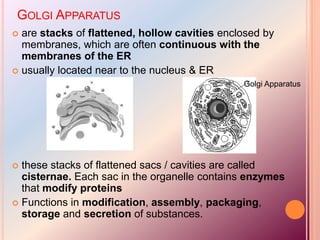
 are stacks of flattened, hollow cavities enclosed by
membranes, which are often continuous with the
membranes of the ER
 usually located near to the nucleus & ER
 these stacks of flattened sacs / cavities are called
cisternae. Each sac in the organelle contains enzymes
that modify proteins
 Functions in modification, assembly, packaging,
storage and secretion of substances.
Golgi Apparatus
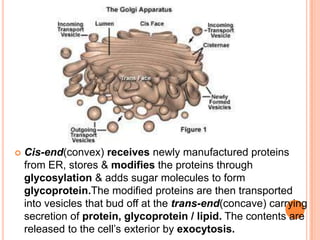
 Cis-end(convex) receives newly manufactured proteins
from ER, stores & modifies the proteins through
glycosylation & adds sugar molecules to form
glycoprotein.The modified proteins are then transported
into vesicles that bud off at the trans-end(concave) carrying
secretion of protein, glycoprotein / lipid. The contents are
released to the cell’s exterior by exocytosis.
LYSOSOMES
 special vesicles(spherical) which are formed by the Golgi
apparatus.
 The membrane(single layer of lipoprotein) is resistant to
digestion & prevents the release of enzymes which would
destroy the cell contents
 Contain high conc. of hydrolytic enzymes(ribonucleas,
deoxyribonucleas, carbohydrase, protease, lipase &
phosphatase) at pH value of 4 to 5(acidic)
 functions in : 1) cellular digestion 2) autophagy or
disposal of damaged cell/worn out components like
mitochondria 3) breakdown of a whole cell/autolysis (ex:
happens in the tail of tadpole where the digestion products
are used for building lungs & adult skin). For this reason,
they are sometimes called “suicide sacs.”
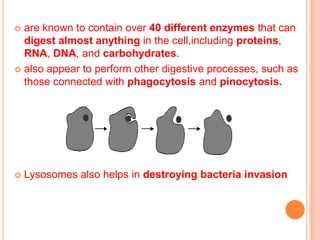
 are known to contain over 40 different enzymes that can
digest almost anything in the cell,including proteins,
RNA, DNA, and carbohydrates.
 also appear to perform other digestive processes, such as
those connected with phagocytosis and pinocytosis.
 Lysosomes also helps in destroying bacteria invasion
RIBOSOMES
 Found attached to the ER forming RER
 Occur singly or group together forming polysomes
 consist of rRna(produced in the nucleolus) and
proteins
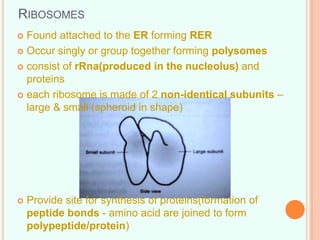
 each ribosome is made of 2 non-identical subunits –
large & small (spheroid in shape)
 Provide site for synthesis of proteins(formation of
peptide bonds - amino acid are joined to form
polypeptide/protein)
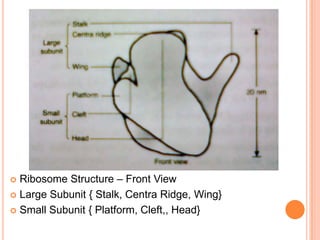
 Ribosome Structure – Front View
 Large Subunit { Stalk, Centra Ridge, Wing}
 Small Subunit { Platform, Cleft,, Head}
CHLOROPLAST
 large plastids found only in the photosynthetic tissues of
plant cell
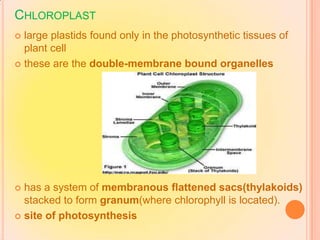
 these are the double-membrane bound organelles
 has a system of membranous flattened sacs(thylakoids)
stacked to form granum(where chlorophyll is located).
 site of photosynthesis
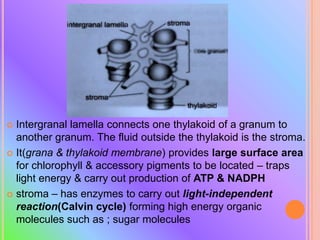
 Intergranal lamella connects one thylakoid of a granum to
another granum. The fluid outside the thylakoid is the stroma.
 It(grana & thylakoid membrane) provides large surface area
for chlorophyll & accessory pigments to be located – traps
light energy & carry out production of ATP & NADPH
 stroma – has enzymes to carry out light-independent
reaction(Calvin cycle) forming high energy organic
molecules such as ; sugar molecules
CYTOSKELETON
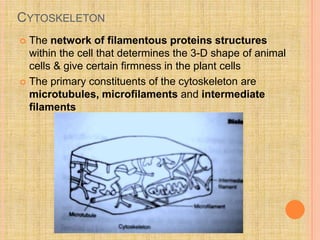
 The network of filamentous proteins structures
within the cell that determines the 3-D shape of animal
cells & give certain firmness in the plant cells
 The primary constituents of the cytoskeleton are
microtubules, microfilaments and intermediate
filaments
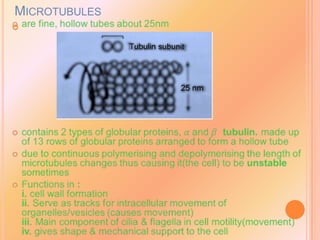
MICROTUBULES

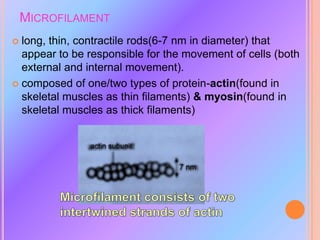
MICROFILAMENT
 long, thin, contractile rods(6-7 nm in diameter) that
appear to be responsible for the movement of cells (both
external and internal movement).
 composed of one/two types of protein-actin(found in
skeletal muscles as thin filaments) & myosin(found in
skeletal muscles as thick filaments)
 Exists in bundles & found in layers in the cytoplasm
 dynamic - can change their length very
quickly(depends on their location & functions)
 Functions in:
i. assist in the cleavage process during cytokinesis
ii. role in cellular movements
Example: cytoplasmic streaming, cell motility –
phagocytosis & pinocytosis
iii. maintains cell shape
INTERMEDIATE FILAMENTS


Cellular component

  • 1.
    Structure & Functions ofOrganelles bY SHALENI KAVIRAJAN STPM BIOLOGY
  • 2.
    GOLGI APPARATUS  arestacks of flattened, hollow cavities enclosed by membranes, which are often continuous with the membranes of the ER  usually located near to the nucleus & ER  these stacks of flattened sacs / cavities are called cisternae. Each sac in the organelle contains enzymes that modify proteins  Functions in modification, assembly, packaging, storage and secretion of substances. Golgi Apparatus
  • 3.
     Cis-end(convex) receivesnewly manufactured proteins from ER, stores & modifies the proteins through glycosylation & adds sugar molecules to form glycoprotein.The modified proteins are then transported into vesicles that bud off at the trans-end(concave) carrying secretion of protein, glycoprotein / lipid. The contents are released to the cell’s exterior by exocytosis.
  • 4.
    LYSOSOMES  special vesicles(spherical)which are formed by the Golgi apparatus.  The membrane(single layer of lipoprotein) is resistant to digestion & prevents the release of enzymes which would destroy the cell contents  Contain high conc. of hydrolytic enzymes(ribonucleas, deoxyribonucleas, carbohydrase, protease, lipase & phosphatase) at pH value of 4 to 5(acidic)  functions in : 1) cellular digestion 2) autophagy or disposal of damaged cell/worn out components like mitochondria 3) breakdown of a whole cell/autolysis (ex: happens in the tail of tadpole where the digestion products are used for building lungs & adult skin). For this reason, they are sometimes called “suicide sacs.”
  • 5.
     are knownto contain over 40 different enzymes that can digest almost anything in the cell,including proteins, RNA, DNA, and carbohydrates.  also appear to perform other digestive processes, such as those connected with phagocytosis and pinocytosis.  Lysosomes also helps in destroying bacteria invasion
  • 6.
    RIBOSOMES  Found attachedto the ER forming RER  Occur singly or group together forming polysomes  consist of rRna(produced in the nucleolus) and proteins  each ribosome is made of 2 non-identical subunits – large & small (spheroid in shape)  Provide site for synthesis of proteins(formation of peptide bonds - amino acid are joined to form polypeptide/protein)
  • 7.
     Ribosome Structure– Front View  Large Subunit { Stalk, Centra Ridge, Wing}  Small Subunit { Platform, Cleft,, Head}
  • 8.
    CHLOROPLAST  large plastidsfound only in the photosynthetic tissues of plant cell  these are the double-membrane bound organelles  has a system of membranous flattened sacs(thylakoids) stacked to form granum(where chlorophyll is located).  site of photosynthesis
  • 9.
     Intergranal lamellaconnects one thylakoid of a granum to another granum. The fluid outside the thylakoid is the stroma.  It(grana & thylakoid membrane) provides large surface area for chlorophyll & accessory pigments to be located – traps light energy & carry out production of ATP & NADPH  stroma – has enzymes to carry out light-independent reaction(Calvin cycle) forming high energy organic molecules such as ; sugar molecules
  • 10.
    CYTOSKELETON  The networkof filamentous proteins structures within the cell that determines the 3-D shape of animal cells & give certain firmness in the plant cells  The primary constituents of the cytoskeleton are microtubules, microfilaments and intermediate filaments
  • 11.
  • 12.
    MICROFILAMENT  long, thin,contractile rods(6-7 nm in diameter) that appear to be responsible for the movement of cells (both external and internal movement).  composed of one/two types of protein-actin(found in skeletal muscles as thin filaments) & myosin(found in skeletal muscles as thick filaments)
  • 13.
     Exists inbundles & found in layers in the cytoplasm  dynamic - can change their length very quickly(depends on their location & functions)  Functions in: i. assist in the cleavage process during cytokinesis ii. role in cellular movements Example: cytoplasmic streaming, cell motility – phagocytosis & pinocytosis iii. maintains cell shape
  • 14.