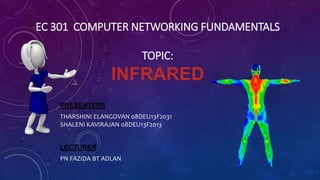
EC 301 COMPUTER NETWORKING FUNDAMENTALS
TOPIC:
INFRARED
PRESENTERS
THARSHINI ELANGOVAN 08DEU13F2031
SHALENI KAVIRAJAN 08DEU13F2013
LECTURER
PN FAZIDA BT ADLAN
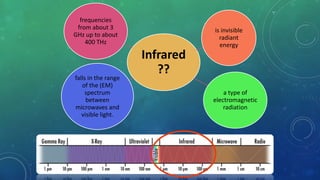
Infrared
??
is invisible
radiant
energy
a type of
electromagnetic
radiation
falls in the range
of the (EM)
spectrum
between
microwaves and
visible light.
frequencies
from about 3
GHz up to about
400 THz
ORIGIN OF “INFRARED”
 The name means below red, the Latin infra meaning "below".
 Red is the color of the longest wavelengths of visible light.
Infrared light has a longer wavelength (and so a lower frequency)
than that of red light visible to humans, hence the literal meaning of
below red.
 INFRARED=INFRA+RED
HISTORY OF INFRARED
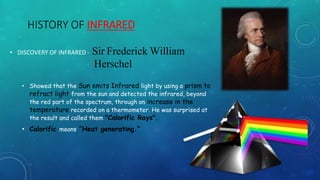
• DISCOVERY OF INFRARED - Sir Frederick William
Herschel
• Showed that the Sun emits Infrared light by using a prism to
refract light from the sun and detected the infrared, beyond
the red part of the spectrum, through an increase in the
temperature recorded on a thermometer. He was surprised at
the result and called them "Calorific Rays".
• Calorific means “Heat generating.”
WHERE IS INFRARED RADIATION FOUND?
• Infrared waves are emitted by all warm objects. They also heat
up the objects on which they fall. When they fall on any
substances, the molecules in the substances absorb this energy
and get excited and as a result of this, the substance gets heated.
• A very good example is the earth. Earth gets heated up, due to
the infrared radiation falling on it from the Sun.
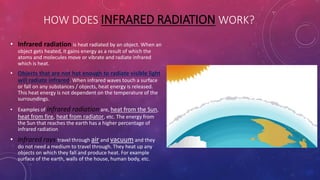
HOW DOES INFRARED RADIATION WORK?
• Infrared radiation is heat radiated by an object. When an
object gets heated, it gains energy as a result of which the
atoms and molecules move or vibrate and radiate infrared
which is heat.
• Objects that are not hot enough to radiate visible light
will radiate infrared. When infrared waves touch a surface
or fall on any substances / objects, heat energy is released.
This heat energy is not dependent on the temperature of the
surroundings.
• Examples of infrared radiation are, heat from the Sun,
heat from fire, heat from radiator, etc. The energy from
the Sun that reaches the earth has a higher percentage of
infrared radiation
• Infrared rays travel through air and vacuum and they
do not need a medium to travel through. They heat up any
objects on which they fall and produce heat. For example
surface of the earth, walls of the house, human body, etc.
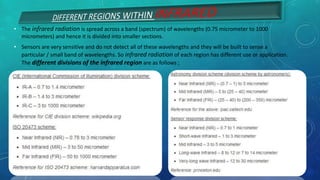
• The infrared radiation is spread across a band (spectrum) of wavelengths (0.75 micrometer to 1000
micrometers) and hence it is divided into smaller sections.
• Sensors are very sensitive and do not detect all of these wavelengths and they will be built to sense a
particular / small band of wavelengths. So infrared radiation of each region has different use or application.
The different divisions of the infrared region are as follows ;
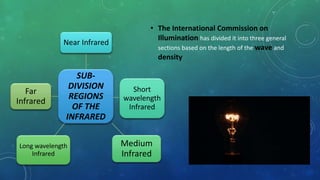
SUB-
DIVISION
REGIONS
OF THE
INFRARED
Near Infrared
Short
wavelength
Infrared
Medium
Infrared
Long wavelength
Infrared
Far
Infrared
• The International Commission on
Illumination has divided it into three general
sections based on the length of the wave and
density
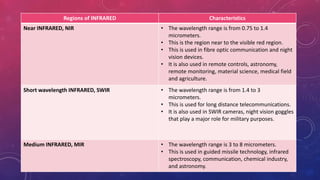
Regions of INFRARED Characteristics
Near INFRARED, NIR • The wavelength range is from 0.75 to 1.4
micrometers.
• This is the region near to the visible red region.
• This is used in fibre optic communication and night
vision devices.
• It is also used in remote controls, astronomy,
remote monitoring, material science, medical field
and agriculture.
Short wavelength INFRARED, SWIR • The wavelength range is from 1.4 to 3
micrometers.
• This is used for long distance telecommunications.
• It is also used in SWIR cameras, night vision goggles
that play a major role for military purposes.
Medium INFRARED, MIR • The wavelength range is 3 to 8 micrometers.
• This is used in guided missile technology, infrared
spectroscopy, communication, chemical industry,
and astronomy.
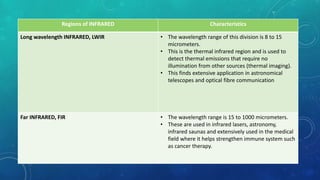
Regions of INFRARED Characteristics
Long wavelength INFRARED, LWIR • The wavelength range of this division is 8 to 15
micrometers.
• This is the thermal infrared region and is used to
detect thermal emissions that require no
illumination from other sources (thermal imaging).
• This finds extensive application in astronomical
telescopes and optical fibre communication
Far INFRARED, FIR • The wavelength range is 15 to 1000 micrometers.
• These are used in infrared lasers, astronomy,
infrared saunas and extensively used in the medical
field where it helps strengthen immune system such
as cancer therapy.
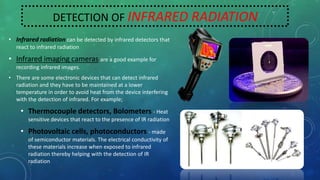
DETECTION OF INFRARED RADIATION
• Infrared radiation can be detected by infrared detectors that
react to infrared radiation
• Infrared imaging cameras are a good example for
recording infrared images.
• There are some electronic devices that can detect infrared
radiation and they have to be maintained at a lower
temperature in order to avoid heat from the device interfering
with the detection of infrared. For example;
• Thermocouple detectors, Bolometers - Heat
sensitive devices that react to the presence of IR radiation
• Photovoltaic cells, photoconductors - made
of semiconductor materials. The electrical conductivity of
these materials increase when exposed to infrared
radiation thereby helping with the detection of IR
radiation
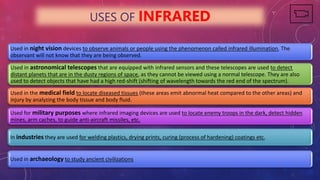
USES OF INFRARED
Used in night vision devices to observe animals or people using the phenomenon called infrared illumination. The
observant will not know that they are being observed.
Used in astronomical telescopes that are equipped with infrared sensors and these telescopes are used to detect
distant planets that are in the dusty regions of space, as they cannot be viewed using a normal telescope. They are also
used to detect objects that have had a high red-shift (shifting of wavelength towards the red end of the spectrum).
Used in the medical field to locate diseased tissues (these areas emit abnormal heat compared to the other areas) and
injury by analyzing the body tissue and body fluid.
Used for military purposes where infrared imaging devices are used to locate enemy troops in the dark, detect hidden
mines, arm caches, to guide anti-aircraft missiles, etc.
In industries they are used for welding plastics, drying prints, curing (process of hardening) coatings etc.
Used in archaeology to study ancient civilizations
APPLICATIONS OF INFRARED
COMMUNICATION
In infrared transmission,
beaming is the communication of
data between wireless devices
using a beam of infrared light. This
beam, invisible to humans, is used
in many familiar devices, such as
television remote controls and
garage door openers.
HEALTH CARE
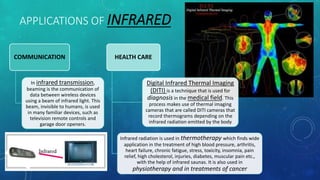
Digital Infrared Thermal Imaging
(DITI) is a technique that is used for
diagnosis in the medical field. This
process makes use of thermal imaging
cameras that are called DITI cameras that
record thermograms depending on the
infrared radiation emitted by the body
Infrared radiation is used in thermotherapy which finds wide
application in the treatment of high blood pressure, arthritis,
heart failure, chronic fatigue, stress, toxicity, insomnia, pain
relief, high cholesterol, injuries, diabetes, muscular pain etc.,
with the help of infrared saunas. It is also used in
physiotherapy and in treatments of cancer
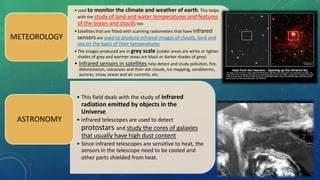
•used to monitor the climate and weather of earth. This helps
with the study of land and water temperatures and features
of the ocean and clouds too
•Satellites that are fitted with scanning radiometers that have infrared
sensors are used to produce infrared images of clouds, land and
sea on the basis of their temperatures
•The images produced are in grey scale (colder areas are white or lighter
shades of grey and warmer areas are black or darker shades of grey)
• Infrared sensors in satellites help detect and study pollution, fire,
deforestation, volcanoes and their ash clouds, ice mapping, sandstorms,
auroras, snow, ocean and air currents, etc.
METEOROLOGY
• This field deals with the study of infrared
radiation emitted by objects in the
Universe.
• infrared telescopes are used to detect
protostars and study the cores of galaxies
that usually have high dust content
• Since infrared telescopes are sensitive to heat, the
sensors in the telescope need to be cooled and
other parts shielded from heat.
ASTRONOMY
HEATING
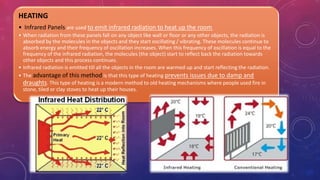
• Infrared Panels are used to emit infrared radiation to heat up the room
• When radiation from these panels fall on any object like wall or floor or any other objects, the radiation is
absorbed by the molecules in the objects and they start oscillating / vibrating. These molecules continue to
absorb energy and their frequency of oscillation increases. When this frequency of oscillation is equal to the
frequency of the infrared radiation, the molecules (the object) start to reflect back the radiation towards
other objects and this process continues.
• Infrared radiation is emitted till all the objects in the room are warmed up and start reflecting the radiation.
• The advantage of this method is that this type of heating prevents issues due to damp and
draughts. This type of heating is a modern method to old heating mechanisms where people used fire in
stone, tiled or clay stoves to heat up their houses.
TRACKING SYSTEM
This is used on missile
guidance system
where the target is
tracked using the
infrared radiation it
emits
For example, an infrared
emitter (transmitter) is
placed on the object that
needs to be tracked and
signals/radiation from this
emitter are received by
infrared receivers that are
connected to a computer
system with display unit, that
will display the location of
the object.
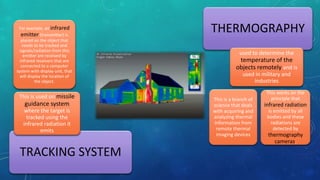
THERMOGRAPHY
used to determine the
temperature of the
objects remotely and is
used in military and
industries
This is a branch of
science that deals
with acquiring and
analyzing thermal
information from
remote thermal
imaging devices
This works on the
principle that
infrared radiation
is emitted by all
bodies and these
radiations are
detected by
thermography
cameras.
Infrared

Infrared

  • 1.
    EC 301 COMPUTERNETWORKING FUNDAMENTALS TOPIC: INFRARED PRESENTERS THARSHINI ELANGOVAN 08DEU13F2031 SHALENI KAVIRAJAN 08DEU13F2013 LECTURER PN FAZIDA BT ADLAN
  • 2.
    Infrared ?? is invisible radiant energy a typeof electromagnetic radiation falls in the range of the (EM) spectrum between microwaves and visible light. frequencies from about 3 GHz up to about 400 THz
  • 3.
    ORIGIN OF “INFRARED” The name means below red, the Latin infra meaning "below".  Red is the color of the longest wavelengths of visible light. Infrared light has a longer wavelength (and so a lower frequency) than that of red light visible to humans, hence the literal meaning of below red.  INFRARED=INFRA+RED
  • 4.
    HISTORY OF INFRARED •DISCOVERY OF INFRARED - Sir Frederick William Herschel • Showed that the Sun emits Infrared light by using a prism to refract light from the sun and detected the infrared, beyond the red part of the spectrum, through an increase in the temperature recorded on a thermometer. He was surprised at the result and called them "Calorific Rays". • Calorific means “Heat generating.”
  • 5.
    WHERE IS INFRAREDRADIATION FOUND? • Infrared waves are emitted by all warm objects. They also heat up the objects on which they fall. When they fall on any substances, the molecules in the substances absorb this energy and get excited and as a result of this, the substance gets heated. • A very good example is the earth. Earth gets heated up, due to the infrared radiation falling on it from the Sun.
  • 6.
    HOW DOES INFRAREDRADIATION WORK? • Infrared radiation is heat radiated by an object. When an object gets heated, it gains energy as a result of which the atoms and molecules move or vibrate and radiate infrared which is heat. • Objects that are not hot enough to radiate visible light will radiate infrared. When infrared waves touch a surface or fall on any substances / objects, heat energy is released. This heat energy is not dependent on the temperature of the surroundings. • Examples of infrared radiation are, heat from the Sun, heat from fire, heat from radiator, etc. The energy from the Sun that reaches the earth has a higher percentage of infrared radiation • Infrared rays travel through air and vacuum and they do not need a medium to travel through. They heat up any objects on which they fall and produce heat. For example surface of the earth, walls of the house, human body, etc.
  • 7.
    • The infraredradiation is spread across a band (spectrum) of wavelengths (0.75 micrometer to 1000 micrometers) and hence it is divided into smaller sections. • Sensors are very sensitive and do not detect all of these wavelengths and they will be built to sense a particular / small band of wavelengths. So infrared radiation of each region has different use or application. The different divisions of the infrared region are as follows ;
  • 8.
    SUB- DIVISION REGIONS OF THE INFRARED Near Infrared Short wavelength Infrared Medium Infrared Longwavelength Infrared Far Infrared • The International Commission on Illumination has divided it into three general sections based on the length of the wave and density
  • 9.
    Regions of INFRAREDCharacteristics Near INFRARED, NIR • The wavelength range is from 0.75 to 1.4 micrometers. • This is the region near to the visible red region. • This is used in fibre optic communication and night vision devices. • It is also used in remote controls, astronomy, remote monitoring, material science, medical field and agriculture. Short wavelength INFRARED, SWIR • The wavelength range is from 1.4 to 3 micrometers. • This is used for long distance telecommunications. • It is also used in SWIR cameras, night vision goggles that play a major role for military purposes. Medium INFRARED, MIR • The wavelength range is 3 to 8 micrometers. • This is used in guided missile technology, infrared spectroscopy, communication, chemical industry, and astronomy.
  • 10.
    Regions of INFRAREDCharacteristics Long wavelength INFRARED, LWIR • The wavelength range of this division is 8 to 15 micrometers. • This is the thermal infrared region and is used to detect thermal emissions that require no illumination from other sources (thermal imaging). • This finds extensive application in astronomical telescopes and optical fibre communication Far INFRARED, FIR • The wavelength range is 15 to 1000 micrometers. • These are used in infrared lasers, astronomy, infrared saunas and extensively used in the medical field where it helps strengthen immune system such as cancer therapy.
  • 11.
    DETECTION OF INFRAREDRADIATION • Infrared radiation can be detected by infrared detectors that react to infrared radiation • Infrared imaging cameras are a good example for recording infrared images. • There are some electronic devices that can detect infrared radiation and they have to be maintained at a lower temperature in order to avoid heat from the device interfering with the detection of infrared. For example; • Thermocouple detectors, Bolometers - Heat sensitive devices that react to the presence of IR radiation • Photovoltaic cells, photoconductors - made of semiconductor materials. The electrical conductivity of these materials increase when exposed to infrared radiation thereby helping with the detection of IR radiation
  • 12.
    USES OF INFRARED Usedin night vision devices to observe animals or people using the phenomenon called infrared illumination. The observant will not know that they are being observed. Used in astronomical telescopes that are equipped with infrared sensors and these telescopes are used to detect distant planets that are in the dusty regions of space, as they cannot be viewed using a normal telescope. They are also used to detect objects that have had a high red-shift (shifting of wavelength towards the red end of the spectrum). Used in the medical field to locate diseased tissues (these areas emit abnormal heat compared to the other areas) and injury by analyzing the body tissue and body fluid. Used for military purposes where infrared imaging devices are used to locate enemy troops in the dark, detect hidden mines, arm caches, to guide anti-aircraft missiles, etc. In industries they are used for welding plastics, drying prints, curing (process of hardening) coatings etc. Used in archaeology to study ancient civilizations
  • 13.
    APPLICATIONS OF INFRARED COMMUNICATION Ininfrared transmission, beaming is the communication of data between wireless devices using a beam of infrared light. This beam, invisible to humans, is used in many familiar devices, such as television remote controls and garage door openers. HEALTH CARE Digital Infrared Thermal Imaging (DITI) is a technique that is used for diagnosis in the medical field. This process makes use of thermal imaging cameras that are called DITI cameras that record thermograms depending on the infrared radiation emitted by the body Infrared radiation is used in thermotherapy which finds wide application in the treatment of high blood pressure, arthritis, heart failure, chronic fatigue, stress, toxicity, insomnia, pain relief, high cholesterol, injuries, diabetes, muscular pain etc., with the help of infrared saunas. It is also used in physiotherapy and in treatments of cancer
  • 14.
    •used to monitorthe climate and weather of earth. This helps with the study of land and water temperatures and features of the ocean and clouds too •Satellites that are fitted with scanning radiometers that have infrared sensors are used to produce infrared images of clouds, land and sea on the basis of their temperatures •The images produced are in grey scale (colder areas are white or lighter shades of grey and warmer areas are black or darker shades of grey) • Infrared sensors in satellites help detect and study pollution, fire, deforestation, volcanoes and their ash clouds, ice mapping, sandstorms, auroras, snow, ocean and air currents, etc. METEOROLOGY • This field deals with the study of infrared radiation emitted by objects in the Universe. • infrared telescopes are used to detect protostars and study the cores of galaxies that usually have high dust content • Since infrared telescopes are sensitive to heat, the sensors in the telescope need to be cooled and other parts shielded from heat. ASTRONOMY
  • 15.
    HEATING • Infrared Panelsare used to emit infrared radiation to heat up the room • When radiation from these panels fall on any object like wall or floor or any other objects, the radiation is absorbed by the molecules in the objects and they start oscillating / vibrating. These molecules continue to absorb energy and their frequency of oscillation increases. When this frequency of oscillation is equal to the frequency of the infrared radiation, the molecules (the object) start to reflect back the radiation towards other objects and this process continues. • Infrared radiation is emitted till all the objects in the room are warmed up and start reflecting the radiation. • The advantage of this method is that this type of heating prevents issues due to damp and draughts. This type of heating is a modern method to old heating mechanisms where people used fire in stone, tiled or clay stoves to heat up their houses.
  • 16.
    TRACKING SYSTEM This isused on missile guidance system where the target is tracked using the infrared radiation it emits For example, an infrared emitter (transmitter) is placed on the object that needs to be tracked and signals/radiation from this emitter are received by infrared receivers that are connected to a computer system with display unit, that will display the location of the object. THERMOGRAPHY used to determine the temperature of the objects remotely and is used in military and industries This is a branch of science that deals with acquiring and analyzing thermal information from remote thermal imaging devices This works on the principle that infrared radiation is emitted by all bodies and these radiations are detected by thermography cameras.