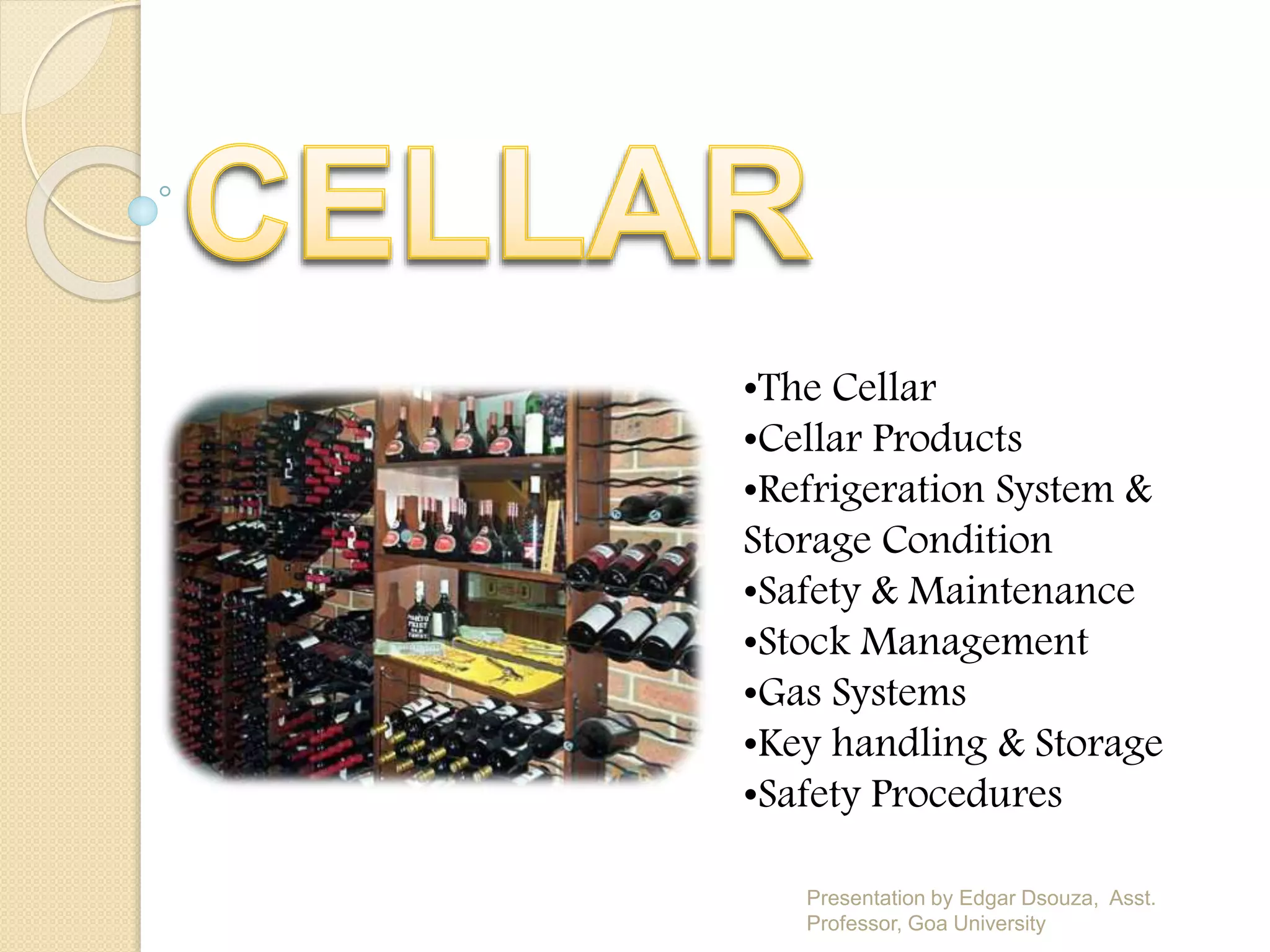
•The Cellar 
•Cellar Products 
•Refrigeration System & 
Storage Condition 
•Safety & Maintenance 
•Stock Management 
•Gas Systems 
•Key handling & Storage 
•Safety Procedures 
Presentation by Edgar Dsouza, Asst. 
Professor, Goa University
Introduction 
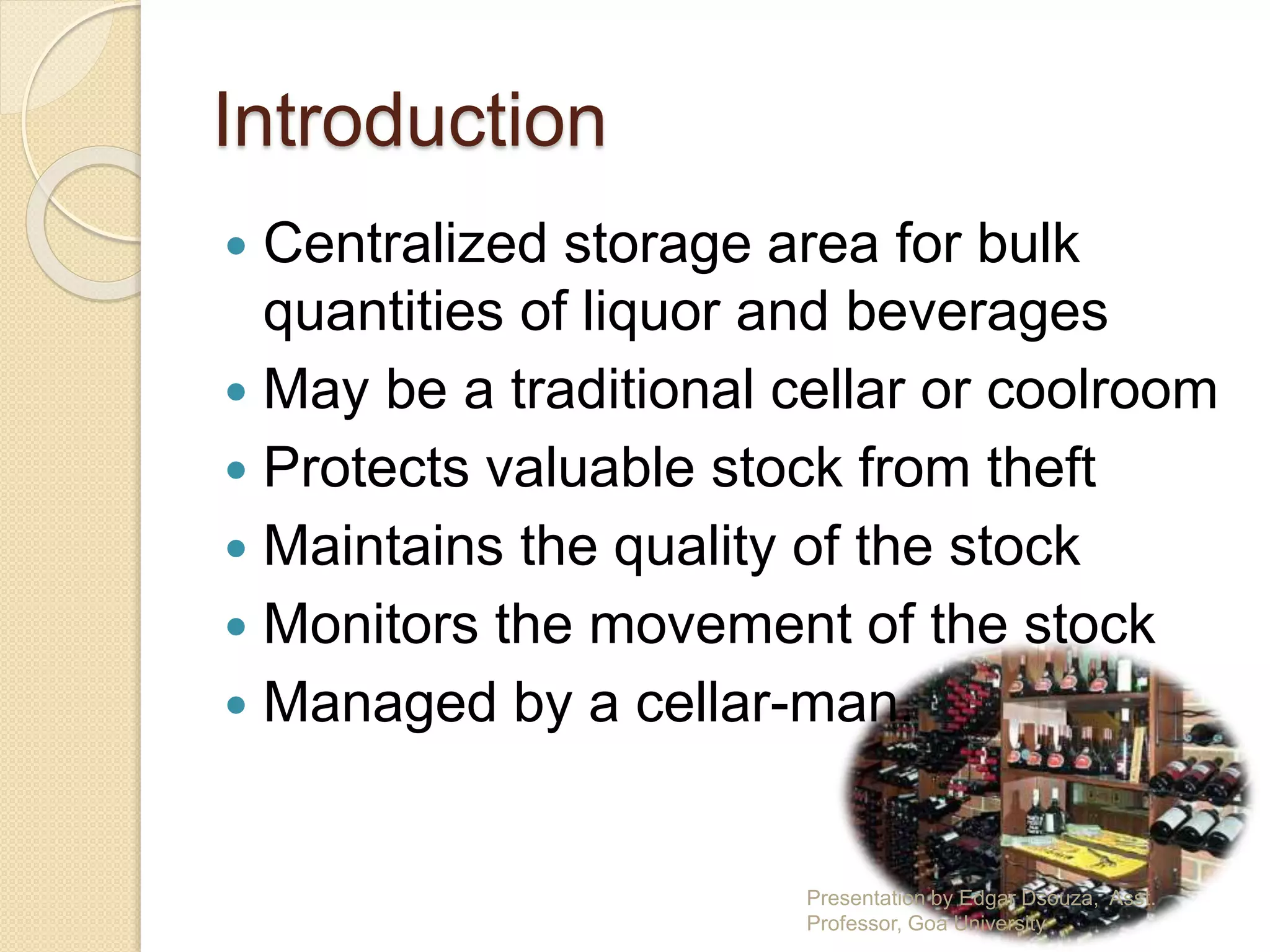
 Centralized storage area for bulk 
quantities of liquor and beverages 
 May be a traditional cellar or coolroom 
 Protects valuable stock from theft 
 Maintains the quality of the stock 
 Monitors the movement of the stock 
 Managed by a cellar-man. 
Presentation by Edgar Dsouza, Asst. 
Professor, Goa University
Main responsibilities of a Cellar-man 
 Stock the cellar with adequate supply 
 Ensure uninterrupted supply to bars 
 Store alcohol at appropriate temperatures 
to prevent spoilage 
 Issuing against authorized requisitions 
 Update the records of the cellar 
 Protect the stock from theft & other 
malpractices. 
Presentation by Edgar Dsouza, Asst. 
Professor, Goa University
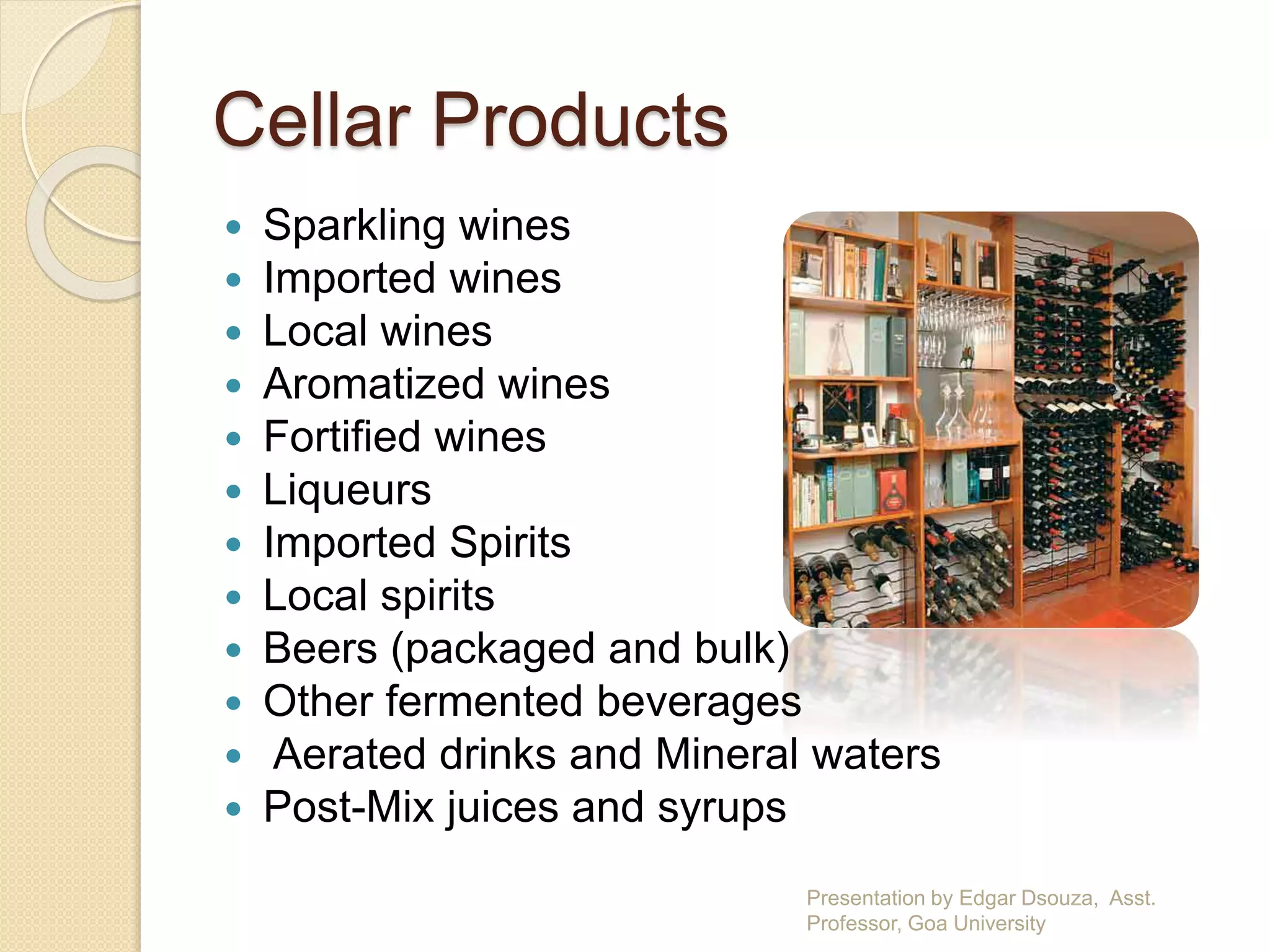
Cellar Products 
 There are 2 main categories of alcoholic 
beverages 
1. Fermented 
2. Distilled 
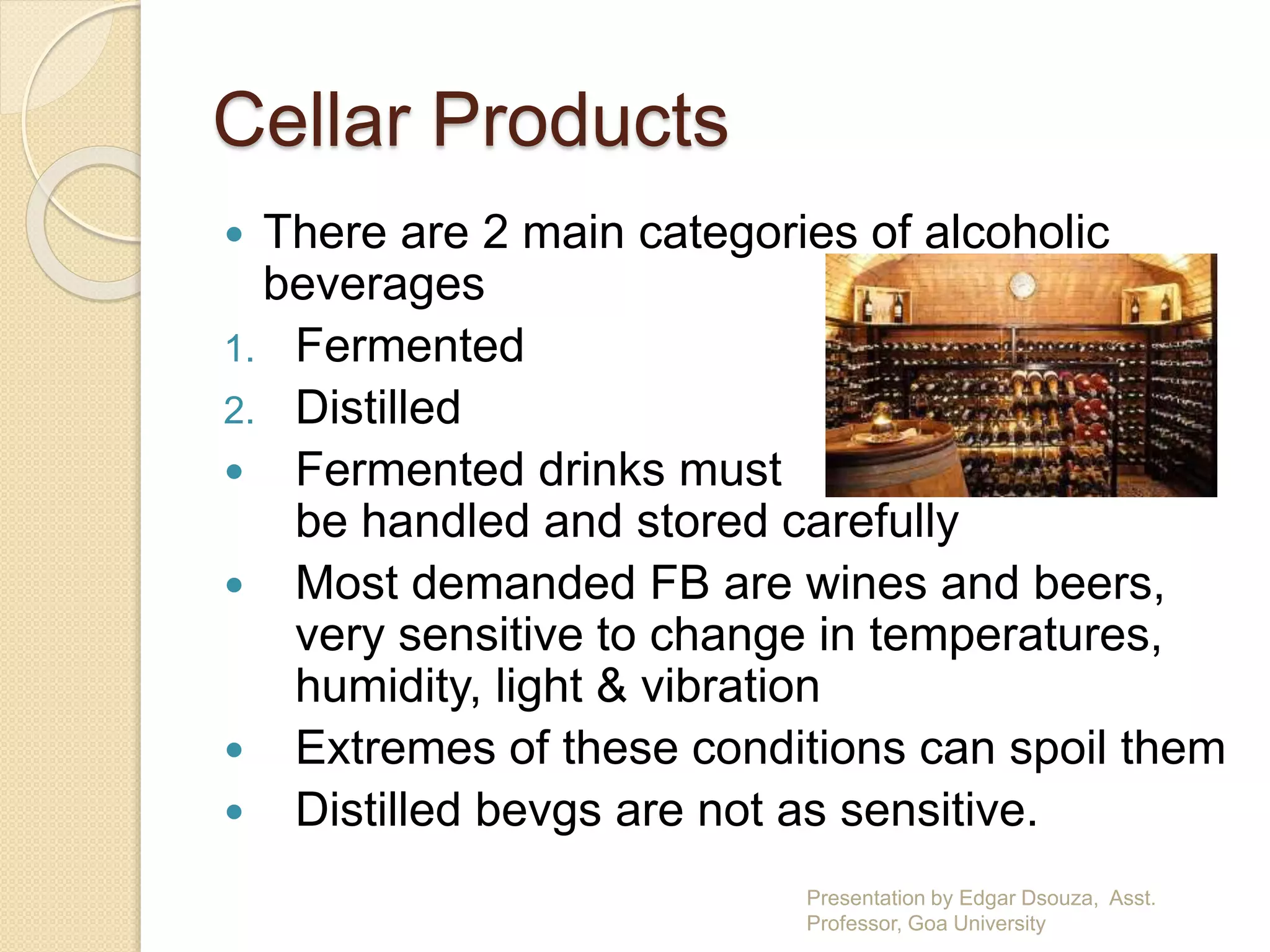
 Fermented drinks must 
be handled and stored carefully 
 Most demanded FB are wines and beers, 
very sensitive to change in temperatures, 
humidity, light & vibration 
 Extremes of these conditions can spoil them 
 Distilled bevgs are not as sensitive. 
Presentation by Edgar Dsouza, Asst. 
Professor, Goa University
Cellar Products 
 Sparkling wines 
 Imported wines 
 Local wines 
 Aromatized wines 
 Fortified wines 
 Liqueurs 
 Imported Spirits 
 Local spirits 
 Beers (packaged and bulk) 
 Other fermented beverages 
 Aerated drinks and Mineral waters 
 Post-Mix juices and syrups 
Presentation by Edgar Dsouza, Asst. 
Professor, Goa University
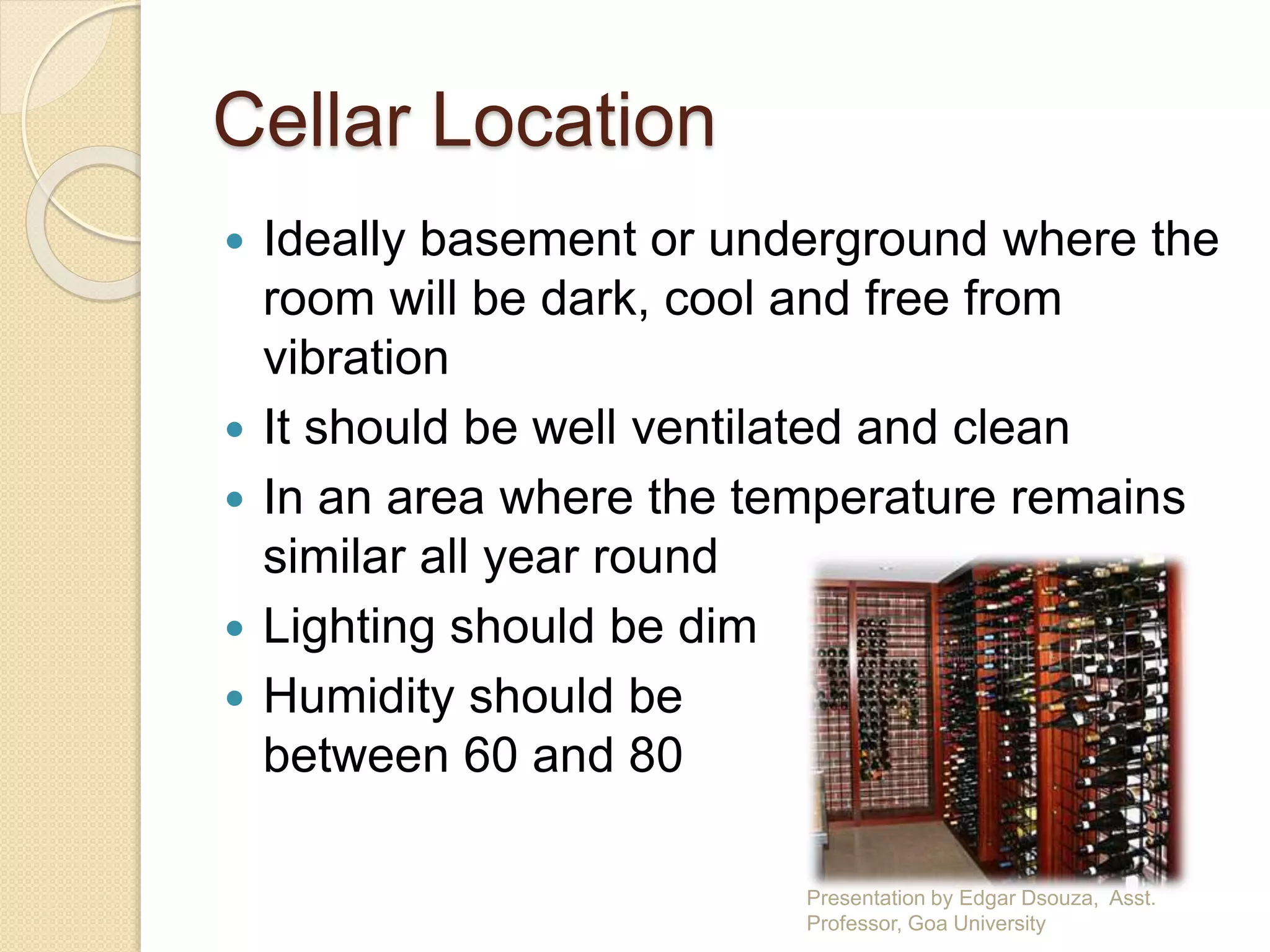
Cellar Location 
 Ideally basement or underground where the 
room will be dark, cool and free from 
vibration 
 It should be well ventilated and clean 
 In an area where the temperature remains 
similar all year round 
 Lighting should be dim 
 Humidity should be 
between 60 and 80 
Presentation by Edgar Dsouza, Asst. 
Professor, Goa University
Areas & Temperatures 
 Area for storing spirits, red wines and keg 
beers (Front part of cellar where issues are 
made) : 13 -16°C (55-60°F) 
 Refrigerated area for storing sparkling, 
white and rose wines: 10°C (50°F) 
 Optional area if movement of keg beer is 
slow: 6 - 8°C (43 - 47°F) 
 Bottled beers and aerated beverages: 
12.5°C (55°F) 
 Unrefrigerated area for receiving empties 
Presentation by Edgar Dsouza, Asst. 
Professor, Goa University
Storage Procedures 
 Unopened bottle cases are stored at lower level 
 Opened cases should be emptied and stored 
using FIFO 
 All table wines are stored horizontally with label 
facing up. 
 Fortified wines are stored upright (except vintage 
Port) 
 If the bottle has a faulty cork and shows signs of 
leakage, its should be returned 
 Store Sparking, white & rose wines in the coolest 
areas or nearest to the floors 
 Reds should be stored near the ceiling since 
warm air rises. 
Presentation by Edgar Dsouza, Asst. 
Professor, Goa University
Storage Procedures 
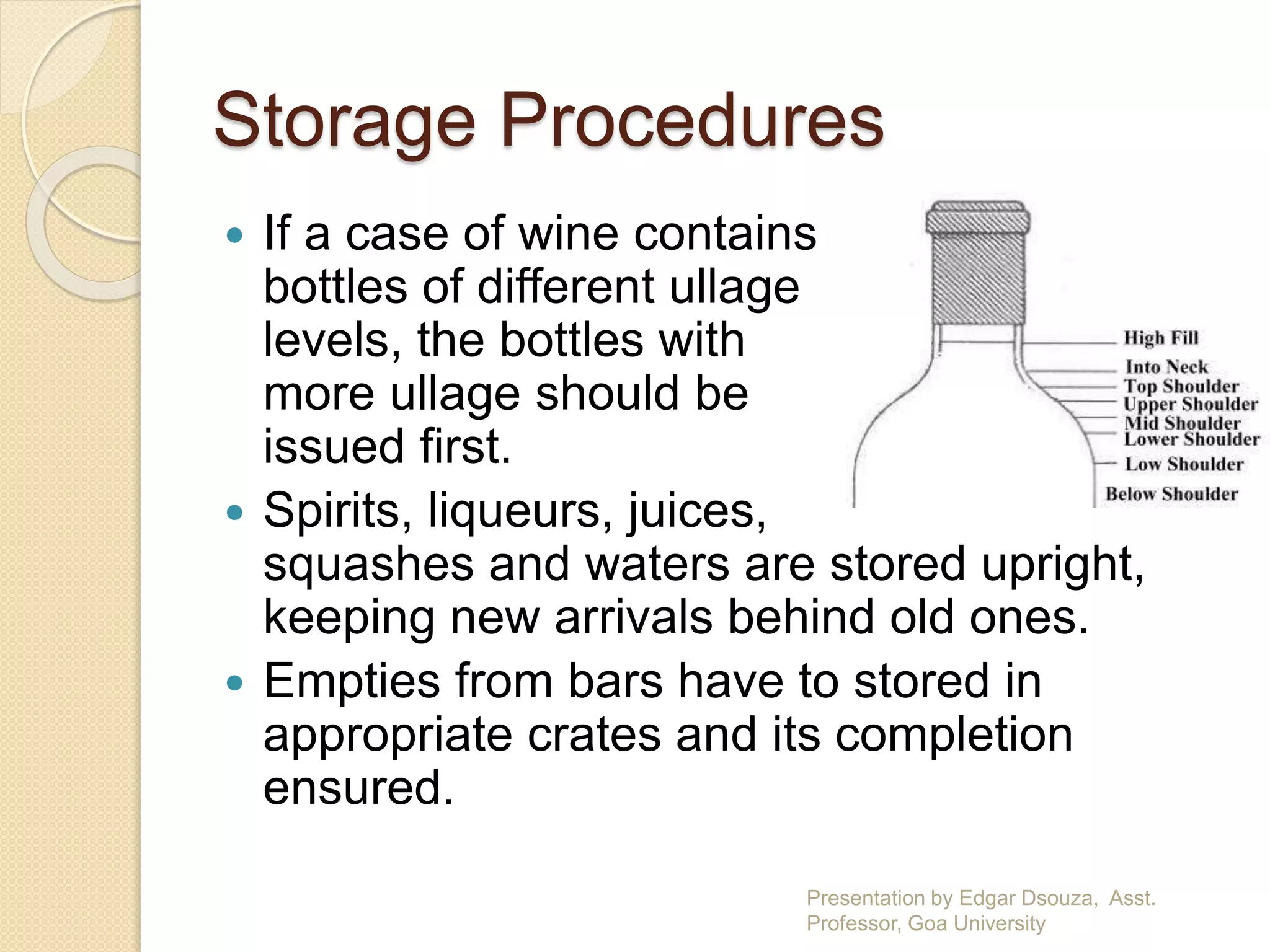
 If a case of wine contains 
bottles of different ullage 
levels, the bottles with 
more ullage should be 
issued first. 
 Spirits, liqueurs, juices, 
squashes and waters are stored upright, 
keeping new arrivals behind old ones. 
 Empties from bars have to stored in 
appropriate crates and its completion 
ensured. 
Presentation by Edgar Dsouza, Asst. 
Professor, Goa University
Refrigeration Systems 
 Refrigeration systems operate on the same 
principal as boiling water. A “refrigerant” is 
used instead of water 
 The refrigerant remains within the system, 
absorbing heat, turning to gas, releasing the 
heat, cooling and being compressed to liquid 
in a continuous cycle. 
 Major parts of the system are Internal 
Evaporator and External Condensing Unit 
 The Condensing unit consists of a 
compressor and a condenser. 
Presentation by Edgar Dsouza, Asst. 
Professor, Goa University
Coolroom refrigeration 
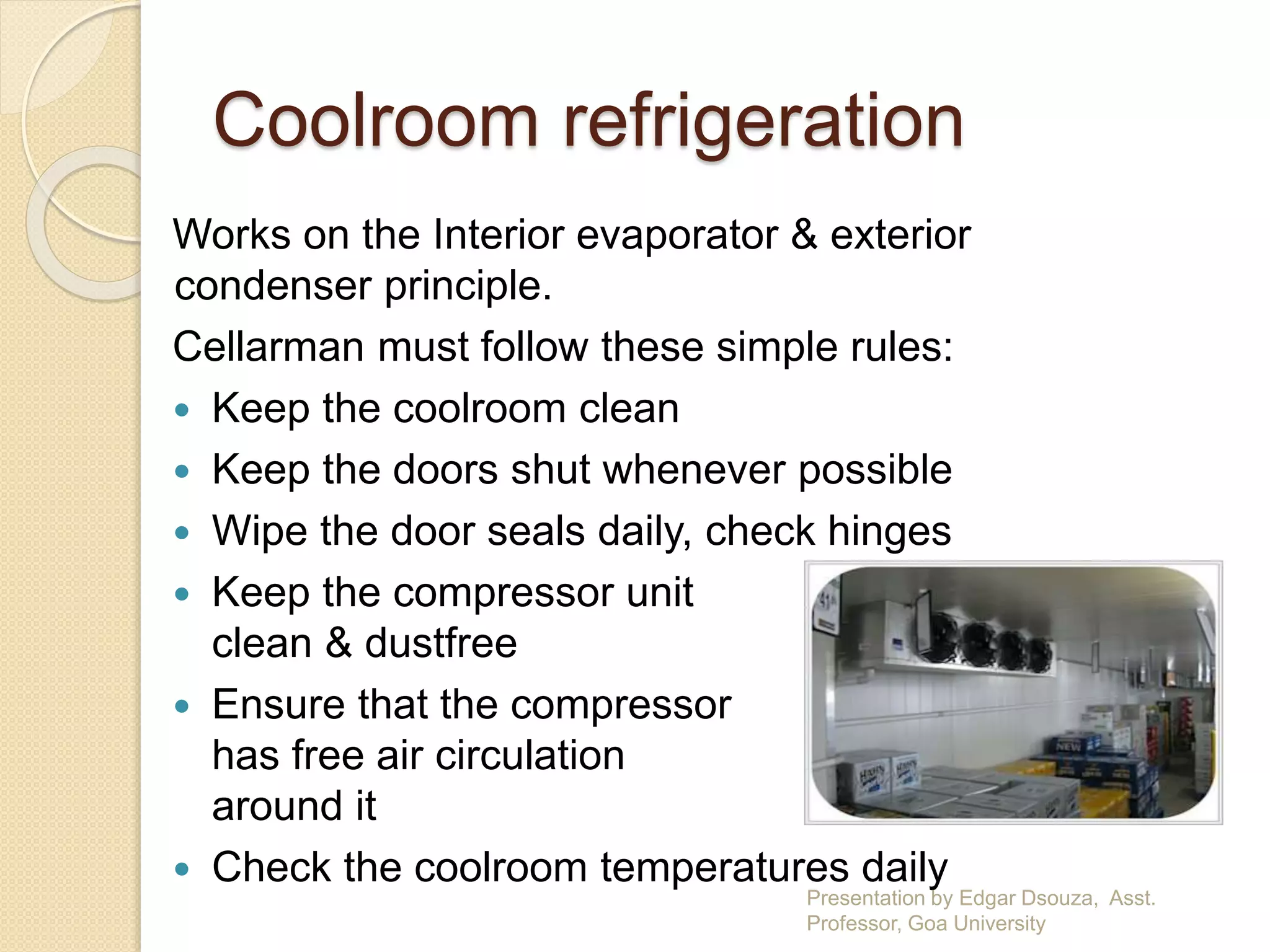
Works on the Interior evaporator & exterior 
condenser principle. 
Cellarman must follow these simple rules: 
 Keep the coolroom clean 
 Keep the doors shut whenever possible 
 Wipe the door seals daily, check hinges 
 Keep the compressor unit 
clean & dustfree 
 Ensure that the compressor 
has free air circulation 
around it 
 Check the coolroom temperatures daily 
Presentation by Edgar Dsouza, Asst. 
Professor, Goa University
Safety & maintenance 
 Turn off all machinery before working on it 
 Fan belts should be covered by safety cages 
at all times 
 Most coolroom accidents results from staff 
getting their hands or clothes caught in the 
fan belts 
 Worn or loose fan belts can result in 
accidents 
 All maintenance work should be carried out 
by qualified refrigeration and electrical 
mechanics 
 The heat exchangers must be inspected bi-monthly 
to ensure they are dust free. 
Presentation by Edgar Dsouza, Asst. 
Professor, Goa University
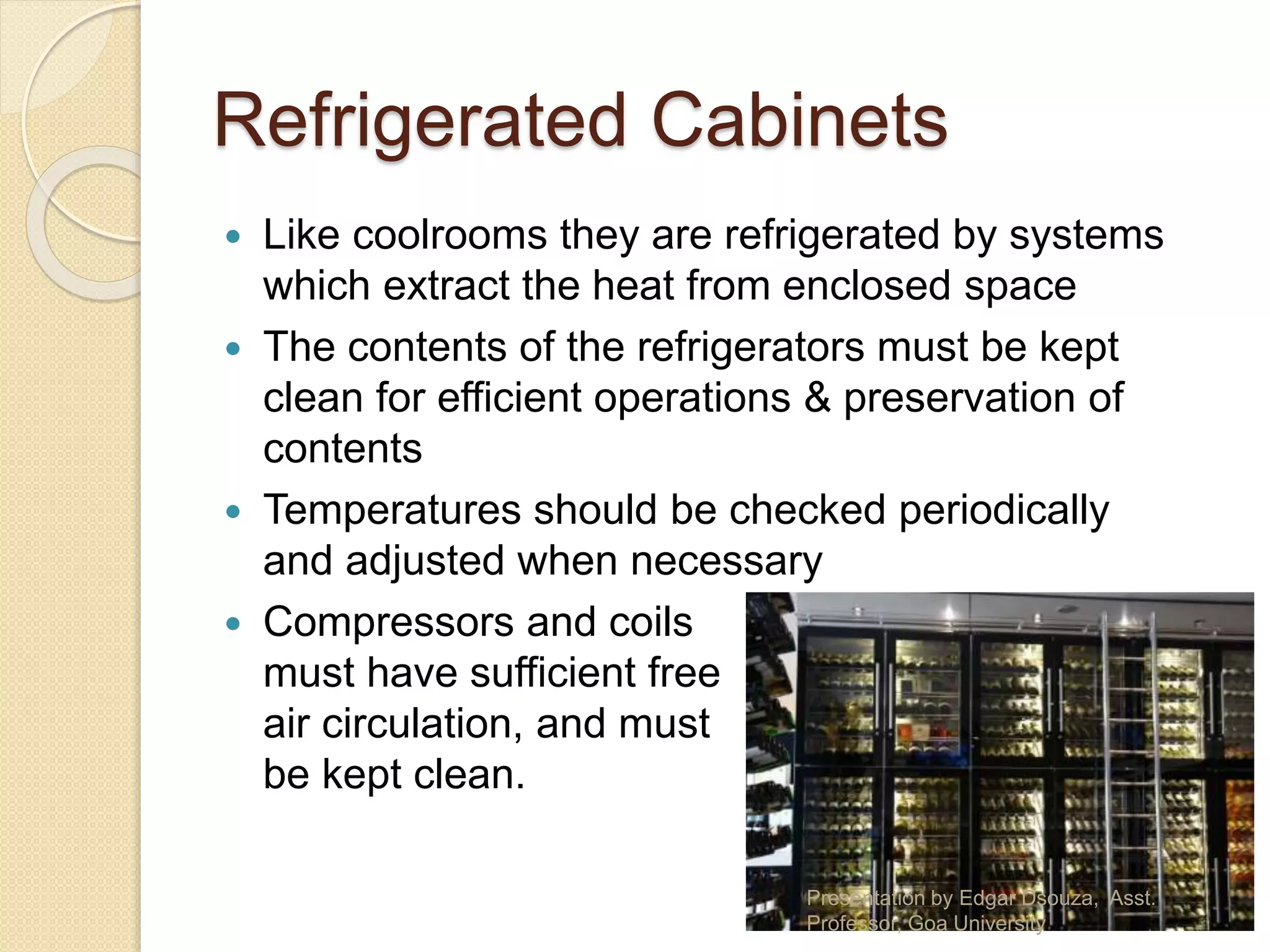
Refrigerated Cabinets 
 Like coolrooms they are refrigerated by systems 
which extract the heat from enclosed space 
 The contents of the refrigerators must be kept 
clean for efficient operations & preservation of 
contents 
 Temperatures should be checked periodically 
and adjusted when necessary 
 Compressors and coils 
must have sufficient free 
air circulation, and must 
be kept clean. 
Presentation by Edgar Dsouza, Asst. 
Professor, Goa University
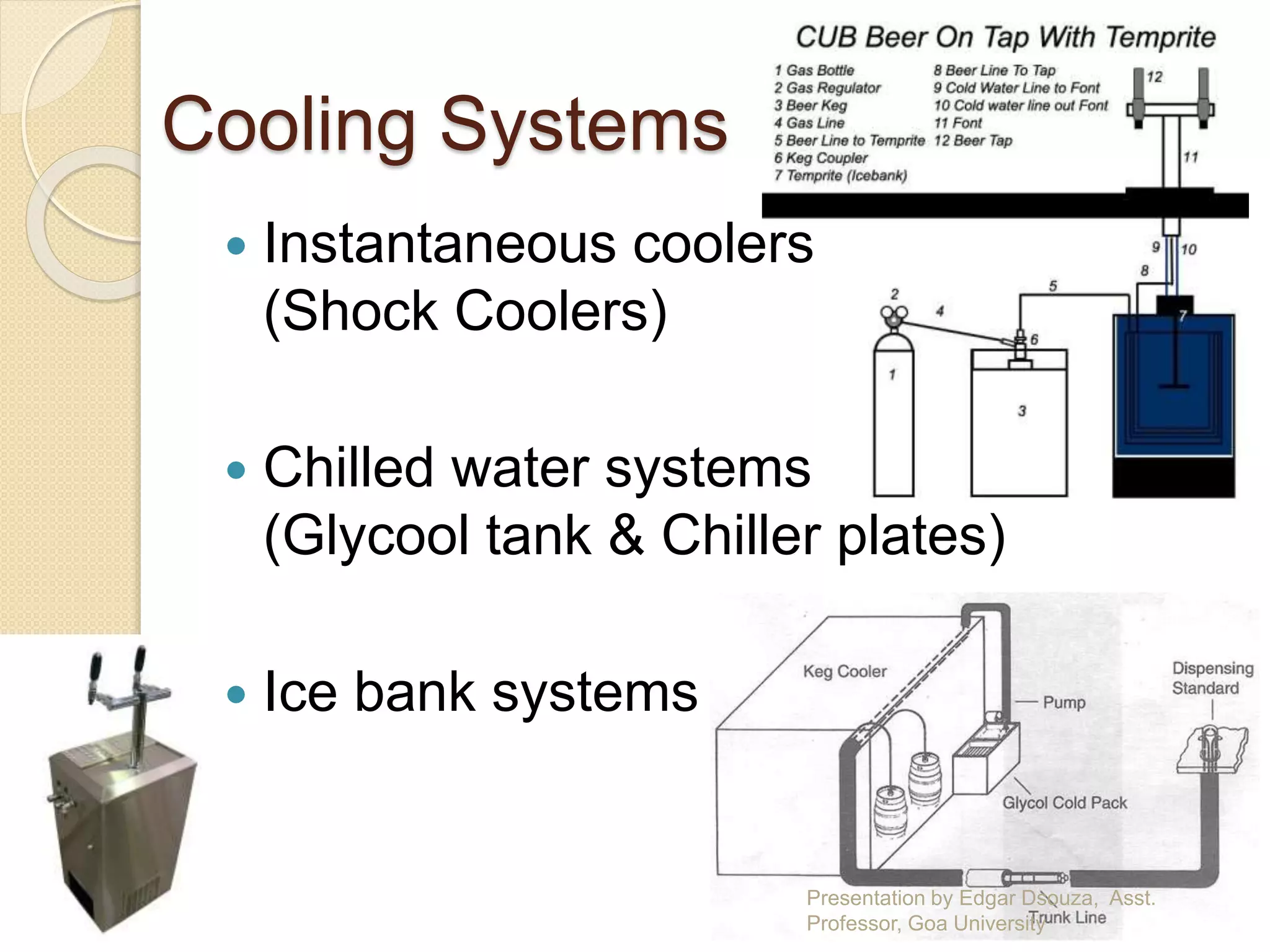
Cooling Systems 
 Instantaneous coolers 
(Shock Coolers) 
 Chilled water systems 
(Glycool tank & Chiller plates) 
 Ice bank systems 
Presentation by Edgar Dsouza, Asst. 
Professor, Goa University
Stock Management 
 To make sure adequate stocks are available 
when required 
 To make sure that too much stock is not held 
 To make sure that stock is kept in top 
condition 
 To make sure that stock is rotated 
 To prevent and discover theft, loss and 
wastage 
 To ascertain the value of stock for the 
purpose of calculating P&L 
 To analyze changes in taste & sales patterns 
Presentation by Edgar Dsouza, Asst. 
Professor, Goa University
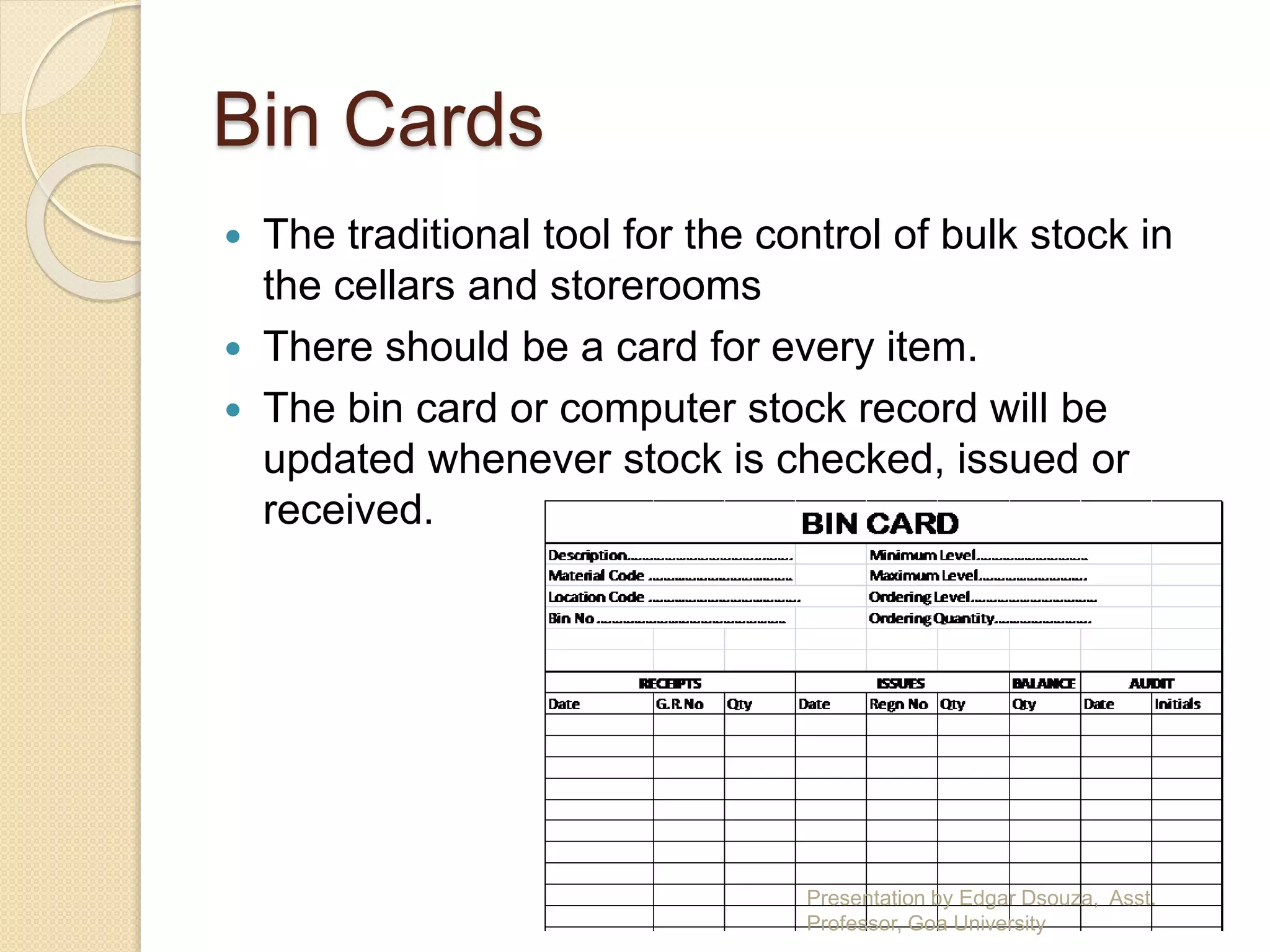
Bin Cards 
 The traditional tool for the control of bulk stock in 
the cellars and storerooms 
 There should be a card for every item. 
 The bin card or computer stock record will be 
updated whenever stock is checked, issued or 
received. 
Presentation by Edgar Dsouza, Asst. 
Professor, Goa University
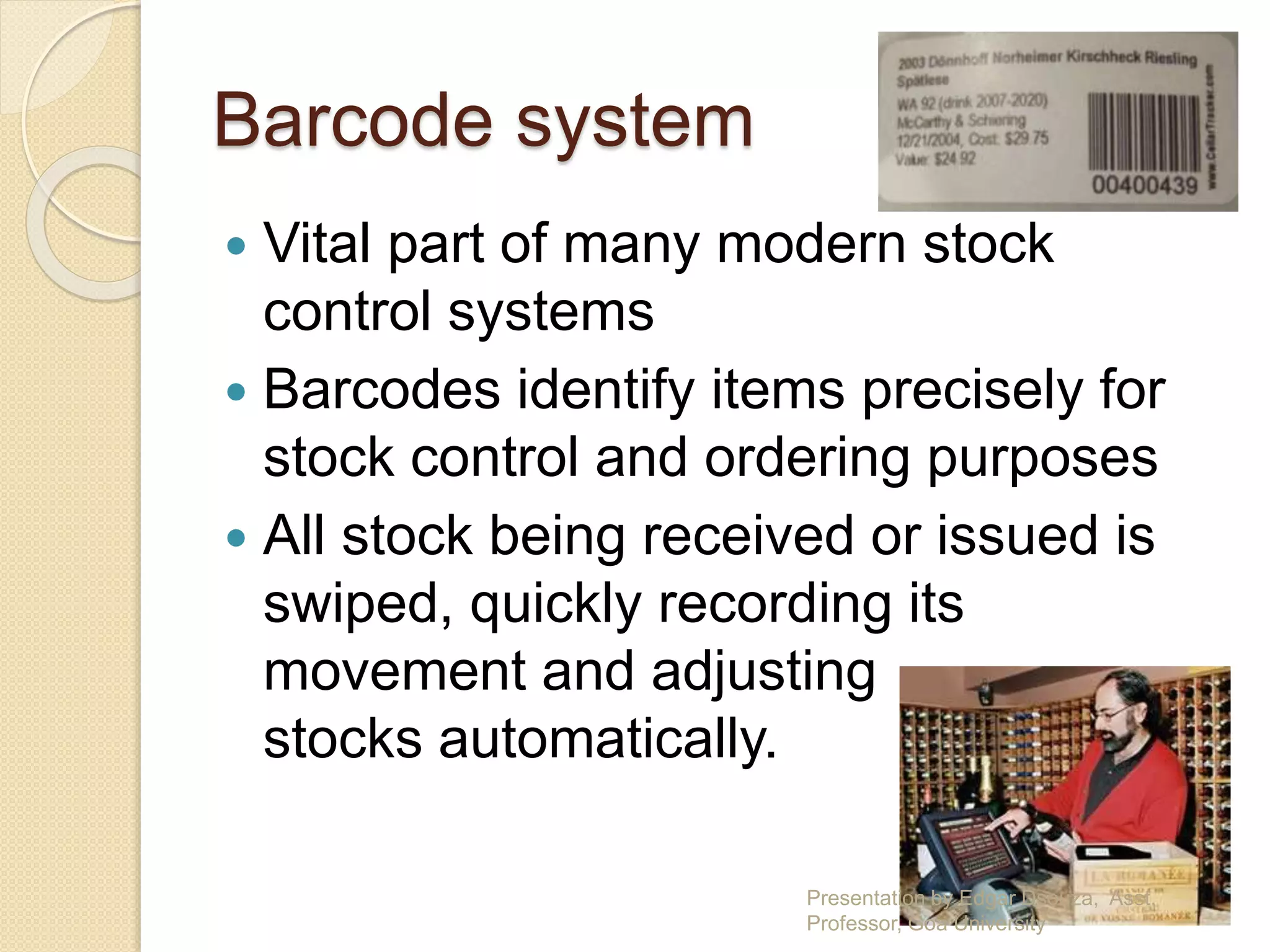
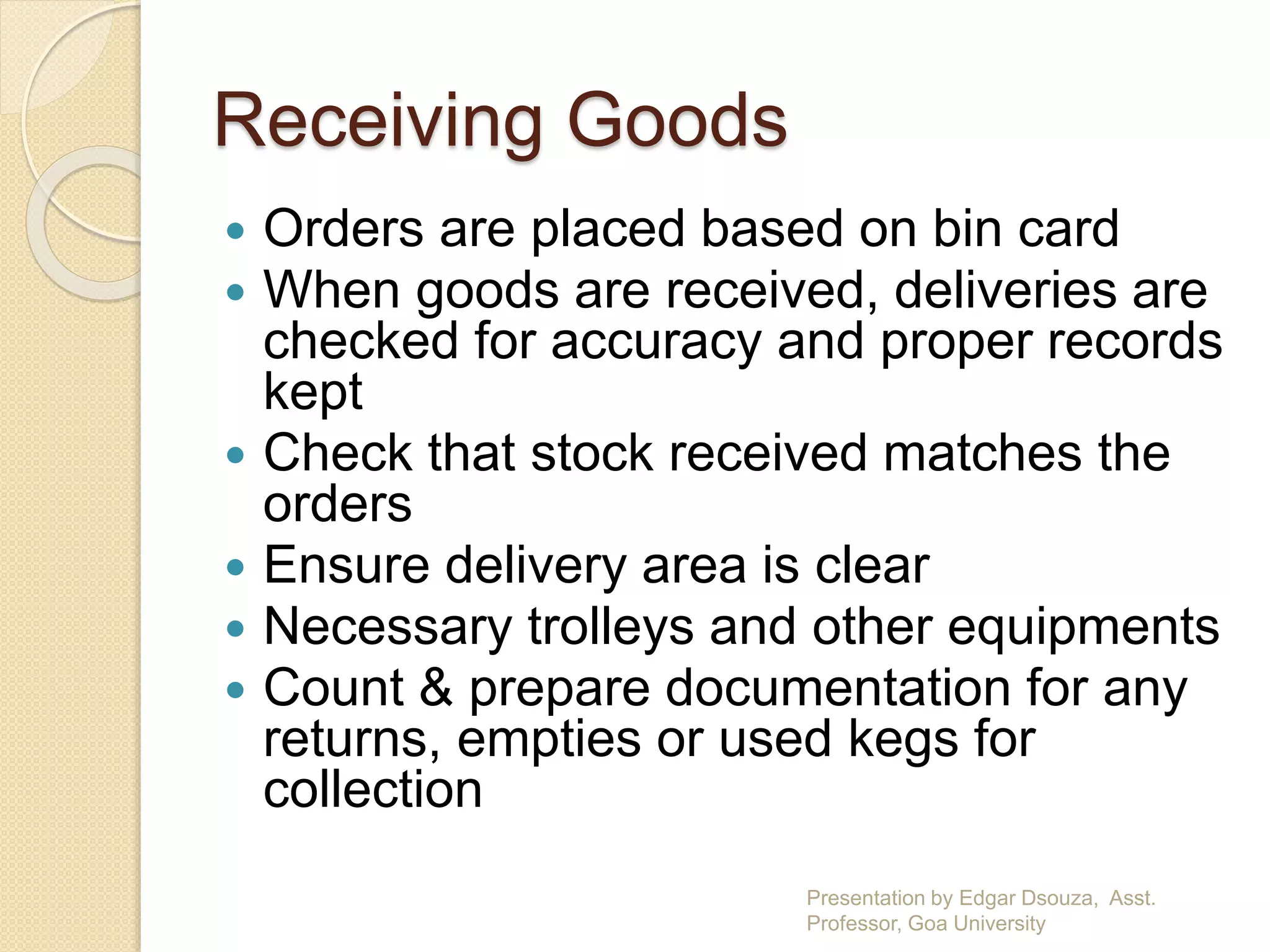
Barcode system 
 Vital part of many modern stock 
control systems 
 Barcodes identify items precisely for 
stock control and ordering purposes 
 All stock being received or issued is 
swiped, quickly recording its 
movement and adjusting 
stocks automatically. 
Presentation by Edgar Dsouza, Asst. 
Professor, Goa University
Receiving Goods 
 Orders are placed based on bin card 
 When goods are received, deliveries are 
checked for accuracy and proper records 
kept 
 Check that stock received matches the 
orders 
 Ensure delivery area is clear 
 Necessary trolleys and other equipments 
 Count & prepare documentation for any 
returns, empties or used kegs for 
collection 
Presentation by Edgar Dsouza, Asst. 
Professor, Goa University
Checking & Signing for deliveries 
 Goods delivered must be 
accompanied by a delivery note or 
copy of the invoice 
 Check that the items on delivery note 
tally, tick & count. 
 Check the goods- correct brand, size, 
package etc 
 If there are discrepancies they should 
be correctly noted in the delivery note. 
 Sign the delivery note if accurate 
Presentation by Edgar Dsouza, Asst. 
Professor, Goa University
Stock leaving the cellar 
 Records must be kept of goods which leave 
the cellar (dispatches) 
 Cellar stock must go to bars, restaurants, or 
may leave the premises 
 Stock should be issued against requisitions 
and staff should check the receipt of stock 
 Returnable items, containers, empty kegs, 
gas cylinders have to be returned to 
suppliers, records are kept of it 
 The documentary records of receipts and 
dispatches is used to update the bin cards or 
computer records 
Presentation by Edgar Dsouza, Asst. 
Professor, Goa University
Storage of Goods in the Cellar 
 Goods stored must be accessible and safe 
 Passage ways to goods must be kept clean 
and clear 
 Stock must be stocked neatly to allow proper 
stock rotation 
 Stacked based on FIFO, it must also be easy 
to see how old it is. 
 Cartons, crates and boxes should be stacked 
clear of the floors on pallets to make sure that 
they don’t get damp 
 Stacks of cartons should not be more than 15 
Presentation by Edgar Dsouza, Asst. 
Professor, Goa University

Cellar Management

  • 1.
    •The Cellar •CellarProducts •Refrigeration System & Storage Condition •Safety & Maintenance •Stock Management •Gas Systems •Key handling & Storage •Safety Procedures Presentation by Edgar Dsouza, Asst. Professor, Goa University
  • 2.
    Introduction  Centralizedstorage area for bulk quantities of liquor and beverages  May be a traditional cellar or coolroom  Protects valuable stock from theft  Maintains the quality of the stock  Monitors the movement of the stock  Managed by a cellar-man. Presentation by Edgar Dsouza, Asst. Professor, Goa University
  • 3.
    Main responsibilities ofa Cellar-man  Stock the cellar with adequate supply  Ensure uninterrupted supply to bars  Store alcohol at appropriate temperatures to prevent spoilage  Issuing against authorized requisitions  Update the records of the cellar  Protect the stock from theft & other malpractices. Presentation by Edgar Dsouza, Asst. Professor, Goa University
  • 4.
    Cellar Products There are 2 main categories of alcoholic beverages 1. Fermented 2. Distilled  Fermented drinks must be handled and stored carefully  Most demanded FB are wines and beers, very sensitive to change in temperatures, humidity, light & vibration  Extremes of these conditions can spoil them  Distilled bevgs are not as sensitive. Presentation by Edgar Dsouza, Asst. Professor, Goa University
  • 5.
    Cellar Products Sparkling wines  Imported wines  Local wines  Aromatized wines  Fortified wines  Liqueurs  Imported Spirits  Local spirits  Beers (packaged and bulk)  Other fermented beverages  Aerated drinks and Mineral waters  Post-Mix juices and syrups Presentation by Edgar Dsouza, Asst. Professor, Goa University
  • 6.
    Cellar Location Ideally basement or underground where the room will be dark, cool and free from vibration  It should be well ventilated and clean  In an area where the temperature remains similar all year round  Lighting should be dim  Humidity should be between 60 and 80 Presentation by Edgar Dsouza, Asst. Professor, Goa University
  • 7.
    Areas & Temperatures  Area for storing spirits, red wines and keg beers (Front part of cellar where issues are made) : 13 -16°C (55-60°F)  Refrigerated area for storing sparkling, white and rose wines: 10°C (50°F)  Optional area if movement of keg beer is slow: 6 - 8°C (43 - 47°F)  Bottled beers and aerated beverages: 12.5°C (55°F)  Unrefrigerated area for receiving empties Presentation by Edgar Dsouza, Asst. Professor, Goa University
  • 8.
    Storage Procedures Unopened bottle cases are stored at lower level  Opened cases should be emptied and stored using FIFO  All table wines are stored horizontally with label facing up.  Fortified wines are stored upright (except vintage Port)  If the bottle has a faulty cork and shows signs of leakage, its should be returned  Store Sparking, white & rose wines in the coolest areas or nearest to the floors  Reds should be stored near the ceiling since warm air rises. Presentation by Edgar Dsouza, Asst. Professor, Goa University
  • 9.
    Storage Procedures If a case of wine contains bottles of different ullage levels, the bottles with more ullage should be issued first.  Spirits, liqueurs, juices, squashes and waters are stored upright, keeping new arrivals behind old ones.  Empties from bars have to stored in appropriate crates and its completion ensured. Presentation by Edgar Dsouza, Asst. Professor, Goa University
  • 10.
    Refrigeration Systems Refrigeration systems operate on the same principal as boiling water. A “refrigerant” is used instead of water  The refrigerant remains within the system, absorbing heat, turning to gas, releasing the heat, cooling and being compressed to liquid in a continuous cycle.  Major parts of the system are Internal Evaporator and External Condensing Unit  The Condensing unit consists of a compressor and a condenser. Presentation by Edgar Dsouza, Asst. Professor, Goa University
  • 11.
    Coolroom refrigeration Workson the Interior evaporator & exterior condenser principle. Cellarman must follow these simple rules:  Keep the coolroom clean  Keep the doors shut whenever possible  Wipe the door seals daily, check hinges  Keep the compressor unit clean & dustfree  Ensure that the compressor has free air circulation around it  Check the coolroom temperatures daily Presentation by Edgar Dsouza, Asst. Professor, Goa University
  • 12.
    Safety & maintenance  Turn off all machinery before working on it  Fan belts should be covered by safety cages at all times  Most coolroom accidents results from staff getting their hands or clothes caught in the fan belts  Worn or loose fan belts can result in accidents  All maintenance work should be carried out by qualified refrigeration and electrical mechanics  The heat exchangers must be inspected bi-monthly to ensure they are dust free. Presentation by Edgar Dsouza, Asst. Professor, Goa University
  • 13.
    Refrigerated Cabinets Like coolrooms they are refrigerated by systems which extract the heat from enclosed space  The contents of the refrigerators must be kept clean for efficient operations & preservation of contents  Temperatures should be checked periodically and adjusted when necessary  Compressors and coils must have sufficient free air circulation, and must be kept clean. Presentation by Edgar Dsouza, Asst. Professor, Goa University
  • 14.
    Cooling Systems Instantaneous coolers (Shock Coolers)  Chilled water systems (Glycool tank & Chiller plates)  Ice bank systems Presentation by Edgar Dsouza, Asst. Professor, Goa University
  • 15.
    Stock Management To make sure adequate stocks are available when required  To make sure that too much stock is not held  To make sure that stock is kept in top condition  To make sure that stock is rotated  To prevent and discover theft, loss and wastage  To ascertain the value of stock for the purpose of calculating P&L  To analyze changes in taste & sales patterns Presentation by Edgar Dsouza, Asst. Professor, Goa University
  • 16.
    Bin Cards The traditional tool for the control of bulk stock in the cellars and storerooms  There should be a card for every item.  The bin card or computer stock record will be updated whenever stock is checked, issued or received. Presentation by Edgar Dsouza, Asst. Professor, Goa University
  • 17.
    Barcode system Vital part of many modern stock control systems  Barcodes identify items precisely for stock control and ordering purposes  All stock being received or issued is swiped, quickly recording its movement and adjusting stocks automatically. Presentation by Edgar Dsouza, Asst. Professor, Goa University
  • 18.
    Receiving Goods Orders are placed based on bin card  When goods are received, deliveries are checked for accuracy and proper records kept  Check that stock received matches the orders  Ensure delivery area is clear  Necessary trolleys and other equipments  Count & prepare documentation for any returns, empties or used kegs for collection Presentation by Edgar Dsouza, Asst. Professor, Goa University
  • 19.
    Checking & Signingfor deliveries  Goods delivered must be accompanied by a delivery note or copy of the invoice  Check that the items on delivery note tally, tick & count.  Check the goods- correct brand, size, package etc  If there are discrepancies they should be correctly noted in the delivery note.  Sign the delivery note if accurate Presentation by Edgar Dsouza, Asst. Professor, Goa University
  • 20.
    Stock leaving thecellar  Records must be kept of goods which leave the cellar (dispatches)  Cellar stock must go to bars, restaurants, or may leave the premises  Stock should be issued against requisitions and staff should check the receipt of stock  Returnable items, containers, empty kegs, gas cylinders have to be returned to suppliers, records are kept of it  The documentary records of receipts and dispatches is used to update the bin cards or computer records Presentation by Edgar Dsouza, Asst. Professor, Goa University
  • 21.
    Storage of Goodsin the Cellar  Goods stored must be accessible and safe  Passage ways to goods must be kept clean and clear  Stock must be stocked neatly to allow proper stock rotation  Stacked based on FIFO, it must also be easy to see how old it is.  Cartons, crates and boxes should be stacked clear of the floors on pallets to make sure that they don’t get damp  Stacks of cartons should not be more than 15 Presentation by Edgar Dsouza, Asst. Professor, Goa University