Types of Beverage Operations
 Beverage-only establishments
       Sales focus on beverage
       Finger foods served
   Bar/entertainment
    combinations
       Consumer draw is entertainment
       Sales focus on beverage
       Finger foods served
Food and Beverage Combinations
 Most common form of operation
 Varies in degree based on
   concept
Hotel Beverage Operations
 F & B combination
 Beverage only
 Bar & entertainment combination
 Room service / mini-bars
 Banquets
Bar Classifications
 Front Bar: Beverages are served directly to
  the guest.
 Service Bar: Beverages served to servers
  who then serve the cocktail to the guest.
 Portable Bar or Mobile Bar: Used for on or
  off-premise catering functions.
 Mini Bar Or Honor Bar: available to the
  guest in their room with charges based on
  usage.
   The physical layout of the bar operation
    begins with the concept.
   The concept will dictate…
       The type of brands and drinks to be offered.
       The type of guest.
       The style of service.
       The function and location of the bar areas.
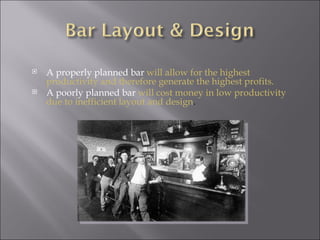
   A properly planned bar will allow for the highest
    productivity and therefore generate the highest profits.
   A poorly planned bar will cost money in low productivity
    due to inefficient layout and design.
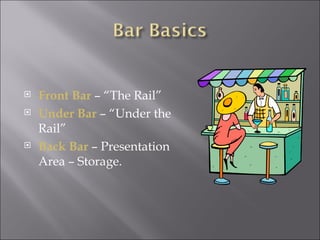
   Front Bar – “The Rail”
   Under Bar – “Under the
    Rail”
   Back Bar – Presentation
    Area – Storage.
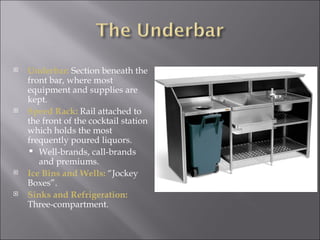
   Underbar: Section beneath the
    front bar, where most
    equipment and supplies are
    kept.
   Speed Rack: Rail attached to
    the front of the cocktail station
    which holds the most
    frequently poured liquors.
     Well-brands, call-brands
       and premiums.
   Ice Bins and Wells: “Jockey
    Boxes”.
   Sinks and Refrigeration:
    Three-compartment.
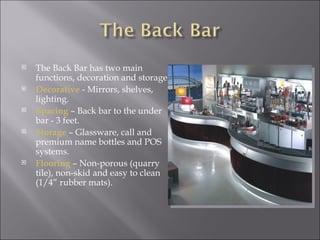
   The Back Bar has two main
    functions, decoration and storage.
   Decorative - Mirrors, shelves,
    lighting.
   Spacing – Back bar to the under
    bar - 3 feet.
   Storage – Glassware, call and
    premium name bottles and POS
    systems.
   Flooring – Non-porous (quarry
    tile), non-skid and easy to clean
    (1/4” rubber mats).
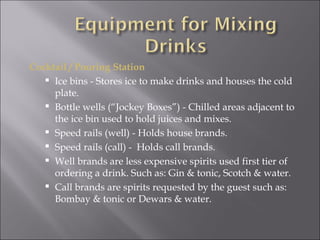
Cocktail / Pouring Station
    Ice bins - Stores ice to make drinks and houses the cold
     plate.
    Bottle wells (“Jockey Boxes”) - Chilled areas adjacent to
     the ice bin used to hold juices and mixes.
    Speed rails (well) - Holds house brands.
    Speed rails (call) - Holds call brands.
    Well brands are less expensive spirits used first tier of
     ordering a drink. Such as: Gin & tonic, Scotch & water.
    Call brands are spirits requested by the guest such as:
     Bombay & tonic or Dewars & water.
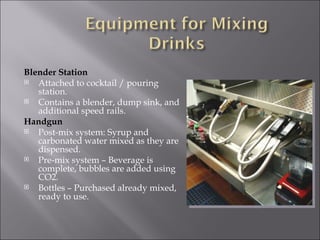
Blender Station
  Attached to cocktail / pouring
   station.
  Contains a blender, dump sink, and
   additional speed rails.
Handgun
  Post-mix system: Syrup and
   carbonated water mixed as they are
   dispensed.
  Pre-mix system – Beverage is
   complete, bubbles are added using
   CO2.
  Bottles – Purchased already mixed,
   ready to use.
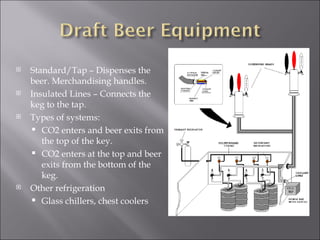
   Standard/Tap – Dispenses the
    beer. Merchandising handles.
   Insulated Lines – Connects the
    keg to the tap.
   Types of systems:
     CO2 enters and beer exits from
       the top of the key.
     CO2 enters at the top and beer
       exits from the bottom of the
       keg.
   Other refrigeration
     Glass chillers, chest coolers
July 2010
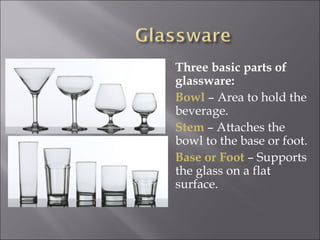
Three basic parts of
glassware:
Bowl – Area to hold the
beverage.
Stem – Attaches the
bowl to the base or foot.
Base or Foot – Supports
the glass on a flat
surface.
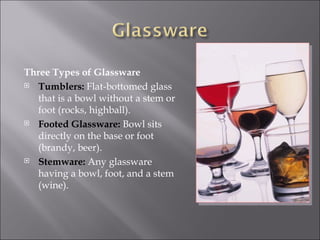
Three Types of Glassware
 Tumblers: Flat-bottomed glass

   that is a bowl without a stem or
   foot (rocks, highball).
 Footed Glassware: Bowl sits

   directly on the base or foot
   (brandy, beer).
 Stemware: Any glassware

   having a bowl, foot, and a stem
   (wine).
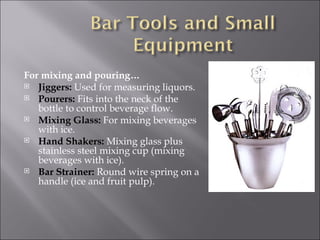
For mixing and pouring…
 Jiggers: Used for measuring liquors.
 Pourers: Fits into the neck of the
   bottle to control beverage flow.
 Mixing Glass: For mixing beverages
   with ice.
 Hand Shakers: Mixing glass plus
   stainless steel mixing cup (mixing
   beverages with ice).
 Bar Strainer: Round wire spring on a
   handle (ice and fruit pulp).
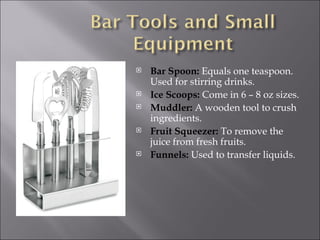
   Bar Spoon: Equals one teaspoon.
    Used for stirring drinks.
   Ice Scoops: Come in 6 – 8 oz sizes.
   Muddler: A wooden tool to crush
    ingredients.
   Fruit Squeezer: To remove the
    juice from fresh fruits.
   Funnels: Used to transfer liquids.
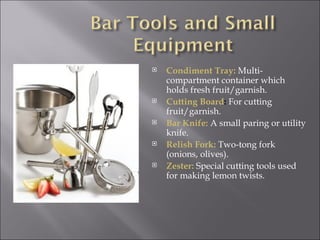
   Condiment Tray: Multi-
    compartment container which
    holds fresh fruit/garnish.
   Cutting Board: For cutting
    fruit/garnish.
   Bar Knife: A small paring or utility
    knife.
   Relish Fork: Two-tong fork
    (onions, olives).
   Zester: Special cutting tools used
    for making lemon twists.
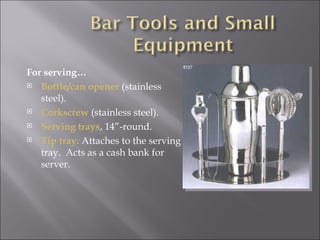
For serving…
 Bottle/can opener (stainless

   steel).
 Corkscrew (stainless steel).

 Serving trays, 14”-round.

 Tip tray: Attaches to the serving

   tray. Acts as a cash bank for
   server.
   Bartender: To mix and serve drinks.
   Bar Back: Assists the bartender with
    prep, sanitation, and serving of
    drinks.
   Cocktail Server: Beverage service to
    guests.
   Wine Steward (Sommelier): Wine
    expert.
   Beverage Steward: Purchasing,
    receiving, storing and issuing of all
    wines and liquors.
   Beverage Director or Beverage
    Manager: Full responsibility for all
    beverage activities.
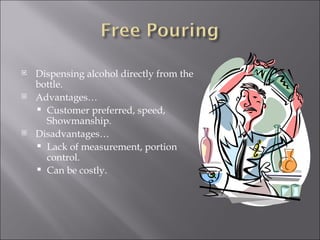
   Dispensing alcohol directly from the
    bottle.
   Advantages…
     Customer preferred, speed,
      Showmanship.
   Disadvantages…
     Lack of measurement, portion
      control.
     Can be costly.
   Most commonly used – Shot
    glass, jigger.
   Calibrated measurer fixed to
    the top of the bottle.
   Advantages…
     More control, consistency.
   Disadvantages…
     Slows down service.
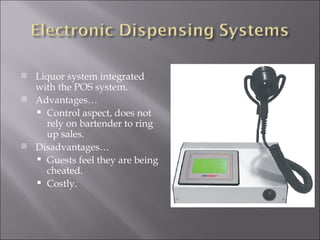
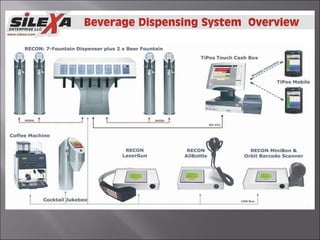
   Liquor system integrated
    with the POS system.
   Advantages…
     Control aspect, does not
      rely on bartender to ring
      up sales.
   Disadvantages…
     Guests feel they are being
      cheated.
     Costly.
   Ice: Size and shape; cubed, crushed, pillowed.
   Base: Primary spirit.
   Modifying Ingredient: – Soda, juice.
   Accent: Optional ingredient (sugar, salt).
   Garnish: Important component, adds to visual
    appeal and taste.
   Build: Made in the glass
    (highball, mixer).
   Stir: Mixing glass and served
    up neat (martini).
   Shake: Mixing glass, vigorous
    mixing (specialty drinks).
   Blend: Ingredients that need
    to be puréed, blended (frozen
    drinks).
   Always use a tray for service.
   Ensure proper glassware and
    garnish.
   Place cocktail napkin with logo
    facing guest.
   Start clockwise around the table.
   Serve women first.
   Pour beer with the glass on the
    table.
   Two-minute rule applies.
   Remove empties from the base or
    stem.
   Liquor – Replenish pars and clean bottles.
   Well – Organize, as needed.
   Beer – Replenish bottled and draft.
   Soda – Sanitize gun.
   Glassware – Check supply and cleanliness.
   Equipment – Checklist and functionality.
   Serving Accessories – Toothpicks, straws,
    napkins.

Beverage Management

  • 2.
    Types of BeverageOperations  Beverage-only establishments  Sales focus on beverage  Finger foods served  Bar/entertainment combinations  Consumer draw is entertainment  Sales focus on beverage  Finger foods served
  • 3.
    Food and BeverageCombinations  Most common form of operation  Varies in degree based on concept Hotel Beverage Operations  F & B combination  Beverage only  Bar & entertainment combination  Room service / mini-bars  Banquets
  • 4.
    Bar Classifications  FrontBar: Beverages are served directly to the guest.  Service Bar: Beverages served to servers who then serve the cocktail to the guest.  Portable Bar or Mobile Bar: Used for on or off-premise catering functions.  Mini Bar Or Honor Bar: available to the guest in their room with charges based on usage.
  • 5.
    The physical layout of the bar operation begins with the concept.  The concept will dictate…  The type of brands and drinks to be offered.  The type of guest.  The style of service.  The function and location of the bar areas.
  • 6.
    A properly planned bar will allow for the highest productivity and therefore generate the highest profits.  A poorly planned bar will cost money in low productivity due to inefficient layout and design.
  • 7.
    Front Bar – “The Rail”  Under Bar – “Under the Rail”  Back Bar – Presentation Area – Storage.
  • 8.
    Underbar: Section beneath the front bar, where most equipment and supplies are kept.  Speed Rack: Rail attached to the front of the cocktail station which holds the most frequently poured liquors.  Well-brands, call-brands and premiums.  Ice Bins and Wells: “Jockey Boxes”.  Sinks and Refrigeration: Three-compartment.
  • 9.
    The Back Bar has two main functions, decoration and storage.  Decorative - Mirrors, shelves, lighting.  Spacing – Back bar to the under bar - 3 feet.  Storage – Glassware, call and premium name bottles and POS systems.  Flooring – Non-porous (quarry tile), non-skid and easy to clean (1/4” rubber mats).
  • 10.
    Cocktail / PouringStation  Ice bins - Stores ice to make drinks and houses the cold plate.  Bottle wells (“Jockey Boxes”) - Chilled areas adjacent to the ice bin used to hold juices and mixes.  Speed rails (well) - Holds house brands.  Speed rails (call) - Holds call brands.  Well brands are less expensive spirits used first tier of ordering a drink. Such as: Gin & tonic, Scotch & water.  Call brands are spirits requested by the guest such as: Bombay & tonic or Dewars & water.
  • 11.
    Blender Station  Attached to cocktail / pouring station.  Contains a blender, dump sink, and additional speed rails. Handgun  Post-mix system: Syrup and carbonated water mixed as they are dispensed.  Pre-mix system – Beverage is complete, bubbles are added using CO2.  Bottles – Purchased already mixed, ready to use.
  • 12.
    Standard/Tap – Dispenses the beer. Merchandising handles.  Insulated Lines – Connects the keg to the tap.  Types of systems:  CO2 enters and beer exits from the top of the key.  CO2 enters at the top and beer exits from the bottom of the keg.  Other refrigeration  Glass chillers, chest coolers
  • 13.
  • 14.
    Three basic partsof glassware: Bowl – Area to hold the beverage. Stem – Attaches the bowl to the base or foot. Base or Foot – Supports the glass on a flat surface.
  • 15.
    Three Types ofGlassware  Tumblers: Flat-bottomed glass that is a bowl without a stem or foot (rocks, highball).  Footed Glassware: Bowl sits directly on the base or foot (brandy, beer).  Stemware: Any glassware having a bowl, foot, and a stem (wine).
  • 16.
    For mixing andpouring…  Jiggers: Used for measuring liquors.  Pourers: Fits into the neck of the bottle to control beverage flow.  Mixing Glass: For mixing beverages with ice.  Hand Shakers: Mixing glass plus stainless steel mixing cup (mixing beverages with ice).  Bar Strainer: Round wire spring on a handle (ice and fruit pulp).
  • 17.
    Bar Spoon: Equals one teaspoon. Used for stirring drinks.  Ice Scoops: Come in 6 – 8 oz sizes.  Muddler: A wooden tool to crush ingredients.  Fruit Squeezer: To remove the juice from fresh fruits.  Funnels: Used to transfer liquids.
  • 18.
    Condiment Tray: Multi- compartment container which holds fresh fruit/garnish.  Cutting Board: For cutting fruit/garnish.  Bar Knife: A small paring or utility knife.  Relish Fork: Two-tong fork (onions, olives).  Zester: Special cutting tools used for making lemon twists.
  • 19.
    For serving…  Bottle/canopener (stainless steel).  Corkscrew (stainless steel).  Serving trays, 14”-round.  Tip tray: Attaches to the serving tray. Acts as a cash bank for server.
  • 20.
    Bartender: To mix and serve drinks.  Bar Back: Assists the bartender with prep, sanitation, and serving of drinks.  Cocktail Server: Beverage service to guests.  Wine Steward (Sommelier): Wine expert.  Beverage Steward: Purchasing, receiving, storing and issuing of all wines and liquors.  Beverage Director or Beverage Manager: Full responsibility for all beverage activities.
  • 21.
    Dispensing alcohol directly from the bottle.  Advantages…  Customer preferred, speed, Showmanship.  Disadvantages…  Lack of measurement, portion control.  Can be costly.
  • 22.
    Most commonly used – Shot glass, jigger.  Calibrated measurer fixed to the top of the bottle.  Advantages…  More control, consistency.  Disadvantages…  Slows down service.
  • 23.
    Liquor system integrated with the POS system.  Advantages…  Control aspect, does not rely on bartender to ring up sales.  Disadvantages…  Guests feel they are being cheated.  Costly.
  • 25.
    Ice: Size and shape; cubed, crushed, pillowed.  Base: Primary spirit.  Modifying Ingredient: – Soda, juice.  Accent: Optional ingredient (sugar, salt).  Garnish: Important component, adds to visual appeal and taste.
  • 26.
    Build: Made in the glass (highball, mixer).  Stir: Mixing glass and served up neat (martini).  Shake: Mixing glass, vigorous mixing (specialty drinks).  Blend: Ingredients that need to be puréed, blended (frozen drinks).
  • 27.
    Always use a tray for service.  Ensure proper glassware and garnish.  Place cocktail napkin with logo facing guest.  Start clockwise around the table.  Serve women first.  Pour beer with the glass on the table.  Two-minute rule applies.  Remove empties from the base or stem.
  • 28.
    Liquor – Replenish pars and clean bottles.  Well – Organize, as needed.  Beer – Replenish bottled and draft.  Soda – Sanitize gun.  Glassware – Check supply and cleanliness.  Equipment – Checklist and functionality.  Serving Accessories – Toothpicks, straws, napkins.
Editor's Notes

  • #2 Revised 12/2/07 Beverage Management
  • #6 Revised 12/2/07 Beverage Management
  • #9 Revised 12/2/07 Beverage Management