LPG specification
What are the important specification items:
1- Vapor pressure
Vapor pressure control is readily understood to
be a matter of balancing the content of the
main C3/C4 hydrocarbon components against
lower and higher boiling homologues, e.g. of
specifying limits as follows:
Composition
Maximum content: ethane, ethylene, pentanes
Minimum content: propane, propylene, butanes,
butenes
LPG specification
What are the important specification items:
2- non volatile residue:
Rust & dirt
elemental sulphur
the lighter ends (C5's, C6's)
LPG specification
What are the important specification items:
2- Water
Free or entrained : non visible during test
Dissolved: maximum content
For full protection:
water content 10 ppm wt for propanes
water content 20 ppm wt for butanes
LPG specification
What are the important specification items:
2- Water
Or adding anti-freezing agent like methanol
Methanol content:
• minimum content is usually 0.05 vol % (to
prevent under-dosing)
• maximum content (to avoid contamination
problems) according to the user application
LPG specification
What are the important specification items:
3- Toxicity & odour control
is a matter of minimizing the content of
hydrogen sulphide but allowing, in commercial
grades, a very small proportion of certain
volatile sulphur compounds such as ethyl
mercaptans or dimethyl sulphide to impart a
detectable odour
LPG specification
What are the important specification items:
odour control
Regulatory codes : it is readily detectable,
by a distinct odor, at one-fifth of the lower limit of flammability
of the gas in the air.
Research and experience have shown
that ethyl mercaptan inject data rate of 1.0 lb per 10,000 gal
Of liquid LP Gas will meet this requirement under normal
conditions.
It is customary practice to inject 1.5 lb or more (preferable) to
ensure an adequate warning agent concentration when
conditions may be less than ideal.
LPG specification
What are the important specification items:
4- Corrosion
By presence of :
H2S
Sulfur compounds
Water
Oxygen
Caustic alkali
LPG specification
What are the important specification items:
4- Corrosion
One is to specify the degree of corrosion which
is allowable under standardized test conditions,
namely a slight discoloration of a copper strip
immersed in liquid LPG for a specified time and
at a prescribed temperature (e.g. 1 hr, 37.8°C).
Copper is chosen because it is the most sensitive
of metals likely to be encountered by LP gases in
ordinary process equipment.
LPG Test & analyzers
LPG test considerations:
- Sample point from life stream or storage
- The moment of sample taking related to the
operations
- Cylinder size compared to the tested quantity
- Sample taking period of cylinder purge
- Leaks in sampling cylinders
- The analyzer calibration
- The analyzer cleaning from previous
sampling
LPG Test & analyzers
LPG test considerations:
- LPG recycling before sampling from Bullet or
sphere is recommended due to stratification
of hydrocarbons in large vessel
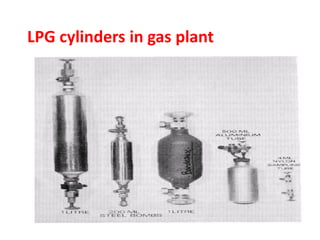
LPG cylinders in gas plant
'Bombs' are sometimes fitted with outage or ‘
ullage' tubes to ensure at least a 20% volume
free vapour space to allow for liquid expansion
with temperature rise.
In sampling refrigerated propane, the ullage
space should be increased to 30% for increased
safety.
LPG Volatility test
The volatility test (ASTM D 1837)
is used with a maximum of (-38.3°C) for the 95%
evaporation temperature in the case of
propanes
and (+2.2°C) for butanes.
Correlation work shows that the(-38.3°C)
temperature is met if the content of 'C4's+ are
not more than 2.5%;
if the butanes content in propane were 10% for
example (as is allowed in B.S. 4250), the
evaporation temperature would rise to (-23.9°C)
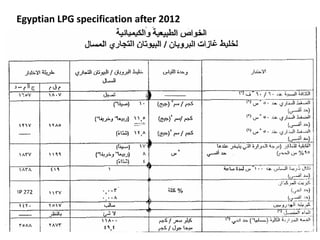
Egyptian LPG specification after 2012
Egyptian LPG specification before 2012
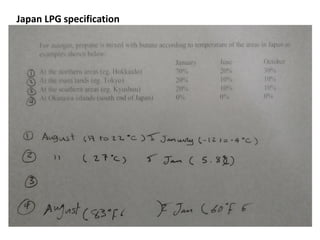
Japan LPG specification
LPG loading
LPG filling capacity
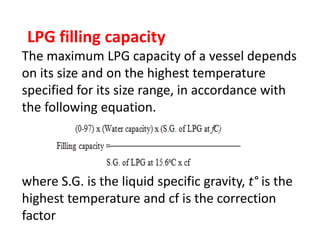
The maximum LPG capacity of a vessel depends
on its size and on the highest temperature
specified for its size range, in accordance with
the following equation.
where S.G. is the liquid specific gravity, t° is the
highest temperature and cf is the correction
factor
LPG filling capacity
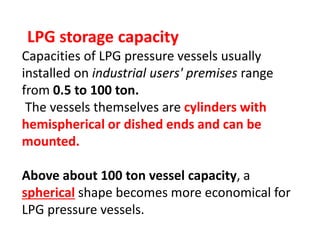
LPG storage capacity
Capacities of LPG pressure vessels usually
installed on industrial users' premises range
from 0.5 to 100 ton.
The vessels themselves are cylinders with
hemispherical or dished ends and can be
mounted.
Above about 100 ton vessel capacity, a
spherical shape becomes more economical for
LPG pressure vessels.
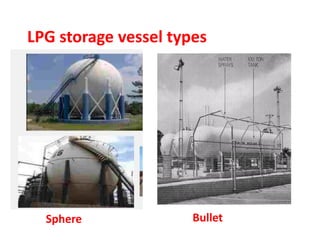
LPG storage vessel types
Sphere Bullet
LPG vessel commissioning
1. pressure testing :
1.5 times the maximum working pressure using
water for 30 minutes without pressure loss
2- Leak test: nearly 90 % of the design pressure
50-90 psi for butanes
105-200 psi for propanes
3- Purging: by inert gas (nitrogen)
LPG safety precautions
1. LPG is stored, normally, as a liquid under pressure
2. Leakage, especially of liquid, may release large
volumes of flammable gases
3 . LPG vapour is heavier than air and may flow along
the ground or through drains and be ignited at a
considerable distance from the source of leakage
4. Because of its low boiling temperature, liquid LPG
will cause skin burning
5. Ignition of a gas cloud will begin many yards distant
downwind of the leakage point
6. The released gas can cause suffocation

LPG specifications for candidates

  • 1.
    LPG specification What arethe important specification items: 1- Vapor pressure Vapor pressure control is readily understood to be a matter of balancing the content of the main C3/C4 hydrocarbon components against lower and higher boiling homologues, e.g. of specifying limits as follows: Composition Maximum content: ethane, ethylene, pentanes Minimum content: propane, propylene, butanes, butenes
  • 2.
    LPG specification What arethe important specification items: 2- non volatile residue: Rust & dirt elemental sulphur the lighter ends (C5's, C6's)
  • 3.
    LPG specification What arethe important specification items: 2- Water Free or entrained : non visible during test Dissolved: maximum content For full protection: water content 10 ppm wt for propanes water content 20 ppm wt for butanes
  • 4.
    LPG specification What arethe important specification items: 2- Water Or adding anti-freezing agent like methanol Methanol content: • minimum content is usually 0.05 vol % (to prevent under-dosing) • maximum content (to avoid contamination problems) according to the user application
  • 5.
    LPG specification What arethe important specification items: 3- Toxicity & odour control is a matter of minimizing the content of hydrogen sulphide but allowing, in commercial grades, a very small proportion of certain volatile sulphur compounds such as ethyl mercaptans or dimethyl sulphide to impart a detectable odour
  • 6.
    LPG specification What arethe important specification items: odour control Regulatory codes : it is readily detectable, by a distinct odor, at one-fifth of the lower limit of flammability of the gas in the air. Research and experience have shown that ethyl mercaptan inject data rate of 1.0 lb per 10,000 gal Of liquid LP Gas will meet this requirement under normal conditions. It is customary practice to inject 1.5 lb or more (preferable) to ensure an adequate warning agent concentration when conditions may be less than ideal.
  • 7.
    LPG specification What arethe important specification items: 4- Corrosion By presence of : H2S Sulfur compounds Water Oxygen Caustic alkali
  • 8.
    LPG specification What arethe important specification items: 4- Corrosion One is to specify the degree of corrosion which is allowable under standardized test conditions, namely a slight discoloration of a copper strip immersed in liquid LPG for a specified time and at a prescribed temperature (e.g. 1 hr, 37.8°C). Copper is chosen because it is the most sensitive of metals likely to be encountered by LP gases in ordinary process equipment.
  • 9.
    LPG Test &analyzers LPG test considerations: - Sample point from life stream or storage - The moment of sample taking related to the operations - Cylinder size compared to the tested quantity - Sample taking period of cylinder purge - Leaks in sampling cylinders - The analyzer calibration - The analyzer cleaning from previous sampling
  • 10.
    LPG Test &analyzers LPG test considerations: - LPG recycling before sampling from Bullet or sphere is recommended due to stratification of hydrocarbons in large vessel
  • 11.
  • 12.
    LPG cylinders ingas plant 'Bombs' are sometimes fitted with outage or ‘ ullage' tubes to ensure at least a 20% volume free vapour space to allow for liquid expansion with temperature rise. In sampling refrigerated propane, the ullage space should be increased to 30% for increased safety.
  • 13.
    LPG Volatility test Thevolatility test (ASTM D 1837) is used with a maximum of (-38.3°C) for the 95% evaporation temperature in the case of propanes and (+2.2°C) for butanes. Correlation work shows that the(-38.3°C) temperature is met if the content of 'C4's+ are not more than 2.5%; if the butanes content in propane were 10% for example (as is allowed in B.S. 4250), the evaporation temperature would rise to (-23.9°C)
  • 15.
  • 16.
  • 17.
  • 18.
  • 19.
  • 20.
  • 21.
    LPG filling capacity Themaximum LPG capacity of a vessel depends on its size and on the highest temperature specified for its size range, in accordance with the following equation. where S.G. is the liquid specific gravity, t° is the highest temperature and cf is the correction factor
  • 22.
  • 23.
    LPG storage capacity Capacitiesof LPG pressure vessels usually installed on industrial users' premises range from 0.5 to 100 ton. The vessels themselves are cylinders with hemispherical or dished ends and can be mounted. Above about 100 ton vessel capacity, a spherical shape becomes more economical for LPG pressure vessels.
  • 24.
    LPG storage vesseltypes Sphere Bullet
  • 25.
    LPG vessel commissioning 1.pressure testing : 1.5 times the maximum working pressure using water for 30 minutes without pressure loss 2- Leak test: nearly 90 % of the design pressure 50-90 psi for butanes 105-200 psi for propanes 3- Purging: by inert gas (nitrogen)
  • 26.
    LPG safety precautions 1.LPG is stored, normally, as a liquid under pressure 2. Leakage, especially of liquid, may release large volumes of flammable gases 3 . LPG vapour is heavier than air and may flow along the ground or through drains and be ignited at a considerable distance from the source of leakage 4. Because of its low boiling temperature, liquid LPG will cause skin burning 5. Ignition of a gas cloud will begin many yards distant downwind of the leakage point 6. The released gas can cause suffocation