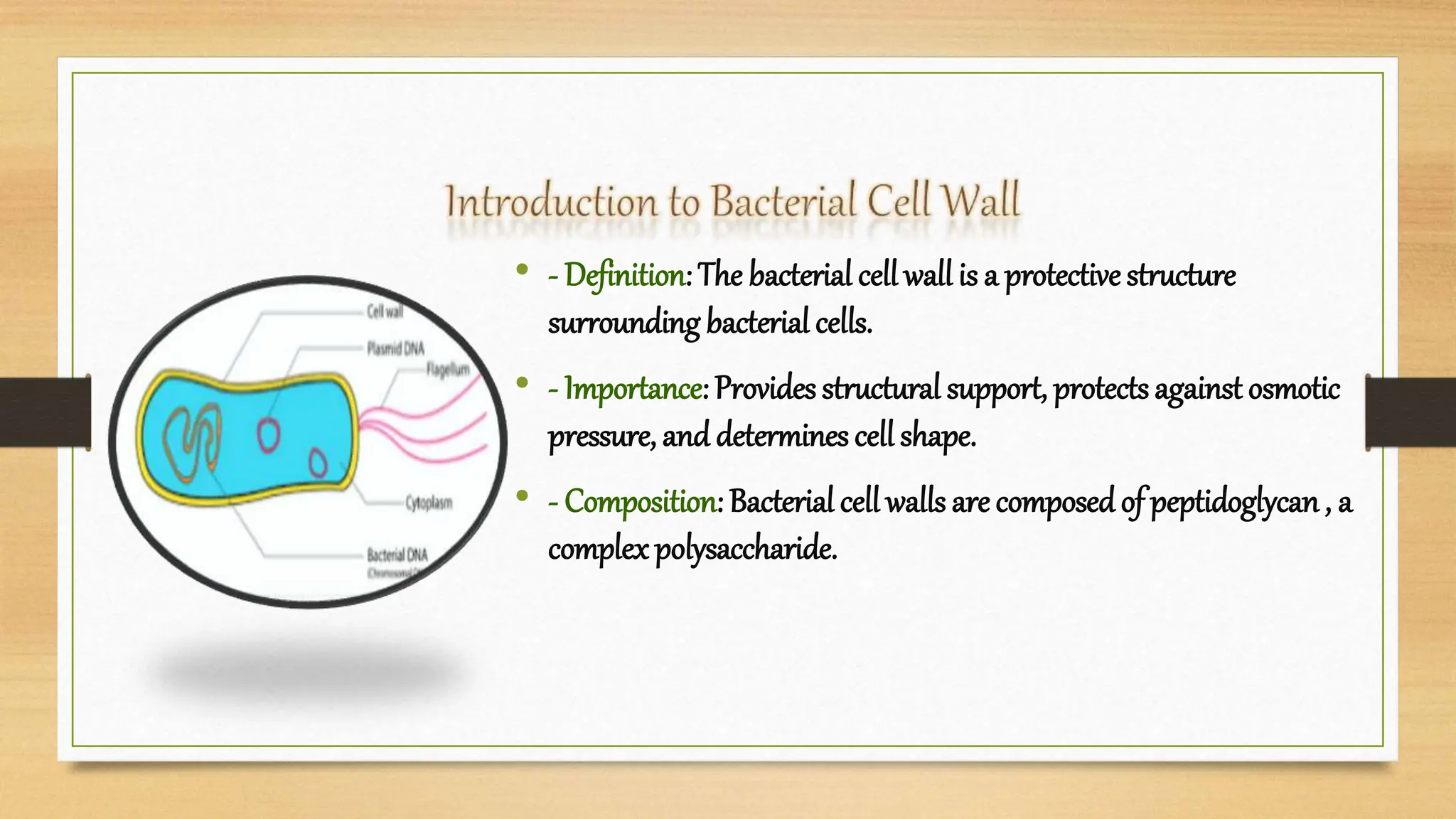
• - Definition: The bacterial cell wall is a protective structure
surrounding bacterial cells.
• - Importance: Provides structural support, protects against osmotic
pressure, and determines cell shape.
• - Composition: Bacterial cell walls are composedof peptidoglycan, a
complexpolysaccharide.
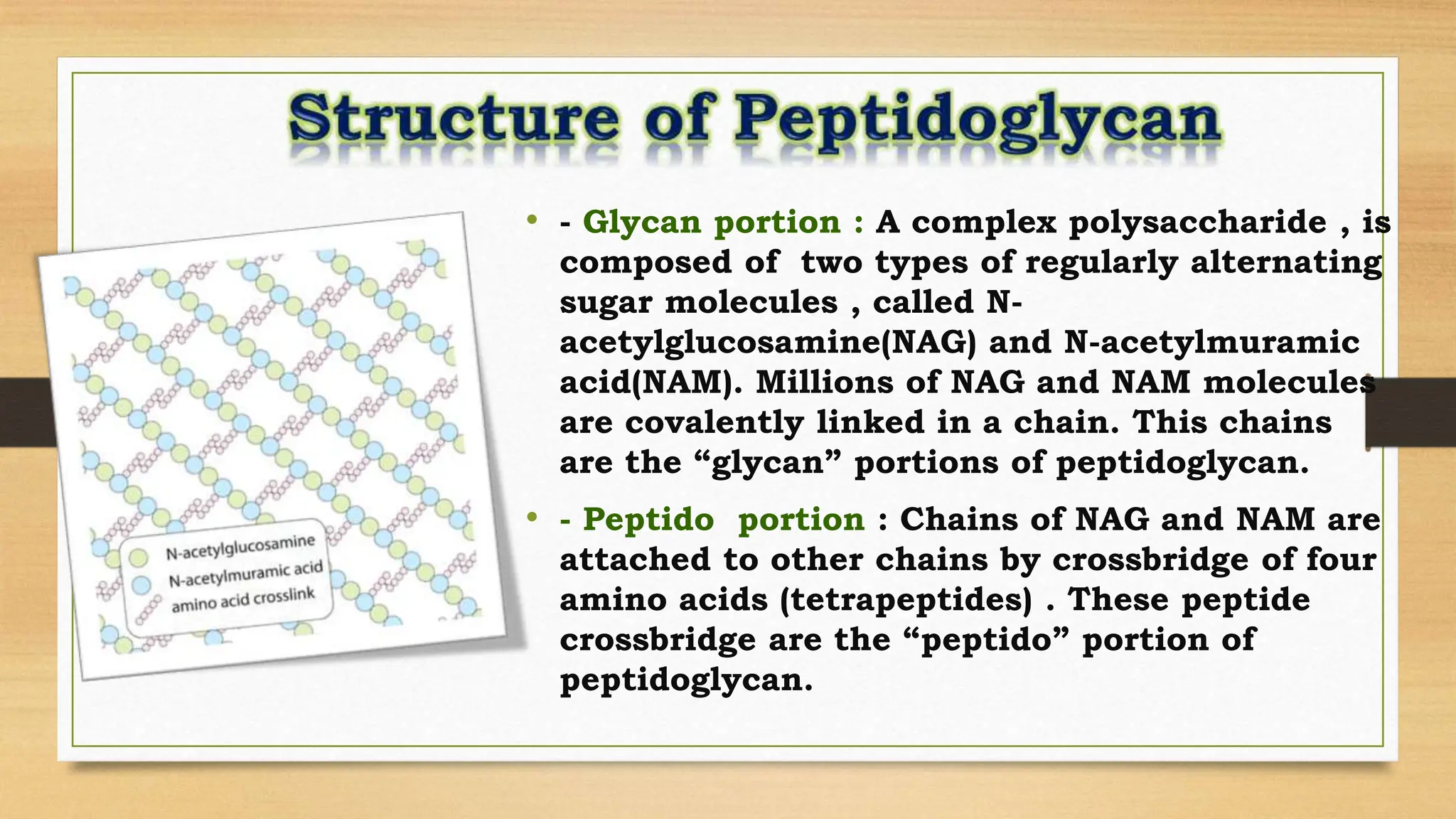
• - Glycan portion : A complex polysaccharide , is
composed of two types of regularly alternating
sugar molecules , called N-
acetylglucosamine(NAG) and N-acetylmuramic
acid(NAM). Millions of NAG and NAM molecules
are covalently linked in a chain. This chains
are the “glycan” portions of peptidoglycan.
• - Peptido portion : Chains of NAG and NAM are
attached to other chains by crossbridge of four
amino acids (tetrapeptides) . These peptide
crossbridge are the “peptido” portion of
peptidoglycan.
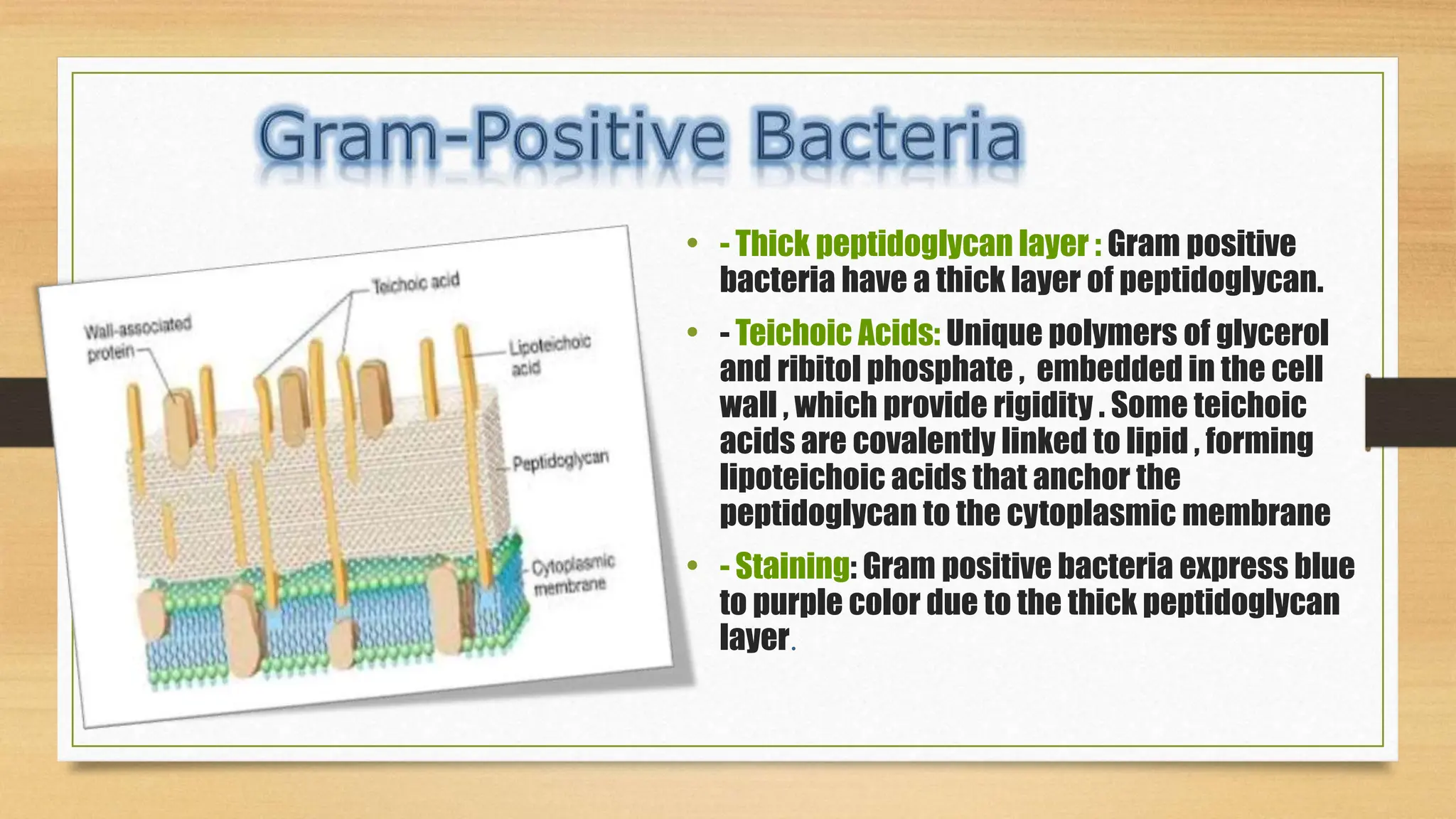
• - Thick peptidoglycan layer : Gram positive
bacteria have a thick layer of peptidoglycan.
• - Teichoic Acids: Unique polymers of glycerol
and ribitol phosphate , embedded in the cell
wall , which provide rigidity . Some teichoic
acids are covalently linked to lipid , forming
lipoteichoic acids that anchor the
peptidoglycan to the cytoplasmic membrane
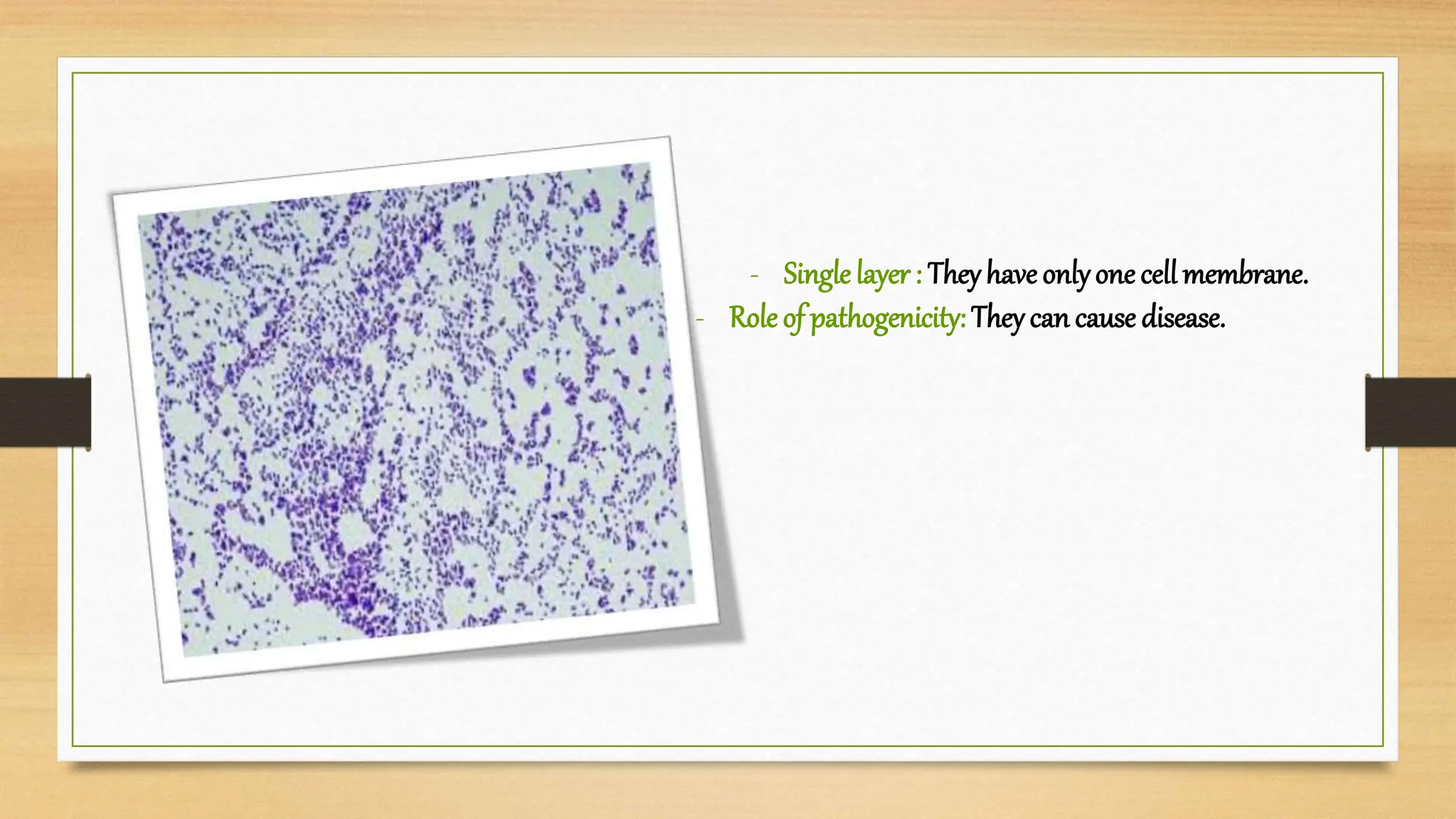
• - Staining: Gram positive bacteria express blue
to purple color due to the thick peptidoglycan
layer.
- Single layer : Theyhave onlyone cell membrane.
- Role of pathogenicity: Theycan cause disease.
• - Thinpeptidoglycan layer : gram negative bacteria have a thin
peptidoglycanlayer surroundedby an outer membrane.
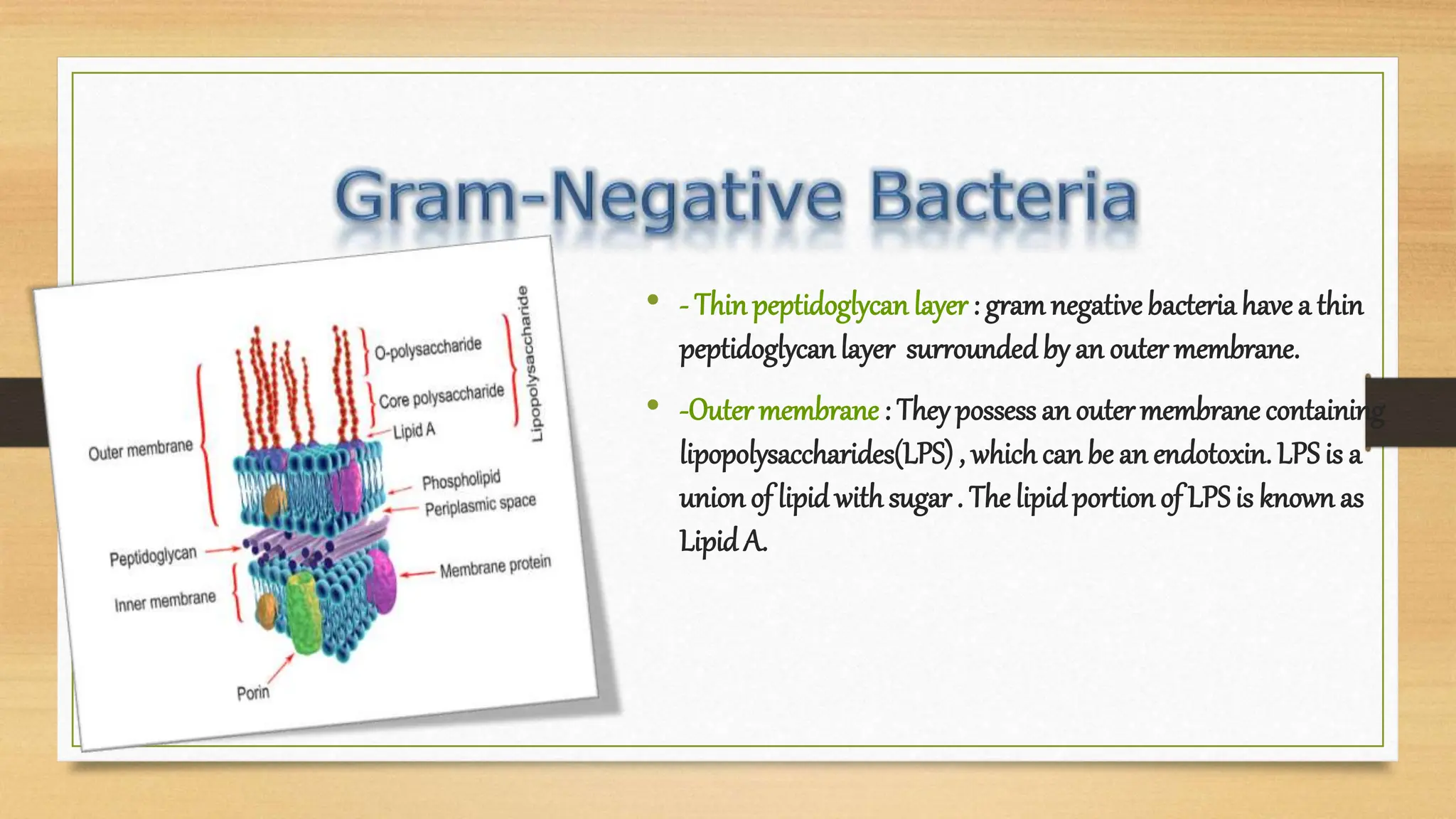
• -Outermembrane : Theypossess an outermembrane containing
lipopolysaccharides(LPS) , whichcan be an endotoxin. LPSis a
union of lipid withsugar . The lipidportion of LPSis known as
Lipid A.
• - Periplasmic Space: The space between the
innerand outermembranescontaining
enzymes and other proteins.
• -PORINS: Their outer membrane have porins .
• -Resistance to Antibiotics : The outer
membrane act as a barrier to certain
antibiotics.
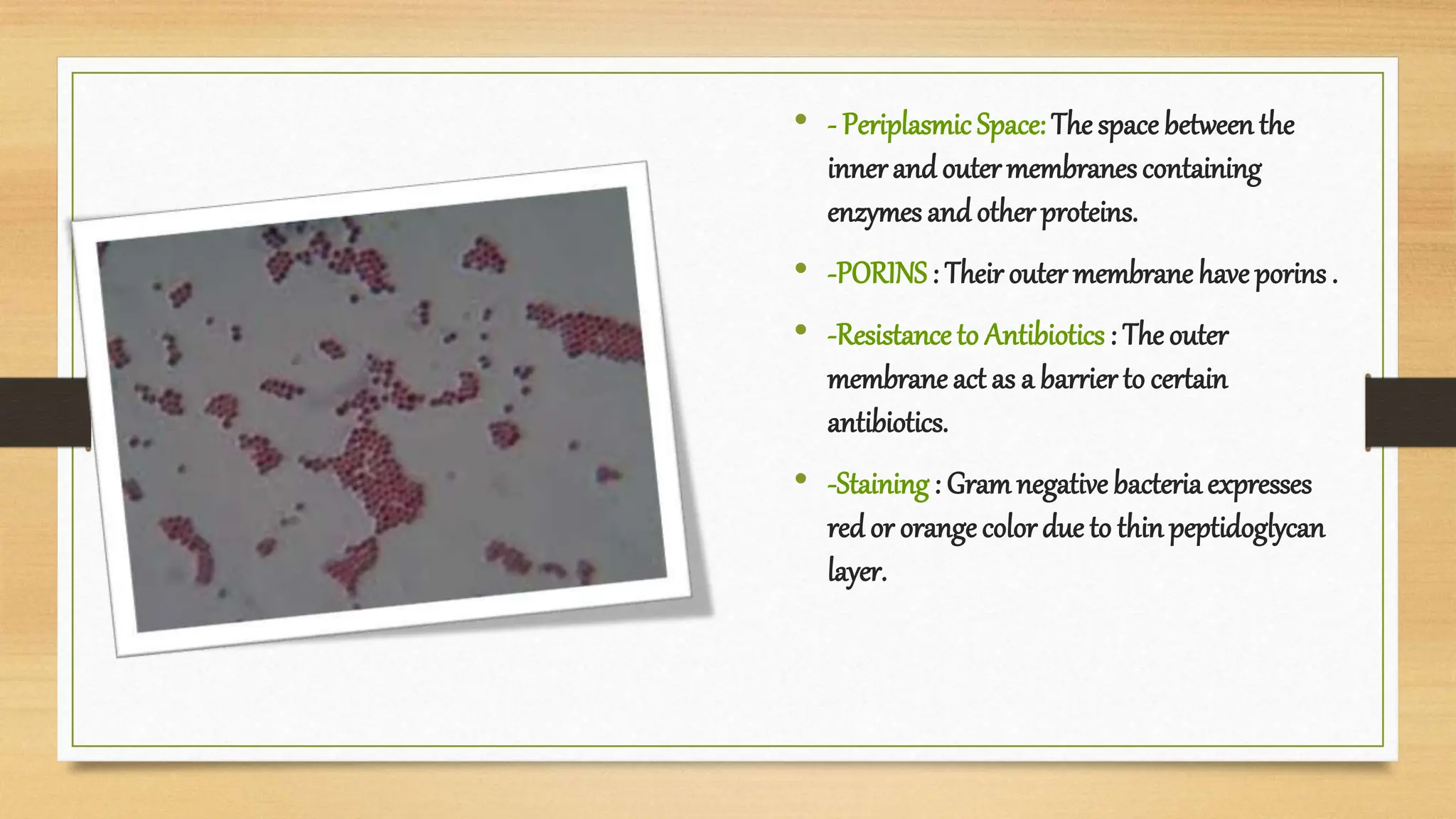
• -Staining: Gram negative bacteria expresses
red or orange colordue to thin peptidoglycan
layer.
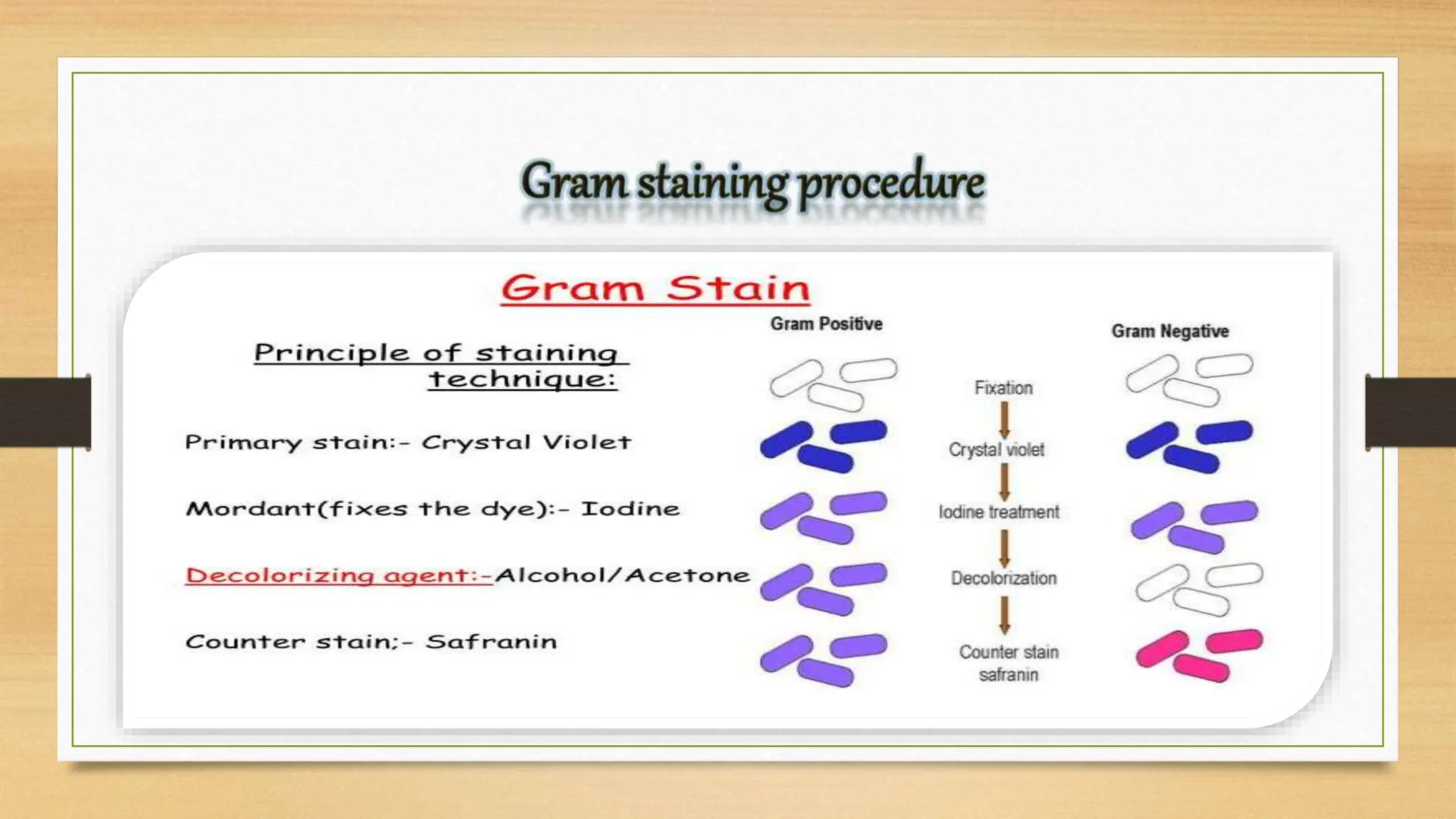
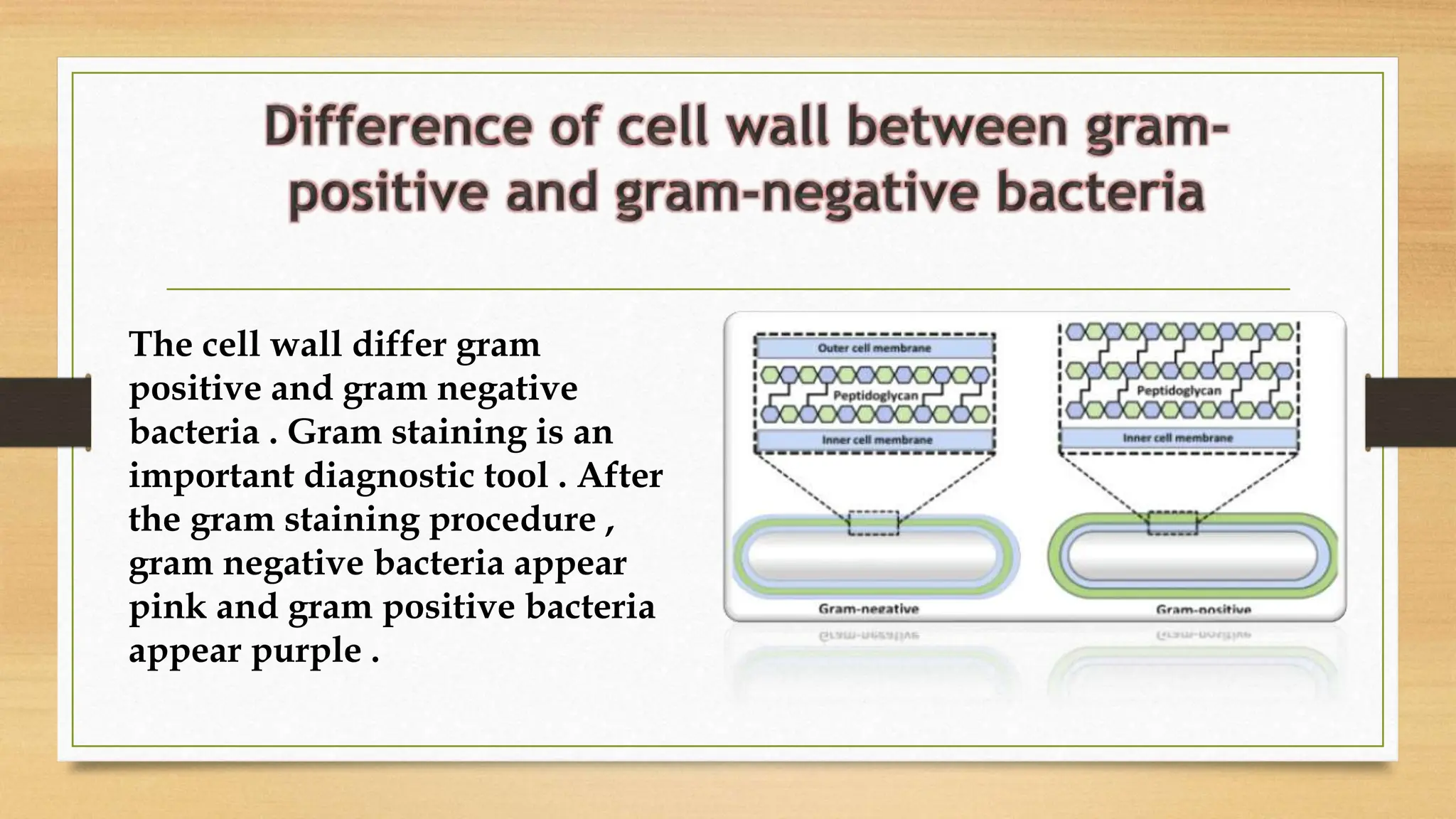
The cell wall differ gram
positive and gram negative
bacteria . Gram staining is an
important diagnostic tool . After
the gram staining procedure ,
gram negative bacteria appear
pink and gram positive bacteria
appear purple .
functions
• -It provides overall strength to the cell.
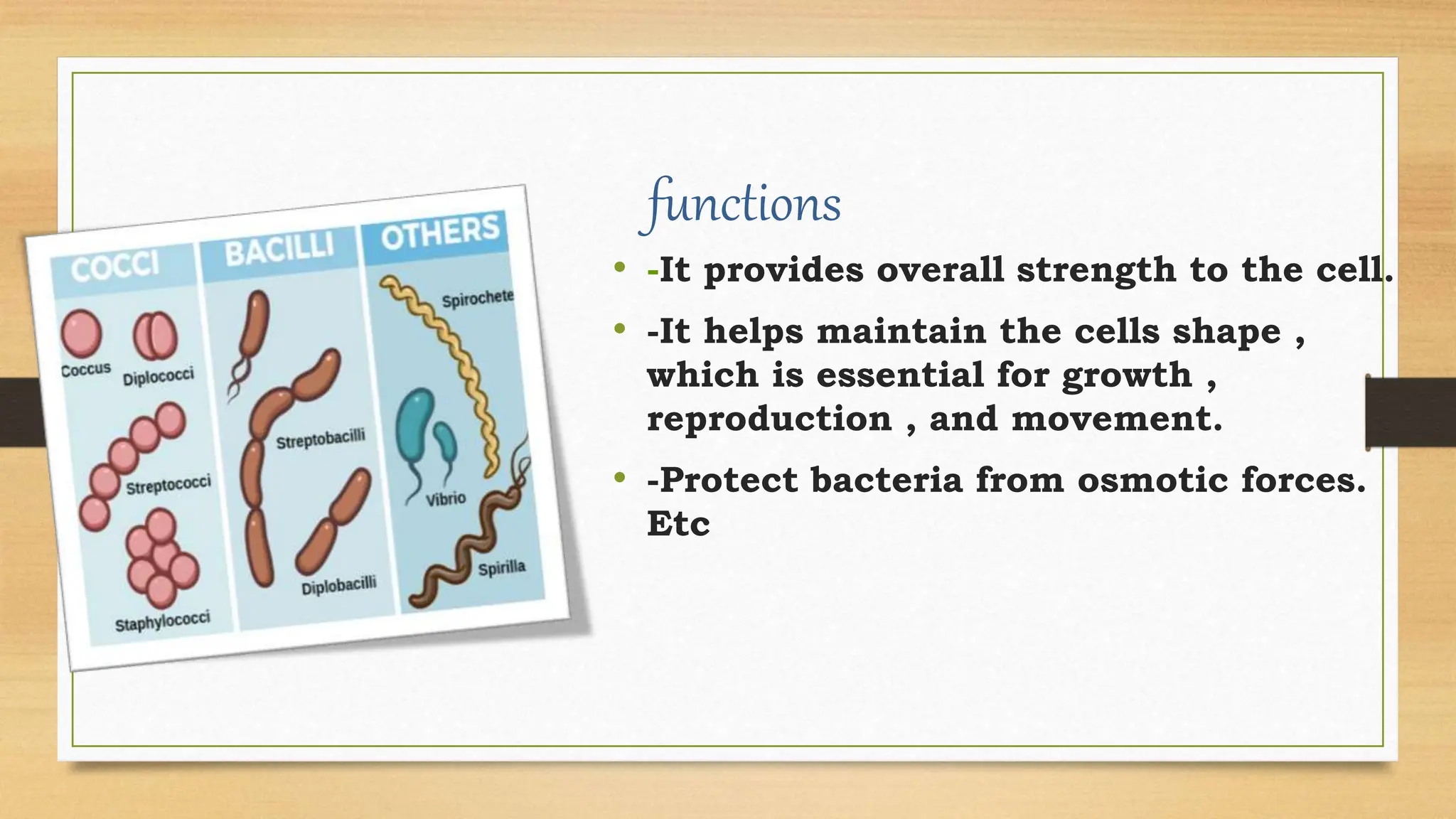
• -It helps maintain the cells shape ,
which is essential for growth ,
reproduction , and movement.
• -Protect bacteria from osmotic forces.
Etc
THANK YOU
•

BACTERIAL CELL WALL, COMPOSITION AND TYPES.ppt

  • 3.
    • - Definition:The bacterial cell wall is a protective structure surrounding bacterial cells. • - Importance: Provides structural support, protects against osmotic pressure, and determines cell shape. • - Composition: Bacterial cell walls are composedof peptidoglycan, a complexpolysaccharide.
  • 4.
    • - Glycanportion : A complex polysaccharide , is composed of two types of regularly alternating sugar molecules , called N- acetylglucosamine(NAG) and N-acetylmuramic acid(NAM). Millions of NAG and NAM molecules are covalently linked in a chain. This chains are the “glycan” portions of peptidoglycan. • - Peptido portion : Chains of NAG and NAM are attached to other chains by crossbridge of four amino acids (tetrapeptides) . These peptide crossbridge are the “peptido” portion of peptidoglycan.
  • 5.
    • - Thickpeptidoglycan layer : Gram positive bacteria have a thick layer of peptidoglycan. • - Teichoic Acids: Unique polymers of glycerol and ribitol phosphate , embedded in the cell wall , which provide rigidity . Some teichoic acids are covalently linked to lipid , forming lipoteichoic acids that anchor the peptidoglycan to the cytoplasmic membrane • - Staining: Gram positive bacteria express blue to purple color due to the thick peptidoglycan layer.
  • 6.
    - Single layer: Theyhave onlyone cell membrane. - Role of pathogenicity: Theycan cause disease.
  • 7.
    • - Thinpeptidoglycanlayer : gram negative bacteria have a thin peptidoglycanlayer surroundedby an outer membrane. • -Outermembrane : Theypossess an outermembrane containing lipopolysaccharides(LPS) , whichcan be an endotoxin. LPSis a union of lipid withsugar . The lipidportion of LPSis known as Lipid A.
  • 8.
    • - PeriplasmicSpace: The space between the innerand outermembranescontaining enzymes and other proteins. • -PORINS: Their outer membrane have porins . • -Resistance to Antibiotics : The outer membrane act as a barrier to certain antibiotics. • -Staining: Gram negative bacteria expresses red or orange colordue to thin peptidoglycan layer.
  • 10.
    The cell walldiffer gram positive and gram negative bacteria . Gram staining is an important diagnostic tool . After the gram staining procedure , gram negative bacteria appear pink and gram positive bacteria appear purple .
  • 11.
    functions • -It providesoverall strength to the cell. • -It helps maintain the cells shape , which is essential for growth , reproduction , and movement. • -Protect bacteria from osmotic forces. Etc
  • 12.