Cellular Transport
aka how to molecules move
     in/out of the cell?
Let’s examine the cell membrane
                • The membrane is
                  selectively permeable
                  – Allows only certain
                    molecules to move
                    into or out of the cell.
Molecules that can pass freely
• The cell membrane is permeable to water
  molecules and a few other small,
  uncharged, molecules like
  oxygen (O2) and carbon dioxide (CO2).
Types of molecules that are NOT
 permeable to the cell membrane
• Macromolecules such as proteins and
  RNA.
• Cations such as K+, Na+, Ca+
• Anions such as Cl-
• Hydrophilic molecules such as glucose
Passive Movement
• Does not require energy or an action

  – Examples: diffusion and osmosis
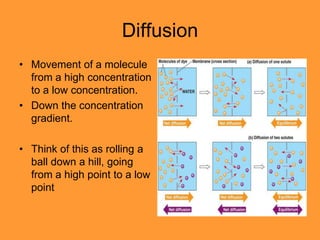
Diffusion
• Movement of a molecule
  from a high concentration
  to a low concentration.
• Down the concentration
  gradient.

• Think of this as rolling a
  ball down a hill, going
  from a high point to a low
  point
Diffusion
Osmosis
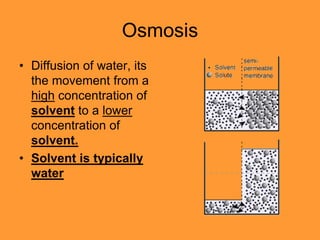
• Diffusion of water, its
  the movement from a
  high concentration of
  solvent to a lower
  concentration of
  solvent.
• Solvent is typically
  water
Animation: How Osmosis Works
Various osmotic conditions
• Remember osmosis is all about the
  concentration of the solvent and
  the the solute.
• Knowing this allows for different
  osmotic conditions to occur.
• Think about eating a bag of salty
  chips… what do your lip feel like
  after that??
• FOR THE NEXT SECTION WE WILL DO
  ALL THE DRAWINGS TOGETHER
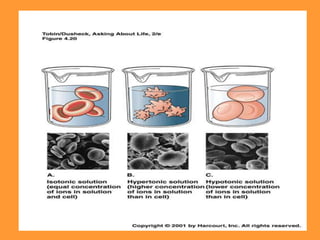
Hypertonic
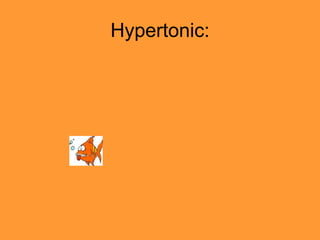
• Hypertonic (above
  normal) the cell
  is hypertonic to
  the
  environment,there
  is water
  movement out of
  cell.
• hypertonic
  solution="more
  solute, less
  water"
• The cell shrivels
Hypertonic:
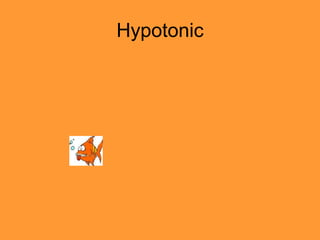
Hypotonic
• Hypotonic (below
  normal) the cell
  is hypotonic to the
  environment,
  there is water
  movement into of
  cell.
• hypotonic
  solution = "less
  solute, more
  water"
• The cell bursts!
Hypotonic
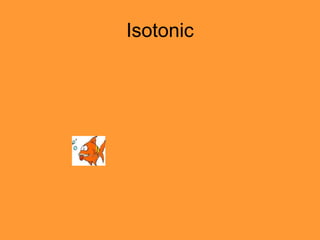
Isotonic
• Isotonic is
  equilibrium and
  there is equal
  movement into
  and out of the
  cell
• isotonic
  solution= "equal
  solute and water"
Isotonic
Try to figure out what is going
      on in the Carrot video
• It’s kind of corny but   • http://www.youtube.co
  really gets the point      m/watch?v=aiUCeNs
  across                     4bo4
So how does the cell get the other
   molecules what is needs to
           survive?

• By using other mechanisms of transporting
  ions and small molecules across their
  membranes that require movement or
  ENERGY
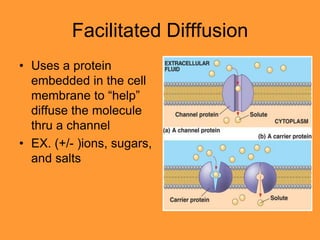
Facilitated Difffusion
• Uses a protein
  embedded in the cell
  membrane to “help”
  diffuse the molecule
  thru a channel
• EX. (+/- )ions, sugars,
  and salts
Facilitated Diffusion
• http://www.youtube.com/watch?v=I4123h
  UU8xo&feature=related
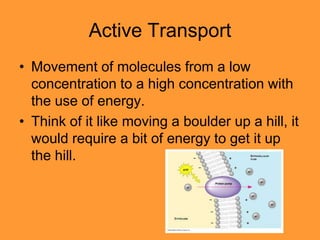
Active Transport
• Movement of molecules from a low
  concentration to a high concentration with
  the use of energy.
• Think of it like moving a boulder up a hill, it
  would require a bit of energy to get it up
  the hill.
Endocytosis
• Engulfing of a solid or
  liquid
• -phago (solid)
• -pino (liquid)
Phagocytosis
Exocytosis
• Opposite of
  endocytosis
• The Golgi body
  creates a vesicle
  around molecules.
• Moves the vesicle
  towards the cell
  membrane and gets
  rid of it.
Endo and Exocytosis
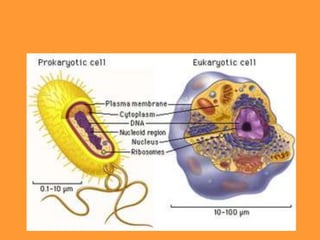
Difference between each cell
               type
Prokaryote Cells                  Eukaryote Cells
• Do not have a defined nucleus   • Contain true nuclei in which
• Chromosomes are dispersed in      chromosomes are compacted
  the cytoplasm                     as chromatin
• Contain no membrane-bound       • Contain membrane-bound
  organelles                        organelles
• Have circular chromosomes       • Have linear DNA called
• Small                             chromosomes
• Don't undergo meiosis but       • Larger
  reproduce sexually by the       • Reproduce sexually with the
  transfer of DNA fragments         use of meiosis
  through conjugation
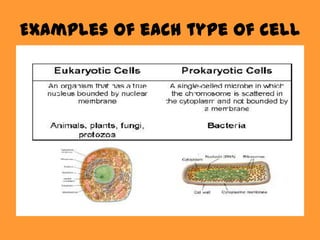
Examples of each type of cell

Cellular transport

  • 1.
    Cellular Transport aka howto molecules move in/out of the cell?
  • 2.
    Let’s examine thecell membrane • The membrane is selectively permeable – Allows only certain molecules to move into or out of the cell.
  • 3.
    Molecules that canpass freely • The cell membrane is permeable to water molecules and a few other small, uncharged, molecules like oxygen (O2) and carbon dioxide (CO2).
  • 4.
    Types of moleculesthat are NOT permeable to the cell membrane • Macromolecules such as proteins and RNA. • Cations such as K+, Na+, Ca+ • Anions such as Cl- • Hydrophilic molecules such as glucose
  • 5.
    Passive Movement • Doesnot require energy or an action – Examples: diffusion and osmosis
  • 6.
    Diffusion • Movement ofa molecule from a high concentration to a low concentration. • Down the concentration gradient. • Think of this as rolling a ball down a hill, going from a high point to a low point
  • 7.
  • 8.
    Osmosis • Diffusion ofwater, its the movement from a high concentration of solvent to a lower concentration of solvent. • Solvent is typically water
  • 9.
  • 10.
    Various osmotic conditions •Remember osmosis is all about the concentration of the solvent and the the solute. • Knowing this allows for different osmotic conditions to occur. • Think about eating a bag of salty chips… what do your lip feel like after that?? • FOR THE NEXT SECTION WE WILL DO ALL THE DRAWINGS TOGETHER
  • 11.
    Hypertonic • Hypertonic (above normal) the cell is hypertonic to the environment,there is water movement out of cell. • hypertonic solution="more solute, less water" • The cell shrivels
  • 12.
  • 13.
    Hypotonic • Hypotonic (below normal) the cell is hypotonic to the environment, there is water movement into of cell. • hypotonic solution = "less solute, more water" • The cell bursts!
  • 14.
  • 15.
    Isotonic • Isotonic is equilibrium and there is equal movement into and out of the cell • isotonic solution= "equal solute and water"
  • 16.
  • 17.
    Try to figureout what is going on in the Carrot video • It’s kind of corny but • http://www.youtube.co really gets the point m/watch?v=aiUCeNs across 4bo4
  • 19.
    So how doesthe cell get the other molecules what is needs to survive? • By using other mechanisms of transporting ions and small molecules across their membranes that require movement or ENERGY
  • 20.
    Facilitated Difffusion • Usesa protein embedded in the cell membrane to “help” diffuse the molecule thru a channel • EX. (+/- )ions, sugars, and salts
  • 21.
  • 22.
    Active Transport • Movementof molecules from a low concentration to a high concentration with the use of energy. • Think of it like moving a boulder up a hill, it would require a bit of energy to get it up the hill.
  • 24.
    Endocytosis • Engulfing ofa solid or liquid • -phago (solid) • -pino (liquid)
  • 25.
  • 26.
    Exocytosis • Opposite of endocytosis • The Golgi body creates a vesicle around molecules. • Moves the vesicle towards the cell membrane and gets rid of it.
  • 27.
  • 28.
    Difference between eachcell type Prokaryote Cells Eukaryote Cells • Do not have a defined nucleus • Contain true nuclei in which • Chromosomes are dispersed in chromosomes are compacted the cytoplasm as chromatin • Contain no membrane-bound • Contain membrane-bound organelles organelles • Have circular chromosomes • Have linear DNA called • Small chromosomes • Don't undergo meiosis but • Larger reproduce sexually by the • Reproduce sexually with the transfer of DNA fragments use of meiosis through conjugation
  • 30.
    Examples of eachtype of cell