Cell Structure and Cell Organisation Cell organisation in multicellular organisms
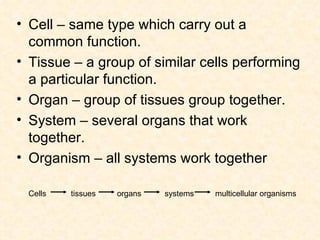
Cell – same type which carry out a common function. Tissue – a group of similar cells performing a particular function. Organ – group of tissues group together. System – several organs that work together. Organism – all systems work together Cells   tissues   organs   systems    multicellular organisms
Cell organisation in animals Tissues  –  Epithelial tissue - tightly interconnected ( continuous layer exp: skin &    mouth ), ( inner linings of cavities exp: digestive tract  & lungs ) and ( form glands exp: exocrine & endocrine  glands ) - act protective barrier, secrete mucus -  Muscle tissue - most abundant tissue - composed of muscle fibres - exp:  smooth muscle, skeletal muscle & cardiac    muscle. - contraction and relaxation of muscle are for doing    activities.
Nerve tissue - Composed of neurones of nerve cells - To detect stimuli and transmit electrical    signals (impulses) -  Connective tissue - consists of various types of cells & fibres    separated by an extracellular matrix. -  Loose connective tissue   - to binds epithelia to underlying tissues and hold  organ. -  Dense fibrous connective tissue   - contains collagenous fibres which packed closely  together.   - exp:  tendons  – connect muscle to bones   ligaments  – join bones together at joints   - cartilage – stronge & flexible connective tissue   - support -  bone  – provides protection to organs and support the body   -  blood cells  – regulating, transporting and protective  -  adipose tissue  – acts as an energy reserve and provides insulation and  protective  Cell organisation in animals
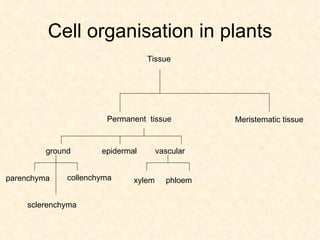
Cell organisation in plants Tissue Meristematic tissue Permanent  tissue epidermal ground vascular parenchyma collenchyma sclerenchyma xylem phloem
Meristematic Consists of small cells which have thin walls, large nuclei, dense cytoplasm & no vacoule. Young and actively dividing which have not undergone differentiation Located at the tips of oots & the buds of shoots.
Epidermal tissue Out most layer that covers the stems, leaves and roots of young plants. Most are flat & have large vacoules The outerlayer of epidermal cells are coved with a waxy waterproof coating (cuticle – minimises water loses through evaporation & protection) The root epidermal cells have root hairs to increase the surface area for water absorption. Specialised epidermal cells contain chloroplasts and involved of guard cells that control the opening and closing of stomata.
Ground tissue Parenchyma  - have thin primary walls and large  vacoules. - store sugar and starch - turgid to give support and shape to  herbaceous plants. Collenchyma - thickened cell walls - supports non-woody plants, young stems & petioless. Sclerenchyma - uniformly thickened by lignin & dead. - give support & mechanical strengh to mature regions of a plant

Cell structure and cell organisation

  • 1.
    Cell Structure andCell Organisation Cell organisation in multicellular organisms
  • 2.
    Cell – sametype which carry out a common function. Tissue – a group of similar cells performing a particular function. Organ – group of tissues group together. System – several organs that work together. Organism – all systems work together Cells tissues organs systems multicellular organisms
  • 3.
    Cell organisation inanimals Tissues – Epithelial tissue - tightly interconnected ( continuous layer exp: skin & mouth ), ( inner linings of cavities exp: digestive tract & lungs ) and ( form glands exp: exocrine & endocrine glands ) - act protective barrier, secrete mucus - Muscle tissue - most abundant tissue - composed of muscle fibres - exp: smooth muscle, skeletal muscle & cardiac muscle. - contraction and relaxation of muscle are for doing activities.
  • 4.
    Nerve tissue -Composed of neurones of nerve cells - To detect stimuli and transmit electrical signals (impulses) - Connective tissue - consists of various types of cells & fibres separated by an extracellular matrix. - Loose connective tissue - to binds epithelia to underlying tissues and hold organ. - Dense fibrous connective tissue - contains collagenous fibres which packed closely together. - exp: tendons – connect muscle to bones ligaments – join bones together at joints - cartilage – stronge & flexible connective tissue - support - bone – provides protection to organs and support the body - blood cells – regulating, transporting and protective - adipose tissue – acts as an energy reserve and provides insulation and protective Cell organisation in animals
  • 5.
    Cell organisation inplants Tissue Meristematic tissue Permanent tissue epidermal ground vascular parenchyma collenchyma sclerenchyma xylem phloem
  • 6.
    Meristematic Consists ofsmall cells which have thin walls, large nuclei, dense cytoplasm & no vacoule. Young and actively dividing which have not undergone differentiation Located at the tips of oots & the buds of shoots.
  • 7.
    Epidermal tissue Outmost layer that covers the stems, leaves and roots of young plants. Most are flat & have large vacoules The outerlayer of epidermal cells are coved with a waxy waterproof coating (cuticle – minimises water loses through evaporation & protection) The root epidermal cells have root hairs to increase the surface area for water absorption. Specialised epidermal cells contain chloroplasts and involved of guard cells that control the opening and closing of stomata.
  • 8.
    Ground tissue Parenchyma - have thin primary walls and large vacoules. - store sugar and starch - turgid to give support and shape to herbaceous plants. Collenchyma - thickened cell walls - supports non-woody plants, young stems & petioless. Sclerenchyma - uniformly thickened by lignin & dead. - give support & mechanical strengh to mature regions of a plant