Tissue
Tissue is a group of cells having common origin and performs same functions
(A)- Plant is made up of different kind of tissue
examples Meristematic tissue and permanent tissue
(B)- Animal also made by different types of tissues
Examples Epithelium tissue, connective tissue, muscle tissue and nerve tissue
MERISTIMATIC TISSUE
• -
• these simple living cells is capable of dividing
and the formation of new cells in plant
• it presents in the growing parts of the plants.
Example - roots, growing branch etc.
• there are three types of meristimatic tissue:-
•
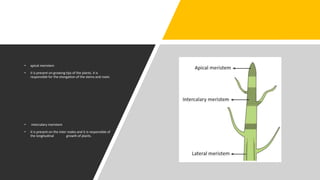
• apical meristem
• it is present on growing tips of the plants. it is
responsible for the elongation of the stems and roots
• intercalary meristem
• it is present on the inter nodes and it is responsible of
the longitudinal growth of plants.
• lateral meristem
it occurs along the side of the longitudnal axis of the plant. it give rise to
vascular tissues. it is responsible for the growth of the girth of stems and
roots. this is responsible for the secondary growth of the plants.
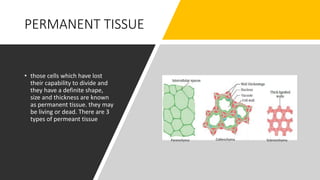
PERMANENT TISSUE
• those cells which have lost
their capability to divide and
they have a definite shape,
size and thickness are known
as permanent tissue. they may
be living or dead. There are 3
types of permeant tissue
• 1) parenchyma
it is composed of thin cell-wall which are composed of living cells. it is oval and spherical in
structure and have large central vacuole where the water is stored. it is found in the leaves,
pith of the stems and roots.
• function of parenchyma
a) storage food in large vacuole.
b) helps in photosynthesis.
c) wound repair and new growth.
d) buoyancy control in aquatic plants.
2) collenchyma
it works as a filer on the soft part of the plant, present at cortex and on
the pith part of the stems and roots. found below the epidermis. cells of
these tissues are living and thickened cell walls.
Functions of collenchyma
a) provide flexibility to plant.
b) provide the mechanical support to plant.
• 3) sclerenchyma
• it is the strengthening part of the cell composed of hard cell wall made
up of lignin. it is present on the vascular tissue and in the veins of the
stems and hard covering seeds and nuts.
fuctions of sclerenchyma
a) provide strength to the plants.
• complex permanent tissue
it is made up of more than one types of cells which works together as a
unit. it is also known as conducting or vascular tissue. it also helps in
transfer of organic materials and water and minerals.
complex tissues are of two types:-
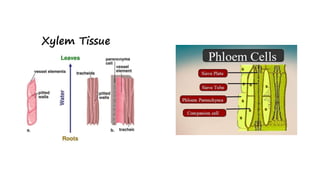
• (1) xylem
• xylem is the vascular tissue in plants which helps in the transporting of
water and dissolved nutrients upwards from the plants. xylem are
consisted of four types
• (a) tracheid
• elongated dead cell which involves in the conduction of water.
• (b) vessels
• these are cylindrical like structures placed on the one above on the
other end from which channel for conduction of water.
• c) xylem parenchyma
• thick cells used of storage of food (starch).
• d) xylem Fiber :
• non-living fibers with thick walls and narrow cavities provide mechanical
support.
• b) phloem
• phloem is the vascular tissue in plants which conducts sugar and
metabolic products from upwards to downwards in plants.
• 1) sieve tubes
• transport organic compound (sugar) made during photosynthesis.
• b) companion cells
• it regulates the activity of sugar in seive tubes
• c) phleom fibres
• provide the mechanical support to seive tubes
• d) phleom parenchyma
• it stores food
ANIMAL TISSUES
• ANIMAL TISSUES ARE OF FOUR TYPES :
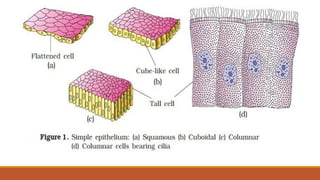
• A) EPITHELIAL TISSUE
• it is a single-layered of cells. blood vessels are absent. it is found in every
organ. skin, lining of mouth, lining of blood vessels, kidneys & tubules
etc. are all made up of these tissues. there are four types of epithelial
tissues:-
• a) squamous epitheliam
• 1) cells form from end to end in the shape of tiles and floor.
• 2) it form the lining of cavaties like mouth, food pipe, nose and alevoli
etc.
• 3) epithelial are arranged in many layers to prevent wear and tear in
skin.
• b) cuboidal epithelium
• 1) it is cube in shape.
• 2) it is found in kidney, vesicles and in gland like- salivary gland and
sweat gland.
• 3) it provides mechanical support.
• 4) it provides geminal epithelial like- testes and ovaries.
c) columanar epitheliam
• 1) it is pillar like structure.
• 2) it forms lining of stomach.
• 3) it also forms small and large intestine.
• 4) it has thread on it's surface which helps on absortion.
d) satrified squamous epitheliam
• 1) it is consists of squamous epitheliam, arranged in layers.
• 2) present in uterine and oesophagus.
• Connective tissue
these are most abandoned and widely distributed in the body of animal.
They help in linking and supporting the other tissue of the body
example cartilage bone adipose blood. Connective tissue are classified
into 3 types
• 1- Loose connective tissue
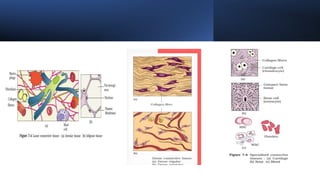
1- Loose connective tissue
Fibers loosely arranged in a semi fluid ground substance.
(A)- Areolar tissue present beneath the sceme it contains fibroblast and
macrophages and mast cell.
(B)Adipose tissue -The cells of this tissue helps in storing fats
2- Dense connective tissue
In the dense connective tissue , the Collison fiber are present in raw
between many parallel
(A) – Tendon , helps in joins skeleton mussel to bones
(B)- Ligaments, which helps in connecting bone to bone
• Specialized connective tissue
They are divided into 3 parts
1- cartilage – connective tissue , The intercellular material of cartilage is solid. The cell of
this tissue (chondrocytes) are enclosed in small cavity in the matrix secreted by them
Ex- Cartilage is present in the tip of nose , outer ear joints, at backbone
2- Bones – connective tissue, the intercellular material of bones have hard ground
substance rich in calcium salt and collision fiber which give bone it’s strength. The bone
cells (osterocytes) are present in the scape called lacunae
Ex- limp bones, such as long bones of leg, the bone marrow in some bones is sight of blood
cells
3. blood – connective tissue- blood is a
specialized liquid connective tissue
containing plasma, RBC, WBC and platelets
• Muscle Tissue :-
Muscles play active role in all the movement of the body muscles are of 3 types
A- Skeletal Muscles
B- Smooth Muscles
C- Cardiac Muscles
A– Skeletal muscles
The skeletal muscles closely attached to the skeletal bones.
They are voluntary Muscles means they controlled by us.
Examples biceps muscles, triceps muscles, gluteal muscles etc.
B-smooth muscles they are involuntary muscles controlled by brain.The smooth muscles fiber
taper at both ends. And do not show STRIATIONS examples the role of internal organs such as
blood vessels, stomach and enter muscles tissue
C- cardiac muscles- they are contact I'll tissue present only in the heart
cell junction fuse the plasma membrane of cardiac muscle cells and make
them stick together
4- neural tissue- they control and coordinate our body. neuron is the unit
of neural system. the nervous system divide into 2 two categories CNS and
PNS.

PPT TISSUE

  • 1.
  • 2.
    Tissue is agroup of cells having common origin and performs same functions (A)- Plant is made up of different kind of tissue examples Meristematic tissue and permanent tissue (B)- Animal also made by different types of tissues Examples Epithelium tissue, connective tissue, muscle tissue and nerve tissue
  • 3.
    MERISTIMATIC TISSUE • - •these simple living cells is capable of dividing and the formation of new cells in plant • it presents in the growing parts of the plants. Example - roots, growing branch etc. • there are three types of meristimatic tissue:- •
  • 4.
    • apical meristem •it is present on growing tips of the plants. it is responsible for the elongation of the stems and roots • intercalary meristem • it is present on the inter nodes and it is responsible of the longitudinal growth of plants.
  • 5.
    • lateral meristem itoccurs along the side of the longitudnal axis of the plant. it give rise to vascular tissues. it is responsible for the growth of the girth of stems and roots. this is responsible for the secondary growth of the plants.
  • 6.
    PERMANENT TISSUE • thosecells which have lost their capability to divide and they have a definite shape, size and thickness are known as permanent tissue. they may be living or dead. There are 3 types of permeant tissue
  • 7.
    • 1) parenchyma itis composed of thin cell-wall which are composed of living cells. it is oval and spherical in structure and have large central vacuole where the water is stored. it is found in the leaves, pith of the stems and roots. • function of parenchyma a) storage food in large vacuole. b) helps in photosynthesis. c) wound repair and new growth. d) buoyancy control in aquatic plants.
  • 8.
    2) collenchyma it worksas a filer on the soft part of the plant, present at cortex and on the pith part of the stems and roots. found below the epidermis. cells of these tissues are living and thickened cell walls. Functions of collenchyma a) provide flexibility to plant. b) provide the mechanical support to plant.
  • 9.
    • 3) sclerenchyma •it is the strengthening part of the cell composed of hard cell wall made up of lignin. it is present on the vascular tissue and in the veins of the stems and hard covering seeds and nuts. fuctions of sclerenchyma a) provide strength to the plants.
  • 10.
    • complex permanenttissue it is made up of more than one types of cells which works together as a unit. it is also known as conducting or vascular tissue. it also helps in transfer of organic materials and water and minerals. complex tissues are of two types:-
  • 12.
    • (1) xylem •xylem is the vascular tissue in plants which helps in the transporting of water and dissolved nutrients upwards from the plants. xylem are consisted of four types • (a) tracheid • elongated dead cell which involves in the conduction of water. • (b) vessels • these are cylindrical like structures placed on the one above on the other end from which channel for conduction of water.
  • 13.
    • c) xylemparenchyma • thick cells used of storage of food (starch). • d) xylem Fiber : • non-living fibers with thick walls and narrow cavities provide mechanical support.
  • 14.
    • b) phloem •phloem is the vascular tissue in plants which conducts sugar and metabolic products from upwards to downwards in plants. • 1) sieve tubes • transport organic compound (sugar) made during photosynthesis.
  • 15.
    • b) companioncells • it regulates the activity of sugar in seive tubes • c) phleom fibres • provide the mechanical support to seive tubes • d) phleom parenchyma • it stores food
  • 16.
    ANIMAL TISSUES • ANIMALTISSUES ARE OF FOUR TYPES : • A) EPITHELIAL TISSUE • it is a single-layered of cells. blood vessels are absent. it is found in every organ. skin, lining of mouth, lining of blood vessels, kidneys & tubules etc. are all made up of these tissues. there are four types of epithelial tissues:-
  • 18.
    • a) squamousepitheliam • 1) cells form from end to end in the shape of tiles and floor. • 2) it form the lining of cavaties like mouth, food pipe, nose and alevoli etc. • 3) epithelial are arranged in many layers to prevent wear and tear in skin.
  • 19.
    • b) cuboidalepithelium • 1) it is cube in shape. • 2) it is found in kidney, vesicles and in gland like- salivary gland and sweat gland. • 3) it provides mechanical support. • 4) it provides geminal epithelial like- testes and ovaries.
  • 20.
    c) columanar epitheliam •1) it is pillar like structure. • 2) it forms lining of stomach. • 3) it also forms small and large intestine. • 4) it has thread on it's surface which helps on absortion. d) satrified squamous epitheliam • 1) it is consists of squamous epitheliam, arranged in layers. • 2) present in uterine and oesophagus.
  • 21.
    • Connective tissue theseare most abandoned and widely distributed in the body of animal. They help in linking and supporting the other tissue of the body example cartilage bone adipose blood. Connective tissue are classified into 3 types • 1- Loose connective tissue
  • 22.
    1- Loose connectivetissue Fibers loosely arranged in a semi fluid ground substance. (A)- Areolar tissue present beneath the sceme it contains fibroblast and macrophages and mast cell. (B)Adipose tissue -The cells of this tissue helps in storing fats 2- Dense connective tissue In the dense connective tissue , the Collison fiber are present in raw between many parallel (A) – Tendon , helps in joins skeleton mussel to bones (B)- Ligaments, which helps in connecting bone to bone
  • 24.
    • Specialized connectivetissue They are divided into 3 parts 1- cartilage – connective tissue , The intercellular material of cartilage is solid. The cell of this tissue (chondrocytes) are enclosed in small cavity in the matrix secreted by them Ex- Cartilage is present in the tip of nose , outer ear joints, at backbone 2- Bones – connective tissue, the intercellular material of bones have hard ground substance rich in calcium salt and collision fiber which give bone it’s strength. The bone cells (osterocytes) are present in the scape called lacunae Ex- limp bones, such as long bones of leg, the bone marrow in some bones is sight of blood cells
  • 25.
    3. blood –connective tissue- blood is a specialized liquid connective tissue containing plasma, RBC, WBC and platelets
  • 26.
    • Muscle Tissue:- Muscles play active role in all the movement of the body muscles are of 3 types A- Skeletal Muscles B- Smooth Muscles C- Cardiac Muscles A– Skeletal muscles The skeletal muscles closely attached to the skeletal bones. They are voluntary Muscles means they controlled by us. Examples biceps muscles, triceps muscles, gluteal muscles etc. B-smooth muscles they are involuntary muscles controlled by brain.The smooth muscles fiber taper at both ends. And do not show STRIATIONS examples the role of internal organs such as blood vessels, stomach and enter muscles tissue
  • 27.
    C- cardiac muscles-they are contact I'll tissue present only in the heart cell junction fuse the plasma membrane of cardiac muscle cells and make them stick together 4- neural tissue- they control and coordinate our body. neuron is the unit of neural system. the nervous system divide into 2 two categories CNS and PNS.