Cell Cycle and Cell Division
© 2022, Aakash BYJU'S. All rights reserved
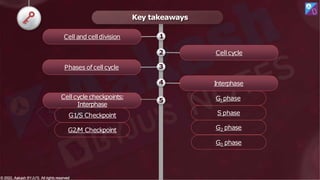
Cell cycle
Cell and celldivision
Interphase
Phases of cell cycle
G1phase
S phase
G2 phase
G0 phase
Cell cycle checkpoints:
Interphase
G1/S Checkpoint
G2/
M Checkpoint
Key takeaways
1
2
3
4
5
© 2022, Aakash BYJU'S. All rights reserved
Key takeaways
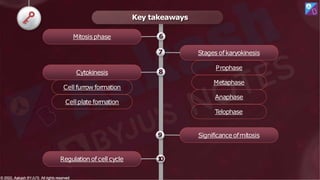
Mitosisphase
Stages of karyokinesis
Prophase
Metaphase
Anaphase
Telophase
Cytokinesis
Cell furrow formation
Cellplate formation
Regulation of cell cycle
Significance ofmitosis
7
8
9
1
0
6
© 2022, Aakash BYJU'S. All rights reserved
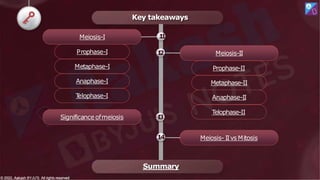
Key takeaways
Meiosis-I
Meiosis-II
Prophase-II
Metaphase-II
Anaphase-II
Telophase-II
Meiosis- IIvs Mitosis
Prophase-I
Metaphase-I
Anaphase-I
T
elophase-I
Significance ofmeiosis
Summary
1
2
1
3
14
1
1
© 2022, Aakash BYJU'S. All rights reserved
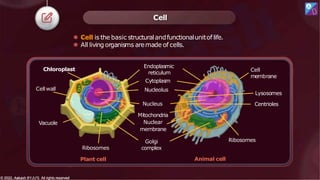
⚫ Cell is the basic structuralandfunctionalunitof life.
⚫ All living organisms aremade of cells.
Cell
Cellwall
Vacuole
Endoplasmic
reticulum
Cytoplasm
Nucleolus
Nucleus
Mitochondria
Nuclear
membrane
Golgi
complex
Cell
membrane
Ribosomes
Plant cell
© 2022, Aakash BYJU'S. All rights reserved
Animal cell
Lysosomes
Centrioles
Ribosomes
Chloroplast
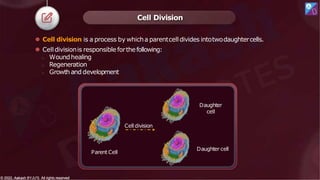
⚫ Cell division is a process by whicha parentcelldivides intotwodaughtercells.
⚫ Celldivisionis responsible forthefollowing:
o Woundhealing
o Regeneration
o Growth and development
Cell Division
Parent Cell
Daughter
cell
Daughter cell
Celldivision
© 2022, Aakash BYJU'S. All rights reserved
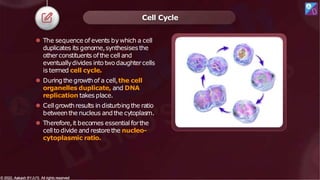
⚫ The sequence of events bywhich a cell
duplicates its genome,synthesisesthe
otherconstituents ofthe cell and
eventuallydivides intotwo daughtercells
is termed cell cycle.
⚫ Duringthe growthof a cell,the cell
organelles duplicate, and DNA
replication takes place.
⚫ Cellgrowthresults in disturbingthe ratio
betweenthe nucleus andthe cytoplasm.
⚫ Therefore,it becomes essential forthe
cellto divide and restorethe nucleo-
cytoplasmic ratio.
Cell Cycle
© 2022, Aakash BYJU'S. All rights reserved
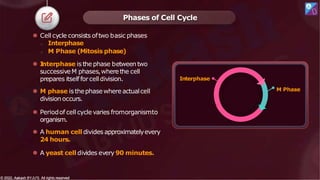
⚫ Cell cycle consists oftwo basic phases
o Interphase
o M Phase (Mitosis phase)
⚫ I
nterphase is the phase betweentwo
successiveM phases,wherethe cell
prepares itself forcelldivision.
⚫ M phase is thephasewhere actualcell
division occurs.
⚫ Periodof cell cyclevaries fromorganismto
organism.
⚫ A human cell divides approximatelyevery
24 hours.
⚫ A yeast cell divides every 90 minutes.
Phases of Cell Cycle
Interphase
M Phase
© 2022, Aakash BYJU'S. All rights reserved
Interphase
CELL
CYCLE
M Phase
G1
G2
© 2022, Aakash BYJU'S. All rights reserved
S
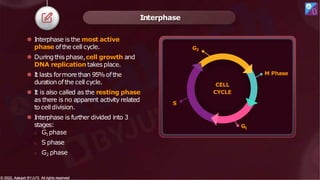
⚫ Interphase is the most active
phase ofthe cell cycle.
⚫ Duringthis phase,cell growth and
DNA replication takes place.
⚫ It lasts formore than 95%ofthe
duration ofthe cell cycle.
⚫ It is also called as the resting phase
as there is no apparent activity related
to cell division.
⚫ Interphase is further divided into 3
stages:
o G1phase
o S phase
o G2 phase
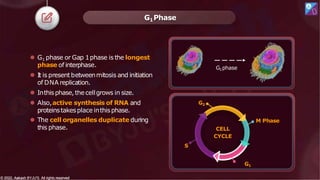
⚫ G1 phase or Gap 1phase is the longest
phase of interphase.
⚫ It is present betweenmitosis and initiation
of DNA replication.
⚫ Inthisphase,thecellgrows in size.
⚫ Also,active synthesis of RNA and
proteinstakesplace inthisphase.
⚫ The cell organelles duplicate during
this phase.
G1Phase
CELL
CYCLE
M Phase
G2
S
G1phase
© 2022, Aakash BYJU'S. All rights reserved
G1
© 2022, Aakash BYJU'S. All rights reserved
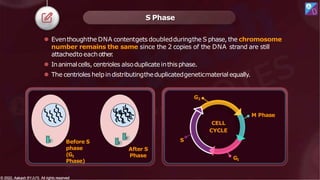
S Phase
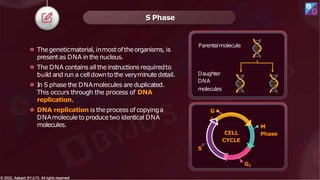
⚫ Thegeneticmaterial, inmostoftheorganisms, is
presentas DNA in the nucleus.
⚫ The DNA contains alltheinstructions requiredto
build and run a celldowntothe veryminute detail.
⚫ In S phase the DNAmolecules are duplicated.
This occurs through the process of DNA
replication.
⚫ DNA replication is theprocess of copyinga
DNAmoleculetoproducetwo identical DNA
molecules.
Parentalmolecule
Daughter
DNA
molecules
CELL
CYCLE
M
Phase
G
2
S
© 2022, Aakash BYJU'S. All rights reserved
G1
© 2022, Aakash BYJU'S. All rights reserved
⚫ Eventhoughthe DNA contentgets doubledduringthe S phase, the chromosome
number remains the same since the 2 copies of the DNA strand are still
attachedtoeachother
.
⚫ Inanimalcells, centrioles alsoduplicateinthisphase.
⚫ The centrioles helpindistributingtheduplicatedgeneticmaterial equally.
S Phase
Before S
phase
(G1
Phase)
After S
Phase
M Phase
CELL
CYCLE
G1
G2
S
© 2022, Aakash BYJU'S. All rights reserved
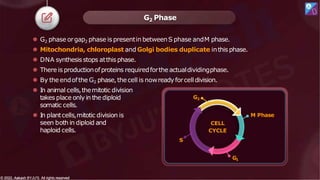
⚫ G2 phase orgap2 phase is presentin betweenS phase andM phase.
⚫ Mitochondria, chloroplast andGolgi bodies duplicate inthis phase.
⚫ DNA synthesis stops atthisphase.
⚫ There is productionofproteins requiredforthe actualdividingphase.
⚫ By theendofthe G2 phase,thecell is nowready forcelldivision.
⚫ In animal cells,themitotic division
takes place onlyin the diploid
somatic cells.
⚫ In plantcells,mitotic division is
seen both in diploid and
haploid cells.
G2 Phase
CELL
CYCLE
M Phase
G1
G2
S
© 2022, Aakash BYJU'S. All rights reserved
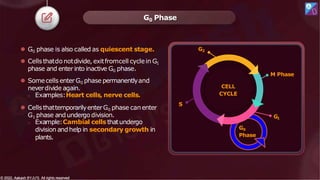
⚫ G0 phase is also called as quiescent stage.
⚫ Cells thatdonotdivide, exitfromcell cyclein G1
phase and enter into inactive G0 phase.
⚫ Somecells enterG0 phase permanentlyand
neverdivide again.
o Examples:Heart cells, nerve cells.
⚫ Cells thattemporarilyenterG0 phase can enter
G1 phase and undergo division.
o Example:Cambial cells thatundergo
division and help in secondary growth in
plants.
G0 Phase
CELL
CYCLE
M Phase
G1
G2
S
G0
Phase
© 2022, Aakash BYJU'S. All rights reserved
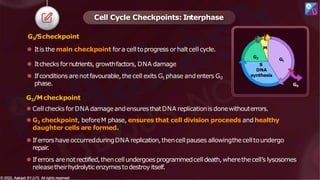
Cell Cycle Checkpoints: Interphase
G1
/Scheckpoint
⚫ Itis the main checkpoint fora celltoprogress orhaltcell cycle.
⚫ Itchecks fornutrients,growthfactors, DNA damage
⚫ Ifconditions arenotfavourable,thecell exits G1 phase andenters G0
phase.
G2/Mcheckpoint
⚫ Cell checks for DNA damageandensuresthatDNA replicationis donewithouterrors.
⚫ G2 checkpoint, beforeM phase, ensures that cell division proceeds andhealthy
daughter cells are formed.
⚫ Iferrorshave occurredduringDNA replication,thencell pauses allowingthecelltoundergo
repair
.
⚫ Iferrors arenotrectified,thencellundergoes programmedcelldeath,wherethecell’s lysosomes
releasetheirhydrolyticenzymestodestroy itself.
G2
© 2022, Aakash BYJU'S. All rights reserved
M
S
DNA
synthesis
G1
G0
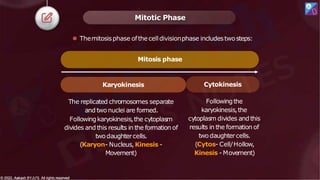
Mitotic Phase
Followingthe
karyokinesis,the
cytoplasm divides andthis
results in the formation of
twodaughtercells.
(Cytos- Cell/Hollow,
Kinesis - Movement)
The replicated chromosomes separate
and two nuclei are formed.
Followingkaryokinesis,the cytoplasm
divides andthis results in the formation of
twodaughtercells.
(Karyon- Nucleus,Kinesis -
Movement)
⚫ Themitosisphase ofthecelldivisionphase includestwosteps:
Mitosis phase
Karyokinesis Cytokinesis
© 2022, Aakash BYJU'S. All rights reserved
Mitosis Phase
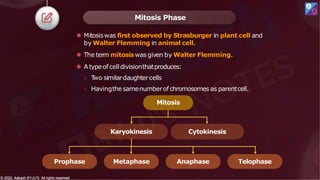
⚫ Mitosiswas first observed by Strasburger in plant cell and
by Walter Flemming in animal cell.
⚫ The term mitosiswas given by Walter Flemming.
⚫ A typeof celldivisionthatproduces:
○ T
wo similardaughtercells
○ Havingthe samenumberof chromosomes as parentcell.
Mitosis
Prophase Metaphase Anaphase Telophase
Karyokinesis Cytokinesis
© 2022, Aakash BYJU'S. All rights reserved
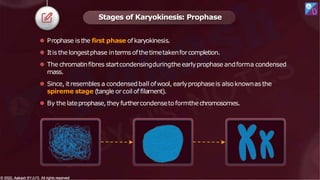
⚫ Prophase is the first phase ofkaryokinesis.
⚫ Itis thelongestphase interms ofthetimetakenforcompletion.
⚫ The chromatinfibres startcondensingduringtheearlyprophase andforma condensed
mass.
⚫ Since, itresembles a condensedball ofwool, earlyprophaseis alsoknownas the
spireme stage (tangle or coil of filament).
⚫ By the lateprophase,theyfurthercondensetoformthechromosomes.
Stages of Karyokinesis: Prophase
© 2022, Aakash BYJU'S. All rights reserved
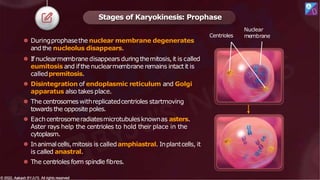
⚫ Duringprophasethe nuclear membrane degenerates
and the nucleolus disappears.
⚫ If nuclearmembranedisappears duringthemitosis,it is called
eumitosis and ifthe nuclearmembrane remains intact it is
calledpremitosis.
⚫ Disintegration of endoplasmic reticulum and Golgi
apparatus also takes place.
⚫ The centrosomeswithreplicatedcentrioles startmoving
towards the oppositepoles.
⚫ Eachcentrosomeradiatesmicrotubulesknownas asters.
Aster rays help the centrioles to hold their place in the
cytoplasm.
⚫ Inanimalcells,mitosis is calledamphiastral. Inplantcells, it
is called anastral.
⚫ The centrioles form spindle fibres.
Stages of Karyokinesis: Prophase
Nuclear
membrane
© 2022, Aakash BYJU'S. All rights reserved
Centrioles
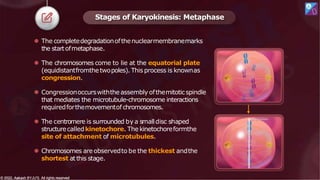
⚫ The completedegradationofthenuclearmembranemarks
the startofmetaphase.
⚫ The chromosomes come to lie at the equatorial plate
(equidistantfromthetwopoles). This process is knownas
congression.
⚫ Congressionoccurswiththeassembly ofthemitoticspindle
that mediates the microtubule-chromosome interactions
requiredforthemovementof chromosomes.
⚫ The centromere is surrounded by a smalldisc shaped
structurecalledkinetochore. Thekinetochoreformthe
site of attachment of microtubules.
⚫ Chromosomes areobservedto be the thickest andthe
shortest atthis stage.
Stages of Karyokinesis: Metaphase
© 2022, Aakash BYJU'S. All rights reserved
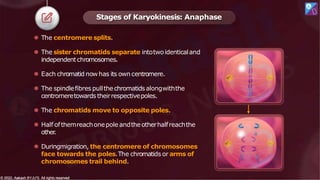
⚫ The centromere splits.
⚫ The sister chromatids separate intotwoidenticaland
independentchromosomes.
⚫ Each chromatid now has its own centromere.
⚫ The spindlefibres pullthechromatids alongwiththe
centromeretowards theirrespectivepoles.
⚫ The chromatids move to opposite poles.
⚫ Half ofthemreachonepole andtheotherhalfreachthe
other
.
⚫ Duringmigration, the centromere of chromosomes
face towards the poles.The chromatids or arms of
chromosomes trail behind.
Stages of Karyokinesis: Anaphase
© 2022, Aakash BYJU'S. All rights reserved
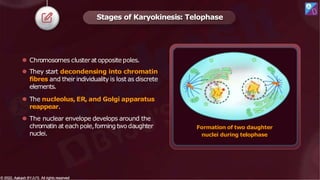
⚫ Chromosomes clusterat oppositepoles.
⚫ They start decondensing into chromatin
fibres and their individuality is lost as discrete
elements.
⚫ The nucleolus, ER, and Golgi apparatus
reappear.
⚫ The nuclear envelope develops around the
chromatin at each pole,formingtwo daughter
nuclei.
Formation of two daughter
nuclei during telophase
Stages of Karyokinesis: Telophase
© 2022, Aakash BYJU'S. All rights reserved
Cell furrow formation
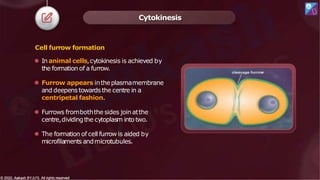
⚫ In animal cells,cytokinesis is achieved by
the formation of a furrow.
⚫ Furrow appears intheplasmamembrane
and deepenstowards the centre in a
centripetal fashion.
⚫ Furrows fromboththe sides joinatthe
centre,dividingthe cytoplasm intotwo.
⚫ The formation of cell furrow is aided by
microfilaments andmicrotubules.
Cytokinesis
© 2022, Aakash BYJU'S. All rights reserved
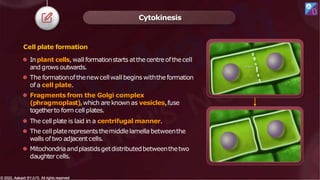
Cell plate formation
⚫ Inplant cells,wallformationstarts atthecentreofthecell
and grows outwards.
⚫ The formationofthenewcellwall begins withtheformation
of a cell plate.
⚫ Fragments from the Golgi complex
(phragmoplast),which are known as vesicles,fuse
togetherto form cell plates.
⚫ The cellplate is laid in a centrifugal manner.
⚫ The cellplaterepresentsthemiddlelamella betweenthe
walls oftwo adjacentcells.
⚫ Mitochondriaandplastidsgetdistributedbetweenthetwo
daughtercells.
Cytokinesis
© 2022, Aakash BYJU'S. All rights reserved
Significance of Mitosis
© 2022, Aakash BYJU'S. All rights reserved
⚫ Growth: Mitosis causes growthanddevelopmentinmulticellularorganisms.
⚫ Plants cangrowfroma tinyzygotetohugeorganisms duetomitosis.
⚫ Helps inmaintenanceofpropersurface area to volume ratio of a cell
⚫ Repair: The oldandworn-outcells are replacedby newcells.
⚫ Reproduction: Unicellularorganisms reproduce (multiply)throughmitosis.
⚫ Inunicellularorganisms, replicationof cells is synonymouswithgrowth.
⚫ Regeneration: Mitosis causes cellgrowththatcauses therevivalofthe lostbodyparts
inanimals suchas starfish,planaria,thetailof a lizard, etc.
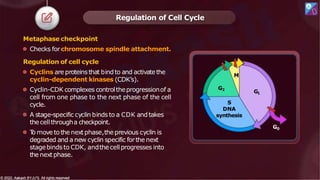
Regulation of Cell Cycle
© 2022, Aakash BYJU'S. All rights reserved
G2
M
S
DNA
synthesis
G1
G0
Metaphase checkpoint
⚫ Checks forchromosome spindle attachment.
Regulation of cell cycle
⚫ Cyclins are proteinsthat bindto and activatethe
cyclin-dependent kinases (CDK’s).
⚫ Cyclin-CDK complexes controltheprogressionof a
cell from one phase to the next phase of the cell
cycle.
⚫ A stage-specific cyclin binds to a CDK andtakes
thecellthrougha checkpoint.
⚫ T
o move tothe next phase,the previous cyclin is
degraded and a new cyclin specific forthe next
stagebinds to CDK, andthecellprogresses into
the nextphase.
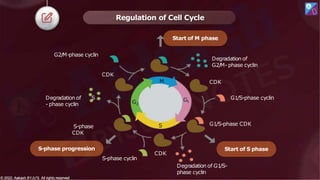
Regulation of Cell Cycle
Degradation of
G2/M-phase cyclin
CDK
G1/S-phase cyclin
G1/S-phase CDK
CDK
CDK
S-phase
CDK
G2/M-phase cyclin
S-phase cyclin
Degradation of S
- phase cyclin
Degradation of G1/S-
phase cyclin
S
G1
M
G2
Start of M phase
Start of S phase
S-phase progression
© 2022, Aakash BYJU'S. All rights reserved
Meiosis
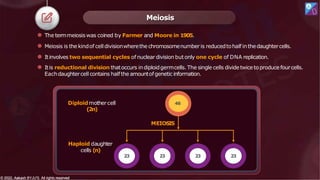
⚫ The termmeiosis was coined by Farmer and Moore in 1905.
⚫ Meiosis is the kindof celldivisionwherethe chromosomenumber is reducedtohalf inthedaughtercells.
⚫ Itinvolves two sequential cycles of nuclear division butonly one cycle of DNA replication.
⚫ Itis reductional division thatoccurs indiploidgermcells. The single cells dividetwicetoproduce fourcells.
Eachdaughtercell contains halfthe amountofgenetic information.
Diploidmother cell
(2n)
Haploid daughter
cells (n)
MEIOSIS
46
23 23 23 23
© 2022, Aakash BYJU'S. All rights reserved
Meiosis
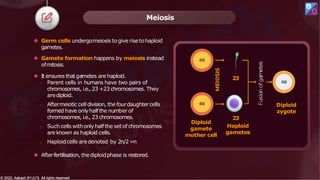
⚫ Germ cells undergomeiosis togive risetohaploid
gametes.
⚫ Gamete formation happens by meiosis instead
ofmitosis.
⚫ It ensures thatgametes are haploid.
o Parent cells in humans have two pairs of
chromosomes, i.e., 23 +23 chromosomes. They
arediploid.
o Aftermeiotic cell division, the fourdaughtercells
formed have onlyhalfthe number of
chromosomes, i.e., 23 chromosomes.
o Such cells withonlyhalfthe setof chromosomes
are known as haploid cells.
o Haploidcells aredenoted by 2n/2 =n
⚫ Afterfertilisation, thediploidphase is restored.
Diploid
gamete
mother cell
23
23
Haploid
gametes
46
Diploid
zygote
46
46
© 2022, Aakash BYJU'S. All rights reserved
Steps of Meiosis
Meiosis I Meiosis I
I
Prophase I
Metaphase I
Anaphase I
Telophase I
Prophase I
I
Metaphase I
I
Anaphase I
I
Telophase I
I
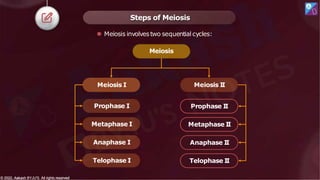
⚫ Meiosis involvestwo sequential cycles:
Meiosis
© 2022, Aakash BYJU'S. All rights reserved
Meiosis I
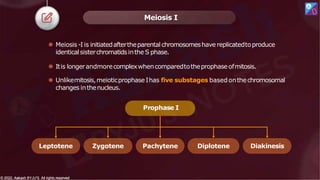
⚫ Meiosis -I is initiatedaftertheparental chromosomeshave replicatedtoproduce
identicalsisterchromatidsinthe S phase.
⚫ Itis longerandmorecomplexwhencomparedtotheprophaseofmitosis.
⚫ Unlikemitosis,meioticprophase Ihas five substages based onthechromosomal
changes inthenucleus.
Prophase I
Leptotene Zygotene Pachytene Diplotene Diakinesis
© 2022, Aakash BYJU'S. All rights reserved
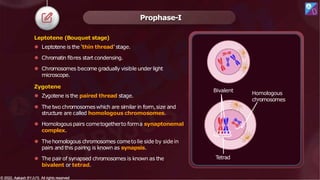
Prophase-I
Leptotene (Bouquet stage)
⚫ Leptotene is the ‘thin thread’ stage.
⚫ Chromatin fibres start condensing.
⚫ Chromosomes become gradually visible under light
microscope.
Zygotene
⚫ Zygotene is the paired thread stage.
⚫ The two chromosomeswhich are similar in form,size and
structure are called homologous chromosomes.
⚫ Homologouspairs cometogetherto forma synaptonemal
complex.
⚫ Thehomologous chromosomes cometo lie side by side in
pairs and this pairing is known as synapsis.
⚫ The pairof synapsed chromosomes is known as the
bivalent or tetrad.
Bivalent
Tetrad
Homologous
chromosomes
© 2022, Aakash BYJU'S. All rights reserved
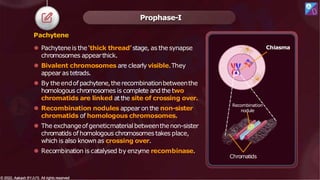
Pachytene
⚫ Pachyteneis the ‘thick thread’ stage, as the synapse
chromosomes appearthick.
⚫ Bivalent chromosomes are clearlyvisible.They
appear as tetrads.
⚫ By theendofpachytene,therecombinationbetweenthe
homologous chromosomes is complete andthe two
chromatids are linked at the site of crossing over.
⚫ Recombination nodules appear on the non-sister
chromatids of homologous chromosomes.
⚫ The exchangeofgeneticmaterial betweenthenon-sister
chromatids ofhomologous chromosomestakes place,
which is also known as crossing over.
⚫ Recombination is catalysed by enzyme recombinase.
Prophase-I
Chiasma
Recombination
nodule
Chromatids
© 2022, Aakash BYJU'S. All rights reserved
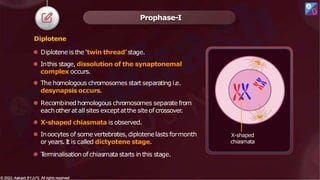
Diplotene
⚫ Diplotene is the ‘twin thread’ stage.
⚫ Inthis stage, dissolution of the synaptonemal
complex occurs.
⚫ The homologous chromosomes start separating i.e.
desynapsis occurs.
⚫ Recombinedhomologous chromosomes separate from
eachotheratall sites exceptatthe siteof crossover
.
⚫ X-shaped chiasmata is observed.
⚫ Inoocytes of somevertebrates,diplotenelasts formonth
or years. It is called dictyotene stage.
⚫ T
erminalisationof chiasmata starts in this stage.
Prophase-I
X-shaped
chiasmata
© 2022, Aakash BYJU'S. All rights reserved
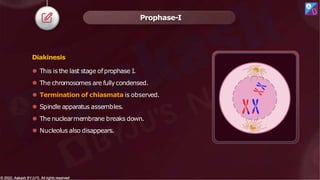
Diakinesis
⚫ This is the last stage ofprophase I.
⚫ The chromosomes are fullycondensed.
⚫ Termination of chiasmata is observed.
⚫ Spindle apparatus assembles.
⚫ The nuclearmembrane breaks down.
⚫ Nucleolus also disappears.
Prophase-I
© 2022, Aakash BYJU'S. All rights reserved
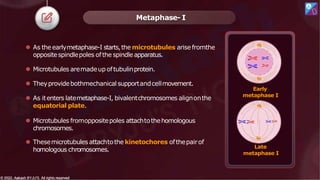
⚫ As the earlymetaphase-I starts,the microtubules arisefromthe
oppositespindlepoles ofthe spindleapparatus.
⚫ Microtubules aremadeupoftubulinprotein.
⚫ Theyprovidebothmechanical supportandcellmovement.
⚫ As itenters latemetaphase-I, bivalentchromosomes alignonthe
equatorial plate.
⚫ Microtubules fromoppositepoles attachtothehomologous
chromosomes.
⚫ Thesemicrotubules attachtothe kinetochores ofthepairof
homologous chromosomes.
Metaphase- I
Early
metaphase I
Late
metaphase I
© 2022, Aakash BYJU'S. All rights reserved
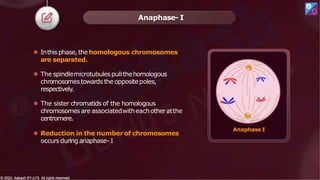
⚫ Inthis phase,the homologous chromosomes
are separated.
⚫ The spindlemicrotubulespullthehomologous
chromosomestowards the oppositepoles,
respectively.
⚫ The sister chromatids of the homologous
chromosomes are associatedwitheachotheratthe
centromere.
⚫ Reduction in the number of chromosomes
occurs during anaphase- I
Anaphase- I
Anaphase I
© 2022, Aakash BYJU'S. All rights reserved
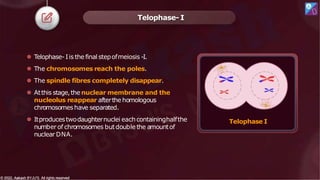
⚫ Telophase- Iis the final stepofmeiosis -I.
⚫ The chromosomes reach the poles.
⚫ The spindle fibres completely disappear.
⚫ Atthis stage,the nuclear membrane and the
nucleolus reappear afterthe homologous
chromosomeshave separated.
⚫ Itproducestwodaughternuclei eachcontaininghalfthe
number of chromosomes butdouble the amountof
nuclear DNA.
Telophase- I
Telophase I
© 2022, Aakash BYJU'S. All rights reserved
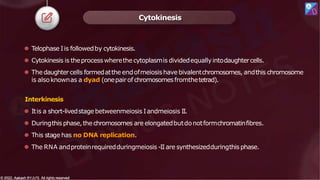
⚫ Telophase Iis followedby cytokinesis.
⚫ Cytokinesis is theprocesswherethecytoplasmis dividedequallyintodaughtercells.
⚫ Thedaughtercells formedatthe endofmeiosishave bivalentchromosomes, andthis chromosome
is alsoknownas a dyad (onepairof chromosomesfromthetetrad).
Interkinesis
⚫ Itis a short-livedstage betweenmeiosis Iandmeiosis II.
⚫ Duringthis phase,thechromosomes are elongatedbutdonotformchromatinfibres.
⚫ This stage has no DNA replication.
⚫ The RNA andproteinrequiredduringmeiosis -IIare synthesizedduringthis phase.
Cytokinesis
© 2022, Aakash BYJU'S. All rights reserved
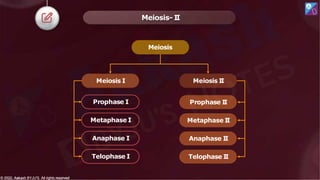
Meiosis- I
I
Meiosis
Meiosis I Meiosis I
I
Prophase I
Metaphase I
Anaphase I
Telophase I
Prophase I
I
Metaphase I
I
Anaphase I
I
Telophase I
I
© 2022, Aakash BYJU'S. All rights reserved
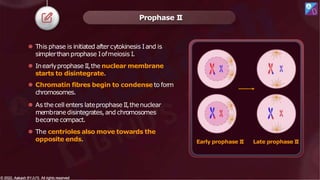
⚫ This phase is initiated aftercytokinesis Iand is
simplerthan prophase Iofmeiosis I.
⚫ Inearlyprophase II,the nuclear membrane
starts to disintegrate.
⚫ Chromatin fibres begin to condense to form
chromosomes.
⚫ As thecell enters lateprophase II,thenuclear
membrane disintegrates,and chromosomes
become compact.
⚫ The centrioles also move towards the
opposite ends.
Prophase I
I
Early prophase I
I
© 2022, Aakash BYJU'S. All rights reserved
Late prophase I
I
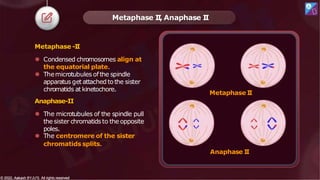
Metaphase -I
I
⚫ Condensed chromosomes align at
the equatorial plate.
⚫ Themicrotubules ofthe spindle
apparatus get attached tothe sister
chromatids at kinetochore.
Anaphase-II
⚫ The microtubules of the spindle pull
the sister chromatidsto the opposite
poles.
⚫ The centromere of the sister
chromatids splits.
Metaphase I
I
, Anaphase I
I
Metaphase I
I
Anaphase I
I
© 2022, Aakash BYJU'S. All rights reserved
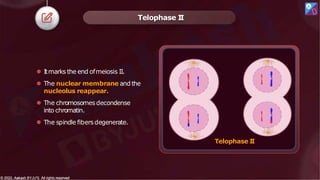
⚫ Itmarks the end ofmeiosis II.
⚫ The nuclear membrane and the
nucleolus reappear.
⚫ The chromosomesdecondense
into chromatin.
⚫ The spindle fibersdegenerate.
Telophase I
I
Telophase I
I
© 2022, Aakash BYJU'S. All rights reserved
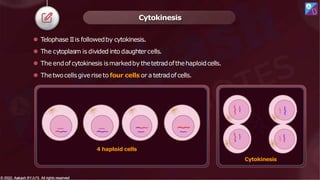
⚫ Telophase IIis followedby cytokinesis.
⚫ The cytoplasm is divided into daughtercells.
⚫ The endof cytokinesis ismarkedby thetetradofthehaploidcells.
⚫ Thetwocellsgiveriseto four cells or a tetradof cells.
Cytokinesis
Cytokinesis
4 haploid cells
© 2022, Aakash BYJU'S. All rights reserved
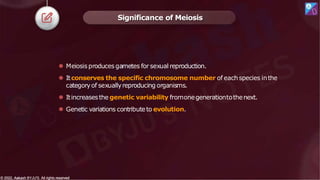
⚫ Meiosis produces gametes for sexual reproduction.
⚫ Itconserves the specific chromosome number of each species inthe
categoryof sexuallyreproducing organisms.
⚫ Itincreasesthe genetic variability fromonegenerationtothenext.
⚫ Genetic variations contributeto evolution.
Significance of Meiosis
© 2022, Aakash BYJU'S. All rights reserved
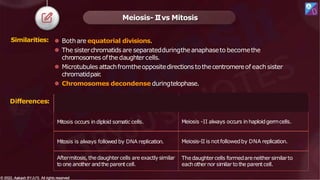
⚫ Bothare equatorial divisions.
⚫ The sisterchromatids are separatedduringthe anaphaseto becomethe
chromosomes ofthe daughtercells.
⚫ Microtubules attachfromtheoppositedirections tothecentromereof each sister
chromatidpair
.
⚫ Chromosomes decondense duringtelophase.
Meiosis- I
Ivs Mitosis
Similarities:
Mitosis Meiosis -II
Mitosis occurs indiploid somatic cells. Meiosis -II always occurs inhaploidgermcells.
Mitosis is always followed by DNA replication. Meiosis-II is notfollowedby DNA replication.
Aftermitosis, thedaughtercells are exactlysimilar
to one another andthe parentcell.
Thedaughtercells formedareneither similarto
eachother nor similar tothe parentcell.
Differences:
© 2022, Aakash BYJU'S. All rights reserved
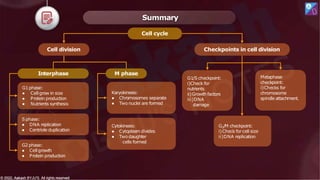
Summary
Cell cycle
Cell division
Interphase M phase
G1phase:
● Cellgrow in size
● Protein production
● Nutrients synthesis
S phase:
● DNA replication
● Centriole duplication
G2 phase:
● Cellgrowth
● Protein production
Karyokinesis:
● Chromosomes separate
● Two nuclei are formed
Cytokinesis:
● Cytoplasm divides
● Two daughter
cells formed
Checkpoints in cell division
G1/S checkpoint:
i)Check for
nutrients
ii)Growth factors
iii)DNA
damage
G2/M checkpoint:
i)Check forcell size
ii)DNA replication
Metaphase
checkpoint:
i)Checks for
chromosome
spindle attachment.
© 2022, Aakash BYJU'S. All rights reserved
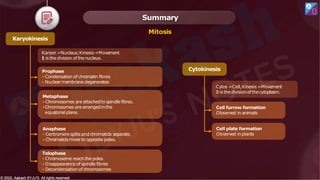
Summary
Karyokinesis
Karyon =Nucleus;Kinesis =Movement
It is the division of the nucleus.
Prophase
- Condensation of chromatin fibres
- Nuclearmembrane degenerates
Anaphase
- Centromere splits andchromatids separate.
- Chromatidsmove to opposite poles.
Metaphase
- Chromosomes are attachedto spindle fibres.
-Chromosomes are arrangedinthe
equatorial plane.
Telophase
- Chromosome reach the poles
- Disappearance of spindle fibres
- Decondensationof chromosomes
Cytokinesis
Cytos =Cell,Kinesis =Movement
Itis thedivisionofthe cytoplasm.
Cell furrow formation
Observed in animals
Cell plate formation
Observed in plants
Mitosis
© 2022, Aakash BYJU'S. All rights reserved
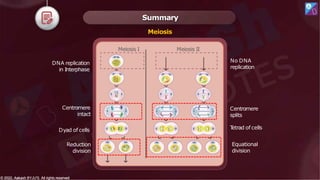
Summary
Reduction
division
Equational
division
Centromere
intact
DNA replication
in Interphase
No DNA
replication
Meiosis I Meiosis II
Centromere
splits
© 2022, Aakash BYJU'S. All rights reserved
Dyad of cells T
etrad of cells
Meiosis

Cell Cycle and Cell Division.pptx

  • 1.
    Cell Cycle andCell Division © 2022, Aakash BYJU'S. All rights reserved © 2022, Aakash BYJU'S. All rights reserved
  • 2.
    Cell cycle Cell andcelldivision Interphase Phases of cell cycle G1phase S phase G2 phase G0 phase Cell cycle checkpoints: Interphase G1/S Checkpoint G2/ M Checkpoint Key takeaways 1 2 3 4 5 © 2022, Aakash BYJU'S. All rights reserved © 2022, Aakash BYJU'S. All rights reserved
  • 3.
    Key takeaways Mitosisphase Stages ofkaryokinesis Prophase Metaphase Anaphase Telophase Cytokinesis Cell furrow formation Cellplate formation Regulation of cell cycle Significance ofmitosis 7 8 9 1 0 6 © 2022, Aakash BYJU'S. All rights reserved © 2022, Aakash BYJU'S. All rights reserved
  • 4.
    Key takeaways Meiosis-I Meiosis-II Prophase-II Metaphase-II Anaphase-II Telophase-II Meiosis- IIvsMitosis Prophase-I Metaphase-I Anaphase-I T elophase-I Significance ofmeiosis Summary 1 2 1 3 14 1 1 © 2022, Aakash BYJU'S. All rights reserved © 2022, Aakash BYJU'S. All rights reserved
  • 5.
    ⚫ Cell isthe basic structuralandfunctionalunitof life. ⚫ All living organisms aremade of cells. Cell Cellwall Vacuole Endoplasmic reticulum Cytoplasm Nucleolus Nucleus Mitochondria Nuclear membrane Golgi complex Cell membrane Ribosomes Plant cell © 2022, Aakash BYJU'S. All rights reserved © 2022, Aakash BYJU'S. All rights reserved Animal cell Lysosomes Centrioles Ribosomes Chloroplast
  • 6.
    ⚫ Cell divisionis a process by whicha parentcelldivides intotwodaughtercells. ⚫ Celldivisionis responsible forthefollowing: o Woundhealing o Regeneration o Growth and development Cell Division Parent Cell Daughter cell Daughter cell Celldivision © 2022, Aakash BYJU'S. All rights reserved © 2022, Aakash BYJU'S. All rights reserved
  • 7.
    ⚫ The sequenceof events bywhich a cell duplicates its genome,synthesisesthe otherconstituents ofthe cell and eventuallydivides intotwo daughtercells is termed cell cycle. ⚫ Duringthe growthof a cell,the cell organelles duplicate, and DNA replication takes place. ⚫ Cellgrowthresults in disturbingthe ratio betweenthe nucleus andthe cytoplasm. ⚫ Therefore,it becomes essential forthe cellto divide and restorethe nucleo- cytoplasmic ratio. Cell Cycle © 2022, Aakash BYJU'S. All rights reserved © 2022, Aakash BYJU'S. All rights reserved
  • 8.
    ⚫ Cell cycleconsists oftwo basic phases o Interphase o M Phase (Mitosis phase) ⚫ I nterphase is the phase betweentwo successiveM phases,wherethe cell prepares itself forcelldivision. ⚫ M phase is thephasewhere actualcell division occurs. ⚫ Periodof cell cyclevaries fromorganismto organism. ⚫ A human cell divides approximatelyevery 24 hours. ⚫ A yeast cell divides every 90 minutes. Phases of Cell Cycle Interphase M Phase © 2022, Aakash BYJU'S. All rights reserved © 2022, Aakash BYJU'S. All rights reserved
  • 9.
    Interphase CELL CYCLE M Phase G1 G2 © 2022,Aakash BYJU'S. All rights reserved © 2022, Aakash BYJU'S. All rights reserved S ⚫ Interphase is the most active phase ofthe cell cycle. ⚫ Duringthis phase,cell growth and DNA replication takes place. ⚫ It lasts formore than 95%ofthe duration ofthe cell cycle. ⚫ It is also called as the resting phase as there is no apparent activity related to cell division. ⚫ Interphase is further divided into 3 stages: o G1phase o S phase o G2 phase
  • 10.
    ⚫ G1 phaseor Gap 1phase is the longest phase of interphase. ⚫ It is present betweenmitosis and initiation of DNA replication. ⚫ Inthisphase,thecellgrows in size. ⚫ Also,active synthesis of RNA and proteinstakesplace inthisphase. ⚫ The cell organelles duplicate during this phase. G1Phase CELL CYCLE M Phase G2 S G1phase © 2022, Aakash BYJU'S. All rights reserved G1 © 2022, Aakash BYJU'S. All rights reserved
  • 11.
    S Phase ⚫ Thegeneticmaterial,inmostoftheorganisms, is presentas DNA in the nucleus. ⚫ The DNA contains alltheinstructions requiredto build and run a celldowntothe veryminute detail. ⚫ In S phase the DNAmolecules are duplicated. This occurs through the process of DNA replication. ⚫ DNA replication is theprocess of copyinga DNAmoleculetoproducetwo identical DNA molecules. Parentalmolecule Daughter DNA molecules CELL CYCLE M Phase G 2 S © 2022, Aakash BYJU'S. All rights reserved G1 © 2022, Aakash BYJU'S. All rights reserved
  • 12.
    ⚫ Eventhoughthe DNAcontentgets doubledduringthe S phase, the chromosome number remains the same since the 2 copies of the DNA strand are still attachedtoeachother . ⚫ Inanimalcells, centrioles alsoduplicateinthisphase. ⚫ The centrioles helpindistributingtheduplicatedgeneticmaterial equally. S Phase Before S phase (G1 Phase) After S Phase M Phase CELL CYCLE G1 G2 S © 2022, Aakash BYJU'S. All rights reserved © 2022, Aakash BYJU'S. All rights reserved
  • 13.
    ⚫ G2 phaseorgap2 phase is presentin betweenS phase andM phase. ⚫ Mitochondria, chloroplast andGolgi bodies duplicate inthis phase. ⚫ DNA synthesis stops atthisphase. ⚫ There is productionofproteins requiredforthe actualdividingphase. ⚫ By theendofthe G2 phase,thecell is nowready forcelldivision. ⚫ In animal cells,themitotic division takes place onlyin the diploid somatic cells. ⚫ In plantcells,mitotic division is seen both in diploid and haploid cells. G2 Phase CELL CYCLE M Phase G1 G2 S © 2022, Aakash BYJU'S. All rights reserved © 2022, Aakash BYJU'S. All rights reserved
  • 14.
    ⚫ G0 phaseis also called as quiescent stage. ⚫ Cells thatdonotdivide, exitfromcell cyclein G1 phase and enter into inactive G0 phase. ⚫ Somecells enterG0 phase permanentlyand neverdivide again. o Examples:Heart cells, nerve cells. ⚫ Cells thattemporarilyenterG0 phase can enter G1 phase and undergo division. o Example:Cambial cells thatundergo division and help in secondary growth in plants. G0 Phase CELL CYCLE M Phase G1 G2 S G0 Phase © 2022, Aakash BYJU'S. All rights reserved © 2022, Aakash BYJU'S. All rights reserved
  • 15.
    Cell Cycle Checkpoints:Interphase G1 /Scheckpoint ⚫ Itis the main checkpoint fora celltoprogress orhaltcell cycle. ⚫ Itchecks fornutrients,growthfactors, DNA damage ⚫ Ifconditions arenotfavourable,thecell exits G1 phase andenters G0 phase. G2/Mcheckpoint ⚫ Cell checks for DNA damageandensuresthatDNA replicationis donewithouterrors. ⚫ G2 checkpoint, beforeM phase, ensures that cell division proceeds andhealthy daughter cells are formed. ⚫ Iferrorshave occurredduringDNA replication,thencell pauses allowingthecelltoundergo repair . ⚫ Iferrors arenotrectified,thencellundergoes programmedcelldeath,wherethecell’s lysosomes releasetheirhydrolyticenzymestodestroy itself. G2 © 2022, Aakash BYJU'S. All rights reserved © 2022, Aakash BYJU'S. All rights reserved M S DNA synthesis G1 G0
  • 16.
    Mitotic Phase Followingthe karyokinesis,the cytoplasm dividesandthis results in the formation of twodaughtercells. (Cytos- Cell/Hollow, Kinesis - Movement) The replicated chromosomes separate and two nuclei are formed. Followingkaryokinesis,the cytoplasm divides andthis results in the formation of twodaughtercells. (Karyon- Nucleus,Kinesis - Movement) ⚫ Themitosisphase ofthecelldivisionphase includestwosteps: Mitosis phase Karyokinesis Cytokinesis © 2022, Aakash BYJU'S. All rights reserved © 2022, Aakash BYJU'S. All rights reserved
  • 17.
    Mitosis Phase ⚫ Mitosiswasfirst observed by Strasburger in plant cell and by Walter Flemming in animal cell. ⚫ The term mitosiswas given by Walter Flemming. ⚫ A typeof celldivisionthatproduces: ○ T wo similardaughtercells ○ Havingthe samenumberof chromosomes as parentcell. Mitosis Prophase Metaphase Anaphase Telophase Karyokinesis Cytokinesis © 2022, Aakash BYJU'S. All rights reserved © 2022, Aakash BYJU'S. All rights reserved
  • 18.
    ⚫ Prophase isthe first phase ofkaryokinesis. ⚫ Itis thelongestphase interms ofthetimetakenforcompletion. ⚫ The chromatinfibres startcondensingduringtheearlyprophase andforma condensed mass. ⚫ Since, itresembles a condensedball ofwool, earlyprophaseis alsoknownas the spireme stage (tangle or coil of filament). ⚫ By the lateprophase,theyfurthercondensetoformthechromosomes. Stages of Karyokinesis: Prophase © 2022, Aakash BYJU'S. All rights reserved © 2022, Aakash BYJU'S. All rights reserved
  • 19.
    ⚫ Duringprophasethe nuclearmembrane degenerates and the nucleolus disappears. ⚫ If nuclearmembranedisappears duringthemitosis,it is called eumitosis and ifthe nuclearmembrane remains intact it is calledpremitosis. ⚫ Disintegration of endoplasmic reticulum and Golgi apparatus also takes place. ⚫ The centrosomeswithreplicatedcentrioles startmoving towards the oppositepoles. ⚫ Eachcentrosomeradiatesmicrotubulesknownas asters. Aster rays help the centrioles to hold their place in the cytoplasm. ⚫ Inanimalcells,mitosis is calledamphiastral. Inplantcells, it is called anastral. ⚫ The centrioles form spindle fibres. Stages of Karyokinesis: Prophase Nuclear membrane © 2022, Aakash BYJU'S. All rights reserved © 2022, Aakash BYJU'S. All rights reserved Centrioles
  • 20.
    ⚫ The completedegradationofthenuclearmembranemarks thestartofmetaphase. ⚫ The chromosomes come to lie at the equatorial plate (equidistantfromthetwopoles). This process is knownas congression. ⚫ Congressionoccurswiththeassembly ofthemitoticspindle that mediates the microtubule-chromosome interactions requiredforthemovementof chromosomes. ⚫ The centromere is surrounded by a smalldisc shaped structurecalledkinetochore. Thekinetochoreformthe site of attachment of microtubules. ⚫ Chromosomes areobservedto be the thickest andthe shortest atthis stage. Stages of Karyokinesis: Metaphase © 2022, Aakash BYJU'S. All rights reserved © 2022, Aakash BYJU'S. All rights reserved
  • 21.
    ⚫ The centromeresplits. ⚫ The sister chromatids separate intotwoidenticaland independentchromosomes. ⚫ Each chromatid now has its own centromere. ⚫ The spindlefibres pullthechromatids alongwiththe centromeretowards theirrespectivepoles. ⚫ The chromatids move to opposite poles. ⚫ Half ofthemreachonepole andtheotherhalfreachthe other . ⚫ Duringmigration, the centromere of chromosomes face towards the poles.The chromatids or arms of chromosomes trail behind. Stages of Karyokinesis: Anaphase © 2022, Aakash BYJU'S. All rights reserved © 2022, Aakash BYJU'S. All rights reserved
  • 22.
    ⚫ Chromosomes clusteratoppositepoles. ⚫ They start decondensing into chromatin fibres and their individuality is lost as discrete elements. ⚫ The nucleolus, ER, and Golgi apparatus reappear. ⚫ The nuclear envelope develops around the chromatin at each pole,formingtwo daughter nuclei. Formation of two daughter nuclei during telophase Stages of Karyokinesis: Telophase © 2022, Aakash BYJU'S. All rights reserved © 2022, Aakash BYJU'S. All rights reserved
  • 23.
    Cell furrow formation ⚫In animal cells,cytokinesis is achieved by the formation of a furrow. ⚫ Furrow appears intheplasmamembrane and deepenstowards the centre in a centripetal fashion. ⚫ Furrows fromboththe sides joinatthe centre,dividingthe cytoplasm intotwo. ⚫ The formation of cell furrow is aided by microfilaments andmicrotubules. Cytokinesis © 2022, Aakash BYJU'S. All rights reserved © 2022, Aakash BYJU'S. All rights reserved
  • 24.
    Cell plate formation ⚫Inplant cells,wallformationstarts atthecentreofthecell and grows outwards. ⚫ The formationofthenewcellwall begins withtheformation of a cell plate. ⚫ Fragments from the Golgi complex (phragmoplast),which are known as vesicles,fuse togetherto form cell plates. ⚫ The cellplate is laid in a centrifugal manner. ⚫ The cellplaterepresentsthemiddlelamella betweenthe walls oftwo adjacentcells. ⚫ Mitochondriaandplastidsgetdistributedbetweenthetwo daughtercells. Cytokinesis © 2022, Aakash BYJU'S. All rights reserved © 2022, Aakash BYJU'S. All rights reserved
  • 25.
    Significance of Mitosis ©2022, Aakash BYJU'S. All rights reserved © 2022, Aakash BYJU'S. All rights reserved ⚫ Growth: Mitosis causes growthanddevelopmentinmulticellularorganisms. ⚫ Plants cangrowfroma tinyzygotetohugeorganisms duetomitosis. ⚫ Helps inmaintenanceofpropersurface area to volume ratio of a cell ⚫ Repair: The oldandworn-outcells are replacedby newcells. ⚫ Reproduction: Unicellularorganisms reproduce (multiply)throughmitosis. ⚫ Inunicellularorganisms, replicationof cells is synonymouswithgrowth. ⚫ Regeneration: Mitosis causes cellgrowththatcauses therevivalofthe lostbodyparts inanimals suchas starfish,planaria,thetailof a lizard, etc.
  • 26.
    Regulation of CellCycle © 2022, Aakash BYJU'S. All rights reserved © 2022, Aakash BYJU'S. All rights reserved G2 M S DNA synthesis G1 G0 Metaphase checkpoint ⚫ Checks forchromosome spindle attachment. Regulation of cell cycle ⚫ Cyclins are proteinsthat bindto and activatethe cyclin-dependent kinases (CDK’s). ⚫ Cyclin-CDK complexes controltheprogressionof a cell from one phase to the next phase of the cell cycle. ⚫ A stage-specific cyclin binds to a CDK andtakes thecellthrougha checkpoint. ⚫ T o move tothe next phase,the previous cyclin is degraded and a new cyclin specific forthe next stagebinds to CDK, andthecellprogresses into the nextphase.
  • 27.
    Regulation of CellCycle Degradation of G2/M-phase cyclin CDK G1/S-phase cyclin G1/S-phase CDK CDK CDK S-phase CDK G2/M-phase cyclin S-phase cyclin Degradation of S - phase cyclin Degradation of G1/S- phase cyclin S G1 M G2 Start of M phase Start of S phase S-phase progression © 2022, Aakash BYJU'S. All rights reserved © 2022, Aakash BYJU'S. All rights reserved
  • 28.
    Meiosis ⚫ The termmeiosiswas coined by Farmer and Moore in 1905. ⚫ Meiosis is the kindof celldivisionwherethe chromosomenumber is reducedtohalf inthedaughtercells. ⚫ Itinvolves two sequential cycles of nuclear division butonly one cycle of DNA replication. ⚫ Itis reductional division thatoccurs indiploidgermcells. The single cells dividetwicetoproduce fourcells. Eachdaughtercell contains halfthe amountofgenetic information. Diploidmother cell (2n) Haploid daughter cells (n) MEIOSIS 46 23 23 23 23 © 2022, Aakash BYJU'S. All rights reserved © 2022, Aakash BYJU'S. All rights reserved
  • 29.
    Meiosis ⚫ Germ cellsundergomeiosis togive risetohaploid gametes. ⚫ Gamete formation happens by meiosis instead ofmitosis. ⚫ It ensures thatgametes are haploid. o Parent cells in humans have two pairs of chromosomes, i.e., 23 +23 chromosomes. They arediploid. o Aftermeiotic cell division, the fourdaughtercells formed have onlyhalfthe number of chromosomes, i.e., 23 chromosomes. o Such cells withonlyhalfthe setof chromosomes are known as haploid cells. o Haploidcells aredenoted by 2n/2 =n ⚫ Afterfertilisation, thediploidphase is restored. Diploid gamete mother cell 23 23 Haploid gametes 46 Diploid zygote 46 46 © 2022, Aakash BYJU'S. All rights reserved © 2022, Aakash BYJU'S. All rights reserved
  • 30.
    Steps of Meiosis MeiosisI Meiosis I I Prophase I Metaphase I Anaphase I Telophase I Prophase I I Metaphase I I Anaphase I I Telophase I I ⚫ Meiosis involvestwo sequential cycles: Meiosis © 2022, Aakash BYJU'S. All rights reserved © 2022, Aakash BYJU'S. All rights reserved
  • 31.
    Meiosis I ⚫ Meiosis-I is initiatedaftertheparental chromosomeshave replicatedtoproduce identicalsisterchromatidsinthe S phase. ⚫ Itis longerandmorecomplexwhencomparedtotheprophaseofmitosis. ⚫ Unlikemitosis,meioticprophase Ihas five substages based onthechromosomal changes inthenucleus. Prophase I Leptotene Zygotene Pachytene Diplotene Diakinesis © 2022, Aakash BYJU'S. All rights reserved © 2022, Aakash BYJU'S. All rights reserved
  • 32.
    Prophase-I Leptotene (Bouquet stage) ⚫Leptotene is the ‘thin thread’ stage. ⚫ Chromatin fibres start condensing. ⚫ Chromosomes become gradually visible under light microscope. Zygotene ⚫ Zygotene is the paired thread stage. ⚫ The two chromosomeswhich are similar in form,size and structure are called homologous chromosomes. ⚫ Homologouspairs cometogetherto forma synaptonemal complex. ⚫ Thehomologous chromosomes cometo lie side by side in pairs and this pairing is known as synapsis. ⚫ The pairof synapsed chromosomes is known as the bivalent or tetrad. Bivalent Tetrad Homologous chromosomes © 2022, Aakash BYJU'S. All rights reserved © 2022, Aakash BYJU'S. All rights reserved
  • 33.
    Pachytene ⚫ Pachyteneis the‘thick thread’ stage, as the synapse chromosomes appearthick. ⚫ Bivalent chromosomes are clearlyvisible.They appear as tetrads. ⚫ By theendofpachytene,therecombinationbetweenthe homologous chromosomes is complete andthe two chromatids are linked at the site of crossing over. ⚫ Recombination nodules appear on the non-sister chromatids of homologous chromosomes. ⚫ The exchangeofgeneticmaterial betweenthenon-sister chromatids ofhomologous chromosomestakes place, which is also known as crossing over. ⚫ Recombination is catalysed by enzyme recombinase. Prophase-I Chiasma Recombination nodule Chromatids © 2022, Aakash BYJU'S. All rights reserved © 2022, Aakash BYJU'S. All rights reserved
  • 34.
    Diplotene ⚫ Diplotene isthe ‘twin thread’ stage. ⚫ Inthis stage, dissolution of the synaptonemal complex occurs. ⚫ The homologous chromosomes start separating i.e. desynapsis occurs. ⚫ Recombinedhomologous chromosomes separate from eachotheratall sites exceptatthe siteof crossover . ⚫ X-shaped chiasmata is observed. ⚫ Inoocytes of somevertebrates,diplotenelasts formonth or years. It is called dictyotene stage. ⚫ T erminalisationof chiasmata starts in this stage. Prophase-I X-shaped chiasmata © 2022, Aakash BYJU'S. All rights reserved © 2022, Aakash BYJU'S. All rights reserved
  • 35.
    Diakinesis ⚫ This isthe last stage ofprophase I. ⚫ The chromosomes are fullycondensed. ⚫ Termination of chiasmata is observed. ⚫ Spindle apparatus assembles. ⚫ The nuclearmembrane breaks down. ⚫ Nucleolus also disappears. Prophase-I © 2022, Aakash BYJU'S. All rights reserved © 2022, Aakash BYJU'S. All rights reserved
  • 36.
    ⚫ As theearlymetaphase-I starts,the microtubules arisefromthe oppositespindlepoles ofthe spindleapparatus. ⚫ Microtubules aremadeupoftubulinprotein. ⚫ Theyprovidebothmechanical supportandcellmovement. ⚫ As itenters latemetaphase-I, bivalentchromosomes alignonthe equatorial plate. ⚫ Microtubules fromoppositepoles attachtothehomologous chromosomes. ⚫ Thesemicrotubules attachtothe kinetochores ofthepairof homologous chromosomes. Metaphase- I Early metaphase I Late metaphase I © 2022, Aakash BYJU'S. All rights reserved © 2022, Aakash BYJU'S. All rights reserved
  • 37.
    ⚫ Inthis phase,thehomologous chromosomes are separated. ⚫ The spindlemicrotubulespullthehomologous chromosomestowards the oppositepoles, respectively. ⚫ The sister chromatids of the homologous chromosomes are associatedwitheachotheratthe centromere. ⚫ Reduction in the number of chromosomes occurs during anaphase- I Anaphase- I Anaphase I © 2022, Aakash BYJU'S. All rights reserved © 2022, Aakash BYJU'S. All rights reserved
  • 38.
    ⚫ Telophase- Iisthe final stepofmeiosis -I. ⚫ The chromosomes reach the poles. ⚫ The spindle fibres completely disappear. ⚫ Atthis stage,the nuclear membrane and the nucleolus reappear afterthe homologous chromosomeshave separated. ⚫ Itproducestwodaughternuclei eachcontaininghalfthe number of chromosomes butdouble the amountof nuclear DNA. Telophase- I Telophase I © 2022, Aakash BYJU'S. All rights reserved © 2022, Aakash BYJU'S. All rights reserved
  • 39.
    ⚫ Telophase Iisfollowedby cytokinesis. ⚫ Cytokinesis is theprocesswherethecytoplasmis dividedequallyintodaughtercells. ⚫ Thedaughtercells formedatthe endofmeiosishave bivalentchromosomes, andthis chromosome is alsoknownas a dyad (onepairof chromosomesfromthetetrad). Interkinesis ⚫ Itis a short-livedstage betweenmeiosis Iandmeiosis II. ⚫ Duringthis phase,thechromosomes are elongatedbutdonotformchromatinfibres. ⚫ This stage has no DNA replication. ⚫ The RNA andproteinrequiredduringmeiosis -IIare synthesizedduringthis phase. Cytokinesis © 2022, Aakash BYJU'S. All rights reserved © 2022, Aakash BYJU'S. All rights reserved
  • 40.
    Meiosis- I I Meiosis Meiosis IMeiosis I I Prophase I Metaphase I Anaphase I Telophase I Prophase I I Metaphase I I Anaphase I I Telophase I I © 2022, Aakash BYJU'S. All rights reserved © 2022, Aakash BYJU'S. All rights reserved
  • 41.
    ⚫ This phaseis initiated aftercytokinesis Iand is simplerthan prophase Iofmeiosis I. ⚫ Inearlyprophase II,the nuclear membrane starts to disintegrate. ⚫ Chromatin fibres begin to condense to form chromosomes. ⚫ As thecell enters lateprophase II,thenuclear membrane disintegrates,and chromosomes become compact. ⚫ The centrioles also move towards the opposite ends. Prophase I I Early prophase I I © 2022, Aakash BYJU'S. All rights reserved © 2022, Aakash BYJU'S. All rights reserved Late prophase I I
  • 42.
    Metaphase -I I ⚫ Condensedchromosomes align at the equatorial plate. ⚫ Themicrotubules ofthe spindle apparatus get attached tothe sister chromatids at kinetochore. Anaphase-II ⚫ The microtubules of the spindle pull the sister chromatidsto the opposite poles. ⚫ The centromere of the sister chromatids splits. Metaphase I I , Anaphase I I Metaphase I I Anaphase I I © 2022, Aakash BYJU'S. All rights reserved © 2022, Aakash BYJU'S. All rights reserved
  • 43.
    ⚫ Itmarks theend ofmeiosis II. ⚫ The nuclear membrane and the nucleolus reappear. ⚫ The chromosomesdecondense into chromatin. ⚫ The spindle fibersdegenerate. Telophase I I Telophase I I © 2022, Aakash BYJU'S. All rights reserved © 2022, Aakash BYJU'S. All rights reserved
  • 44.
    ⚫ Telophase IIisfollowedby cytokinesis. ⚫ The cytoplasm is divided into daughtercells. ⚫ The endof cytokinesis ismarkedby thetetradofthehaploidcells. ⚫ Thetwocellsgiveriseto four cells or a tetradof cells. Cytokinesis Cytokinesis 4 haploid cells © 2022, Aakash BYJU'S. All rights reserved © 2022, Aakash BYJU'S. All rights reserved
  • 45.
    ⚫ Meiosis producesgametes for sexual reproduction. ⚫ Itconserves the specific chromosome number of each species inthe categoryof sexuallyreproducing organisms. ⚫ Itincreasesthe genetic variability fromonegenerationtothenext. ⚫ Genetic variations contributeto evolution. Significance of Meiosis © 2022, Aakash BYJU'S. All rights reserved © 2022, Aakash BYJU'S. All rights reserved
  • 46.
    ⚫ Bothare equatorialdivisions. ⚫ The sisterchromatids are separatedduringthe anaphaseto becomethe chromosomes ofthe daughtercells. ⚫ Microtubules attachfromtheoppositedirections tothecentromereof each sister chromatidpair . ⚫ Chromosomes decondense duringtelophase. Meiosis- I Ivs Mitosis Similarities: Mitosis Meiosis -II Mitosis occurs indiploid somatic cells. Meiosis -II always occurs inhaploidgermcells. Mitosis is always followed by DNA replication. Meiosis-II is notfollowedby DNA replication. Aftermitosis, thedaughtercells are exactlysimilar to one another andthe parentcell. Thedaughtercells formedareneither similarto eachother nor similar tothe parentcell. Differences: © 2022, Aakash BYJU'S. All rights reserved © 2022, Aakash BYJU'S. All rights reserved
  • 47.
    Summary Cell cycle Cell division InterphaseM phase G1phase: ● Cellgrow in size ● Protein production ● Nutrients synthesis S phase: ● DNA replication ● Centriole duplication G2 phase: ● Cellgrowth ● Protein production Karyokinesis: ● Chromosomes separate ● Two nuclei are formed Cytokinesis: ● Cytoplasm divides ● Two daughter cells formed Checkpoints in cell division G1/S checkpoint: i)Check for nutrients ii)Growth factors iii)DNA damage G2/M checkpoint: i)Check forcell size ii)DNA replication Metaphase checkpoint: i)Checks for chromosome spindle attachment. © 2022, Aakash BYJU'S. All rights reserved © 2022, Aakash BYJU'S. All rights reserved
  • 48.
    Summary Karyokinesis Karyon =Nucleus;Kinesis =Movement Itis the division of the nucleus. Prophase - Condensation of chromatin fibres - Nuclearmembrane degenerates Anaphase - Centromere splits andchromatids separate. - Chromatidsmove to opposite poles. Metaphase - Chromosomes are attachedto spindle fibres. -Chromosomes are arrangedinthe equatorial plane. Telophase - Chromosome reach the poles - Disappearance of spindle fibres - Decondensationof chromosomes Cytokinesis Cytos =Cell,Kinesis =Movement Itis thedivisionofthe cytoplasm. Cell furrow formation Observed in animals Cell plate formation Observed in plants Mitosis © 2022, Aakash BYJU'S. All rights reserved © 2022, Aakash BYJU'S. All rights reserved
  • 49.
    Summary Reduction division Equational division Centromere intact DNA replication in Interphase NoDNA replication Meiosis I Meiosis II Centromere splits © 2022, Aakash BYJU'S. All rights reserved © 2022, Aakash BYJU'S. All rights reserved Dyad of cells T etrad of cells Meiosis