CELL-CELL ADHESION
MSc Zoology I
Miss Bushra Iqbal
Recent studies show that boundaries
between tissues can indeed be created
by:
a. Different cell types having different
types of cell adhesion molecule
b. Different cell types having different
amount of cell adhesion molecule
There are several classes of molecule that can mediate
cell adhesion. The major cell adhesion molecules
appears to be Cadherins: (Calcium Dependent
Adhesion Molecules).
They are:
i. Critical for establishing and maintaining
intercellular connection
ii. Crucial to the spatial segregation of cell type and
to the organization of animal form
a. Cadherins interact with other cadherins on
adjacent cells and they anchored into the cell by a
complex of protein called catenin.
b. The catenin complex form the classic adherens
junctions that connect epithelial cell together.
c. Moreover since the catenins bind to the actin
cytoskeleton of the cell, they integrate the epithelial
cell together into mechanical unit.
Cadherin structure
Cadherins are a family
of membrane receptors
that mediate calcium-
dependent homophilic
cell-cell adhesion.
Cadherins play a key
role in the regulation of
organ and tissue
development during
embryogenesis.
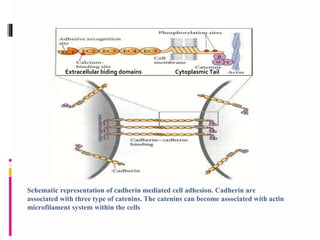
Schematic representation of cadherin mediated cell adhesion. Cadherin are
associated with three type of catenins. The catenins can become associated with actin
microfilament system within the cells
Extracellular biding domains Cytoplasmic Tail
In vertebrate embryo several major
cadherin class has been identified
1. E- cadherin
2. P-cadherin
3. N-cadherin
4. EP-cadherin
5. Protocadherin
E- cadherin: Epithelial
cadherin
▪ Also called Uvomorulin and L-CAM is
expressed on early mammalian embryonic
cells even at the 1-cell stage. Later this
molecule is restricted to epithelial tissue of
embryo and adults.
P-cadherin: Placental cadherin
▪ They appear to be expressed primarily on the
trophoblast cell ( those placental cell of
mammalian embryo that contact the uterine
wall) and on the uterine wall epithelim. It is
possible that P-cadherin facilitates the
connection of embryo to the uterus.
N-cadherin: Neural cadherin
▪ It is first seen in mesodermal cell in the
gastrulating embryo as they lose their e-
cadherin expression . It is also called highly
expressed on cells on developing central
nervous system.
EP-cadherin (C-cadherin)
▪ C- cadherin has found to be critical to maintain
adhesion between the blastoderm of the Xenopus
blastula and is required for normal movement of
gastrulation.
Protocadherin:
▪ These are calcium dependent adhesion protein
that differ from classic cadherins in that the
lack connection to cytoskeleton to catenins.
▪ Protocadherin have been found to be very
important in separating the notochord from the
other mesodermal tissue during Xenopus
gastrulation.
Homophillic binding:
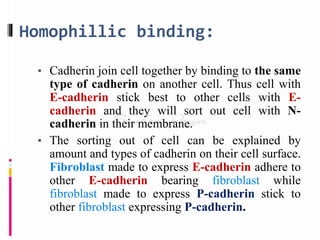
▪ Cadherin join cell together by binding to the same
type of cadherin on another cell. Thus cell with
E-cadherin stick best to other cells with E-
cadherin and they will sort out cell with N-
cadherin in their membrane.
▪ The sorting out of cell can be explained by
amount and types of cadherin on their cell surface.
Fibroblast made to express E-cadherin adhere to
other E-cadherin bearing fibroblast while
fibroblast made to express P-cadherin stick to
other fibroblast expressing P-cadherin.
▪ These adhesion patterns may have important
consequence in the embryo. In the gastrula of frog
Xenopus the neural tube expresses N-cadherin while
the epidermis expresses E-cadherin.
▪ Normally these two tissues separate from each other
such that the neural tube is inside the body and the
epidermis cover the body. If the epidermis is
experimentally manipulated to remove its E-cadherin
the epidermal epithelium cannot hold together. If the
epidermis is made to express N-cadherin or if the
neural cells are made to lose it, the neural tube will
not separate from the epidermis.
Localization of two different cadherins during the formation of the mouse neural tube. (A) Double
immunofluorescent staining was used to localize E-cadherin and N-cadherin in the same transverse section
of an 8.5-day embryonic mouse hindbrain. Antibodies to E-cadherin were labeled with one type of
fluorescent dye (which fluoresces under one set of wavelengths), while antibodies to N-cadherin were
marked with a second type of fluorescent dye (which emits its color at other wavelengths).
Photographs taken at the different wavelengths reveal that the outer ectoderm expresses predominantly E-
cadherin, while the invaginating neural plate ceases E-cadherin expression and instead expresses N-cadherin.
When the neural tube has formed, it expresses N-cadherin, the epidermis expresses E-cadherin, and the
neural crest cells between them express neither.
▪ During development the cadherins often work
with other adhesion systems. For instance one of
the most critical time in the mammals life is
when the embryo is passing through the uterus. If
development is continues the embryo must
adhere to the uterus and embedded itself to the
uterine wall.
▪ That‘s why the first differentiation event in the
mammalian development distinguished the
trophoblast cell from inner cell mass.
▪ This process occurs as the embryo travel
down from the upper region of the oviduct on
its way to the uterus. The trophoblast cell
endowed with several adhesion molecule to
anchored the embryo to uterine wall.
▪ First they contain both E-cadherin and P-
cadherin and these cadherin recognize similar
cadherin on uterine cell.
▪ Second they have receptors for the collagen
and heparin sulphate glycoprotein of the
uterine wall.
▪ Third the trophoblast cell is also have modified
glycosyltransferase enzyme that extend out the
transferase membrane and can bind to the
specific carbohydrate residues on uterine
glycoprotein.
▪ For something as important as implantation of the
mammalian embryo it is not surprising that
several cell adhesion systems appear to be
working together.

Cell cell adhesion

  • 1.
    CELL-CELL ADHESION MSc ZoologyI Miss Bushra Iqbal
  • 2.
    Recent studies showthat boundaries between tissues can indeed be created by: a. Different cell types having different types of cell adhesion molecule b. Different cell types having different amount of cell adhesion molecule
  • 3.
    There are severalclasses of molecule that can mediate cell adhesion. The major cell adhesion molecules appears to be Cadherins: (Calcium Dependent Adhesion Molecules). They are: i. Critical for establishing and maintaining intercellular connection ii. Crucial to the spatial segregation of cell type and to the organization of animal form
  • 4.
    a. Cadherins interactwith other cadherins on adjacent cells and they anchored into the cell by a complex of protein called catenin. b. The catenin complex form the classic adherens junctions that connect epithelial cell together. c. Moreover since the catenins bind to the actin cytoskeleton of the cell, they integrate the epithelial cell together into mechanical unit.
  • 5.
    Cadherin structure Cadherins area family of membrane receptors that mediate calcium- dependent homophilic cell-cell adhesion. Cadherins play a key role in the regulation of organ and tissue development during embryogenesis.
  • 6.
    Schematic representation ofcadherin mediated cell adhesion. Cadherin are associated with three type of catenins. The catenins can become associated with actin microfilament system within the cells Extracellular biding domains Cytoplasmic Tail
  • 7.
    In vertebrate embryoseveral major cadherin class has been identified 1. E- cadherin 2. P-cadherin 3. N-cadherin 4. EP-cadherin 5. Protocadherin
  • 8.
    E- cadherin: Epithelial cadherin ▪Also called Uvomorulin and L-CAM is expressed on early mammalian embryonic cells even at the 1-cell stage. Later this molecule is restricted to epithelial tissue of embryo and adults.
  • 9.
    P-cadherin: Placental cadherin ▪They appear to be expressed primarily on the trophoblast cell ( those placental cell of mammalian embryo that contact the uterine wall) and on the uterine wall epithelim. It is possible that P-cadherin facilitates the connection of embryo to the uterus.
  • 10.
    N-cadherin: Neural cadherin ▪It is first seen in mesodermal cell in the gastrulating embryo as they lose their e- cadherin expression . It is also called highly expressed on cells on developing central nervous system.
  • 11.
    EP-cadherin (C-cadherin) ▪ C-cadherin has found to be critical to maintain adhesion between the blastoderm of the Xenopus blastula and is required for normal movement of gastrulation.
  • 12.
    Protocadherin: ▪ These arecalcium dependent adhesion protein that differ from classic cadherins in that the lack connection to cytoskeleton to catenins. ▪ Protocadherin have been found to be very important in separating the notochord from the other mesodermal tissue during Xenopus gastrulation.
  • 13.
    Homophillic binding: ▪ Cadherinjoin cell together by binding to the same type of cadherin on another cell. Thus cell with E-cadherin stick best to other cells with E- cadherin and they will sort out cell with N- cadherin in their membrane. ▪ The sorting out of cell can be explained by amount and types of cadherin on their cell surface. Fibroblast made to express E-cadherin adhere to other E-cadherin bearing fibroblast while fibroblast made to express P-cadherin stick to other fibroblast expressing P-cadherin.
  • 14.
    ▪ These adhesionpatterns may have important consequence in the embryo. In the gastrula of frog Xenopus the neural tube expresses N-cadherin while the epidermis expresses E-cadherin. ▪ Normally these two tissues separate from each other such that the neural tube is inside the body and the epidermis cover the body. If the epidermis is experimentally manipulated to remove its E-cadherin the epidermal epithelium cannot hold together. If the epidermis is made to express N-cadherin or if the neural cells are made to lose it, the neural tube will not separate from the epidermis.
  • 15.
    Localization of twodifferent cadherins during the formation of the mouse neural tube. (A) Double immunofluorescent staining was used to localize E-cadherin and N-cadherin in the same transverse section of an 8.5-day embryonic mouse hindbrain. Antibodies to E-cadherin were labeled with one type of fluorescent dye (which fluoresces under one set of wavelengths), while antibodies to N-cadherin were marked with a second type of fluorescent dye (which emits its color at other wavelengths). Photographs taken at the different wavelengths reveal that the outer ectoderm expresses predominantly E- cadherin, while the invaginating neural plate ceases E-cadherin expression and instead expresses N-cadherin. When the neural tube has formed, it expresses N-cadherin, the epidermis expresses E-cadherin, and the neural crest cells between them express neither.
  • 16.
    ▪ During developmentthe cadherins often work with other adhesion systems. For instance one of the most critical time in the mammals life is when the embryo is passing through the uterus. If development is continues the embryo must adhere to the uterus and embedded itself to the uterine wall. ▪ That‘s why the first differentiation event in the mammalian development distinguished the trophoblast cell from inner cell mass.
  • 17.
    ▪ This processoccurs as the embryo travel down from the upper region of the oviduct on its way to the uterus. The trophoblast cell endowed with several adhesion molecule to anchored the embryo to uterine wall. ▪ First they contain both E-cadherin and P- cadherin and these cadherin recognize similar cadherin on uterine cell. ▪ Second they have receptors for the collagen and heparin sulphate glycoprotein of the uterine wall.
  • 18.
    ▪ Third thetrophoblast cell is also have modified glycosyltransferase enzyme that extend out the transferase membrane and can bind to the specific carbohydrate residues on uterine glycoprotein. ▪ For something as important as implantation of the mammalian embryo it is not surprising that several cell adhesion systems appear to be working together.