Celestial Objects
IFFAT ARA
Lecturer
Dept. of Geomatics, LMA
PSTU
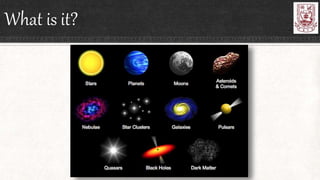
What is it?
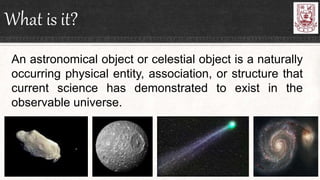
An astronomical object or celestial object is a naturally
occurring physical entity, association, or structure that
current science has demonstrated to exist in the
observable universe.
Object & Body
In astronomy, the terms "object"
and "body" are often used
interchangeably.
Object & Body
• An astronomical body or celestial body refers to
a single, tightly bound contiguous entity,
while…..
• An astronomical or celestial object refers to a
complex, less cohesively bound structure, that
may consist of multiple bodies or even other
objects with substructures.
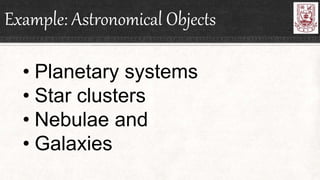
Example: Astronomical Objects
• Planetary systems
• Star clusters
• Nebulae and
• Galaxies
Example: Astronomical Bodies
• Asteroids
• Moons
• Planets and
• Stars
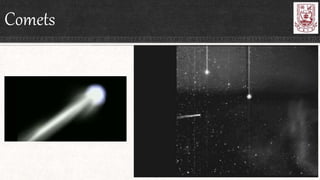
What about “Comet”
A comet may be identified as both body and object:
• It is a body when referring to the frozen nucleus of ice and
dust.
• An object when describing the entire object with its diffuse
coma and tail.
What about “Comet”
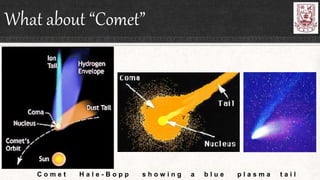
C o m e t H a l e - B o p p s h o w i n g a b l u e p l a s m a t a i l
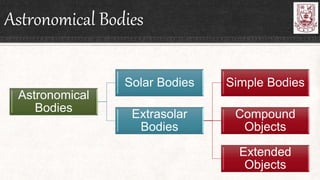
Astronomical Bodies
Astronomical
Bodies
Solar Bodies
Extrasolar
Bodies
Simple Bodies
Compound
Objects
Extended
Objects
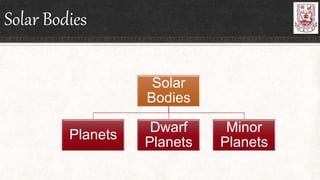
Solar Bodies
Solar
Bodies
Planets
Dwarf
Planets
Minor
Planets
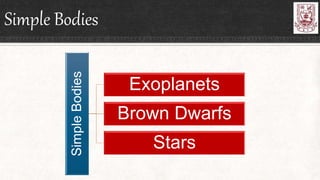
Simple Bodies
SimpleBodies
Exoplanets
Brown Dwarfs
Stars
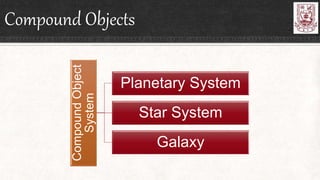
Compound Objects
CompoundObject
System Planetary System
Star System
Galaxy
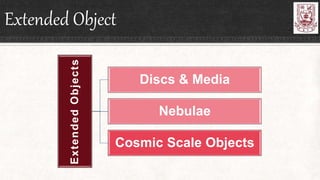
Extended Object
ExtendedObjects
Discs & Media
Nebulae
Cosmic Scale Objects
What is AU?
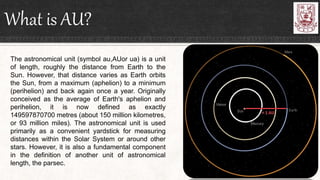
The astronomical unit (symbol au,AUor ua) is a unit
of length, roughly the distance from Earth to the
Sun. However, that distance varies as Earth orbits
the Sun, from a maximum (aphelion) to a minimum
(perihelion) and back again once a year. Originally
conceived as the average of Earth's aphelion and
perihelion, it is now defined as exactly
149597870700 metres (about 150 million kilometres,
or 93 million miles). The astronomical unit is used
primarily as a convenient yardstick for measuring
distances within the Solar System or around other
stars. However, it is also a fundamental component
in the definition of another unit of astronomical
length, the parsec.
What is it?
Kuiper Belt
Kuiper Belt
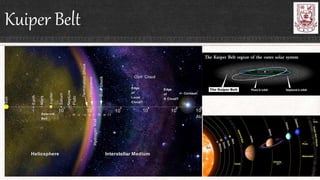
The Kuiper belt is an area of the solar system extending from
the orbit of Neptune (at 30 AU) to 50 AU from the Sun. The

objects within the Kuiper Belt together with the members of the
scattered disk extending beyond, are collectively referred to as
trans-Neptunian objects
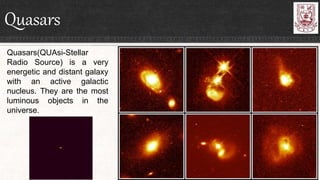
Quasars
Quasars(QUAsi-Stellar
Radio Source) is a very
energetic and distant galaxy
with an active galactic
nucleus. They are the most
luminous objects in the
universe.
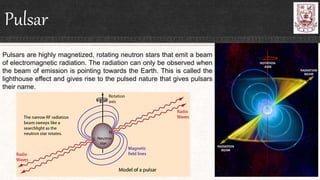
Pulsar
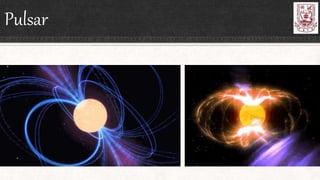
Pulsars are highly magnetized, rotating neutron stars that emit a beam
of electromagnetic radiation. The radiation can only be observed when
the beam of emission is pointing towards the Earth. This is called the
lighthouse effect and gives rise to the pulsed nature that gives pulsars
their name.
Pulsar
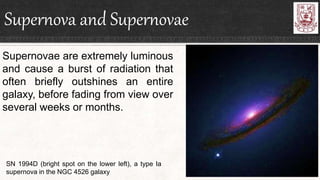
Supernova and Supernovae
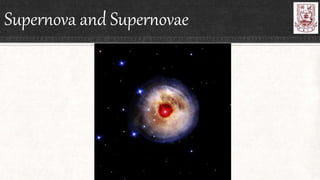
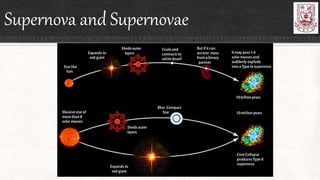
Supernovae are extremely luminous
and cause a burst of radiation that
often briefly outshines an entire
galaxy, before fading from view over
several weeks or months.
SN 1994D (bright spot on the lower left), a type Ia
supernova in the NGC 4526 galaxy
Supernova and Supernovae
Galaxy
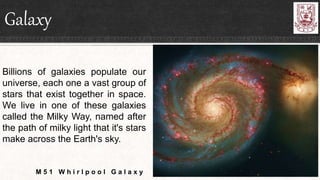
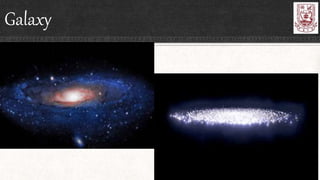
Billions of galaxies populate our
universe, each one a vast group of
stars that exist together in space.
We live in one of these galaxies
called the Milky Way, named after
the path of milky light that it's stars
make across the Earth's sky.
M 5 1 W h i r l p o o l G a l a x y
Galaxy
Asteroids
Meteors
Meteors
Comets
Comets
Gamma Ray Bursts
g a m m a - r a y b u r s t i n a c t i o n .
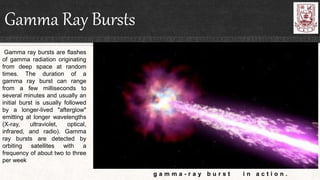
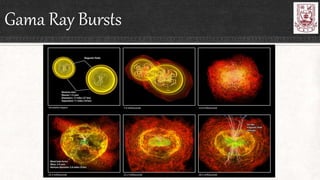
Gamma ray bursts are flashes
of gamma radiation originating
from deep space at random
times. The duration of a
gamma ray burst can range
from a few milliseconds to
several minutes and usually an
initial burst is usually followed
by a longer-lived "afterglow"
emitting at longer wavelengths
(X-ray, ultraviolet, optical,
infrared, and radio). Gamma
ray bursts are detected by
orbiting satellites with a
frequency of about two to three
per week
Gama Ray Bursts
Q & A
Thank You!

Celestial objects

  • 1.
  • 2.
    What is it? Anastronomical object or celestial object is a naturally occurring physical entity, association, or structure that current science has demonstrated to exist in the observable universe.
  • 3.
    Object & Body Inastronomy, the terms "object" and "body" are often used interchangeably.
  • 4.
    Object & Body •An astronomical body or celestial body refers to a single, tightly bound contiguous entity, while….. • An astronomical or celestial object refers to a complex, less cohesively bound structure, that may consist of multiple bodies or even other objects with substructures.
  • 5.
    Example: Astronomical Objects •Planetary systems • Star clusters • Nebulae and • Galaxies
  • 6.
    Example: Astronomical Bodies •Asteroids • Moons • Planets and • Stars
  • 7.
    What about “Comet” Acomet may be identified as both body and object: • It is a body when referring to the frozen nucleus of ice and dust. • An object when describing the entire object with its diffuse coma and tail.
  • 8.
    What about “Comet” Co m e t H a l e - B o p p s h o w i n g a b l u e p l a s m a t a i l
  • 9.
  • 11.
  • 13.
  • 14.
  • 15.
    Extended Object ExtendedObjects Discs &Media Nebulae Cosmic Scale Objects
  • 16.
    What is AU? Theastronomical unit (symbol au,AUor ua) is a unit of length, roughly the distance from Earth to the Sun. However, that distance varies as Earth orbits the Sun, from a maximum (aphelion) to a minimum (perihelion) and back again once a year. Originally conceived as the average of Earth's aphelion and perihelion, it is now defined as exactly 149597870700 metres (about 150 million kilometres, or 93 million miles). The astronomical unit is used primarily as a convenient yardstick for measuring distances within the Solar System or around other stars. However, it is also a fundamental component in the definition of another unit of astronomical length, the parsec.
  • 17.
  • 18.
  • 19.
    Kuiper Belt The Kuiperbelt is an area of the solar system extending from the orbit of Neptune (at 30 AU) to 50 AU from the Sun. The objects within the Kuiper Belt together with the members of the scattered disk extending beyond, are collectively referred to as trans-Neptunian objects
  • 20.
    Quasars Quasars(QUAsi-Stellar Radio Source) isa very energetic and distant galaxy with an active galactic nucleus. They are the most luminous objects in the universe.
  • 21.
    Pulsar Pulsars are highlymagnetized, rotating neutron stars that emit a beam of electromagnetic radiation. The radiation can only be observed when the beam of emission is pointing towards the Earth. This is called the lighthouse effect and gives rise to the pulsed nature that gives pulsars their name.
  • 22.
  • 23.
    Supernova and Supernovae Supernovaeare extremely luminous and cause a burst of radiation that often briefly outshines an entire galaxy, before fading from view over several weeks or months. SN 1994D (bright spot on the lower left), a type Ia supernova in the NGC 4526 galaxy
  • 24.
  • 25.
  • 26.
    Galaxy Billions of galaxiespopulate our universe, each one a vast group of stars that exist together in space. We live in one of these galaxies called the Milky Way, named after the path of milky light that it's stars make across the Earth's sky. M 5 1 W h i r l p o o l G a l a x y
  • 27.
  • 29.
  • 30.
  • 31.
  • 32.
  • 33.
  • 34.
    Gamma Ray Bursts ga m m a - r a y b u r s t i n a c t i o n . Gamma ray bursts are flashes of gamma radiation originating from deep space at random times. The duration of a gamma ray burst can range from a few milliseconds to several minutes and usually an initial burst is usually followed by a longer-lived "afterglow" emitting at longer wavelengths (X-ray, ultraviolet, optical, infrared, and radio). Gamma ray bursts are detected by orbiting satellites with a frequency of about two to three per week
  • 35.
  • 36.
  • 37.

Editor's Notes

  • #3 Do scientists know all about our galaxy, the Milky Way? No. There is much that waits to be discovered. Celestial bodies are constellations, comets, meteors, asteroids, galaxies, and basically everything in space.
  • #17 জ্যোতির্বিদ্যার একক বা মহাকাশীয় একক (ইংরেজি: astronomical unit, সংক্ষেপে AU বা au বা a.u. বা কখনো ua) দৈর্ঘ্যের একটি একক। এটি সূর্য ও পৃথিবীর মধ্যকার গড় দূরত্বের প্রায় সমান। অতীতে পৃথিবীর অপসূর ও অনুসূরের গড় কে মহাকাশীয় এককের মান ধরা হলেও, AU-কে বর্তমানে সংজ্ঞায়িত করা হয় ঠিক ১৪৯ ৫৯৭ ৮৭০ ৭০০ মিটার (প্রায় ১৫০ মিলিয়ন কিলোমিটার বা ৯৩ মিলিয়ন মাইল) হিসেবে। Earth orbits the Sun, from a maximum (aphelion) to a minimum (perihelion)
  • #19 সৌরজগতের কুইপার বেল্ট অঞ্চলে উল্লেখযোগ্যভাবে বস্তুর নড়াচড়া লক্ষ্য করা গেছে। কুইপার বেল্ট অঞ্চলটি নেপচুনের কক্ষপথের উপরে অবস্থিত। ধারণা করা হয় অঞ্চলটি ধূমকেতু, গ্রহাণু ও বরফের তৈরি।
  • #21 Quasar: Quasar শব্দটি “Quasi Stellar Radio Sources” শব্দগুচ্ছের সংক্ষিপ্ত রূপ। মূলত এরাই হল নক্ষত্রের মত বিন্দুবৎ রেডিও উৎস। কিন্তু পরে এমন অনেক কোয়েসার পাওয়া গিয়েছে যাদের তেমন কোনো উল্লেখযোগ্য রেডিও বিকিরন নেই। তাই সাধারণভাবে এদেরকে Quasi Steller Objects বা সংক্ষেপে QSO বলে। কোয়েসারদের কৌনিক ব্যাস ১” এর কম। তাই পৃথিবী থেকে তোলা আলোকচিত্রে এদেরকে নক্ষত্রের মত অবিশ্লেষিত অবস্থায় দেখা যায়। কোয়েসারের সবচেয়ে অবাক করা বৈশিষ্ট্য হল এই যে, আকাশের খুব চোট একটি অঞ্চল তেকে একটি গ্যালক্সির একশ গুনের বেশী বিকিরন পাওয়া যায়।সৌরজগতে প্লুটোর বক্ষপথের ব্যাস যতোটা তার চেয়ে সামান্য বড় এলাকা থেকে একটি কোয়েসার যে পরিমান শক্তি বিকিরণ করে তা আমাদের আকাশ গঙ্গা গ্যালাক্সির মত কোটি কোটি গ্যালাক্সির বিকিরনের সমান।
  • #22 Pulsar বা Neutron Star আমাদের সূর্যের মত নক্ষত্রগুলো তৈরি হয়েছে আন্তঃমহাকাশীয় গ্যাসীয়(Inter-Stellar Gas) বস্তুর সঙ্কোচনের ফলে । এসব গ্যাসীয় বস্তুর প্রধান উপাদান মূলতঃ হাইড্রোজেন ও হিলিয়াম। এসব গ্যাস এদের নিজ মহাকর্ষ বলের প্রভাবে সঙ্কুচিত হতে থাকে।আর সঙ্কুচিত হতে থাকলে এদের ঘনত্ব ক্রমশ বাড়তে থাকে। ফলে উৎপন্ন হয় প্রচণ্ড তাপ। সেটা যখন বেড়ে গিয়ে প্রায় ১০ মিলিয়ন ডিগ্রি পর্যন্ত হয় তখন শুরু হয় পারমাণবিক ফিউশন বিক্রিয়া। এ বিক্রিয়ায় হাইড্রোজেন ভেঙ্গে হিলিয়াম ও হিলিয়াম ভেঙ্গে হাইড্রোজেন তৈরি হয়। আর এই প্রচণ্ড শক্তিশালী বিক্রিয়ার ফলে আইনস্টাইনের E=mc^2 সুত্র অনুসারে যে ভর হারিয়ে যায় তা পরিণত হয় বিপুল পরিমাণ শক্তিতে। এভাবেই তৈরি হয় নক্ষত্রগুলো।
  • #24 Supernova সুপারনোভা হলো এক ধরনের নাক্ষত্রিক বিস্ফোরণ যার ফলশ্রুতিতে নক্ষত্র ধ্বংসপ্রাপ্ত হয় এবং অবশেষরূপে থাকে নিউট্রন তারা কিংবা কৃষ্ণবিবর। সূর্যের চেয়ে তিন গুণ বেশি ভরের নক্ষত্রসমূহের অভ্যন্তরে হাইড্রোজেনের সংযোজন বিক্রিয়ায় তৈরি হয় হিলিয়াম, হিলিয়ামের সংযোজনে তৈরি হয় কার্বন এবং সেই কার্বনের সংযোজনে তৈরি হয় লোহা। লোহা তৈরির মধ্য দিয়ে কেন্দ্রীণ বিক্রিয়াসমূহের পরম্পরার পরিসমাপ্তি ঘটে, কারণ এর পরের বিক্রিয়াটি তাপশোষী। এমনই এক সময়ে নক্ষত্রের অভ্যন্তরস্থ বহির্মুখী চাপ যথেষ্ট পরিমাণ কমে যাওয়ায় এটি আর মহাকর্ষীয় আকর্ষণ বলকে ঠেকিয়ে রাখতে পারে না, ফলে নক্ষত্রে ঘটে এক প্রচণ্ড অন্তস্ফোটন (Implosion)। নক্ষত্রটির বেশিরভাগ ভরই এর কেন্দ্রে সংকুচিত হয়ে পড়ে, আর গ্যাসীয় বাতাবরণটি ছিন্ন-বিচ্ছিন্ন হয়ে প্রবলবেগে চারদিকে ছড়িয়ে পড়ে। এই ঘটনাই অতিনবতারা বিস্ফোরণ হিসেবে পরিচিত। এই ধরনের বিস্ফোরণে বিপুল পরিমাণ শক্তি নির্গত হয় এবং সংশ্লিষ্ট নক্ষত্রটি সাময়িকভাবে পুরো ছায়াপথের চেয়েও বেশি উজ্জ্বল হয়ে ওঠে। অতিনবতারা বিস্ফোরণকে নিষ্ক্রান্ত গ্যাসীয় পদার্থসমূহে উপস্থিত হাইড্রোজেনের পরিমাণের ভিত্তিতে ২ ভাগে ভাগ করা হয় --- নির্গত পদার্থ হাইড্রোজেন-সমৃদ্ধ হলে ধরন-২ আর হাইড্রোজেনের পরিমাণ অল্প হলে ধরন-১। অনেক অনেক আগে থেকেই মানুষ অতিনবতারা সম্পর্কে জানত। ১০৫৪ খ্রীষ্টাব্দে চীনা জ্যোতির্বিদেরা একটি অতিনবতারা দেখেছিলেন বলে উল্লেখ পাওয়া যায়। সাম্প্রতিককালে বৃহৎ ম্যাজেলানীয় মেঘে (LMC) SN1987A নামের যে অতিনবতারাটির বিস্ফোরণ সংঘটিত হয়েছে, তা প্রায় খালি চোখেই দেখা গিয়েছিল। অতিনবতারার বিস্ফোরণে অনেক ভারী মৌলিক পদার্থ তৈরি হয়ে ছায়াপথে ছড়িয়ে পড়তে পারে।
  • #25  অতিনবতারা বিস্ফোরণকে নিষ্ক্রান্ত গ্যাসীয় পদার্থসমূহে উপস্থিত হাইড্রোজেনের পরিমাণের ভিত্তিতে ২ ভাগে ভাগ করা হয় --- নির্গত পদার্থ হাইড্রোজেন-সমৃদ্ধ হলে ধরন-২ আর হাইড্রোজেনের পরিমাণ অল্প হলে ধরন-১। অনেক অনেক আগে থেকেই মানুষ অতিনবতারা সম্পর্কে জানত। ১০৫৪ খ্রীষ্টাব্দে চীনা জ্যোতির্বিদেরা একটি অতিনবতারা দেখেছিলেন বলে উল্লেখ পাওয়া যায়। সাম্প্রতিককালে বৃহৎ ম্যাজেলানীয় মেঘে (LMC) SN1987A নামের যে অতিনবতারাটির বিস্ফোরণ সংঘটিত হয়েছে, তা প্রায় খালি চোখেই দেখা গিয়েছিল। অতিনবতারার বিস্ফোরণে অনেক ভারী মৌলিক পদার্থ তৈরি হয়ে ছায়াপথে ছড়িয়ে পড়তে পারে।
  • #27 ছায়াপথ মহাকর্ষীয় শক্তি দ্বারা আবদ্ধ একটি অতি বৃহৎ সুশৃঙ্খল ব্যবস্থা যা তারা, আন্তঃনাক্ষত্রিক গ্যাস ও ধূলিকণা, প্লাসমা এবং প্রচুর পরিমাণে অদৃশ্য বস্তু দ্বারা গঠিত। একটি আদর্শ ছায়াপথে ১০ মিলিয়ন থেকে এক ট্রিলিয়ন পর্যন্ত তারা থাকে যারা সবাই একটি সাধারণ মহাকর্ষীয় কেন্দ্রের চারদিকে ঘূর্ণায়মান। বিচ্ছিন্ন তারা ছাড়াও ছায়াপথে বহুতারা ব্যবস্থা, তারা স্তবক এবং বিভিন্ন ধরনের নীহারিকা থাকে। অধিকাংশ ছায়াপথের ব্যস কয়েকশ আলোকবর্ষ থেকে শুরু করে কয়েক হাজার আলোকবর্ষ পর্যন্ত এবং ছায়াপথসমূহের মধ্যবর্তী দূরত্ব মিলিয়ন আলোকবর্ষের পর্যায়ে।
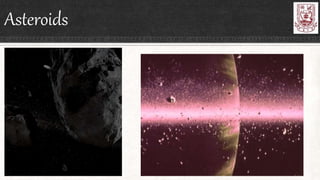
  • #30 গ্রহাণু হল প্রধানত পাথর দ্বারা গঠিত বস্তু যা তার তারাকে কেন্দ্র করে আবর্তন করে। আমাদের সৌরজগতে গ্রহাণুগুলো ক্ষুদ্র গ্রহ (Minor planet অথবা Planetoid) নামক শ্রেণীর সবচেয়ে পরিচিত বস্তু। এরা ছোট আকারের গ্রহ যেমন বুধের চেয়েও ছোট। বেশিরভাগ গ্রহাণুই মঙ্গল এবং বৃহস্পতি গ্রহের মধ্যবর্তী স্থানে অবস্থিত গ্রহাণু বেল্টে থেকে নির্দিষ্ট উপবৃত্তাকার কক্ষপথে সূর্যকে আবর্তন করে। ধারণা করা হয় গ্রহাণুগুলো ভ্রূণগ্রহীয় চাকতির (Protoplanetary disc) অবশিষ্টাংশ। বলা হয় গ্রহাণু বেল্টের অঞ্চলে সৌরজগতের গঠনের প্রাথমিক সময় যেসকল ভ্রূণগ্রহ সৃষ্টি হয়েছিলো তাদের অবশিষ্টাংশ বৃহস্পতির আবেশ দ্বারা সৃষ্ট মহাকর্ষীয় অক্ষ বিচলনের কারণে গ্রহের সাথ মিলিত হবার সুযোগ পায়নি। আর এই অবশিষ্টাংশই গ্রহাণু বেল্টের উৎপত্তির কারণ। কিছু গ্রহাণুর চাঁদও রয়েছে।Asteroid Belt: এটি হলো মঙ্গল ও বৃহস্পতির মধ্যবর্তী একটি জায়গা যেখানে আমাদের সৌর জগতের বেশিরভাগ গ্রহাণু সূর্যকে প্রদক্ষিণ করে। Asteriod Belt সম্ভবত কয়েক মিলিয়ন গ্রহাণু বহন করে।
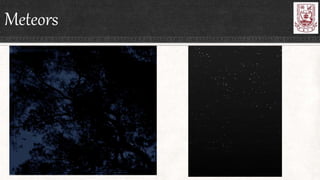
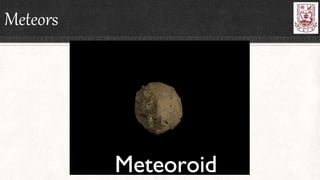
  • #31 উল্কা হল মহাকাশে পরিভ্রমণরত পাথর বা ধাতু দ্বারা গঠিত ছোট মহাজাগতিক বস্তু যা পৃথিবীর বায়ুমন্ডলে প্রবেশ করলে বায়ুর সংঘর্ষে জ্বলে উঠে। তখন একে উল্কাপাত (meteor) বলে। এই উল্কাপাতের জন্য দায়ী বস্তুগুলোকে উল্কা (meteroid) বলে। উল্কাপিন্ড গ্রহানুর তুলানায় আকারে অনেক ক্ষুদ্র। আকারে এরা ছোট ধূলিকনা থেকে ১ মিটার দৈর্ঘ্যের হয়ে থাকে। এর চেয়ে ছোট বস্তুকে মহাজাগতিক ধূলিকনা বলে। [১] [২] এসব উল্কার বেশীরভাগই গ্রহানু বা ধূমকেতুর অংশবিশেষ। বাকী অংশ মহাজাগতিক বস্তুর সংঘর্ষের ফলে সৃষ্ট ধ্বংসাবশেষ।[৩] যখন কোন উল্কা পৃথিবীর বায়ুমন্ডলে প্রবেশ করে তখন এর গতীবেগ প্রতি সেকেন্ডে ২০ কিমি বৃদ্ধিপ্রাপ্ত হয় (৭২,০০০ কিমি/ঘন্টা; ৪৫,০০০ মাইল/ঘন্টা।)। এসময়ে এ্যারোডাইনামিক্স তাপের কারনে উজ্জ্বল আলোক ছটার সৃষ্টি হয়। এই বাহ্যমূর্তীর কারনে একে তারা খসা (Shooting Star) বলে। কিছু কিছু উল্কা একই উৎস হতে উৎপন্ন হয়ে বিভিন্ন ক্ষুদ্র ক্ষুদ্র অংশে ভেঙে প্রজ্জ্বলিত হয় যাকে উল্কা বৃষ্টি বলা হয়। প্রায় ১৫,০০০ টন পরিমাণ উল্কা, ক্ষুদ্র উল্কাকণা এবং মহাজাগতিক ধূলিকনা প্রতি বছর পৃথিবীর বায়ুমন্ডলে প্রবেশ করে।[৪]
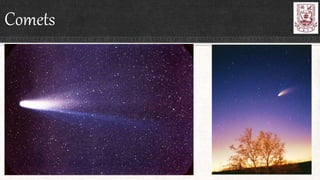
  • #33 হল ধুলো, বরফ ও গ্যাসের তৈরি এক ধরনের মহাজাগতিক বস্তু। ধূমকেতু একটি ক্ষুদ্র বরফাবৃত সৌরজাগতিক বস্তু যা সূর্যের খুব নিকট দিয়ে পরিভ্রমণ করার সময় দর্শনীয় কমা (একটি পাতলা, ক্ষণস্থায়ী বায়ুমন্ডল) এবং কখনও লেজও প্রদর্শন করে । ধূমকেতুর নিউক্লিয়াসের ওপর সূর্যের বিকিরণ ও সৌরবায়ুর প্রভাবের কারণে এমনটি ঘটে। ধূমকেতুর নিউক্লিয়াস বরফ, ধূলা ও ক্ষুদ্র ক্ষুদ্র পাথুরে কণিকার একটি দুর্বল সংকলনে গঠিত। প্রস্থে কয়েকশ মিটার থেকে দশ কি.মি. এবং লেজ দৈর্ঘ্যে কয়েকশ কোটি কি.মি. পর্যন্ত হতে পারে ।
  • #34 হল ধুলো, বরফ ও গ্যাসের তৈরি এক ধরনের মহাজাগতিক বস্তু। ধূমকেতু একটি ক্ষুদ্র বরফাবৃত সৌরজাগতিক বস্তু যা সূর্যের খুব নিকট দিয়ে পরিভ্রমণ করার সময় দর্শনীয় কমা (একটি পাতলা, ক্ষণস্থায়ী বায়ুমন্ডল) এবং কখনও লেজও প্রদর্শন করে । ধূমকেতুর নিউক্লিয়াসের ওপর সূর্যের বিকিরণ ও সৌরবায়ুর প্রভাবের কারণে এমনটি ঘটে। ধূমকেতুর নিউক্লিয়াস বরফ, ধূলা ও ক্ষুদ্র ক্ষুদ্র পাথুরে কণিকার একটি দুর্বল সংকলনে গঠিত। প্রস্থে কয়েকশ মিটার থেকে দশ কি.মি. এবং লেজ দৈর্ঘ্যে কয়েকশ কোটি কি.মি. পর্যন্ত হতে পারে ।
  • #35 Gamma Ray Bursts (or GRB's) are the most luminous electromagnetic events occurring in the universe since the Big Bang. গামা রশ্মি বিস্ফোরণ হলো উচ্চশক্তি বিকিরণের ফলে সৃষ্ট আভা বা স্ফুলিঙ্গ। গামা রশ্মি বিস্ফোরণের সময় মহাকাশে এ ধরনের স্ফুলিঙ্গের বিক্ষিপ্ত সঞ্চারণ লক্ষ্য করা যায়। এ স্ফুলিঙ্গ দুই ধররে_ কোনোটি ছোট কোনোটি দীর্ঘ।