Learnings from Participatory
Budgeting in Pune
Sanskriti Menon & Avinash Madhale
CEE
Centre for Environment Education
Introduction
 Meaning of participatory budgeting:
 A different way to manage public money, and to
engage people in organizing Hope.
 It is a democratic process in which community members
directly decide how to spend part of a public budget.
 It enables citizens to work with government to make the
budget decisions that affect their lives.
UN-Habitat
 ‘Participatory budgeting’ and participation opportunities,
and suggests ‘Regular, organized and open
consultations of citizens on city financial matters and
other important issues, through such mechanisms as the
participatory budget’, to operationalize transparency and
accountability. (UN-Habitat 2002)
What is it?/ Why PB?
 Deepening Democracy
 Way of engaging people effectively in decisions about Pub. Expend.
 More informed decisions
 Learn macro and micro picture our cities
 Public Education
 Practice 7th Std Civics
 Fairer Spending
 Use municipal resource wisely through deliberation
 Community Building
 Create ownership, sense of belonging
 Ensures transparency and accountability process Innovation
Where its stared and has it worked?
 The Brazilian city of Porto Alegre started the first full PB
process in 1989, for the municipal budget. In Porto
Alegre, as many as 50,000 people have participated
each year, to decide as much as 20% of the city budget.
 PB has spread to over 1,500 cities in Latin America,
North America, Asia, Africa, and Europe. In the US and
Canada, PB has been used in Toronto, Montreal,
Guelph, Chicago, New York City, and Vallejo
(California).
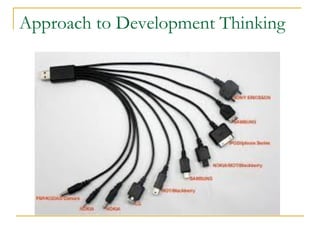
Approach to Development Thinking
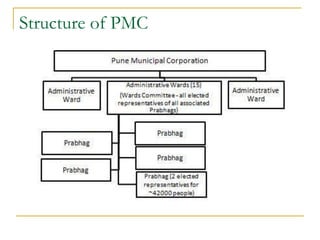
Structure of PMC
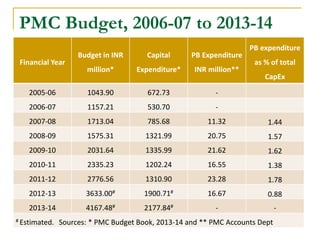
PMC Budget, 2006-07 to 2013-14
Financial Year
Budget in INR
million*
Capital
Expenditure*
PB Expenditure
INR million**
PB expenditure
as % of total
CapEx
2005-06 1043.90 672.73 -
2006-07 1157.21 530.70 -
2007-08 1713.04 785.68 11.32 1.44
2008-09 1575.31 1321.99 20.75 1.57
2009-10 2031.64 1335.99 21.62 1.62
2010-11 2335.23 1202.24 16.55 1.38
2011-12 2776.56 1310.90 23.28 1.78
2012-13 3633.00# 1900.71# 16.67 0.88
2013-14 4167.48# 2177.84# - -
# Estimated. Sources: * PMC Budget Book, 2013-14 and ** PMC Accounts Dept
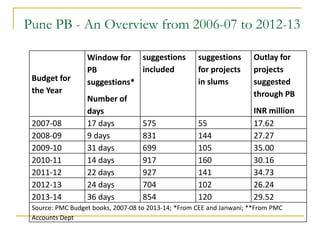
Pune PB - An Overview from 2006-07 to 2012-13
Budget for
the Year
Window for
PB
suggestions*
Number of
days
suggestions
included
suggestions
for projects
in slums
Outlay for
projects
suggested
through PB
INR million
2007-08 17 days 575 55 17.62
2008-09 9 days 831 144 27.27
2009-10 31 days 699 105 35.00
2010-11 14 days 917 160 30.16
2011-12 22 days 927 141 34.73
2012-13 24 days 704 102 26.24
2013-14 36 days 854 120 29.52
Source: PMC Budget books, 2007-08 to 2013-14; *From CEE and Janwani; **From PMC
Accounts Dept
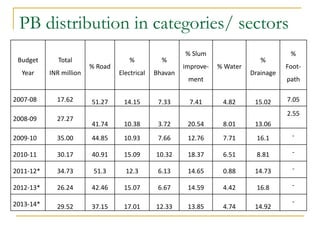
PB distribution in categories/ sectors
Budget
Year
Total
INR million
% Road
%
Electrical
%
Bhavan
% Slum
improve-
ment
% Water
%
Drainage
%
Foot-
path
2007-08 17.62 51.27 14.15 7.33 7.41 4.82 15.02 7.05
2008-09 27.27
41.74 10.38 3.72 20.54 8.01 13.06
2.55
2009-10 35.00 44.85 10.93 7.66 12.76 7.71 16.1 -
2010-11 30.17 40.91 15.09 10.32 18.37 6.51 8.81 -
2011-12* 34.73 51.3 12.3 6.13 14.65 0.88 14.73 -
2012-13* 26.24 42.46 15.07 6.67 14.59 4.42 16.8 -
2013-14* 29.52 37.15 17.01 12.33 13.85 4.74 14.92
-
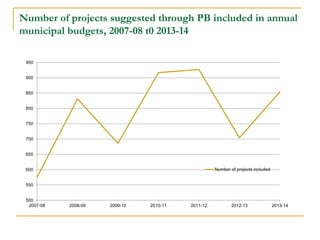
Number of projects suggested through PB included in annual
municipal budgets, 2007-08 t0 2013-14
500
550
600
650
700
750
800
850
900
950
2007-08 2008-09 2009-10 2010-11 2011-12 2012-13 2013-14
Number of projects included
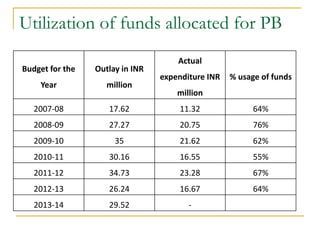
Utilization of funds allocated for PB
Budget for the
Year
Outlay in INR
million
Actual
expenditure INR
million
% usage of funds
2007-08 17.62 11.32 64%
2008-09 27.27 20.75 76%
2009-10 35 21.62 62%
2010-11 30.16 16.55 55%
2011-12 34.73 23.28 67%
2012-13 26.24 16.67 64%
2013-14 29.52 -
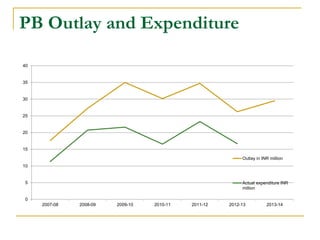
PB Outlay and Expenditure
0
5
10
15
20
25
30
35
40
2007-08 2008-09 2009-10 2010-11 2011-12 2012-13 2013-14
Outlay in INR million
Actual expenditure INR
million
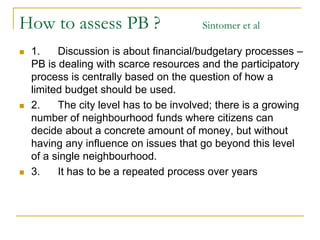
How to assess PB ? Sintomer et al
 1. Discussion is about financial/budgetary processes –
PB is dealing with scarce resources and the participatory
process is centrally based on the question of how a
limited budget should be used.
 2. The city level has to be involved; there is a growing
number of neighbourhood funds where citizens can
decide about a concrete amount of money, but without
having any influence on issues that go beyond this level
of a single neighbourhood.
 3. It has to be a repeated process over years
Cont.
 Some forms of public deliberation must be
included within the framework of specific
meetings/forums; though PB deliberation
may not necessarily directly lead to
decision-making.
 Some accountability on the results of the
process is required, such as through
annual meetings or publications where
organisers provide information about the
realization of the proposed projects
Framework to Assess the PB Process
Indicators related to the Nature and Scope of the Process
 Participation is about use of a limited budget
 It is repeated over the years
 There is political acceptance about the process
 The process is proactive and invites/ facilitates
participation
 Disadvantaged persons are able to easily participate
 Adequate information is available to citizens at various
stages of the PB process, such as when the process gets
underway, information about the wards including maps,
lists of projects already underway, and what is already
being planned
Cont
 Public deliberation is part of the process
 Public deliberations are easily accessible, fair and
facilitate public decision-making on the budget or at least
the priorities
 The results at various stages of the process are known/
transparent (what has been submitted; what’s being
taken on board; reasons why suggestions are accepted
or not accepted).
 Projects suggested and agreed upon in public
deliberations are actually included in the city’s budget
Quantitative Indicators
 Proportion of population in the city aware about the
process and can participate easily if they wish to
 Numbers of people participating
 Numbers of projects being submitted
 Numbers of projects getting included in the budget
 Proportion of the total discretionary budget (that is non-
establishment related, meant for projects, capital
expenditure, O and M etc) available for citizens inputs
Main Findings
 Lack of:
 Publicity
 information
 transparency
 Elite centered
 Participation mainly from middle & high income groups
 online forms, newspaper advertisements reach educated
classes only
 Women’s participation low
 Very few participants
 Housewives : ‘I m not citizen my husband is’.
Main Findings
 Corporator’s network is important
 Those who knew corporator personally didn’t find
need to participate
 Some filled forms after consulting corporator
 Lack of forum for coordination between
corporators, ward officers and citizens
 Adequate/ inadequate?
 No base document to have overview
Main Findings
 Few participants from youth
 Citizens lack understanding of the nuances of the
process
 Made demands that didn’t fall within scope of budget
 Follow up not satisfactory
 Many citizens showed a very positive attitude
towards the process and it has led to some
awareness regarding government functioning
Views of stakeholders
 Corporators:
 Sometimes apathetic or against the process
 Some tried to influence process
 Some expressed that citizens not educated/aware enough
to participate in process
 Ward officers:
 Busy with routine tasks, no time or interest in PB
 Claimed lack of awareness about process in other cities or
countries
 Feel citizens not capable of participating
 Citizens ??
Recommendations
 Innovative forms of communication and publicity
 Should be different for different sections of society
 Use of radio, street plays, folk traditions, rallies
 Billboards displayed in public areas in different languages
 Media’s role important
 Local women’s groups
 Measures to increase women’s participation
 Important due to the priorities they give for basic facilities
 Reservation
 Made aware of their rights
Recommendations
 Education
 Citizens: to know about what can be voted on in budget.
Small neighborhood committees to put forward demands
 Corporators: why the system can benefit them
 Ward officers: training and relationship with finance
department
 Distribution of work among ward officers to facilitate
process
 NGOs to provide support
 Monitor & ensure no political pressure
Recommendations
 Participation
 Encourage those who participate to attend meetings
 Encourage those who participate to continue their participation
 Follow up
 Monitoring system of what has been suggested & what has been
implemented
 Monitoring committee with all stakeholders to provide checks
 Display list of works implemented as result of PB
 Institutionalization of the process so that it does not get
politicized
Case studies
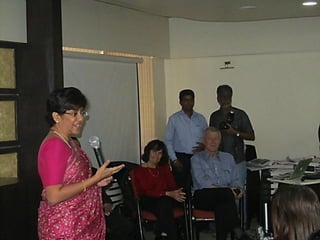
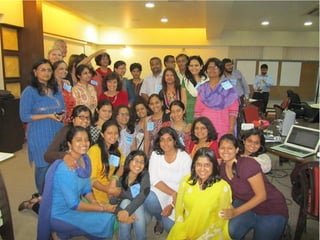
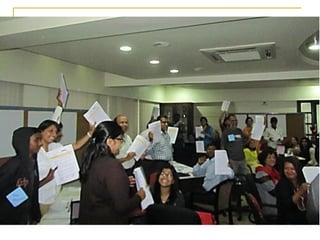
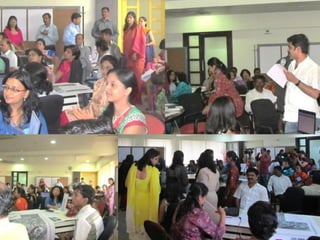
 Dattawadi Experience with
 Streets for People in Aundh
लोक सहभागातून रस्ते व पररसर
ववकासा साठी सहववचार सभा
SUM Net
Sustainable Urban Mobility Network
CEE
Centre for Environment Education
Way forward
 Inquiry Based Approach in 5 wards
 Challenges and the need for innovation in methods of
public engagement.
 Updating Menu Card
 Deepening democracy requires a lot more innovation in
methods of public engagement, since the desire is to go
beyond voting, into more and more complex problems
with need to integrate multiple views from different
scales.
 Challenges include: time, equity, environment,
information, differing views about the problem, power
relations, conflicts etc.
Institutionalizing role of Facilitator
 Local area planning seems to require a
Facilitator, but who is playing this role?
 Is it the elected rep? Is it a community social
worker? A planner? An Educator?
 The practice of planning with public participation
is yet evolving. Practitioners are not only
planners but many different types of actors. We
should continue to cooperate and built a
community of practice around facilitating multi-
stakeholder processes.
Cont
 The CEE CEPT UNESCO Chair of Human
Habitat is one way that the two institutions
are jointly exploring this.
 Chair work and the tentative proposal to offer
a Facilitators' program as a professional
development program by CEE CEPT and
ICLEI jointly in October this year.

CEE PB in Pune

  • 1.
    Learnings from Participatory Budgetingin Pune Sanskriti Menon & Avinash Madhale CEE Centre for Environment Education
  • 2.
    Introduction  Meaning ofparticipatory budgeting:  A different way to manage public money, and to engage people in organizing Hope.  It is a democratic process in which community members directly decide how to spend part of a public budget.  It enables citizens to work with government to make the budget decisions that affect their lives.
  • 3.
    UN-Habitat  ‘Participatory budgeting’and participation opportunities, and suggests ‘Regular, organized and open consultations of citizens on city financial matters and other important issues, through such mechanisms as the participatory budget’, to operationalize transparency and accountability. (UN-Habitat 2002)
  • 4.
    What is it?/Why PB?  Deepening Democracy  Way of engaging people effectively in decisions about Pub. Expend.  More informed decisions  Learn macro and micro picture our cities  Public Education  Practice 7th Std Civics  Fairer Spending  Use municipal resource wisely through deliberation  Community Building  Create ownership, sense of belonging  Ensures transparency and accountability process Innovation
  • 5.
    Where its staredand has it worked?  The Brazilian city of Porto Alegre started the first full PB process in 1989, for the municipal budget. In Porto Alegre, as many as 50,000 people have participated each year, to decide as much as 20% of the city budget.  PB has spread to over 1,500 cities in Latin America, North America, Asia, Africa, and Europe. In the US and Canada, PB has been used in Toronto, Montreal, Guelph, Chicago, New York City, and Vallejo (California).
  • 6.
  • 8.
  • 10.
    PMC Budget, 2006-07to 2013-14 Financial Year Budget in INR million* Capital Expenditure* PB Expenditure INR million** PB expenditure as % of total CapEx 2005-06 1043.90 672.73 - 2006-07 1157.21 530.70 - 2007-08 1713.04 785.68 11.32 1.44 2008-09 1575.31 1321.99 20.75 1.57 2009-10 2031.64 1335.99 21.62 1.62 2010-11 2335.23 1202.24 16.55 1.38 2011-12 2776.56 1310.90 23.28 1.78 2012-13 3633.00# 1900.71# 16.67 0.88 2013-14 4167.48# 2177.84# - - # Estimated. Sources: * PMC Budget Book, 2013-14 and ** PMC Accounts Dept
  • 11.
    Pune PB -An Overview from 2006-07 to 2012-13 Budget for the Year Window for PB suggestions* Number of days suggestions included suggestions for projects in slums Outlay for projects suggested through PB INR million 2007-08 17 days 575 55 17.62 2008-09 9 days 831 144 27.27 2009-10 31 days 699 105 35.00 2010-11 14 days 917 160 30.16 2011-12 22 days 927 141 34.73 2012-13 24 days 704 102 26.24 2013-14 36 days 854 120 29.52 Source: PMC Budget books, 2007-08 to 2013-14; *From CEE and Janwani; **From PMC Accounts Dept
  • 12.
    PB distribution incategories/ sectors Budget Year Total INR million % Road % Electrical % Bhavan % Slum improve- ment % Water % Drainage % Foot- path 2007-08 17.62 51.27 14.15 7.33 7.41 4.82 15.02 7.05 2008-09 27.27 41.74 10.38 3.72 20.54 8.01 13.06 2.55 2009-10 35.00 44.85 10.93 7.66 12.76 7.71 16.1 - 2010-11 30.17 40.91 15.09 10.32 18.37 6.51 8.81 - 2011-12* 34.73 51.3 12.3 6.13 14.65 0.88 14.73 - 2012-13* 26.24 42.46 15.07 6.67 14.59 4.42 16.8 - 2013-14* 29.52 37.15 17.01 12.33 13.85 4.74 14.92 -
  • 13.
    Number of projectssuggested through PB included in annual municipal budgets, 2007-08 t0 2013-14 500 550 600 650 700 750 800 850 900 950 2007-08 2008-09 2009-10 2010-11 2011-12 2012-13 2013-14 Number of projects included
  • 14.
    Utilization of fundsallocated for PB Budget for the Year Outlay in INR million Actual expenditure INR million % usage of funds 2007-08 17.62 11.32 64% 2008-09 27.27 20.75 76% 2009-10 35 21.62 62% 2010-11 30.16 16.55 55% 2011-12 34.73 23.28 67% 2012-13 26.24 16.67 64% 2013-14 29.52 -
  • 15.
    PB Outlay andExpenditure 0 5 10 15 20 25 30 35 40 2007-08 2008-09 2009-10 2010-11 2011-12 2012-13 2013-14 Outlay in INR million Actual expenditure INR million
  • 16.
    How to assessPB ? Sintomer et al  1. Discussion is about financial/budgetary processes – PB is dealing with scarce resources and the participatory process is centrally based on the question of how a limited budget should be used.  2. The city level has to be involved; there is a growing number of neighbourhood funds where citizens can decide about a concrete amount of money, but without having any influence on issues that go beyond this level of a single neighbourhood.  3. It has to be a repeated process over years
  • 17.
    Cont.  Some formsof public deliberation must be included within the framework of specific meetings/forums; though PB deliberation may not necessarily directly lead to decision-making.  Some accountability on the results of the process is required, such as through annual meetings or publications where organisers provide information about the realization of the proposed projects
  • 18.
    Framework to Assessthe PB Process Indicators related to the Nature and Scope of the Process  Participation is about use of a limited budget  It is repeated over the years  There is political acceptance about the process  The process is proactive and invites/ facilitates participation  Disadvantaged persons are able to easily participate  Adequate information is available to citizens at various stages of the PB process, such as when the process gets underway, information about the wards including maps, lists of projects already underway, and what is already being planned
  • 19.
    Cont  Public deliberationis part of the process  Public deliberations are easily accessible, fair and facilitate public decision-making on the budget or at least the priorities  The results at various stages of the process are known/ transparent (what has been submitted; what’s being taken on board; reasons why suggestions are accepted or not accepted).  Projects suggested and agreed upon in public deliberations are actually included in the city’s budget
  • 20.
    Quantitative Indicators  Proportionof population in the city aware about the process and can participate easily if they wish to  Numbers of people participating  Numbers of projects being submitted  Numbers of projects getting included in the budget  Proportion of the total discretionary budget (that is non- establishment related, meant for projects, capital expenditure, O and M etc) available for citizens inputs
  • 21.
    Main Findings  Lackof:  Publicity  information  transparency  Elite centered  Participation mainly from middle & high income groups  online forms, newspaper advertisements reach educated classes only  Women’s participation low  Very few participants  Housewives : ‘I m not citizen my husband is’.
  • 22.
    Main Findings  Corporator’snetwork is important  Those who knew corporator personally didn’t find need to participate  Some filled forms after consulting corporator  Lack of forum for coordination between corporators, ward officers and citizens  Adequate/ inadequate?  No base document to have overview
  • 23.
    Main Findings  Fewparticipants from youth  Citizens lack understanding of the nuances of the process  Made demands that didn’t fall within scope of budget  Follow up not satisfactory  Many citizens showed a very positive attitude towards the process and it has led to some awareness regarding government functioning
  • 24.
    Views of stakeholders Corporators:  Sometimes apathetic or against the process  Some tried to influence process  Some expressed that citizens not educated/aware enough to participate in process  Ward officers:  Busy with routine tasks, no time or interest in PB  Claimed lack of awareness about process in other cities or countries  Feel citizens not capable of participating  Citizens ??
  • 25.
    Recommendations  Innovative formsof communication and publicity  Should be different for different sections of society  Use of radio, street plays, folk traditions, rallies  Billboards displayed in public areas in different languages  Media’s role important  Local women’s groups  Measures to increase women’s participation  Important due to the priorities they give for basic facilities  Reservation  Made aware of their rights
  • 26.
    Recommendations  Education  Citizens:to know about what can be voted on in budget. Small neighborhood committees to put forward demands  Corporators: why the system can benefit them  Ward officers: training and relationship with finance department  Distribution of work among ward officers to facilitate process  NGOs to provide support  Monitor & ensure no political pressure
  • 27.
    Recommendations  Participation  Encouragethose who participate to attend meetings  Encourage those who participate to continue their participation  Follow up  Monitoring system of what has been suggested & what has been implemented  Monitoring committee with all stakeholders to provide checks  Display list of works implemented as result of PB  Institutionalization of the process so that it does not get politicized
  • 28.
    Case studies  DattawadiExperience with  Streets for People in Aundh
  • 29.
    लोक सहभागातून रस्तेव पररसर ववकासा साठी सहववचार सभा SUM Net Sustainable Urban Mobility Network CEE Centre for Environment Education
  • 34.
    Way forward  InquiryBased Approach in 5 wards  Challenges and the need for innovation in methods of public engagement.  Updating Menu Card  Deepening democracy requires a lot more innovation in methods of public engagement, since the desire is to go beyond voting, into more and more complex problems with need to integrate multiple views from different scales.  Challenges include: time, equity, environment, information, differing views about the problem, power relations, conflicts etc.
  • 35.
    Institutionalizing role ofFacilitator  Local area planning seems to require a Facilitator, but who is playing this role?  Is it the elected rep? Is it a community social worker? A planner? An Educator?  The practice of planning with public participation is yet evolving. Practitioners are not only planners but many different types of actors. We should continue to cooperate and built a community of practice around facilitating multi- stakeholder processes.
  • 36.
    Cont  The CEECEPT UNESCO Chair of Human Habitat is one way that the two institutions are jointly exploring this.  Chair work and the tentative proposal to offer a Facilitators' program as a professional development program by CEE CEPT and ICLEI jointly in October this year.