Community Development 
Concept Participatory Approach& 
IN 
Agricultural Resources Management 
Project Phase II 
PPrreeppaarreedd bbyy 
AAhhllaamm MMaahhaaddeeeenn 
MM&&EE ooffffiicceerr
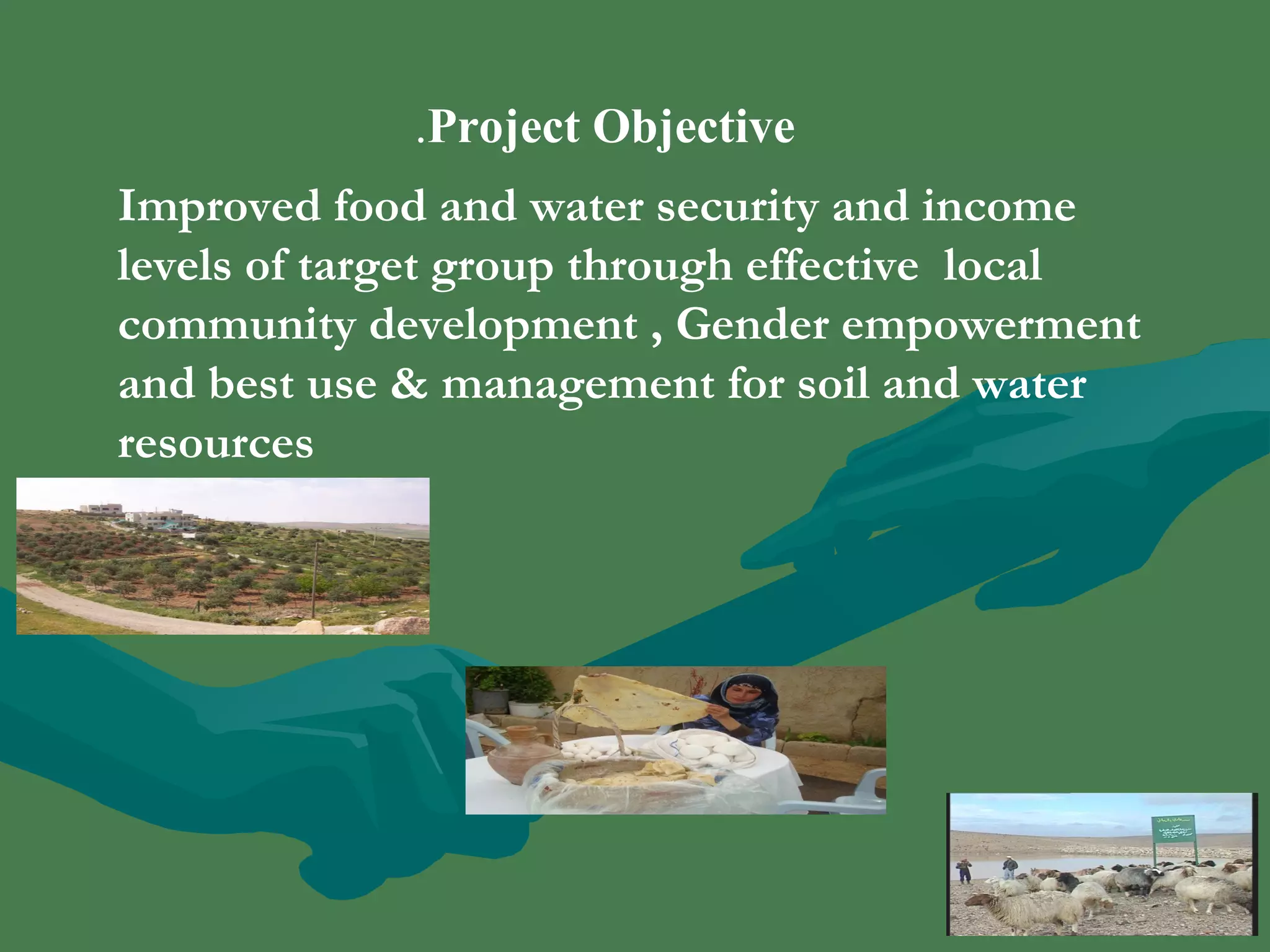
.Project Objective 
Improved food and water security and income 
levels of target group through effective local 
community development , Gender empowerment 
and best use & management for soil and water 
resources
AArreeaa aanndd TTaarrggeett GGrroouupp 
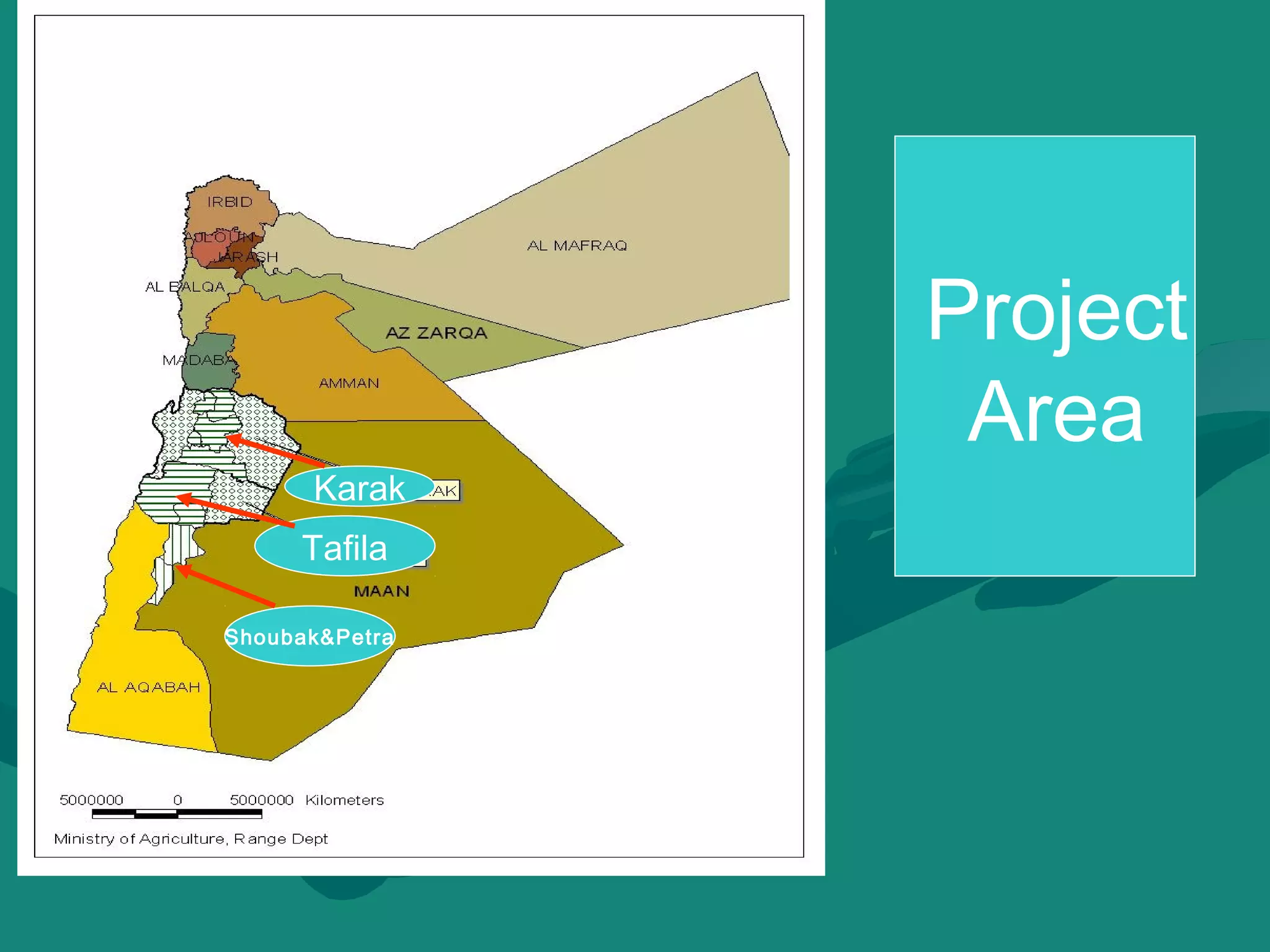
• TThhee pprroojjeecctt aarreeaa iiss llooccaatteedd iinn tthhee ssoouutthheerrnn 
hhiigghhllaannddss.. 
• AAddmmiinniissttrraattiivveellyy,, iitt ccoovveerrss tthhee 
 GGoovveerrnnoorraatteess ooff KKaarraakk aanndd TTaaffiillaa aanndd 
 TThhee ddiissttrriiccttss ooff SShhoouubbaakk,, WWaaddii MMuussaa aanndd AAiill ooff tthhee MMaa’’aann 
GGoovveerrnnoorraattee.. 
 TThhee pprroojjeecctt hhaavvee ffiivvee ((CCSSCCss ))ccoovveerriinngg aallll ttaarrggeett aarreeaa 
• TThhee pprroojjeecctt iiss ttaarrggeettiinngg 2222 330000 hhoouusseehhoollddss 
• ((113344 000000 ppeeooppllee)) ccoommpprriissiinngg 
 1133 550000 ssmmaallll aanndd mmeeddiiuumm ffaarrmmeerrss,, 
 22 770000 rruurraall llaannddlleessss aanndd 
 66 110000 ootthheerr ddiissaaddvvaannttaaggeedd hhoouusseehhoollddss..
Karak 
Tafila 
Shoubak&Petra 
Project 
Area
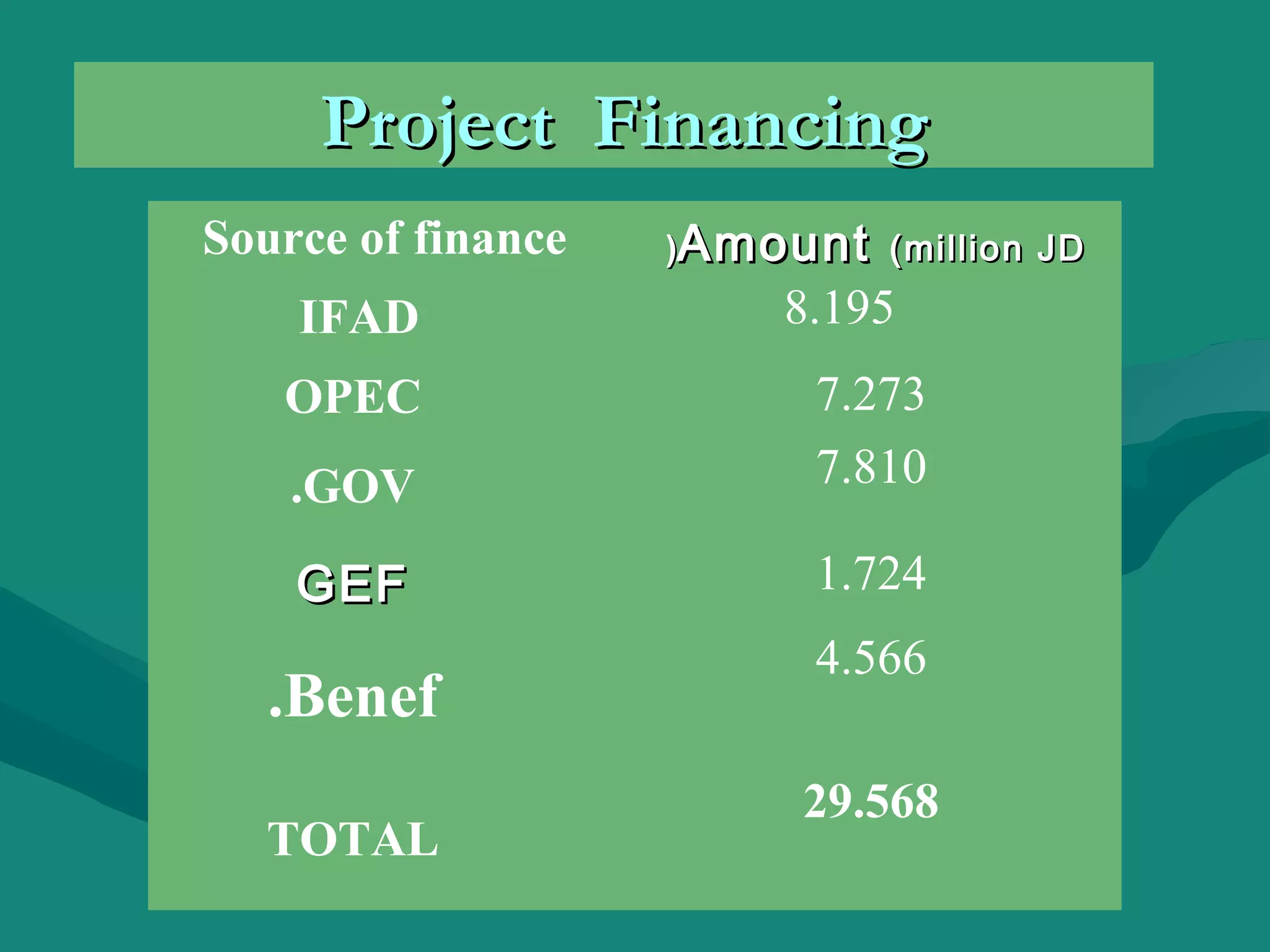
PPrroojjeecctt FFiinnaanncciinngg 
Source of finance ))AAmmoouunntt ((mmiilllliioonn JJDD 
IFAD 8.195 
OPEC 7.273 
.GOV 7.810 
GGEEFF 1.724 
.Benef 4.566 
TOTAL 
29.568
PPrroojjeecctt IImmpplleemmeennttaattiioonn 
AApppprrooaacchh 
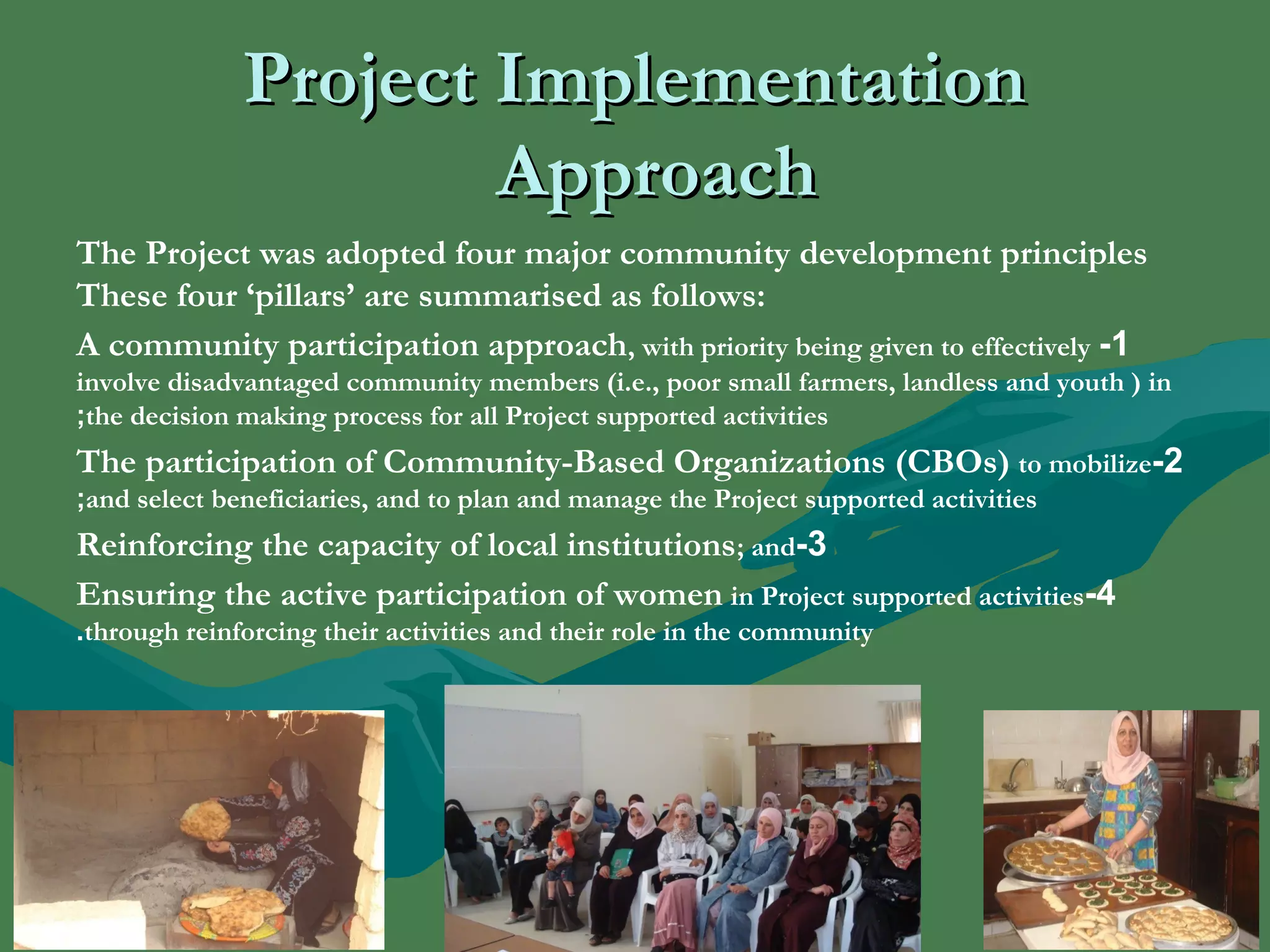
The Project was adopted four major community development principles 
These four ‘pillars’ are summarised as follows: 
A community participation approach, with priority being given to effectively -1 
involve disadvantaged community members (i.e., poor small farmers, landless and youth ) in 
;the decision making process for all Project supported activities 
The participation of Community-Based Organizations (CBOs) to mobilize -2 
;and select beneficiaries, and to plan and manage the Project supported activities 
Reinforcing the capacity of local institutions; and-3 
Ensuring the active participation of women in Project supported activities -4 
.through reinforcing their activities and their role in the community 
..
COMMUNITY DEVELOPMENT AND 
CAPACITY BUILDING 
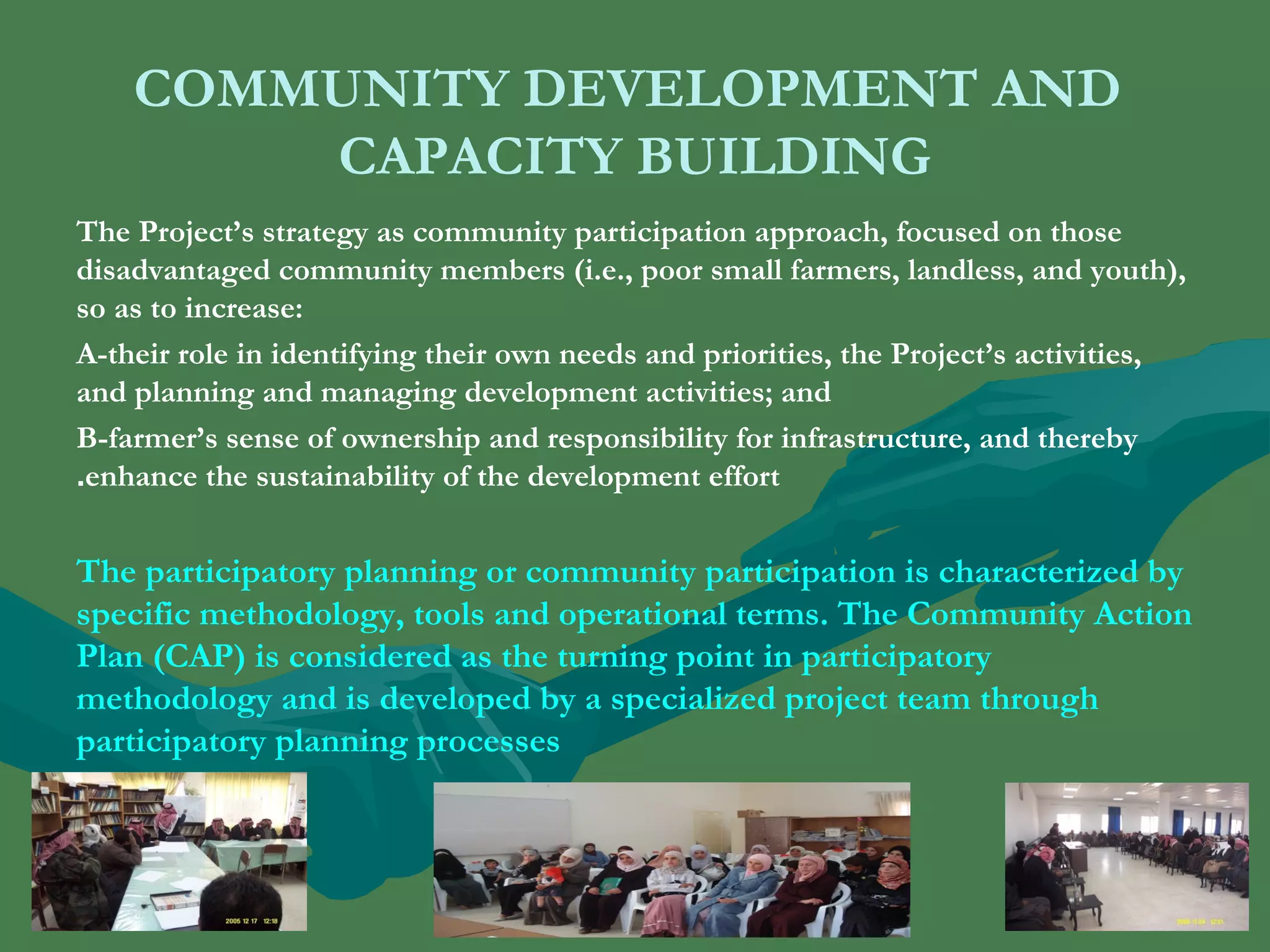
The Project’s strategy as community participation approach, focused on those 
disadvantaged community members (i.e., poor small farmers, landless, and youth), 
so as to increase: 
A-their role in identifying their own needs and priorities, the Project’s activities, 
and planning and managing development activities; and 
B-farmer’s sense of ownership and responsibility for infrastructure, and thereby 
enhance the sustainability of the . development effort 
The participatory planning or community participation is characterized by 
specific methodology, tools and operational terms. The Community Action 
Plan (CAP) is considered as the turning point in participatory 
methodology and is developed by a specialized project team through 
participatory planning processes 
.
CCoommmmuunniittyy AAccttiioonn PPllaann pprreeppaarraattiioonn 
sstteeppss 
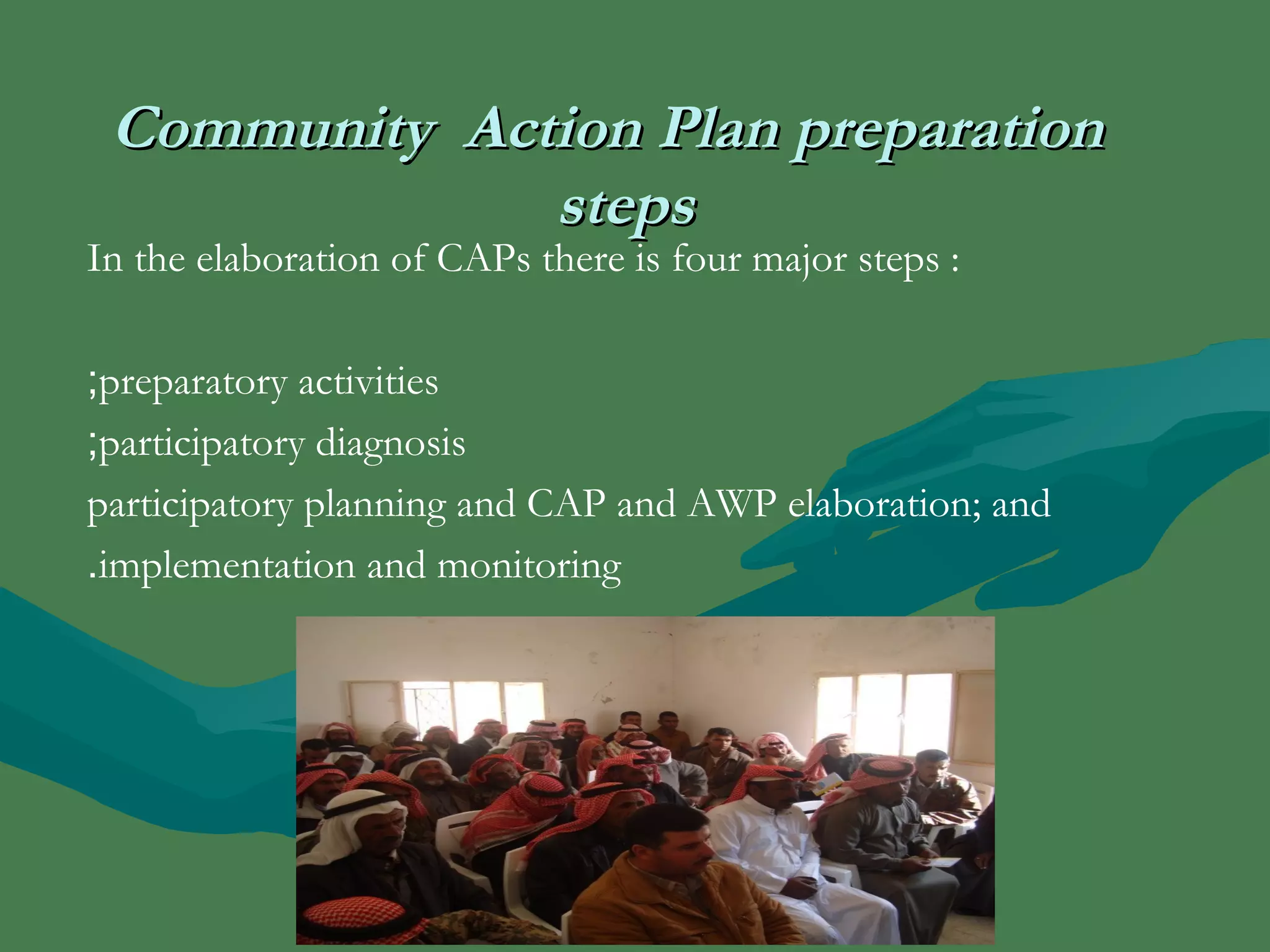
In the elaboration of CAPs there is four major steps : 
;preparatory activities 
;participatory diagnosis 
participatory planning and CAP and AWP elaboration; and 
.implementation and monitoring
Preparatory Activities 
In order to prepare appropriate conditions at the community or village 
level, to allow for the population to play there expected role. The activities 
under the first step are: 
preliminary identification of the concerned community (e.g., one - 1 
village or more, group of scattered houses) and collection of survey data 
(;(e.g., population, farm lands, natural resources, productions 
the project area were divided to 55 villages and clustered villages as 2 - 2 
( .proirties ( very poor & poor ) and(near to poor villages
3-information provided to the local leaders and the communities on the 
Project’s objectives and approach, This action has been done in one or 
more general meetings in the village (i.e., awareness campaigns) 
4-identification/assessment of local organizations that 
as project stakeholders 
5-assistance provided to the population to ellect ‘Local Community 
Committee’ (LCC) representing the existing cooperatives and charitable 
societies, and other informal interest groups, including women and 
youth
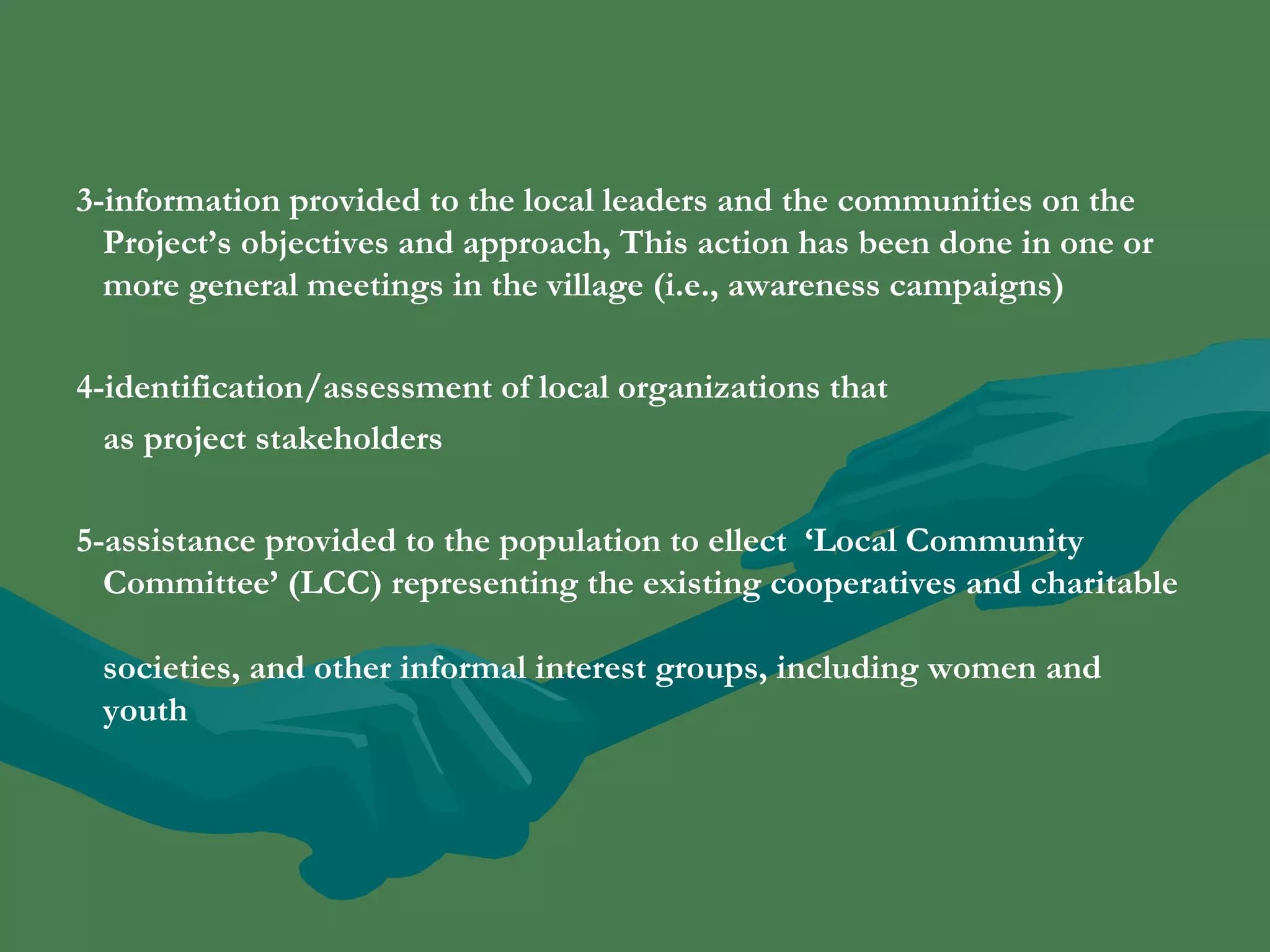
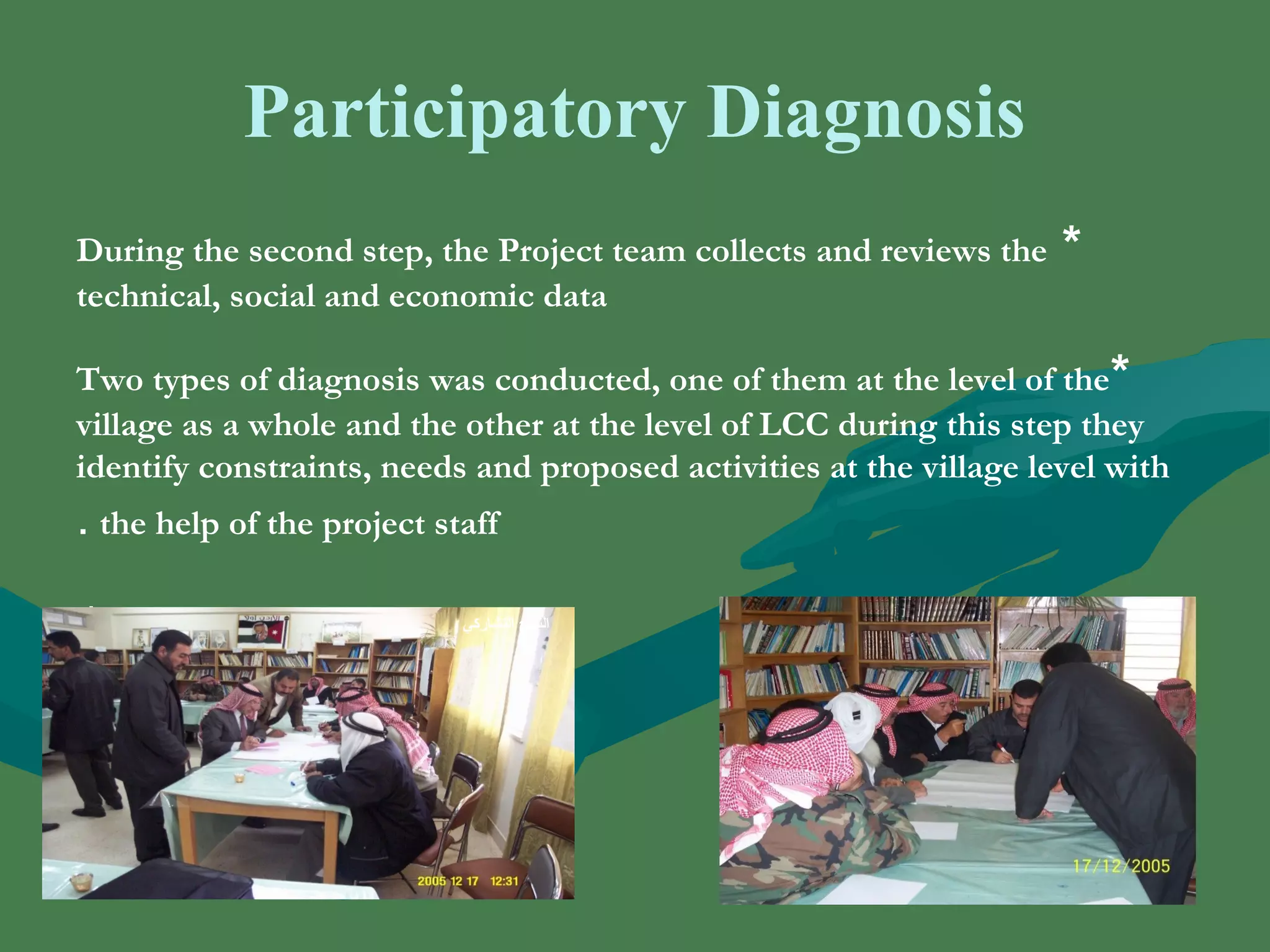
Participatory Diagnosis 
During the second step, the Project team collects and reviews the * 
technical, social and economic data 
Two types of diagnosis was conducted, one of them at the level of the * 
village as a whole and the other at the level of LCC during this step they 
identify constraints, needs and proposed activities at the village level with 
. the help of the project staff 
. 
النهج التشاركي
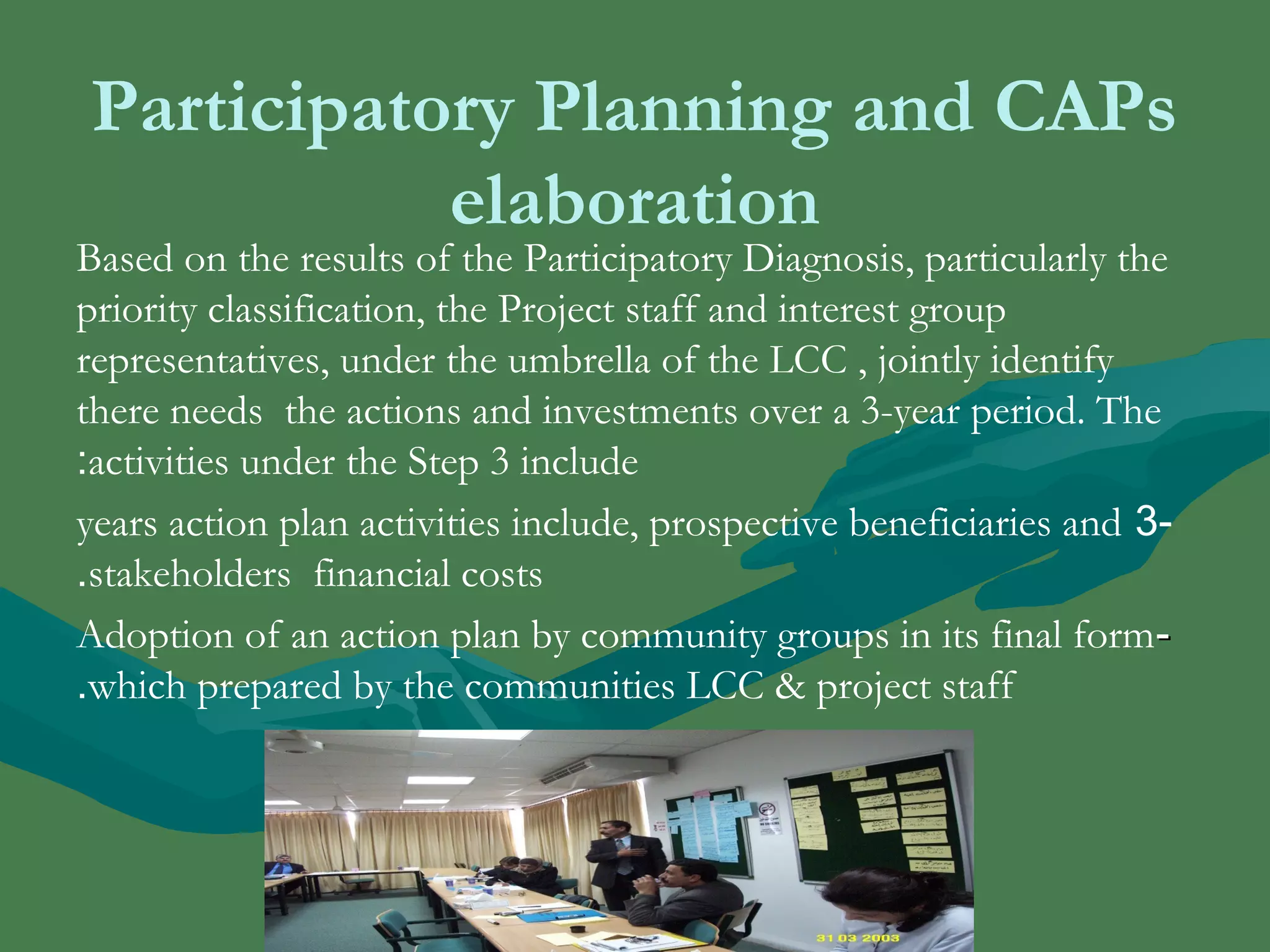
Participatory Planning and CAPs 
elaboration 
Based on the results of the Participatory Diagnosis, particularly the 
priority classification, the Project staff and interest group 
representatives, under the umbrella of the LCC , jointly identify 
there needs the actions and investments over a 3-year period. The 
activities : under the Step 3 include 
years action plan activities include, prospective beneficiaries and 3- 
.stakeholders financial costs 
Adoption of an action plan by community groups in its final form -- 
.which prepared by the communities LCC & project staff
Elaboration of an AWP&B for PY1 based on CAP proposals - - 
. and priorities 
- After the community’s adoption and validation of the AWP by 
the LCC, the results presented to Project management for 
confirmation. 
- This formalization provides ownership of the AWP, and 
formalises the relationship, which is intended to enhance each 
party’s compliance with their respective obligations. The villages’ 
programmes would be collected for elaboration in the Project’s 
Annual Work Plan and Budget (AWPB).
Implementation and Monitoring 
- Implementation based on AWP and follow-up. preparatory and 
support activities include: 
Information/dispatching of CAPs to the CSCs and institutions in - 
.charge of implementation 
Support to the community to allow them to achieve the scheduled - 
.actions in the best conditions 
Coordination between the various parties involved in the - 
.implementation 
Follow-up on implementation progress against CAPs and AWPs; - 
and elaboration of quarterly and annual progress reports in a 
.context of the project continuous follow-up and evaluation
Regular meetings with local committees to verify - 
the implementation and follow-up developments 
.in the targeted villages 
During this phase adjusted plans and add any new - 
activities and to exclude any activity can not be 
achieved for reasons 
Review the CAPs after three years to measure the - 
progress
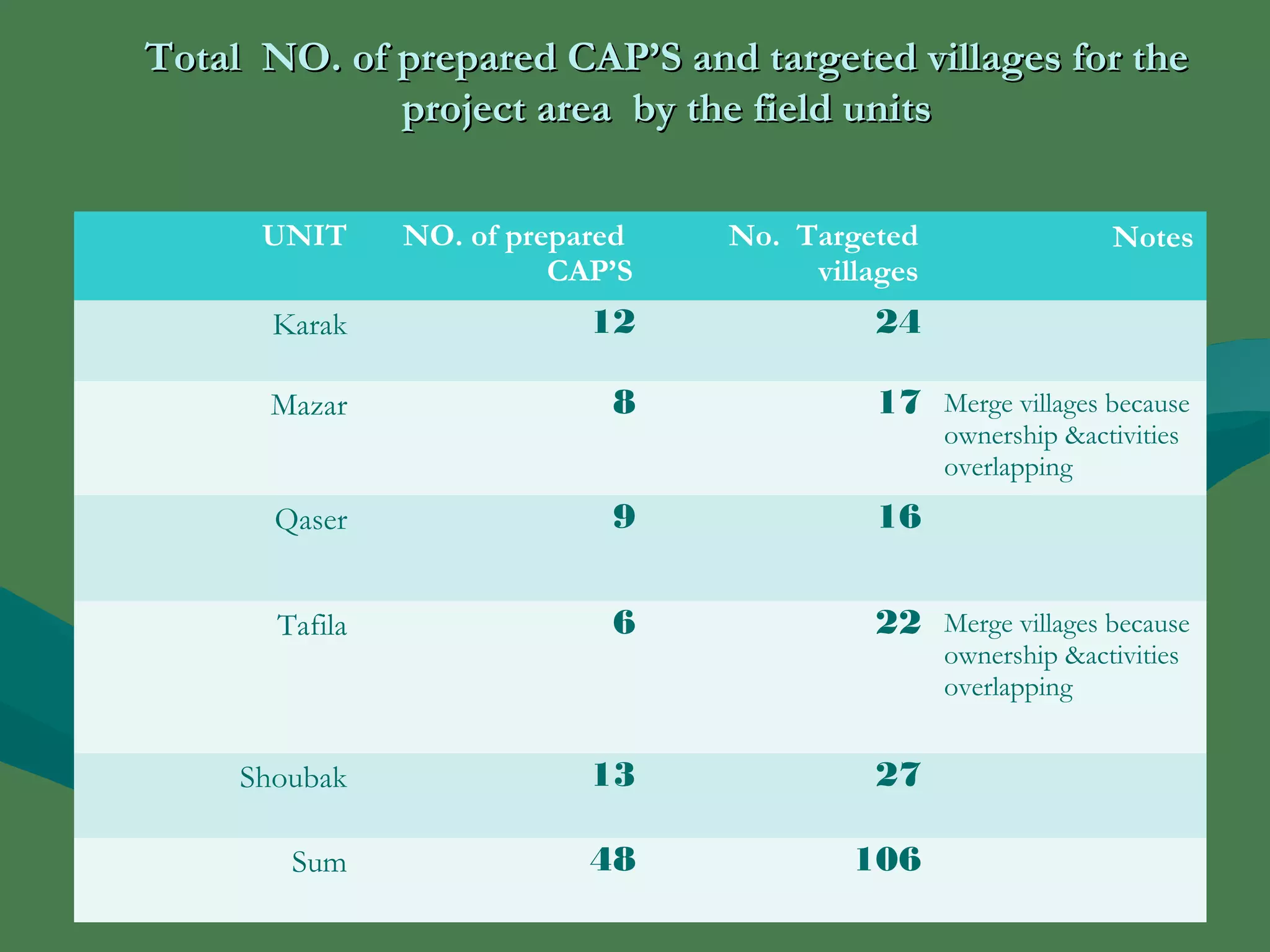
TToottaall NNOO.. ooff pprreeppaarreedd CCAAPP’’SS aanndd ttaarrggeetteedd vviillllaaggeess ffoorr tthhee 
pprroojjeecctt aarreeaa bbyy tthhee ffiieelldd uunniittss 
UNIT NO. of prepared 
CAP’S 
No. Targeted 
villages 
Notes 
Karak 12 24 
Mazar 8 17 Merge villages because 
ownership &activities 
overlapping 
Qaser 9 16 
Tafila 6 22 Merge villages because 
ownership &activities 
overlapping 
Shoubak 13 27 
Sum 48 106
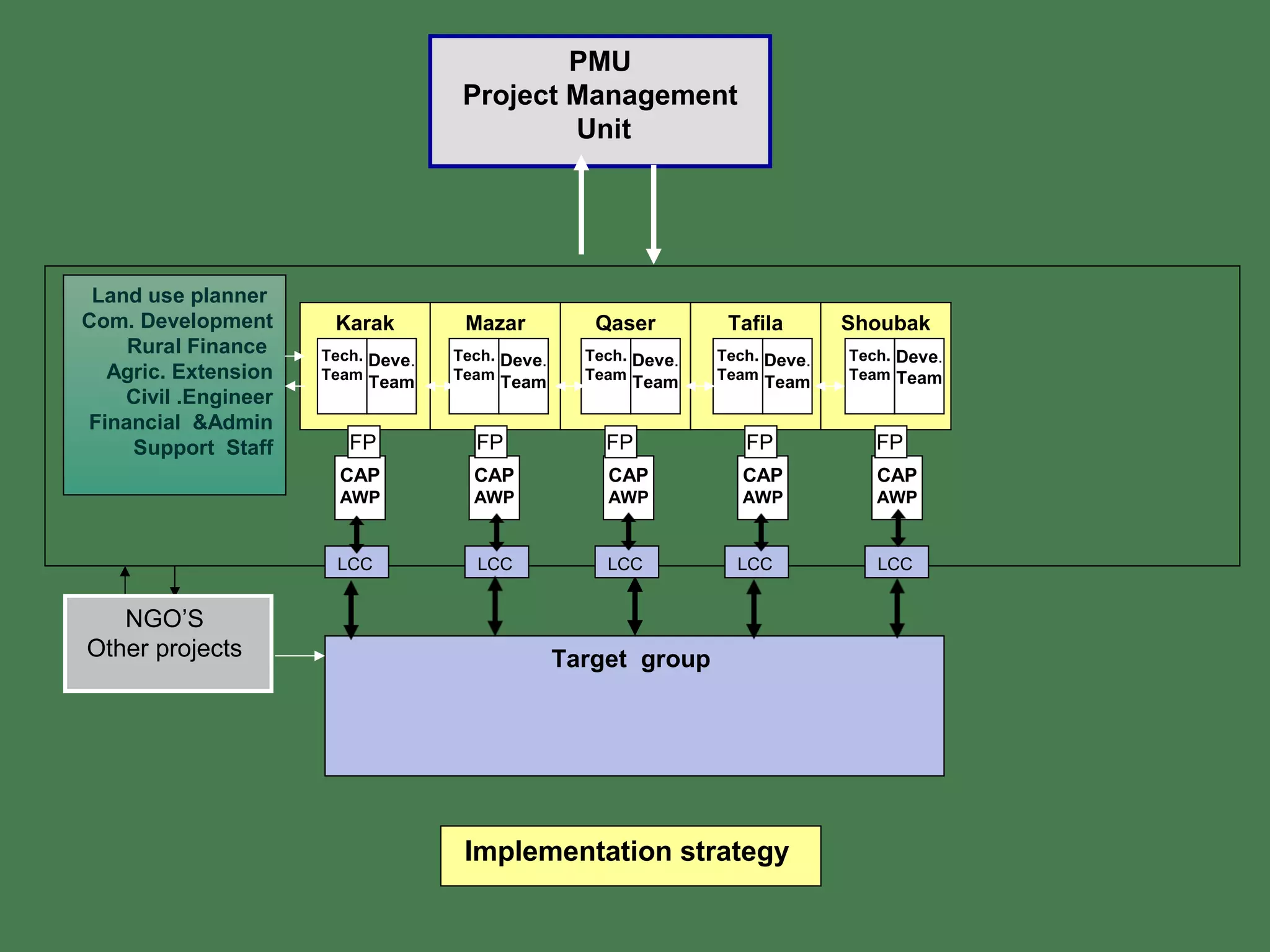
Land use planner 
Com. Development 
Rural Finance 
Agric. Extension 
Civil .Engineer 
Financial &Admin 
Support Staff 
PMU 
Project Management 
Unit 
Karak Mazar Qaser Tafila Shoubak 
CAP 
AWP 
CAP 
AWP 
CAP 
AWP 
CAP 
AWP 
CAP 
AWP 
Tech. 
Team 
Deve. 
Team 
Tech. 
Team 
Deve. 
Team 
Tech. 
Team 
Deve. 
Team 
Tech. 
Team 
Deve. 
Team 
Tech. 
Team 
Deve. 
Team 
FP FP FP FP FP 
LCC LCC LCC LCC LCC 
Target group 
NGO’S 
Other projects 
Implementation strategy
LLeessssoonnss lleeaarrnneedd ffrroomm ccoommmmuunniittyy 
ppaarrttiicciippaattoorryy aapppprrooaacchh aatt AARRMMPPIIII 
Communities know their situation better than any party thus are better * 
.able to manage the development process 
participatory approach allow communities effectively sharing in * 
situation analysis, thinking and planning for a better future 
Respect the community diversity consider the most important * 
principles of participatory approach
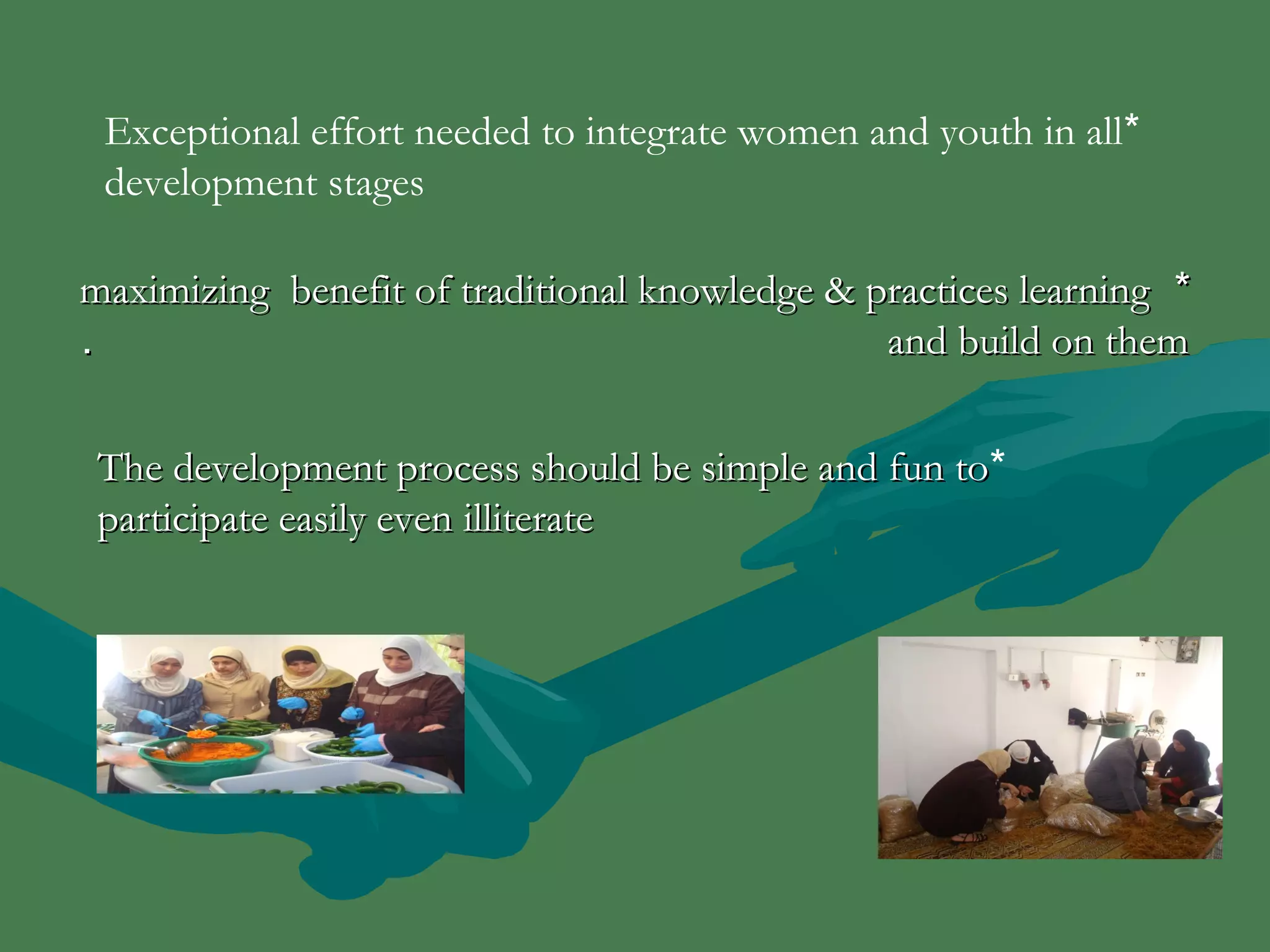
Exceptional effort needed to integrate women and youth in all * 
development stages 
mmaaxxiimmiizziinngg bbeenneeffiitt ooff ttrraaddiittiioonnaall kknnoowwlleeddggee && pprraaccttiicceess lleeaarrnniinngg ** 
.. aanndd bbuuiilldd oonn tthheemm 
TThhee ddeevveellooppmmeenntt pprroocceessss sshhoouulldd bbee ssiimmppllee aanndd ffuunn ttoo * 
ppaarrttiicciippaattee eeaassiillyy eevveenn iilllliitteerraattee
CCoonnssttrraaiinnss && cchhaalllleennggeess 
CCoonnfflliiccttss ooff iinntteerreesstt aammoonngg ssoommee mmeemmbbeerrss ooff tthhee llooccaall** 
ccoommmmuunniittyy 
..pprreesseennccee ooff ttrriibbaall pprroobblleemmss iinn ssoommee ccoommmmuunniittiieess** 
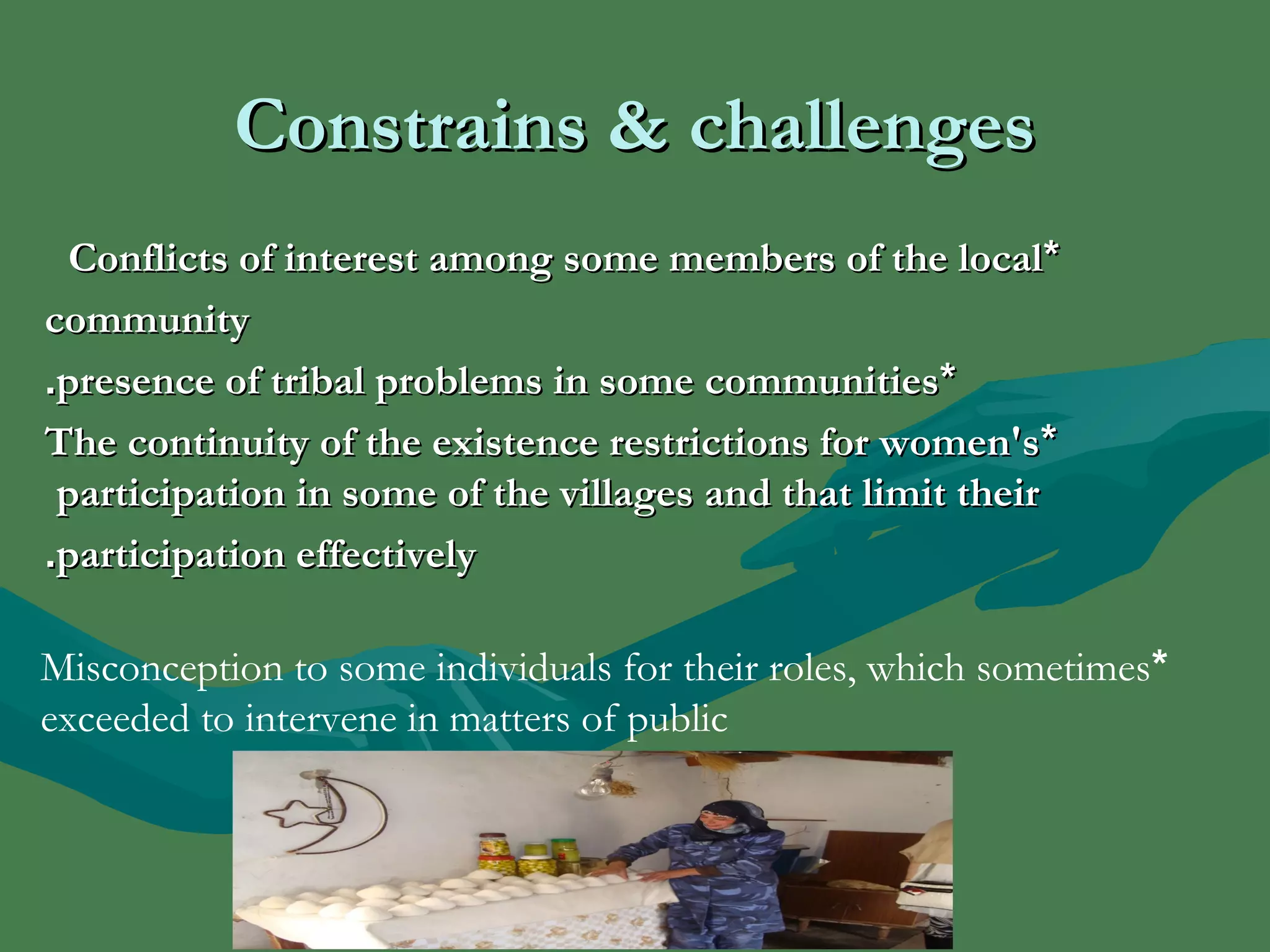
TThhee ccoonnttiinnuuiittyy ooff tthhee eexxiisstteennccee rreessttrriiccttiioonnss ffoorr wwoommeenn''ss * 
ppaarrttiicciippaattiioonn iinn ssoommee ooff tthhee vviillllaaggeess aanndd tthhaatt lliimmiitt tthheeiirr 
..ppaarrttiicciippaattiioonn eeffffeeccttiivveellyy 
Misconception to some individuals for their roles, which sometimes * 
exceeded to intervene in matters of public
TTHHAANNKK YYOOUU

Community development and participatory approach concept (phase 2)

  • 1.
    Community Development ConceptParticipatory Approach& IN Agricultural Resources Management Project Phase II PPrreeppaarreedd bbyy AAhhllaamm MMaahhaaddeeeenn MM&&EE ooffffiicceerr
  • 2.
    .Project Objective Improvedfood and water security and income levels of target group through effective local community development , Gender empowerment and best use & management for soil and water resources
  • 3.
    AArreeaa aanndd TTaarrggeettGGrroouupp • TThhee pprroojjeecctt aarreeaa iiss llooccaatteedd iinn tthhee ssoouutthheerrnn hhiigghhllaannddss.. • AAddmmiinniissttrraattiivveellyy,, iitt ccoovveerrss tthhee  GGoovveerrnnoorraatteess ooff KKaarraakk aanndd TTaaffiillaa aanndd  TThhee ddiissttrriiccttss ooff SShhoouubbaakk,, WWaaddii MMuussaa aanndd AAiill ooff tthhee MMaa’’aann GGoovveerrnnoorraattee..  TThhee pprroojjeecctt hhaavvee ffiivvee ((CCSSCCss ))ccoovveerriinngg aallll ttaarrggeett aarreeaa • TThhee pprroojjeecctt iiss ttaarrggeettiinngg 2222 330000 hhoouusseehhoollddss • ((113344 000000 ppeeooppllee)) ccoommpprriissiinngg  1133 550000 ssmmaallll aanndd mmeeddiiuumm ffaarrmmeerrss,,  22 770000 rruurraall llaannddlleessss aanndd  66 110000 ootthheerr ddiissaaddvvaannttaaggeedd hhoouusseehhoollddss..
  • 4.
  • 5.
    PPrroojjeecctt FFiinnaanncciinngg Sourceof finance ))AAmmoouunntt ((mmiilllliioonn JJDD IFAD 8.195 OPEC 7.273 .GOV 7.810 GGEEFF 1.724 .Benef 4.566 TOTAL 29.568
  • 6.
    PPrroojjeecctt IImmpplleemmeennttaattiioonn AApppprrooaacchh The Project was adopted four major community development principles These four ‘pillars’ are summarised as follows: A community participation approach, with priority being given to effectively -1 involve disadvantaged community members (i.e., poor small farmers, landless and youth ) in ;the decision making process for all Project supported activities The participation of Community-Based Organizations (CBOs) to mobilize -2 ;and select beneficiaries, and to plan and manage the Project supported activities Reinforcing the capacity of local institutions; and-3 Ensuring the active participation of women in Project supported activities -4 .through reinforcing their activities and their role in the community ..
  • 7.
    COMMUNITY DEVELOPMENT AND CAPACITY BUILDING The Project’s strategy as community participation approach, focused on those disadvantaged community members (i.e., poor small farmers, landless, and youth), so as to increase: A-their role in identifying their own needs and priorities, the Project’s activities, and planning and managing development activities; and B-farmer’s sense of ownership and responsibility for infrastructure, and thereby enhance the sustainability of the . development effort The participatory planning or community participation is characterized by specific methodology, tools and operational terms. The Community Action Plan (CAP) is considered as the turning point in participatory methodology and is developed by a specialized project team through participatory planning processes .
  • 8.
    CCoommmmuunniittyy AAccttiioonn PPllaannpprreeppaarraattiioonn sstteeppss In the elaboration of CAPs there is four major steps : ;preparatory activities ;participatory diagnosis participatory planning and CAP and AWP elaboration; and .implementation and monitoring
  • 9.
    Preparatory Activities Inorder to prepare appropriate conditions at the community or village level, to allow for the population to play there expected role. The activities under the first step are: preliminary identification of the concerned community (e.g., one - 1 village or more, group of scattered houses) and collection of survey data (;(e.g., population, farm lands, natural resources, productions the project area were divided to 55 villages and clustered villages as 2 - 2 ( .proirties ( very poor & poor ) and(near to poor villages
  • 10.
    3-information provided tothe local leaders and the communities on the Project’s objectives and approach, This action has been done in one or more general meetings in the village (i.e., awareness campaigns) 4-identification/assessment of local organizations that as project stakeholders 5-assistance provided to the population to ellect ‘Local Community Committee’ (LCC) representing the existing cooperatives and charitable societies, and other informal interest groups, including women and youth
  • 11.
    Participatory Diagnosis Duringthe second step, the Project team collects and reviews the * technical, social and economic data Two types of diagnosis was conducted, one of them at the level of the * village as a whole and the other at the level of LCC during this step they identify constraints, needs and proposed activities at the village level with . the help of the project staff . النهج التشاركي
  • 12.
    Participatory Planning andCAPs elaboration Based on the results of the Participatory Diagnosis, particularly the priority classification, the Project staff and interest group representatives, under the umbrella of the LCC , jointly identify there needs the actions and investments over a 3-year period. The activities : under the Step 3 include years action plan activities include, prospective beneficiaries and 3- .stakeholders financial costs Adoption of an action plan by community groups in its final form -- .which prepared by the communities LCC & project staff
  • 13.
    Elaboration of anAWP&B for PY1 based on CAP proposals - - . and priorities - After the community’s adoption and validation of the AWP by the LCC, the results presented to Project management for confirmation. - This formalization provides ownership of the AWP, and formalises the relationship, which is intended to enhance each party’s compliance with their respective obligations. The villages’ programmes would be collected for elaboration in the Project’s Annual Work Plan and Budget (AWPB).
  • 14.
    Implementation and Monitoring - Implementation based on AWP and follow-up. preparatory and support activities include: Information/dispatching of CAPs to the CSCs and institutions in - .charge of implementation Support to the community to allow them to achieve the scheduled - .actions in the best conditions Coordination between the various parties involved in the - .implementation Follow-up on implementation progress against CAPs and AWPs; - and elaboration of quarterly and annual progress reports in a .context of the project continuous follow-up and evaluation
  • 15.
    Regular meetings withlocal committees to verify - the implementation and follow-up developments .in the targeted villages During this phase adjusted plans and add any new - activities and to exclude any activity can not be achieved for reasons Review the CAPs after three years to measure the - progress
  • 16.
    TToottaall NNOO.. ooffpprreeppaarreedd CCAAPP’’SS aanndd ttaarrggeetteedd vviillllaaggeess ffoorr tthhee pprroojjeecctt aarreeaa bbyy tthhee ffiieelldd uunniittss UNIT NO. of prepared CAP’S No. Targeted villages Notes Karak 12 24 Mazar 8 17 Merge villages because ownership &activities overlapping Qaser 9 16 Tafila 6 22 Merge villages because ownership &activities overlapping Shoubak 13 27 Sum 48 106
  • 17.
    Land use planner Com. Development Rural Finance Agric. Extension Civil .Engineer Financial &Admin Support Staff PMU Project Management Unit Karak Mazar Qaser Tafila Shoubak CAP AWP CAP AWP CAP AWP CAP AWP CAP AWP Tech. Team Deve. Team Tech. Team Deve. Team Tech. Team Deve. Team Tech. Team Deve. Team Tech. Team Deve. Team FP FP FP FP FP LCC LCC LCC LCC LCC Target group NGO’S Other projects Implementation strategy
  • 18.
    LLeessssoonnss lleeaarrnneedd ffrroommccoommmmuunniittyy ppaarrttiicciippaattoorryy aapppprrooaacchh aatt AARRMMPPIIII Communities know their situation better than any party thus are better * .able to manage the development process participatory approach allow communities effectively sharing in * situation analysis, thinking and planning for a better future Respect the community diversity consider the most important * principles of participatory approach
  • 19.
    Exceptional effort neededto integrate women and youth in all * development stages mmaaxxiimmiizziinngg bbeenneeffiitt ooff ttrraaddiittiioonnaall kknnoowwlleeddggee && pprraaccttiicceess lleeaarrnniinngg ** .. aanndd bbuuiilldd oonn tthheemm TThhee ddeevveellooppmmeenntt pprroocceessss sshhoouulldd bbee ssiimmppllee aanndd ffuunn ttoo * ppaarrttiicciippaattee eeaassiillyy eevveenn iilllliitteerraattee
  • 20.
    CCoonnssttrraaiinnss && cchhaalllleennggeess CCoonnfflliiccttss ooff iinntteerreesstt aammoonngg ssoommee mmeemmbbeerrss ooff tthhee llooccaall** ccoommmmuunniittyy ..pprreesseennccee ooff ttrriibbaall pprroobblleemmss iinn ssoommee ccoommmmuunniittiieess** TThhee ccoonnttiinnuuiittyy ooff tthhee eexxiisstteennccee rreessttrriiccttiioonnss ffoorr wwoommeenn''ss * ppaarrttiicciippaattiioonn iinn ssoommee ooff tthhee vviillllaaggeess aanndd tthhaatt lliimmiitt tthheeiirr ..ppaarrttiicciippaattiioonn eeffffeeccttiivveellyy Misconception to some individuals for their roles, which sometimes * exceeded to intervene in matters of public
  • 21.

Editor's Notes

  • #5 يعمل مشروع إدارة المصادر الزراعية المرحلة الثانية في المرتفعات الجنوبيـــــة من الأردن فـي الأراضي الزراعية ذات الميول من 0 – 40 % ومعدلات سقوط أمطار اكثر من 200 ملم في كل من: - محافظة الكرك, ألوية ( قصبة الكرك, عي, القصر, فقوع, المزار). - محافظة الطفيلة، لوائي ( قصبة الطفيلــة وبصيرا ). - محافظة معان، لوائي ( الشوبك و البتراء وقضاء ايل). تقوم إدارة المشروع في مدينة الربة بالعمل على تنفيذ ومتابعة أنشطة المشروع من خلال وحدات دعم المجتمعات المحلية الخمسة والموزعة كالتالي:   - وحدة الكرك في مديرية زراعة محافظة الكرك . - وحدة القصر في مديرية زراعة لواء القصر . - وحدة المزار في مديرية زراعة لواء المزار الجنوبي . - وحدة الطفيلة في مديرية زراعة محافظة الطفيلة . - وحدة الشوبك في مديرية زراعة لواء الشوبك .