Participatory
Budgeting
DR. RAVIKANT JOSHI
TRAINING ON LEADERSHIP AND GENDER EQUALITY FOR
IMPROVED LOCAL GOVERNANCE
ORGANISED BY UCLG, ASPAC, EQUICITY AND AIILSG
3RD MAY 2018; INDIA HABITAT CENTRE NEW DELHI
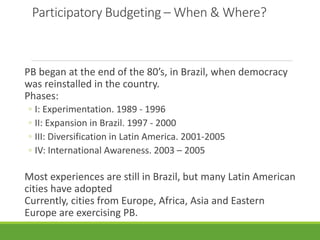
Participatory Budgeting – When & Where?
PB began at the end of the 80’s, in Brazil, when democracy
was reinstalled in the country.
Phases:
◦ I: Experimentation. 1989 - 1996
◦ II: Expansion in Brazil. 1997 - 2000
◦ III: Diversification in Latin America. 2001-2005
◦ IV: International Awareness. 2003 – 2005
Most experiences are still in Brazil, but many Latin American
cities have adopted
Currently, cities from Europe, Africa, Asia and Eastern
Europe are exercising PB.
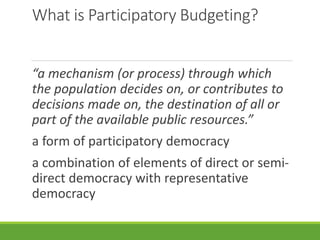
What is Participatory Budgeting?
“a mechanism (or process) through which
the population decides on, or contributes to
decisions made on, the destination of all or
part of the available public resources.”
a form of participatory democracy
a combination of elements of direct or semi-
direct democracy with representative
democracy
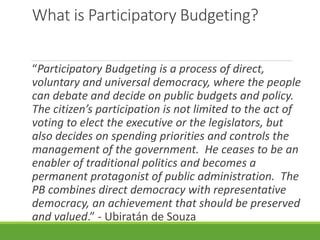
What is Participatory Budgeting?
“Participatory Budgeting is a process of direct,
voluntary and universal democracy, where the people
can debate and decide on public budgets and policy.
The citizen’s participation is not limited to the act of
voting to elect the executive or the legislators, but
also decides on spending priorities and controls the
management of the government. He ceases to be an
enabler of traditional politics and becomes a
permanent protagonist of public administration. The
PB combines direct democracy with representative
democracy, an achievement that should be preserved
and valued.” - Ubiratán de Souza
What is Participatory Budgeting?
Citizens can get involved in all phases of the
budget process and cycle they may be engaged
◦in the formulation of the budget,
◦in the review and analysis of the budget,
◦in tracking the expenditure, or
◦in audit and control.
Participatory budgeting is a way of promoting
good governance through increased
participation, accountability, and transparency.
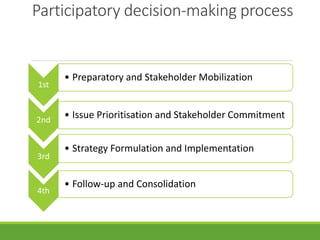
Participatory decision-making process
1st
• Preparatory and Stakeholder Mobilization
2nd
• Issue Prioritisation and Stakeholder Commitment
3rd
• Strategy Formulation and Implementation
4th
• Follow-up and Consolidation
Participatory decision-making process
1. Preparatory and Stakeholder Mobilization
◦ Identifying and mobilising stakeholders; raising
awareness and understanding; preparing systematic,
focused profiles; organising core consultative groups;
beginning identification of key issues;
2. Issue Prioritisation and Stakeholder
Commitment
◦ Elaborating Issues
◦ Building Collaboration and Forging Consensus
◦ Formalising Commitment on Ways Forward
Participatory decision-making process
3. Strategy Formulation and Implementation
◦ Formulating Priority Strategies
◦ Negotiating and Agreeing Action Plans
◦ Designing and Implementing Demonstration Projects
◦ Integrating Projects and Plans into Strategic
Approaches
4. Follow-up and Consolidation
◦ Implementing Action Plans
◦ Monitoring and Evaluation
◦ Up-scaling and Replication • Institutionalisation
Operational Needs of Participative Budgeting
The operational needs of participatory budgeting
exist at three levels:
◦ (1) normative, citizen participation has to be given a legal
basis;
◦ (2) regulative, an operational framework of participation
with clear definition of roles and functions, including the
methodology of participation must be mutually agreed
upon and put in place; and finally,
◦ (3) regenerative, participation practice warrants several
capacity building interventions involving both the civil
society as well as the government organizations (Guthrie,
D.M., 2003).
Prerequisites of Participative Budgeting
Identifying and designing clear points of entry
for civil society participation in local governance.
Developing a policy to provide the framework
for participatory budgeting.
Investment in capacity building - not only of
local governments and civil society, but also of
national governments agencies.
A realization that participatory budgeting can
not be fast- tracked.
Prerequisites of Participative Budgeting
A management that can overcome long
established systems and procedures.
A formal system of accountabilities being in
place.
Efforts to institutionalize participatory
governance through participatory planning and
budgeting that tap institutions already working
in the area.
What could be the model of PB?
There is no single model, nor would it be
desirable to have one, because the
experiences are the products of
the reality of each region, of its local history,
civic culture, and the organization of its civil
society,
the available resources and
also the administrative culture of the
governments which administer them.
What is Participatory Budget?
The Participatory Budget is a
multidimensional process:
Budgetary/financial dimension
Participatory Dimension (these two dimensions
are the foundation of the process)
Normative and legal-judicial dimension
Spatial/territorial dimension
Political/governance dimension
Contributions (benefits) of PB
i) an expansion and deepening of participatory democracy,
ii) improves transparency of public administration
iii) provides qualitatively different accountability system,
iv) increased effectiveness,
v) improved equity, and
vi) enhanced public safety
vii) re-orders social priorities and promote social justice
viii) links democratic processes with concrete and perceptible
results in the short term.
ix) Collective prioritisation and co-management
Preconditions for Participatory Budget
Political will (if not present, create it through demand
side management)
Presence and interest of civil society (citizens in
general)
A clear and shared definition of rules of games /
participation / engagement
Capacity of citizens and ULB officials to participate
Dissemination of information in all possible manner
Prioritisation of demand
PB - Basic Guiding Principles
Participatory Budgeting Law in Peru.
Participation
Transparency
Equality
Tolerance
Efficiency and effectiveness
Equity
Competitiveness
Respect for agreements
Co-management of public resources provides
another dimension
Steps to put PB in practice
No universal recipe to initiate participatory
budget as it differs from place to place
 Situation analysis / assessment about main
principles respected and preconditions met
Mapping of local actors in a participatory way
Clear analysis and definitions by government
Creation of alliances and opening dialogue
Designing the internal regulations for the PB
Steps to put PB in practice
Universal participation:
Transparency of the budget
Flexibility:
Objectivity
Gender focus
Pluri-cultural and multi-ethnic focus
Indicators
How much resources or % of budget under
participatory process
The larger the budget under discussion (in
absolute and percentage terms), the better for
the citizens.
No linkage between level (qualitative and
quantitative) of participation and size of resources
Assigning Resources under PB
Two broad ways for assigning resources
Area wise
Sector/function wise
Criteria for assigning resources (should not be casted in
stone)
the population of a certain region,
the priorities (housing, streets, education, health, sewage,
etc.) selected by the inhabitants,
unmet basic needs (water, electricity, sanitation),
Assigning Resources under PB
Criteria for assigning resources
the degree of participation in the process,
the degree of tax evasion or arrears,
the attention received during previous years,
the impact of a project on the community and
the impact for disadvantaged or vulnerable groups.
Weightages of each criteria
Participative
Budgeting
THANK YOU

01. participatory budgeting

  • 1.
    Participatory Budgeting DR. RAVIKANT JOSHI TRAININGON LEADERSHIP AND GENDER EQUALITY FOR IMPROVED LOCAL GOVERNANCE ORGANISED BY UCLG, ASPAC, EQUICITY AND AIILSG 3RD MAY 2018; INDIA HABITAT CENTRE NEW DELHI
  • 2.
    Participatory Budgeting –When & Where? PB began at the end of the 80’s, in Brazil, when democracy was reinstalled in the country. Phases: ◦ I: Experimentation. 1989 - 1996 ◦ II: Expansion in Brazil. 1997 - 2000 ◦ III: Diversification in Latin America. 2001-2005 ◦ IV: International Awareness. 2003 – 2005 Most experiences are still in Brazil, but many Latin American cities have adopted Currently, cities from Europe, Africa, Asia and Eastern Europe are exercising PB.
  • 3.
    What is ParticipatoryBudgeting? “a mechanism (or process) through which the population decides on, or contributes to decisions made on, the destination of all or part of the available public resources.” a form of participatory democracy a combination of elements of direct or semi- direct democracy with representative democracy
  • 4.
    What is ParticipatoryBudgeting? “Participatory Budgeting is a process of direct, voluntary and universal democracy, where the people can debate and decide on public budgets and policy. The citizen’s participation is not limited to the act of voting to elect the executive or the legislators, but also decides on spending priorities and controls the management of the government. He ceases to be an enabler of traditional politics and becomes a permanent protagonist of public administration. The PB combines direct democracy with representative democracy, an achievement that should be preserved and valued.” - Ubiratán de Souza
  • 5.
    What is ParticipatoryBudgeting? Citizens can get involved in all phases of the budget process and cycle they may be engaged ◦in the formulation of the budget, ◦in the review and analysis of the budget, ◦in tracking the expenditure, or ◦in audit and control. Participatory budgeting is a way of promoting good governance through increased participation, accountability, and transparency.
  • 6.
    Participatory decision-making process 1st •Preparatory and Stakeholder Mobilization 2nd • Issue Prioritisation and Stakeholder Commitment 3rd • Strategy Formulation and Implementation 4th • Follow-up and Consolidation
  • 7.
    Participatory decision-making process 1.Preparatory and Stakeholder Mobilization ◦ Identifying and mobilising stakeholders; raising awareness and understanding; preparing systematic, focused profiles; organising core consultative groups; beginning identification of key issues; 2. Issue Prioritisation and Stakeholder Commitment ◦ Elaborating Issues ◦ Building Collaboration and Forging Consensus ◦ Formalising Commitment on Ways Forward
  • 8.
    Participatory decision-making process 3.Strategy Formulation and Implementation ◦ Formulating Priority Strategies ◦ Negotiating and Agreeing Action Plans ◦ Designing and Implementing Demonstration Projects ◦ Integrating Projects and Plans into Strategic Approaches 4. Follow-up and Consolidation ◦ Implementing Action Plans ◦ Monitoring and Evaluation ◦ Up-scaling and Replication • Institutionalisation
  • 9.
    Operational Needs ofParticipative Budgeting The operational needs of participatory budgeting exist at three levels: ◦ (1) normative, citizen participation has to be given a legal basis; ◦ (2) regulative, an operational framework of participation with clear definition of roles and functions, including the methodology of participation must be mutually agreed upon and put in place; and finally, ◦ (3) regenerative, participation practice warrants several capacity building interventions involving both the civil society as well as the government organizations (Guthrie, D.M., 2003).
  • 10.
    Prerequisites of ParticipativeBudgeting Identifying and designing clear points of entry for civil society participation in local governance. Developing a policy to provide the framework for participatory budgeting. Investment in capacity building - not only of local governments and civil society, but also of national governments agencies. A realization that participatory budgeting can not be fast- tracked.
  • 11.
    Prerequisites of ParticipativeBudgeting A management that can overcome long established systems and procedures. A formal system of accountabilities being in place. Efforts to institutionalize participatory governance through participatory planning and budgeting that tap institutions already working in the area.
  • 12.
    What could bethe model of PB? There is no single model, nor would it be desirable to have one, because the experiences are the products of the reality of each region, of its local history, civic culture, and the organization of its civil society, the available resources and also the administrative culture of the governments which administer them.
  • 13.
    What is ParticipatoryBudget? The Participatory Budget is a multidimensional process: Budgetary/financial dimension Participatory Dimension (these two dimensions are the foundation of the process) Normative and legal-judicial dimension Spatial/territorial dimension Political/governance dimension
  • 14.
    Contributions (benefits) ofPB i) an expansion and deepening of participatory democracy, ii) improves transparency of public administration iii) provides qualitatively different accountability system, iv) increased effectiveness, v) improved equity, and vi) enhanced public safety vii) re-orders social priorities and promote social justice viii) links democratic processes with concrete and perceptible results in the short term. ix) Collective prioritisation and co-management
  • 15.
    Preconditions for ParticipatoryBudget Political will (if not present, create it through demand side management) Presence and interest of civil society (citizens in general) A clear and shared definition of rules of games / participation / engagement Capacity of citizens and ULB officials to participate Dissemination of information in all possible manner Prioritisation of demand
  • 16.
    PB - BasicGuiding Principles Participatory Budgeting Law in Peru. Participation Transparency Equality Tolerance Efficiency and effectiveness Equity Competitiveness Respect for agreements Co-management of public resources provides another dimension
  • 17.
    Steps to putPB in practice No universal recipe to initiate participatory budget as it differs from place to place  Situation analysis / assessment about main principles respected and preconditions met Mapping of local actors in a participatory way Clear analysis and definitions by government Creation of alliances and opening dialogue Designing the internal regulations for the PB
  • 18.
    Steps to putPB in practice Universal participation: Transparency of the budget Flexibility: Objectivity Gender focus Pluri-cultural and multi-ethnic focus
  • 19.
    Indicators How much resourcesor % of budget under participatory process The larger the budget under discussion (in absolute and percentage terms), the better for the citizens. No linkage between level (qualitative and quantitative) of participation and size of resources
  • 20.
    Assigning Resources underPB Two broad ways for assigning resources Area wise Sector/function wise Criteria for assigning resources (should not be casted in stone) the population of a certain region, the priorities (housing, streets, education, health, sewage, etc.) selected by the inhabitants, unmet basic needs (water, electricity, sanitation),
  • 21.
    Assigning Resources underPB Criteria for assigning resources the degree of participation in the process, the degree of tax evasion or arrears, the attention received during previous years, the impact of a project on the community and the impact for disadvantaged or vulnerable groups. Weightages of each criteria
  • 22.