
Open Access and Preservation
in eGovernment
CEDEM 2012 Workshop
03. May 2012

Ross King, Joachim Jung, Michela Vignoli
Safety & Security Department
AIT Austrian Institute of Technology GmbH
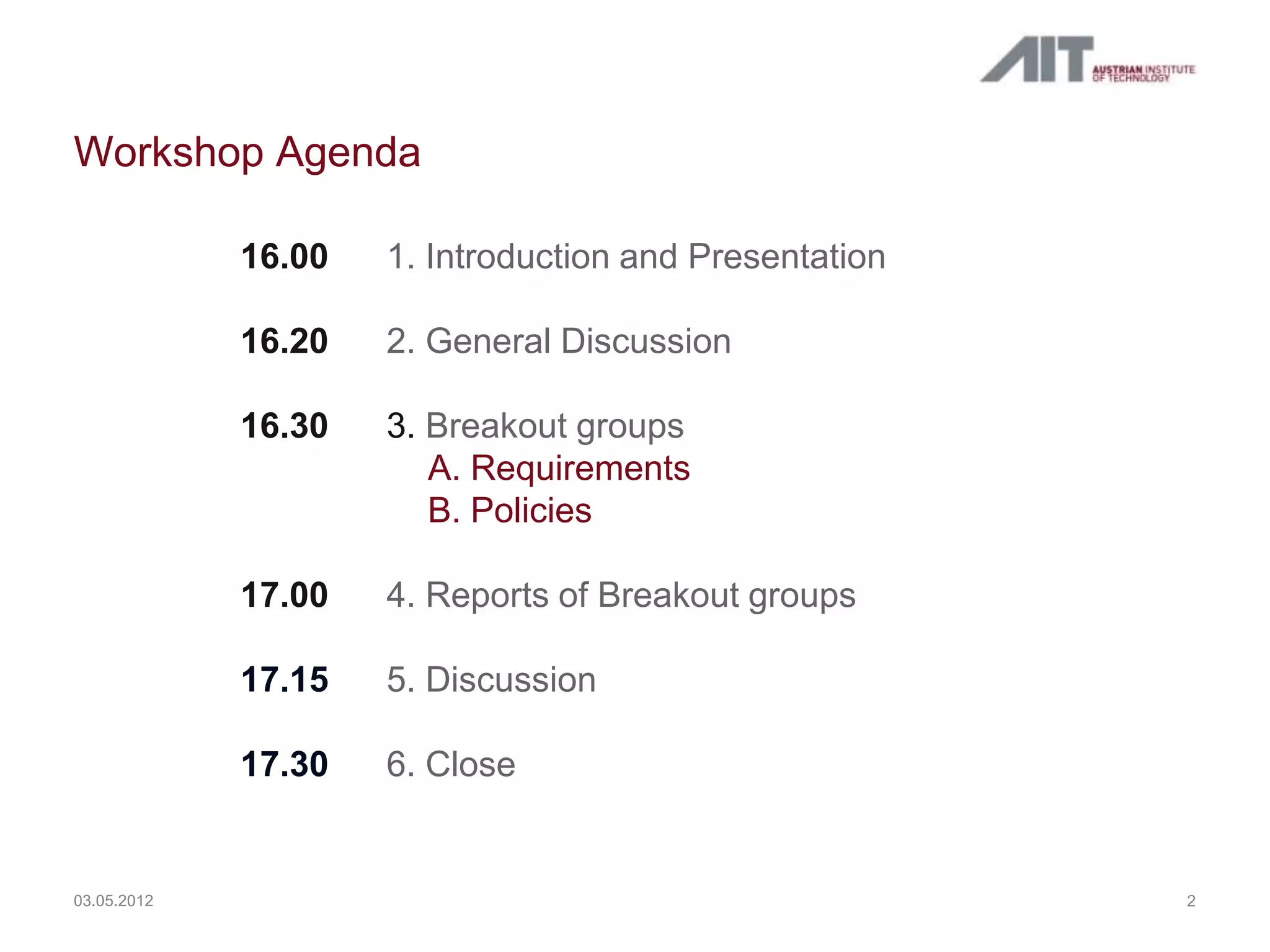
Workshop Agenda

             16.00   1. Introduction and Presentation

             16.20   2. General Discussion

             16.30   3. Breakout groups
                        A. Requirements
                        B. Policies

             17.00   4. Reports of Breakout groups

             17.15   5. Discussion

             17.30   6. Close


03.05.2012                                              2
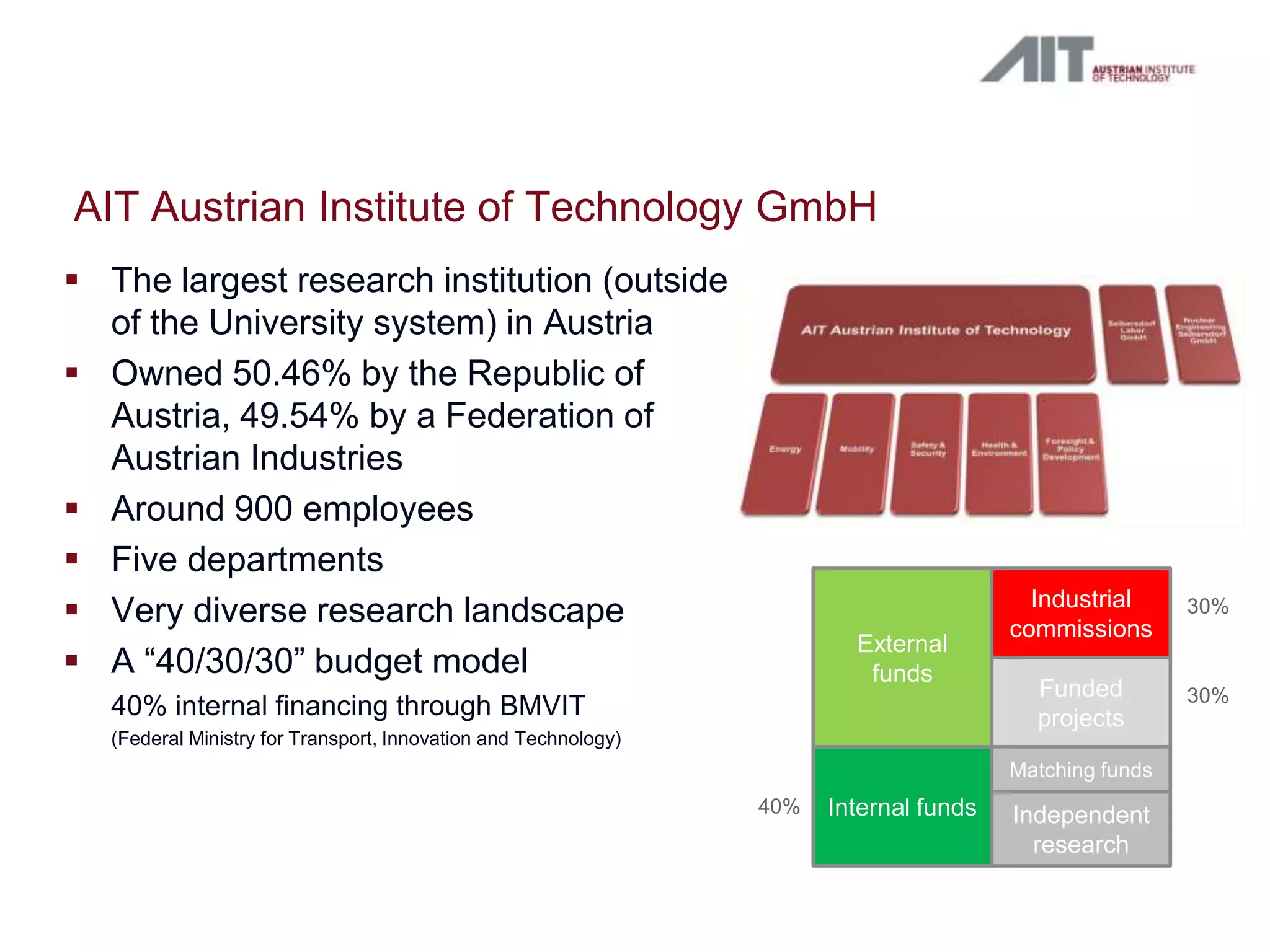
AIT Austrian Institute of Technology GmbH
 The largest research institution (outside
  of the University system) in Austria
 Owned 50.46% by the Republic of
  Austria, 49.54% by a Federation of
  Austrian Industries
 Around 900 employees
 Five departments
                                                                                          Industrial
 Very diverse research landscape                                                       commissions
                                                                                                         30%
                                                                         External
 A “40/30/30” budget model                                               funds
                                                                                          Funded         30%
   40% internal financing through BMVIT                                                   projects
   (Federal Ministry for Transport, Innovation and Technology)
                                                                                        Matching funds
                                                                 40%   Internal funds   Independent
                                                                                          research
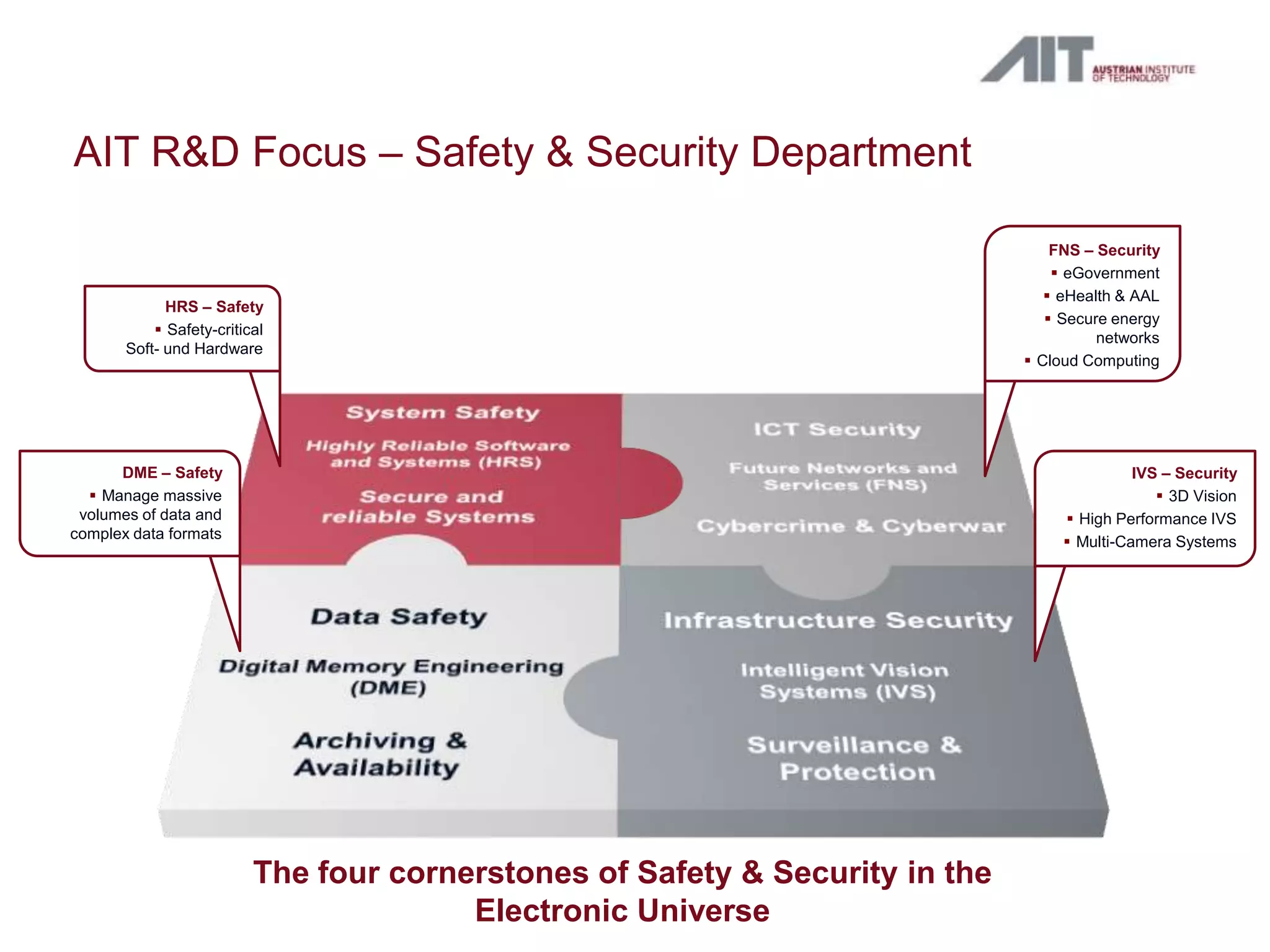
AIT R&D Focus – Safety & Security Department

                                                                                  FNS – Security
                                                                                   eGovernment
                                                                                  eHealth & AAL
             HRS – Safety
                                                                                  Secure energy
            Safety-critical
                                                                                        networks
       Soft- und Hardware
                                                                               Cloud Computing


      DME – Safety                                                                           IVS – Security
   Manage massive                                                                               3D Vision
 volumes of data and                                                                High Performance IVS
complex data formats
                                                                                    Multi-Camera Systems


                          The four cornerstones of Safety & Security in the
                                        Electronic Universe
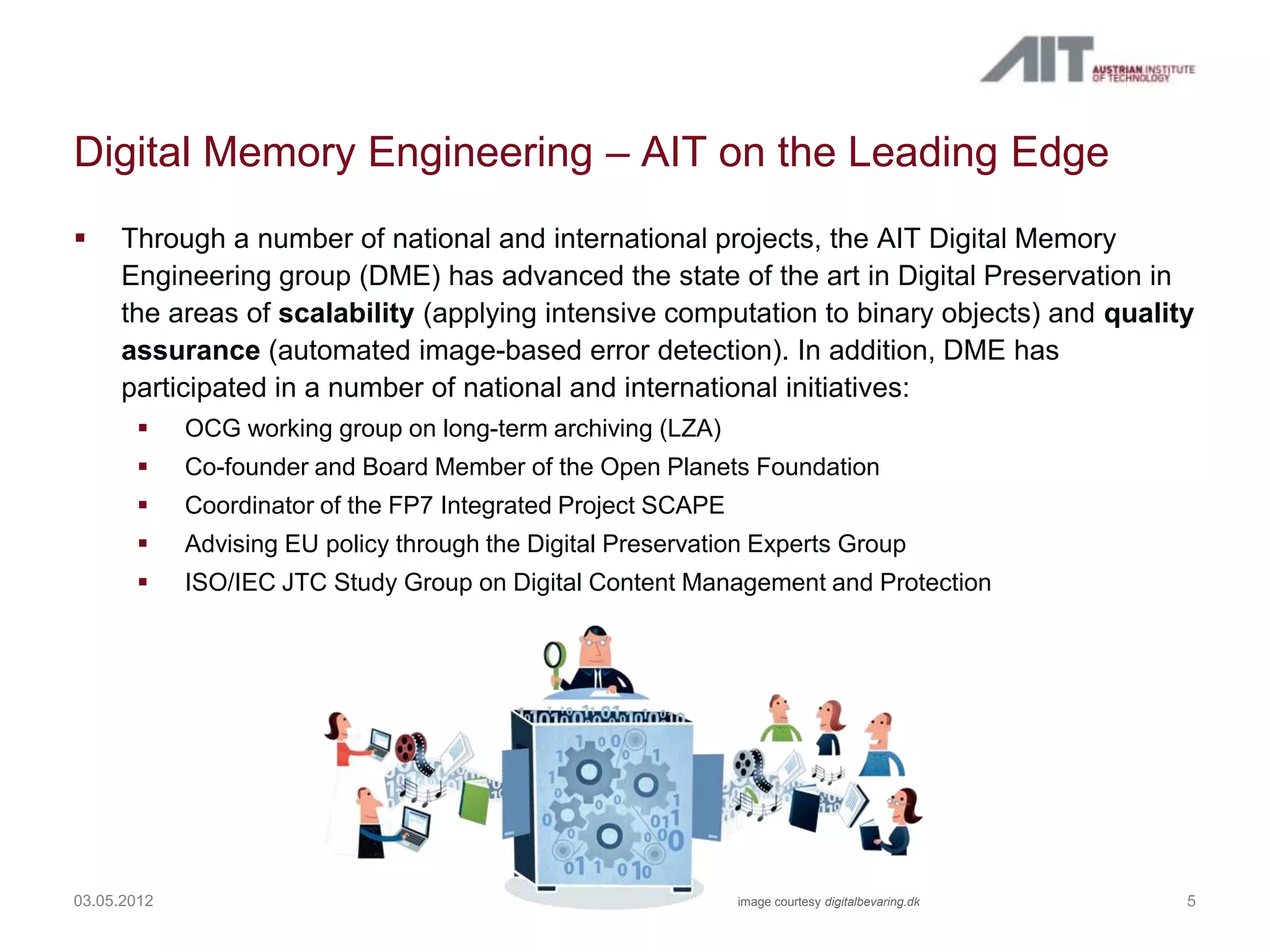
Digital Memory Engineering – AIT on the Leading Edge
    Through a number of national and international projects, the AIT Digital Memory
     Engineering group (DME) has advanced the state of the art in Digital Preservation in
     the areas of scalability (applying intensive computation to binary objects) and quality
     assurance (automated image-based error detection). In addition, DME has
     participated in a number of national and international initiatives:
            OCG working group on long-term archiving (LZA)
            Co-founder and Board Member of the Open Planets Foundation
            Coordinator of the FP7 Integrated Project SCAPE
            Advising EU policy through the Digital Preservation Experts Group
            ISO/IEC JTC Study Group on Digital Content Management and Protection


03.05.2012                                                     image courtesy digitalbevaring.dk   5
Presentation
Open Access and Preservation
in eGovernment
The case for an Austrian National Data Service


Dr. Ross King
Senior Scientist
Safety & Security Department
AIT Austrian Institute of Technology GmbH
Outline

    Arguments for Open Access

    Arguments for a National Data Service

    Existing National Data Services

    Next Steps

    Conclusions


03/05/2012                                   8
Arguments for Open Access
    Moral Argument
       Publically funded research should be publically available
       Publically funded government should by publically available

    Pragmatic Argument
       Open Access improves research efficiency
       Open Access improves governmental efficiency

    Economic Argument
       Open Access and Open Data can be
        the foundation of new economic growth
             (see for example: Graham Vickery, Review of Recent Studies
             on PSI Re-Use and Related Market Developments [2011].)

        Is publishing today a value-adding or
         a rent-seeking behaviour?

03.05.2012                                                                                                    9
                                                                          image courtesy digitalbevaring.dk
Open Access – Economic Necessity?
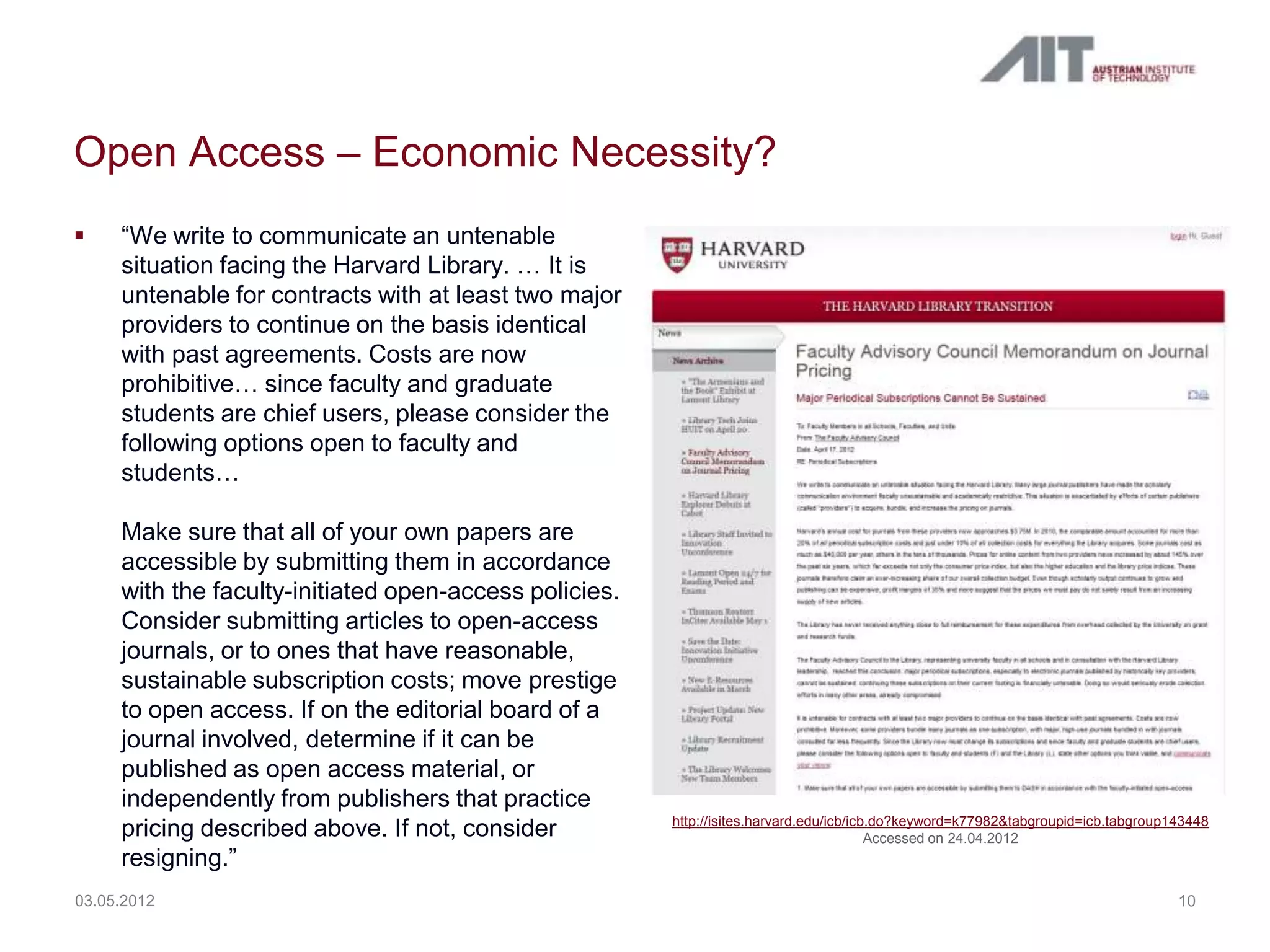
    “We write to communicate an untenable
     situation facing the Harvard Library. … It is
     untenable for contracts with at least two major
     providers to continue on the basis identical
     with past agreements. Costs are now
     prohibitive… since faculty and graduate
     students are chief users, please consider the
     following options open to faculty and
     students…

     Make sure that all of your own papers are
     accessible by submitting them in accordance
     with the faculty-initiated open-access policies.
     Consider submitting articles to open-access
     journals, or to ones that have reasonable,
     sustainable subscription costs; move prestige
     to open access. If on the editorial board of a
     journal involved, determine if it can be
     published as open access material, or
     independently from publishers that practice
                                                        http://isites.harvard.edu/icb/icb.do?keyword=k77982&tabgroupid=icb.tabgroup143448
     pricing described above. If not, consider                                           Accessed on 24.04.2012
     resigning.”
03.05.2012                                                                                                                          10
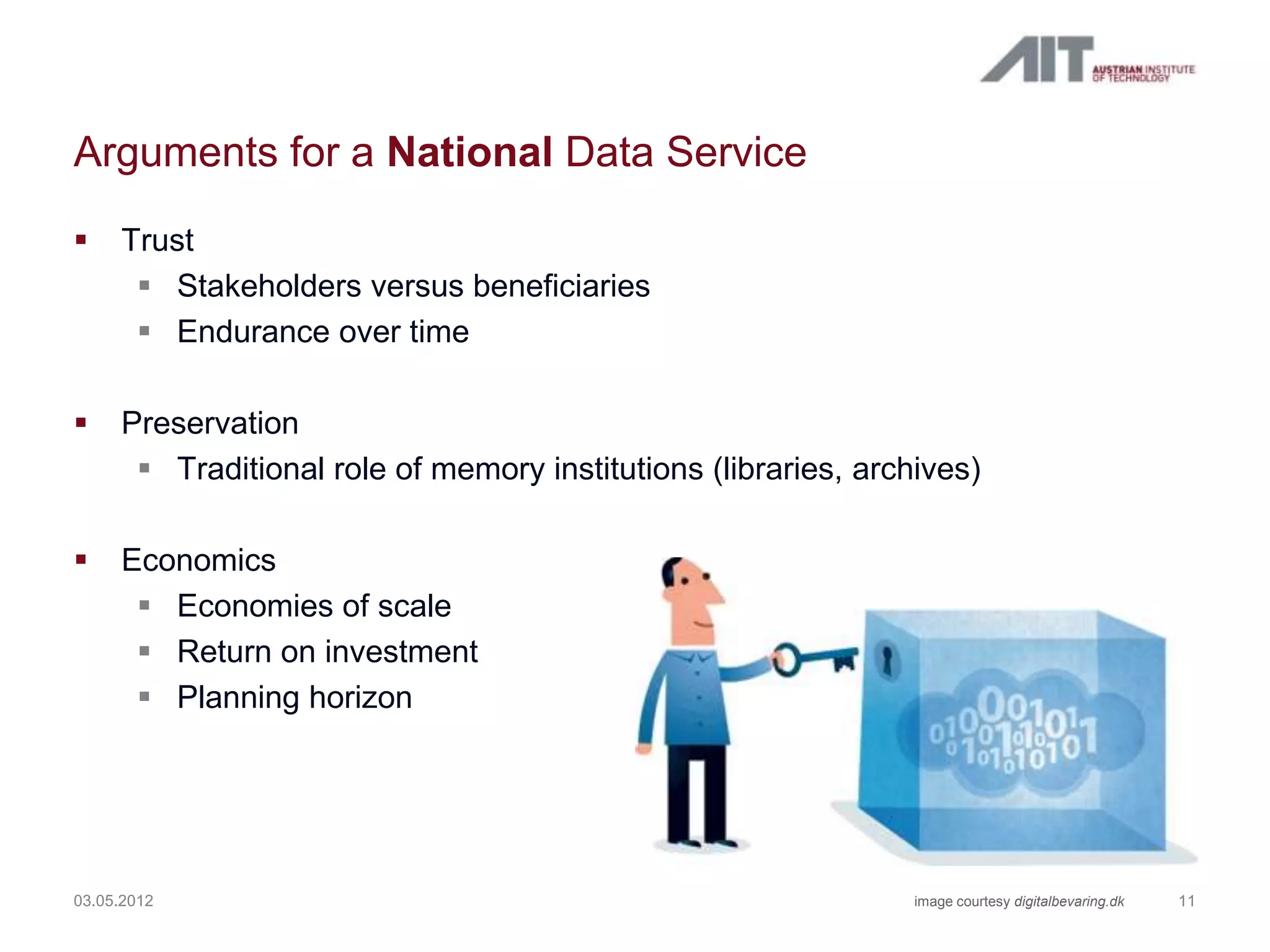
Arguments for a National Data Service
    Trust
       Stakeholders versus beneficiaries
       Endurance over time

    Preservation
       Traditional role of memory institutions (libraries, archives)

    Economics
       Economies of scale
       Return on investment
       Planning horizon


03.05.2012                                                      image courtesy digitalbevaring.dk   11
Examples of National Data Services
Australia

    data.gov.au

     This site provides an easy way to find, access, and reuse public datasets
     from the Australian state and federal governments

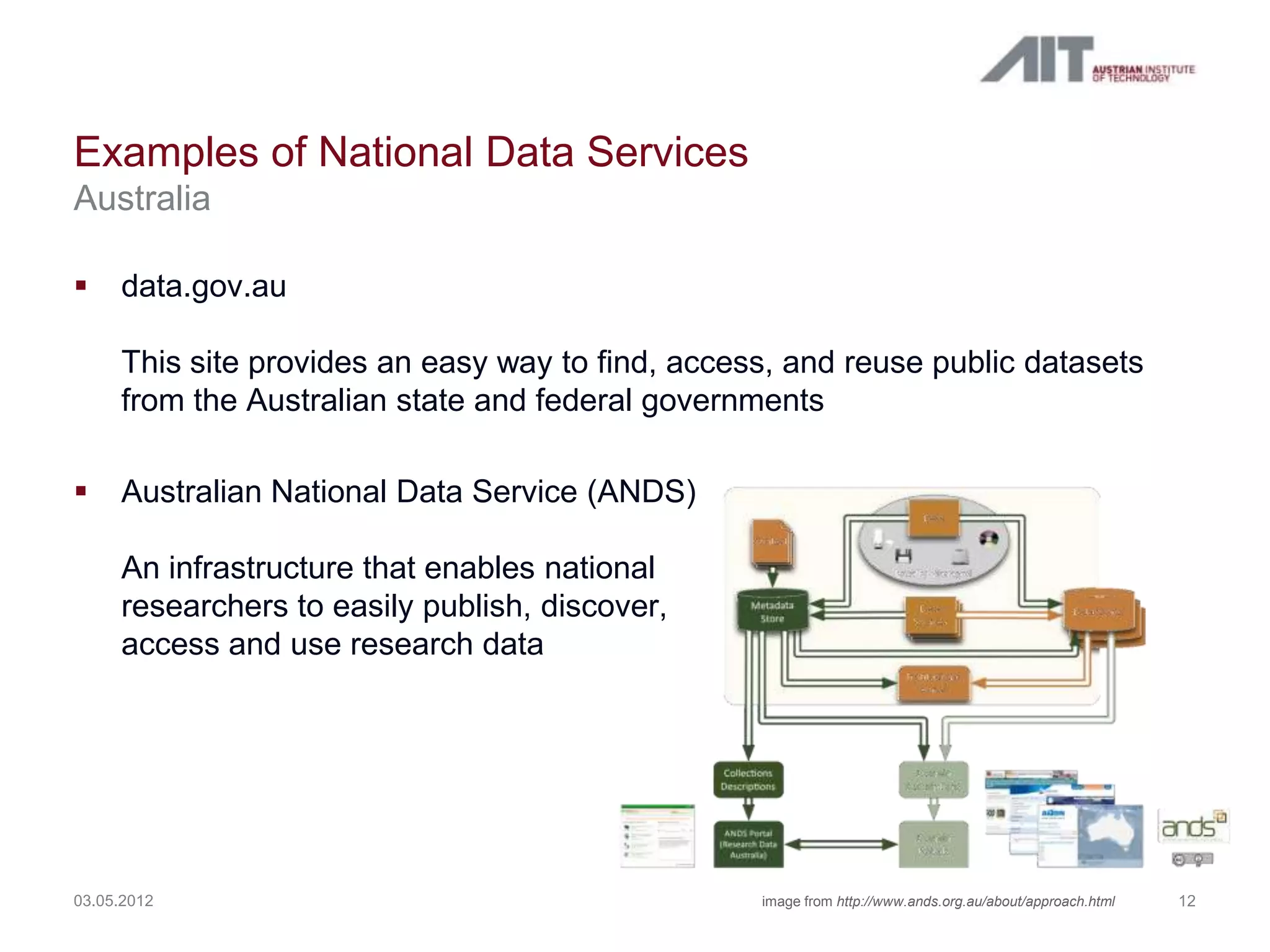
    Australian National Data Service (ANDS)

     An infrastructure that enables national
     researchers to easily publish, discover,
     access and use research data


03.05.2012                                        image from http://www.ands.org.au/about/approach.html   12
Examples of National Data Services
Netherlands

    overheid.nl

     The central access point to all information from government organizations of
     The Netherlands. data.overheid.nl (launched 2011) is the central register
     providing links to all open government data sets

    Data Archiving and Networked Services (DANS)

     This service encourages researchers to archive and reuse data in a
     sustained manner, e.g. through its online archiving system. It provides
     access to scientific datasets, e-publications and other research information.


03.05.2012                                                                           13
Examples of National Data Services
Austria

    http://offener.datenkatalog.at/

     Katalog Offene Daten Österreich began collecting openly accessible data
     from both governmental and science related sources

    http://gov.opendata.at/site/

     Cooperation Open Government Data (OGD) Österreich

    http://www.archivinformationssystem.at/suchinfo.aspx

     Austrian State Archive


03.05.2012                                                                     14
Next steps
    User requirements
       Must derive from a broad spectrum of public beneficiaries
    Technical solutions
       Should be selected based on the requirements, as well as on the
         lessons learned from other National Services
    Policies
       A commitment to preserve and provide permanent access within
         government, the scientific community and society in general must be
         codified at the national policy level
    Funding
       Initial estimate for such a service: € 20 Million


03.05.2012                                                                     15
Conclusion
    Austria is considered a world leader in eGovernment
    There are compelling arguments for an Austrian National Data Service
    This service could be unique in a number of ways:
       Integrate eGovernment and Research Access
       Expand support for more content types
           • Documents (and Publications)
           • Raw Data
           but also
           • Structured Data (XML)
           • Databases
           • Software/Applications


03.05.2012                                                                  16
AIT Austrian Institute of Technology
your ingenious partner


Dr. Ross King
Senior Scientist
T: +43 (0) 50550 4271
F: +43 (0) 50550 4150
email: ross.king@ait.ac.at
Discussion

Open Access, Preservation and eGovernment

  • 1.
    Open Access andPreservation in eGovernment CEDEM 2012 Workshop 03. May 2012 Ross King, Joachim Jung, Michela Vignoli Safety & Security Department AIT Austrian Institute of Technology GmbH
  • 2.
    Workshop Agenda 16.00 1. Introduction and Presentation 16.20 2. General Discussion 16.30 3. Breakout groups A. Requirements B. Policies 17.00 4. Reports of Breakout groups 17.15 5. Discussion 17.30 6. Close 03.05.2012 2
  • 3.
    AIT Austrian Instituteof Technology GmbH  The largest research institution (outside of the University system) in Austria  Owned 50.46% by the Republic of Austria, 49.54% by a Federation of Austrian Industries  Around 900 employees  Five departments Industrial  Very diverse research landscape commissions 30% External  A “40/30/30” budget model funds Funded 30% 40% internal financing through BMVIT projects (Federal Ministry for Transport, Innovation and Technology) Matching funds 40% Internal funds Independent research
  • 4.
    AIT R&D Focus– Safety & Security Department FNS – Security  eGovernment  eHealth & AAL HRS – Safety  Secure energy  Safety-critical networks Soft- und Hardware  Cloud Computing DME – Safety IVS – Security  Manage massive  3D Vision volumes of data and  High Performance IVS complex data formats  Multi-Camera Systems The four cornerstones of Safety & Security in the Electronic Universe
  • 5.
    Digital Memory Engineering– AIT on the Leading Edge  Through a number of national and international projects, the AIT Digital Memory Engineering group (DME) has advanced the state of the art in Digital Preservation in the areas of scalability (applying intensive computation to binary objects) and quality assurance (automated image-based error detection). In addition, DME has participated in a number of national and international initiatives:  OCG working group on long-term archiving (LZA)  Co-founder and Board Member of the Open Planets Foundation  Coordinator of the FP7 Integrated Project SCAPE  Advising EU policy through the Digital Preservation Experts Group  ISO/IEC JTC Study Group on Digital Content Management and Protection 03.05.2012 image courtesy digitalbevaring.dk 5
  • 6.
  • 7.
    Open Access andPreservation in eGovernment The case for an Austrian National Data Service Dr. Ross King Senior Scientist Safety & Security Department AIT Austrian Institute of Technology GmbH
  • 8.
    Outline  Arguments for Open Access  Arguments for a National Data Service  Existing National Data Services  Next Steps  Conclusions 03/05/2012 8
  • 9.
    Arguments for OpenAccess  Moral Argument  Publically funded research should be publically available  Publically funded government should by publically available  Pragmatic Argument  Open Access improves research efficiency  Open Access improves governmental efficiency  Economic Argument  Open Access and Open Data can be the foundation of new economic growth (see for example: Graham Vickery, Review of Recent Studies on PSI Re-Use and Related Market Developments [2011].)  Is publishing today a value-adding or a rent-seeking behaviour? 03.05.2012 9 image courtesy digitalbevaring.dk
  • 10.
    Open Access –Economic Necessity?  “We write to communicate an untenable situation facing the Harvard Library. … It is untenable for contracts with at least two major providers to continue on the basis identical with past agreements. Costs are now prohibitive… since faculty and graduate students are chief users, please consider the following options open to faculty and students… Make sure that all of your own papers are accessible by submitting them in accordance with the faculty-initiated open-access policies. Consider submitting articles to open-access journals, or to ones that have reasonable, sustainable subscription costs; move prestige to open access. If on the editorial board of a journal involved, determine if it can be published as open access material, or independently from publishers that practice http://isites.harvard.edu/icb/icb.do?keyword=k77982&tabgroupid=icb.tabgroup143448 pricing described above. If not, consider Accessed on 24.04.2012 resigning.” 03.05.2012 10
  • 11.
    Arguments for aNational Data Service  Trust  Stakeholders versus beneficiaries  Endurance over time  Preservation  Traditional role of memory institutions (libraries, archives)  Economics  Economies of scale  Return on investment  Planning horizon 03.05.2012 image courtesy digitalbevaring.dk 11
  • 12.
    Examples of NationalData Services Australia  data.gov.au This site provides an easy way to find, access, and reuse public datasets from the Australian state and federal governments  Australian National Data Service (ANDS) An infrastructure that enables national researchers to easily publish, discover, access and use research data 03.05.2012 image from http://www.ands.org.au/about/approach.html 12
  • 13.
    Examples of NationalData Services Netherlands  overheid.nl The central access point to all information from government organizations of The Netherlands. data.overheid.nl (launched 2011) is the central register providing links to all open government data sets  Data Archiving and Networked Services (DANS) This service encourages researchers to archive and reuse data in a sustained manner, e.g. through its online archiving system. It provides access to scientific datasets, e-publications and other research information. 03.05.2012 13
  • 14.
    Examples of NationalData Services Austria  http://offener.datenkatalog.at/ Katalog Offene Daten Österreich began collecting openly accessible data from both governmental and science related sources  http://gov.opendata.at/site/ Cooperation Open Government Data (OGD) Österreich  http://www.archivinformationssystem.at/suchinfo.aspx Austrian State Archive 03.05.2012 14
  • 15.
    Next steps  User requirements  Must derive from a broad spectrum of public beneficiaries  Technical solutions  Should be selected based on the requirements, as well as on the lessons learned from other National Services  Policies  A commitment to preserve and provide permanent access within government, the scientific community and society in general must be codified at the national policy level  Funding  Initial estimate for such a service: € 20 Million 03.05.2012 15
  • 16.
    Conclusion  Austria is considered a world leader in eGovernment  There are compelling arguments for an Austrian National Data Service  This service could be unique in a number of ways:  Integrate eGovernment and Research Access  Expand support for more content types • Documents (and Publications) • Raw Data but also • Structured Data (XML) • Databases • Software/Applications 03.05.2012 16
  • 17.
    AIT Austrian Instituteof Technology your ingenious partner Dr. Ross King Senior Scientist T: +43 (0) 50550 4271 F: +43 (0) 50550 4150 email: ross.king@ait.ac.at
  • 18.