Digital Enterprise Research Institute                                                                             www.deri.ie


              An Environmental Chargeback for Data
              Center & Cloud Computing Consumers
                       Edward Curry, Souleiman Hasan, Mark White, Hugh Melvin
                                                             ed.curry@deri.org - www.edwardcurry.org

           1st International Workshop on Energy-Efficient Data Centres, Madrid,
                                          2012


 Copyright 2011 Digital Enterprise Research Institute. All rights reserved.


    Digital Enterprise Research Institute
    National University of Ireland, Galway
                                                                                            Enabling Networked Knowledge
Overview
Digital Enterprise Research Institute                               www.deri.ie


            Motivation for Environmental Chargeback

            Environmental Chargeback Model
                   Requirements
                   Definition Methodology
                   Allocating Impacts

            Proof of Concept at DERI

            Related Work

            Conclusions & Future Work

                                              Enabling Networked Knowledge
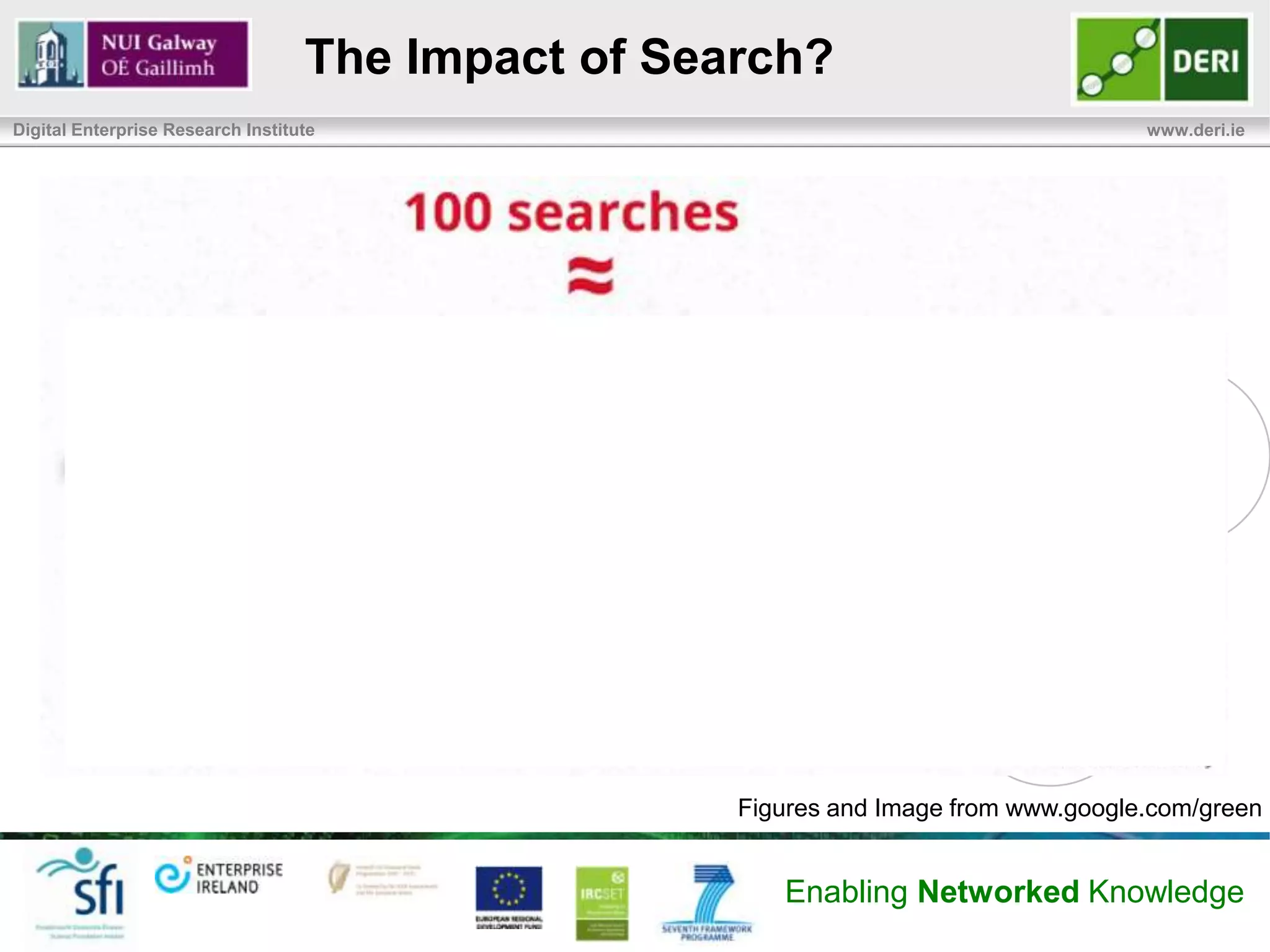
The Impact of Search?
Digital Enterprise Research Institute                                                www.deri.ie


                                                    Figures and Image from www.google.com/green


                                                       Enabling Networked Knowledge
Cost of Other Services?
Digital Enterprise Research Institute                                                www.deri.ie


                                                    Figures and Image from www.google.com/green


                                                       Enabling Networked Knowledge
Google’s Carbon Footprint
Digital Enterprise Research Institute                                                 www.deri.ie


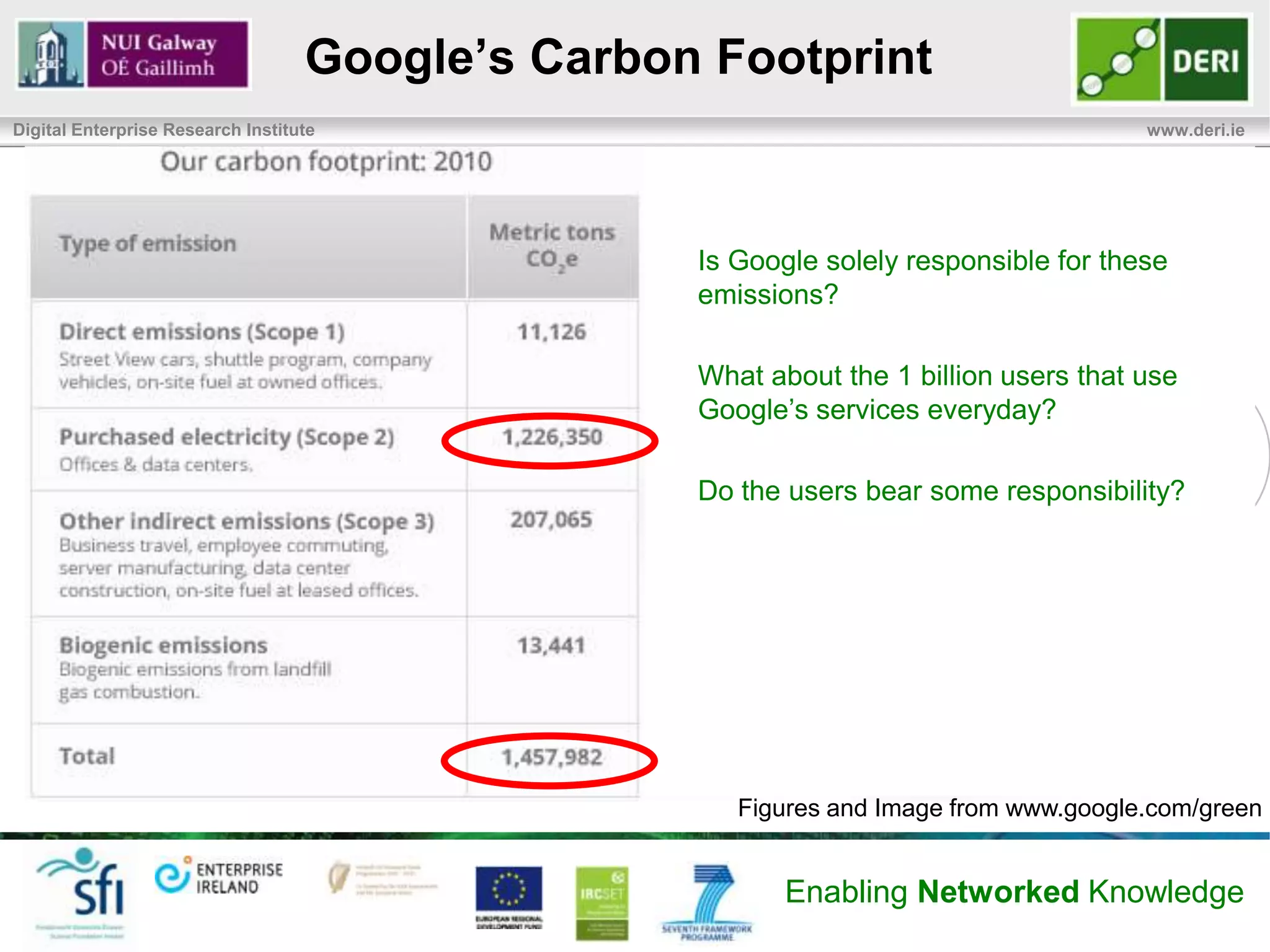
                                                  Is Google solely responsible for these
                                                  emissions?

                                                  What about the 1 billion users that use
                                                  Google’s services everyday?

                                                  Do the users bear some responsibility?


                                                     Figures and Image from www.google.com/green


                                                         Enabling Networked Knowledge
Google’s Carbon Footprint
Digital Enterprise Research Institute                                                www.deri.ie


                                                    Figures and Image from www.google.com/green


                                                       Enabling Networked Knowledge
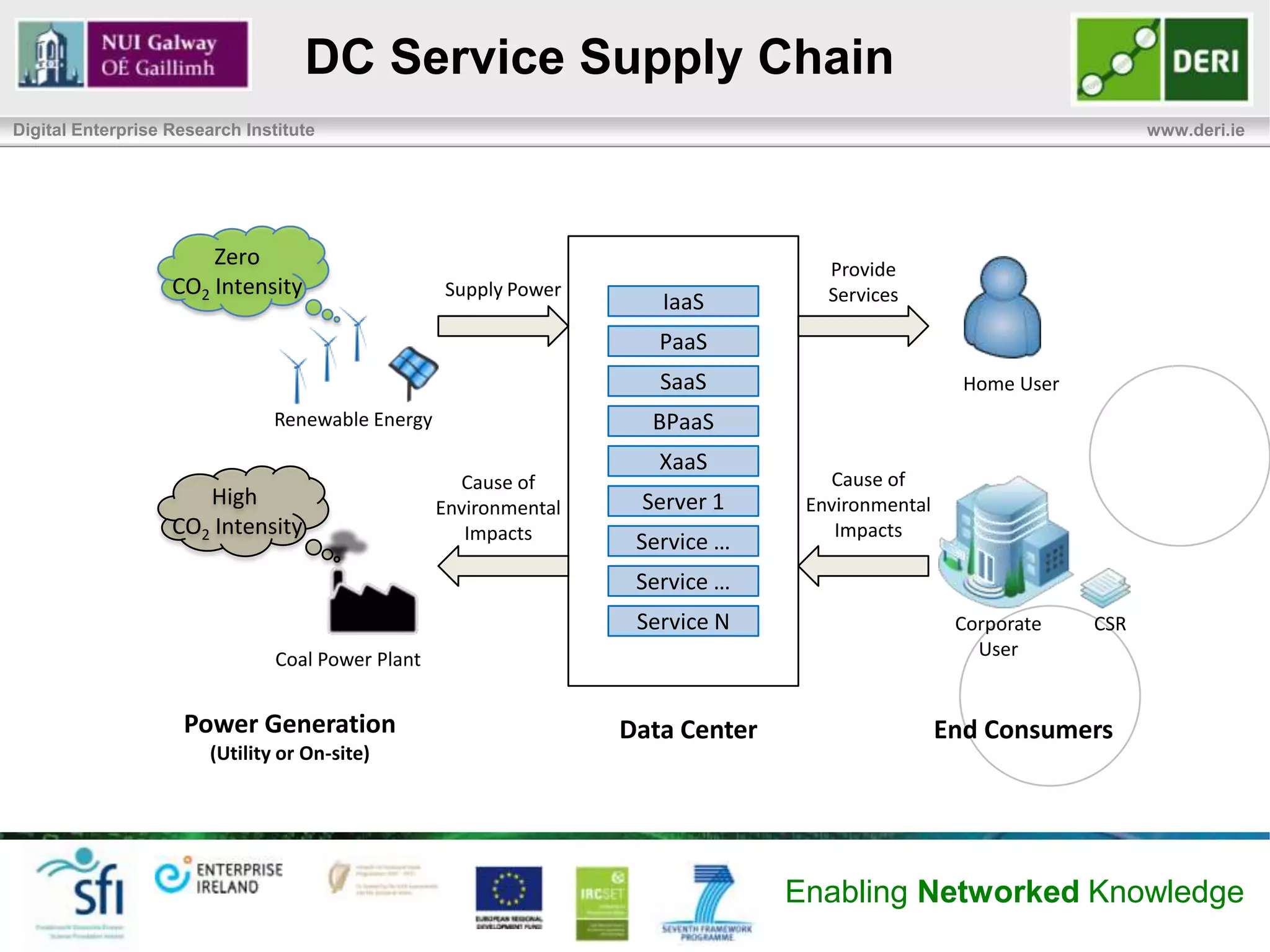
DC Service Supply Chain
Digital Enterprise Research Institute                                                                                 www.deri.ie


                       Zero                                                         Provide
                   CO2 Intensity                   Supply Power                     Services
                                                                      IaaS
                                                                      PaaS
                                                                      SaaS                          Home User
                                Renewable Energy                     BPaaS
                                                                      XaaS
                                                     Cause of                       Cause of
                      High                         Environmental    Server 1      Environmental
                   CO2 Intensity                      Impacts                        Impacts
                                                                    Service …
                                                                    Service …
                                                                    Service N                      Corporate    CSR
                                Coal Power Plant                                                     User


                    Power Generation                               Data Center                    End Consumers
                        (Utility or On-site)


                                                                                 Enabling Networked Knowledge
The Polluter Pays
Digital Enterprise Research Institute                                               www.deri.ie


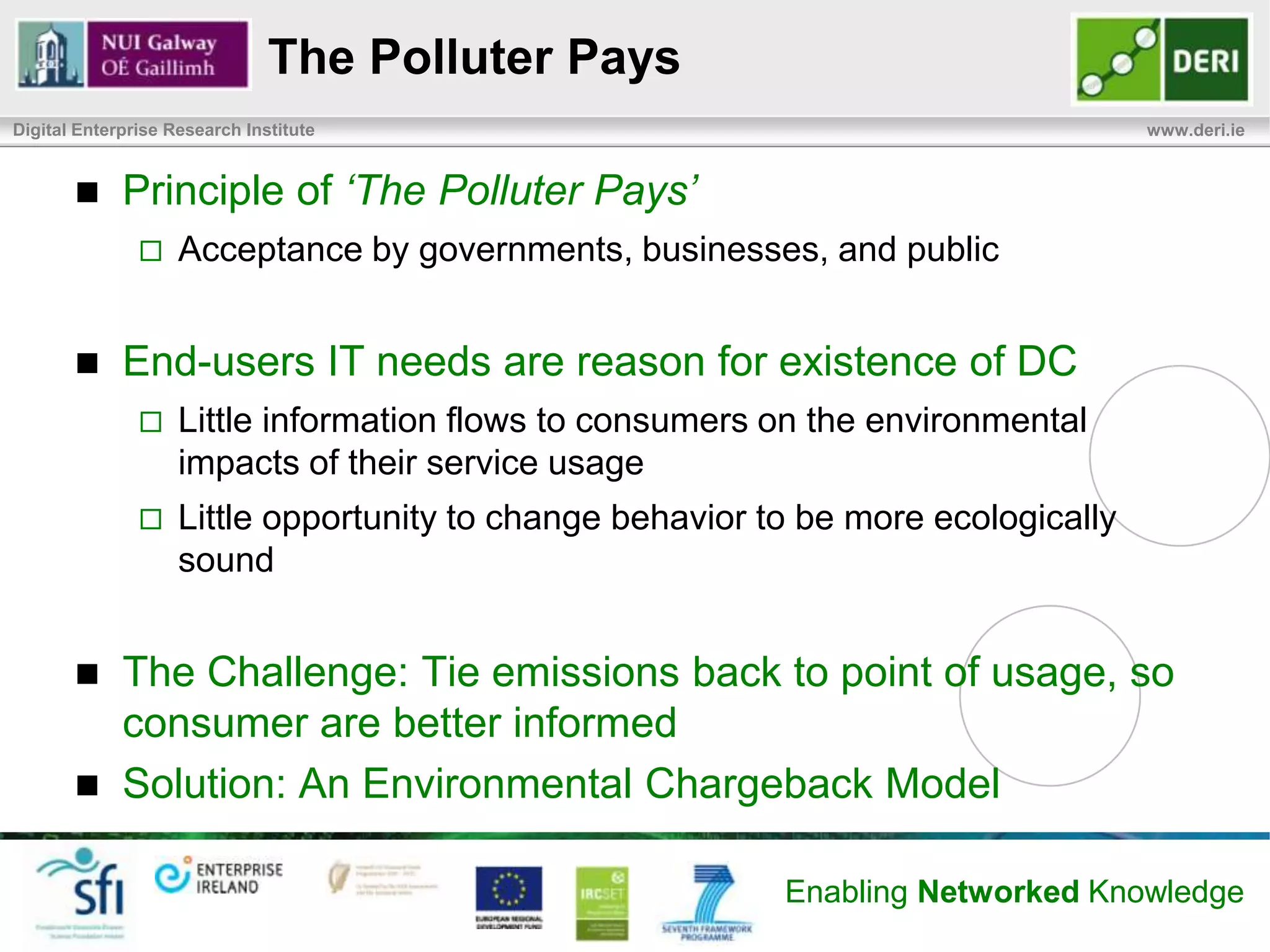
            Principle of ‘The Polluter Pays’
                   Acceptance by governments, businesses, and public


            End-users IT needs are reason for existence of DC
                   Little information flows to consumers on the environmental
                    impacts of their service usage
                   Little opportunity to change behavior to be more ecologically
                    sound


            The Challenge: Tie emissions back to point of usage, so
             consumer are better informed
            Solution: An Environmental Chargeback Model

                                                           Enabling Networked Knowledge
Empowering the Consumer
Digital Enterprise Research Institute                                                  www.deri.ie


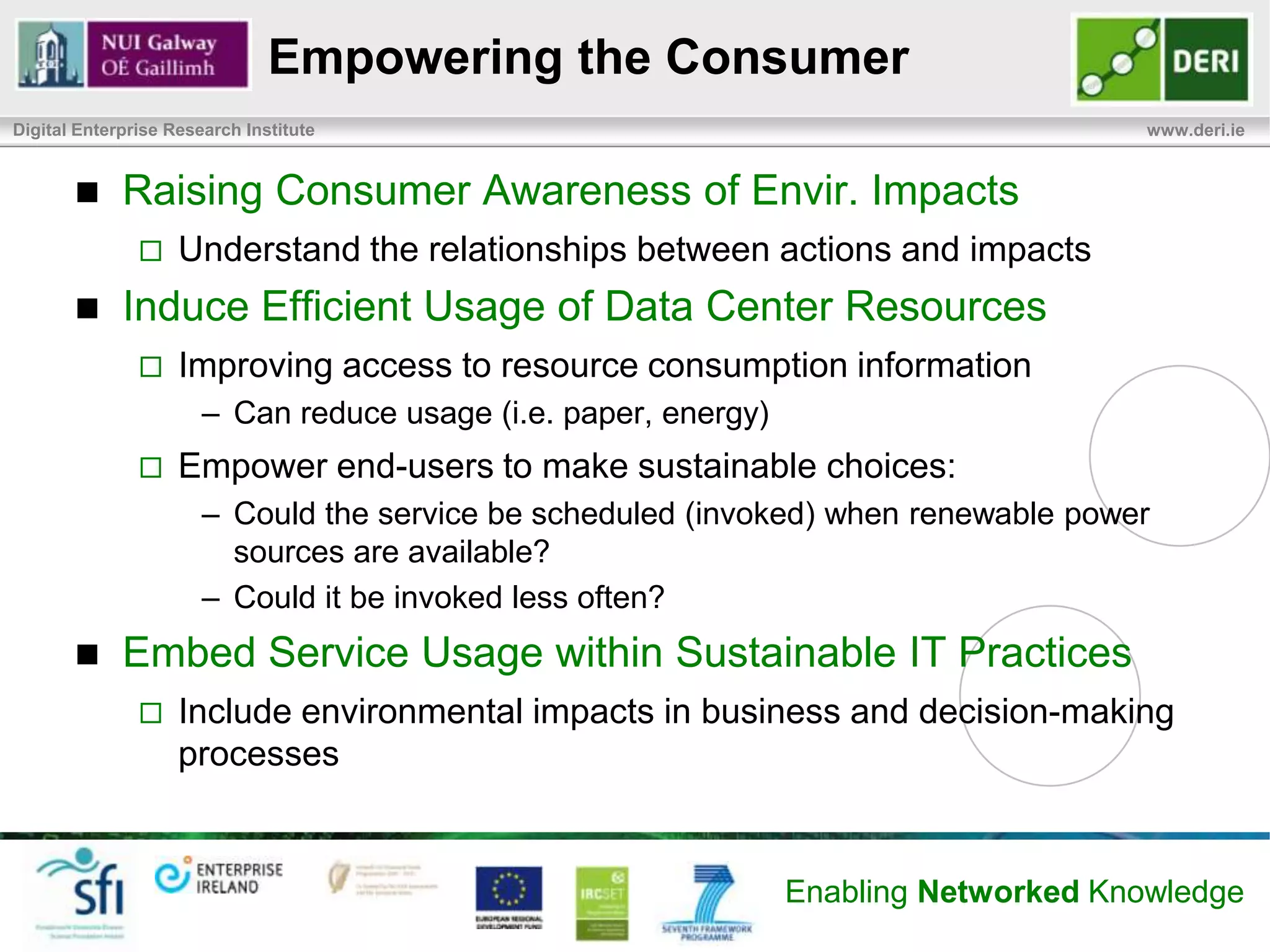
            Raising Consumer Awareness of Envir. Impacts
                   Understand the relationships between actions and impacts
            Induce Efficient Usage of Data Center Resources
                   Improving access to resource consumption information
                       – Can reduce usage (i.e. paper, energy)
                   Empower end-users to make sustainable choices:
                       – Could the service be scheduled (invoked) when renewable power
                         sources are available?
                       – Could it be invoked less often?
            Embed Service Usage within Sustainable IT Practices
                   Include environmental impacts in business and decision-making
                    processes


                                                                 Enabling Networked Knowledge
Overview
Digital Enterprise Research Institute                               www.deri.ie


            Motivation for Environmental Chargeback

            Environmental Chargeback Model
                   Requirements
                   Definition Methodology
                   Allocating Impacts

            Proof of Concept at DERI

            Related Work

            Conclusions & Future Work

                                              Enabling Networked Knowledge
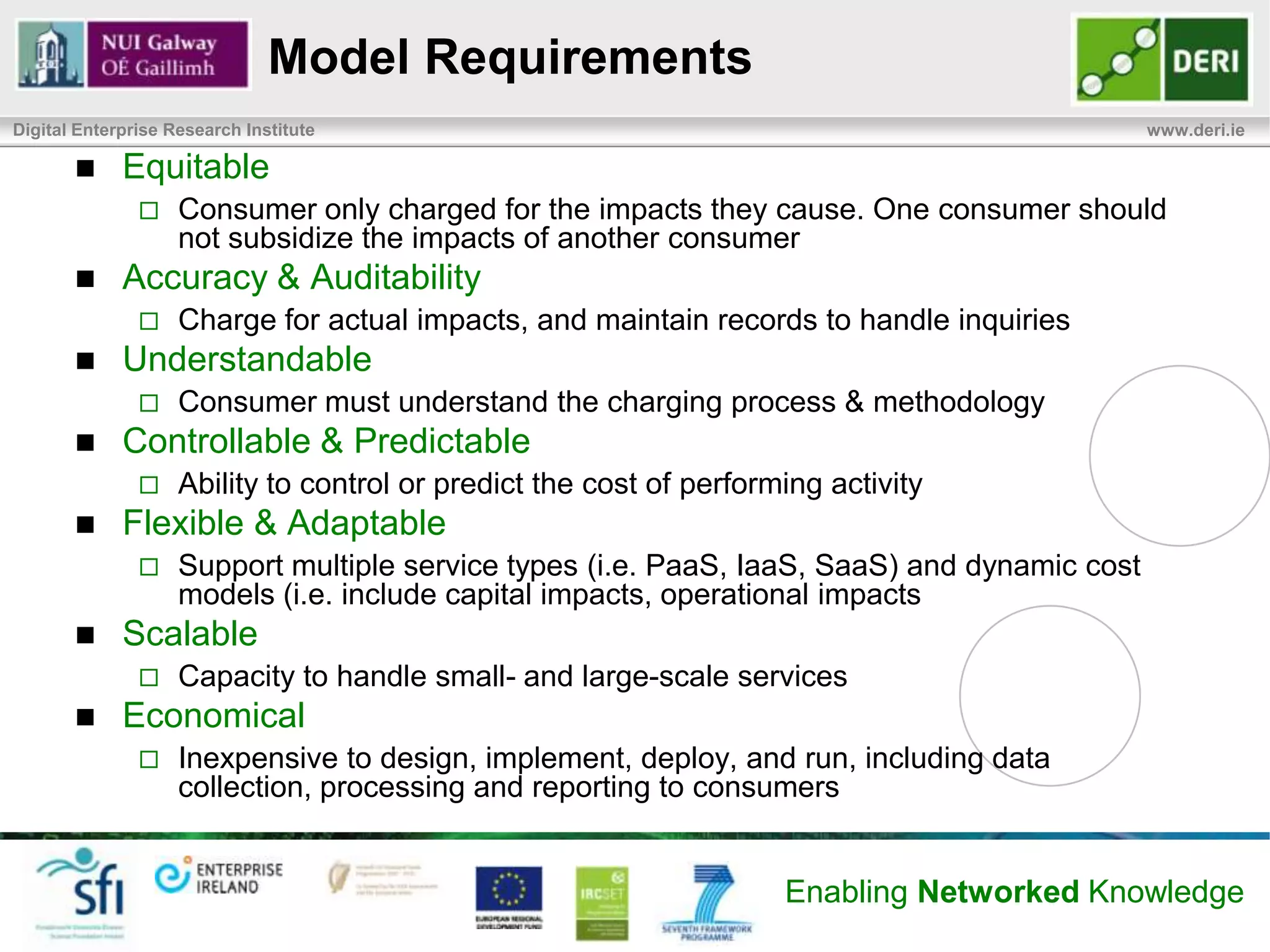
Model Requirements
Digital Enterprise Research Institute                                                         www.deri.ie

            Equitable
                   Consumer only charged for the impacts they cause. One consumer should
                    not subsidize the impacts of another consumer
            Accuracy & Auditability
                   Charge for actual impacts, and maintain records to handle inquiries
            Understandable
                   Consumer must understand the charging process & methodology
            Controllable & Predictable
                   Ability to control or predict the cost of performing activity
            Flexible & Adaptable
                   Support multiple service types (i.e. PaaS, IaaS, SaaS) and dynamic cost
                    models (i.e. include capital impacts, operational impacts
            Scalable
                   Capacity to handle small- and large-scale services
            Economical
                   Inexpensive to design, implement, deploy, and run, including data
                    collection, processing and reporting to consumers


                                                                     Enabling Networked Knowledge
Definition Methodology
Digital Enterprise Research Institute                                                       www.deri.ie


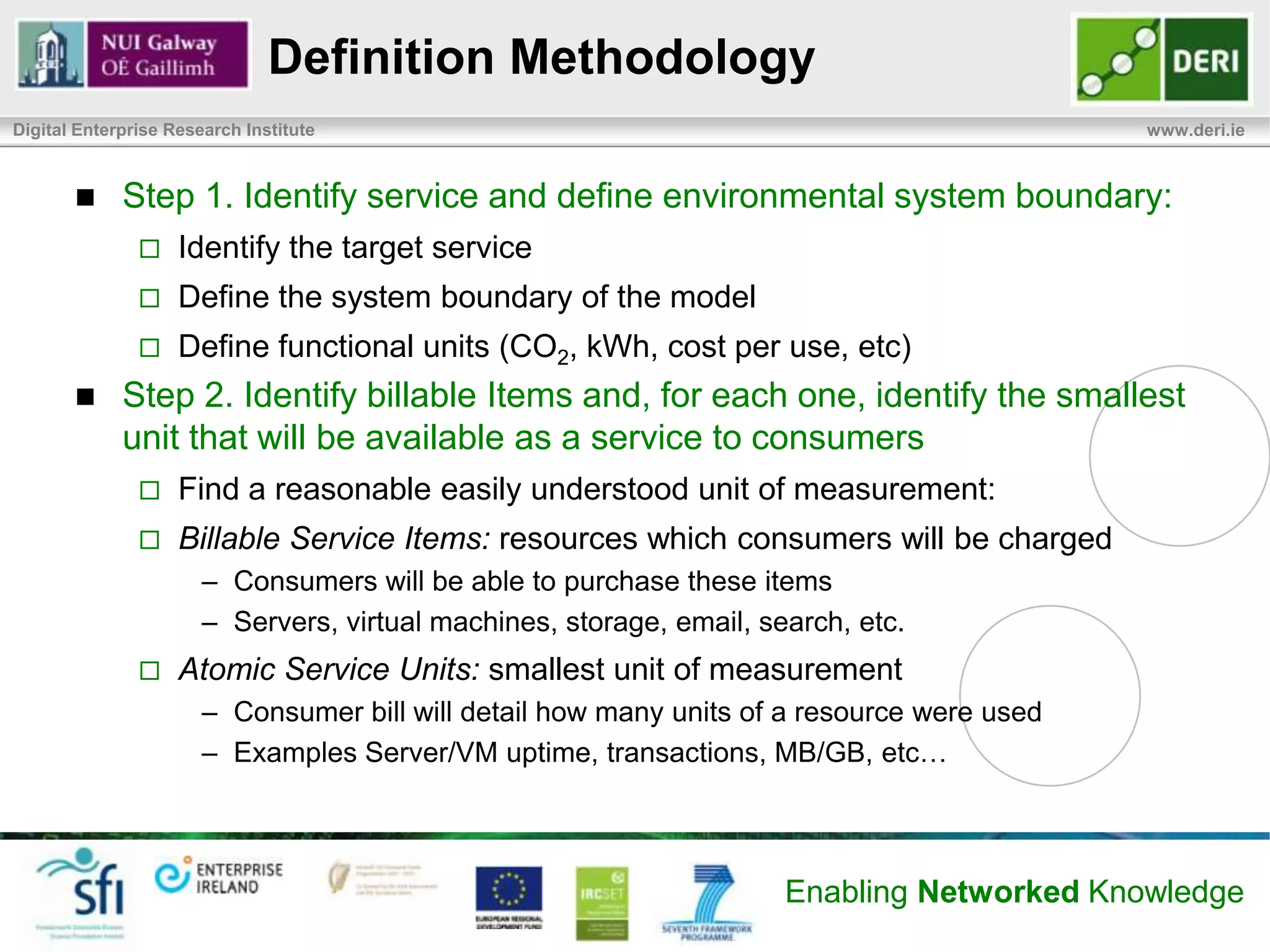
            Step 1. Identify service and define environmental system boundary:
                   Identify the target service
                   Define the system boundary of the model
                   Define functional units (CO2, kWh, cost per use, etc)
            Step 2. Identify billable Items and, for each one, identify the smallest
             unit that will be available as a service to consumers
                   Find a reasonable easily understood unit of measurement:
                   Billable Service Items: resources which consumers will be charged
                       – Consumers will be able to purchase these items
                       – Servers, virtual machines, storage, email, search, etc.
                   Atomic Service Units: smallest unit of measurement
                       – Consumer bill will detail how many units of a resource were used
                       – Examples Server/VM uptime, transactions, MB/GB, etc…


                                                                      Enabling Networked Knowledge
Definition Methodology
Digital Enterprise Research Institute                                                www.deri.ie

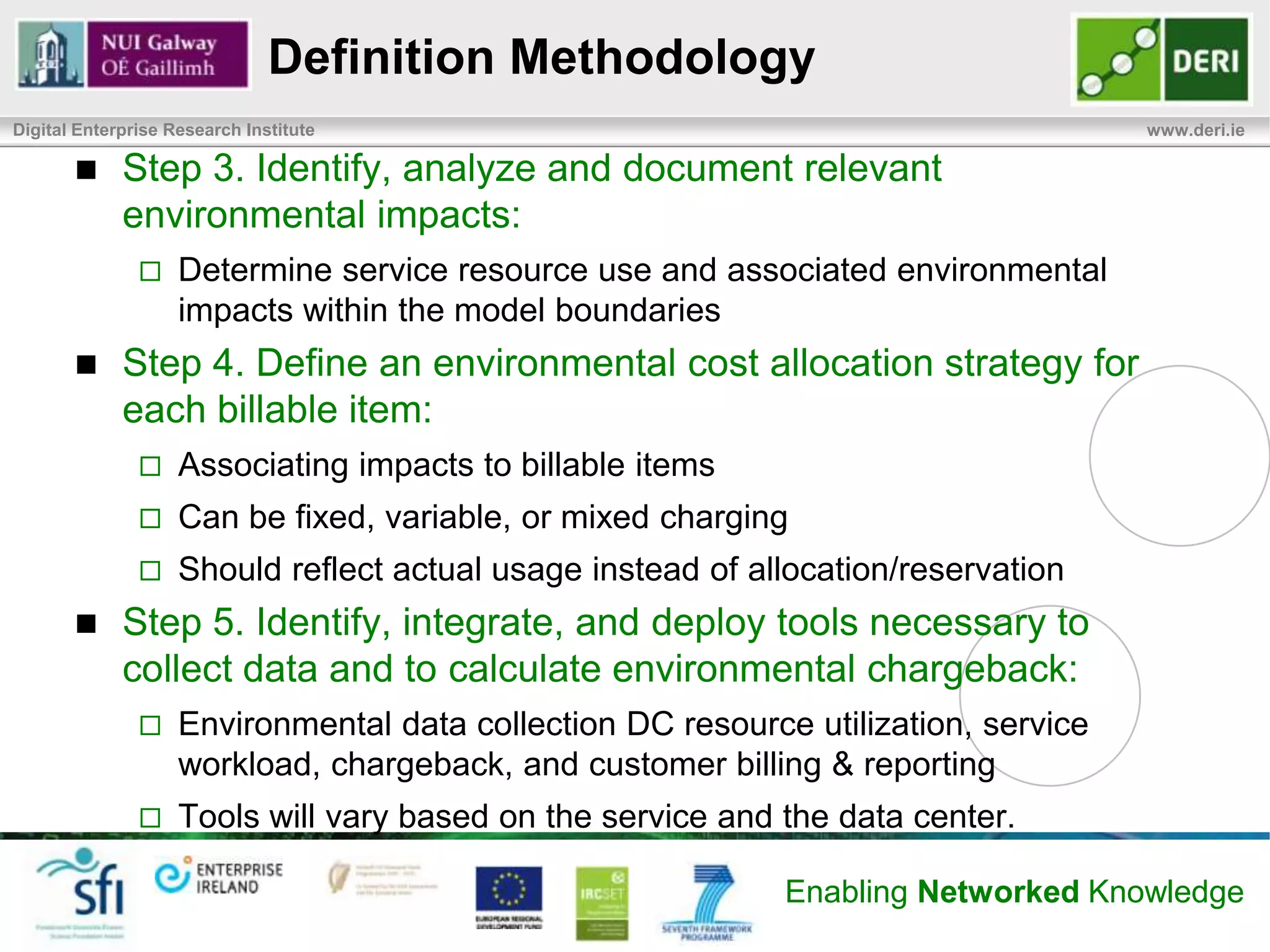
            Step 3. Identify, analyze and document relevant
             environmental impacts:
                   Determine service resource use and associated environmental
                    impacts within the model boundaries
            Step 4. Define an environmental cost allocation strategy for
             each billable item:
                   Associating impacts to billable items
                   Can be fixed, variable, or mixed charging
                   Should reflect actual usage instead of allocation/reservation
            Step 5. Identify, integrate, and deploy tools necessary to
             collect data and to calculate environmental chargeback:
                   Environmental data collection DC resource utilization, service
                    workload, chargeback, and customer billing & reporting
                   Tools will vary based on the service and the data center.

                                                             Enabling Networked Knowledge
Allocating Impacts
Digital Enterprise Research Institute                                                  www.deri.ie


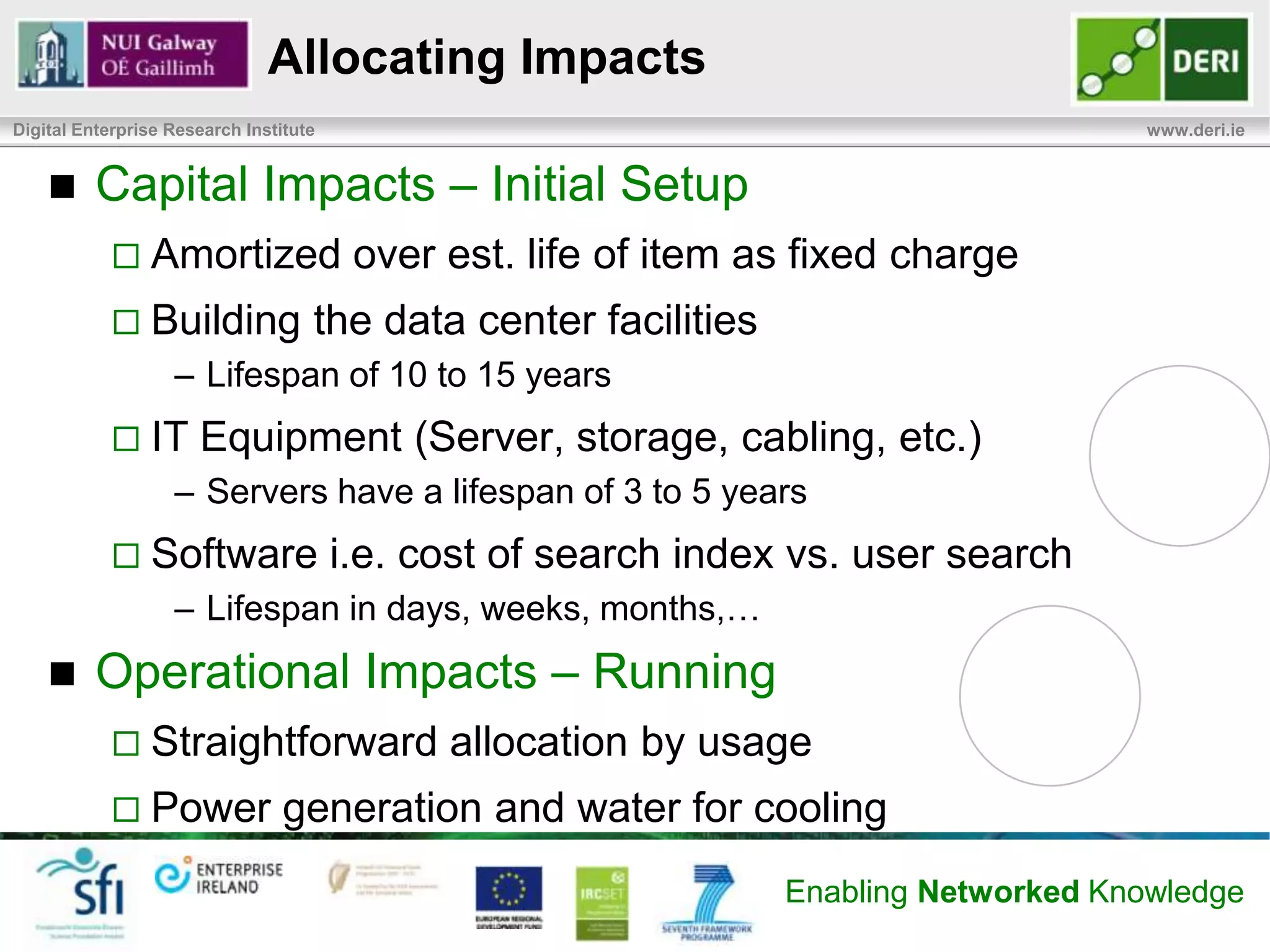
         Capital Impacts – Initial Setup
             Amortized                  over est. life of item as fixed charge
             Building              the data center facilities
                   – Lifespan of 10 to 15 years
             IT      Equipment (Server, storage, cabling, etc.)
                   – Servers have a lifespan of 3 to 5 years
             Software                  i.e. cost of search index vs. user search
                   – Lifespan in days, weeks, months,…
         Operational Impacts – Running
             Straightforward                 allocation by usage
             Power              generation and water for cooling
                                                                 Enabling Networked Knowledge
Allocating Impacts
Digital Enterprise Research Institute                                                                   www.deri.ie


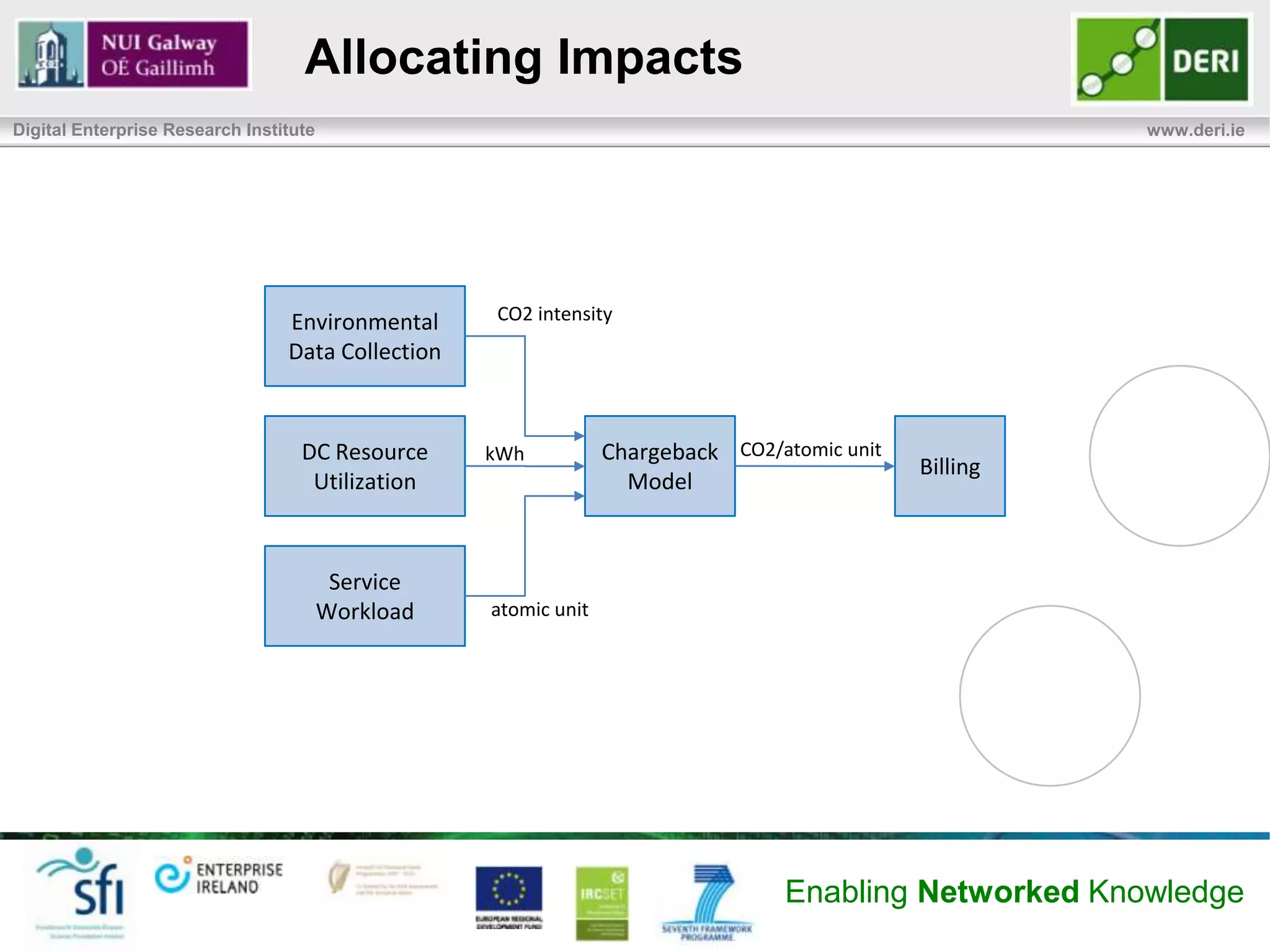
                                 Environmental     CO2 intensity
                                 Data Collection


                                   DC Resource     kWh           Chargeback CO2/atomic unit
                                                                                              Billing
                                    Utilization                    Model


                                         Service
                                        Workload   atomic unit


                                                                                  Enabling Networked Knowledge
Overview
Digital Enterprise Research Institute                               www.deri.ie


            Motivation for Environmental Chargeback

            Environmental Chargeback Model
                   Requirements
                   Definition Methodology
                   Allocating Impacts

            Proof of Concept at DERI

            Related Work

            Conclusions & Future Work

                                              Enabling Networked Knowledge
Proof of Concept
Digital Enterprise Research Institute                                            www.deri.ie


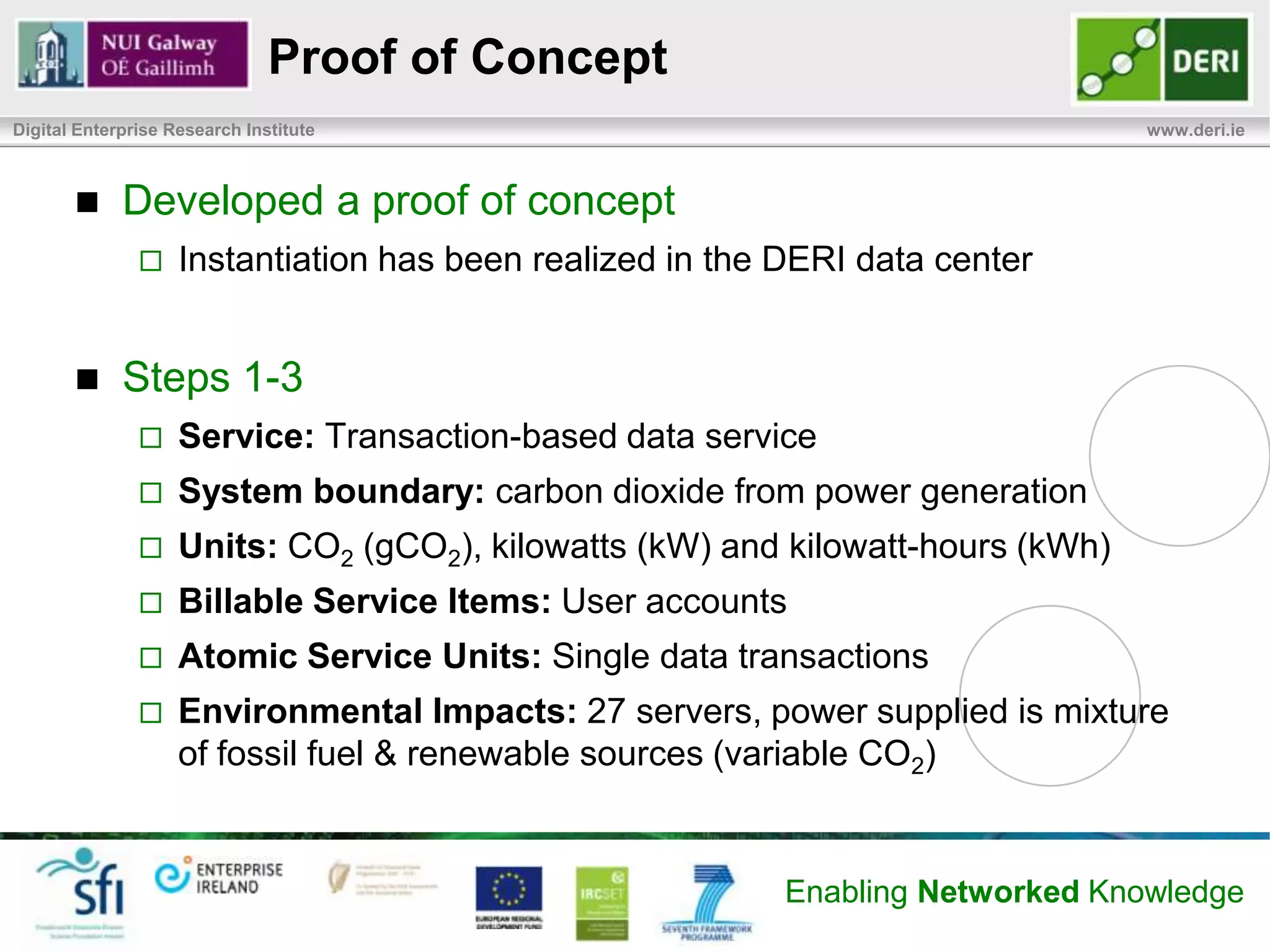
            Developed a proof of concept
                   Instantiation has been realized in the DERI data center


            Steps 1-3
                   Service: Transaction-based data service
                   System boundary: carbon dioxide from power generation
                   Units: CO2 (gCO2), kilowatts (kW) and kilowatt-hours (kWh)
                   Billable Service Items: User accounts
                   Atomic Service Units: Single data transactions
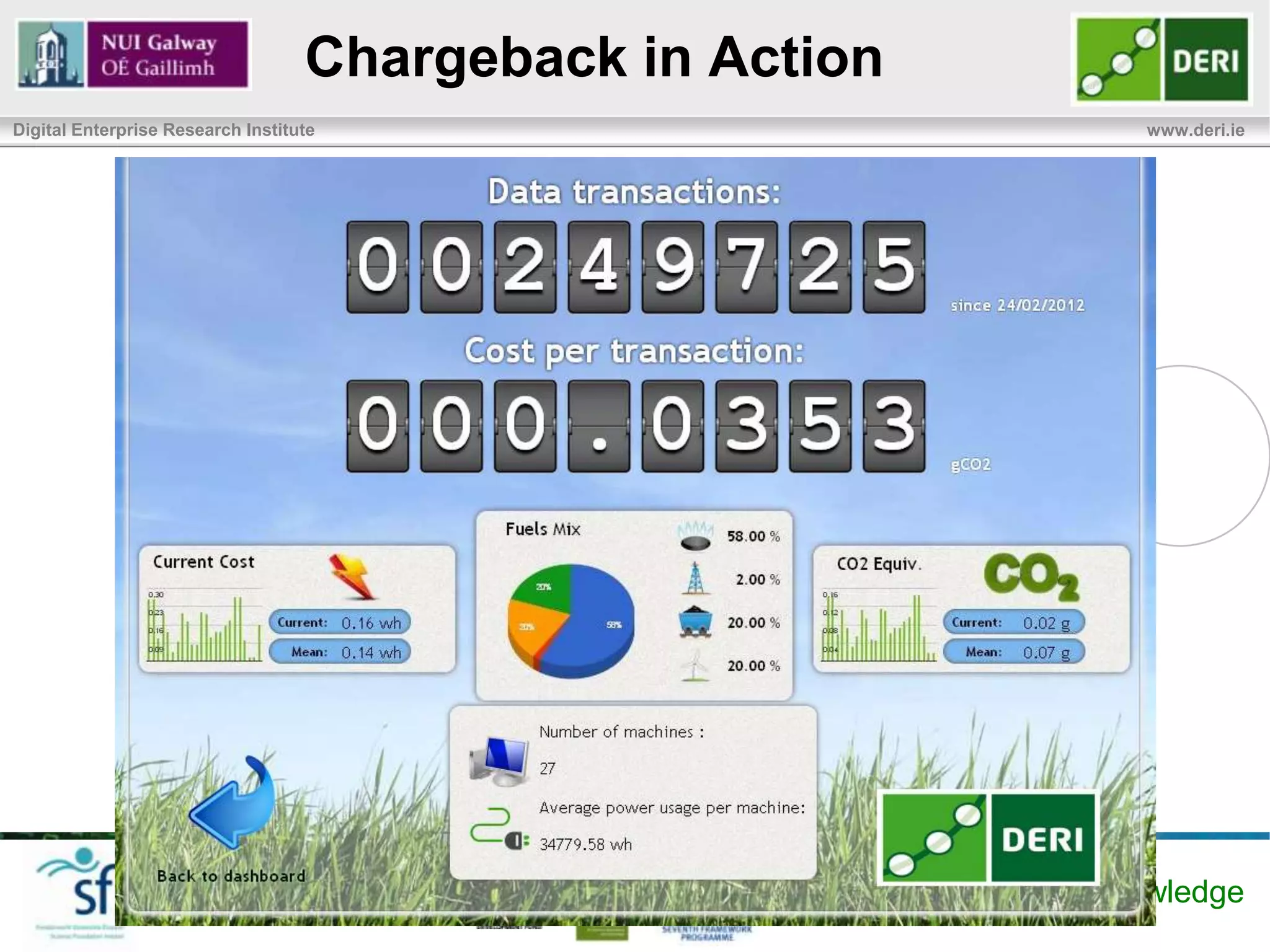
                   Environmental Impacts: 27 servers, power supplied is mixture
                    of fossil fuel & renewable sources (variable CO2)


                                                           Enabling Networked Knowledge
Proof of Concept
Digital Enterprise Research Institute                                                     www.deri.ie


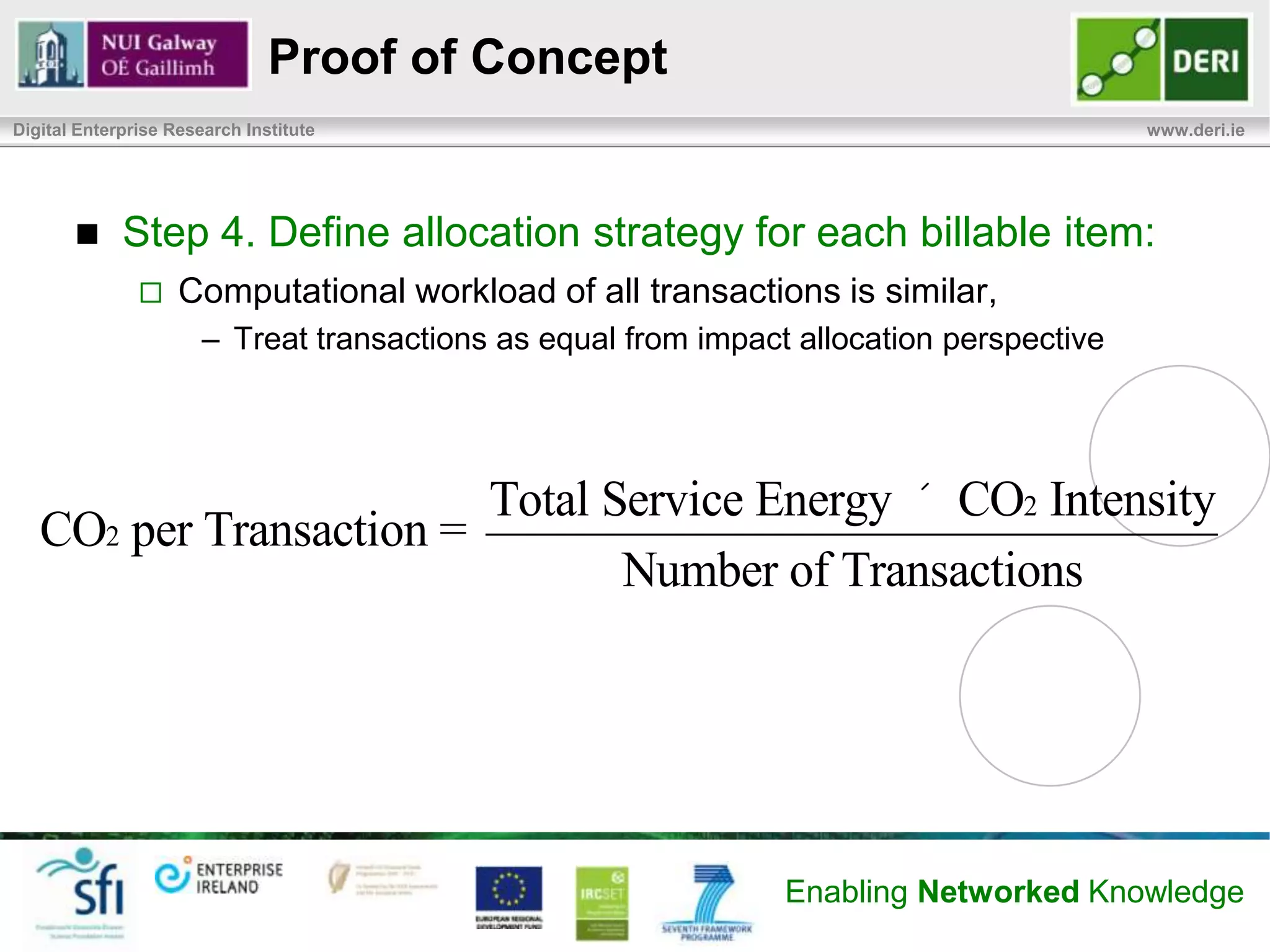
            Step 4. Define allocation strategy for each billable item:
                   Computational workload of all transactions is similar,
                       – Treat transactions as equal from impact allocation perspective


                         Total Service Energy ´ CO2 Intensity
   CO2 per Transaction =
                                Number of Transactions


                                                                Enabling Networked Knowledge
Proof of Concept
Digital Enterprise Research Institute                                              www.deri.ie


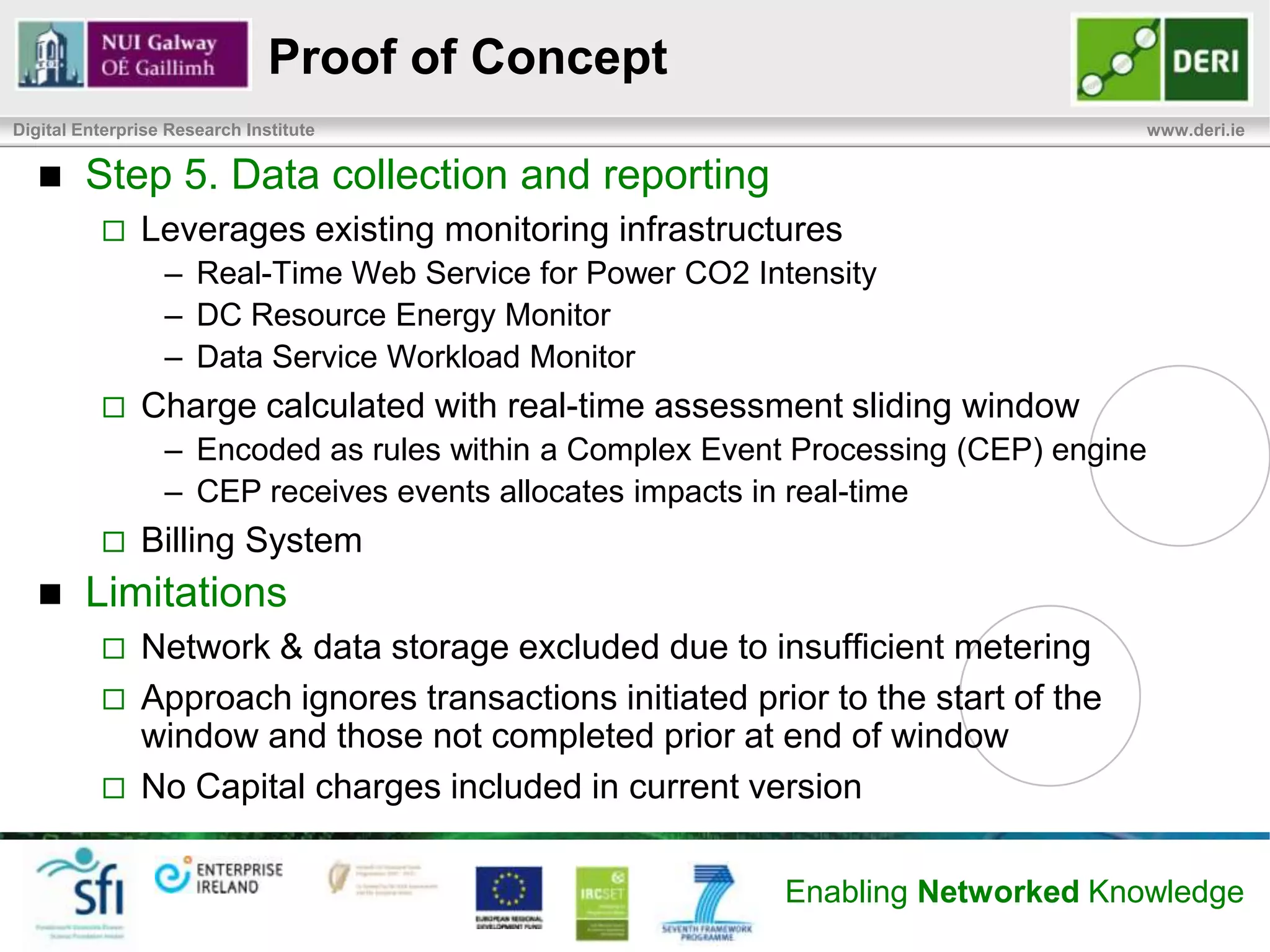
       Step 5. Data collection and reporting
              Leverages existing monitoring infrastructures
                  – Real-Time Web Service for Power CO2 Intensity
                  – DC Resource Energy Monitor
                  – Data Service Workload Monitor
              Charge calculated with real-time assessment sliding window
                  – Encoded as rules within a Complex Event Processing (CEP) engine
                  – CEP receives events allocates impacts in real-time
              Billing System
       Limitations
              Network & data storage excluded due to insufficient metering
              Approach ignores transactions initiated prior to the start of the
               window and those not completed prior at end of window
              No Capital charges included in current version

                                                           Enabling Networked Knowledge
Chargeback in Action
Digital Enterprise Research Institute                                    www.deri.ie


                                                   Enabling Networked Knowledge
Linked dataspace for Energy
                              Intelligence
Digital Enterprise Research Institute                                                                                                          www.deri.ie


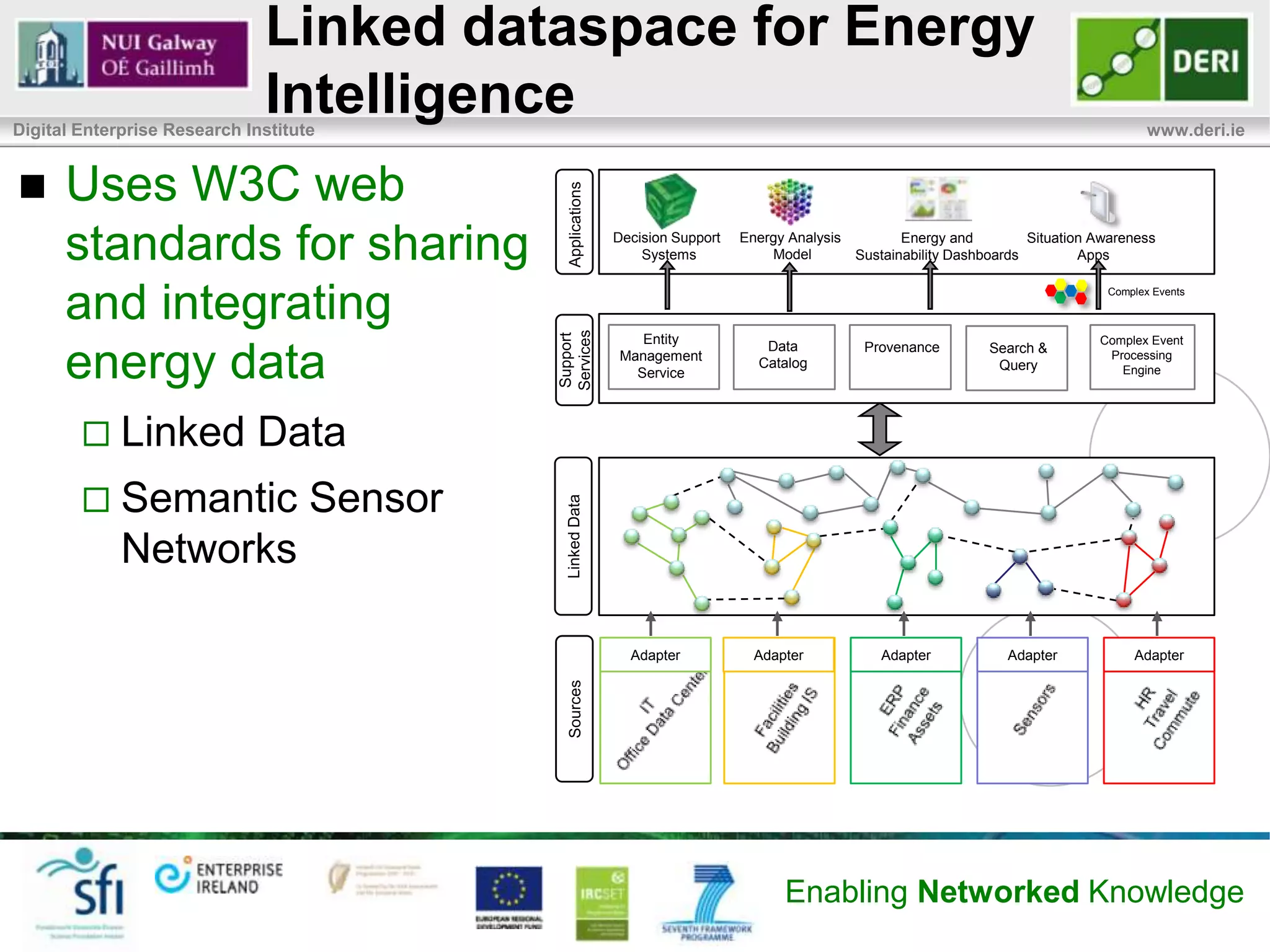
     Uses W3C web


                                               Applications
      standards for sharing                                   Decision Support
                                                                  Systems
                                                                                 Energy Analysis
                                                                                     Model
                                                                                                          Energy and
                                                                                                   Sustainability Dashboards
                                                                                                                             Situation Awareness
                                                                                                                                     Apps


      and integrating                                                                                                                   Complex Events


                                             Services
                                             Support
                                                                 Entity                                                                Complex Event
                                                                                    Data            Provenance         Search &
      energy data                                             Management
                                                                Service
                                                                                   Catalog                              Query
                                                                                                                                        Processing
                                                                                                                                          Engine


         Linked             Data
         Semantic                  Sensor
                                               Linked Data
             Networks

                                                                Adapter            Adapter            Adapter            Adapter            Adapter
                                               Sources


                                                                                       Enabling Networked Knowledge
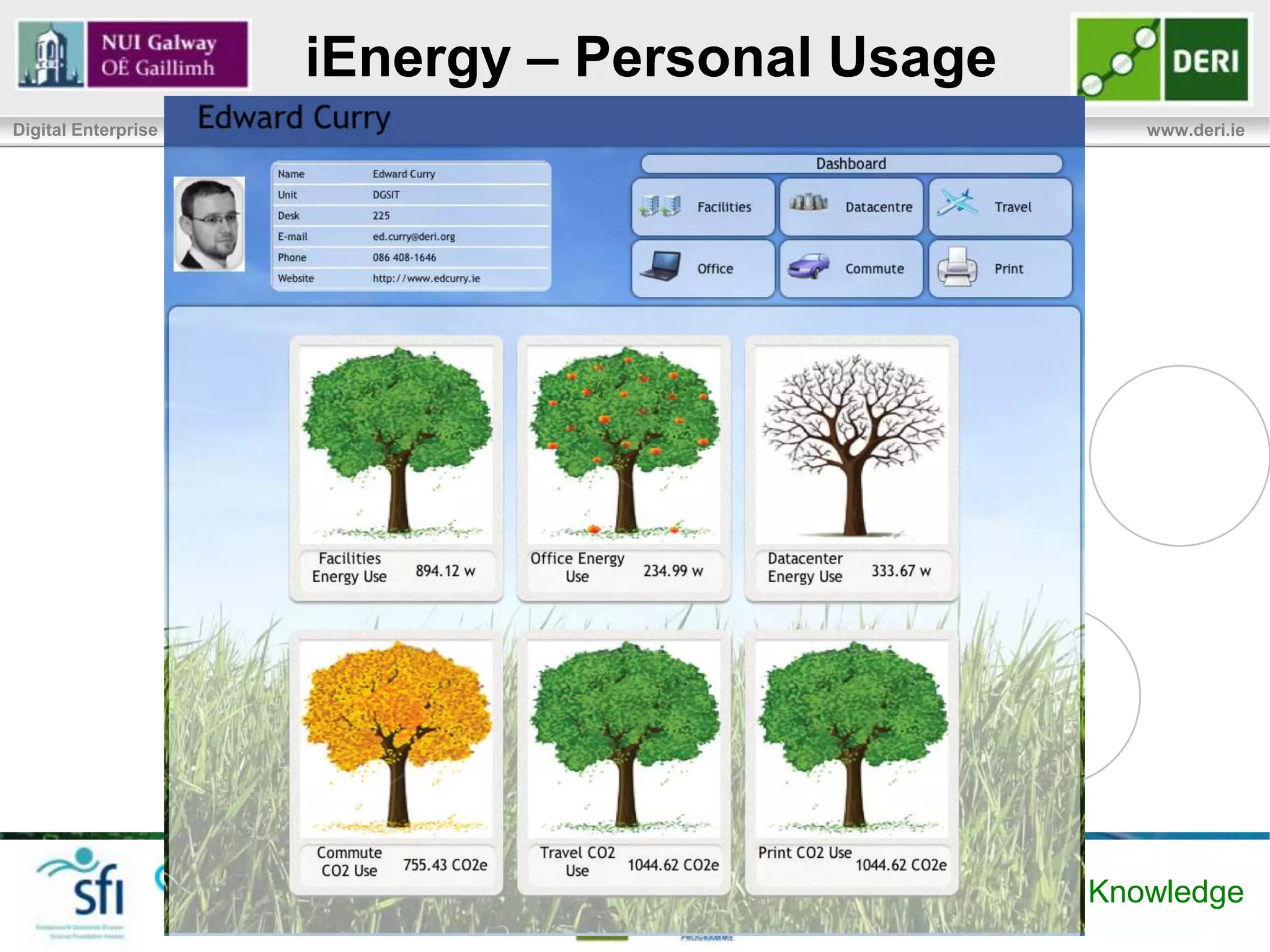
iEnergy – Personal Usage
Digital Enterprise Research Institute                                    www.deri.ie


                                                   Enabling Networked Knowledge
Experience
Digital Enterprise Research Institute                                            www.deri.ie


            Metering and Monitoring
                Piggy-backed           on existing infrastructure
            Service & Infrastructure Complexity
                Shared      and federated across multiple data centers
                    will be more difficult to allocate impacts
            Stakeholder Collaboration
                Require    collaboration from more players, such as
                    service managers and developers
            Security and Privacy
                Considered     within wider area of security and privacy
                    for data centers and cloud computing
                                                           Enabling Networked Knowledge
Overview
Digital Enterprise Research Institute                               www.deri.ie


            Motivation for Environmental Chargeback

            Environmental Chargeback Model
                   Requirements
                   Definition Methodology
                   Allocating Impacts

            Proof of Concept at DERI

            Related Work

            Conclusions & Future Work

                                              Enabling Networked Knowledge
Related Work
Digital Enterprise Research Institute                                             www.deri.ie


            Model complements existing research on DC EE
                   SLA@SOI, GAMES, FIT4Green, OPTIMIS, ALL4Green, etc, …
            Green Grid Metrics
                   Power usage effectiveness (PUE), Data Center infrastructure
                    Efficiency (DCiE), Water Usage Effectiveness (WUE), Carbon
                    Usage Effectiveness (CUE), Data Center compute Efficiency
                    (DCcE), The Data Center Productivity (DCP) framework
                   Focus on DC efficiency


            Not Consumer-centric
                   Do not inform consumer of cost of their service usage
                   Do not give information necessary to change behavior to be more
                    sustainable


                                                            Enabling Networked Knowledge
Overview
Digital Enterprise Research Institute                               www.deri.ie


            Motivation for Environmental Chargeback

            Environmental Chargeback Model
                   Requirements
                   Definition Methodology
                   Allocating Impacts

            Proof of Concept at DERI

            Related Work

            Conclusions & Future Work

                                              Enabling Networked Knowledge
Conclusion & Future Work
Digital Enterprise Research Institute                                              www.deri.ie

       Environmental Chargeback Model
              Correlate service utilization back to service consumers
              Provide visibility into service & associated resource utilization
              Enable consumers to understand environmental footprint
              Bring transparency to sustainability of outsourced enterprise IT
              Encourage use of green power with lower footprint

       Future Work
              User evaluation to determine if model can effectively change user
               behavior and reduce the impacts of services
              Deployment challenges in different environments (i.e. homogenous &
               heterogeneous), at large scale (i.e. warehouse)
              Methods for allocation of capital environmental impacts

                                                          Enabling Networked Knowledge
Further Reading
Digital Enterprise Research Institute                                    www.deri.ie


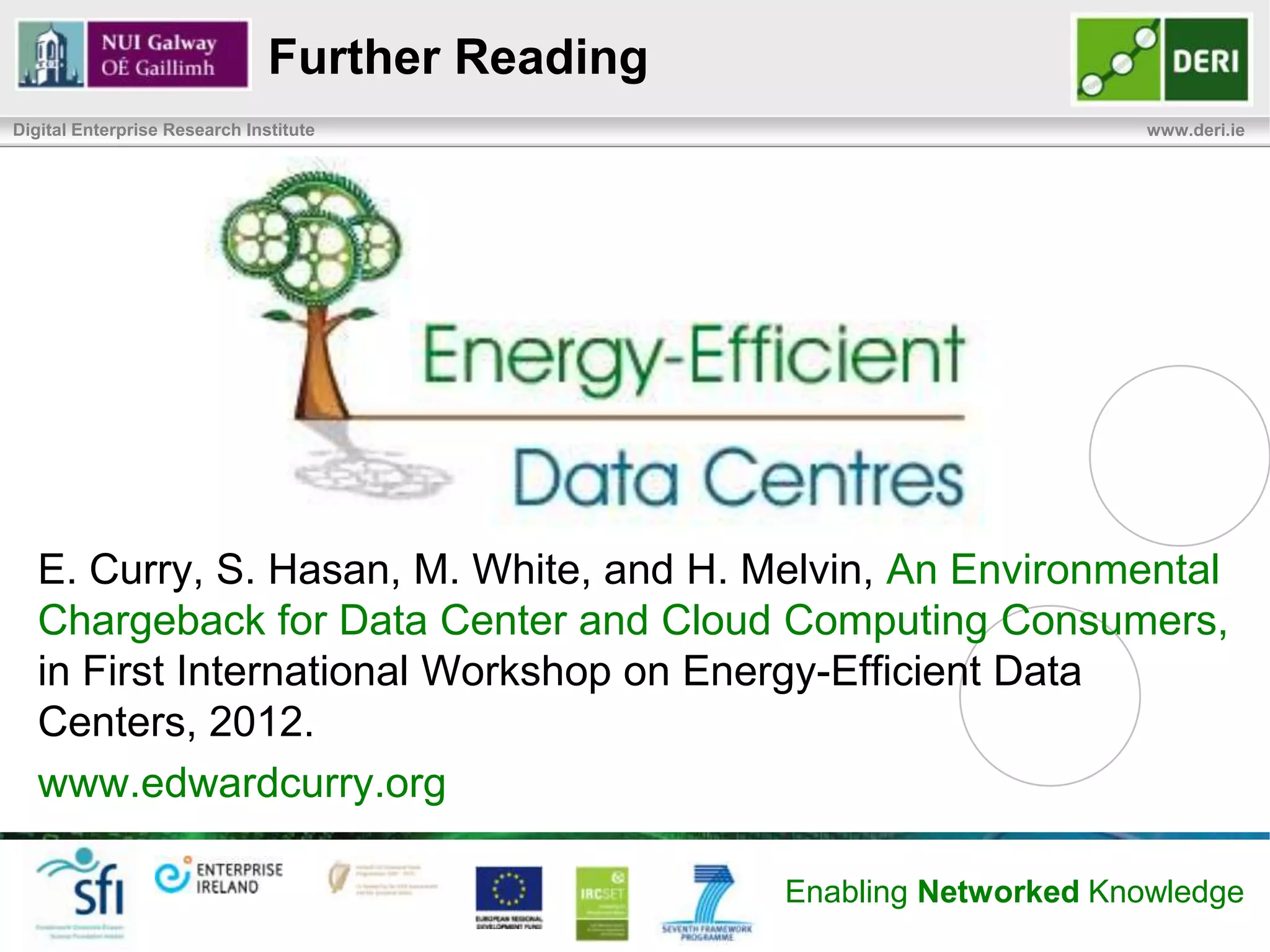
   Curry, E.; Hasan, S.; White, M.; and Melvin, H. 2012. An
   Environmental Chargeback for Data Center and Cloud Computing
   Consumers. In Huusko, J.; de Meer, H.; Klingert, S.; and Somov, A., eds.,
   First International Workshop on Energy-Efficient Data Centers. Madrid,
   Spain: Springer Berlin / Heidelberg.

   www.edwardcurry.org

                                                  Enabling Networked Knowledge

An Environmental Chargeback for Data Center and Cloud Computing Consumers

  • 1.
    Digital Enterprise ResearchInstitute www.deri.ie An Environmental Chargeback for Data Center & Cloud Computing Consumers Edward Curry, Souleiman Hasan, Mark White, Hugh Melvin ed.curry@deri.org - www.edwardcurry.org 1st International Workshop on Energy-Efficient Data Centres, Madrid, 2012 Copyright 2011 Digital Enterprise Research Institute. All rights reserved. Digital Enterprise Research Institute National University of Ireland, Galway Enabling Networked Knowledge
  • 2.
    Overview Digital Enterprise ResearchInstitute www.deri.ie  Motivation for Environmental Chargeback  Environmental Chargeback Model  Requirements  Definition Methodology  Allocating Impacts  Proof of Concept at DERI  Related Work  Conclusions & Future Work Enabling Networked Knowledge
  • 3.
    The Impact ofSearch? Digital Enterprise Research Institute www.deri.ie Figures and Image from www.google.com/green Enabling Networked Knowledge
  • 4.
    Cost of OtherServices? Digital Enterprise Research Institute www.deri.ie Figures and Image from www.google.com/green Enabling Networked Knowledge
  • 5.
    Google’s Carbon Footprint DigitalEnterprise Research Institute www.deri.ie Is Google solely responsible for these emissions? What about the 1 billion users that use Google’s services everyday? Do the users bear some responsibility? Figures and Image from www.google.com/green Enabling Networked Knowledge
  • 6.
    Google’s Carbon Footprint DigitalEnterprise Research Institute www.deri.ie Figures and Image from www.google.com/green Enabling Networked Knowledge
  • 7.
    DC Service SupplyChain Digital Enterprise Research Institute www.deri.ie Zero Provide CO2 Intensity Supply Power Services IaaS PaaS SaaS Home User Renewable Energy BPaaS XaaS Cause of Cause of High Environmental Server 1 Environmental CO2 Intensity Impacts Impacts Service … Service … Service N Corporate CSR Coal Power Plant User Power Generation Data Center End Consumers (Utility or On-site) Enabling Networked Knowledge
  • 8.
    The Polluter Pays DigitalEnterprise Research Institute www.deri.ie  Principle of ‘The Polluter Pays’  Acceptance by governments, businesses, and public  End-users IT needs are reason for existence of DC  Little information flows to consumers on the environmental impacts of their service usage  Little opportunity to change behavior to be more ecologically sound  The Challenge: Tie emissions back to point of usage, so consumer are better informed  Solution: An Environmental Chargeback Model Enabling Networked Knowledge
  • 9.
    Empowering the Consumer DigitalEnterprise Research Institute www.deri.ie  Raising Consumer Awareness of Envir. Impacts  Understand the relationships between actions and impacts  Induce Efficient Usage of Data Center Resources  Improving access to resource consumption information – Can reduce usage (i.e. paper, energy)  Empower end-users to make sustainable choices: – Could the service be scheduled (invoked) when renewable power sources are available? – Could it be invoked less often?  Embed Service Usage within Sustainable IT Practices  Include environmental impacts in business and decision-making processes Enabling Networked Knowledge
  • 10.
    Overview Digital Enterprise ResearchInstitute www.deri.ie  Motivation for Environmental Chargeback  Environmental Chargeback Model  Requirements  Definition Methodology  Allocating Impacts  Proof of Concept at DERI  Related Work  Conclusions & Future Work Enabling Networked Knowledge
  • 11.
    Model Requirements Digital EnterpriseResearch Institute www.deri.ie  Equitable  Consumer only charged for the impacts they cause. One consumer should not subsidize the impacts of another consumer  Accuracy & Auditability  Charge for actual impacts, and maintain records to handle inquiries  Understandable  Consumer must understand the charging process & methodology  Controllable & Predictable  Ability to control or predict the cost of performing activity  Flexible & Adaptable  Support multiple service types (i.e. PaaS, IaaS, SaaS) and dynamic cost models (i.e. include capital impacts, operational impacts  Scalable  Capacity to handle small- and large-scale services  Economical  Inexpensive to design, implement, deploy, and run, including data collection, processing and reporting to consumers Enabling Networked Knowledge
  • 12.
    Definition Methodology Digital EnterpriseResearch Institute www.deri.ie  Step 1. Identify service and define environmental system boundary:  Identify the target service  Define the system boundary of the model  Define functional units (CO2, kWh, cost per use, etc)  Step 2. Identify billable Items and, for each one, identify the smallest unit that will be available as a service to consumers  Find a reasonable easily understood unit of measurement:  Billable Service Items: resources which consumers will be charged – Consumers will be able to purchase these items – Servers, virtual machines, storage, email, search, etc.  Atomic Service Units: smallest unit of measurement – Consumer bill will detail how many units of a resource were used – Examples Server/VM uptime, transactions, MB/GB, etc… Enabling Networked Knowledge
  • 13.
    Definition Methodology Digital EnterpriseResearch Institute www.deri.ie  Step 3. Identify, analyze and document relevant environmental impacts:  Determine service resource use and associated environmental impacts within the model boundaries  Step 4. Define an environmental cost allocation strategy for each billable item:  Associating impacts to billable items  Can be fixed, variable, or mixed charging  Should reflect actual usage instead of allocation/reservation  Step 5. Identify, integrate, and deploy tools necessary to collect data and to calculate environmental chargeback:  Environmental data collection DC resource utilization, service workload, chargeback, and customer billing & reporting  Tools will vary based on the service and the data center. Enabling Networked Knowledge
  • 14.
    Allocating Impacts Digital EnterpriseResearch Institute www.deri.ie  Capital Impacts – Initial Setup  Amortized over est. life of item as fixed charge  Building the data center facilities – Lifespan of 10 to 15 years  IT Equipment (Server, storage, cabling, etc.) – Servers have a lifespan of 3 to 5 years  Software i.e. cost of search index vs. user search – Lifespan in days, weeks, months,…  Operational Impacts – Running  Straightforward allocation by usage  Power generation and water for cooling Enabling Networked Knowledge
  • 15.
    Allocating Impacts Digital EnterpriseResearch Institute www.deri.ie Environmental CO2 intensity Data Collection DC Resource kWh Chargeback CO2/atomic unit Billing Utilization Model Service Workload atomic unit Enabling Networked Knowledge
  • 16.
    Overview Digital Enterprise ResearchInstitute www.deri.ie  Motivation for Environmental Chargeback  Environmental Chargeback Model  Requirements  Definition Methodology  Allocating Impacts  Proof of Concept at DERI  Related Work  Conclusions & Future Work Enabling Networked Knowledge
  • 17.
    Proof of Concept DigitalEnterprise Research Institute www.deri.ie  Developed a proof of concept  Instantiation has been realized in the DERI data center  Steps 1-3  Service: Transaction-based data service  System boundary: carbon dioxide from power generation  Units: CO2 (gCO2), kilowatts (kW) and kilowatt-hours (kWh)  Billable Service Items: User accounts  Atomic Service Units: Single data transactions  Environmental Impacts: 27 servers, power supplied is mixture of fossil fuel & renewable sources (variable CO2) Enabling Networked Knowledge
  • 18.
    Proof of Concept DigitalEnterprise Research Institute www.deri.ie  Step 4. Define allocation strategy for each billable item:  Computational workload of all transactions is similar, – Treat transactions as equal from impact allocation perspective Total Service Energy ´ CO2 Intensity CO2 per Transaction = Number of Transactions Enabling Networked Knowledge
  • 19.
    Proof of Concept DigitalEnterprise Research Institute www.deri.ie  Step 5. Data collection and reporting  Leverages existing monitoring infrastructures – Real-Time Web Service for Power CO2 Intensity – DC Resource Energy Monitor – Data Service Workload Monitor  Charge calculated with real-time assessment sliding window – Encoded as rules within a Complex Event Processing (CEP) engine – CEP receives events allocates impacts in real-time  Billing System  Limitations  Network & data storage excluded due to insufficient metering  Approach ignores transactions initiated prior to the start of the window and those not completed prior at end of window  No Capital charges included in current version Enabling Networked Knowledge
  • 20.
    Chargeback in Action DigitalEnterprise Research Institute www.deri.ie Enabling Networked Knowledge
  • 21.
    Linked dataspace forEnergy Intelligence Digital Enterprise Research Institute www.deri.ie  Uses W3C web Applications standards for sharing Decision Support Systems Energy Analysis Model Energy and Sustainability Dashboards Situation Awareness Apps and integrating Complex Events Services Support Entity Complex Event Data Provenance Search & energy data Management Service Catalog Query Processing Engine  Linked Data  Semantic Sensor Linked Data Networks Adapter Adapter Adapter Adapter Adapter Sources Enabling Networked Knowledge
  • 22.
    iEnergy – PersonalUsage Digital Enterprise Research Institute www.deri.ie Enabling Networked Knowledge
  • 23.
    Experience Digital Enterprise ResearchInstitute www.deri.ie  Metering and Monitoring  Piggy-backed on existing infrastructure  Service & Infrastructure Complexity  Shared and federated across multiple data centers will be more difficult to allocate impacts  Stakeholder Collaboration  Require collaboration from more players, such as service managers and developers  Security and Privacy  Considered within wider area of security and privacy for data centers and cloud computing Enabling Networked Knowledge
  • 24.
    Overview Digital Enterprise ResearchInstitute www.deri.ie  Motivation for Environmental Chargeback  Environmental Chargeback Model  Requirements  Definition Methodology  Allocating Impacts  Proof of Concept at DERI  Related Work  Conclusions & Future Work Enabling Networked Knowledge
  • 25.
    Related Work Digital EnterpriseResearch Institute www.deri.ie  Model complements existing research on DC EE  SLA@SOI, GAMES, FIT4Green, OPTIMIS, ALL4Green, etc, …  Green Grid Metrics  Power usage effectiveness (PUE), Data Center infrastructure Efficiency (DCiE), Water Usage Effectiveness (WUE), Carbon Usage Effectiveness (CUE), Data Center compute Efficiency (DCcE), The Data Center Productivity (DCP) framework  Focus on DC efficiency  Not Consumer-centric  Do not inform consumer of cost of their service usage  Do not give information necessary to change behavior to be more sustainable Enabling Networked Knowledge
  • 26.
    Overview Digital Enterprise ResearchInstitute www.deri.ie  Motivation for Environmental Chargeback  Environmental Chargeback Model  Requirements  Definition Methodology  Allocating Impacts  Proof of Concept at DERI  Related Work  Conclusions & Future Work Enabling Networked Knowledge
  • 27.
    Conclusion & FutureWork Digital Enterprise Research Institute www.deri.ie  Environmental Chargeback Model  Correlate service utilization back to service consumers  Provide visibility into service & associated resource utilization  Enable consumers to understand environmental footprint  Bring transparency to sustainability of outsourced enterprise IT  Encourage use of green power with lower footprint  Future Work  User evaluation to determine if model can effectively change user behavior and reduce the impacts of services  Deployment challenges in different environments (i.e. homogenous & heterogeneous), at large scale (i.e. warehouse)  Methods for allocation of capital environmental impacts Enabling Networked Knowledge
  • 28.
    Further Reading Digital EnterpriseResearch Institute www.deri.ie Curry, E.; Hasan, S.; White, M.; and Melvin, H. 2012. An Environmental Chargeback for Data Center and Cloud Computing Consumers. In Huusko, J.; de Meer, H.; Klingert, S.; and Somov, A., eds., First International Workshop on Energy-Efficient Data Centers. Madrid, Spain: Springer Berlin / Heidelberg. www.edwardcurry.org Enabling Networked Knowledge

Editor's Notes

  • #22 Technology Stack uses tool from across the DERI house
  • #23 Low—level analysis of the energy usage of a person. Across multiple energy consumption areas…office, IT, business travel, DC usage, building usage etc