How to achieve interoperability?

Evangelos Argyzoudis
ICT Expert, Intrasoft (Luxemburg)

Email : evangelos.argyzoudis@intrasoft-intl.com
Outline
• Vision for interoperability

• Problem statement

• Challenges and solutions

• The Citadel On the Move approach
Vision
• Improve public sector data interoperability
  – Across member states
  – Within member states
• European governments being open, flexible
  and collaborative in their relations with
  citizens and businesses (Malmö Vision)
• Common architecture (Citadel statement, ISA
  – EIA action)
Problem statement
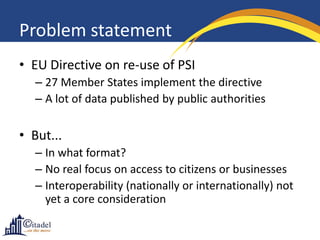
• EU Directive on re-use of PSI
  – 27 Member States implement the directive
  – A lot of data published by public authorities

• But...
  – In what format?
  – No real focus on access to citizens or businesses
  – Interoperability (nationally or internationally) not
    yet a core consideration
Problem statement
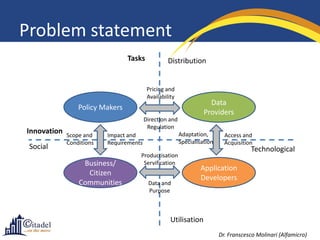
                                 Tasks             Distribution


                                          Pricing and
                                          Availability
                                                                     Data
                 Policy Makers
                                                                   Providers
                                         Direction and
                                          Regulation
Innovation   Scope and    Impact and                     Adaptation,        Access and
             Conditions   Requirements                   Specialisation     Acquisition
 Social                                                                               Technological
                                     Productisation
                  Business/           Servification
                                                                 Application
                   Citizen
                                                                 Developers
                 Communities              Data and
                                          Purpose


                                                    Utilisation
                                                                          Dr. Franscesco Molinari (Alfamicro)
Challenges & Solutions
• Semantic
   –   Lack of (common) semantics
   –   Common data/meta-data models
   –   Core vocabularies
   –   CITADEL, ENGAGE

• Technological
   –   Ways to upload, download, maintain datasets exist
   –   Ways to search, link, visualise, use in applications also exist
   –   Infrastructures
   –   Semantic Web “stack” of standard technologies
   –   Joinup platform, ISA programme, LOD2, CITADEL

• Legal/policy
   – Licensing
   – Contractual and intellectual property rights associated with the data
   – LAPSI project, ISA programme, ePractice.eu, +Spaces, WeGov, CITADEL
Challenges & Solutions
• Privacy
    – Personal, health, financial data, national security etc
    – epSOS

• Language
    – eGovernment services provided internationally poses challenges
    – CITADEL, ENGAGE

• Data Quality, Evolution, Provenance
    – Is the data we find of appropriate quality? Has it changed and how?
      Who owns it?
    – DIACHRON

• Financial
    – Cost of publishing data in a way which facilitates interoperability
    – What happens to data which has already been published?
Within the context of
Citadel... On the Move
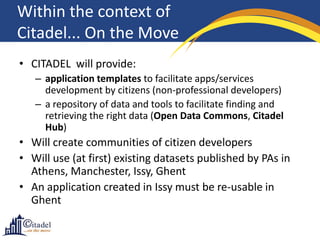
• CITADEL will provide:
   – application templates to facilitate apps/services
     development by citizens (non-professional developers)
   – a repository of data and tools to facilitate finding and
     retrieving the right data (Open Data Commons, Citadel
     Hub)
• Will create communities of citizen developers
• Will use (at first) existing datasets published by PAs in
  Athens, Manchester, Issy, Ghent
• An application created in Issy must be re-usable in
  Ghent
Within the context of
Citadel... On the Move
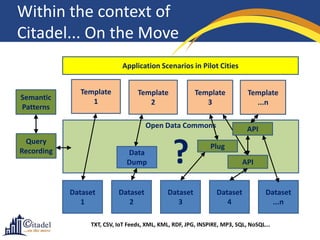
                            Application Scenarios in Pilot Cities


              Template            Template              Template            Template
Semantic
                 1                   2                     3                  ...n
Patterns

                                     Open Data Commons                      API


                                               ?
 Query
                                                              Plug
Recording                     Data
                              Dump                                        API


            Dataset        Dataset            Dataset           Dataset            Dataset
               1              2                  3                 4                 ...n

                 TXT, CSV, IoT Feeds, XML, KML, RDF, JPG, INSPIRE, MP3, SQL, NoSQL...
Q&A

Conférence Open Data par où commencer ? "How to achieve interoperability?" E.Argyzoudis, Intrasoft

  • 1.
    How to achieveinteroperability? Evangelos Argyzoudis ICT Expert, Intrasoft (Luxemburg) Email : evangelos.argyzoudis@intrasoft-intl.com
  • 2.
    Outline • Vision forinteroperability • Problem statement • Challenges and solutions • The Citadel On the Move approach
  • 3.
    Vision • Improve publicsector data interoperability – Across member states – Within member states • European governments being open, flexible and collaborative in their relations with citizens and businesses (Malmö Vision) • Common architecture (Citadel statement, ISA – EIA action)
  • 4.
    Problem statement • EUDirective on re-use of PSI – 27 Member States implement the directive – A lot of data published by public authorities • But... – In what format? – No real focus on access to citizens or businesses – Interoperability (nationally or internationally) not yet a core consideration
  • 5.
    Problem statement Tasks Distribution Pricing and Availability Data Policy Makers Providers Direction and Regulation Innovation Scope and Impact and Adaptation, Access and Conditions Requirements Specialisation Acquisition Social Technological Productisation Business/ Servification Application Citizen Developers Communities Data and Purpose Utilisation Dr. Franscesco Molinari (Alfamicro)
  • 6.
    Challenges & Solutions •Semantic – Lack of (common) semantics – Common data/meta-data models – Core vocabularies – CITADEL, ENGAGE • Technological – Ways to upload, download, maintain datasets exist – Ways to search, link, visualise, use in applications also exist – Infrastructures – Semantic Web “stack” of standard technologies – Joinup platform, ISA programme, LOD2, CITADEL • Legal/policy – Licensing – Contractual and intellectual property rights associated with the data – LAPSI project, ISA programme, ePractice.eu, +Spaces, WeGov, CITADEL
  • 7.
    Challenges & Solutions •Privacy – Personal, health, financial data, national security etc – epSOS • Language – eGovernment services provided internationally poses challenges – CITADEL, ENGAGE • Data Quality, Evolution, Provenance – Is the data we find of appropriate quality? Has it changed and how? Who owns it? – DIACHRON • Financial – Cost of publishing data in a way which facilitates interoperability – What happens to data which has already been published?
  • 8.
    Within the contextof Citadel... On the Move • CITADEL will provide: – application templates to facilitate apps/services development by citizens (non-professional developers) – a repository of data and tools to facilitate finding and retrieving the right data (Open Data Commons, Citadel Hub) • Will create communities of citizen developers • Will use (at first) existing datasets published by PAs in Athens, Manchester, Issy, Ghent • An application created in Issy must be re-usable in Ghent
  • 9.
    Within the contextof Citadel... On the Move Application Scenarios in Pilot Cities Template Template Template Template Semantic 1 2 3 ...n Patterns Open Data Commons API ? Query Plug Recording Data Dump API Dataset Dataset Dataset Dataset Dataset 1 2 3 4 ...n TXT, CSV, IoT Feeds, XML, KML, RDF, JPG, INSPIRE, MP3, SQL, NoSQL...
  • 10.

Editor's Notes

  • #4 Borderless eGovernment services for EuropeansBetter eGovernment servicesISA – Interoperability Solutions for European Public AdministrationsEIA – European Interoperability ArchitectureAll this is accompanied by EU directives and actions for PSI re-use
  • #5 No real focus on access to citizens or businesses -> Lack of tools, guidelines, consultation on business models
  • #7 The actual meaning of the data itselfCommon data models and meta-data models are neededENGAGE – eInfrastructure for PSI curation etc.Data interchange, querying, defining rulesLAPSI – Legal Aspects of Public Sector InformationThe LAPSI project intends to build a network apt to become the main European point of reference for high-level policy discussions and strategic action on all legal issues related to the access and the re-use of the PSI, namely in the digital environment.PositiveSpaces (+Spaces)Was a research project aiming at real-world-policy – making in popular online communities. Modelling real-world behaviour. Engage citizens from different online communities by utilizing these virtual spaces for assisting policy makers in reaching out and gaining insight from the citizens about their opinions and potential acceptance of new policies.
  • #8 epSOS attempts to offer seamless healthcare to European citizens. Key goals are to improve the quality and safety of healthcare for citizens when travelling to another European country. Moreover, it concentrates on developing a practical eHealth framework and ICT infrastructure that enables secure access to patient health information among different European healthcare systems.Language:Translation mechanisms, language is inherent in the meta-data model used for datasets.Interoperability and provenance: more systems are using varied sources and multiple information manipulation engines, thus increasing interoperability requirements Financial: The level of effort required to make data connectable post-hoc is significant – frequently unbearable
  • #10 Existing “standards”, models, vocabularies, APIs in the ODC (e.g. For the representation of PoI, Transportation information etc) updated as they become available.Mapping between existing datasets and the standardsInteroperability doesn’t necessarily have to start top-to-bottom. Bottom-up initiatives can contribute to the realisation of interoperable European eGovernment.