CCS334 BIG DATAANALYTICS
(R-21 III (I Sem))
Department of Artificial Intelligence and Data Science )
Session 3
by
Asst.Prof.M.Gokilavani
NIET
9/19/2023 Department of AI & DS 1
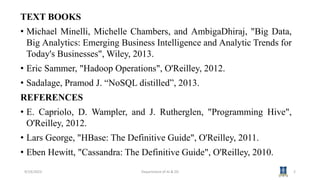
TEXT BOOKS
• Michael Minelli, Michelle Chambers, and AmbigaDhiraj, "Big Data,
Big Analytics: Emerging Business Intelligence and Analytic Trends for
Today's Businesses", Wiley, 2013.
• Eric Sammer, "Hadoop Operations", O'Reilley, 2012.
• Sadalage, Pramod J. “NoSQL distilled”, 2013.
REFERENCES
• E. Capriolo, D. Wampler, and J. Rutherglen, "Programming Hive",
O'Reilley, 2012.
• Lars George, "HBase: The Definitive Guide", O'Reilley, 2011.
• Eben Hewitt, "Cassandra: The Definitive Guide", O'Reilley, 2010.
9/19/2023 Department of AI & DS 2
Topics covered in Unit 2 session
9/19/2023 Department of AI & DS 3
UNIT II NOSQL DATA MANAGEMENT
Introduction to NoSQL – aggregate data models – key-value and
document data models – relationships – graph databases – schema
less databases – materialized views – distribution models – master-
slave replication – consistency - Cassandra – Cassandra data model
– Cassandra examples – Cassandra clients.
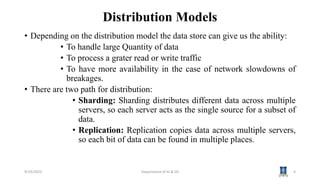
Distribution Models
• Depending on the distribution model the data store can give us the ability:
• To handle large Quantity of data
• To process a grater read or write traffic
• To have more availability in the case of network slowdowns of
breakages.
• There are two path for distribution:
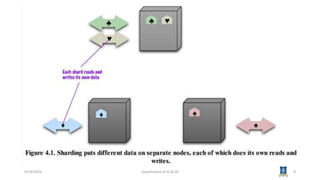
• Sharding: Sharding distributes different data across multiple
servers, so each server acts as the single source for a subset of
data.
• Replication: Replication copies data across multiple servers,
so each bit of data can be found in multiple places.
9/19/2023 Department of AI & DS 4
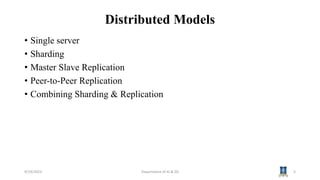
Distributed Models
• Single server
• Sharding
• Master Slave Replication
• Peer-to-Peer Replication
• Combining Sharding & Replication
9/19/2023 Department of AI & DS 5
Single Server
• It is the first and simplest distribution option.
• Also if NoSQL database are designed to run on a cluster they can be
used in a single server application.
• This make sense if a NoSQL database is more suited for the
application data model.
• Graph database are the more obvious.
• If data usage is most about processing aggregates, than a key or a
document store may be useful.
9/19/2023 Department of AI & DS 6
Sharding
• Often, a data store is busy because different people are accessing
different part of the dataset.
• In this cases we can support horizontal scalability by putting different
part of the data onto different servers (Sharding)
• The concept of sharding is not new as a part of application logic.
• It consists in put all the customer with surname A-D on one shard and
E-G to another
• This complicates the programming model as the application code
needs to distributed the load across the shards.
• In the ideal setting we have each user to talk one server and the load is
balanced.
• Of course the ideal case is rare.
9/19/2023 Department of AI & DS 7
9/19/2023 Department of AI & DS 8
Sharding and NoSQL
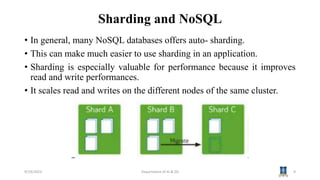
• In general, many NoSQL databases offers auto- sharding.
• This can make much easier to use sharding in an application.
• Sharding is especially valuable for performance because it improves
read and write performances.
• It scales read and writes on the different nodes of the same cluster.
9/19/2023 Department of AI & DS 9
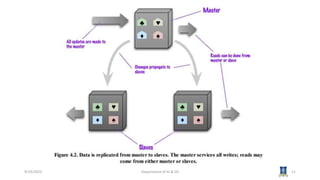
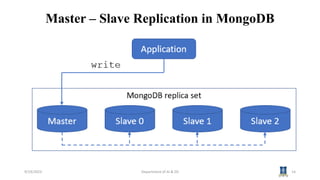
Master – Slave Replication
• In this setting one node is designated as the master, or primary ad the
other as slaves.
• The master is the authoritative source for the date and designed to
process updates and send them to slaves.
• The slaves are used for read operations.
• This allows us to scale in data intensive dataset.
9/19/2023 Department of AI & DS 10
9/19/2023 Department of AI & DS 11
Master – Slave Replication
• We can scale horizontally by adding more slaves.
• But, we are limited by the ability of the master in processing incoming
data.
An advantage is read resilience.
Disadvantage:
• Also if the master fails the slaves can still handle read requests.
• Anyway writes are not allowed until the master is not restored.
9/19/2023 Department of AI & DS 12
Master – Slave Replication
• Another characteristic is that a slave can be appointed as master.
• Masters can be appointed manually or automatically.
• In order to achieve resilience we need that read and write paths are
different.
• This is normally done using separate database connections.
• Disadvantage: Replication in master-slave have the analyzed
advantages but it come with the problem of inconsistency.
• The readers reading from the slaves can read data not updated.
9/19/2023 Department of AI & DS 13
Master – Slave Replication in MongoDB
9/19/2023 Department of AI & DS 14
Peer to Peer Replication
• Master-Slave replication helps with read scalability but has problems
on scalability of writes.
• Moreover, it provides resilience on read but not on writes.
• The master is still a single point of failure.
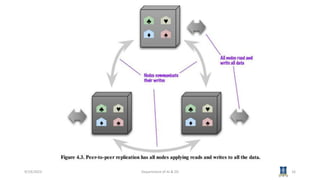
• Peer-to-Peer attacks these problems by not having a master.
• All the replica are equal (accept writes and reads).
• With a Peer-to-Peer we can have node failures without lose write
capability and losing data.
9/19/2023 Department of AI & DS 15
9/19/2023 Department of AI & DS 16
Combine Sharing
• We have multiple masters, but each data has a single master.
• Depending on the configuration we can decide the master for each
group of data.
• Peer-to-Peer and sharding is a common strategy for column-family
databases.
• This is commonly composed using replication of the shards.
9/19/2023 Department of AI & DS 17
Topics to be covered in next session 4
• Cassandra data model
9/19/2023 Department of AI & DS 18
Thank you!!!

CCS334 BIG DATA ANALYTICS Session 3 Distributed models.pptx

  • 1.
    CCS334 BIG DATAANALYTICS (R-21III (I Sem)) Department of Artificial Intelligence and Data Science ) Session 3 by Asst.Prof.M.Gokilavani NIET 9/19/2023 Department of AI & DS 1
  • 2.
    TEXT BOOKS • MichaelMinelli, Michelle Chambers, and AmbigaDhiraj, "Big Data, Big Analytics: Emerging Business Intelligence and Analytic Trends for Today's Businesses", Wiley, 2013. • Eric Sammer, "Hadoop Operations", O'Reilley, 2012. • Sadalage, Pramod J. “NoSQL distilled”, 2013. REFERENCES • E. Capriolo, D. Wampler, and J. Rutherglen, "Programming Hive", O'Reilley, 2012. • Lars George, "HBase: The Definitive Guide", O'Reilley, 2011. • Eben Hewitt, "Cassandra: The Definitive Guide", O'Reilley, 2010. 9/19/2023 Department of AI & DS 2
  • 3.
    Topics covered inUnit 2 session 9/19/2023 Department of AI & DS 3 UNIT II NOSQL DATA MANAGEMENT Introduction to NoSQL – aggregate data models – key-value and document data models – relationships – graph databases – schema less databases – materialized views – distribution models – master- slave replication – consistency - Cassandra – Cassandra data model – Cassandra examples – Cassandra clients.
  • 4.
    Distribution Models • Dependingon the distribution model the data store can give us the ability: • To handle large Quantity of data • To process a grater read or write traffic • To have more availability in the case of network slowdowns of breakages. • There are two path for distribution: • Sharding: Sharding distributes different data across multiple servers, so each server acts as the single source for a subset of data. • Replication: Replication copies data across multiple servers, so each bit of data can be found in multiple places. 9/19/2023 Department of AI & DS 4
  • 5.
    Distributed Models • Singleserver • Sharding • Master Slave Replication • Peer-to-Peer Replication • Combining Sharding & Replication 9/19/2023 Department of AI & DS 5
  • 6.
    Single Server • Itis the first and simplest distribution option. • Also if NoSQL database are designed to run on a cluster they can be used in a single server application. • This make sense if a NoSQL database is more suited for the application data model. • Graph database are the more obvious. • If data usage is most about processing aggregates, than a key or a document store may be useful. 9/19/2023 Department of AI & DS 6
  • 7.
    Sharding • Often, adata store is busy because different people are accessing different part of the dataset. • In this cases we can support horizontal scalability by putting different part of the data onto different servers (Sharding) • The concept of sharding is not new as a part of application logic. • It consists in put all the customer with surname A-D on one shard and E-G to another • This complicates the programming model as the application code needs to distributed the load across the shards. • In the ideal setting we have each user to talk one server and the load is balanced. • Of course the ideal case is rare. 9/19/2023 Department of AI & DS 7
  • 8.
  • 9.
    Sharding and NoSQL •In general, many NoSQL databases offers auto- sharding. • This can make much easier to use sharding in an application. • Sharding is especially valuable for performance because it improves read and write performances. • It scales read and writes on the different nodes of the same cluster. 9/19/2023 Department of AI & DS 9
  • 10.
    Master – SlaveReplication • In this setting one node is designated as the master, or primary ad the other as slaves. • The master is the authoritative source for the date and designed to process updates and send them to slaves. • The slaves are used for read operations. • This allows us to scale in data intensive dataset. 9/19/2023 Department of AI & DS 10
  • 11.
  • 12.
    Master – SlaveReplication • We can scale horizontally by adding more slaves. • But, we are limited by the ability of the master in processing incoming data. An advantage is read resilience. Disadvantage: • Also if the master fails the slaves can still handle read requests. • Anyway writes are not allowed until the master is not restored. 9/19/2023 Department of AI & DS 12
  • 13.
    Master – SlaveReplication • Another characteristic is that a slave can be appointed as master. • Masters can be appointed manually or automatically. • In order to achieve resilience we need that read and write paths are different. • This is normally done using separate database connections. • Disadvantage: Replication in master-slave have the analyzed advantages but it come with the problem of inconsistency. • The readers reading from the slaves can read data not updated. 9/19/2023 Department of AI & DS 13
  • 14.
    Master – SlaveReplication in MongoDB 9/19/2023 Department of AI & DS 14
  • 15.
    Peer to PeerReplication • Master-Slave replication helps with read scalability but has problems on scalability of writes. • Moreover, it provides resilience on read but not on writes. • The master is still a single point of failure. • Peer-to-Peer attacks these problems by not having a master. • All the replica are equal (accept writes and reads). • With a Peer-to-Peer we can have node failures without lose write capability and losing data. 9/19/2023 Department of AI & DS 15
  • 16.
  • 17.
    Combine Sharing • Wehave multiple masters, but each data has a single master. • Depending on the configuration we can decide the master for each group of data. • Peer-to-Peer and sharding is a common strategy for column-family databases. • This is commonly composed using replication of the shards. 9/19/2023 Department of AI & DS 17
  • 18.
    Topics to becovered in next session 4 • Cassandra data model 9/19/2023 Department of AI & DS 18 Thank you!!!