Banking Technology
Centralized Banking –
Concepts and Opportunities
Banking Technology August 2005
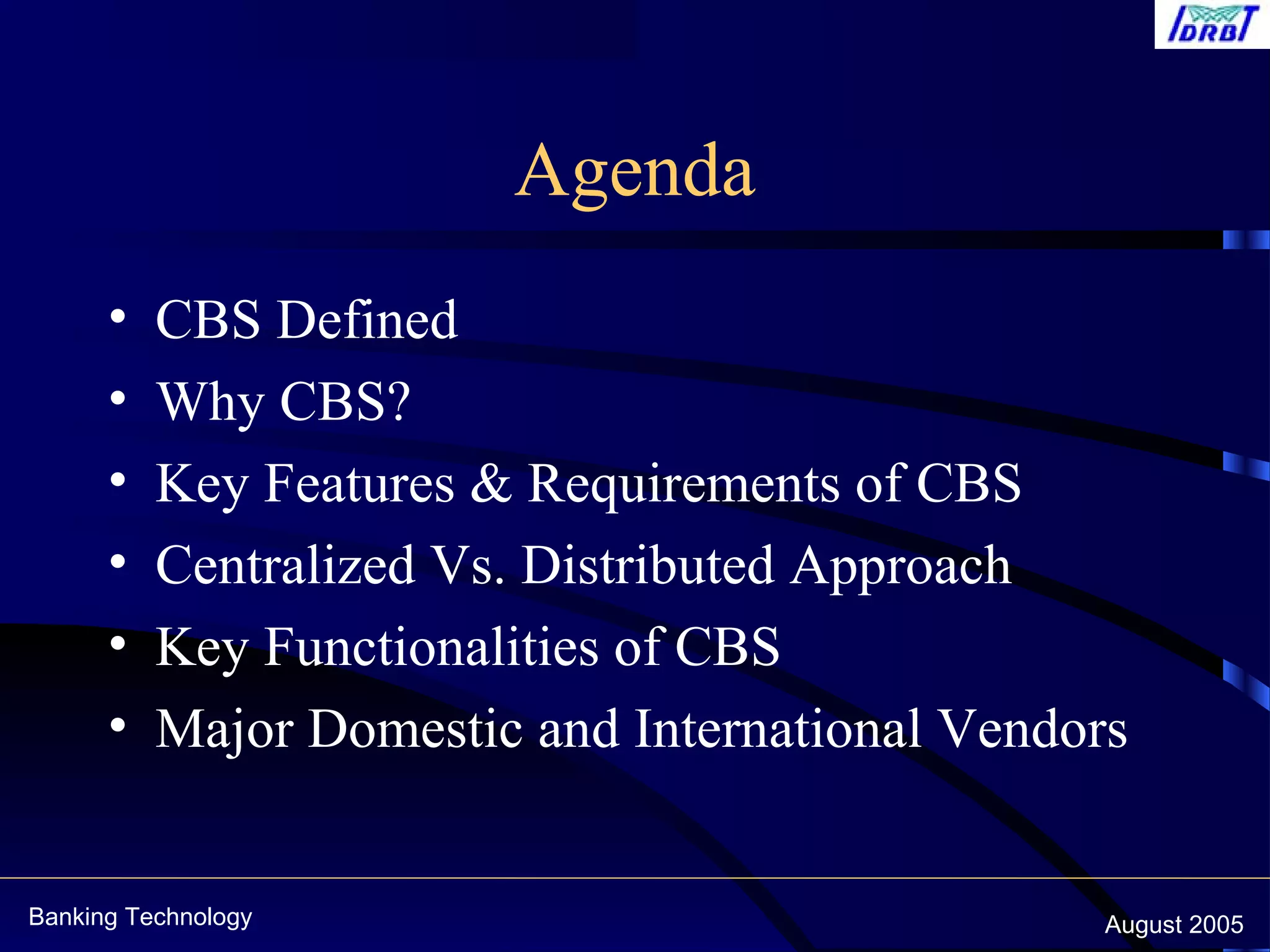
Agenda
• CBS Defined
• Why CBS?
• Key Features & Requirements of CBS
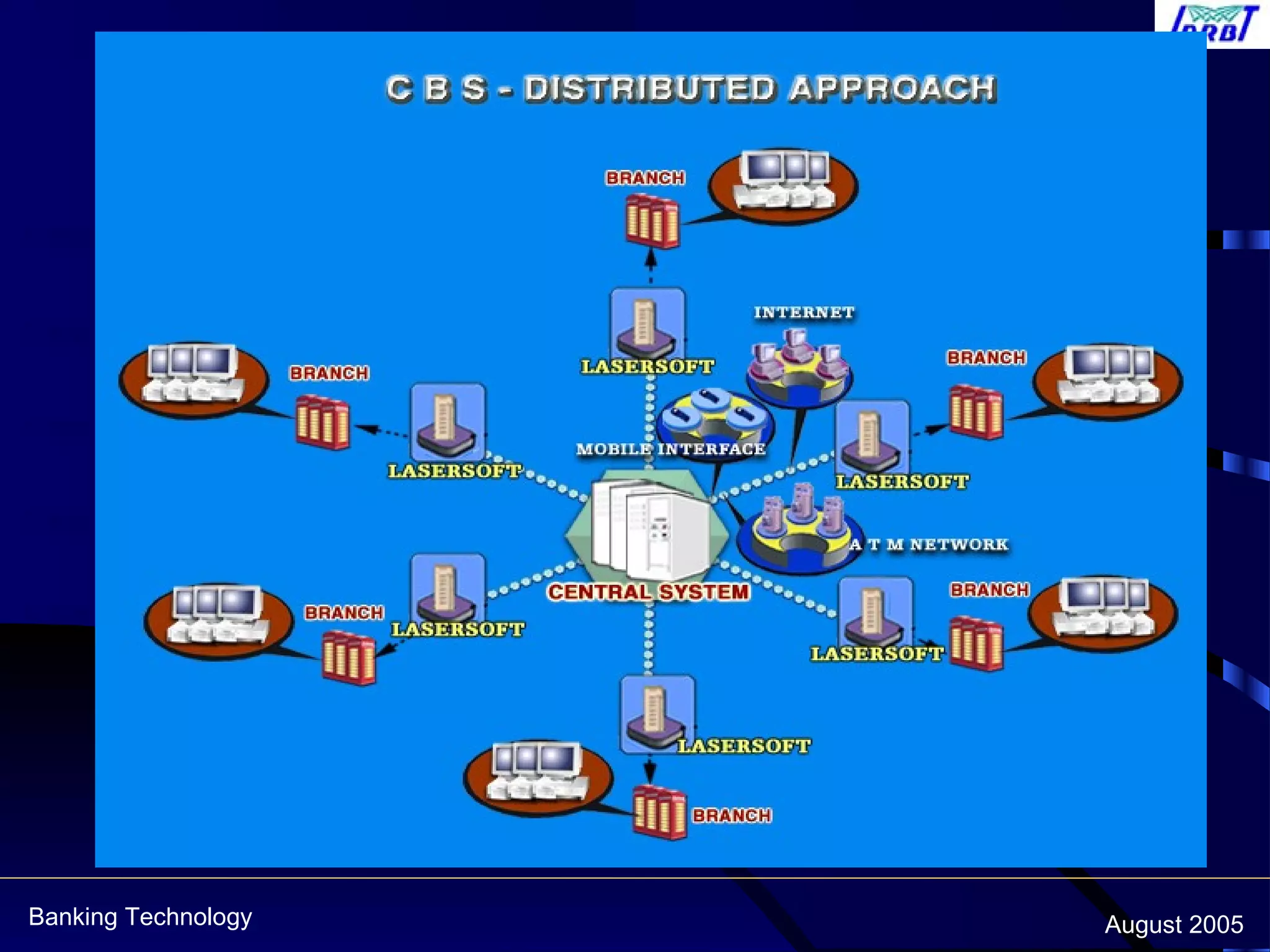
• Centralized Vs. Distributed Approach
• Key Functionalities of CBS
• Major Domestic and International Vendors
Banking Technology August 2005
Some facts…
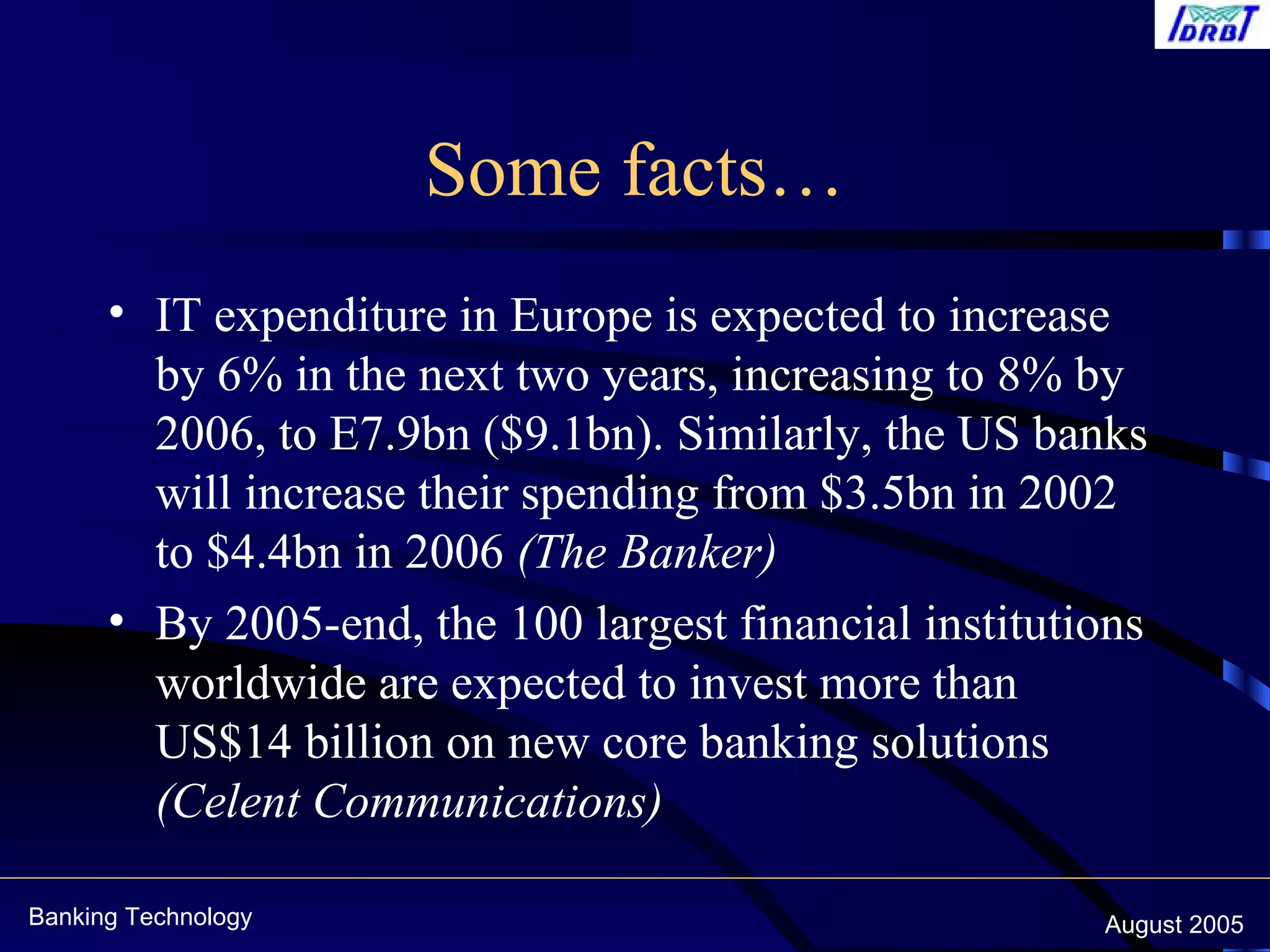
• IT expenditure in Europe is expected to increase
by 6% in the next two years, increasing to 8% by
2006, to E7.9bn ($9.1bn). Similarly, the US banks
will increase their spending from $3.5bn in 2002
to $4.4bn in 2006 (The Banker)
• By 2005-end, the 100 largest financial institutions
worldwide are expected to invest more than
US$14 billion on new core banking solutions
(Celent Communications)
Banking Technology August 2005
Definition
•  
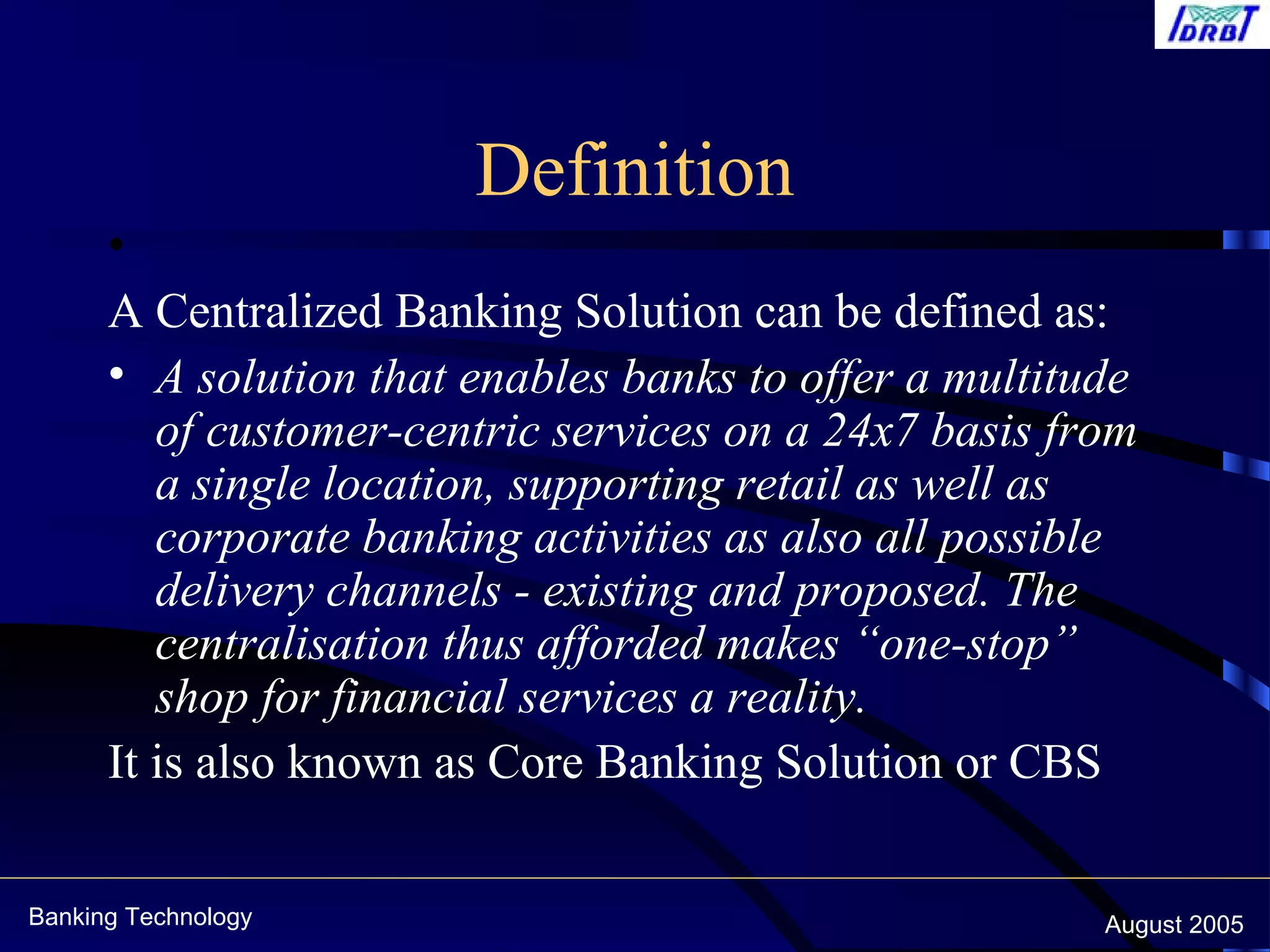
A Centralized Banking Solution can be defined as:
• A solution that enables banks to offer a multitude
of customer-centric services on a 24x7 basis from
a single location, supporting retail as well as
corporate banking activities as also all possible
delivery channels - existing and proposed. The
centralisation thus afforded makes “one-stop”
shop for financial services a reality.
It is also known as Core Banking Solution or CBS
Banking Technology August 2005
The Integration Mantra
• In the era of customer centricity, bank must
deliver all banking products and services
over all delivery channels.
• This is possible only by integrating:
– Delivery channels with core systems and
customer data
– Delivery channels with each other
– New channels, services, and technologies, as
quickly as they evolve
Banking Technology August 2005
Why CBS?
• Offer a “one-stop” IT management shop
• Make banks prepared for current as well as future
requirements
• Decrease the risks arising from solutions requiring
multiple components and multiple vendors
• Better the returns via seamless integration of
software and hardware services
• Provide a greater choice through the availability of
an array of technologies
• Up to date housekeeping and data and records
• Approximately 40% space savings and 30% staff
savings
Banking Technology August 2005
Innumerable More Benefits
• Centralized administration & standardization.
• Betters returns via seamless integration of software and hardware services
• Creates base for efficient MIS implementation via centralized databases
• Eliminates risks arising from solutions requiring multiple components and
multiple vendors
• Enables better M&A integration
• Enables launch of techno based services including cash management, Internet
Banking, ABB, Any Time & Any Where Banking.
• Facilitates integrated communications management
• Facilitates rapid deployment of Internet banking services and supports their
growth over time.
• Helps identify and execute cross-selling opportunities
• Makes banks prepared for current as well as future requirements
• Provides instant verifications and information to customers regarding their
transactions and enquiries
• Supports expanded functionalities like CRM, wealth management, and remote
banking
• Optimises training
• Reduces transaction costs ….and Many More
Banking Technology August 2005
Key Drivers for Adoption of
CBS
• Outdated hardware of existing systems
• Inadequacy of software for meeting current needs
• Changes in business model
• Need for better ownership costs
• Need for customer-oriented solutions
• “Spaghetti” Architectures
• CRM
Banking Technology August 2005
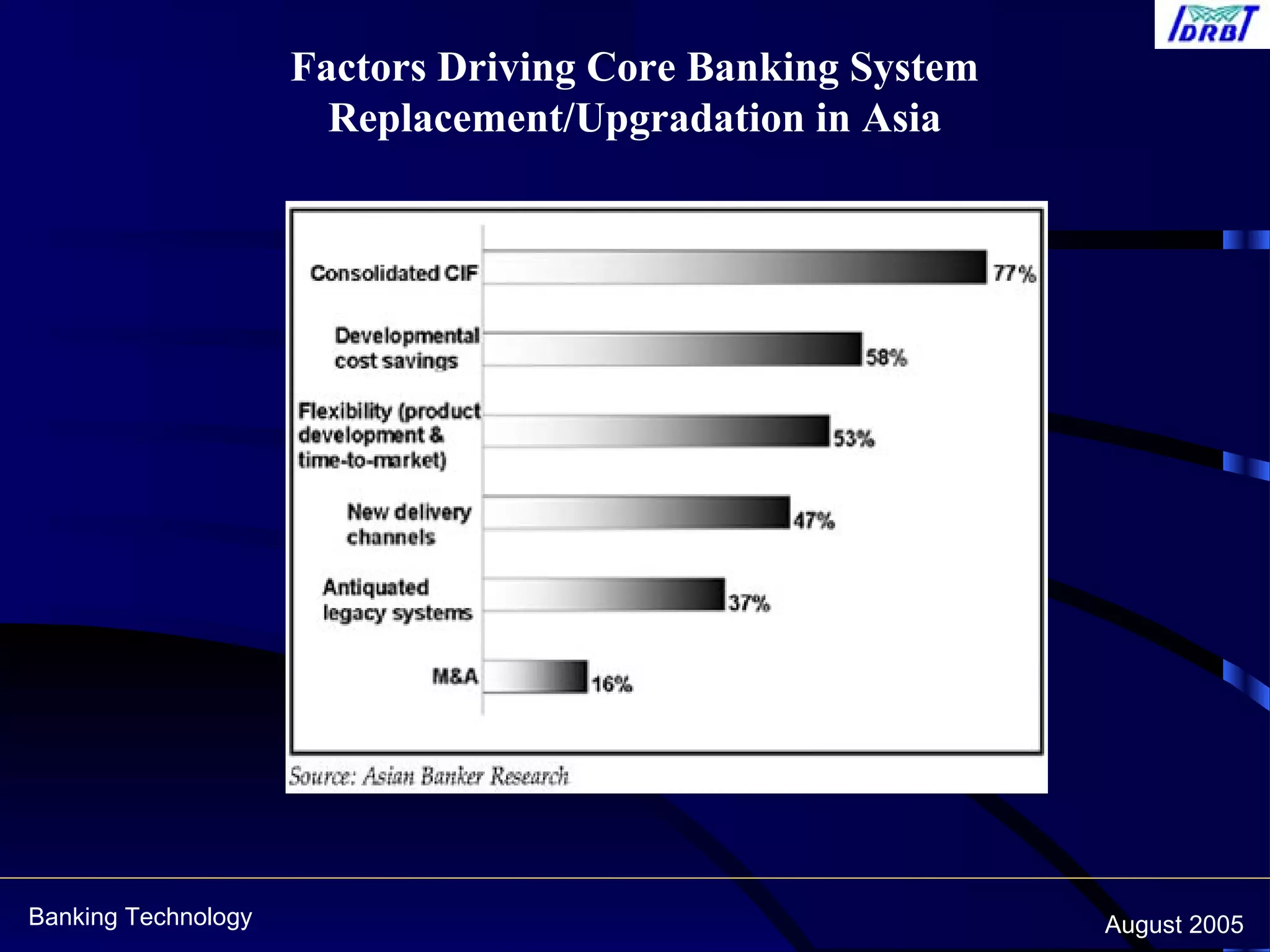
Factors Driving Core Banking System
Replacement/Upgradation in Asia
Banking Technology August 2005
Key Features of CBS
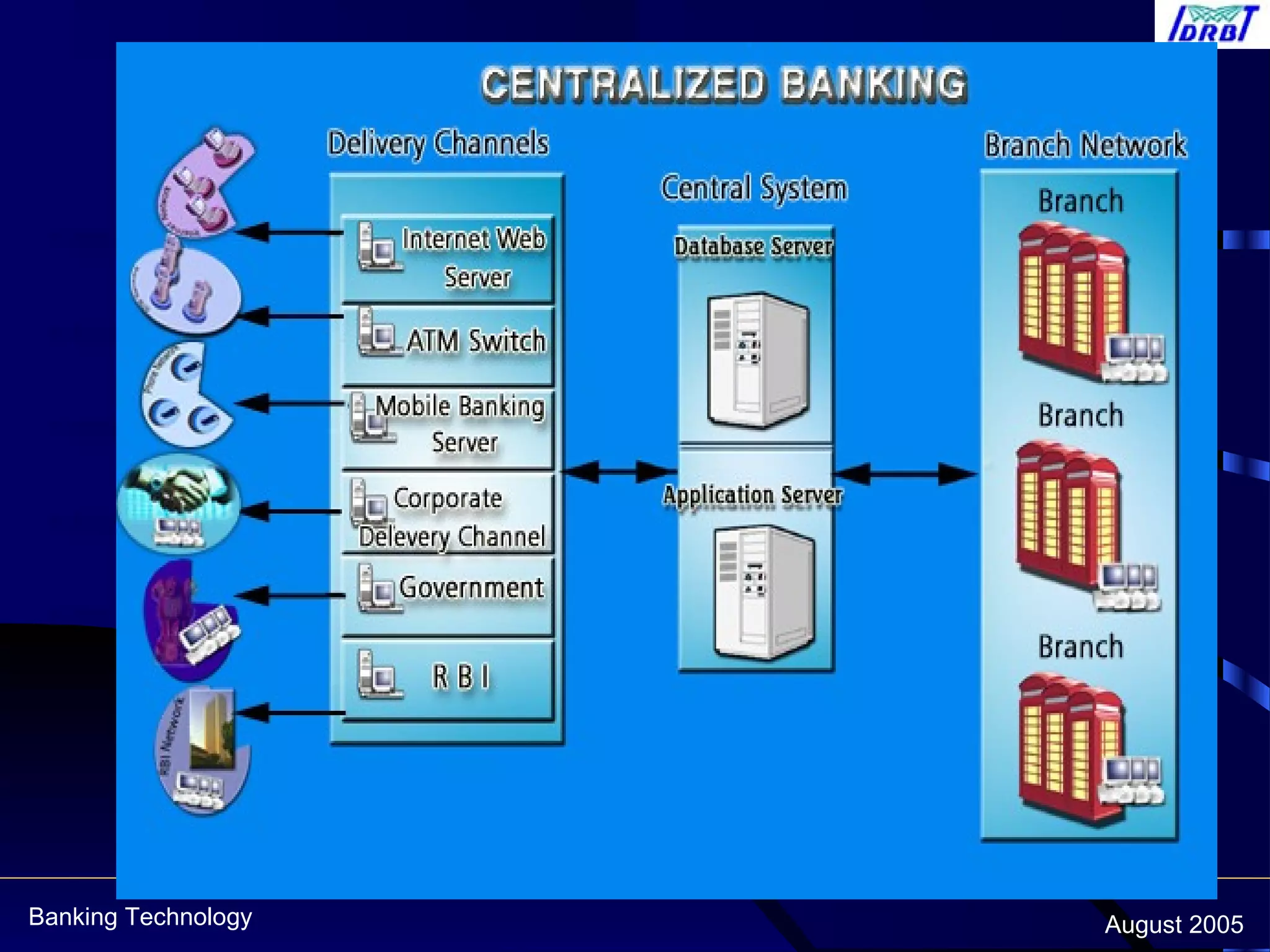
• A centralised server stores the total system software, utilities
and customer data. This server is linked via high-speed, secure,
redundant network to branches
• Branches offer services to customers and clear their queries
across the counter via online nodes
• Client server architecture ensures data updating on a per
transaction basis at the data centre
• Remote branches are provided with nodes that are linked
through satellite/terrestrial links with adequate redundancies
built in. This will ensure immediate response from the data
center
• The main server at the Data Centre is connected to all delivery
channels including ATMs, tele-banking, internet banking and
mobile banking
Banking Technology August 2005
Data Center – Heart of the Matter
“Centralized repository for the storage,
management and dissemination of data and
information.”
Hosts critical equipment such as high-end
servers, ATM switch, UPS
Needs strong security measures
Requires appropriate Disaster Recovery Site
Banking Technology August 2005
The Key Requirements
• Software
– Application software for all modules
– Systems software (Operating System, Compilers, Utilities)
– RDBMS (such as Oracle, MS SQL Server, DB2 etc)
• Hardware
– Servers, PCs & Peripherals
– Networking Equipment
– Power & UPS
• Security
– Anti-virus software, Firewall
– Intrusion Detection System
– Physical security tools
• Documentation
Banking Technology August 2005
The Application SW must support:
• All retail modules including deposits and advances in
all their forms and versions
• Bank’s MIS and accounting requirements
• Foreign exchange functions
• Corporate banking activities
• All delivery channels including branches, ATMs,
Internet Banking, Tele Banking, Mobile Banking, etc.
• Interfaces with all applications existing at the branches,
regional and head offices
• Interfaces with inter-bank systems
Banking Technology August 2005
Software Strategy: Two basic
approaches
• Distributed branch automation with
interconnected branches
– Automate the branches in stages
– Provide interconnectivity across select branches
• Centralized Model
– Centralized transaction processing
– Branch effectively acting as a delivery channel
Banking Technology August 2005
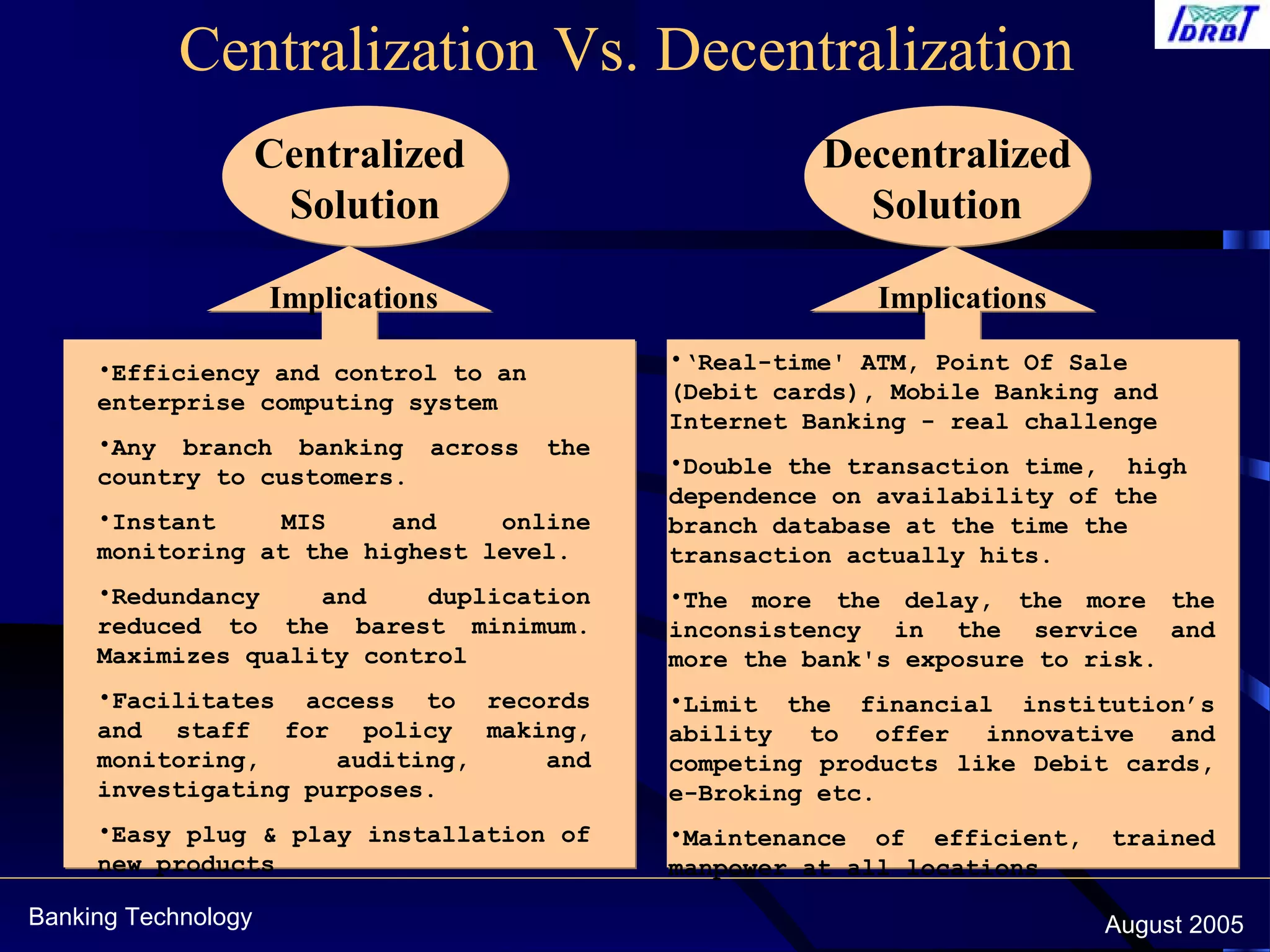
Centralization Vs. Decentralization
Centralized
Solution
Centralized
Solution
Decentralized
Solution
Decentralized
Solution
•‘Real-time' ATM, Point Of Sale
(Debit cards), Mobile Banking and
Internet Banking - real challenge
•Double the transaction time, high
dependence on availability of the
branch database at the time the
transaction actually hits.
•The more the delay, the more the
inconsistency in the service and
more the bank's exposure to risk.
•Limit the financial institution’s
ability to offer innovative and
competing products like Debit cards,
e-Broking etc.
•Maintenance of efficient, trained
manpower at all locations
•Efficiency and control to an
enterprise computing system
•Any branch banking across the
country to customers.
•Instant MIS and online
monitoring at the highest level.
•Redundancy and duplication
reduced to the barest minimum.
Maximizes quality control
•Facilitates access to records
and staff for policy making,
monitoring, auditing, and
investigating purposes.
•Easy plug & play installation of
new products
Implications Implications
Banking Technology August 2005
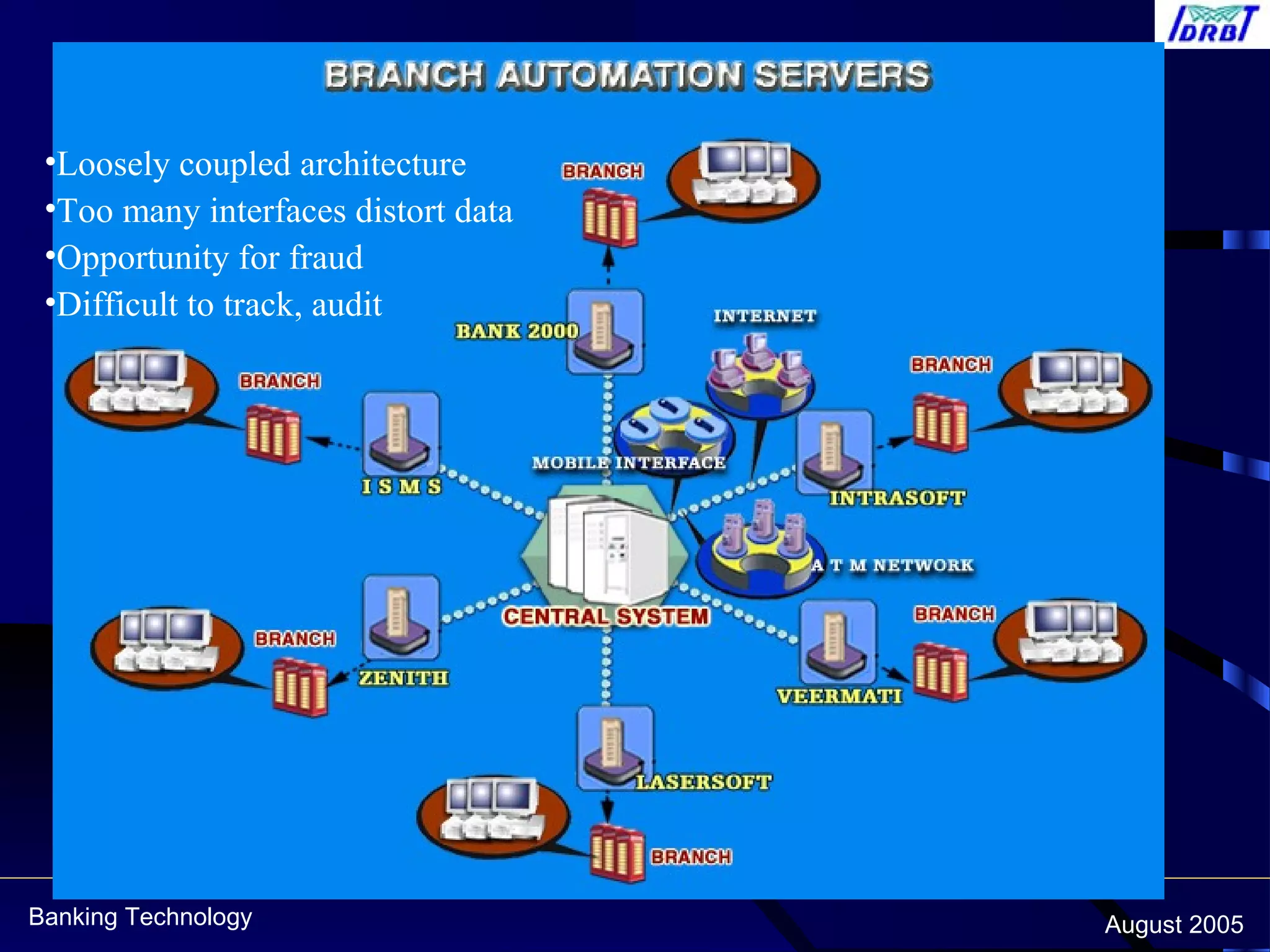
•Loosely coupled architecture
•Too many interfaces distort data
•Opportunity for fraud
•Difficult to track, audit
Banking Technology August 2005
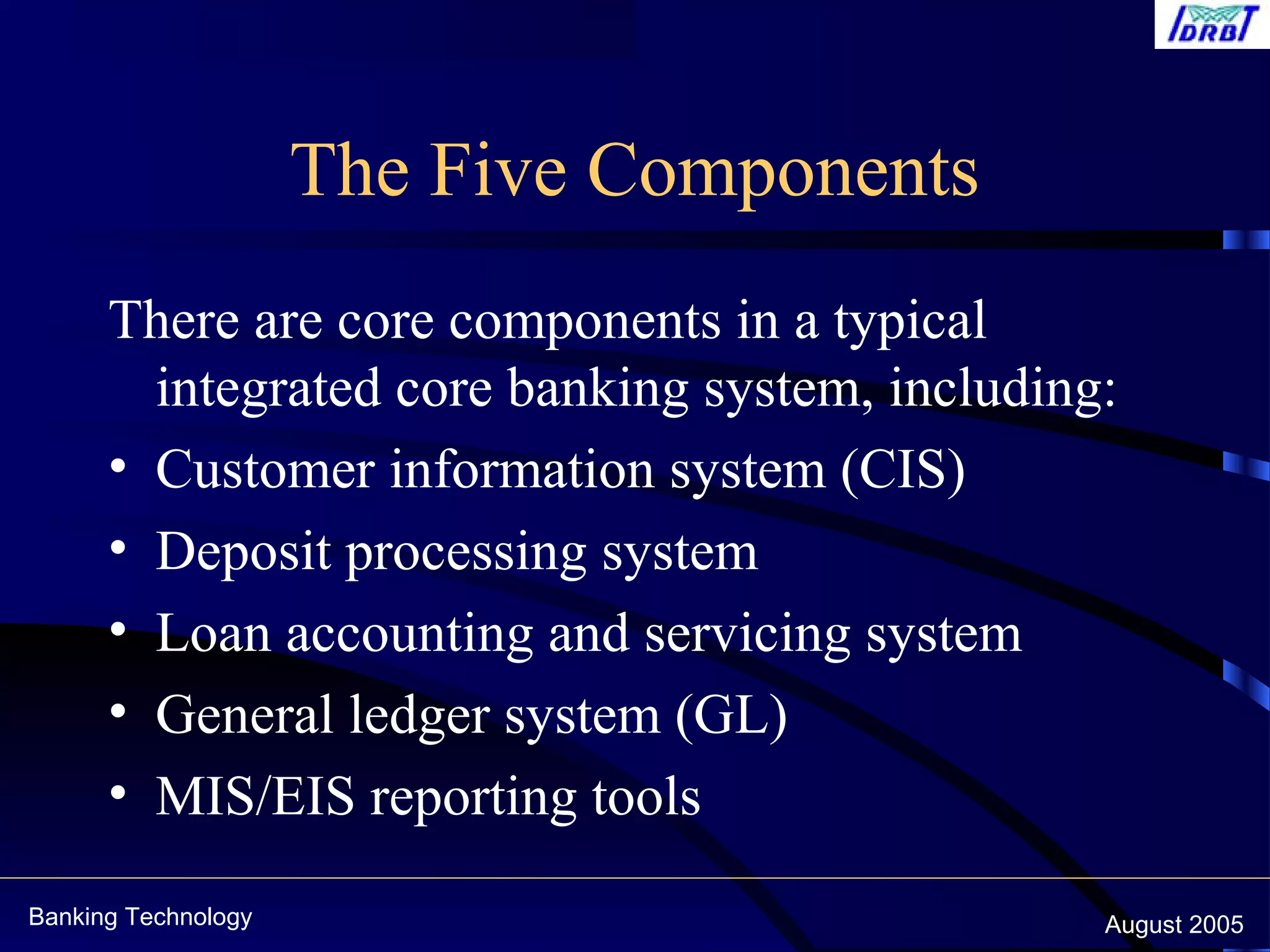
The Five Components
There are core components in a typical
integrated core banking system, including:
• Customer information system (CIS)
• Deposit processing system
• Loan accounting and servicing system
• General ledger system (GL)
• MIS/EIS reporting tools
Banking Technology August 2005
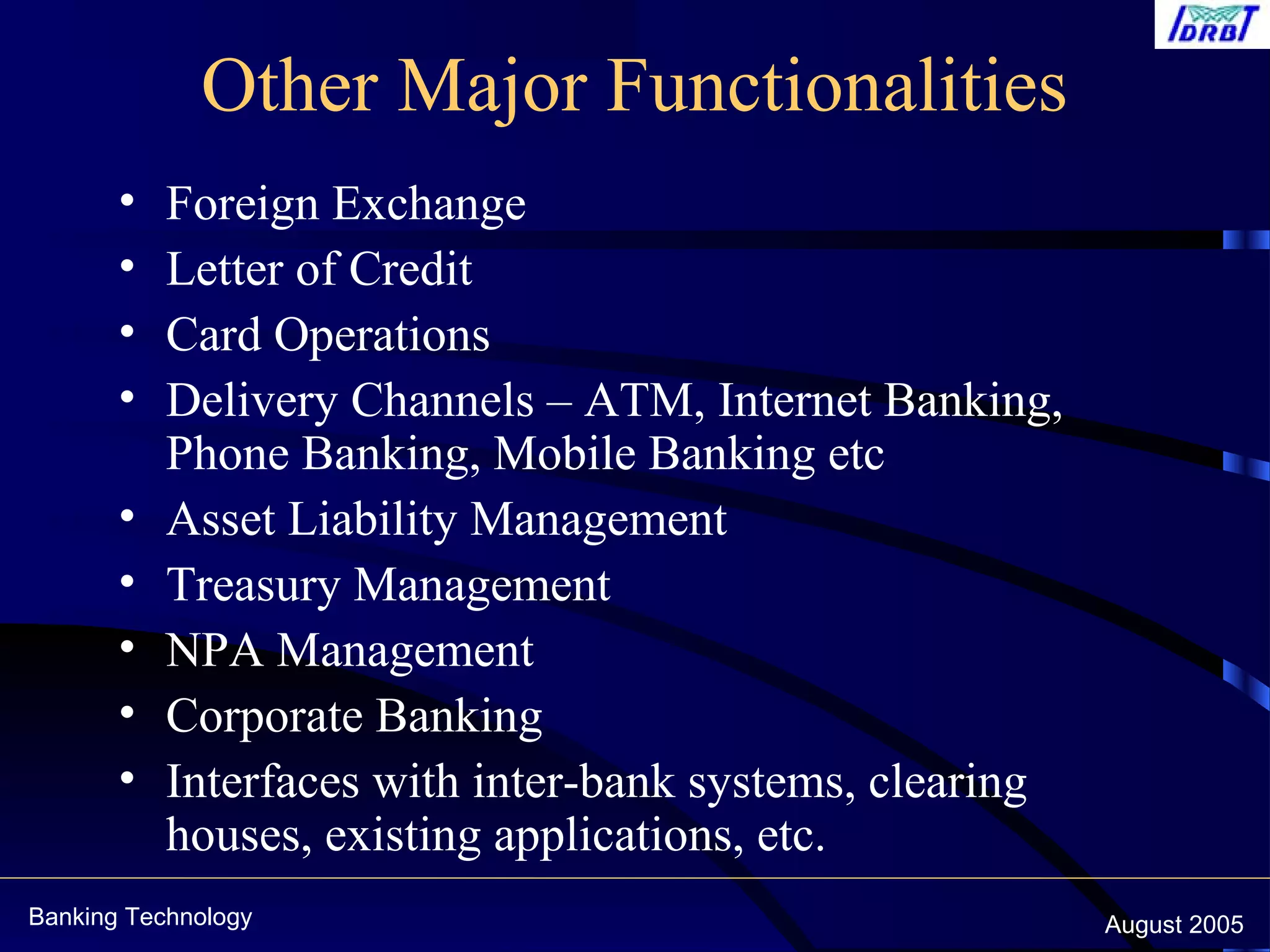
Other Major Functionalities
• Foreign Exchange
• Letter of Credit
• Card Operations
• Delivery Channels – ATM, Internet Banking,
Phone Banking, Mobile Banking etc
• Asset Liability Management
• Treasury Management
• NPA Management
• Corporate Banking
• Interfaces with inter-bank systems, clearing
houses, existing applications, etc.
Banking Technology August 2005
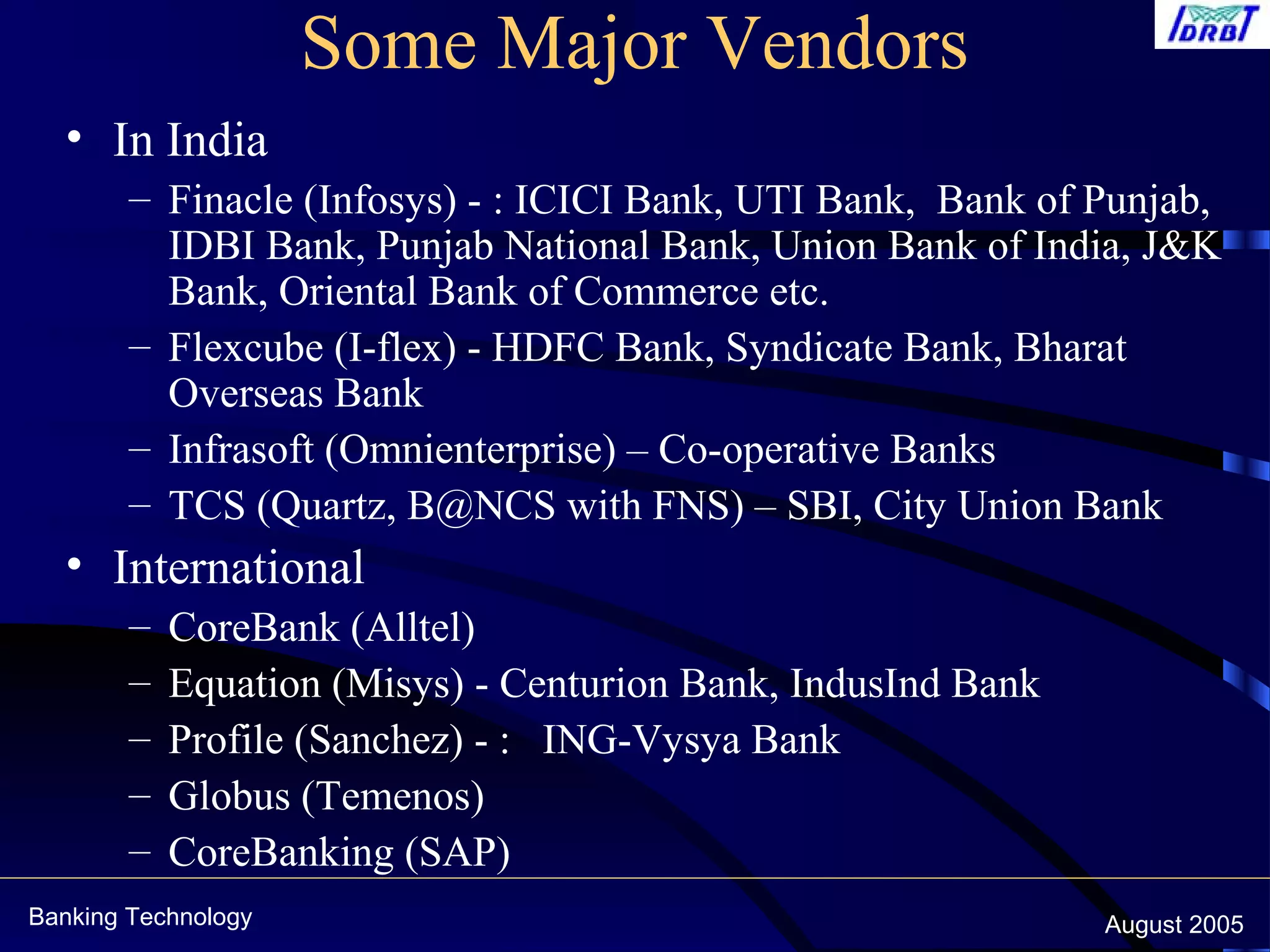
Some Major Vendors
• In India
– Finacle (Infosys) - : ICICI Bank, UTI Bank, Bank of Punjab,
IDBI Bank, Punjab National Bank, Union Bank of India, J&K
Bank, Oriental Bank of Commerce etc.
– Flexcube (I-flex) - HDFC Bank, Syndicate Bank, Bharat
Overseas Bank
– Infrasoft (Omnienterprise) – Co-operative Banks
– TCS (Quartz, B@NCS with FNS) – SBI, City Union Bank
• International
– CoreBank (Alltel)
– Equation (Misys) - Centurion Bank, IndusInd Bank
– Profile (Sanchez) - : ING-Vysya Bank
– Globus (Temenos)
– CoreBanking (SAP)

Cbs concepts and opportunities

  • 1.
    Banking Technology Centralized Banking– Concepts and Opportunities
  • 2.
    Banking Technology August2005 Agenda • CBS Defined • Why CBS? • Key Features & Requirements of CBS • Centralized Vs. Distributed Approach • Key Functionalities of CBS • Major Domestic and International Vendors
  • 3.
    Banking Technology August2005 Some facts… • IT expenditure in Europe is expected to increase by 6% in the next two years, increasing to 8% by 2006, to E7.9bn ($9.1bn). Similarly, the US banks will increase their spending from $3.5bn in 2002 to $4.4bn in 2006 (The Banker) • By 2005-end, the 100 largest financial institutions worldwide are expected to invest more than US$14 billion on new core banking solutions (Celent Communications)
  • 4.
    Banking Technology August2005 Definition •   A Centralized Banking Solution can be defined as: • A solution that enables banks to offer a multitude of customer-centric services on a 24x7 basis from a single location, supporting retail as well as corporate banking activities as also all possible delivery channels - existing and proposed. The centralisation thus afforded makes “one-stop” shop for financial services a reality. It is also known as Core Banking Solution or CBS
  • 5.
    Banking Technology August2005 The Integration Mantra • In the era of customer centricity, bank must deliver all banking products and services over all delivery channels. • This is possible only by integrating: – Delivery channels with core systems and customer data – Delivery channels with each other – New channels, services, and technologies, as quickly as they evolve
  • 6.
    Banking Technology August2005 Why CBS? • Offer a “one-stop” IT management shop • Make banks prepared for current as well as future requirements • Decrease the risks arising from solutions requiring multiple components and multiple vendors • Better the returns via seamless integration of software and hardware services • Provide a greater choice through the availability of an array of technologies • Up to date housekeeping and data and records • Approximately 40% space savings and 30% staff savings
  • 7.
    Banking Technology August2005 Innumerable More Benefits • Centralized administration & standardization. • Betters returns via seamless integration of software and hardware services • Creates base for efficient MIS implementation via centralized databases • Eliminates risks arising from solutions requiring multiple components and multiple vendors • Enables better M&A integration • Enables launch of techno based services including cash management, Internet Banking, ABB, Any Time & Any Where Banking. • Facilitates integrated communications management • Facilitates rapid deployment of Internet banking services and supports their growth over time. • Helps identify and execute cross-selling opportunities • Makes banks prepared for current as well as future requirements • Provides instant verifications and information to customers regarding their transactions and enquiries • Supports expanded functionalities like CRM, wealth management, and remote banking • Optimises training • Reduces transaction costs ….and Many More
  • 8.
    Banking Technology August2005 Key Drivers for Adoption of CBS • Outdated hardware of existing systems • Inadequacy of software for meeting current needs • Changes in business model • Need for better ownership costs • Need for customer-oriented solutions • “Spaghetti” Architectures • CRM
  • 9.
    Banking Technology August2005 Factors Driving Core Banking System Replacement/Upgradation in Asia
  • 10.
    Banking Technology August2005 Key Features of CBS • A centralised server stores the total system software, utilities and customer data. This server is linked via high-speed, secure, redundant network to branches • Branches offer services to customers and clear their queries across the counter via online nodes • Client server architecture ensures data updating on a per transaction basis at the data centre • Remote branches are provided with nodes that are linked through satellite/terrestrial links with adequate redundancies built in. This will ensure immediate response from the data center • The main server at the Data Centre is connected to all delivery channels including ATMs, tele-banking, internet banking and mobile banking
  • 11.
    Banking Technology August2005 Data Center – Heart of the Matter “Centralized repository for the storage, management and dissemination of data and information.” Hosts critical equipment such as high-end servers, ATM switch, UPS Needs strong security measures Requires appropriate Disaster Recovery Site
  • 12.
    Banking Technology August2005 The Key Requirements • Software – Application software for all modules – Systems software (Operating System, Compilers, Utilities) – RDBMS (such as Oracle, MS SQL Server, DB2 etc) • Hardware – Servers, PCs & Peripherals – Networking Equipment – Power & UPS • Security – Anti-virus software, Firewall – Intrusion Detection System – Physical security tools • Documentation
  • 13.
    Banking Technology August2005 The Application SW must support: • All retail modules including deposits and advances in all their forms and versions • Bank’s MIS and accounting requirements • Foreign exchange functions • Corporate banking activities • All delivery channels including branches, ATMs, Internet Banking, Tele Banking, Mobile Banking, etc. • Interfaces with all applications existing at the branches, regional and head offices • Interfaces with inter-bank systems
  • 14.
    Banking Technology August2005 Software Strategy: Two basic approaches • Distributed branch automation with interconnected branches – Automate the branches in stages – Provide interconnectivity across select branches • Centralized Model – Centralized transaction processing – Branch effectively acting as a delivery channel
  • 15.
    Banking Technology August2005 Centralization Vs. Decentralization Centralized Solution Centralized Solution Decentralized Solution Decentralized Solution •‘Real-time' ATM, Point Of Sale (Debit cards), Mobile Banking and Internet Banking - real challenge •Double the transaction time, high dependence on availability of the branch database at the time the transaction actually hits. •The more the delay, the more the inconsistency in the service and more the bank's exposure to risk. •Limit the financial institution’s ability to offer innovative and competing products like Debit cards, e-Broking etc. •Maintenance of efficient, trained manpower at all locations •Efficiency and control to an enterprise computing system •Any branch banking across the country to customers. •Instant MIS and online monitoring at the highest level. •Redundancy and duplication reduced to the barest minimum. Maximizes quality control •Facilitates access to records and staff for policy making, monitoring, auditing, and investigating purposes. •Easy plug & play installation of new products Implications Implications
  • 16.
    Banking Technology August2005 •Loosely coupled architecture •Too many interfaces distort data •Opportunity for fraud •Difficult to track, audit
  • 17.
  • 18.
  • 19.
    Banking Technology August2005 The Five Components There are core components in a typical integrated core banking system, including: • Customer information system (CIS) • Deposit processing system • Loan accounting and servicing system • General ledger system (GL) • MIS/EIS reporting tools
  • 20.
    Banking Technology August2005 Other Major Functionalities • Foreign Exchange • Letter of Credit • Card Operations • Delivery Channels – ATM, Internet Banking, Phone Banking, Mobile Banking etc • Asset Liability Management • Treasury Management • NPA Management • Corporate Banking • Interfaces with inter-bank systems, clearing houses, existing applications, etc.
  • 21.
    Banking Technology August2005 Some Major Vendors • In India – Finacle (Infosys) - : ICICI Bank, UTI Bank, Bank of Punjab, IDBI Bank, Punjab National Bank, Union Bank of India, J&K Bank, Oriental Bank of Commerce etc. – Flexcube (I-flex) - HDFC Bank, Syndicate Bank, Bharat Overseas Bank – Infrasoft (Omnienterprise) – Co-operative Banks – TCS (Quartz, B@NCS with FNS) – SBI, City Union Bank • International – CoreBank (Alltel) – Equation (Misys) - Centurion Bank, IndusInd Bank – Profile (Sanchez) - : ING-Vysya Bank – Globus (Temenos) – CoreBanking (SAP)