Banking Technology
Centralized Banking-
Challenges, Implementation
and Management Issues
Banking Technology August 2005
In Brief
Key Issues
CBS Implementation Issues
Implementation Guidelines
Critical Success Factors
Business Continuity Essentials
Banking Technology August 2005
Three Kinds of Issues
• Pre-Implementation – The Groundwork required
• Implementation – What to do during
implementation
• Post-Implementation – Change Management,
BPR, Training, Maintenance
Less than 10% of failures are due toLess than 10% of failures are due to
technical snags – most are due to poortechnical snags – most are due to poor
management and implementation”management and implementation”
Banking Technology August 2005
The Key Issues in a Nutshell
• People issues
• Change management
• Legacy systems
• Infrastructure
• Customer Trust
• Governance
• Security
• Legal/regulatory issues
Banking Technology August 2005
People Issues
• At the core are –
– Resistance to change
– Career Progression
• After CBS, there is urgent need for:
– redeployment and redefinition of jobs
– New skills
– “Young Blood”
People represent the most
precious asset
Banking Technology August 2005
People Issues
• A typical average sized bank has 2-3% IT specialists
• Need to increase this to 20%
• about 12-15% of staff in banks are involved in
administrative activities … in tech savvy banks it is 6-
8% - PSBs to aim for 10%
Ultimately, the banker of future must be a “Technology and
Application Manager” having knowledge of technology,
application and management
Banking Technology August 2005
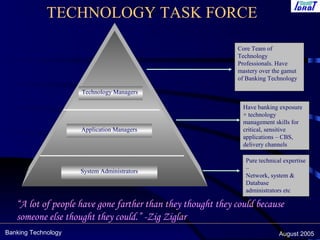
Technology Managers
Application Managers
System Administrators
Pure technical expertise
–
Network, system &
Database
administrators etc
Have banking exposure
+ technology
management skills for
critical, sensitive
applications – CBS,
delivery channels
Core Team of
Technology
Professionals. Have
mastery over the gamut
of Banking Technology
TECHNOLOGY TASK FORCE
“A lot of people have gone farther than they thought they could because
someone else thought they could.” -Zig Ziglar
Banking Technology August 2005
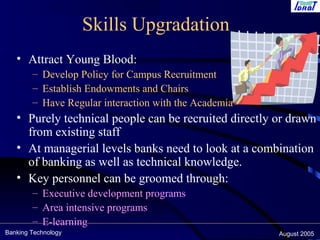
Skills Upgradation
• Attract Young Blood:
– Develop Policy for Campus Recruitment
– Establish Endowments and Chairs
– Have Regular interaction with the Academia
• Purely technical people can be recruited directly or drawn
from existing staff
• At managerial levels banks need to look at a combination
of banking as well as technical knowledge.
• Key personnel can be groomed through:
– Executive development programs
– Area intensive programs
– E-learning
Banking Technology August 2005
Change Management
• “Tell me and I will forget, show me and I may
remember, involve me and I will understand”
• Ushering in change is never easy
• Banks need to:
– Develop appropriate policies and procedure for
change management
– Train employees in their new duties
– Involve employees
Banking Technology August 2005
Legacy Systems
“During the 80s and 90s, there was not one Top 100
bank globally that could change its core banking
platform successfully” (Celent)
Major issues involved:
• Limits on capital, resources and operating
expenses
• The training required
• Risk of losing customers
• Data Cleansing and migration issues
Banking Technology August 2005
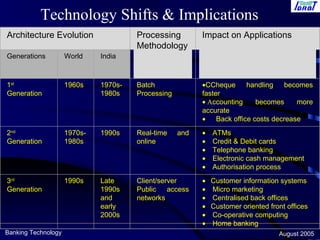
Architecture Evolution Processing
Methodology
Impact on Applications
Generations World India
1st
Generation
1960s 1970s-
1980s
Batch
Processing
•CCheque handling becomes
faster
• Accounting becomes more
accurate
• Back office costs decrease
2nd
Generation
1970s-
1980s
1990s Real-time and
online
• ATMs
• Credit & Debit cards
• Telephone banking
• Electronic cash management
• Authorisation process
3rd
Generation
1990s Late
1990s
and
early
2000s
Client/server
Public access
networks
• Customer information systems
• Micro marketing
• Centralised back offices
• Customer oriented front offices
• Co-operative computing
• Home banking
Technology Shifts & Implications
Banking Technology August 2005
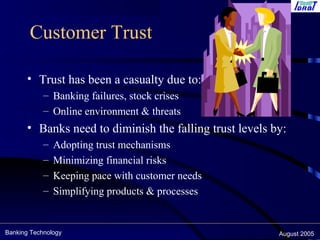
Customer Trust
• Trust has been a casualty due to:
– Banking failures, stock crises
– Online environment & threats
• Banks need to diminish the falling trust levels by:
– Adopting trust mechanisms
– Minimizing financial risks
– Keeping pace with customer needs
– Simplifying products & processes
Banking Technology August 2005
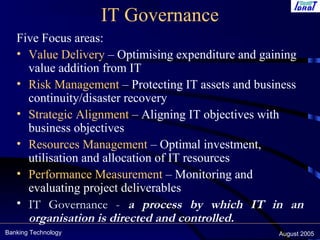
IT Governance
Five Focus areas:
• Value Delivery – Optimising expenditure and gaining
value addition from IT
• Risk Management – Protecting IT assets and business
continuity/disaster recovery
• Strategic Alignment – Aligning IT objectives with
business objectives
• Resources Management – Optimal investment,
utilisation and allocation of IT resources
• Performance Measurement – Monitoring and
evaluating project deliverables
• IT Governance - a process by which IT in an
organisation is directed and controlled.
Banking Technology August 2005
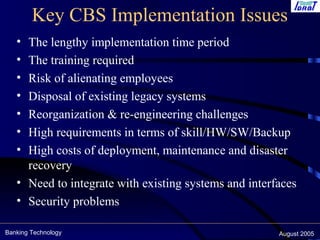
Key CBS Implementation Issues
• The lengthy implementation time period
• The training required
• Risk of alienating employees
• Disposal of existing legacy systems
• Reorganization & re-engineering challenges
• High requirements in terms of skill/HW/SW/Backup
• High costs of deployment, maintenance and disaster
recovery
• Need to integrate with existing systems and interfaces
• Security problems
Banking Technology August 2005
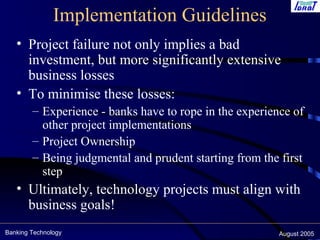
Implementation Guidelines
• Project failure not only implies a bad
investment, but more significantly extensive
business losses
• To minimise these losses:
– Experience - banks have to rope in the experience of
other project implementations
– Project Ownership
– Being judgmental and prudent starting from the first
step
• Ultimately, technology projects must align with
business goals!
Banking Technology August 2005
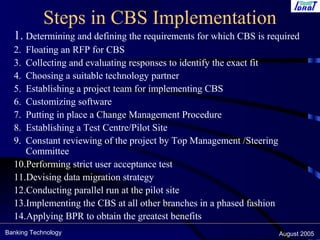
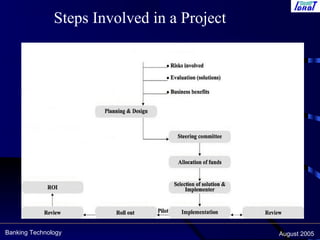
Steps in CBS Implementation
1. Determining and defining the requirements for which CBS is required
2. Floating an RFP for CBS
3. Collecting and evaluating responses to identify the exact fit
4. Choosing a suitable technology partner
5. Establishing a project team for implementing CBS
6. Customizing software
7. Putting in place a Change Management Procedure
8. Establishing a Test Centre/Pilot Site
9. Constant reviewing of the project by Top Management /Steering
Committee
10.Performing strict user acceptance test
11.Devising data migration strategy
12.Conducting parallel run at the pilot site
13.Implementing the CBS at all other branches in a phased fashion
14.Applying BPR to obtain the greatest benefits
Banking Technology August 2005
Steps Involved in a Project
Banking Technology August 2005
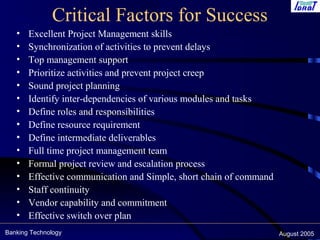
Critical Factors for Success
• Excellent Project Management skills
• Synchronization of activities to prevent delays
• Top management support
• Prioritize activities and prevent project creep
• Sound project planning
• Identify inter-dependencies of various modules and tasks
• Define roles and responsibilities
• Define resource requirement
• Define intermediate deliverables
• Full time project management team
• Formal project review and escalation process
• Effective communication and Simple, short chain of command
• Staff continuity
• Vendor capability and commitment
• Effective switch over plan
Banking Technology August 2005
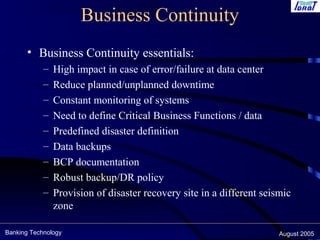
Business Continuity
• Business Continuity essentials:
– High impact in case of error/failure at data center
– Reduce planned/unplanned downtime
– Constant monitoring of systems
– Need to define Critical Business Functions / data
– Predefined disaster definition
– Data backups
– BCP documentation
– Robust backup/DR policy
– Provision of disaster recovery site in a different seismic
zone
Banking Technology August 2005
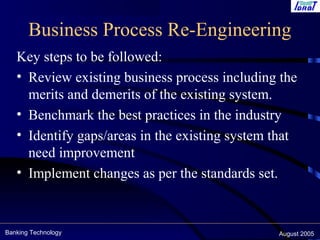
Business Process Re-Engineering
Key steps to be followed:
• Review existing business process including the
merits and demerits of the existing system.
• Benchmark the best practices in the industry
• Identify gaps/areas in the existing system that
need improvement
• Implement changes as per the standards set.
Banking Technology August 2005

CENTRALIZED challenges implementation and MANAGEMENT issues

  • 1.
    Banking Technology Centralized Banking- Challenges,Implementation and Management Issues
  • 2.
    Banking Technology August2005 In Brief Key Issues CBS Implementation Issues Implementation Guidelines Critical Success Factors Business Continuity Essentials
  • 3.
    Banking Technology August2005 Three Kinds of Issues • Pre-Implementation – The Groundwork required • Implementation – What to do during implementation • Post-Implementation – Change Management, BPR, Training, Maintenance Less than 10% of failures are due toLess than 10% of failures are due to technical snags – most are due to poortechnical snags – most are due to poor management and implementation”management and implementation”
  • 4.
    Banking Technology August2005 The Key Issues in a Nutshell • People issues • Change management • Legacy systems • Infrastructure • Customer Trust • Governance • Security • Legal/regulatory issues
  • 5.
    Banking Technology August2005 People Issues • At the core are – – Resistance to change – Career Progression • After CBS, there is urgent need for: – redeployment and redefinition of jobs – New skills – “Young Blood” People represent the most precious asset
  • 6.
    Banking Technology August2005 People Issues • A typical average sized bank has 2-3% IT specialists • Need to increase this to 20% • about 12-15% of staff in banks are involved in administrative activities … in tech savvy banks it is 6- 8% - PSBs to aim for 10% Ultimately, the banker of future must be a “Technology and Application Manager” having knowledge of technology, application and management
  • 7.
    Banking Technology August2005 Technology Managers Application Managers System Administrators Pure technical expertise – Network, system & Database administrators etc Have banking exposure + technology management skills for critical, sensitive applications – CBS, delivery channels Core Team of Technology Professionals. Have mastery over the gamut of Banking Technology TECHNOLOGY TASK FORCE “A lot of people have gone farther than they thought they could because someone else thought they could.” -Zig Ziglar
  • 8.
    Banking Technology August2005 Skills Upgradation • Attract Young Blood: – Develop Policy for Campus Recruitment – Establish Endowments and Chairs – Have Regular interaction with the Academia • Purely technical people can be recruited directly or drawn from existing staff • At managerial levels banks need to look at a combination of banking as well as technical knowledge. • Key personnel can be groomed through: – Executive development programs – Area intensive programs – E-learning
  • 9.
    Banking Technology August2005 Change Management • “Tell me and I will forget, show me and I may remember, involve me and I will understand” • Ushering in change is never easy • Banks need to: – Develop appropriate policies and procedure for change management – Train employees in their new duties – Involve employees
  • 10.
    Banking Technology August2005 Legacy Systems “During the 80s and 90s, there was not one Top 100 bank globally that could change its core banking platform successfully” (Celent) Major issues involved: • Limits on capital, resources and operating expenses • The training required • Risk of losing customers • Data Cleansing and migration issues
  • 11.
    Banking Technology August2005 Architecture Evolution Processing Methodology Impact on Applications Generations World India 1st Generation 1960s 1970s- 1980s Batch Processing •CCheque handling becomes faster • Accounting becomes more accurate • Back office costs decrease 2nd Generation 1970s- 1980s 1990s Real-time and online • ATMs • Credit & Debit cards • Telephone banking • Electronic cash management • Authorisation process 3rd Generation 1990s Late 1990s and early 2000s Client/server Public access networks • Customer information systems • Micro marketing • Centralised back offices • Customer oriented front offices • Co-operative computing • Home banking Technology Shifts & Implications
  • 12.
    Banking Technology August2005 Customer Trust • Trust has been a casualty due to: – Banking failures, stock crises – Online environment & threats • Banks need to diminish the falling trust levels by: – Adopting trust mechanisms – Minimizing financial risks – Keeping pace with customer needs – Simplifying products & processes
  • 13.
    Banking Technology August2005 IT Governance Five Focus areas: • Value Delivery – Optimising expenditure and gaining value addition from IT • Risk Management – Protecting IT assets and business continuity/disaster recovery • Strategic Alignment – Aligning IT objectives with business objectives • Resources Management – Optimal investment, utilisation and allocation of IT resources • Performance Measurement – Monitoring and evaluating project deliverables • IT Governance - a process by which IT in an organisation is directed and controlled.
  • 14.
    Banking Technology August2005 Key CBS Implementation Issues • The lengthy implementation time period • The training required • Risk of alienating employees • Disposal of existing legacy systems • Reorganization & re-engineering challenges • High requirements in terms of skill/HW/SW/Backup • High costs of deployment, maintenance and disaster recovery • Need to integrate with existing systems and interfaces • Security problems
  • 15.
    Banking Technology August2005 Implementation Guidelines • Project failure not only implies a bad investment, but more significantly extensive business losses • To minimise these losses: – Experience - banks have to rope in the experience of other project implementations – Project Ownership – Being judgmental and prudent starting from the first step • Ultimately, technology projects must align with business goals!
  • 16.
    Banking Technology August2005 Steps in CBS Implementation 1. Determining and defining the requirements for which CBS is required 2. Floating an RFP for CBS 3. Collecting and evaluating responses to identify the exact fit 4. Choosing a suitable technology partner 5. Establishing a project team for implementing CBS 6. Customizing software 7. Putting in place a Change Management Procedure 8. Establishing a Test Centre/Pilot Site 9. Constant reviewing of the project by Top Management /Steering Committee 10.Performing strict user acceptance test 11.Devising data migration strategy 12.Conducting parallel run at the pilot site 13.Implementing the CBS at all other branches in a phased fashion 14.Applying BPR to obtain the greatest benefits
  • 17.
    Banking Technology August2005 Steps Involved in a Project
  • 18.
    Banking Technology August2005 Critical Factors for Success • Excellent Project Management skills • Synchronization of activities to prevent delays • Top management support • Prioritize activities and prevent project creep • Sound project planning • Identify inter-dependencies of various modules and tasks • Define roles and responsibilities • Define resource requirement • Define intermediate deliverables • Full time project management team • Formal project review and escalation process • Effective communication and Simple, short chain of command • Staff continuity • Vendor capability and commitment • Effective switch over plan
  • 19.
    Banking Technology August2005 Business Continuity • Business Continuity essentials: – High impact in case of error/failure at data center – Reduce planned/unplanned downtime – Constant monitoring of systems – Need to define Critical Business Functions / data – Predefined disaster definition – Data backups – BCP documentation – Robust backup/DR policy – Provision of disaster recovery site in a different seismic zone
  • 20.
    Banking Technology August2005 Business Process Re-Engineering Key steps to be followed: • Review existing business process including the merits and demerits of the existing system. • Benchmark the best practices in the industry • Identify gaps/areas in the existing system that need improvement • Implement changes as per the standards set.
  • 21.