Technology and the changing
face of Banking Sector
Group Members:-
-Neha Rewale
-Neha Aranha
-Hirni Mewada
-Pooja Lotankar
-Pooja Kadam
RUSTOMJ
EE
BUSINESS
SCHOOL
Introduction to Banking Technology
• The term “Banking Technology” refers to offer better banking services to its
customers in a secure, reliable and affordable manner , In order to have a
competitive advantage over the other banks.
• Entry of new banks resulted in a paradigm shift in the ways of banking in
India. The growing competition, growing expectations led to increased
awareness amongst banks on the role and importance of technology in
banking.
RUSTOMJ
EE
BUSINESS
SCHOOL
Cont..
 Information technology is one of the most important facilitators for the
transformation of the Indian banking industry in terms of its transactions
processing as well as for various other internal systems and processes.
Definition of E- banking
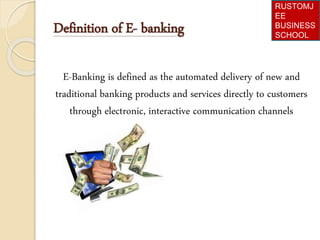
E-Banking is defined as the automated delivery of new and
traditional banking products and services directly to customers
through electronic, interactive communication channels
RUSTOMJ
EE
BUSINESS
SCHOOL
E -banking
Electronic banking (E-banking) is a generic term
encompassing:
 internet banking
 telephone banking
 mobile banking
 In other words, it is a process of delivery of banking
services and products through electronic channel such as
telephone, internet, cell phone etc.
RUSTOMJ
EE
BUSINESS
SCHOOL
Cont.
 , “The new generation banks showed the way and others
had no option but to follow the tech infusion to retain and
attract profitable customer.”
 The improved connectivity and falling cost offered by
leased lines provided a booster to inter-branch automation.
 With centralized infrastructure and numerous connectivity
options, banks started exploring multiple delivery channels
like ATM, Net-banking, Mobile banking and Tele-banking
thus driving down cost per transaction.
RUSTOMJ
EE
BUSINESS
SCHOOL
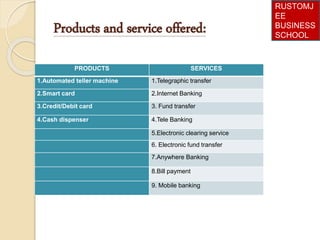
Products and service offered:
PRODUCTS SERVICES
1.Automated teller machine 1.Telegraphic transfer
2.Smart card 2.Internet Banking
3.Credit/Debit card 3. Fund transfer
4.Cash dispenser 4.Tele Banking
5.Electronic clearing service
6. Electronic fund transfer
7.Anywhere Banking
8.Bill payment
9. Mobile banking
RUSTOMJ
EE
BUSINESS
SCHOOL
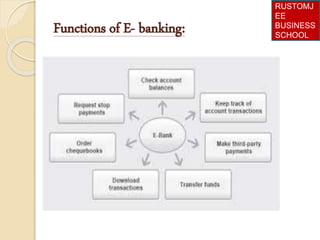
Functions of E- banking:
RUSTOMJ
EE
BUSINESS
SCHOOL
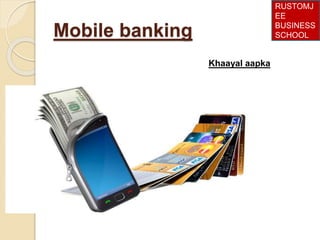
Mobile banking
Khaayal aapka
RUSTOMJ
EE
BUSINESS
SCHOOL
Mobile Banking System
 A system that allows customers of a financial
institution to conduct a number of financial
transactions through a mobile device such as
a mobile phone or tablet.
 The earliest mobile banking services were offered
over SMS, a service known as SMS banking.
 Advancements in web technologies such
as HTML5, CSS3 and JavaScript have seen more
banks launching mobile web based services to
complement native applications.
RUSTOMJ
EE
BUSINESS
SCHOOL
Mobile banking services
 Account information
◦ Mini-statements and checking of account history
◦ Access to loan statements
◦ Access to card statements
◦ Insurance policy management
 Transaction
◦ Funds transfers between the customer's linked accounts
◦ Check Remote Deposit
◦ Paying third parties, including bill payments and third party fund
transfers
 Support
◦ ATM Location
◦ Check (cheque) book and card requests
 Investments
◦ Personalized alerts and notifications on security prices
◦ Real-time stock quotes
RUSTOMJ
EE
BUSINESS
SCHOOL
Future functionalities in
mobile banking
 Mobile Banking functionality would
enable customer connect across
entire customer life cycle much
comprehensively than before.
◦ building relationships,
◦ reducing cost,
◦ achieving new revenue stream will
transform to enable new objectives
targeting higher level goals such as
building brand of the banking
organization.
 Personalization
 It would be expected from the mobile
application to support personalization
such as :
◦ Preferred Language
◦ Date / Time format
◦ Amount format
◦ Default transactions
◦ Standard Beneficiary list
◦ Alerts
Mobile Banking Security Tips
• Use Official Bank Apps When Possible.
• Be Careful of What You Download.
• Avoid Banking While on Public Network.
RUSTOMJ
EE
BUSINESS
SCHOOL
Mobile Banking features and benefits
• Register in less than 5 minutes.
• Safe and secure.
• View your statement quickly .
• Quick Balance.
.
RUSTOMJ
EE
BUSINESS
SCHOOL
M-PESA
 M- Pesa is a mobile-phone based money transfer and micro
financing service, launched in 2007 by Vodafone for Safaricom
and Vodacom, the largest mobile network operators in Kenya
and Tanzania.
 It has since expanded to Afghanistan, South Africa, India and in
2014 to Eastern Europe.
 M- Pesa allows users with a national ID card or passport to deposit,
withdraw, and transfer money easily with a mobile device.
RUSTOMJ
EE
BUSINESS
SCHOOL
Cont..
The service enables its users to:
 deposit and withdraw money
 transfer money to other users and non-users
 pay bills
 purchase airtime
RUSTOMJ
EE
BUSINESS
SCHOOL
BITCOIN
 Software Based online payment by Satoshi
Nakamoto.
 Form of Payment for Products& Services.
 What makes it different from normal
currencies.
 Creation
 Who Prints it.
RUSTOMJ
EE
BUSINESS
SCHOOL
Characteristics of BITCOIN
 It is Decentralized.
 It’s easy to setup.
 It’s anonymous
 It is completely transparent.
 It is fast.
RUSTOMJ
EE
BUSINESS
SCHOOL
RUPAY
 Who initiated it?
 Benefits of RUPAY card.
 RUPAY EMV
RUSTOMJ
EE
BUSINESS
SCHOOL
RUPAY for farmers.
 Also provides unified Kisan Card issued by banks across the
country.
 PUNGRAIN pays commission agents through RUPAY
Debit Card.
RUSTOMJ
EE
BUSINESS
SCHOOL

Technology and the Changing face of Banking Sector

  • 1.
    Technology and thechanging face of Banking Sector Group Members:- -Neha Rewale -Neha Aranha -Hirni Mewada -Pooja Lotankar -Pooja Kadam RUSTOMJ EE BUSINESS SCHOOL
  • 2.
    Introduction to BankingTechnology • The term “Banking Technology” refers to offer better banking services to its customers in a secure, reliable and affordable manner , In order to have a competitive advantage over the other banks. • Entry of new banks resulted in a paradigm shift in the ways of banking in India. The growing competition, growing expectations led to increased awareness amongst banks on the role and importance of technology in banking. RUSTOMJ EE BUSINESS SCHOOL
  • 3.
    Cont..  Information technologyis one of the most important facilitators for the transformation of the Indian banking industry in terms of its transactions processing as well as for various other internal systems and processes.
  • 4.
    Definition of E-banking E-Banking is defined as the automated delivery of new and traditional banking products and services directly to customers through electronic, interactive communication channels RUSTOMJ EE BUSINESS SCHOOL
  • 5.
    E -banking Electronic banking(E-banking) is a generic term encompassing:  internet banking  telephone banking  mobile banking  In other words, it is a process of delivery of banking services and products through electronic channel such as telephone, internet, cell phone etc. RUSTOMJ EE BUSINESS SCHOOL
  • 6.
    Cont.  , “Thenew generation banks showed the way and others had no option but to follow the tech infusion to retain and attract profitable customer.”  The improved connectivity and falling cost offered by leased lines provided a booster to inter-branch automation.  With centralized infrastructure and numerous connectivity options, banks started exploring multiple delivery channels like ATM, Net-banking, Mobile banking and Tele-banking thus driving down cost per transaction. RUSTOMJ EE BUSINESS SCHOOL
  • 7.
    Products and serviceoffered: PRODUCTS SERVICES 1.Automated teller machine 1.Telegraphic transfer 2.Smart card 2.Internet Banking 3.Credit/Debit card 3. Fund transfer 4.Cash dispenser 4.Tele Banking 5.Electronic clearing service 6. Electronic fund transfer 7.Anywhere Banking 8.Bill payment 9. Mobile banking RUSTOMJ EE BUSINESS SCHOOL
  • 8.
    Functions of E-banking: RUSTOMJ EE BUSINESS SCHOOL
  • 9.
  • 10.
    Mobile Banking System A system that allows customers of a financial institution to conduct a number of financial transactions through a mobile device such as a mobile phone or tablet.  The earliest mobile banking services were offered over SMS, a service known as SMS banking.  Advancements in web technologies such as HTML5, CSS3 and JavaScript have seen more banks launching mobile web based services to complement native applications. RUSTOMJ EE BUSINESS SCHOOL
  • 11.
    Mobile banking services Account information ◦ Mini-statements and checking of account history ◦ Access to loan statements ◦ Access to card statements ◦ Insurance policy management  Transaction ◦ Funds transfers between the customer's linked accounts ◦ Check Remote Deposit ◦ Paying third parties, including bill payments and third party fund transfers  Support ◦ ATM Location ◦ Check (cheque) book and card requests  Investments ◦ Personalized alerts and notifications on security prices ◦ Real-time stock quotes RUSTOMJ EE BUSINESS SCHOOL
  • 12.
    Future functionalities in mobilebanking  Mobile Banking functionality would enable customer connect across entire customer life cycle much comprehensively than before. ◦ building relationships, ◦ reducing cost, ◦ achieving new revenue stream will transform to enable new objectives targeting higher level goals such as building brand of the banking organization.
  • 13.
     Personalization  Itwould be expected from the mobile application to support personalization such as : ◦ Preferred Language ◦ Date / Time format ◦ Amount format ◦ Default transactions ◦ Standard Beneficiary list ◦ Alerts
  • 15.
    Mobile Banking SecurityTips • Use Official Bank Apps When Possible. • Be Careful of What You Download. • Avoid Banking While on Public Network. RUSTOMJ EE BUSINESS SCHOOL
  • 16.
    Mobile Banking featuresand benefits • Register in less than 5 minutes. • Safe and secure. • View your statement quickly . • Quick Balance. . RUSTOMJ EE BUSINESS SCHOOL
  • 17.
    M-PESA  M- Pesais a mobile-phone based money transfer and micro financing service, launched in 2007 by Vodafone for Safaricom and Vodacom, the largest mobile network operators in Kenya and Tanzania.  It has since expanded to Afghanistan, South Africa, India and in 2014 to Eastern Europe.  M- Pesa allows users with a national ID card or passport to deposit, withdraw, and transfer money easily with a mobile device. RUSTOMJ EE BUSINESS SCHOOL
  • 18.
    Cont.. The service enablesits users to:  deposit and withdraw money  transfer money to other users and non-users  pay bills  purchase airtime RUSTOMJ EE BUSINESS SCHOOL
  • 19.
    BITCOIN  Software Basedonline payment by Satoshi Nakamoto.  Form of Payment for Products& Services.  What makes it different from normal currencies.  Creation  Who Prints it. RUSTOMJ EE BUSINESS SCHOOL
  • 20.
    Characteristics of BITCOIN It is Decentralized.  It’s easy to setup.  It’s anonymous  It is completely transparent.  It is fast. RUSTOMJ EE BUSINESS SCHOOL
  • 21.
    RUPAY  Who initiatedit?  Benefits of RUPAY card.  RUPAY EMV RUSTOMJ EE BUSINESS SCHOOL
  • 22.
    RUPAY for farmers. Also provides unified Kisan Card issued by banks across the country.  PUNGRAIN pays commission agents through RUPAY Debit Card. RUSTOMJ EE BUSINESS SCHOOL