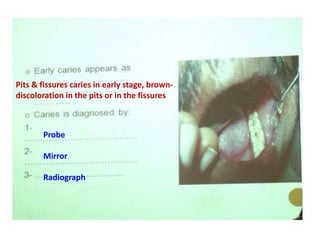
Pits & fissures caries in early stage, brown-
discoloration in the pits or in the fissures
Probe
Mirror
Radiograph
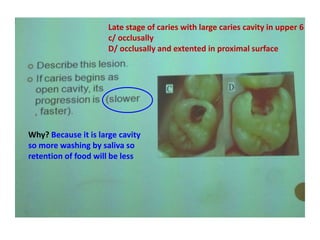
Late stage of caries with large caries cavity in upper 6
c/ occlusally
D/ occlusally and extented in proximal surface
Why? Because it is large cavity
so more washing by saliva so
retention of food will be less
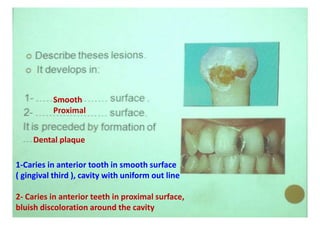
Smooth
Proximal
Dental plaque
1-Caries in anterior tooth in smooth surface
( gingival third ), cavity with uniform out line
2- Caries in anterior teeth in proximal surface,
bluish discoloration around the cavity
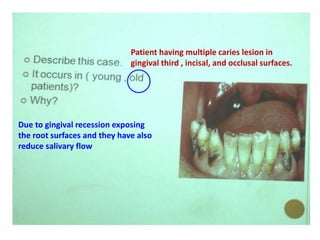
Patient having multiple caries lesion in
gingival third , incisal, and occlusal surfaces.
Due to gingival recession exposing
the root surfaces and they have also
reduce salivary flow
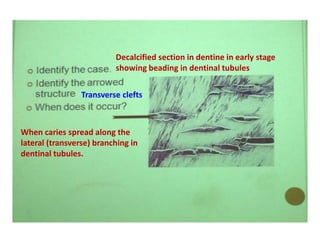
Decalcified section in dentine in early stage
showing beading in dentinal tubules
Transverse clefts
When caries spread along the
lateral (transverse) branching in
dentinal tubules.
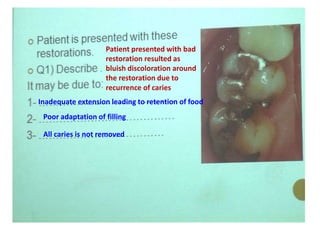
Patient presented with bad
restoration resulted as
bluish discoloration around
the restoration due to
recurrence of caries
Inadequate extension leading to retention of food
Poor adaptation of filling
All caries is not removed
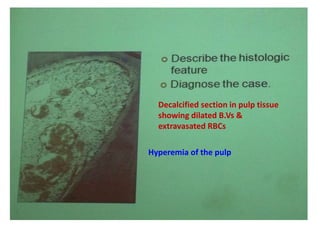
Decalcified section in pulp tissue
showing dilated B.Vs &
extravasated RBCs
Hyperemia of the pulp
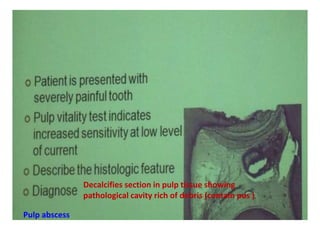
Decalcifies section in pulp tissue showing
pathological cavity rich of debris (contain pus )
Pulp abscess
1-
2-
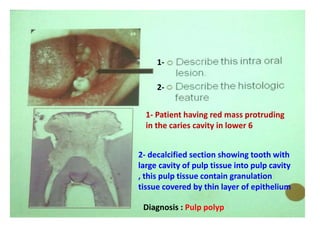
1- Patient having red mass protruding
in the caries cavity in lower 6
2- decalcified section showing tooth with
large cavity of pulp tissue into pulp cavity
, this pulp tissue contain granulation
tissue covered by thin layer of epithelium
Diagnosis : Pulp polyp
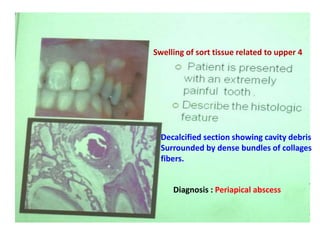
Swelling of sort tissue related to upper 4
Decalcified section showing cavity debris
Surrounded by dense bundles of collages
fibers.
Diagnosis : Periapical abscess
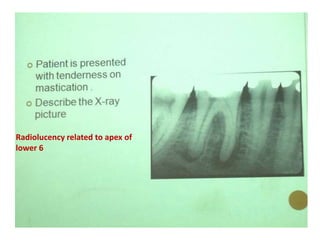
Radiolucency related to apex of
lower 6
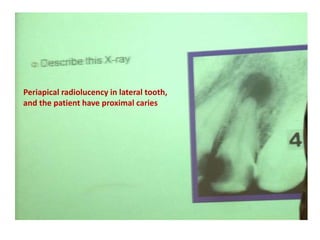
Periapical radiolucency in lateral tooth,
and the patient have proximal caries
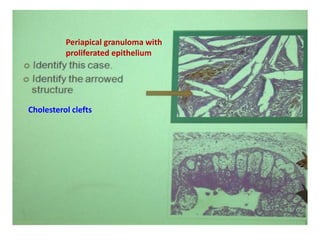
Periapical granuloma with
proliferated epithelium
Cholesterol clefts
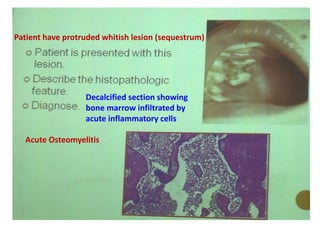
Patient have protruded whitish lesion (sequestrum)
Decalcified section showing
bone marrow infiltrated by
acute inflammatory cells
Acute Osteomyelitis
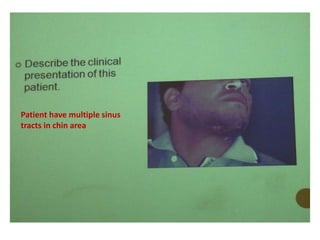
Patient have multiple sinus
tracts in chin area
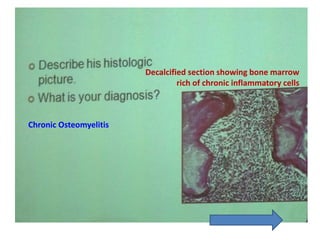
Decalcified section showing bone marrow
rich of chronic inflammatory cells
Chronic Osteomyelitis
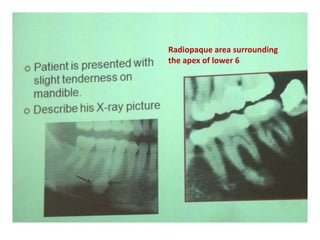
Radiopaque area surrounding
the apex of lower 6
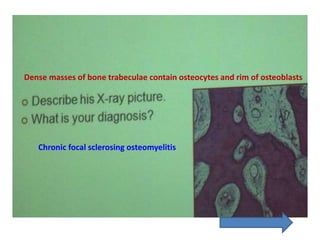
Dense masses of bone trabeculae contain osteocytes and rim of osteoblasts
Chronic focal sclerosing osteomyelitis
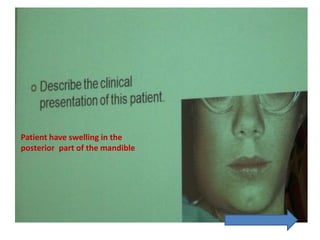
Patient have swelling in the
part of the mandibleposterior
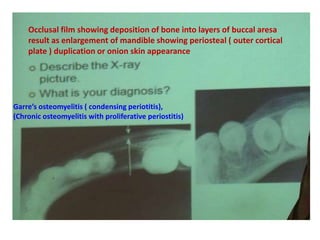
Occlusal film showing deposition of bone into layers of buccal aresa
result as enlargement of mandible showing periosteal ( outer cortical
plate ) duplication or onion skin appearance
Garre’s osteomyelitis ( condensing periotitis),
(Chronic osteomyelitis with proliferative periostitis)
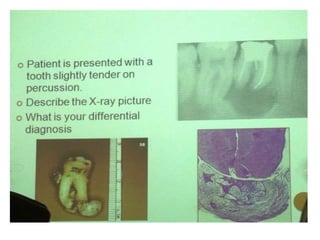
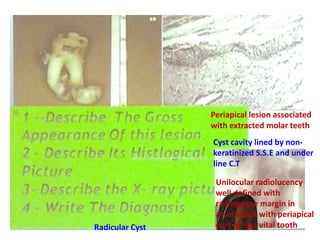
Periapical lesion associated
with extracted molar teeth
Cyst cavity lined by non-
keratinized S.S.E and under
line C.T
Unilocular radiolucency
well defined with
radiopaque margin in
association with periapical
part of non vital toothRadicular Cyst
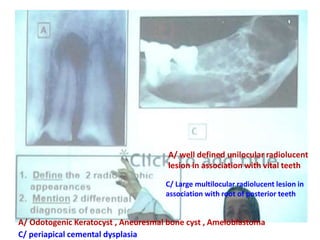
A/ well defined unilocular radiolucent
lesion in association with vital teeth
C/ Large multilocular radiolucent lesion in
association with root of posterior teeth
A/ Odotogenic Keratocyst , Aneuresmal bone cyst , Ameloblastoma
C/ periapical cemental dysplasia
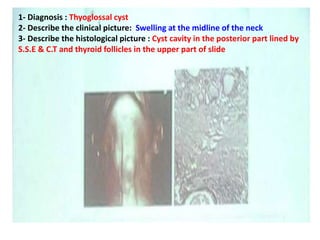
1- Diagnosis : Thyoglossal cyst
2- Describe the clinical picture: Swelling at the midline of the neck
3- Describe the histological picture : Cyst cavity in the posterior part lined by
S.S.E & C.T and thyroid follicles in the upper part of slide
1
2
3
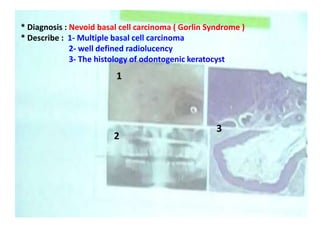
* Diagnosis : Nevoid basal cell carcinoma ( Gorlin Syndrome )
* Describe : 1- Multiple basal cell carcinoma
2- well defined radiolucency
3- The histology of odontogenic keratocyst
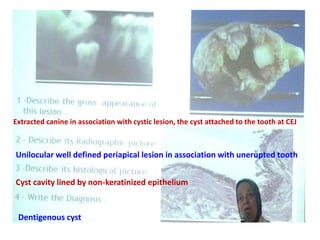
Extracted canine in association with cystic lesion, the cyst attached to the tooth at CEJ
Unilocular well defined periapical lesion in association with unerupted tooth
Cyst cavity lined by non-keratinized epithelium
Dentigenous cyst
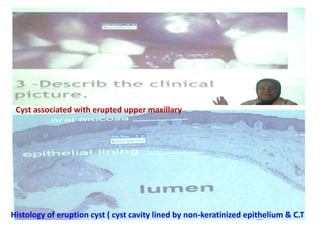
Cyst associated with erupted upper maxillary
Histology of eruption cyst ( cyst cavity lined by non-keratinized epithelium & C.T
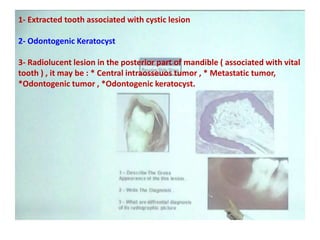
1- Extracted tooth associated with cystic lesion
2- Odontogenic Keratocyst
3- Radiolucent lesion in the posterior part of mandible ( associated with vital
tooth ) , it may be : * Central intraosseuos tumor , * Metastatic tumor,
*Odontogenic tumor , *Odontogenic keratocyst.
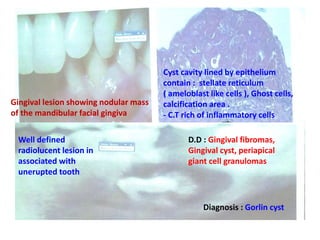
Gingival lesion showing nodular mass
of the mandibular facial gingiva
Cyst cavity lined by epithelium
contain : stellate reticulum
( ameloblast like cells ), Ghost cells,
calcification area .
- C.T rich of inflammatory cells
Well defined
radiolucent lesion in
associated with
unerupted tooth
D.D : Gingival fibromas,
Gingival cyst, periapical
giant cell granulomas
Diagnosis : Gorlin cyst

Cbc revision

  • 1.
    Pits & fissurescaries in early stage, brown- discoloration in the pits or in the fissures Probe Mirror Radiograph
  • 2.
    Late stage ofcaries with large caries cavity in upper 6 c/ occlusally D/ occlusally and extented in proximal surface Why? Because it is large cavity so more washing by saliva so retention of food will be less
  • 3.
    Smooth Proximal Dental plaque 1-Caries inanterior tooth in smooth surface ( gingival third ), cavity with uniform out line 2- Caries in anterior teeth in proximal surface, bluish discoloration around the cavity
  • 4.
    Patient having multiplecaries lesion in gingival third , incisal, and occlusal surfaces. Due to gingival recession exposing the root surfaces and they have also reduce salivary flow
  • 5.
    Decalcified section indentine in early stage showing beading in dentinal tubules Transverse clefts When caries spread along the lateral (transverse) branching in dentinal tubules.
  • 6.
    Patient presented withbad restoration resulted as bluish discoloration around the restoration due to recurrence of caries Inadequate extension leading to retention of food Poor adaptation of filling All caries is not removed
  • 7.
    Decalcified section inpulp tissue showing dilated B.Vs & extravasated RBCs Hyperemia of the pulp
  • 8.
    Decalcifies section inpulp tissue showing pathological cavity rich of debris (contain pus ) Pulp abscess
  • 9.
    1- 2- 1- Patient havingred mass protruding in the caries cavity in lower 6 2- decalcified section showing tooth with large cavity of pulp tissue into pulp cavity , this pulp tissue contain granulation tissue covered by thin layer of epithelium Diagnosis : Pulp polyp
  • 10.
    Swelling of sorttissue related to upper 4 Decalcified section showing cavity debris Surrounded by dense bundles of collages fibers. Diagnosis : Periapical abscess
  • 11.
    Radiolucency related toapex of lower 6
  • 12.
    Periapical radiolucency inlateral tooth, and the patient have proximal caries
  • 13.
    Periapical granuloma with proliferatedepithelium Cholesterol clefts
  • 14.
    Patient have protrudedwhitish lesion (sequestrum) Decalcified section showing bone marrow infiltrated by acute inflammatory cells Acute Osteomyelitis
  • 15.
    Patient have multiplesinus tracts in chin area
  • 16.
    Decalcified section showingbone marrow rich of chronic inflammatory cells Chronic Osteomyelitis
  • 17.
  • 18.
    Dense masses ofbone trabeculae contain osteocytes and rim of osteoblasts Chronic focal sclerosing osteomyelitis
  • 19.
    Patient have swellingin the part of the mandibleposterior
  • 20.
    Occlusal film showingdeposition of bone into layers of buccal aresa result as enlargement of mandible showing periosteal ( outer cortical plate ) duplication or onion skin appearance Garre’s osteomyelitis ( condensing periotitis), (Chronic osteomyelitis with proliferative periostitis)
  • 22.
    Periapical lesion associated withextracted molar teeth Cyst cavity lined by non- keratinized S.S.E and under line C.T Unilocular radiolucency well defined with radiopaque margin in association with periapical part of non vital toothRadicular Cyst
  • 23.
    A/ well definedunilocular radiolucent lesion in association with vital teeth C/ Large multilocular radiolucent lesion in association with root of posterior teeth A/ Odotogenic Keratocyst , Aneuresmal bone cyst , Ameloblastoma C/ periapical cemental dysplasia
  • 24.
    1- Diagnosis :Thyoglossal cyst 2- Describe the clinical picture: Swelling at the midline of the neck 3- Describe the histological picture : Cyst cavity in the posterior part lined by S.S.E & C.T and thyroid follicles in the upper part of slide
  • 25.
    1 2 3 * Diagnosis :Nevoid basal cell carcinoma ( Gorlin Syndrome ) * Describe : 1- Multiple basal cell carcinoma 2- well defined radiolucency 3- The histology of odontogenic keratocyst
  • 26.
    Extracted canine inassociation with cystic lesion, the cyst attached to the tooth at CEJ Unilocular well defined periapical lesion in association with unerupted tooth Cyst cavity lined by non-keratinized epithelium Dentigenous cyst
  • 27.
    Cyst associated witherupted upper maxillary Histology of eruption cyst ( cyst cavity lined by non-keratinized epithelium & C.T
  • 28.
    1- Extracted toothassociated with cystic lesion 2- Odontogenic Keratocyst 3- Radiolucent lesion in the posterior part of mandible ( associated with vital tooth ) , it may be : * Central intraosseuos tumor , * Metastatic tumor, *Odontogenic tumor , *Odontogenic keratocyst.
  • 29.
    Gingival lesion showingnodular mass of the mandibular facial gingiva Cyst cavity lined by epithelium contain : stellate reticulum ( ameloblast like cells ), Ghost cells, calcification area . - C.T rich of inflammatory cells Well defined radiolucent lesion in associated with unerupted tooth D.D : Gingival fibromas, Gingival cyst, periapical giant cell granulomas Diagnosis : Gorlin cyst