by:Trajan Cuellar MB BCh and AdrianVlada, MB, BCh
June 2015
 General Surgery
 MIS
 BMS
 CRS
 PBS
 Vascular
 Plastics
 Transplant
 Trauma
 Burn
 Paediatric
The management of the patient after surgery.
This includes care given during the immediate
post operative period, both in the operating
room and the post anaesthesia care unit
(PACU), as well as the days following surgery.
 Relish in your position
 Enjoy the fruits of your labour in medical
school
 Grow into the physician/surgeon role
 You will often stand alone with the family in
the room
 You are the first line of defense
 Past Medical History
 Past Surgical History
 Social History
 Family History
 Past Medical History
 CNS – priorTIA, CVAs, mobility post op.
 CVS – CHF, prior MIs
▪ Antiplatelet agents
▪ IVF administration
 Resp – COPD home O2, CPAP for OSA
 FEN/GI - Renal Failure – prescribe/dose all
medications appropriately (no Enoxaparin for renal
impairment patients), dialysis days, dialysis access?
 Endo – DM (no dextrose in IVF, Insulin Sliding Scale),
Steroids – dose stress steroids appropriately
 Past Surgical History
 Prior surgical intervention often makes further
surgical intervention more complex
 Prior post operative issues are often relevant
again
 Social History
 Home support structure, if any
 EtOH
▪ DeliriumTremens (not unique toVA system)
 Smoking
▪ Pulmonary toliet, O2 requirements
 Drugs
 Family History
 Familial Medical Conditions
▪ DM, CAD, amongst many others
 Commonest bleeding disorder in the USA is von
Willebrands Disease
▪ Best way to determine its presence is a sound history
 If you did the case, you may be asked to…
 Write the brief operative note
 Talk to the family regarding the outcome of the
surgery
 Write post operative orders
 Dictate the case
 Skin/Fascial closure, Final dressings,
abdominal binder, transport the patient to
PACU
 Day case surgery
 Final review
 Appropriate Discharge Paperwork
 Discharge Prescriptions
 Follow up Appointment
For Shands 352-265-0535
7:30am – 5pm, get an appointment for every pt.
 Family questions
 AdmittingTeam/Attending
 Diagnosis
 Condition
 SpecifyVital Sign monitoring (Neuro exams?)
 New Medications/Home Medications
 Diet order, Mobility orders, Elevate HOB
 Wound care, IVF, Analgesia, DVT prophylaxis,
Abx
 NG, Foley Catheter, Drain orders
 Post Op Labs and/or Imaging Ordered
 ENSURETHE PATIENT IS ONTHE LIST
 Post OperativeCheck – to be performed on
EVERY patient,ABSOLUTELY NO
EXCEPTIONS
 Consists of
 Chart review
▪ Surgical procedure (EBL, IVFs, intraoperative events)
▪ Pre-Operative medical/surgical conditions
▪ Pre-Admission Medications
▪ Current Post-Operative Medications
 Review ofVital Sign trends
 Pyrexia (Febrile)
 HR/BP/O2 Sats
▪ Tachycardia
▪ Tachypnoea
 I/O, hourly urine outputs
 Analgesic Requirements
 RN notes – pt received resting soundly vs.
obtunded
 Finally go see the patient.
 Eyeball test – comes with experience
 Talk to the patient
 Examine the patient
 HS 1-2, Lungs, Abdomen, Incision sites
▪ Pulse check, Neurological exam
 Don’t forget Drains
 Volume, colour, consistency, smell
 Check Line sites, IVs, a-lines,CVLs, Urinary
catheters, Chest tube sites.
 Go back to the computer
 Final chart review
 Check Labs (perhaps order them)
 Check Imaging (perhaps order CXR/KUB)
 Monitoring (perhaps add a continuous pulse ox or
telemetry)
 DOCUMENT your findings with a PLAN
 With experience this takes 10mins to perform
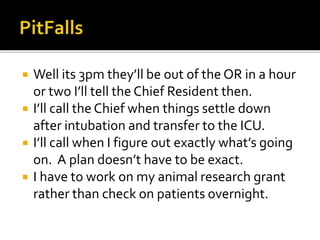
 Well its 3pm they’ll be out of the OR in a hour
or two I’ll tell the Chief Resident then.
 I’ll call the Chief when things settle down
after intubation and transfer to the ICU.
 I’ll call when I figure out exactly what’s going
on. A plan doesn’t have to be exact.
 I have to work on my animal research grant
rather than check on patients overnight.
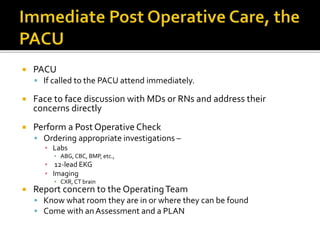
 PACU
 If called to the PACU attend immediately.
 Face to face discussion with MDs or RNs and address their
concerns directly
 Perform a Post Operative Check
 Ordering appropriate investigations –
▪ Labs
▪ ABG, CBC, BMP, etc.,
▪ 12-lead EKG
▪ Imaging
▪ CXR, CT brain
 Report concern to the OperatingTeam
 Know what room they are in or where they can be found
 Come with an Assessment and a PLAN
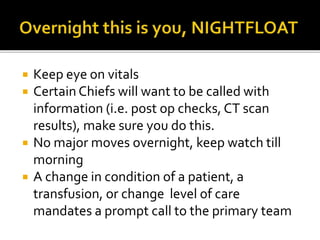
 Keep eye on vitals
 Certain Chiefs will want to be called with
information (i.e. post op checks, CT scan
results), make sure you do this.
 No major moves overnight, keep watch till
morning
 A change in condition of a patient, a
transfusion, or change level of care
mandates a prompt call to the primary team
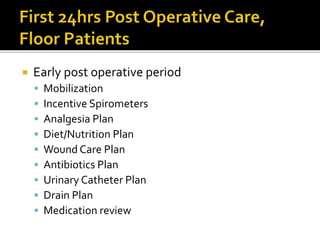
 Early post operative period
 Mobilization
 Incentive Spirometers
 Analgesia Plan
 Diet/Nutrition Plan
 Wound Care Plan
 Antibiotics Plan
 Urinary Catheter Plan
 Drain Plan
 Medication review
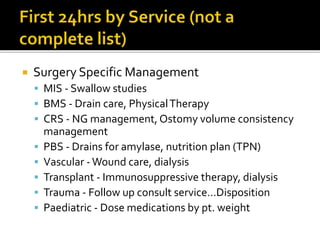
 Surgery Specific Management
 MIS - Swallow studies
 BMS - Drain care, PhysicalTherapy
 CRS - NG management, Ostomy volume consistency
management
 PBS - Drains for amylase, nutrition plan (TPN)
 Vascular -Wound care, dialysis
 Transplant - Immunosuppressive therapy, dialysis
 Trauma - Follow up consult service…Disposition
 Paediatric - Dose medications by pt. weight
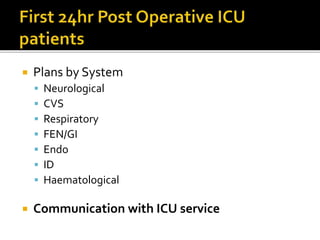
 Plans by System
 Neurological
 CVS
 Respiratory
 FEN/GI
 Endo
 ID
 Haematological
 Communication with ICU service
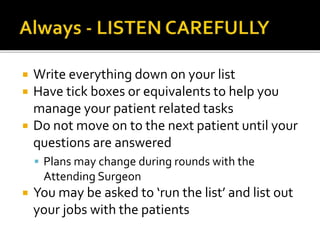
 Write everything down on your list
 Have tick boxes or equivalents to help you
manage your patient related tasks
 Do not move on to the next patient until your
questions are answered
 Plans may change during rounds with the
Attending Surgeon
 You may be asked to ‘run the list’ and list out
your jobs with the patients
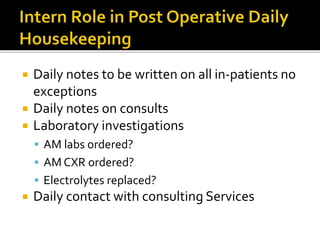
 Daily notes to be written on all in-patients no
exceptions
 Daily notes on consults
 Laboratory investigations
 AM labs ordered?
 AM CXR ordered?
 Electrolytes replaced?
 Daily contact with consulting Services
 Identify with your team your ‘sickest’ patients
and ensure their tasks are performed first
 Put in all orders on all patients at once
 Call consults early (UF Surgery is not like
certain services that drop the 5:30pm
bombshell)
 Half fill in boxes of tasks that have follow up
 CT scan order and reviewed
 Gradual return to preoperative state
 Improved mobility and mood
 Reduction in IVF, toleration of PO intake
 Return to home medication regiment
 Return of Bowel Activity (flatus then BMs)
 Reduced Analgesia requirements and transition to
oral pain medications.
 Wound healing
 Disposition and home environment
 Look better/feels better
 No fever, normalVS, normal WCC, stable
HCT/plt count, normal electrolytes
 Mobilisation of fluid
 Spontaneously negative I/O fluid balance
 Patient crosses legs in bed and starts to
complain about hospital food
 Fever
 RisingWCC
 Drop in HCT, Hb
 Electrolyte imbalance
 Drain output change
 Reduced Urine Output
 Pt has little to say for him/herself
 Surgery Specific Concerns
 POD 5 Colorectal pt with fever, elevated WCC
 Salmon coloured fluid escaping from a previously dry
abdominal wound
 Arrest
 Sudden change in mental status
 Sudden respiratory compromise
 Sudden cardiovascular embarrassment
 Audible Bleeding
 Bleeding, bleeding, bleeding
 Surgical bed
 GI tract
 Anticoagulation
 Sepsis (UTIs, RTI, Intraabdominal Abscesses)
 Myocardial Infarction
 CerebrovascularAccident
 Acute Urinary Retention
 Confusion
 Atelectasis
 Mucus plug
 Pneumothorax
 DVT
Surgery specific complications…
 MIS – Anastomotic leak
 BMS – Haematoma
 Colorectal – Anastomotic leak
 PBS – Bleeding, Sepsis
 Transplant – Organ rejection
 Vascular – Bypass occlusion,
pseudoaneurysms
 Trauma – DTs, withdrawal
 Paediatric – Necrotizing enterocolitis
 Know your surgical procedures and their
expected post operative courses
 Attention to detail
 Check vitals carefully looking for clues
▪ Tachycardia (gradually developing)
▪ Tachypnoea (gradually developing)
 Dare to think
 Eyeball
 Distressed, obtunded, tachypnoeic, tachycardic
 Vital Signs
 IV access?
 Lines working
 Finger stick glucose
 Labs
 Imaging
 Monitoring (continuous pulse ox, telemetry)
 Level of care (floor, IMC, ICU)
 Contact senior resident early with concerns
and Plan
 Communication continues until resolution of
the concern (may occur over days)
 Follow through on plan – CT scan etc…
 PACU
 DuringTransfer
 CT scanner
 Interventional Radiology
 Date/Time/Venue on all notes
 Time of incident to time of initiation of legal
action averages 18 months, how good is your
memory?
 Call your covering chief with information
regarding –
 Current state of patient
 Your working diagnosis
 Your plan of action
 You will receive gentle guidance
 Calling is what you are expected to do
 As your experience level increases you will
feel more confident and identify routine
calls from serious pathology.
 Communicate, ask questions
 Be proactive
 Know and utilize allied staff
 Instruct and utilize students
 Be detail oriented and document thoroughly
 Be seen around the OR
 Being rude to allied/nursing staff
 Assuming an order equivalates action
 Assuming anything
 Calling without an assessment and plan
 Making students do your work
 Text anything urgent/emergent/HIPAA
related
 Take pictures on your phone
 Tertiary Level UniversityTeaching and
AcademicCenter
 We take the cases that local and sometimes
distant hospitals refer to us for ‘Complexity of
Care’
 Level 1Trauma care for the local population
 Standards are high
 Expectations are high
 You are all here for a reason
 Everyone here is capable of performing the
tasks required
‘I have given my name and day clothes to the
nurses and my history to the anaesthetist and my
body to surgeons.’
Excerpt from ‘Tulips’ by Sylvia Plath 1961
QUESTIONS?
Trajan A. Cuellar MB BCh MRCSI
352-413-0313 (pager)
352-642-2704 (mobile)
Postoperative-managment.pptx

Postoperative-managment.pptx

  • 1.
    by:Trajan Cuellar MBBCh and AdrianVlada, MB, BCh June 2015
  • 2.
     General Surgery MIS  BMS  CRS  PBS  Vascular  Plastics  Transplant  Trauma  Burn  Paediatric
  • 3.
    The management ofthe patient after surgery. This includes care given during the immediate post operative period, both in the operating room and the post anaesthesia care unit (PACU), as well as the days following surgery.
  • 4.
     Relish inyour position  Enjoy the fruits of your labour in medical school  Grow into the physician/surgeon role  You will often stand alone with the family in the room  You are the first line of defense
  • 5.
     Past MedicalHistory  Past Surgical History  Social History  Family History
  • 6.
     Past MedicalHistory  CNS – priorTIA, CVAs, mobility post op.  CVS – CHF, prior MIs ▪ Antiplatelet agents ▪ IVF administration  Resp – COPD home O2, CPAP for OSA  FEN/GI - Renal Failure – prescribe/dose all medications appropriately (no Enoxaparin for renal impairment patients), dialysis days, dialysis access?  Endo – DM (no dextrose in IVF, Insulin Sliding Scale), Steroids – dose stress steroids appropriately
  • 7.
     Past SurgicalHistory  Prior surgical intervention often makes further surgical intervention more complex  Prior post operative issues are often relevant again
  • 8.
     Social History Home support structure, if any  EtOH ▪ DeliriumTremens (not unique toVA system)  Smoking ▪ Pulmonary toliet, O2 requirements  Drugs
  • 9.
     Family History Familial Medical Conditions ▪ DM, CAD, amongst many others  Commonest bleeding disorder in the USA is von Willebrands Disease ▪ Best way to determine its presence is a sound history
  • 10.
     If youdid the case, you may be asked to…  Write the brief operative note  Talk to the family regarding the outcome of the surgery  Write post operative orders  Dictate the case  Skin/Fascial closure, Final dressings, abdominal binder, transport the patient to PACU
  • 11.
     Day casesurgery  Final review  Appropriate Discharge Paperwork  Discharge Prescriptions  Follow up Appointment For Shands 352-265-0535 7:30am – 5pm, get an appointment for every pt.  Family questions
  • 12.
     AdmittingTeam/Attending  Diagnosis Condition  SpecifyVital Sign monitoring (Neuro exams?)  New Medications/Home Medications  Diet order, Mobility orders, Elevate HOB  Wound care, IVF, Analgesia, DVT prophylaxis, Abx  NG, Foley Catheter, Drain orders  Post Op Labs and/or Imaging Ordered  ENSURETHE PATIENT IS ONTHE LIST
  • 13.
     Post OperativeCheck– to be performed on EVERY patient,ABSOLUTELY NO EXCEPTIONS  Consists of  Chart review ▪ Surgical procedure (EBL, IVFs, intraoperative events) ▪ Pre-Operative medical/surgical conditions ▪ Pre-Admission Medications ▪ Current Post-Operative Medications
  • 14.
     Review ofVitalSign trends  Pyrexia (Febrile)  HR/BP/O2 Sats ▪ Tachycardia ▪ Tachypnoea  I/O, hourly urine outputs  Analgesic Requirements  RN notes – pt received resting soundly vs. obtunded
  • 15.
     Finally gosee the patient.  Eyeball test – comes with experience  Talk to the patient  Examine the patient  HS 1-2, Lungs, Abdomen, Incision sites ▪ Pulse check, Neurological exam  Don’t forget Drains  Volume, colour, consistency, smell  Check Line sites, IVs, a-lines,CVLs, Urinary catheters, Chest tube sites.
  • 16.
     Go backto the computer  Final chart review  Check Labs (perhaps order them)  Check Imaging (perhaps order CXR/KUB)  Monitoring (perhaps add a continuous pulse ox or telemetry)  DOCUMENT your findings with a PLAN  With experience this takes 10mins to perform
  • 17.
     Well its3pm they’ll be out of the OR in a hour or two I’ll tell the Chief Resident then.  I’ll call the Chief when things settle down after intubation and transfer to the ICU.  I’ll call when I figure out exactly what’s going on. A plan doesn’t have to be exact.  I have to work on my animal research grant rather than check on patients overnight.
  • 18.
     PACU  Ifcalled to the PACU attend immediately.  Face to face discussion with MDs or RNs and address their concerns directly  Perform a Post Operative Check  Ordering appropriate investigations – ▪ Labs ▪ ABG, CBC, BMP, etc., ▪ 12-lead EKG ▪ Imaging ▪ CXR, CT brain  Report concern to the OperatingTeam  Know what room they are in or where they can be found  Come with an Assessment and a PLAN
  • 19.
     Keep eyeon vitals  Certain Chiefs will want to be called with information (i.e. post op checks, CT scan results), make sure you do this.  No major moves overnight, keep watch till morning  A change in condition of a patient, a transfusion, or change level of care mandates a prompt call to the primary team
  • 20.
     Early postoperative period  Mobilization  Incentive Spirometers  Analgesia Plan  Diet/Nutrition Plan  Wound Care Plan  Antibiotics Plan  Urinary Catheter Plan  Drain Plan  Medication review
  • 21.
     Surgery SpecificManagement  MIS - Swallow studies  BMS - Drain care, PhysicalTherapy  CRS - NG management, Ostomy volume consistency management  PBS - Drains for amylase, nutrition plan (TPN)  Vascular -Wound care, dialysis  Transplant - Immunosuppressive therapy, dialysis  Trauma - Follow up consult service…Disposition  Paediatric - Dose medications by pt. weight
  • 22.
     Plans bySystem  Neurological  CVS  Respiratory  FEN/GI  Endo  ID  Haematological  Communication with ICU service
  • 23.
     Write everythingdown on your list  Have tick boxes or equivalents to help you manage your patient related tasks  Do not move on to the next patient until your questions are answered  Plans may change during rounds with the Attending Surgeon  You may be asked to ‘run the list’ and list out your jobs with the patients
  • 24.
     Daily notesto be written on all in-patients no exceptions  Daily notes on consults  Laboratory investigations  AM labs ordered?  AM CXR ordered?  Electrolytes replaced?  Daily contact with consulting Services
  • 25.
     Identify withyour team your ‘sickest’ patients and ensure their tasks are performed first  Put in all orders on all patients at once  Call consults early (UF Surgery is not like certain services that drop the 5:30pm bombshell)  Half fill in boxes of tasks that have follow up  CT scan order and reviewed
  • 26.
     Gradual returnto preoperative state  Improved mobility and mood  Reduction in IVF, toleration of PO intake  Return to home medication regiment  Return of Bowel Activity (flatus then BMs)  Reduced Analgesia requirements and transition to oral pain medications.  Wound healing  Disposition and home environment
  • 27.
     Look better/feelsbetter  No fever, normalVS, normal WCC, stable HCT/plt count, normal electrolytes  Mobilisation of fluid  Spontaneously negative I/O fluid balance  Patient crosses legs in bed and starts to complain about hospital food
  • 28.
     Fever  RisingWCC Drop in HCT, Hb  Electrolyte imbalance  Drain output change  Reduced Urine Output  Pt has little to say for him/herself  Surgery Specific Concerns  POD 5 Colorectal pt with fever, elevated WCC  Salmon coloured fluid escaping from a previously dry abdominal wound
  • 29.
     Arrest  Suddenchange in mental status  Sudden respiratory compromise  Sudden cardiovascular embarrassment  Audible Bleeding
  • 30.
     Bleeding, bleeding,bleeding  Surgical bed  GI tract  Anticoagulation  Sepsis (UTIs, RTI, Intraabdominal Abscesses)  Myocardial Infarction  CerebrovascularAccident  Acute Urinary Retention  Confusion  Atelectasis  Mucus plug  Pneumothorax  DVT
  • 31.
    Surgery specific complications… MIS – Anastomotic leak  BMS – Haematoma  Colorectal – Anastomotic leak  PBS – Bleeding, Sepsis  Transplant – Organ rejection  Vascular – Bypass occlusion, pseudoaneurysms  Trauma – DTs, withdrawal  Paediatric – Necrotizing enterocolitis
  • 32.
     Know yoursurgical procedures and their expected post operative courses  Attention to detail  Check vitals carefully looking for clues ▪ Tachycardia (gradually developing) ▪ Tachypnoea (gradually developing)  Dare to think
  • 33.
     Eyeball  Distressed,obtunded, tachypnoeic, tachycardic  Vital Signs  IV access?  Lines working  Finger stick glucose  Labs  Imaging  Monitoring (continuous pulse ox, telemetry)  Level of care (floor, IMC, ICU)
  • 34.
     Contact seniorresident early with concerns and Plan  Communication continues until resolution of the concern (may occur over days)  Follow through on plan – CT scan etc…
  • 35.
     PACU  DuringTransfer CT scanner  Interventional Radiology
  • 36.
     Date/Time/Venue onall notes  Time of incident to time of initiation of legal action averages 18 months, how good is your memory?
  • 37.
     Call yourcovering chief with information regarding –  Current state of patient  Your working diagnosis  Your plan of action  You will receive gentle guidance  Calling is what you are expected to do  As your experience level increases you will feel more confident and identify routine calls from serious pathology.
  • 38.
     Communicate, askquestions  Be proactive  Know and utilize allied staff  Instruct and utilize students  Be detail oriented and document thoroughly  Be seen around the OR
  • 39.
     Being rudeto allied/nursing staff  Assuming an order equivalates action  Assuming anything  Calling without an assessment and plan  Making students do your work  Text anything urgent/emergent/HIPAA related  Take pictures on your phone
  • 40.
     Tertiary LevelUniversityTeaching and AcademicCenter  We take the cases that local and sometimes distant hospitals refer to us for ‘Complexity of Care’  Level 1Trauma care for the local population
  • 41.
     Standards arehigh  Expectations are high  You are all here for a reason  Everyone here is capable of performing the tasks required
  • 42.
    ‘I have givenmy name and day clothes to the nurses and my history to the anaesthetist and my body to surgeons.’ Excerpt from ‘Tulips’ by Sylvia Plath 1961 QUESTIONS? Trajan A. Cuellar MB BCh MRCSI 352-413-0313 (pager) 352-642-2704 (mobile)