UNIVERSAL PROTOCOL
The Universal Protocol is based on
the fact that wrong site, wrong
procedure, and wrong person surgery
can be prevented
It became effective in July 2004
UNIVERSAL PROTOCOL
JCI Collects reports
from accredited
organizations that have
experienced a sentinel
event within their
organization
Data from reports are
collected, aggregated,
and analyzed to identify
root causes of adverse
events
UNIVERSAL PROTOCOL
The goal is to use the data to prevent
similar errors from occurring in other
health care organizations
The joint commission found the wrong
site surgery to be the third-highest-
ranking event
UNIVERSAL PROTOCOL
The protocol includes many
recommended steps but
there are three principal
elements:
a) Pre-procedure verification
b) Site marking
c) Time out prior to incision
AT-RISK BEHAVIOR IN THE OR
Not checking equipment before use
Surgeon entering after prep and drape
Surgeon running 2 rooms
Multi-tasking from O.R.
Relying on memory about the
pathology
Unannounced substitutions in mid case
Continuing to close during sponge
search
O.R. TEAM
Be Patient- focused
Not surgeon-focused
Not workflow-focused
Not specialty-focused
Not budget-focused
Not break-focused
High Reliability Organizations
“ CARE “
Commitment by the Leaders
Attention to the Task
Respond as a Team
Effective Communication
Safety in surgery require the reliable
execution of multiple necessary
steps in care by health team working
together for the benefit of the patient
PRE-PROCEDURE VERIFICATION
PROCESS
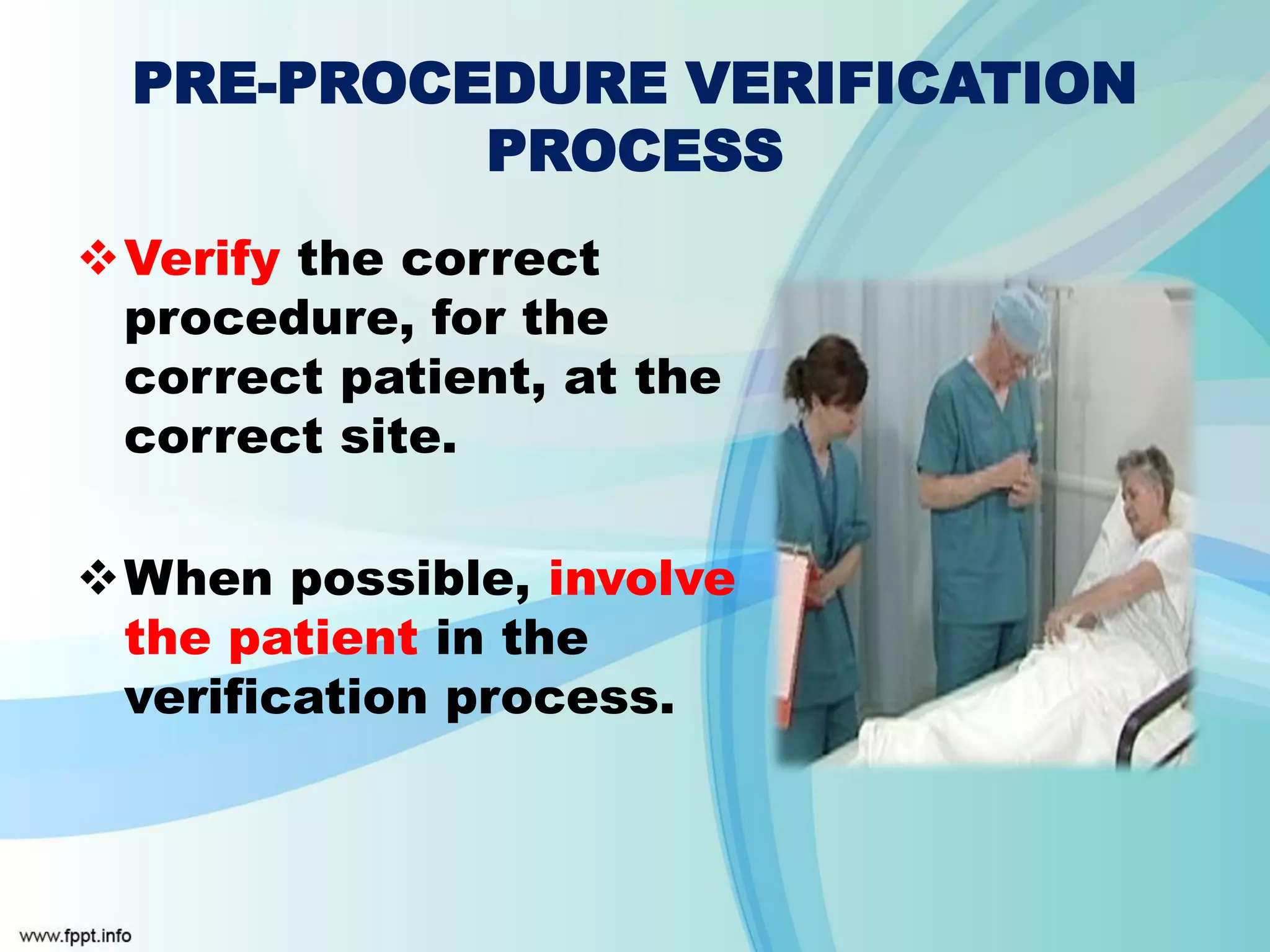
Verify the correct
procedure, for the
correct patient, at the
correct site.
When possible, involve
the patient in the
verification process.
PRE-PROCEDURE VERIFICATION
PROCESS
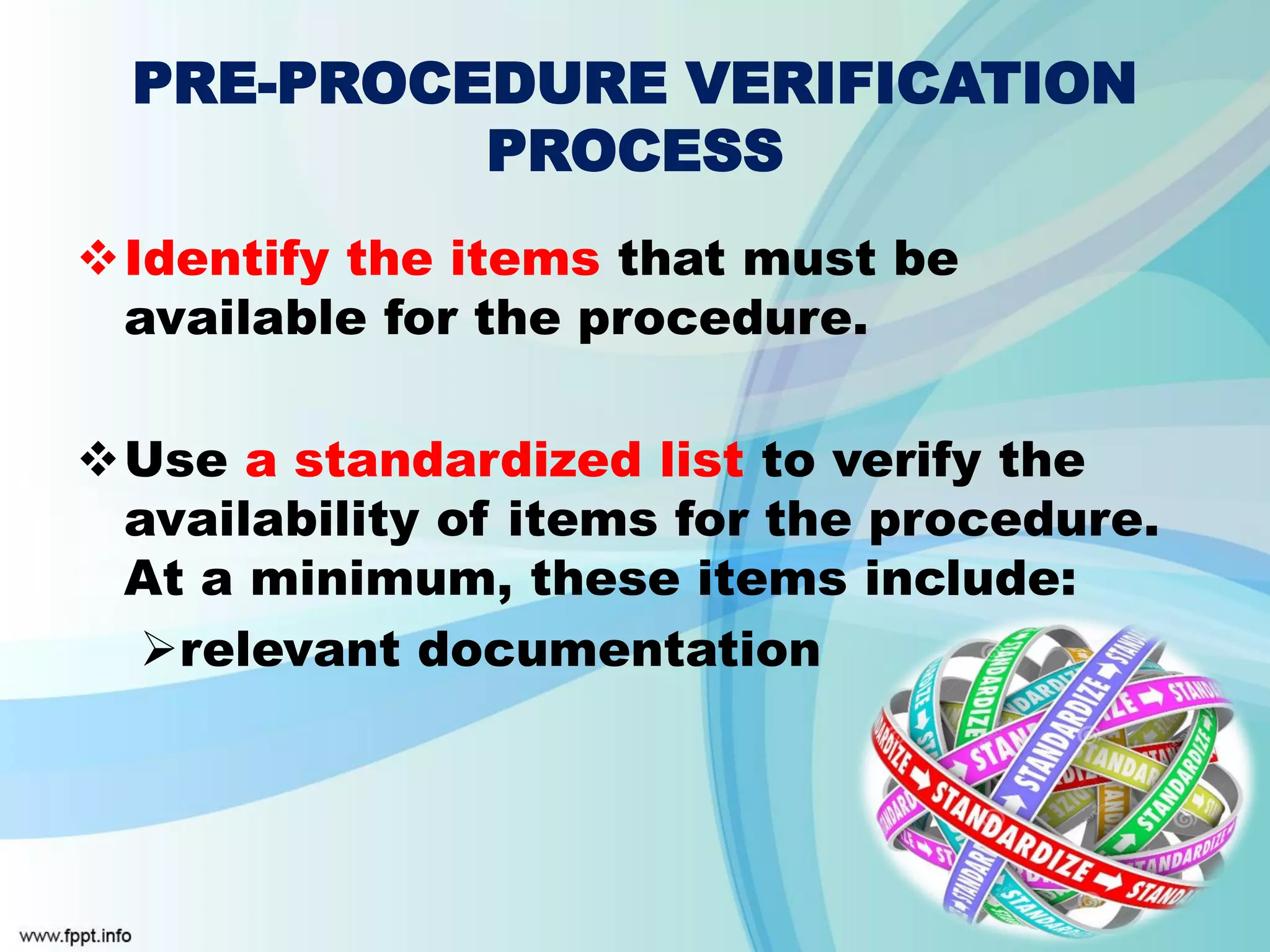
Identify the items that must be
available for the procedure.
Use a standardized list to verify the
availability of items for the procedure.
At a minimum, these items include:
relevant documentation
labeled diagnostic and
radiology test results that
are properly displayed
any required blood
products, implants,
devices, special equipment
Match the items that are to
be available in the procedure
area to the patient.
PRE-PROCEDURE VERIFICATION
PROCESS
MARK THE PROCEDURE SITE
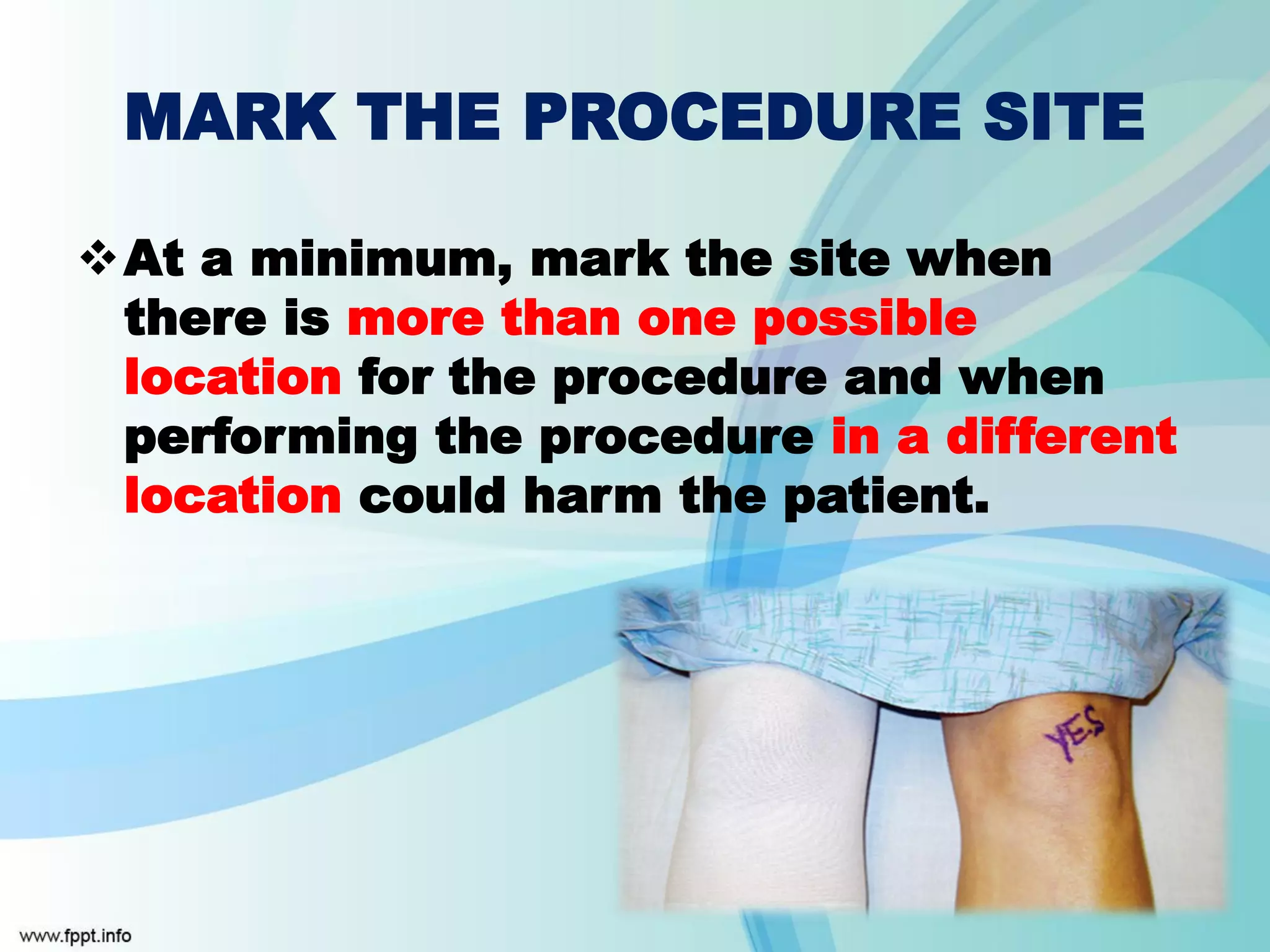
At a minimum, mark the site when
there is more than one possible
location for the procedure and when
performing the procedure in a different
location could harm the patient.
MARK THE PROCEDURE SITE
For spinal procedures: Mark the
general spinal region on the skin.
Special intraoperative imaging
techniques may be used to locate
and mark the exact vertebral level.
Mark the site before the procedure is
performed.
MARK THE PROCEDURE SITE
If possible, involve the patient in the
site marking process.
The site is marked by a licensed
independent practitioner who is
ultimately accountable for the
procedure and will be present when
the procedure is performed.
MARK THE PROCEDURE SITE
In limited circumstances, site
marking may be delegated to some
medical residents, physician
assistants (P.A.), or registered
nurses (R.N.). Ultimately, the
licensed independent practitioner is
accountable for the procedure even
when delegating site marking.
MARK THE PROCEDURE SITE
The mark is unambiguous and is used
consistently throughout the
organization.
The mark is made at or near the
procedure site.
The mark is sufficiently permanent to
be visible after skin preparation and
draping.
MARK THE PROCEDURE SITE
Adhesive markers are not the sole
means of marking the site.
For patients who refuse site marking
or when it is technically or
anatomically impossible or
impractical to mark the site: Use
your organization’s written,
alternative process to ensure that
the correct site is operated on.
MARK THE PROCEDURE SITE
Examples of situations that involve
alternative processes:
mucosal surfaces or perineum
minimal access procedures treating a
lateralized internal organ, whether
percutaneous or through a natural
orifice
teeth
premature infants, for whom the mark
may cause a permanent tattoo
PERFORM A TIME-OUT
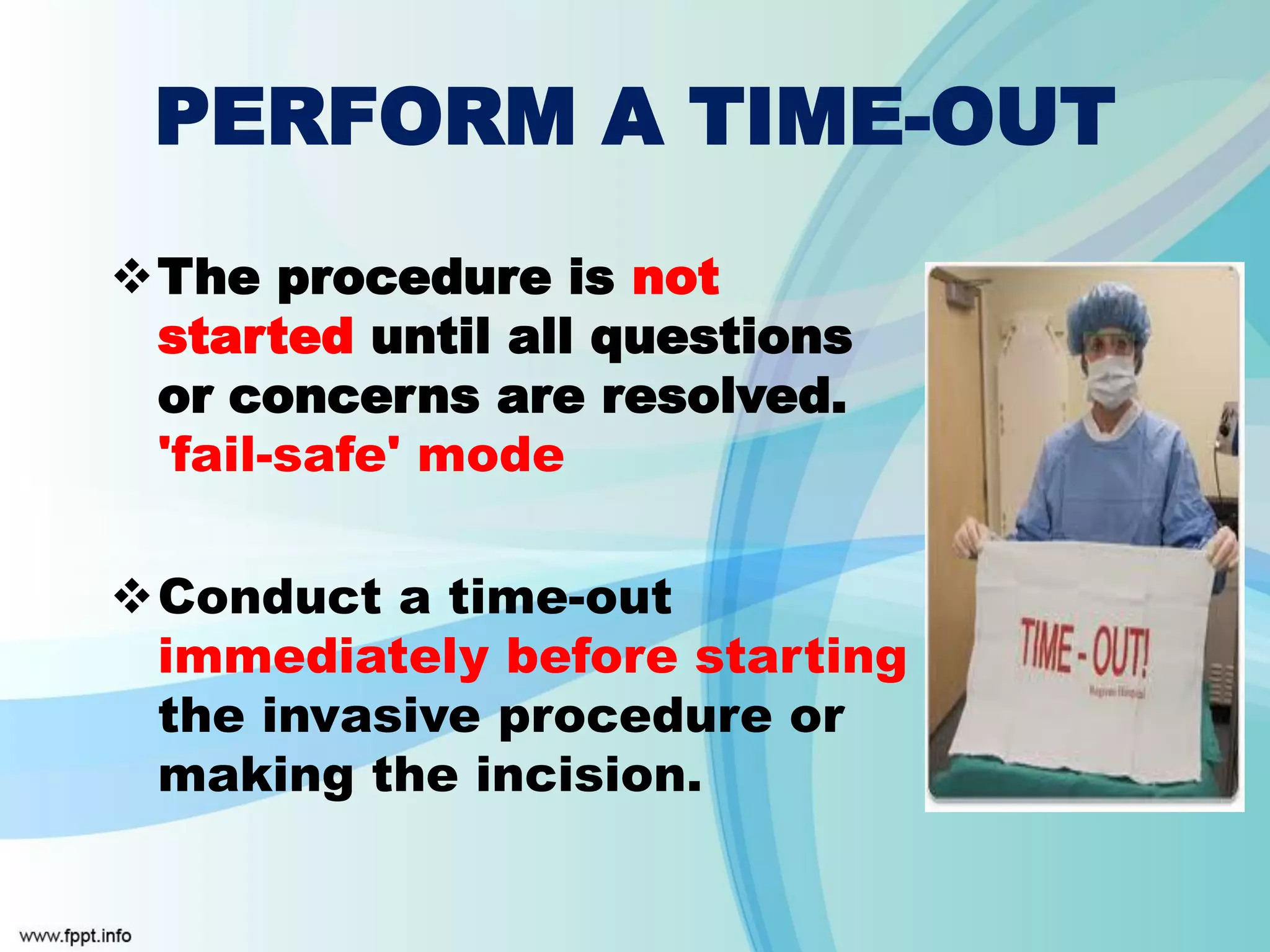
The procedure is not
started until all questions
or concerns are resolved.
'fail-safe' mode
Conduct a time-out
immediately before starting
the invasive procedure or
making the incision.
PERFORM A TIME-OUT
The time-out is standardized.
The time-out involves the immediate
members of the procedure team: the
individual performing the procedure,
anesthesia providers, circulating
nurse, operating room technician,
and other active participants who
will be participating in the procedure
from the beginning.
PERFORM A TIME-OUT
All relevant members of the
procedure team actively
communicate during the time-out.
During the time-out, the team
members agree, at a minimum, on
the following:
correct patient identity
correct site
procedure to be done
PERFORM A TIME-OUT
When the same patient has
two or more procedures: If the
person performing the
procedure changes, another
time-out needs to be
performed before starting each
procedure.
Document the completion of
the time-out.
Universal Protocol

Universal Protocol

  • 2.
    UNIVERSAL PROTOCOL The UniversalProtocol is based on the fact that wrong site, wrong procedure, and wrong person surgery can be prevented It became effective in July 2004
  • 3.
    UNIVERSAL PROTOCOL JCI Collectsreports from accredited organizations that have experienced a sentinel event within their organization Data from reports are collected, aggregated, and analyzed to identify root causes of adverse events
  • 4.
    UNIVERSAL PROTOCOL The goalis to use the data to prevent similar errors from occurring in other health care organizations The joint commission found the wrong site surgery to be the third-highest- ranking event
  • 5.
    UNIVERSAL PROTOCOL The protocolincludes many recommended steps but there are three principal elements: a) Pre-procedure verification b) Site marking c) Time out prior to incision
  • 6.
    AT-RISK BEHAVIOR INTHE OR Not checking equipment before use Surgeon entering after prep and drape Surgeon running 2 rooms Multi-tasking from O.R. Relying on memory about the pathology Unannounced substitutions in mid case Continuing to close during sponge search
  • 7.
    O.R. TEAM Be Patient-focused Not surgeon-focused Not workflow-focused Not specialty-focused Not budget-focused Not break-focused
  • 8.
    High Reliability Organizations “CARE “ Commitment by the Leaders Attention to the Task Respond as a Team Effective Communication Safety in surgery require the reliable execution of multiple necessary steps in care by health team working together for the benefit of the patient
  • 9.
    PRE-PROCEDURE VERIFICATION PROCESS Verify thecorrect procedure, for the correct patient, at the correct site. When possible, involve the patient in the verification process.
  • 10.
    PRE-PROCEDURE VERIFICATION PROCESS Identify theitems that must be available for the procedure. Use a standardized list to verify the availability of items for the procedure. At a minimum, these items include: relevant documentation
  • 11.
    labeled diagnostic and radiologytest results that are properly displayed any required blood products, implants, devices, special equipment Match the items that are to be available in the procedure area to the patient. PRE-PROCEDURE VERIFICATION PROCESS
  • 12.
    MARK THE PROCEDURESITE At a minimum, mark the site when there is more than one possible location for the procedure and when performing the procedure in a different location could harm the patient.
  • 13.
    MARK THE PROCEDURESITE For spinal procedures: Mark the general spinal region on the skin. Special intraoperative imaging techniques may be used to locate and mark the exact vertebral level. Mark the site before the procedure is performed.
  • 14.
    MARK THE PROCEDURESITE If possible, involve the patient in the site marking process. The site is marked by a licensed independent practitioner who is ultimately accountable for the procedure and will be present when the procedure is performed.
  • 15.
    MARK THE PROCEDURESITE In limited circumstances, site marking may be delegated to some medical residents, physician assistants (P.A.), or registered nurses (R.N.). Ultimately, the licensed independent practitioner is accountable for the procedure even when delegating site marking.
  • 16.
    MARK THE PROCEDURESITE The mark is unambiguous and is used consistently throughout the organization. The mark is made at or near the procedure site. The mark is sufficiently permanent to be visible after skin preparation and draping.
  • 17.
    MARK THE PROCEDURESITE Adhesive markers are not the sole means of marking the site. For patients who refuse site marking or when it is technically or anatomically impossible or impractical to mark the site: Use your organization’s written, alternative process to ensure that the correct site is operated on.
  • 18.
    MARK THE PROCEDURESITE Examples of situations that involve alternative processes: mucosal surfaces or perineum minimal access procedures treating a lateralized internal organ, whether percutaneous or through a natural orifice teeth premature infants, for whom the mark may cause a permanent tattoo
  • 19.
    PERFORM A TIME-OUT Theprocedure is not started until all questions or concerns are resolved. 'fail-safe' mode Conduct a time-out immediately before starting the invasive procedure or making the incision.
  • 20.
    PERFORM A TIME-OUT Thetime-out is standardized. The time-out involves the immediate members of the procedure team: the individual performing the procedure, anesthesia providers, circulating nurse, operating room technician, and other active participants who will be participating in the procedure from the beginning.
  • 21.
    PERFORM A TIME-OUT Allrelevant members of the procedure team actively communicate during the time-out. During the time-out, the team members agree, at a minimum, on the following: correct patient identity correct site procedure to be done
  • 22.
    PERFORM A TIME-OUT Whenthe same patient has two or more procedures: If the person performing the procedure changes, another time-out needs to be performed before starting each procedure. Document the completion of the time-out.