QUALITY CHAPTERS 1 - 10
Scope of Services
 Scope
 Not in scope – life saving treatment
 Each dept
 PMRN – one time
 IP Number
 OP Number
 Prioritization
 Triaging
 Estimated cost form/ financial consent
Initial Assessment
 Emergency, OPD, IPD
 Vitals – pain
 Weight and height (paed)
 IPD – doctors and nurses
 Time frame – 24 hours documented, emergency – 1
hour, begin – 4-6 hours, ½ an hour - emergency
 History, examination, vital signs, drug allergies,
provisional diagnosis
 Nursing assessment
 Screen all for nutritional assessment – doctor/nurse –
OPD/IPD/Emergency
 Care plan – main treating doctor needs to
countersign within 24 hours – junior doctor can
initiate
Reassessments
 Once daily by treating consultant
 Twice daily by SR
 Thrice daily by JR/PG
 Every shift – nursing staff
 OPD – next follow up date is must
 IPD – vitals, examination findings, medication orders
 Doctors progress notes – each visit
 Round notes – countersign by consultant within 24
hours
 No CST/ continue same treatment
LAB Services
 For sample collection – PMRN and lab number
 Turn around time for each test is defined and
displayed
 Biological reference values
 Critical values
 Critical values communicate to clinician – register
 Each report – name and signature of person
reporting the test
 Recall of reports – error, mark as recalled/amended
in records, date and time for recall, give new report
with – CAUTION – please ignore earlier one
 Lab quality assurance – internal / external
 Internal – peer review
 External – exchange sample with outside lab
 Calibration certificates - yearly
Imaging
 AERB clearance
 Dosimeters, lead shields, lead aprons
 TLD badges – technicians, nurses, doctors, class IV
 Display and signages
 RSO
 Turn around time – for all tests
 Waiting time/ time taken to perform test/ time taken
to prepare report
 Critical results reporting
 Recall/Amended reports
 Peer review – 10% reports – external/ internal with
CAPA
 Appropriateness of investigations asked – discuss
with clinician
 Calibration
 Pre exposure screening of patients by radiologist –
USG/CT/MRI
 Lead aprons – screen once a year for cracks
 Train nurses, helpers, housekeeping, security on
MRI safety
Patient care
 One doctor – SR/PG responsible for every patient
 Structured clinical handover – doctor and nurse –
register
 Inter department transfer – form – documented
handover
 Patient record – nursing station – confidential
 Referral – form – opinion/ takeover
 IPD patient – waiting time noted – OPD, lab, radiology
 Critical value alert register – wards, action report - file
Discharge process
 MLC – police information
 LAMA/DOR – reason to be documented, patient
counseling documented, patient declaration, give
discharge summary and reports as usual
 Every discharge summary signed by doctor,
acknowledged by patient/relatives
 Copy retained in file
 Every discharge summary – reason for admission,
findings, diagnosis, patient condition at time of
discharge, investigation results, procedures,
medications, name of primary clinician, follow up
and medication orders
 No BD, OD, TDS, QID
 When and how to obtain urgent care – contact
number
 Death – cause , PM - findings
Emergency
 Patient identification bands
 Triaging – Disaster (code yellow) – if more than 6
patients
 Red – 1st priority – most urgent – life threatening
shock, hypoxia
 Yellow – 2nd priority – can wait 10-15 min,
significant injuries
 Green – non urgent – can wait 30 minutes –
localised injuries
 Black – dead patients
 MLC – police information
 Decision – Physician
 Beds – 25 , resuscitation – 5
 All staff including attendants – BLS, selected – ACLS
 Dead on arrival – registration, breaking bad news,
police information, PM, storage
 Death certificate/summary – even if brought dead
 Code blue – cardiopulmonary arrest
 Announce – code activated x location x 3 times
 Deactivated
 Mock drill for disaster – twice a year
 Crash cart – similar
 CPR protocols – display in emergency, ICU
 CPR team – ACLS training
 Shift wise duty
 All other hospital staff – BLS trained
 Mock drill record
Procedures
 Identify the patient – PMRN, Name
 Site – surgical safety check list
 Informed written consent
 PPE
 Disinfectants/ sterilisation
 Intra procedure monitoring – pulse, BP, RR and post
procedure for 2 hours – another person
 Documentation – steps, post procedure care
 Sign with name, date, time
Blood transfusion
 Transportation of blood
 Verification of blood and patient
 Consent for blood transfusion and donation – can be
valid if multiple transfusion during that admission
 Chronic blood disorders – 6 months once, but endorsed
each visit
 Consent – risks, benefits, complications
 Leaflets and booklets – patient and family education –
blood bank, wards
 Report – for every patient for transfusion reaction
 feedback from patients
 Training of doctor/nurse/technician - record
ICU
 Admission and discharge criteria – displayed
 Staff trained for criteria
 Monitor – infection rate, readmission rate within 48
hours, reintubation rate within 48 hours,
Cauterisation associated infection, ventilator
associated pneumonia
 Patient and family counseling by doctor once a day,
when condition changes – documented
 Nurse patient ratio – venti 1:1, non venti 1:2
Vulnerable patient
 Elderly > 65 years, child < 12 years, physically or
mentally challenged, comatosed, under sedation,
abused
 Yellow bands (others – white bands)
 Monitor – twice a normal patient
 Risk of falls – bed railing, ramp railings
 Consent – guardians/ relatives
 Training of all hospital staff for vulnerable patients
Obstetrics
 Assessment – nutrition, immunisation, education
 Display – WE CARE FOR HIGH RISK
PREGNANCIES near OPD
 Priveleged nursing staff
 NICU
Paediatrics
 Well baby clinic
 NICU PICU
 Some posters promoting breast feeding
 Privileged staff
 Breast feeding room – OPD and IPD
 Immunisation, nutrition, growth, development
 Code Pink – child abduction
 CCTV cameras – labour room, NICU, PICU
 Family education – nutrition, immunisation, safe
parenting
 Growth chart and Immunisation chart displayed in
OPD and IPD plus in each patient file
 In patient language
 Child < 12 years
 Infant < 1 year
Moderate sedation
 Consent
 Sedation by doctor or nurse
 Not by one performing the procedure
 Intra procedure monitoring
 Discharge from recovery area
 Emergency resuscitation equipment
 Anaesthesist on call
Anaesthesia
 PAC – pre anaesthesia check up – before entering OT or
before admission
 Should contain anaesthesia plan – pre medication, type
of anaesthesia, medication and investigations review
 Immediate pre op evaluation – in pre op room – any
change in plan
 Consent for anaesthesia – risks, benefits, alternatives
 Separate from surgical consent
 During anaesthesia monitoring – documented – temp,
HR, PR, RR, BP, SpO2, ETCO2
 Cardiac rhythm – on monitor – only abnormality to be
documented
 Recovery area – patient shifting – bon basis of
physiological parameters
 Please mention – type, anaesthesia medication,
name of anaesthesist
 Sign with date and time and name
 Adverse anaesthesia events – documented
 Change in anaesthesia plan
Surgical procedure
 Pre op assessment
 Provisional diagnosis
 Consent by operating surgeon
 If procedure changed intra op – fresh consent
 Surgical safety checklist
 Privelege
 Operative notes detail steps and post op care
 Look for post operative complications, surgical site
checklist compliance, surgical site infection, change
in surgery plan
OT
 No mixture of sterile and unsterile patients
 Humidity control
 Temperature control
 Pressure differential monitoring
 Filter integrity monitoring – in 6 months
 Look for rational use of antibiotics
End of life care
 Training of staff
 Pain and palliative
 Respect religious/ social/ cultural beliefs
 REHABILITATIVE SERVICES
 Physiotherapy
 Speech therapy
 Antenatal and post natal exercises
Patient under restraint
 Physical or chemical
 Who can authorize
 Consent – relatives
 Can be at stretch for 4 hours
 Reason for restraint to be documented
 Signed by clinician or within one hour
 RESEARCH – Ethics committee, consent, right to
withdraw from research
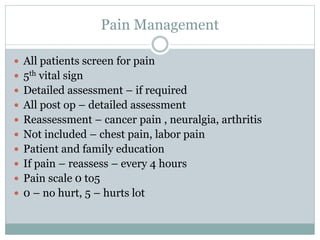
Pain Management
 All patients screen for pain
 5th vital sign
 Detailed assessment – if required
 All post op – detailed assessment
 Reassessment – cancer pain , neuralgia, arthritis
 Not included – chest pain, labor pain
 Patient and family education
 If pain – reassess – every 4 hours
 Pain scale 0 to5
 0 – no hurt, 5 – hurts lot
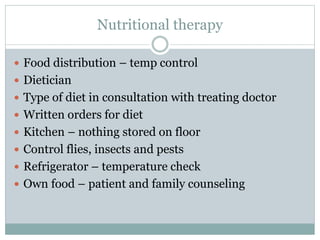
Nutritional therapy
 Food distribution – temp control
 Dietician
 Type of diet in consultation with treating doctor
 Written orders for diet
 Kitchen – nothing stored on floor
 Control flies, insects and pests
 Refrigerator – temperature check
 Own food – patient and family counseling
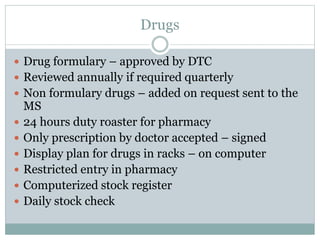
Drugs
 Drug formulary – approved by DTC
 Reviewed annually if required quarterly
 Non formulary drugs – added on request sent to the
MS
 24 hours duty roaster for pharmacy
 Only prescription by doctor accepted – signed
 Display plan for drugs in racks – on computer
 Restricted entry in pharmacy
 Computerized stock register
 Daily stock check
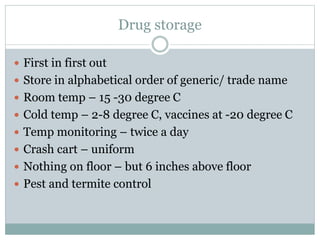
Drug storage
 First in first out
 Store in alphabetical order of generic/ trade name
 Room temp – 15 -30 degree C
 Cold temp – 2-8 degree C, vaccines at -20 degree C
 Temp monitoring – twice a day
 Crash cart – uniform
 Nothing on floor – but 6 inches above floor
 Pest and termite control
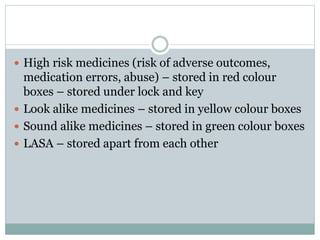
 High risk medicines (risk of adverse outcomes,
medication errors, abuse) – stored in red colour
boxes – stored under lock and key
 Look alike medicines – stored in yellow colour boxes
 Sound alike medicines – stored in green colour boxes
 LASA – stored apart from each other
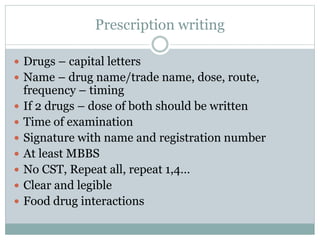
Prescription writing
 Drugs – capital letters
 Name – drug name/trade name, dose, route,
frequency – timing
 If 2 drugs – dose of both should be written
 Time of examination
 Signature with name and registration number
 At least MBBS
 No CST, Repeat all, repeat 1,4…
 Clear and legible
 Food drug interactions
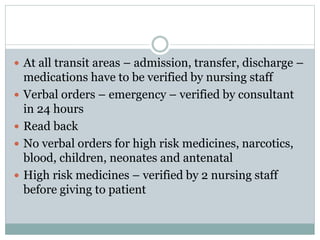
 At all transit areas – admission, transfer, discharge –
medications have to be verified by nursing staff
 Verbal orders – emergency – verified by consultant
in 24 hours
 Read back
 No verbal orders for high risk medicines, narcotics,
blood, children, neonates and antenatal
 High risk medicines – verified by 2 nursing staff
before giving to patient
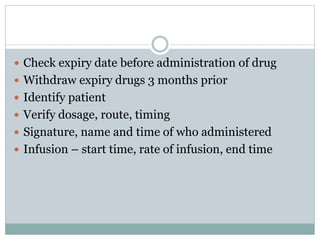
 Check expiry date before administration of drug
 Withdraw expiry drugs 3 months prior
 Identify patient
 Verify dosage, route, timing
 Signature, name and time of who administered
 Infusion – start time, rate of infusion, end time
 Alternative brands – authorized by doctor
 If prescription not legible – pharmacist should
contact the doctor on phone
 Maintain stock – give requirement atleast 1 month
prior
 Recall of drug – adverse health consequences, drug
reaction – MS – circular
 Self administration – patient and family counseling,
under supervision
 Counseling – cash memo
 Expiry date
 Avoid cut strips not having expiry date/ open or
tampered bottles
 Drug - drug interactions
 Drug – food interactions
 Near miss
 Medication error
 Adverse drug reaction – dose related
 All such incidents should be reported
 LABELLING OF DRUG IN SYRINGE – name of
medicine, strength, quantity, expiry date, patient
name and PMRN
Narcotics
 License
 Specific area for storage
 Double locking facility – pharmacist and doctor
 Prescription by doctor
 Duplicate of prescription to be preserved
 Double check by 2nd pharmacist
 Consumed ampules to be returned to pharmacy
 Record register
 Disposed off – running water, witness
Implants
 Patient and family counseling regarding implant and
cost – documented
 Batch and serial number of implant - recorded in
patient file, discharge summary and OT register
 If no pre labeled sticker – manufacturer name, batch
number and serial number
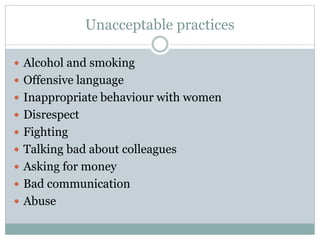
Unacceptable practices
 Alcohol and smoking
 Offensive language
 Inappropriate behaviour with women
 Disrespect
 Fighting
 Talking bad about colleagues
 Asking for money
 Bad communication
 Abuse
Patient rights
 Bilingual display
 Respect for personal dignity and privacy during
examination
 Protection from neglect and abuse – trolley and
wheel chair belts, bed railing
 Confidentialty – avoid discussion in public places,
patient information not to be revealed
 HIV status – cant be written on front of file, OPD
slip, cant be revealed
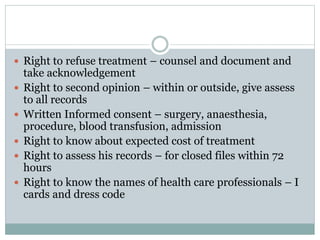
 Right to refuse treatment – counsel and document and
take acknowledgement
 Right to second opinion – within or outside, give assess
to all records
 Written Informed consent – surgery, anaesthesia,
procedure, blood transfusion, admission
 Right to know about expected cost of treatment
 Right to assess his records – for closed files within 72
hours
 Right to know the names of health care professionals – I
cards and dress code
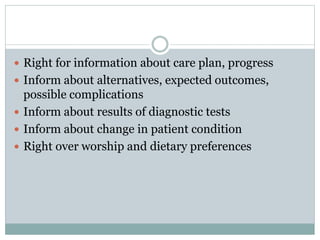
 Right for information about care plan, progress
 Inform about alternatives, expected outcomes,
possible complications
 Inform about results of diagnostic tests
 Inform about change in patient condition
 Right over worship and dietary preferences
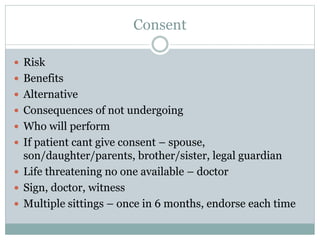
Consent
 Risk
 Benefits
 Alternative
 Consequences of not undergoing
 Who will perform
 If patient cant give consent – spouse,
son/daughter/parents, brother/sister, legal guardian
 Life threatening no one available – doctor
 Sign, doctor, witness
 Multiple sittings – once in 6 months, endorse each time
 If no consent – defer – document counseling and
take acknowledgement
 Court consent – if serious condition and consent not
given – vulnerable patient , 3rd trimester pregnancy
Feedback
 Right and responsibilities – explained by admission
clerk, PRO, nursing staff
 Any grief – hospital administration
 Right to voice their complaint
 Feedback – experience, communication with doctor,
pain management, hospital enviroment,
responsiveness of hospital staff, communication
about medication and overall rating
 Mechanism of lodging complaint – complaint box –
every monday
Tariff
 Uniform billing policy
 Tariff available at billing counters and registration
area
 Explain estimated cost in written – cost form and
take acknowledgement – resident doctor/ nursing
staff
 Explain costs when change in patient condition
Patient education
 Medication and side effects
 Diet and nutrition
 Immunisation – influenza, typhoid and hep B
 Diseases, complications
 Life style modifications, dietary changes
 In form of leaflets/ print
 Inform about preventing health care associated
infections – handwashing, avoid patient bed
 In patient language
Hospital infection control
 HIC team – ICO, ICN
 ICO – Microbiologist, privelege
 ICN – privelege – trained
 HIC committee – monthly basis meet
 High risk areas – ICU, OT, Blood bank, CSSD, Dialysis,
Labs, Kitchen, Mortuary
 High risk procedures – surgeries > 2 hours, endoscopies
 Antibiotic policy – based on c/s, reviewed once in 3
months (antimicrobials – antibiotics and antifungal) –
identify clinical conditions where used
 Notify all notifiable diseases to govt
 Staff training regarding HIC – once a year
 Induction training within 15 days of joining
 Policies, procedures and practices of infection control
programme
 Separate budget for HIC
 OT – Time gap b/w 2 surgeries – 20 minutes
 Antibiotic – 2 hours before surgery
 Fumigation – gas or smoke – 24 hours – sealed with tape
– Bacilo acid
 HIV/HBV/HCV – red colour band with black dots
 TB – blue colour band
Hand hygiene
 Hand hygiene guidelines – displayed near hand
washing area
 Hand washing
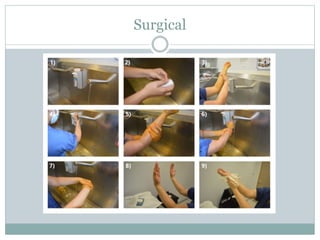
 Surgical – no nail polish, short nails, no ornaments,
soap and water/ scrub – above elbow – 4-6 minutes
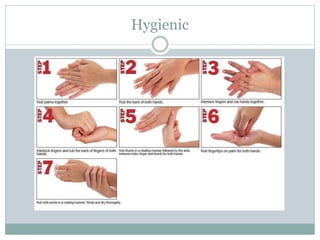
 Hygienic – soap and water - 20-30 sec – before
procedure
 Social – food, toilet – 10 sec
 Steps of hand washing
Surgical
Hygienic
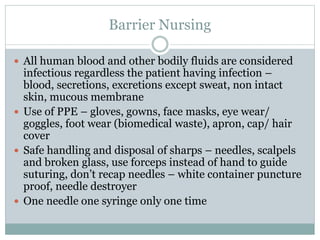
Barrier Nursing
 All human blood and other bodily fluids are considered
infectious regardless the patient having infection –
blood, secretions, excretions except sweat, non intact
skin, mucous membrane
 Use of PPE – gloves, gowns, face masks, eye wear/
goggles, foot wear (biomedical waste), apron, cap/ hair
cover
 Safe handling and disposal of sharps – needles, scalpels
and broken glass, use forceps instead of hand to guide
suturing, don’t recap needles – white container puncture
proof, needle destroyer
 One needle one syringe only one time
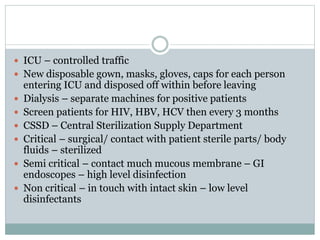
 ICU – controlled traffic
 New disposable gown, masks, gloves, caps for each person
entering ICU and disposed off within before leaving
 Dialysis – separate machines for positive patients
 Screen patients for HIV, HBV, HCV then every 3 months
 CSSD – Central Sterilization Supply Department
 Critical – surgical/ contact with patient sterile parts/ body
fluids – sterilized
 Semi critical – contact much mucous membrane – GI
endoscopes – high level disinfection
 Non critical – in touch with intact skin – low level
disinfectants
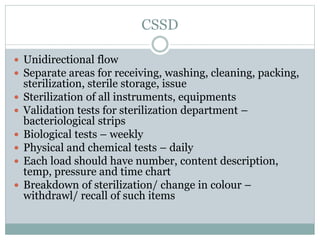
CSSD
 Unidirectional flow
 Separate areas for receiving, washing, cleaning, packing,
sterilization, sterile storage, issue
 Sterilization of all instruments, equipments
 Validation tests for sterilization department –
bacteriological strips
 Biological tests – weekly
 Physical and chemical tests – daily
 Each load should have number, content description,
temp, pressure and time chart
 Breakdown of sterilization/ change in colour –
withdrawl/ recall of such items
 Blood Bank/ Labs – white coat, PPE, restricted entry
 Kitchen – refrigerator – 3-7 C
 Periodic screening of kitchen staff for parasites,
salmonella typhi every 6 months or if rejoin after 15 days
leave or more
 Vaccinated – Hep B, Typhoid, TT
 Before any procedure – clean the site – alcohol swab,
savlon, betadine
Minimum distance b/w beds – 1- 2 m
 No seepage – fungal growth
 Any renovation – approved by IC committee
House Keeping
 NO BROOMING/ DRY DUSTING
 Disinfectants/detergents/soap and water
 Mopping should be done/ wet cleaning/ dust attract
mops
 If soiled – disinfectants
 For infected areas – mop laundrised before re use
 Dirty water and used disinfectant solution – discarded
 Walls and ceiling – cleaned when dirty
 While cleaning – area condoned off – with wet floor
signage
 Isolation rooms – contact/ droplet/ air borne
infections
 Closed doors with negative pressure
 Prophylaxis – pre and post exposure , Hepatitis B
Spillage
 Hazardous material – blood, body fluids, microbial cultures,
mercury, medical gases, ETO, steam
 Any material which due to its physical characterstic, quantity
or concentration can cause real harm to a individual
 Hazmat kits – handle spills
 MSDS – Material safety data sheets
 Code orange/ hazmat
 Spill – minor - < 30 cm – clean using PPE and 1% sodium
hypochlorite
 Major - > 30 cm – Code, hazmat kit
 Spillage – cover with paper towel, blotting paper, use 1%
sodium hypochlorite poured all around and covered with
paper for 10 minutes
Laundry
 Used linen – hand washed/ machine with gloves
 Infected/ soiled linen – disposable gloves, plastic
aprons
 PEST CONTROL
 Rats, flies, mosquitoes, termites
 Fogging
 Spraying
 Glue pads
 Outsourced
Bio medical waste
 Outsourced
 Visit to site once in 6 months
 PPE
 Colour coded bags
 Collected morning 7-8 am, 1-2 pm, 7-8 pm
 Liquid – no container
 Sharps – needles, blades, scalpels – puncture proof white box
containing 1% sodium hypochlorite
 Glass, slides, syringes, vials – Blue bags/bins
 Plastic syringes, IV set, tube, catheter, drains, gloves – Red
bags/bins
 Blood/body fluid soaked cotton swab, linen dressing, microbiology
and other lab waste, discarded medicines, expiry drugs, anatomical
waste – Yellow plastic bags, bins
 General waste, eatables, plates, glass, cups – Black
bag/bin
 Human anatomical waste – deep burial/ incinerators
 Lab waste - autoclave
Employee rights and responsibilities
 Employee – regular, Staff – contractual
 Respect and dignity
 Terms and conditions in appointment letter
 Clarity about targets to achieve/job to perform
 Benefits from organisation to be clear
 Responsibilities – discipline, duties, ethics, aware of
hospital policies, plan leaves in advance, care about
equipments under him/her, discrete, patient
interest, wear uniform , I card as required
FMS
 Hand bars, trolley and wheel chair belts, grab bars, bed
railings
 Separate toilet for physically disabled
 NO SMOKING AREA
 Facility round – twice a year in patient areas, once a year –
non patient areas
 Safety committee
 Safety education programmes – fire safety, lab safety,
occupational safety, radiation safety
 Controlled assess – I Cards
 Round the clock maintenance staff
 Complaint register – date and time of complaint,
confirmation of completion of job
 GREEN HOSPITAL – rain water harvesting, solar panels,
recycling, energy efficient lighting
 Cleaning of water storage tanks, RO unit, STP
 Dialysis water – endotoxin testing, PH, hardness
 Maintenance of lifts, Chiller unit, air conditioners
 Equipment inventory – UIN to each equipment,
calibration – once/twice a year as required, quality
certificates to be retained, manufacturers certificates/
manual to be retained
 Training of staff in usage of equipment
 Coding of all equipment – Dept/ name of equipment/
serial number
 Condemnation of equipment – condemnation
committee
 If cost of repair/ renewal exceeds 50% of original
value
 Outdated version – cant compete with new version
 Buy back/ sold/ scrap/ retained for spares
 Recall of equipment – letter from company –
immediate action
 Complaint about equipment after repair –
acknowledged by department
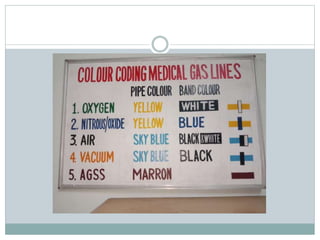
Medical gases
 Central oxygen plant
 D type oxygen cylinders – 47 liters – 63
 B type oxygen cylinders – 10 liters – 80
 A type oxygen cylinders – 5 liters – 13
 A type nitrous – 30
 A type carbon dioxide – 15
 Oxygen – black with white neck
 Nitrous – blue
 Carbon dioxide - grey
 Separate empty, use and full cylinders – mark them
 Gas pipeline – uniform colour code policy
Sentinel events
 Events cause harm to patient in hospital not related to patient
disease for a minimum of 2 weeks of disability or death
 Surgery – wrong patient, wrong site, wrong surgery, death due to
surgery, adverse anaesthesia events
 Device – contaminated medication/drug, failure/breakdown of
medical equipment
 Protection – discharge of infant to a wrong mother/person, suicide
or attempted suicide, no gas/oxygen, nosocromial infection
 Enviroment – blast, fall, slip, electric shock
 Criminal – abduction, sexual assault
 Medical error – medication error
 All sentinel events to be analysed within 24 hours of occuring
 CAPA
Fire safety
 Code red
 Mock drills twice a year
 Safe exit plans – each floor – displayed
 Alarm activated by pulling down the handle
 Disconnect medical gas flow and put off electric
equipments
 Close the doors and windows to prevent fire and smoke
from spreading
 Avoid lifts
 1st horizontal – then – vertical evacuation
 1st evacuate closure to dangerous area – then ambulatory
– then non ambulatory (stretcher or cloth sheet)
 USE FIRE EXTINGUISHER-
 P – Pull the pin in the nozzle of extinguisher
 A – Aim the nozzle at the base of fire
 S – Squeeze the handle
 S – Sweep from side to side to contain the fire
 Dial 444 – to activate Code Red
 PREVENTION OF FIRE
 No smoking
 No loose wire
 No inflammable materials – Petrol, LPG, Kerosene oil,
candles
 Put off lights, fans, electrical equipment when not in
use
 Remove the equipment connection from the plug
 CODE VIOLET
 Fights/ violence
 CODE YELLOW
 Disaster
 CODE BLACK
 Terrorist attack/ Bob threat
Quality
 Quality committee or core committee meets every 3
months – decides the mission, vision, quality policy,
quality objectives and service standards
 Quality coordinator/ Quality manager/ Accreditation
coordinator
 Audits
 Performance
 Committee meetings
 Hospital clinical audit – once in 6 months
 Patient safety committee – doctors, nurses, engineers,
management, security, house keeping
 Adverse events – injury related to medical
management or failure to manage
 No harm – error is not recognised, deed done but no
adverse even happened
 Near miss – error realised in last nick of time and
prevented
HRM
 Employee/ Staff
 Criminal/ negligence background check
 Induction training within 15 days at hospital &
departmental level
 Induction record – list of trainers and trainees with
signature, content of training
 Feedback is must
 Pre and post test
 Also when job change/ new equipment
 Pre employment medical check up
 Regular free health check up – once a year
 Documented
 Credentials – qualification
 Privelege – skills
 Priveleging after 1 month of joining
 Nurse: Patient = 1:5
 Needle stick injury – don’t squeeze or suck, wash
with soap and water, report to emergency
IMS
 Daily census report
 Birth and death statistics
 Every entry – named, signed, dated, timed – patient file
 Cardiac and respiratory arrest are event of death – not
cause
 Copy of PM - file
 MRD
 Restricted access
 Tracer card
 Pest and rodent control
 Fire fighting equipment
 Retention of records
 10 years all IPD
 MLC – permanent
 MTP – permanent
 Birth and death reports - permanent
Patient responsibilities
 Proper history and credentials
 To be on time
 To take medications regularly, follow advise
 Respect towards staff and other
 No alcohol, smoking, weapons
 No violence
 To share insurance data
 Follow up regularly
 Pay bills
 Give priority to emergencies
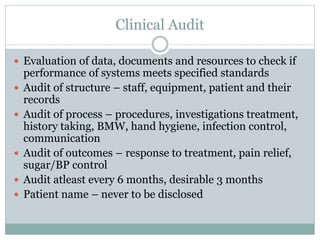
Clinical Audit
 Evaluation of data, documents and resources to check if
performance of systems meets specified standards
 Audit of structure – staff, equipment, patient and their
records
 Audit of process – procedures, investigations treatment,
history taking, BMW, hand hygiene, infection control,
communication
 Audit of outcomes – response to treatment, pain relief,
sugar/BP control
 Audit atleast every 6 months, desirable 3 months
 Patient name – never to be disclosed
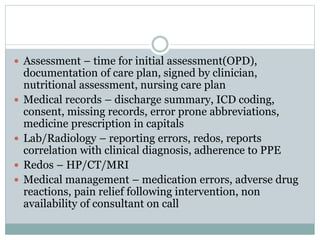
 Assessment – time for initial assessment(OPD),
documentation of care plan, signed by clinician,
nutritional assessment, nursing care plan
 Medical records – discharge summary, ICD coding,
consent, missing records, error prone abbreviations,
medicine prescription in capitals
 Lab/Radiology – reporting errors, redos, reports
correlation with clinical diagnosis, adherence to PPE
 Redos – HP/CT/MRI
 Medical management – medication errors, adverse drug
reactions, pain relief following intervention, non
availability of consultant on call
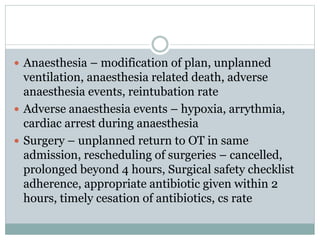
 Anaesthesia – modification of plan, unplanned
ventilation, anaesthesia related death, adverse
anaesthesia events, reintubation rate
 Adverse anaesthesia events – hypoxia, arrythmia,
cardiac arrest during anaesthesia
 Surgery – unplanned return to OT in same
admission, rescheduling of surgeries – cancelled,
prolonged beyond 4 hours, Surgical safety checklist
adherence, appropriate antibiotic given within 2
hours, timely cesation of antibiotics, cs rate
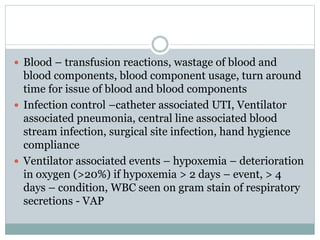
 Blood – transfusion reactions, wastage of blood and
blood components, blood component usage, turn around
time for issue of blood and blood components
 Infection control –catheter associated UTI, Ventilator
associated pneumonia, central line associated blood
stream infection, surgical site infection, hand hygience
compliance
 Ventilator associated events – hypoxemia – deterioration
in oxygen (>20%) if hypoxemia > 2 days – event, > 4
days – condition, WBC seen on gram stain of respiratory
secretions - VAP
 Return to ICU within 48 hours, return to emergency
within 72 hours
 Clinical research – percentage of research activities
approved, percentage of patients withdrawing from
study, protocol violations, serious adverse effects
 Patient safety – communication errors icluding
handover, patient identification errors, timely refilling of
fire extinguishers, sentinel events, near misses, falls
 Pharmacy – turn around time for dispensing medicines,
percentage of drugs purchased outside formulary,
percentage of stock outs
 Patient satisfaction – OPD satisfaction index, IPD
satisfaction index, waiting time for OPD and diagnostics
(registration – check up), time taken for discharge (
writing discharge summary – final billing)
 Employee satisfaction – employee satisfaction index,
attrition index, absenteeism rate, awareness about
employee rights and responsibilities
 Employee safety – blood and other body fluids exposure,
needle stick injuries, provision of pre exposure
prophylaxis
 Variations in mock drills
 Bed occupancy rate, average length of stay, OT
utilisation rate, ICU utilisation rate, critical
equipment downtime
 Nurse patient ratio
Communication in HCO
 HCW – Physicians, surgeons, anaesthesiologist,
dentists, nursing staff, technicians, therapists,
pharmacist, dietician – Interprofessional Team
 Supporting staff – engineers, public health,
electricians, plumber, security staff, transport, house
keeping, attendants, clerical, health workers
 How to communicate?
 b/w health care team themselves
 b/w health care team and patients/relatives
 Not included in any curriculum
 Good communication – good outcome
 Bad communication – errors, financial loss, litigation
 Need –
 Doctor patient interview
 Consent
 Nursing assessment
 Problematic areas – breaking bad news, disclosing death,
handling aggressive patient/ families, emergency/
disaster, disclosing adverse events, managing angry
employee, patient and staff argument handling
 Greetings, establish the rappot
 Listen patiently
 Favorable body language – dressing up, sitting
posture, eye contact, hand movements
 Show empathy – be in patient position
 Avoid unnecessary medical jargon
 Don’t be judgemental
 Be clear in your talk
 Be brief and specific
 Have a positive attitude with a smile
 Be calm but assertive
 Adapt to audience
 Understand body language and non verbal clues
 Be open minded
 BREAKING BAD NEWS – by treating consultant,
separate room, give time, should have knowledge of
case, in patient language, no jargons, use experience,
plan out before with team
IP SET UP
 IP Team to work together
 To communicate effectively with each other
 To take decisions together – shared decision making
 Division of roles
 Leadership
 Problem areas – education difference, age difference,
gender difference, cultural difference, ego
 Don’t understand the roles and responsibilities of
each other
 Fatigue, lack of interest, language barrier
 To work together – need to learn together as IP team
 Team work
 Centre point – patient
 IP concept – IPE, IPP
 Group discussions
 Role plays
 Videos
 Patient feedback
 Patient complaints
 Direct observation by peers – peer feedback

Quality care in hco

  • 1.
  • 2.
    Scope of Services Scope  Not in scope – life saving treatment  Each dept  PMRN – one time  IP Number  OP Number  Prioritization  Triaging  Estimated cost form/ financial consent
  • 3.
    Initial Assessment  Emergency,OPD, IPD  Vitals – pain  Weight and height (paed)  IPD – doctors and nurses  Time frame – 24 hours documented, emergency – 1 hour, begin – 4-6 hours, ½ an hour - emergency  History, examination, vital signs, drug allergies, provisional diagnosis  Nursing assessment  Screen all for nutritional assessment – doctor/nurse – OPD/IPD/Emergency
  • 4.
     Care plan– main treating doctor needs to countersign within 24 hours – junior doctor can initiate
  • 5.
    Reassessments  Once dailyby treating consultant  Twice daily by SR  Thrice daily by JR/PG  Every shift – nursing staff  OPD – next follow up date is must  IPD – vitals, examination findings, medication orders  Doctors progress notes – each visit  Round notes – countersign by consultant within 24 hours  No CST/ continue same treatment
  • 6.
    LAB Services  Forsample collection – PMRN and lab number  Turn around time for each test is defined and displayed  Biological reference values  Critical values  Critical values communicate to clinician – register  Each report – name and signature of person reporting the test
  • 7.
     Recall ofreports – error, mark as recalled/amended in records, date and time for recall, give new report with – CAUTION – please ignore earlier one  Lab quality assurance – internal / external  Internal – peer review  External – exchange sample with outside lab  Calibration certificates - yearly
  • 8.
    Imaging  AERB clearance Dosimeters, lead shields, lead aprons  TLD badges – technicians, nurses, doctors, class IV  Display and signages  RSO  Turn around time – for all tests  Waiting time/ time taken to perform test/ time taken to prepare report  Critical results reporting  Recall/Amended reports
  • 9.
     Peer review– 10% reports – external/ internal with CAPA  Appropriateness of investigations asked – discuss with clinician  Calibration  Pre exposure screening of patients by radiologist – USG/CT/MRI  Lead aprons – screen once a year for cracks  Train nurses, helpers, housekeeping, security on MRI safety
  • 10.
    Patient care  Onedoctor – SR/PG responsible for every patient  Structured clinical handover – doctor and nurse – register  Inter department transfer – form – documented handover  Patient record – nursing station – confidential  Referral – form – opinion/ takeover  IPD patient – waiting time noted – OPD, lab, radiology  Critical value alert register – wards, action report - file
  • 11.
    Discharge process  MLC– police information  LAMA/DOR – reason to be documented, patient counseling documented, patient declaration, give discharge summary and reports as usual  Every discharge summary signed by doctor, acknowledged by patient/relatives  Copy retained in file
  • 12.
     Every dischargesummary – reason for admission, findings, diagnosis, patient condition at time of discharge, investigation results, procedures, medications, name of primary clinician, follow up and medication orders  No BD, OD, TDS, QID  When and how to obtain urgent care – contact number  Death – cause , PM - findings
  • 13.
    Emergency  Patient identificationbands  Triaging – Disaster (code yellow) – if more than 6 patients  Red – 1st priority – most urgent – life threatening shock, hypoxia  Yellow – 2nd priority – can wait 10-15 min, significant injuries  Green – non urgent – can wait 30 minutes – localised injuries  Black – dead patients
  • 14.
     MLC –police information  Decision – Physician  Beds – 25 , resuscitation – 5  All staff including attendants – BLS, selected – ACLS  Dead on arrival – registration, breaking bad news, police information, PM, storage  Death certificate/summary – even if brought dead  Code blue – cardiopulmonary arrest  Announce – code activated x location x 3 times  Deactivated
  • 15.
     Mock drillfor disaster – twice a year  Crash cart – similar  CPR protocols – display in emergency, ICU  CPR team – ACLS training  Shift wise duty  All other hospital staff – BLS trained  Mock drill record
  • 16.
    Procedures  Identify thepatient – PMRN, Name  Site – surgical safety check list  Informed written consent  PPE  Disinfectants/ sterilisation  Intra procedure monitoring – pulse, BP, RR and post procedure for 2 hours – another person  Documentation – steps, post procedure care  Sign with name, date, time
  • 17.
    Blood transfusion  Transportationof blood  Verification of blood and patient  Consent for blood transfusion and donation – can be valid if multiple transfusion during that admission  Chronic blood disorders – 6 months once, but endorsed each visit  Consent – risks, benefits, complications  Leaflets and booklets – patient and family education – blood bank, wards  Report – for every patient for transfusion reaction  feedback from patients  Training of doctor/nurse/technician - record
  • 18.
    ICU  Admission anddischarge criteria – displayed  Staff trained for criteria  Monitor – infection rate, readmission rate within 48 hours, reintubation rate within 48 hours, Cauterisation associated infection, ventilator associated pneumonia  Patient and family counseling by doctor once a day, when condition changes – documented  Nurse patient ratio – venti 1:1, non venti 1:2
  • 19.
    Vulnerable patient  Elderly> 65 years, child < 12 years, physically or mentally challenged, comatosed, under sedation, abused  Yellow bands (others – white bands)  Monitor – twice a normal patient  Risk of falls – bed railing, ramp railings  Consent – guardians/ relatives  Training of all hospital staff for vulnerable patients
  • 20.
    Obstetrics  Assessment –nutrition, immunisation, education  Display – WE CARE FOR HIGH RISK PREGNANCIES near OPD  Priveleged nursing staff  NICU
  • 21.
    Paediatrics  Well babyclinic  NICU PICU  Some posters promoting breast feeding  Privileged staff  Breast feeding room – OPD and IPD  Immunisation, nutrition, growth, development  Code Pink – child abduction  CCTV cameras – labour room, NICU, PICU
  • 22.
     Family education– nutrition, immunisation, safe parenting  Growth chart and Immunisation chart displayed in OPD and IPD plus in each patient file  In patient language  Child < 12 years  Infant < 1 year
  • 23.
    Moderate sedation  Consent Sedation by doctor or nurse  Not by one performing the procedure  Intra procedure monitoring  Discharge from recovery area  Emergency resuscitation equipment  Anaesthesist on call
  • 24.
    Anaesthesia  PAC –pre anaesthesia check up – before entering OT or before admission  Should contain anaesthesia plan – pre medication, type of anaesthesia, medication and investigations review  Immediate pre op evaluation – in pre op room – any change in plan  Consent for anaesthesia – risks, benefits, alternatives  Separate from surgical consent  During anaesthesia monitoring – documented – temp, HR, PR, RR, BP, SpO2, ETCO2  Cardiac rhythm – on monitor – only abnormality to be documented
  • 25.
     Recovery area– patient shifting – bon basis of physiological parameters  Please mention – type, anaesthesia medication, name of anaesthesist  Sign with date and time and name  Adverse anaesthesia events – documented  Change in anaesthesia plan
  • 26.
    Surgical procedure  Preop assessment  Provisional diagnosis  Consent by operating surgeon  If procedure changed intra op – fresh consent  Surgical safety checklist  Privelege  Operative notes detail steps and post op care  Look for post operative complications, surgical site checklist compliance, surgical site infection, change in surgery plan
  • 27.
    OT  No mixtureof sterile and unsterile patients  Humidity control  Temperature control  Pressure differential monitoring  Filter integrity monitoring – in 6 months  Look for rational use of antibiotics
  • 28.
    End of lifecare  Training of staff  Pain and palliative  Respect religious/ social/ cultural beliefs  REHABILITATIVE SERVICES  Physiotherapy  Speech therapy  Antenatal and post natal exercises
  • 29.
    Patient under restraint Physical or chemical  Who can authorize  Consent – relatives  Can be at stretch for 4 hours  Reason for restraint to be documented  Signed by clinician or within one hour  RESEARCH – Ethics committee, consent, right to withdraw from research
  • 30.
    Pain Management  Allpatients screen for pain  5th vital sign  Detailed assessment – if required  All post op – detailed assessment  Reassessment – cancer pain , neuralgia, arthritis  Not included – chest pain, labor pain  Patient and family education  If pain – reassess – every 4 hours  Pain scale 0 to5  0 – no hurt, 5 – hurts lot
  • 31.
    Nutritional therapy  Fooddistribution – temp control  Dietician  Type of diet in consultation with treating doctor  Written orders for diet  Kitchen – nothing stored on floor  Control flies, insects and pests  Refrigerator – temperature check  Own food – patient and family counseling
  • 32.
    Drugs  Drug formulary– approved by DTC  Reviewed annually if required quarterly  Non formulary drugs – added on request sent to the MS  24 hours duty roaster for pharmacy  Only prescription by doctor accepted – signed  Display plan for drugs in racks – on computer  Restricted entry in pharmacy  Computerized stock register  Daily stock check
  • 33.
    Drug storage  Firstin first out  Store in alphabetical order of generic/ trade name  Room temp – 15 -30 degree C  Cold temp – 2-8 degree C, vaccines at -20 degree C  Temp monitoring – twice a day  Crash cart – uniform  Nothing on floor – but 6 inches above floor  Pest and termite control
  • 34.
     High riskmedicines (risk of adverse outcomes, medication errors, abuse) – stored in red colour boxes – stored under lock and key  Look alike medicines – stored in yellow colour boxes  Sound alike medicines – stored in green colour boxes  LASA – stored apart from each other
  • 35.
    Prescription writing  Drugs– capital letters  Name – drug name/trade name, dose, route, frequency – timing  If 2 drugs – dose of both should be written  Time of examination  Signature with name and registration number  At least MBBS  No CST, Repeat all, repeat 1,4…  Clear and legible  Food drug interactions
  • 36.
     At alltransit areas – admission, transfer, discharge – medications have to be verified by nursing staff  Verbal orders – emergency – verified by consultant in 24 hours  Read back  No verbal orders for high risk medicines, narcotics, blood, children, neonates and antenatal  High risk medicines – verified by 2 nursing staff before giving to patient
  • 37.
     Check expirydate before administration of drug  Withdraw expiry drugs 3 months prior  Identify patient  Verify dosage, route, timing  Signature, name and time of who administered  Infusion – start time, rate of infusion, end time
  • 38.
     Alternative brands– authorized by doctor  If prescription not legible – pharmacist should contact the doctor on phone  Maintain stock – give requirement atleast 1 month prior  Recall of drug – adverse health consequences, drug reaction – MS – circular  Self administration – patient and family counseling, under supervision
  • 39.
     Counseling –cash memo  Expiry date  Avoid cut strips not having expiry date/ open or tampered bottles  Drug - drug interactions  Drug – food interactions
  • 40.
     Near miss Medication error  Adverse drug reaction – dose related  All such incidents should be reported  LABELLING OF DRUG IN SYRINGE – name of medicine, strength, quantity, expiry date, patient name and PMRN
  • 41.
    Narcotics  License  Specificarea for storage  Double locking facility – pharmacist and doctor  Prescription by doctor  Duplicate of prescription to be preserved  Double check by 2nd pharmacist  Consumed ampules to be returned to pharmacy  Record register  Disposed off – running water, witness
  • 42.
    Implants  Patient andfamily counseling regarding implant and cost – documented  Batch and serial number of implant - recorded in patient file, discharge summary and OT register  If no pre labeled sticker – manufacturer name, batch number and serial number
  • 43.
    Unacceptable practices  Alcoholand smoking  Offensive language  Inappropriate behaviour with women  Disrespect  Fighting  Talking bad about colleagues  Asking for money  Bad communication  Abuse
  • 44.
    Patient rights  Bilingualdisplay  Respect for personal dignity and privacy during examination  Protection from neglect and abuse – trolley and wheel chair belts, bed railing  Confidentialty – avoid discussion in public places, patient information not to be revealed  HIV status – cant be written on front of file, OPD slip, cant be revealed
  • 45.
     Right torefuse treatment – counsel and document and take acknowledgement  Right to second opinion – within or outside, give assess to all records  Written Informed consent – surgery, anaesthesia, procedure, blood transfusion, admission  Right to know about expected cost of treatment  Right to assess his records – for closed files within 72 hours  Right to know the names of health care professionals – I cards and dress code
  • 46.
     Right forinformation about care plan, progress  Inform about alternatives, expected outcomes, possible complications  Inform about results of diagnostic tests  Inform about change in patient condition  Right over worship and dietary preferences
  • 47.
    Consent  Risk  Benefits Alternative  Consequences of not undergoing  Who will perform  If patient cant give consent – spouse, son/daughter/parents, brother/sister, legal guardian  Life threatening no one available – doctor  Sign, doctor, witness  Multiple sittings – once in 6 months, endorse each time
  • 48.
     If noconsent – defer – document counseling and take acknowledgement  Court consent – if serious condition and consent not given – vulnerable patient , 3rd trimester pregnancy
  • 49.
    Feedback  Right andresponsibilities – explained by admission clerk, PRO, nursing staff  Any grief – hospital administration  Right to voice their complaint  Feedback – experience, communication with doctor, pain management, hospital enviroment, responsiveness of hospital staff, communication about medication and overall rating  Mechanism of lodging complaint – complaint box – every monday
  • 50.
    Tariff  Uniform billingpolicy  Tariff available at billing counters and registration area  Explain estimated cost in written – cost form and take acknowledgement – resident doctor/ nursing staff  Explain costs when change in patient condition
  • 51.
    Patient education  Medicationand side effects  Diet and nutrition  Immunisation – influenza, typhoid and hep B  Diseases, complications  Life style modifications, dietary changes  In form of leaflets/ print  Inform about preventing health care associated infections – handwashing, avoid patient bed  In patient language
  • 52.
    Hospital infection control HIC team – ICO, ICN  ICO – Microbiologist, privelege  ICN – privelege – trained  HIC committee – monthly basis meet  High risk areas – ICU, OT, Blood bank, CSSD, Dialysis, Labs, Kitchen, Mortuary  High risk procedures – surgeries > 2 hours, endoscopies  Antibiotic policy – based on c/s, reviewed once in 3 months (antimicrobials – antibiotics and antifungal) – identify clinical conditions where used  Notify all notifiable diseases to govt
  • 53.
     Staff trainingregarding HIC – once a year  Induction training within 15 days of joining  Policies, procedures and practices of infection control programme  Separate budget for HIC  OT – Time gap b/w 2 surgeries – 20 minutes  Antibiotic – 2 hours before surgery  Fumigation – gas or smoke – 24 hours – sealed with tape – Bacilo acid  HIV/HBV/HCV – red colour band with black dots  TB – blue colour band
  • 54.
    Hand hygiene  Handhygiene guidelines – displayed near hand washing area  Hand washing  Surgical – no nail polish, short nails, no ornaments, soap and water/ scrub – above elbow – 4-6 minutes  Hygienic – soap and water - 20-30 sec – before procedure  Social – food, toilet – 10 sec  Steps of hand washing
  • 55.
  • 56.
  • 57.
    Barrier Nursing  Allhuman blood and other bodily fluids are considered infectious regardless the patient having infection – blood, secretions, excretions except sweat, non intact skin, mucous membrane  Use of PPE – gloves, gowns, face masks, eye wear/ goggles, foot wear (biomedical waste), apron, cap/ hair cover  Safe handling and disposal of sharps – needles, scalpels and broken glass, use forceps instead of hand to guide suturing, don’t recap needles – white container puncture proof, needle destroyer  One needle one syringe only one time
  • 58.
     ICU –controlled traffic  New disposable gown, masks, gloves, caps for each person entering ICU and disposed off within before leaving  Dialysis – separate machines for positive patients  Screen patients for HIV, HBV, HCV then every 3 months  CSSD – Central Sterilization Supply Department  Critical – surgical/ contact with patient sterile parts/ body fluids – sterilized  Semi critical – contact much mucous membrane – GI endoscopes – high level disinfection  Non critical – in touch with intact skin – low level disinfectants
  • 59.
    CSSD  Unidirectional flow Separate areas for receiving, washing, cleaning, packing, sterilization, sterile storage, issue  Sterilization of all instruments, equipments  Validation tests for sterilization department – bacteriological strips  Biological tests – weekly  Physical and chemical tests – daily  Each load should have number, content description, temp, pressure and time chart  Breakdown of sterilization/ change in colour – withdrawl/ recall of such items
  • 60.
     Blood Bank/Labs – white coat, PPE, restricted entry  Kitchen – refrigerator – 3-7 C  Periodic screening of kitchen staff for parasites, salmonella typhi every 6 months or if rejoin after 15 days leave or more  Vaccinated – Hep B, Typhoid, TT  Before any procedure – clean the site – alcohol swab, savlon, betadine Minimum distance b/w beds – 1- 2 m  No seepage – fungal growth  Any renovation – approved by IC committee
  • 61.
    House Keeping  NOBROOMING/ DRY DUSTING  Disinfectants/detergents/soap and water  Mopping should be done/ wet cleaning/ dust attract mops  If soiled – disinfectants  For infected areas – mop laundrised before re use  Dirty water and used disinfectant solution – discarded  Walls and ceiling – cleaned when dirty  While cleaning – area condoned off – with wet floor signage
  • 62.
     Isolation rooms– contact/ droplet/ air borne infections  Closed doors with negative pressure  Prophylaxis – pre and post exposure , Hepatitis B
  • 63.
    Spillage  Hazardous material– blood, body fluids, microbial cultures, mercury, medical gases, ETO, steam  Any material which due to its physical characterstic, quantity or concentration can cause real harm to a individual  Hazmat kits – handle spills  MSDS – Material safety data sheets  Code orange/ hazmat  Spill – minor - < 30 cm – clean using PPE and 1% sodium hypochlorite  Major - > 30 cm – Code, hazmat kit  Spillage – cover with paper towel, blotting paper, use 1% sodium hypochlorite poured all around and covered with paper for 10 minutes
  • 64.
    Laundry  Used linen– hand washed/ machine with gloves  Infected/ soiled linen – disposable gloves, plastic aprons  PEST CONTROL  Rats, flies, mosquitoes, termites  Fogging  Spraying  Glue pads  Outsourced
  • 65.
    Bio medical waste Outsourced  Visit to site once in 6 months  PPE  Colour coded bags  Collected morning 7-8 am, 1-2 pm, 7-8 pm  Liquid – no container  Sharps – needles, blades, scalpels – puncture proof white box containing 1% sodium hypochlorite  Glass, slides, syringes, vials – Blue bags/bins  Plastic syringes, IV set, tube, catheter, drains, gloves – Red bags/bins  Blood/body fluid soaked cotton swab, linen dressing, microbiology and other lab waste, discarded medicines, expiry drugs, anatomical waste – Yellow plastic bags, bins
  • 66.
     General waste,eatables, plates, glass, cups – Black bag/bin  Human anatomical waste – deep burial/ incinerators  Lab waste - autoclave
  • 67.
    Employee rights andresponsibilities  Employee – regular, Staff – contractual  Respect and dignity  Terms and conditions in appointment letter  Clarity about targets to achieve/job to perform  Benefits from organisation to be clear  Responsibilities – discipline, duties, ethics, aware of hospital policies, plan leaves in advance, care about equipments under him/her, discrete, patient interest, wear uniform , I card as required
  • 68.
    FMS  Hand bars,trolley and wheel chair belts, grab bars, bed railings  Separate toilet for physically disabled  NO SMOKING AREA  Facility round – twice a year in patient areas, once a year – non patient areas  Safety committee  Safety education programmes – fire safety, lab safety, occupational safety, radiation safety  Controlled assess – I Cards  Round the clock maintenance staff  Complaint register – date and time of complaint, confirmation of completion of job
  • 69.
     GREEN HOSPITAL– rain water harvesting, solar panels, recycling, energy efficient lighting  Cleaning of water storage tanks, RO unit, STP  Dialysis water – endotoxin testing, PH, hardness  Maintenance of lifts, Chiller unit, air conditioners  Equipment inventory – UIN to each equipment, calibration – once/twice a year as required, quality certificates to be retained, manufacturers certificates/ manual to be retained  Training of staff in usage of equipment  Coding of all equipment – Dept/ name of equipment/ serial number
  • 70.
     Condemnation ofequipment – condemnation committee  If cost of repair/ renewal exceeds 50% of original value  Outdated version – cant compete with new version  Buy back/ sold/ scrap/ retained for spares  Recall of equipment – letter from company – immediate action  Complaint about equipment after repair – acknowledged by department
  • 71.
    Medical gases  Centraloxygen plant  D type oxygen cylinders – 47 liters – 63  B type oxygen cylinders – 10 liters – 80  A type oxygen cylinders – 5 liters – 13  A type nitrous – 30  A type carbon dioxide – 15  Oxygen – black with white neck  Nitrous – blue  Carbon dioxide - grey  Separate empty, use and full cylinders – mark them  Gas pipeline – uniform colour code policy
  • 73.
    Sentinel events  Eventscause harm to patient in hospital not related to patient disease for a minimum of 2 weeks of disability or death  Surgery – wrong patient, wrong site, wrong surgery, death due to surgery, adverse anaesthesia events  Device – contaminated medication/drug, failure/breakdown of medical equipment  Protection – discharge of infant to a wrong mother/person, suicide or attempted suicide, no gas/oxygen, nosocromial infection  Enviroment – blast, fall, slip, electric shock  Criminal – abduction, sexual assault  Medical error – medication error  All sentinel events to be analysed within 24 hours of occuring  CAPA
  • 74.
    Fire safety  Codered  Mock drills twice a year  Safe exit plans – each floor – displayed  Alarm activated by pulling down the handle  Disconnect medical gas flow and put off electric equipments  Close the doors and windows to prevent fire and smoke from spreading  Avoid lifts  1st horizontal – then – vertical evacuation  1st evacuate closure to dangerous area – then ambulatory – then non ambulatory (stretcher or cloth sheet)
  • 75.
     USE FIREEXTINGUISHER-  P – Pull the pin in the nozzle of extinguisher  A – Aim the nozzle at the base of fire  S – Squeeze the handle  S – Sweep from side to side to contain the fire  Dial 444 – to activate Code Red  PREVENTION OF FIRE  No smoking  No loose wire  No inflammable materials – Petrol, LPG, Kerosene oil, candles
  • 76.
     Put offlights, fans, electrical equipment when not in use  Remove the equipment connection from the plug  CODE VIOLET  Fights/ violence  CODE YELLOW  Disaster  CODE BLACK  Terrorist attack/ Bob threat
  • 77.
    Quality  Quality committeeor core committee meets every 3 months – decides the mission, vision, quality policy, quality objectives and service standards  Quality coordinator/ Quality manager/ Accreditation coordinator  Audits  Performance  Committee meetings  Hospital clinical audit – once in 6 months  Patient safety committee – doctors, nurses, engineers, management, security, house keeping
  • 78.
     Adverse events– injury related to medical management or failure to manage  No harm – error is not recognised, deed done but no adverse even happened  Near miss – error realised in last nick of time and prevented
  • 79.
    HRM  Employee/ Staff Criminal/ negligence background check  Induction training within 15 days at hospital & departmental level  Induction record – list of trainers and trainees with signature, content of training  Feedback is must  Pre and post test  Also when job change/ new equipment  Pre employment medical check up  Regular free health check up – once a year
  • 80.
     Documented  Credentials– qualification  Privelege – skills  Priveleging after 1 month of joining  Nurse: Patient = 1:5  Needle stick injury – don’t squeeze or suck, wash with soap and water, report to emergency
  • 81.
    IMS  Daily censusreport  Birth and death statistics  Every entry – named, signed, dated, timed – patient file  Cardiac and respiratory arrest are event of death – not cause  Copy of PM - file  MRD  Restricted access  Tracer card  Pest and rodent control  Fire fighting equipment
  • 82.
     Retention ofrecords  10 years all IPD  MLC – permanent  MTP – permanent  Birth and death reports - permanent
  • 83.
    Patient responsibilities  Properhistory and credentials  To be on time  To take medications regularly, follow advise  Respect towards staff and other  No alcohol, smoking, weapons  No violence  To share insurance data  Follow up regularly  Pay bills  Give priority to emergencies
  • 84.
    Clinical Audit  Evaluationof data, documents and resources to check if performance of systems meets specified standards  Audit of structure – staff, equipment, patient and their records  Audit of process – procedures, investigations treatment, history taking, BMW, hand hygiene, infection control, communication  Audit of outcomes – response to treatment, pain relief, sugar/BP control  Audit atleast every 6 months, desirable 3 months  Patient name – never to be disclosed
  • 85.
     Assessment –time for initial assessment(OPD), documentation of care plan, signed by clinician, nutritional assessment, nursing care plan  Medical records – discharge summary, ICD coding, consent, missing records, error prone abbreviations, medicine prescription in capitals  Lab/Radiology – reporting errors, redos, reports correlation with clinical diagnosis, adherence to PPE  Redos – HP/CT/MRI  Medical management – medication errors, adverse drug reactions, pain relief following intervention, non availability of consultant on call
  • 86.
     Anaesthesia –modification of plan, unplanned ventilation, anaesthesia related death, adverse anaesthesia events, reintubation rate  Adverse anaesthesia events – hypoxia, arrythmia, cardiac arrest during anaesthesia  Surgery – unplanned return to OT in same admission, rescheduling of surgeries – cancelled, prolonged beyond 4 hours, Surgical safety checklist adherence, appropriate antibiotic given within 2 hours, timely cesation of antibiotics, cs rate
  • 87.
     Blood –transfusion reactions, wastage of blood and blood components, blood component usage, turn around time for issue of blood and blood components  Infection control –catheter associated UTI, Ventilator associated pneumonia, central line associated blood stream infection, surgical site infection, hand hygience compliance  Ventilator associated events – hypoxemia – deterioration in oxygen (>20%) if hypoxemia > 2 days – event, > 4 days – condition, WBC seen on gram stain of respiratory secretions - VAP
  • 88.
     Return toICU within 48 hours, return to emergency within 72 hours  Clinical research – percentage of research activities approved, percentage of patients withdrawing from study, protocol violations, serious adverse effects  Patient safety – communication errors icluding handover, patient identification errors, timely refilling of fire extinguishers, sentinel events, near misses, falls  Pharmacy – turn around time for dispensing medicines, percentage of drugs purchased outside formulary, percentage of stock outs
  • 89.
     Patient satisfaction– OPD satisfaction index, IPD satisfaction index, waiting time for OPD and diagnostics (registration – check up), time taken for discharge ( writing discharge summary – final billing)  Employee satisfaction – employee satisfaction index, attrition index, absenteeism rate, awareness about employee rights and responsibilities  Employee safety – blood and other body fluids exposure, needle stick injuries, provision of pre exposure prophylaxis  Variations in mock drills
  • 90.
     Bed occupancyrate, average length of stay, OT utilisation rate, ICU utilisation rate, critical equipment downtime  Nurse patient ratio
  • 91.
    Communication in HCO HCW – Physicians, surgeons, anaesthesiologist, dentists, nursing staff, technicians, therapists, pharmacist, dietician – Interprofessional Team  Supporting staff – engineers, public health, electricians, plumber, security staff, transport, house keeping, attendants, clerical, health workers  How to communicate?  b/w health care team themselves  b/w health care team and patients/relatives  Not included in any curriculum
  • 92.
     Good communication– good outcome  Bad communication – errors, financial loss, litigation  Need –  Doctor patient interview  Consent  Nursing assessment  Problematic areas – breaking bad news, disclosing death, handling aggressive patient/ families, emergency/ disaster, disclosing adverse events, managing angry employee, patient and staff argument handling
  • 93.
     Greetings, establishthe rappot  Listen patiently  Favorable body language – dressing up, sitting posture, eye contact, hand movements  Show empathy – be in patient position  Avoid unnecessary medical jargon  Don’t be judgemental  Be clear in your talk  Be brief and specific
  • 94.
     Have apositive attitude with a smile  Be calm but assertive  Adapt to audience  Understand body language and non verbal clues  Be open minded  BREAKING BAD NEWS – by treating consultant, separate room, give time, should have knowledge of case, in patient language, no jargons, use experience, plan out before with team
  • 95.
    IP SET UP IP Team to work together  To communicate effectively with each other  To take decisions together – shared decision making  Division of roles  Leadership  Problem areas – education difference, age difference, gender difference, cultural difference, ego  Don’t understand the roles and responsibilities of each other  Fatigue, lack of interest, language barrier
  • 96.
     To worktogether – need to learn together as IP team  Team work  Centre point – patient  IP concept – IPE, IPP  Group discussions  Role plays  Videos  Patient feedback  Patient complaints  Direct observation by peers – peer feedback