CATEGORY MANAGEMENT
Definition, need and Importance
1
Category
2
 A Category is a group of similar or related items
which the customer would ideally like to find
together in a store
 Categories are mainly used as organizational aids
to better manage and monitor predefined groups of
products
Category Management
3
 Category management is a retailing and purchasing
concept in which the range of products purchased by
a business organization or sold by a retailer is broken
down into discrete groups of similar or related
products
 It is a systematic, disciplined approach to managing
a product category as a strategic business unit
Category Management- Definition
4
 Category management is a process that involves
managing product categories as business units and
customizing them [on a store by store basis] to satisfy
customer needs- Nielsen
 The strategic management of product groups through
trade partnerships which aims to maximize sales and
profit by satisfying consumer and shopper needs-
Institute of Grocery Distribution
Significance of Category Management
5
 Increased sales, goodwill and market share
 Proper care and devotion to each item of
merchandise
 Increased sales further lead to increased turnover
 Maximize shelf efficiencies
 Less inventory shrinkage
 Recognizes procurement opportunities
 Enhances customer knowledge level
Significance of Category Management
6
 Improves return on investment (ROI)
 Decreases chances of out-of-stock positions
 Enhances return on money invested in marketing
efforts
 Classifies the performance of brands as doing well,
not doing well, problem brands, etc.
 Purchasing merchandise exercise becomes easy and
cost effective
Prerequisites of Category Management
7
 Category should be divided and arranged as per
consumers’ ease not because of retailer’s convenience
 CM should be based on differentiation and
uniqueness
 CM should drive multiple item purchases at the same
time
 It should result in better customers’ relations rather
than relations with suppliers
 Category division should be based on the basis of
product response, space, time and profitability
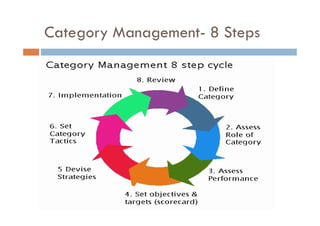
Category Management- 8 Steps
8-Step process defined
 Define the category (i.e. what products are
included/excluded).
 Define the role of the category within the retailer.
 Assess the current performance.
 Set objectives and targets for the category.
 Devise an overall Strategy.
 Devise specific tactics.
 Implementation.
 The eighth step is one of review which takes us back to step 1
Category Captain
 It is commonplace for a particular supplier in a
category to be nominated by the retailer as a
category captain
 The category captain will be expected to have the
closest and most regular contact with the retailer
 He will also be expected to invest time, effort, and
often financial assets into the strategic development
of the category within the retailer
 In return, the supplier will gain a more influential
voice with the retailer
Category Captain
 The category captain is often the supplier with the
largest turnover in the category
 Traditionally the job of category captain is given to
a brand supplier, but in recent times the role has
also gone to particularly switched-on private label
suppliers

Category Management- Definition and 8 step process.pdf

  • 1.
  • 2.
    Category 2  A Categoryis a group of similar or related items which the customer would ideally like to find together in a store  Categories are mainly used as organizational aids to better manage and monitor predefined groups of products
  • 3.
    Category Management 3  Categorymanagement is a retailing and purchasing concept in which the range of products purchased by a business organization or sold by a retailer is broken down into discrete groups of similar or related products  It is a systematic, disciplined approach to managing a product category as a strategic business unit
  • 4.
    Category Management- Definition 4 Category management is a process that involves managing product categories as business units and customizing them [on a store by store basis] to satisfy customer needs- Nielsen  The strategic management of product groups through trade partnerships which aims to maximize sales and profit by satisfying consumer and shopper needs- Institute of Grocery Distribution
  • 5.
    Significance of CategoryManagement 5  Increased sales, goodwill and market share  Proper care and devotion to each item of merchandise  Increased sales further lead to increased turnover  Maximize shelf efficiencies  Less inventory shrinkage  Recognizes procurement opportunities  Enhances customer knowledge level
  • 6.
    Significance of CategoryManagement 6  Improves return on investment (ROI)  Decreases chances of out-of-stock positions  Enhances return on money invested in marketing efforts  Classifies the performance of brands as doing well, not doing well, problem brands, etc.  Purchasing merchandise exercise becomes easy and cost effective
  • 7.
    Prerequisites of CategoryManagement 7  Category should be divided and arranged as per consumers’ ease not because of retailer’s convenience  CM should be based on differentiation and uniqueness  CM should drive multiple item purchases at the same time  It should result in better customers’ relations rather than relations with suppliers  Category division should be based on the basis of product response, space, time and profitability
  • 8.
  • 9.
    8-Step process defined Define the category (i.e. what products are included/excluded).  Define the role of the category within the retailer.  Assess the current performance.  Set objectives and targets for the category.  Devise an overall Strategy.  Devise specific tactics.  Implementation.  The eighth step is one of review which takes us back to step 1
  • 10.
    Category Captain  Itis commonplace for a particular supplier in a category to be nominated by the retailer as a category captain  The category captain will be expected to have the closest and most regular contact with the retailer  He will also be expected to invest time, effort, and often financial assets into the strategic development of the category within the retailer  In return, the supplier will gain a more influential voice with the retailer
  • 11.
    Category Captain  Thecategory captain is often the supplier with the largest turnover in the category  Traditionally the job of category captain is given to a brand supplier, but in recent times the role has also gone to particularly switched-on private label suppliers