
Cash Flow statement
Meaning of Certain Terms:

Cash comprises cash on hand and demand deposit with bank

Cash equivalents are short term, highly liquid investment
                e.g. treasury bills.

Cash flows are inflows and out flows of cash & cash equivalent
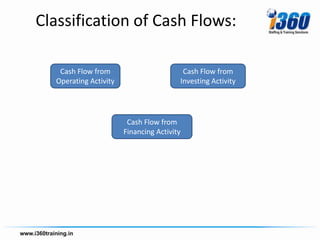
Classification of Cash Flows:

   Cash Flow from                        Cash Flow from
  Operating Activity                    Investing Activity


                        Cash Flow from
                       Financing Activity
CF from Operating Activities:

Operating cash flow is the cash that a company
  generates through running its business.
CF from Operating Activities:
Examples of cash flows from operating
 activities:
• Cash receipt from the sale of goods and rendering of
  services
• Cash receipts from royalties, fees, commissions and other
   revenue
• Cash payments to suppliers for goods and services
• Cash payments to and on behalf of employees
CF from Investing Activities:
An item on the cash flow statement that reports the
aggregate change in a company's cash position resulting
from any gains (or losses) from investments in the
financial markets and changes resulting from amounts
spent on investments in capital assets such as plant and
equipment.
CF from Investing Activities:
Examples of cash flows from investing
 activities:
• Cash payments to acquire fixed assets (including
  intangibles)
• Cash receipts from disposal of fixed assets
• Cash payments to acquire shares or debt instruments of
  other enterprises
• Cash advances and loans made to third parties (other
  than advances and loans made by a financial enterprise)
CF from Financing Activities:

Financing activities are activities that result in changes in the
    size and composition of the owner’s capital (including
   preference share capital in the case of a company) and
                 borrowings of the enterprise.
CF from Financing Activities
Examples of cash flows from Financing
 activities
• Cash proceeds from issuing shares or other similar
  instruments
• Cash proceeds from issuing debentures, bonds and other
  short-term borrowing
• Cash repayments of amounts borrowed
• Payments of dividend and interest
Information required for
         CashFlow Statement:

1.Comparative Balance Sheets: BS at the beginning and at
the end of the accounting period indicate the amount of
changes that have taken place in assets, liabilities and capital
2. Profit and Loss Account: The P & L A/c. of the current
period enables to determine the amounts of cash provided
by or used in operations during the accounting period after
making adjustments for non-cash, current assets and current
liabilities
Information required for
          CashFlow Statement
3.Additional Data: In addition to the above statements,
additional data are collected to determine how cash has
been provided or used e.g. sale or purchase of assets for
cash.
Cash from operations may be
    ascertained by either

1. Direct Method known as ‘Cash Sales Method’
                       or
2. Indirect Method known as ‘ Net Profit Method’
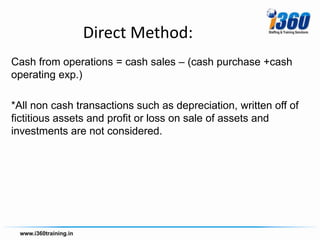
Direct Method:
Cash from operations = cash sales – (cash purchase +cash
operating exp.)

*All non cash transactions such as depreciation, written off of
fictitious assets and profit or loss on sale of assets and
investments are not considered.
Indirect Method
Normally it is used when amount of sales is not
                    available
Uses of Cash Flow Statement
 Helpful in Planning and Co-ordination
 Helpful in control
 Useful in Internal Financial Management
 Knowledge of Changes in Cash Position
 Helpful in Short-term Financial Decisions
Limitations of Cash Flow Statement:

Conflicting areas
Incomplete Substitute
Defective Presentation of Liquidity
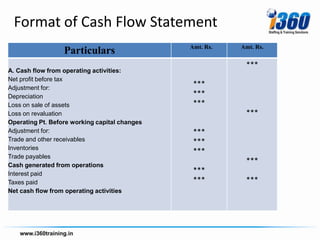
Format of Cash Flow Statement
                                               Amt. Rs.   Amt. Rs.
                  Particulars
                                                           ***
A. Cash flow from operating activities:
Net profit before tax
Adjustment for:
                                                ***
Depreciation                                    ***
Loss on sale of assets                          ***
Loss on revaluation                                        ***
Operating Pt. Before working capital changes
Adjustment for:                                 ***
Trade and other receivables                     ***
Inventories
                                                ***
Trade payables
                                                           ***
Cash generated from operations
Interest paid                                   ***
Taxes paid                                      ***        ***
Net cash flow from operating activities
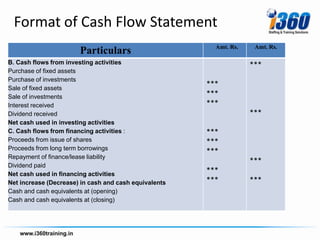
Format of Cash Flow Statement
                                                         Amt. Rs.    Amt. Rs.
                       Particulars
B. Cash flows from investing activities                             ***
Purchase of fixed assets
Purchase of investments
Sale of fixed assets
                                                       ***
Sale of investments                                    ***
Interest received                                      ***
Dividend received                                                   ***
Net cash used in investing activities
C. Cash flows from financing activities :              ***
Proceeds from issue of shares                          ***
Proceeds from long term borrowings
                                                       ***
Repayment of finance/lease liability
                                                                    ***
Dividend paid
Net cash used in financing activities
                                                       ***
Net increase (Decrease) in cash and cash equivalents   ***          ***
Cash and cash equivalents at (opening)
Cash and cash equivalents at (closing)
Thank you

Cash flow statements

  • 1.
  • 2.
    Meaning of CertainTerms: Cash comprises cash on hand and demand deposit with bank Cash equivalents are short term, highly liquid investment e.g. treasury bills. Cash flows are inflows and out flows of cash & cash equivalent
  • 3.
    Classification of CashFlows: Cash Flow from Cash Flow from Operating Activity Investing Activity Cash Flow from Financing Activity
  • 4.
    CF from OperatingActivities: Operating cash flow is the cash that a company generates through running its business.
  • 5.
    CF from OperatingActivities: Examples of cash flows from operating activities: • Cash receipt from the sale of goods and rendering of services • Cash receipts from royalties, fees, commissions and other revenue • Cash payments to suppliers for goods and services • Cash payments to and on behalf of employees
  • 6.
    CF from InvestingActivities: An item on the cash flow statement that reports the aggregate change in a company's cash position resulting from any gains (or losses) from investments in the financial markets and changes resulting from amounts spent on investments in capital assets such as plant and equipment.
  • 7.
    CF from InvestingActivities: Examples of cash flows from investing activities: • Cash payments to acquire fixed assets (including intangibles) • Cash receipts from disposal of fixed assets • Cash payments to acquire shares or debt instruments of other enterprises • Cash advances and loans made to third parties (other than advances and loans made by a financial enterprise)
  • 8.
    CF from FinancingActivities: Financing activities are activities that result in changes in the size and composition of the owner’s capital (including preference share capital in the case of a company) and borrowings of the enterprise.
  • 9.
    CF from FinancingActivities Examples of cash flows from Financing activities • Cash proceeds from issuing shares or other similar instruments • Cash proceeds from issuing debentures, bonds and other short-term borrowing • Cash repayments of amounts borrowed • Payments of dividend and interest
  • 10.
    Information required for CashFlow Statement: 1.Comparative Balance Sheets: BS at the beginning and at the end of the accounting period indicate the amount of changes that have taken place in assets, liabilities and capital 2. Profit and Loss Account: The P & L A/c. of the current period enables to determine the amounts of cash provided by or used in operations during the accounting period after making adjustments for non-cash, current assets and current liabilities
  • 11.
    Information required for CashFlow Statement 3.Additional Data: In addition to the above statements, additional data are collected to determine how cash has been provided or used e.g. sale or purchase of assets for cash.
  • 12.
    Cash from operationsmay be ascertained by either 1. Direct Method known as ‘Cash Sales Method’ or 2. Indirect Method known as ‘ Net Profit Method’
  • 13.
    Direct Method: Cash fromoperations = cash sales – (cash purchase +cash operating exp.) *All non cash transactions such as depreciation, written off of fictitious assets and profit or loss on sale of assets and investments are not considered.
  • 14.
    Indirect Method Normally itis used when amount of sales is not available
  • 15.
    Uses of CashFlow Statement  Helpful in Planning and Co-ordination  Helpful in control  Useful in Internal Financial Management  Knowledge of Changes in Cash Position  Helpful in Short-term Financial Decisions
  • 16.
    Limitations of CashFlow Statement: Conflicting areas Incomplete Substitute Defective Presentation of Liquidity
  • 17.
    Format of CashFlow Statement Amt. Rs. Amt. Rs. Particulars *** A. Cash flow from operating activities: Net profit before tax Adjustment for: *** Depreciation *** Loss on sale of assets *** Loss on revaluation *** Operating Pt. Before working capital changes Adjustment for: *** Trade and other receivables *** Inventories *** Trade payables *** Cash generated from operations Interest paid *** Taxes paid *** *** Net cash flow from operating activities
  • 18.
    Format of CashFlow Statement Amt. Rs. Amt. Rs. Particulars B. Cash flows from investing activities *** Purchase of fixed assets Purchase of investments Sale of fixed assets *** Sale of investments *** Interest received *** Dividend received *** Net cash used in investing activities C. Cash flows from financing activities : *** Proceeds from issue of shares *** Proceeds from long term borrowings *** Repayment of finance/lease liability *** Dividend paid Net cash used in financing activities *** Net increase (Decrease) in cash and cash equivalents *** *** Cash and cash equivalents at (opening) Cash and cash equivalents at (closing)
  • 19.