Forms of Lending
By
Ashra Rehmat
Contents
• Principles of Lending
• Form of Lending
– Cash Finance (Cash Credit)
– Overdraft
– Loans (Term Finance)
– Purchase and Discounting of Bills
– Hire-purchase and Leasing Finance
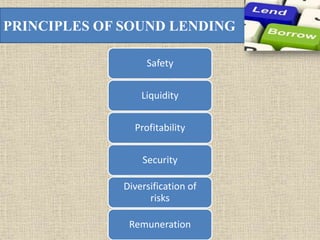
PRINCIPLES OF SOUND LENDING
Safety
Liquidity
Profitability
Security
Diversification of
risks
Remuneration
SAFETY
• When a loan or investment is made, the banker will
have to ensure that the money advanced is returned
by the borrower along with interest within the
predetermined period.
• This is possible only when the borrower does not face
any risk & strictly stick to the terms & conditions of
the loan.
• For this purpose, the banker will have to chose such
type of borrowers who are prompt in repayment of
the principal and interest amount.
LIQUIDITY
• The banker while making advances must see that the
money he is lending is not going to be locked up for a
long time, which should make his loans & advances
less liquid & more difficult to realize in cases of
emergency.
• An asset is said to be liquid when it can be converted
into cash within a short notice, without loss. As the
bank is investing or lending the depositors’ money, it
has to take more precaution while doing so. The
depositor may demand his/her money at any time &
the bank must be in a position to repay the same.
SECURITY
• The banker should ensure that the borrower has
the ability & will to repay the advances as per
agreement.
• Before granting a secured advance the banker
should carefully consider the margin of safety
offered by the security concerned & possibilities
of fluctuations in its value. If it is an unsecured
advance, its repayment depends on the
creditworthiness of the borrower, & that of the
guarantor, wherever applicable.
DIVERSIFICATION OF RISKS
• The banker should aim at spreading the advances
as widely as possible over different industries &
different localities.
• This would enable him to compensate any losses
which might arise as a result of unexpected
factors adversely affecting particular industries
and/or particular localities.
• Dispersal of advances is very necessary from the
point of security as well, because it reduces risk
of recovery.
Remuneration
• The banker need sufficient earnings to meet
the following besides others:
– Return payable to money deposited with it
– To meet various statutory monitory requirements
under the banking law.
– Salaries and benefits payable to staff members.
– Payment of dividends to shareholders.
Forms of Lending
o Cash Finance (Cash Credit)
o Overdraft
o Loans (Term Finance)
o Purchase and Discounting of Bills
o Hire-purchase and Leasing Finance
Cash Finance (CASH CREDIT)
• A Cash Credit is a very common form of borrowing
by commercial and industrial concerns, and it is made
available either against pledge or hypothecation of
good.
• In cash finance, a borrower is allowed to borrow
money upto a certain limit, either at once or as and
when required.
• The borrower prefer this form of lending due to the
facility of paying markup or service charges only on
the amount he actually utilizes.
OVERDRAFTS
• When a customer requires temporary adjustment,
he may be allowed to overdraw his current
account. This arrangement like the cash credit is
advantageous as he is required to pay interest on
the amount actually used by him.
– Secured overdraft
– Clean overdraft
• The main difference between cash credit &
overdraft is the latter is supposed to be a form of
bank credit to be made use of occasionally & the
former is used for long terms by commercial &
industrial concerns doing regular business.
LOANS
• In case of loan, the banker advances a lump sum for a
certain period at an agreed rate of interest.
• The entire amount is paid on an occasion either in cash
or by credit in his current account which he can draw at
any time.
• The interest is charged for the full amount sanctioned
whether he withdraws the money from his account or
not.
• The loan may be repaid in instalments or at the expiry
of a certain period. The loan may be made with or
without security.
• A loan once repaid in full or in part cannot be
withdrawn again by the customer. In case a borrower
wants further loan, he has to arrange for a fresh loan.
Two categories of loan
• Unsecured loans are those loans
which are not covered by the
security of tangible assets. Such
loans are granted to
firms/institutions against the
personal security of the owner,
manager or director.
• Secured loans are those which are
granted against the security of
tangible assets, like stock in trade
and immovable property. Thus,
while granting loan against the
security of some assets, a charge
is created over the assets of the
borrower in favor of the bank.
This enables the bank to recover
the dues from the customer out of
the sale proceeds of the assets in
case the borrower fails to repay
the loan.
Unsecured
Secured
TERM LOAN
• Where a loan is granted for a period exceeding
one year & is repayable according to a
schedule of repayment, as against on demand
& at a time is known as ‘term loan’.
• Where the period exceeds one year but not, 5
to 7 years, it is known as ‘medium term loan’.
• A loan with longer repayment schedule is
known as ‘long term loan’.
PARTICIPATION LOAN or CONSORTIUM
ADVANCE
• Where single loan is granted by more than one
financing agency, it is termed as a participation
or consortium loan.
• The assets or the securities of the borrower are
charged jointly and severally in the same ratio
as the contribution of participating bank.
• This system is now been quite popular in
Pakistan also.
Purchase and Discounting of bills
• The banker advances money on the security of
bills of exchange after deducting a certain
percentage, technically known as ‘discount’, from
the face value of the bill.
– Documentary bills of exchange
– Clean bills of exchange
– Demand bills of exchange
– Usance bills of exchange
• When discounting , the banks deduct amount at
mentioned discount rate and balance is paid to the
party.
Hire-purchase and Leasing Finance
• Sometimes an intending purchaser has no
money sufficient to purchase a certain
transport vehicle, machinery, computers or
other durable consumer goods.
• Therefore, banks provide finance to hire
purchase or lease the needed goods.
Thank You! 

Forms of lending

  • 2.
  • 3.
    Contents • Principles ofLending • Form of Lending – Cash Finance (Cash Credit) – Overdraft – Loans (Term Finance) – Purchase and Discounting of Bills – Hire-purchase and Leasing Finance
  • 4.
    PRINCIPLES OF SOUNDLENDING Safety Liquidity Profitability Security Diversification of risks Remuneration
  • 5.
    SAFETY • When aloan or investment is made, the banker will have to ensure that the money advanced is returned by the borrower along with interest within the predetermined period. • This is possible only when the borrower does not face any risk & strictly stick to the terms & conditions of the loan. • For this purpose, the banker will have to chose such type of borrowers who are prompt in repayment of the principal and interest amount.
  • 6.
    LIQUIDITY • The bankerwhile making advances must see that the money he is lending is not going to be locked up for a long time, which should make his loans & advances less liquid & more difficult to realize in cases of emergency. • An asset is said to be liquid when it can be converted into cash within a short notice, without loss. As the bank is investing or lending the depositors’ money, it has to take more precaution while doing so. The depositor may demand his/her money at any time & the bank must be in a position to repay the same.
  • 7.
    SECURITY • The bankershould ensure that the borrower has the ability & will to repay the advances as per agreement. • Before granting a secured advance the banker should carefully consider the margin of safety offered by the security concerned & possibilities of fluctuations in its value. If it is an unsecured advance, its repayment depends on the creditworthiness of the borrower, & that of the guarantor, wherever applicable.
  • 8.
    DIVERSIFICATION OF RISKS •The banker should aim at spreading the advances as widely as possible over different industries & different localities. • This would enable him to compensate any losses which might arise as a result of unexpected factors adversely affecting particular industries and/or particular localities. • Dispersal of advances is very necessary from the point of security as well, because it reduces risk of recovery.
  • 9.
    Remuneration • The bankerneed sufficient earnings to meet the following besides others: – Return payable to money deposited with it – To meet various statutory monitory requirements under the banking law. – Salaries and benefits payable to staff members. – Payment of dividends to shareholders.
  • 10.
    Forms of Lending oCash Finance (Cash Credit) o Overdraft o Loans (Term Finance) o Purchase and Discounting of Bills o Hire-purchase and Leasing Finance
  • 11.
    Cash Finance (CASHCREDIT) • A Cash Credit is a very common form of borrowing by commercial and industrial concerns, and it is made available either against pledge or hypothecation of good. • In cash finance, a borrower is allowed to borrow money upto a certain limit, either at once or as and when required. • The borrower prefer this form of lending due to the facility of paying markup or service charges only on the amount he actually utilizes.
  • 12.
    OVERDRAFTS • When acustomer requires temporary adjustment, he may be allowed to overdraw his current account. This arrangement like the cash credit is advantageous as he is required to pay interest on the amount actually used by him. – Secured overdraft – Clean overdraft • The main difference between cash credit & overdraft is the latter is supposed to be a form of bank credit to be made use of occasionally & the former is used for long terms by commercial & industrial concerns doing regular business.
  • 13.
    LOANS • In caseof loan, the banker advances a lump sum for a certain period at an agreed rate of interest. • The entire amount is paid on an occasion either in cash or by credit in his current account which he can draw at any time. • The interest is charged for the full amount sanctioned whether he withdraws the money from his account or not. • The loan may be repaid in instalments or at the expiry of a certain period. The loan may be made with or without security. • A loan once repaid in full or in part cannot be withdrawn again by the customer. In case a borrower wants further loan, he has to arrange for a fresh loan.
  • 14.
    Two categories ofloan • Unsecured loans are those loans which are not covered by the security of tangible assets. Such loans are granted to firms/institutions against the personal security of the owner, manager or director. • Secured loans are those which are granted against the security of tangible assets, like stock in trade and immovable property. Thus, while granting loan against the security of some assets, a charge is created over the assets of the borrower in favor of the bank. This enables the bank to recover the dues from the customer out of the sale proceeds of the assets in case the borrower fails to repay the loan. Unsecured Secured
  • 15.
    TERM LOAN • Wherea loan is granted for a period exceeding one year & is repayable according to a schedule of repayment, as against on demand & at a time is known as ‘term loan’. • Where the period exceeds one year but not, 5 to 7 years, it is known as ‘medium term loan’. • A loan with longer repayment schedule is known as ‘long term loan’.
  • 16.
    PARTICIPATION LOAN orCONSORTIUM ADVANCE • Where single loan is granted by more than one financing agency, it is termed as a participation or consortium loan. • The assets or the securities of the borrower are charged jointly and severally in the same ratio as the contribution of participating bank. • This system is now been quite popular in Pakistan also.
  • 17.
    Purchase and Discountingof bills • The banker advances money on the security of bills of exchange after deducting a certain percentage, technically known as ‘discount’, from the face value of the bill. – Documentary bills of exchange – Clean bills of exchange – Demand bills of exchange – Usance bills of exchange • When discounting , the banks deduct amount at mentioned discount rate and balance is paid to the party.
  • 18.
    Hire-purchase and LeasingFinance • Sometimes an intending purchaser has no money sufficient to purchase a certain transport vehicle, machinery, computers or other durable consumer goods. • Therefore, banks provide finance to hire purchase or lease the needed goods.
  • 19.