CASES
OF
PRONOUN
DONNA FAITH B. FAJARDO DR. DETTIE MARGATE
Discussant Professor
Structure of English
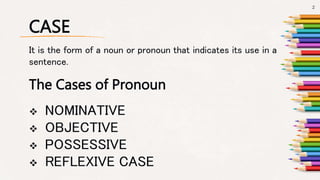
CASE
The Cases of Pronoun
It is the form of a noun or pronoun that indicates its use in a
sentence.
 NOMINATIVE
 OBJECTIVE
 POSSESSIVE
 REFLEXIVE CASE
2
3
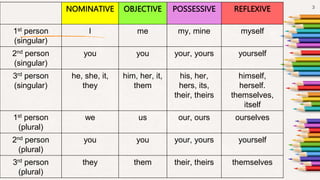
NOMINATIVE OBJECTIVE POSSESSIVE REFLEXIVE
1st person
(singular)
I me my, mine myself
2nd person
(singular)
you you your, yours yourself
3rd person
(singular)
he, she, it,
they
him, her, it,
them
his, her,
hers, its,
their, theirs
himself,
herself.
themselves,
itself
1st person
(plural)
we us our, ours ourselves
2nd person
(plural)
you you your, yours yourself
3rd person
(plural)
they them their, theirs themselves
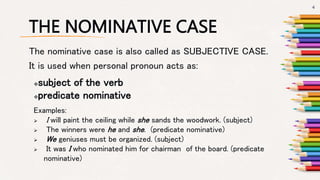
THE NOMINATIVE CASE
subject of the verb
predicate nominative
The nominative case is also called as SUBJECTIVE CASE.
It is used when personal pronoun acts as:
Examples:
 I will paint the ceiling while she sands the woodwork. (subject)
 The winners were he and she. (predicate nominative)
 We geniuses must be organized. (subject)
 It was I who nominated him for chairman of the board. (predicate
nominative)
4
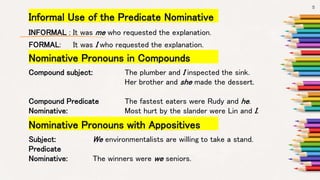
Informal Use of the Predicate Nominative
INFORMAL : It was me who requested the explanation.
FORMAL: It was I who requested the explanation.
Compound subject: The plumber and I inspected the sink.
Her brother and she made the dessert.
Compound Predicate The fastest eaters were Rudy and he.
Nominative: Most hurt by the slander were Lin and I.
5
Nominative Pronouns in Compounds
Subject: We environmentalists are willing to take a stand.
Predicate
Nominative: The winners were we seniors.
Nominative Pronouns with Appositives
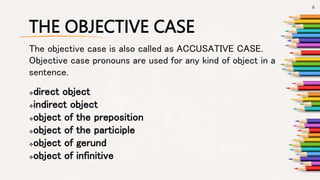
THE OBJECTIVE CASE
direct object
indirect object
object of the preposition
object of the participle
object of gerund
object of infinitive
The objective case is also called as ACCUSATIVE CASE.
Objective case pronouns are used for any kind of object in a
sentence.
6
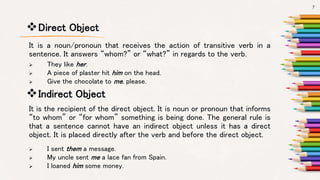
Direct Object
 They like her.
 A piece of plaster hit him on the head.
 Give the chocolate to me, please.
7
It is a noun/pronoun that receives the action of transitive verb in a
sentence. It answers “whom?” or “what?” in regards to the verb.
Indirect Object
It is the recipient of the direct object. It is noun or pronoun that informs
“to whom” or “for whom” something is being done. The general rule is
that a sentence cannot have an indirect object unless it has a direct
object. It is placed directly after the verb and before the direct object.
 I sent them a message.
 My uncle sent me a lace fan from Spain.
 I loaned him some money.
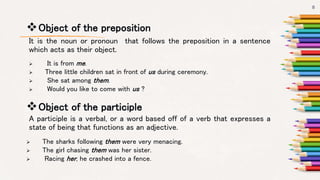
Object of the preposition
 It is from me.
 Three little children sat in front of us during ceremony.
 She sat among them.
 Would you like to come with us ?
8
It is the noun or pronoun that follows the preposition in a sentence
which acts as their object.
Object of the participle
 The sharks following them were very menacing.
 The girl chasing them was her sister.
 Racing her, he crashed into a fence.
A participle is a verbal, or a word based off of a verb that expresses a
state of being that functions as an adjective.
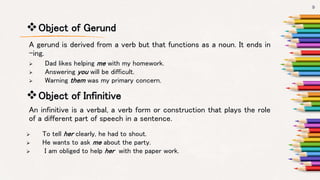
Object of Gerund
 Dad likes helping me with my homework.
 Answering you will be difficult.
 Warning them was my primary concern.
9
A gerund is derived from a verb but that functions as a noun. It ends in
–ing.
Object of Infinitive
An infinitive is a verbal, a verb form or construction that plays the role
of a different part of speech in a sentence.
 To tell her clearly, he had to shout.
 He wants to ask me about the party.
 I am obliged to help her with the paper work.
10
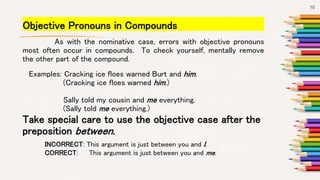
As with the nominative case, errors with objective pronouns
most often occur in compounds. To check yourself, mentally remove
the other part of the compound.
Objective Pronouns in Compounds
Examples: Cracking ice floes warned Burt and him.
(Cracking ice floes warned him.)
Sally told my cousin and me everything.
(Sally told me everything.)
Take special care to use the objective case after the
preposition between.
INCORRECT: This argument is just between you and I.
CORRECT: This argument is just between you and me.
11
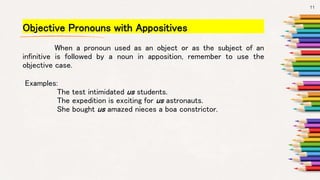
When a pronoun used as an object or as the subject of an
infinitive is followed by a noun in apposition, remember to use the
objective case.
Objective Pronouns with Appositives
Examples:
The test intimidated us students.
The expedition is exciting for us astronauts.
She bought us amazed nieces a boa constrictor.
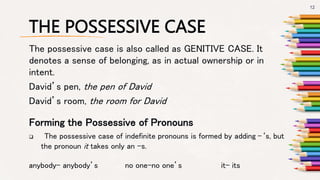
THE POSSESSIVE CASE
Forming the Possessive of Pronouns
 The possessive case of indefinite pronouns is formed by adding -‘s, but
the pronoun it takes only an –s.
anybody- anybody’s no one-no one’s it- its
The possessive case is also called as GENITIVE CASE. It
denotes a sense of belonging, as in actual ownership or in
intent.
David’s pen, the pen of David
David’s room, the room for David
12
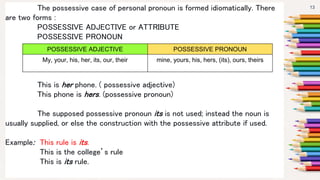
The possessive case of personal pronoun is formed idiomatically. There
are two forms :
POSSESSIVE ADJECTIVE or ATTRIBUTE
POSSESSIVE PRONOUN
This is her phone. ( possessive adjective)
This phone is hers. (possessive pronoun)
The supposed possessive pronoun its is not used; instead the noun is
usually supplied, or else the construction with the possessive attribute if used.
Example: This rule is its.
This is the college’s rule
This is its rule.
13
POSSESSIVE ADJECTIVE POSSESSIVE PRONOUN
My, your, his, her, its, our, their mine, yours, his, hers, (its), ours, theirs
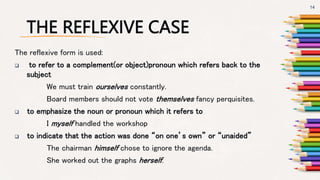
THE REFLEXIVE CASE
The reflexive form is used:
 to refer to a complement(or object)pronoun which refers back to the
subject
We must train ourselves constantly.
Board members should not vote themselves fancy perquisites.
 to emphasize the noun or pronoun which it refers to
I myself handled the workshop
 to indicate that the action was done “on one’s own” or “unaided”
The chairman himself chose to ignore the agenda.
She worked out the graphs herself.
14
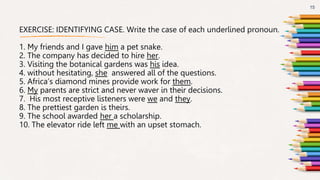
EXERCISE: IDENTIFYING CASE. Write the case of each underlined pronoun.
1. My friends and I gave him a pet snake.
2. The company has decided to hire her.
3. Visiting the botanical gardens was his idea.
4. without hesitating, she answered all of the questions.
5. Africa’s diamond mines provide work for them.
6. My parents are strict and never waver in their decisions.
7. His most receptive listeners were we and they.
8. The prettiest garden is theirs.
9. The school awarded her a scholarship.
10. The elevator ride left me with an upset stomach.
15
THANK YOU!
16

CASES-of-PRONOUN.pptx

  • 1.
    CASES OF PRONOUN DONNA FAITH B.FAJARDO DR. DETTIE MARGATE Discussant Professor Structure of English
  • 2.
    CASE The Cases ofPronoun It is the form of a noun or pronoun that indicates its use in a sentence.  NOMINATIVE  OBJECTIVE  POSSESSIVE  REFLEXIVE CASE 2
  • 3.
    3 NOMINATIVE OBJECTIVE POSSESSIVEREFLEXIVE 1st person (singular) I me my, mine myself 2nd person (singular) you you your, yours yourself 3rd person (singular) he, she, it, they him, her, it, them his, her, hers, its, their, theirs himself, herself. themselves, itself 1st person (plural) we us our, ours ourselves 2nd person (plural) you you your, yours yourself 3rd person (plural) they them their, theirs themselves
  • 4.
    THE NOMINATIVE CASE subjectof the verb predicate nominative The nominative case is also called as SUBJECTIVE CASE. It is used when personal pronoun acts as: Examples:  I will paint the ceiling while she sands the woodwork. (subject)  The winners were he and she. (predicate nominative)  We geniuses must be organized. (subject)  It was I who nominated him for chairman of the board. (predicate nominative) 4
  • 5.
    Informal Use ofthe Predicate Nominative INFORMAL : It was me who requested the explanation. FORMAL: It was I who requested the explanation. Compound subject: The plumber and I inspected the sink. Her brother and she made the dessert. Compound Predicate The fastest eaters were Rudy and he. Nominative: Most hurt by the slander were Lin and I. 5 Nominative Pronouns in Compounds Subject: We environmentalists are willing to take a stand. Predicate Nominative: The winners were we seniors. Nominative Pronouns with Appositives
  • 6.
    THE OBJECTIVE CASE directobject indirect object object of the preposition object of the participle object of gerund object of infinitive The objective case is also called as ACCUSATIVE CASE. Objective case pronouns are used for any kind of object in a sentence. 6
  • 7.
    Direct Object  Theylike her.  A piece of plaster hit him on the head.  Give the chocolate to me, please. 7 It is a noun/pronoun that receives the action of transitive verb in a sentence. It answers “whom?” or “what?” in regards to the verb. Indirect Object It is the recipient of the direct object. It is noun or pronoun that informs “to whom” or “for whom” something is being done. The general rule is that a sentence cannot have an indirect object unless it has a direct object. It is placed directly after the verb and before the direct object.  I sent them a message.  My uncle sent me a lace fan from Spain.  I loaned him some money.
  • 8.
    Object of thepreposition  It is from me.  Three little children sat in front of us during ceremony.  She sat among them.  Would you like to come with us ? 8 It is the noun or pronoun that follows the preposition in a sentence which acts as their object. Object of the participle  The sharks following them were very menacing.  The girl chasing them was her sister.  Racing her, he crashed into a fence. A participle is a verbal, or a word based off of a verb that expresses a state of being that functions as an adjective.
  • 9.
    Object of Gerund Dad likes helping me with my homework.  Answering you will be difficult.  Warning them was my primary concern. 9 A gerund is derived from a verb but that functions as a noun. It ends in –ing. Object of Infinitive An infinitive is a verbal, a verb form or construction that plays the role of a different part of speech in a sentence.  To tell her clearly, he had to shout.  He wants to ask me about the party.  I am obliged to help her with the paper work.
  • 10.
    10 As with thenominative case, errors with objective pronouns most often occur in compounds. To check yourself, mentally remove the other part of the compound. Objective Pronouns in Compounds Examples: Cracking ice floes warned Burt and him. (Cracking ice floes warned him.) Sally told my cousin and me everything. (Sally told me everything.) Take special care to use the objective case after the preposition between. INCORRECT: This argument is just between you and I. CORRECT: This argument is just between you and me.
  • 11.
    11 When a pronounused as an object or as the subject of an infinitive is followed by a noun in apposition, remember to use the objective case. Objective Pronouns with Appositives Examples: The test intimidated us students. The expedition is exciting for us astronauts. She bought us amazed nieces a boa constrictor.
  • 12.
    THE POSSESSIVE CASE Formingthe Possessive of Pronouns  The possessive case of indefinite pronouns is formed by adding -‘s, but the pronoun it takes only an –s. anybody- anybody’s no one-no one’s it- its The possessive case is also called as GENITIVE CASE. It denotes a sense of belonging, as in actual ownership or in intent. David’s pen, the pen of David David’s room, the room for David 12
  • 13.
    The possessive caseof personal pronoun is formed idiomatically. There are two forms : POSSESSIVE ADJECTIVE or ATTRIBUTE POSSESSIVE PRONOUN This is her phone. ( possessive adjective) This phone is hers. (possessive pronoun) The supposed possessive pronoun its is not used; instead the noun is usually supplied, or else the construction with the possessive attribute if used. Example: This rule is its. This is the college’s rule This is its rule. 13 POSSESSIVE ADJECTIVE POSSESSIVE PRONOUN My, your, his, her, its, our, their mine, yours, his, hers, (its), ours, theirs
  • 14.
    THE REFLEXIVE CASE Thereflexive form is used:  to refer to a complement(or object)pronoun which refers back to the subject We must train ourselves constantly. Board members should not vote themselves fancy perquisites.  to emphasize the noun or pronoun which it refers to I myself handled the workshop  to indicate that the action was done “on one’s own” or “unaided” The chairman himself chose to ignore the agenda. She worked out the graphs herself. 14
  • 15.
    EXERCISE: IDENTIFYING CASE.Write the case of each underlined pronoun. 1. My friends and I gave him a pet snake. 2. The company has decided to hire her. 3. Visiting the botanical gardens was his idea. 4. without hesitating, she answered all of the questions. 5. Africa’s diamond mines provide work for them. 6. My parents are strict and never waver in their decisions. 7. His most receptive listeners were we and they. 8. The prettiest garden is theirs. 9. The school awarded her a scholarship. 10. The elevator ride left me with an upset stomach. 15
  • 16.