Induction day
Module: Improving Schools
Afternoon session: What is a case study?
Session Aims:
• Understand why case study is a research approach
(not a method)
• Understand the unique features of case study
What is a case study?
Discuss with a partner:
Can you define ‘case study’?
Has any of the research discussed so far today
been something you would call a case study?
Why/ why not?
Case Study
“A case study is an enquiry which uses multiple
sources of evidence. It investigates a contemporary
phenomenon within its real life context, when the
boundaries between phenomenon and context are
not clearly evident” (Johnson, 1994:20).
Case Study – an example
Have a look at the hand-out (Pyburn, 2006).
What features of this small-scale research project
make it a case study?
In what ways do you think it might be typical of a
case study?
[If you have time, try applying Wallace & Poulson’
analytical criteria to Pyburn’s work.]
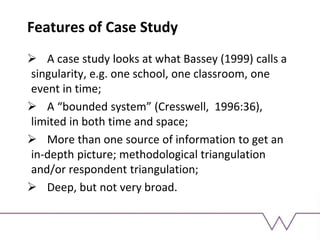
Features of Case Study
 A case study looks at what Bassey (1999) calls a
singularity, e.g. one school, one classroom, one
event in time;
 A “bounded system” (Cresswell, 1996:36),
limited in both time and space;
 More than one source of information to get an
in-depth picture; methodological triangulation
and/or respondent triangulation;
 Deep, but not very broad.
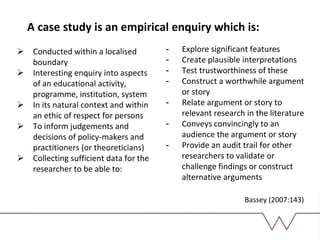
A case study is an empirical enquiry which is:
 Conducted within a localised
boundary
 Interesting enquiry into aspects
of an educational activity,
programme, institution, system
 In its natural context and within
an ethic of respect for persons
 To inform judgements and
decisions of policy-makers and
practitioners (or theoreticians)
 Collecting sufficient data for the
researcher to be able to:
- Explore significant features
- Create plausible interpretations
- Test trustworthiness of these
- Construct a worthwhile argument
or story
- Relate argument or story to
relevant research in the literature
- Conveys convincingly to an
audience the argument or story
- Provide an audit trail for other
researchers to validate or
challenge findings or construct
alternative arguments
Bassey (2007:143)
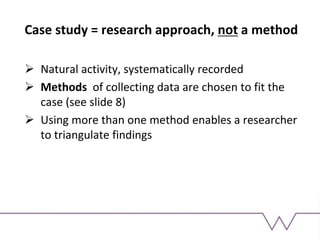
Case study = research approach, not a method
 Natural activity, systematically recorded
 Methods of collecting data are chosen to fit the
case (see slide 8)
 Using more than one method enables a researcher
to triangulate findings
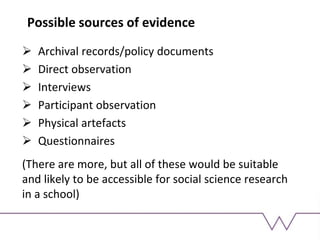
Possible sources of evidence
 Archival records/policy documents
 Direct observation
 Interviews
 Participant observation
 Physical artefacts
 Questionnaires
(There are more, but all of these would be suitable
and likely to be accessible for social science research
in a school)
Collecting data for a case study
Methods will be discussed in depth on the next Teaching
Day, but for now think about:
 Methods should be ‘fit for purpose’, not just a
personal choice. How might the purpose be clarified?
 Methods may well be derived from reading literature
about the topic. Borrowing someone else’s methods
– with proper attribution – has benefits. What might
these be?
Benefits of getting ideas from literature
Someone else’s methods have been used at least once
before, and hopefully ‘debugged’.
We can learn from the experience of previous
researchers (their successes and failures).
Our own tiny sample of evidence from a single case
can be compared with the findings of others.
Disadvantages of getting ideas from
literature
Someone else’s methods may not fit our context
Someone else’s research may be dated, i.e.
overtaken by more recent findings
Using someone else’s work is plagiarism unless…?
Advantages of a case study approach
 Allows in-depth investigation
 Copes with complexity
 Provides a ‘rounded’ picture (from the multiple
sources of evidence, and if qualitative in nature)
 Methodological triangulation is ‘built-in’
 Findings are often easily understood
 Good fit with small-scale research and a single
researcher in a short period of time
Disadvantages of a case study approach
 Lack of ‘rigour’
 Lack of ‘generalizability’ – findings might be unique
to the case
 May generate a large quantity of data
 Access may be uneven
 Can be demanding of researcher’s time (in terms of
both data collection and interpretation/ analysis)
One more feature of your case study
Like Pyburn, you will be an insider researcher, i.e.
researching your own school. What challenges might
this throw up?
The recommended follow-on reading from today
includes an article (Mercer, 2007) on being an insider-
researcher, and the BERA (2011) guidelines for ethical
research.
Things to ponder (1)
 Case studies are complex and require careful
planning and field work flexibility
 Insider research may be problematic (for
participant(s) and researcher). These should be
carefully considered, especially in terms of ethics.
 Using more than one method is desirable, but that
adds a lot to planning time. For your assignment, you
will have to balance the benefits of multiple methods
against the disadvantages of preparing more than
one, and decide your approach accordingly.
Things to ponder (2)
We advise against choosing your research topic
immediately. On the November Teaching Day we will
look at methodology and methods, which will help you
to frame your choice and draft your research proposal.
The best next step is to do as much reading as you can.
Please see the ‘homework’ sheet for guidance. It
covers the subject of today’s lecture, today’s topics,
and pre-reading in preparation for the next Teaching
Day.

4_tf_induction_what_is_a_case_study_october_2015.ppt

  • 1.
    Induction day Module: ImprovingSchools Afternoon session: What is a case study?
  • 2.
    Session Aims: • Understandwhy case study is a research approach (not a method) • Understand the unique features of case study
  • 3.
    What is acase study? Discuss with a partner: Can you define ‘case study’? Has any of the research discussed so far today been something you would call a case study? Why/ why not?
  • 4.
    Case Study “A casestudy is an enquiry which uses multiple sources of evidence. It investigates a contemporary phenomenon within its real life context, when the boundaries between phenomenon and context are not clearly evident” (Johnson, 1994:20).
  • 5.
    Case Study –an example Have a look at the hand-out (Pyburn, 2006). What features of this small-scale research project make it a case study? In what ways do you think it might be typical of a case study? [If you have time, try applying Wallace & Poulson’ analytical criteria to Pyburn’s work.]
  • 6.
    Features of CaseStudy  A case study looks at what Bassey (1999) calls a singularity, e.g. one school, one classroom, one event in time;  A “bounded system” (Cresswell, 1996:36), limited in both time and space;  More than one source of information to get an in-depth picture; methodological triangulation and/or respondent triangulation;  Deep, but not very broad.
  • 7.
    A case studyis an empirical enquiry which is:  Conducted within a localised boundary  Interesting enquiry into aspects of an educational activity, programme, institution, system  In its natural context and within an ethic of respect for persons  To inform judgements and decisions of policy-makers and practitioners (or theoreticians)  Collecting sufficient data for the researcher to be able to: - Explore significant features - Create plausible interpretations - Test trustworthiness of these - Construct a worthwhile argument or story - Relate argument or story to relevant research in the literature - Conveys convincingly to an audience the argument or story - Provide an audit trail for other researchers to validate or challenge findings or construct alternative arguments Bassey (2007:143)
  • 8.
    Case study =research approach, not a method  Natural activity, systematically recorded  Methods of collecting data are chosen to fit the case (see slide 8)  Using more than one method enables a researcher to triangulate findings
  • 9.
    Possible sources ofevidence  Archival records/policy documents  Direct observation  Interviews  Participant observation  Physical artefacts  Questionnaires (There are more, but all of these would be suitable and likely to be accessible for social science research in a school)
  • 10.
    Collecting data fora case study Methods will be discussed in depth on the next Teaching Day, but for now think about:  Methods should be ‘fit for purpose’, not just a personal choice. How might the purpose be clarified?  Methods may well be derived from reading literature about the topic. Borrowing someone else’s methods – with proper attribution – has benefits. What might these be?
  • 11.
    Benefits of gettingideas from literature Someone else’s methods have been used at least once before, and hopefully ‘debugged’. We can learn from the experience of previous researchers (their successes and failures). Our own tiny sample of evidence from a single case can be compared with the findings of others.
  • 12.
    Disadvantages of gettingideas from literature Someone else’s methods may not fit our context Someone else’s research may be dated, i.e. overtaken by more recent findings Using someone else’s work is plagiarism unless…?
  • 13.
    Advantages of acase study approach  Allows in-depth investigation  Copes with complexity  Provides a ‘rounded’ picture (from the multiple sources of evidence, and if qualitative in nature)  Methodological triangulation is ‘built-in’  Findings are often easily understood  Good fit with small-scale research and a single researcher in a short period of time
  • 14.
    Disadvantages of acase study approach  Lack of ‘rigour’  Lack of ‘generalizability’ – findings might be unique to the case  May generate a large quantity of data  Access may be uneven  Can be demanding of researcher’s time (in terms of both data collection and interpretation/ analysis)
  • 15.
    One more featureof your case study Like Pyburn, you will be an insider researcher, i.e. researching your own school. What challenges might this throw up? The recommended follow-on reading from today includes an article (Mercer, 2007) on being an insider- researcher, and the BERA (2011) guidelines for ethical research.
  • 16.
    Things to ponder(1)  Case studies are complex and require careful planning and field work flexibility  Insider research may be problematic (for participant(s) and researcher). These should be carefully considered, especially in terms of ethics.  Using more than one method is desirable, but that adds a lot to planning time. For your assignment, you will have to balance the benefits of multiple methods against the disadvantages of preparing more than one, and decide your approach accordingly.
  • 17.
    Things to ponder(2) We advise against choosing your research topic immediately. On the November Teaching Day we will look at methodology and methods, which will help you to frame your choice and draft your research proposal. The best next step is to do as much reading as you can. Please see the ‘homework’ sheet for guidance. It covers the subject of today’s lecture, today’s topics, and pre-reading in preparation for the next Teaching Day.