Presented by:
Trilochan pandey, Romit Subba, Harif Ghimire, Mamata Panthi,
Arunima Shrestha [B.Pharmacy II year]
ARRHYTHMIA
 Arrhythmia is defined as loss of cardiac rhythm, especially irregularity of
heartbeat.
 It covers the group of conditions caused by an abnormality in the rate, regularity,
or sequence of cardiac activation.
Types of arrhythmia
Atrial flutter (AFL) is an abnormal heart rhythm that occurs in the atria of the heart.
When it first occurs, it is usually associated with a fast heart rate or
tachycardia(beats over 100 per minute),and falls into the category of supra-
ventricular tachycardias.
Supraventricular tachycardia (SVT) is a rapid heart rhythm originating at or above
the atrioventricular node. Supraventricular tachycardias can be contrasted with the
potentially more dangerous ventricular tachycardias—rapid rhythms that originate
within the ventricular tissue.
Atrial fibrillation (AF or A-fib) is the most common cardiac arrhythmia (heart rhythm
disorder). It may cause no symptoms, but it is often associated with palpitations,
fainting, chest pain, or congestive heart failure.
Paroxysmal supraventricular tachycardia (PSVT) is episodes of rapid heart rate that
start in a part of the heart above the ventricles. "Paroxysmal" means from time to
time.
Automatic tachycardias are rapid heart arrhythmias caused by an abnormal generation of
electrical impulses within the heart. Normally, the heart rhythm is controlled by the
rhythmic production of electrical impulses by the "pacemaker" cells of the heart,
located in the sinus node
Sinus arrhythmia the physiologic cyclic variation in heart rate related to vagal impulses
to the sinoatrial node; it is common, particularly in children, and is not abnormal.
One of the most common arrhythmias is a sinus arrhythmia. It involves cyclic changes in
the heart rate during breathing. It is very common in children and often found in
young adults. Patients with sinus arrhythmia do not experience any cardiovascular
symptoms.
Sinus tachycardia (also colloquially known as sinus tach or sinus tachy) is a heart rhythm
with elevated rate of impulses originating from the sinoatrial node, defined as a rate
greater than 100 beats/min (bpm) in an average adult.
Atrial premature complexes are also called premature atrial contractions (PACs) and
may cause heart palpitations or unusual awareness of your
heartbeats. Palpitations may be heartbeats that are extra fast, extra slow, or
irregularly timed. PACs occur when a beat of your heart occurs early in the heart cycle
or prematurely.
Wandering atrial pacemaker is an arrhythmia originating in shifting pacemaker sites from
the SA node to the atria and back to the SA node.
Sinus bradyarrhythmias (heart rate less than 60 beats/min) are common especially in
young, athletically active individuals.
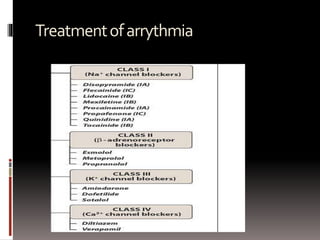
Treatmentofarrythmia
 Subjective: Pt. D is a caucasian M, 68 y/o, who presents
to the emergency department complaining of increasing
shortness of breath, dizziness, and the sensation of heart
racing
 PMH: Long standing HTN, CAD and a recent
percutaneous transluminal angioplasty with placement
of 2 stents
 SH: Social drinker , No smoking
 FH: No FH
 MH: No MH
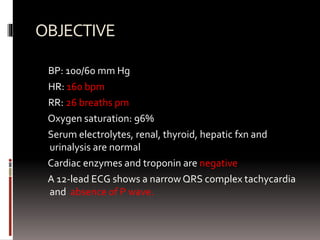
OBJECTIVE
BP: 100/60 mm Hg
HR: 160 bpm
RR: 26 breaths pm
Oxygen saturation: 96%
Serum electrolytes, renal, thyroid, hepatic fxn and
urinalysis are normal
Cardiac enzymes and troponin are negative
A 12-lead ECG shows a narrow QRS complex tachycardia
and absence of P wave.
ASSESMENT
 ECG characteristics like absence of P waves and irregular
R-R intervals due to irregular conduction of impulses to
ventricles diagnosed atrial fibrillation(A-Fib)
 Initial goal of treatment is to slow his HR. A CCB is drug
of choice,slows conduction and increases refractoriness
 To prevent thromboembolic events such as CVA, Heparin
and warfarin should be given. IV heparin drip should be
given until warfarin reaches a therapeutic serum
level[PT/INR and PTT monitoring must be set up]
PLAN
INPATIENT
o 20mg Diltiazem is given by IV push
[In response, pt. HR slowed to 120bpm bt rapidly returned
to high rate]
o After 15 mins, another bolus was ordered, followed by
continuous IV infusion of diltiazem at 5mg/hr[can be
titrated upto 15mg/hr to achieve desired rate]
After 1-2 hrs on diltiazem drip, pt. HR drops to 80-90bpm
o A Heparin drip is started along with oral warfarin 2mg
[PT/INR and PTT is ordered]
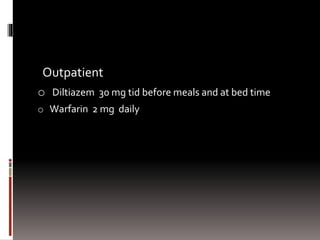
Outpatient
o Diltiazem 30 mg tid before meals and at bed time
o Warfarin 2 mg daily
EDUCATION
 Appointment with outpatient laboratory are set-up for
PT/INR monitoring and a f/u with his physician is
scheduled.
 If pt. develops recurrent episodes ofA-fib, or experience
troublesome symptoms at home despite optimal
medication , he should contact physician immediately.
 Intake of Low cholesterol diet are encouraged.Trans fat
and junk foods are discouraged
 Aerobic exercises are scheduled.
THANKYOU
QUESTIONS?????

case study on arrythmia

  • 1.
    Presented by: Trilochan pandey,Romit Subba, Harif Ghimire, Mamata Panthi, Arunima Shrestha [B.Pharmacy II year]
  • 2.
    ARRHYTHMIA  Arrhythmia isdefined as loss of cardiac rhythm, especially irregularity of heartbeat.  It covers the group of conditions caused by an abnormality in the rate, regularity, or sequence of cardiac activation. Types of arrhythmia Atrial flutter (AFL) is an abnormal heart rhythm that occurs in the atria of the heart. When it first occurs, it is usually associated with a fast heart rate or tachycardia(beats over 100 per minute),and falls into the category of supra- ventricular tachycardias. Supraventricular tachycardia (SVT) is a rapid heart rhythm originating at or above the atrioventricular node. Supraventricular tachycardias can be contrasted with the potentially more dangerous ventricular tachycardias—rapid rhythms that originate within the ventricular tissue. Atrial fibrillation (AF or A-fib) is the most common cardiac arrhythmia (heart rhythm disorder). It may cause no symptoms, but it is often associated with palpitations, fainting, chest pain, or congestive heart failure. Paroxysmal supraventricular tachycardia (PSVT) is episodes of rapid heart rate that start in a part of the heart above the ventricles. "Paroxysmal" means from time to time.
  • 3.
    Automatic tachycardias arerapid heart arrhythmias caused by an abnormal generation of electrical impulses within the heart. Normally, the heart rhythm is controlled by the rhythmic production of electrical impulses by the "pacemaker" cells of the heart, located in the sinus node Sinus arrhythmia the physiologic cyclic variation in heart rate related to vagal impulses to the sinoatrial node; it is common, particularly in children, and is not abnormal. One of the most common arrhythmias is a sinus arrhythmia. It involves cyclic changes in the heart rate during breathing. It is very common in children and often found in young adults. Patients with sinus arrhythmia do not experience any cardiovascular symptoms. Sinus tachycardia (also colloquially known as sinus tach or sinus tachy) is a heart rhythm with elevated rate of impulses originating from the sinoatrial node, defined as a rate greater than 100 beats/min (bpm) in an average adult. Atrial premature complexes are also called premature atrial contractions (PACs) and may cause heart palpitations or unusual awareness of your heartbeats. Palpitations may be heartbeats that are extra fast, extra slow, or irregularly timed. PACs occur when a beat of your heart occurs early in the heart cycle or prematurely. Wandering atrial pacemaker is an arrhythmia originating in shifting pacemaker sites from the SA node to the atria and back to the SA node. Sinus bradyarrhythmias (heart rate less than 60 beats/min) are common especially in young, athletically active individuals.
  • 4.
  • 5.
     Subjective: Pt.D is a caucasian M, 68 y/o, who presents to the emergency department complaining of increasing shortness of breath, dizziness, and the sensation of heart racing  PMH: Long standing HTN, CAD and a recent percutaneous transluminal angioplasty with placement of 2 stents  SH: Social drinker , No smoking  FH: No FH  MH: No MH
  • 6.
    OBJECTIVE BP: 100/60 mmHg HR: 160 bpm RR: 26 breaths pm Oxygen saturation: 96% Serum electrolytes, renal, thyroid, hepatic fxn and urinalysis are normal Cardiac enzymes and troponin are negative A 12-lead ECG shows a narrow QRS complex tachycardia and absence of P wave.
  • 7.
    ASSESMENT  ECG characteristicslike absence of P waves and irregular R-R intervals due to irregular conduction of impulses to ventricles diagnosed atrial fibrillation(A-Fib)  Initial goal of treatment is to slow his HR. A CCB is drug of choice,slows conduction and increases refractoriness  To prevent thromboembolic events such as CVA, Heparin and warfarin should be given. IV heparin drip should be given until warfarin reaches a therapeutic serum level[PT/INR and PTT monitoring must be set up]
  • 8.
    PLAN INPATIENT o 20mg Diltiazemis given by IV push [In response, pt. HR slowed to 120bpm bt rapidly returned to high rate] o After 15 mins, another bolus was ordered, followed by continuous IV infusion of diltiazem at 5mg/hr[can be titrated upto 15mg/hr to achieve desired rate] After 1-2 hrs on diltiazem drip, pt. HR drops to 80-90bpm o A Heparin drip is started along with oral warfarin 2mg [PT/INR and PTT is ordered]
  • 9.
    Outpatient o Diltiazem 30mg tid before meals and at bed time o Warfarin 2 mg daily
  • 10.
    EDUCATION  Appointment withoutpatient laboratory are set-up for PT/INR monitoring and a f/u with his physician is scheduled.  If pt. develops recurrent episodes ofA-fib, or experience troublesome symptoms at home despite optimal medication , he should contact physician immediately.  Intake of Low cholesterol diet are encouraged.Trans fat and junk foods are discouraged  Aerobic exercises are scheduled.
  • 11.
  • 12.