Case Study
- First
      issue was printed in February 1983 as a 16
page black and white magazine, intended as
a newsletter for DJs
- With the rise of house music, editor/DJ David
Seaman turned the newsletter into a magazine
which covered all dance music and club
culture
- Focused on acid house and rave culture
within the mid 1990s, then started to focus on
the rise of superstar DJs and Ibiza
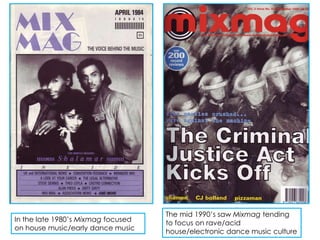
The mid 1990‟s saw Mixmag tending
In the late 1980‟s Mixmag focused   to focus on rave/acid
on house music/early dance music    house/electronic dance music culture
- Nowadays the mag tends to focus on all electronic
dance music and aspects of club culture
- Has always included cover mount in the form of a CD
by a different DJ or artist
- Was sold from DMC publishing in mid nineties to EMAP
Ltd, and was then bought by Development Hell Ltd in
2005
- Development Hell relaunched the magazine in 2006
with a new, revamped design
- Sales have risen and fallen throughout the years; the
circulation for the year 2011 was approximately 20,000
- In 2009 the magazine launched a Brazilian edition
- Costs £4.50
- Released monthly
- Calls itself “the world‟s biggest selling dance music and
clubbing magazine”
- Has its own website, and, as stated earlier, a Brazilian
version of the magazine
- The pages of the magazine present a combination of
both images and text, with articles themselves tending to
appear text heavy. Nevertheless, the magazine is kept
interesting through a use of funky futuristic fonts and
bright colours and images which capture the essence of
clubbing
-The mode of address used is also friendly and colloquial
appealing to the reader and signalling genre (i.e. “big
tunes”, “club radar”, “party”, “glam”)
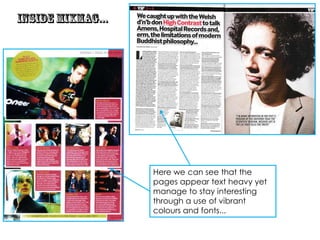
Here we can see that the
pages appear text heavy yet
manage to stay interesting
through a use of vibrant
colours and fonts...
• Aged around 26 (26 = median age)
• 72% male, 28% female
• Single, with a high disposable income
• First to recommend new songs or fashion
  trends to their friends
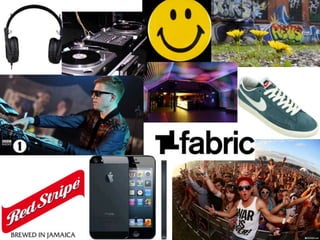
• They are trendy, unique, urban individuals
  who are just as in touch with technology as
  they are with music
• Tend to spend money on nights out with
  their mates, on on-trend clothes, music (i.e.
  vinyl, albums, etc), technology (such as the
  latest mobile phone/ipod, sound systems, DJ
  decks, etc)
• Album and single reviews, rave/festival
  reviews, interviews with artists, a technology
  section, fashion section, letter page, articles
  on issues regarding the genre and
  gig/festival/rave listings are commonly
  found in Mixmag
• Artists that commonly feature are: Benga,
  Rusko, Jack Beats, Calvin Harris, Fat Boy Slim,
  Carl Cox, Skream, Kissy Sell Out
• The Magazine ALWAYS has a cover mount
  CD, showing just how seriously its readers
  take their music
•   The magazine always has a vibrant colour scheme, making it grab
    attention easily
•   Throughout the magazine text and images tend to be set out in
    column/row format giving Mixmag a sophisticated, mature feel
•   The style of the magazine tends to be set out in columns and rows,
    with repeated fonts and a spacious layout and the magazine has
    headers featuring throughout – all these factors help maintain a clear
    brand identity
•   Features different, vibrantly coloured texts and unique and kooky
    fonts; the magazine is quite text-heavy. Therefore this would keep the
    reader interested, whilst also creating an edgy, club/rave feel
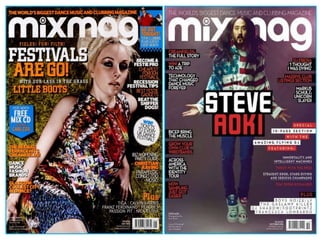
•   The front cover of Mixmag always looks extremely similar with its
    layout; the main sell line is placed in the middle or top left, with
    smaller sell lines placed in columns going down on the left and right
    hand side. The images seem to be of a single artist or model and so it
    creates brand identity for Mixmag as they either seem to be a DJ in
    front of a basic background or a model presented in a provocative
    way.
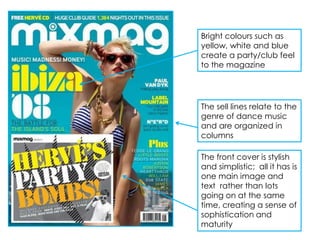
Bright colours such as
yellow, white and blue
create a party/club feel
to the magazine


The sell lines relate to the
genre of dance music
and are organized in
columns

The front cover is stylish
and simplistic; all it has is
one main image and
text rather than lots
going on at the same
time, creating a sense of
sophistication and
maturity
• The mode of address commonly used by
  Mixmag is friendly, trendy and colloquial
• It features words that the target audience
  would know of and use, signalling the young
  audience of twenty-somethings
• The mode of address will attract the
  audience; they will be able to relate to the
  magazine and will feel as if they have a
  connection to it
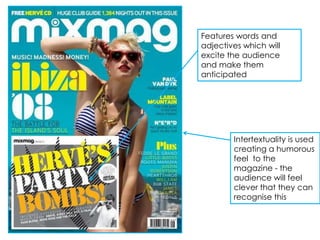
Features words and
adjectives which will
excite the audience
and make them
anticipated


        Intertextuality is used
        creating a humorous
        feel to the
        magazine - the
        audience will feel
        clever that they can
        recognise this
Examples of mode of address include:
• “meet the young things that run tings!”
• “with our lass in the grass”
• “glam, bam, thank you ma‟am...how Alison built
  her wonderland”
• “clubland”
• “california screaming”
• “every raver should read”
• “Britain‟s club scene is still killing it”
• “..brew of booty bass, gutter house and weirdo
  techno”
• Mixmag was originally published by DMC Publishing,
  was then sold to EMAP Ltd, but is now owned by
  Development Hell Ltd
• Development Hell is an independent media
  company based in Islington, London
• As well as publishing Mixmag, Development Hell
  also publish the Mixmag iPad app, the website
  mixmag.net, Mixmag TV, Mixmag Events and
  dontstayin.com (“the worlds biggest clubbing social
  network”)
• Development Hell have also provided consultancy
  for some of the biggest publishers in Britain and
  have produced tour brochures„ for chart topping,
  international artists.
Being owned by Development Hell benefits Mixmag in the
  following ways...
• It owns „dontstayin.com‟, the world‟s largest clubbing
  social network, which gives them easy access to
  clubbers to find out what they want from a magazine
  and what the current trends are. This allows them to
  produce a dance mag that is current and relevant for its
  audience.
• It is an independent company, so it is fresh, edgy and
  cool.
• It focuses solely on dance and clubbing material without
  branching out elsewhere. This means they are likely to be
  experts within this field.
• They are on top of embracing technological change to
  maximise e-media and cross media synergy.
Case Study

Case Study

  • 1.
  • 3.
    - First issue was printed in February 1983 as a 16 page black and white magazine, intended as a newsletter for DJs - With the rise of house music, editor/DJ David Seaman turned the newsletter into a magazine which covered all dance music and club culture - Focused on acid house and rave culture within the mid 1990s, then started to focus on the rise of superstar DJs and Ibiza
  • 4.
    The mid 1990‟ssaw Mixmag tending In the late 1980‟s Mixmag focused to focus on rave/acid on house music/early dance music house/electronic dance music culture
  • 5.
    - Nowadays themag tends to focus on all electronic dance music and aspects of club culture - Has always included cover mount in the form of a CD by a different DJ or artist - Was sold from DMC publishing in mid nineties to EMAP Ltd, and was then bought by Development Hell Ltd in 2005 - Development Hell relaunched the magazine in 2006 with a new, revamped design - Sales have risen and fallen throughout the years; the circulation for the year 2011 was approximately 20,000 - In 2009 the magazine launched a Brazilian edition
  • 6.
    - Costs £4.50 -Released monthly - Calls itself “the world‟s biggest selling dance music and clubbing magazine” - Has its own website, and, as stated earlier, a Brazilian version of the magazine - The pages of the magazine present a combination of both images and text, with articles themselves tending to appear text heavy. Nevertheless, the magazine is kept interesting through a use of funky futuristic fonts and bright colours and images which capture the essence of clubbing -The mode of address used is also friendly and colloquial appealing to the reader and signalling genre (i.e. “big tunes”, “club radar”, “party”, “glam”)
  • 7.
    Here we cansee that the pages appear text heavy yet manage to stay interesting through a use of vibrant colours and fonts...
  • 8.
    • Aged around26 (26 = median age) • 72% male, 28% female • Single, with a high disposable income • First to recommend new songs or fashion trends to their friends • They are trendy, unique, urban individuals who are just as in touch with technology as they are with music • Tend to spend money on nights out with their mates, on on-trend clothes, music (i.e. vinyl, albums, etc), technology (such as the latest mobile phone/ipod, sound systems, DJ decks, etc)
  • 10.
    • Album andsingle reviews, rave/festival reviews, interviews with artists, a technology section, fashion section, letter page, articles on issues regarding the genre and gig/festival/rave listings are commonly found in Mixmag • Artists that commonly feature are: Benga, Rusko, Jack Beats, Calvin Harris, Fat Boy Slim, Carl Cox, Skream, Kissy Sell Out • The Magazine ALWAYS has a cover mount CD, showing just how seriously its readers take their music
  • 12.
    The magazine always has a vibrant colour scheme, making it grab attention easily • Throughout the magazine text and images tend to be set out in column/row format giving Mixmag a sophisticated, mature feel • The style of the magazine tends to be set out in columns and rows, with repeated fonts and a spacious layout and the magazine has headers featuring throughout – all these factors help maintain a clear brand identity • Features different, vibrantly coloured texts and unique and kooky fonts; the magazine is quite text-heavy. Therefore this would keep the reader interested, whilst also creating an edgy, club/rave feel • The front cover of Mixmag always looks extremely similar with its layout; the main sell line is placed in the middle or top left, with smaller sell lines placed in columns going down on the left and right hand side. The images seem to be of a single artist or model and so it creates brand identity for Mixmag as they either seem to be a DJ in front of a basic background or a model presented in a provocative way.
  • 13.
    Bright colours suchas yellow, white and blue create a party/club feel to the magazine The sell lines relate to the genre of dance music and are organized in columns The front cover is stylish and simplistic; all it has is one main image and text rather than lots going on at the same time, creating a sense of sophistication and maturity
  • 14.
    • The modeof address commonly used by Mixmag is friendly, trendy and colloquial • It features words that the target audience would know of and use, signalling the young audience of twenty-somethings • The mode of address will attract the audience; they will be able to relate to the magazine and will feel as if they have a connection to it
  • 15.
    Features words and adjectiveswhich will excite the audience and make them anticipated Intertextuality is used creating a humorous feel to the magazine - the audience will feel clever that they can recognise this
  • 16.
    Examples of modeof address include: • “meet the young things that run tings!” • “with our lass in the grass” • “glam, bam, thank you ma‟am...how Alison built her wonderland” • “clubland” • “california screaming” • “every raver should read” • “Britain‟s club scene is still killing it” • “..brew of booty bass, gutter house and weirdo techno”
  • 17.
    • Mixmag wasoriginally published by DMC Publishing, was then sold to EMAP Ltd, but is now owned by Development Hell Ltd • Development Hell is an independent media company based in Islington, London • As well as publishing Mixmag, Development Hell also publish the Mixmag iPad app, the website mixmag.net, Mixmag TV, Mixmag Events and dontstayin.com (“the worlds biggest clubbing social network”) • Development Hell have also provided consultancy for some of the biggest publishers in Britain and have produced tour brochures„ for chart topping, international artists.
  • 18.
    Being owned byDevelopment Hell benefits Mixmag in the following ways... • It owns „dontstayin.com‟, the world‟s largest clubbing social network, which gives them easy access to clubbers to find out what they want from a magazine and what the current trends are. This allows them to produce a dance mag that is current and relevant for its audience. • It is an independent company, so it is fresh, edgy and cool. • It focuses solely on dance and clubbing material without branching out elsewhere. This means they are likely to be experts within this field. • They are on top of embracing technological change to maximise e-media and cross media synergy.