Zoe Ramsdale-Clark
KEY CONCEPTS ANALYSIS
CODES AND CONVENTIONS
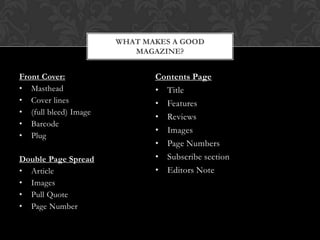
Front Cover:
• Masthead
• Cover lines
• (full bleed) Image
• Barcode
• Plug
Double Page Spread
• Article
• Images
• Pull Quote
• Page Number
WHAT MAKES A GOOD
MAGAZINE?
Contents Page
• Title
• Features
• Reviews
• Images
• Page Numbers
• Subscribe section
• Editors Note
AUDIENCE
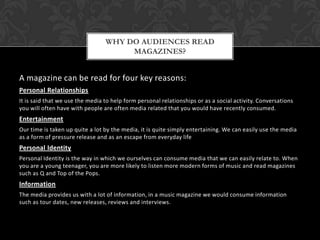
A magazine can be read for four key reasons:
Personal Relationships
It is said that we use the media to help form personal relationships or as a social activity. Conversations
you will often have with people are often media related that you would have recently consumed.
Entertainment
Our time is taken up quite a lot by the media, it is quite simply entertaining. We can easily use the media
as a form of pressure release and as an escape from everyday life
Personal Identity
Personal Identity is the way in which we ourselves can consume media that we can easily relate to. When
you are a young teenager, you are more likely to listen more modern forms of music and read magazines
such as Q and Top of the Pops.
Information
The media provides us with a lot of information, in a music magazine we would consume information
such as tour dates, new releases, reviews and interviews.
WHY DO AUDIENCES READ
MAGAZINES?
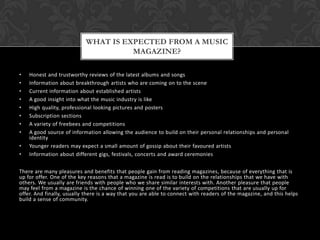
• Honest and trustworthy reviews of the latest albums and songs
• Information about breakthrough artists who are coming on to the scene
• Current information about established artists
• A good insight into what the music industry is like
• High quality, professional looking pictures and posters
• Subscription sections
• A variety of freebees and competitions
• A good source of information allowing the audience to build on their personal relationships and personal
identity
• Younger readers may expect a small amount of gossip about their favoured artists
• Information about different gigs, festivals, concerts and award ceremonies
There are many pleasures and benefits that people gain from reading magazines, because of everything that is
up for offer. One of the key reasons that a magazine is read is to build on the relationships that we have with
others. We usually are friends with people who we share similar interests with. Another pleasure that people
may feel from a magazine is the chance of winning one of the variety of competitions that are usually up for
offer. And finally, usually there is a way that you are able to connect with readers of the magazine, and this helps
build a sense of community.
WHAT IS EXPECTED FROM A MUSIC
MAGAZINE?
• An easy way of making profit
• Some readers like to collect issues and keep a selection
• Sometimes, the internet can fail but print magazines are a reliable source of information
on our favourite artists
• Easy way to connect with the writer
• Easily portable
• Print is superior to online because online versions are not able to connect with all of their
audience because they may not be online
• You do not have to wait for articles and pictures to load
• There is a constant loyal readership
• Easy to target a specific geographical area
• Because print magazines are constantly in use, big branded companies will want to
sponsor these magazines by giving potential freebees away
WHY IS PRINT STILL SUCCESSFUL WHEN
THERE IS AN ONLINE VERSION?
REPRESENTATION
Indie music is presented the majority of the time through the music artist themselves, each
artist is quite unique, putting a twist on the indie genre to make it different compared to the
next artist. This is portrayed through live performances, singles, albums and music videos.
Compared to those in the pop genre for example whose music videos tell a story, indie artists
tend to have their music videos portrayed through a gig or live performance which could
range from a small stage at an intimate gig or a big stage at Glastonbury.
Many indie artists will be dressed in dark clothing which is usually quite alternative compared
to other genres of music such as pop, who are usually dressed in bright, bold and eccentric
clothing which is a signifier of the upbeat music they produce. The dark clothing that is worn
by indie artists forebodes the style of music that they produce, telling a story board and
producing something quite ambiguous.
HOW IS INDIE MUSIC
REPRESENTED?
There are many ideologies and iconographic ideas that are portrayed through things from the clothes
they wear to the music that they produce.
Iconography:
• Dark colours
• Bright fonts which are used to contrast the dark clothing they might wear
• Live music
• Raw, instrumental music
• It is extremely uncommon for close up shots to be used in their music videos which can be used to create a sense of
ambiguity
Key Artists
• Mumford and Sons
• Of Monster and Men
• Bon Iver
• The Fray
• Florence and the Machine
Stereotypes
• Calm
• Collected
• Passionate about music
• freedom
KEY ICONOGRAPHY
INSTITUTION
How do publishers make their money?
There are two key factors that magazine publishers will get their money from and that is the
magazines readership and advertisements. The readership will help bring in the money because
they are spending their disposable income on the magazine. The second thing is that the revenue
that is made from advertisements in the magazine helps to bring in the money also.
How are the institutions keeping their audiences?
• Attractive front covers
• Use of bold colours
• Freebees
• Competitions
• Famous music artists featuring on the front cover
• Special editions and lowered prices
• Social media
• Regular features
INSTITUTION
What business models are used to ensure a sustained audience?
Music magazines are extremely popular, however publishers will use a variety of business models
to make sure that they have a sustained audience. Mediums such as
televisions, radios, gigs, festivals and award ceremonies are used to help keep their audience going
strong. These models are key features which will help the circulation of a magazine because things
are things that are constantly used in everyday life
What are some of the magazines wider assets?
• TV
• Radio
• Award Ceremonies
• Stages at festivals
• Merchandise
• Gigs
• Concerts
• Competitions and prizes
INSTITUTION

Key Concepts Analysis

  • 1.
  • 2.
  • 3.
    Front Cover: • Masthead •Cover lines • (full bleed) Image • Barcode • Plug Double Page Spread • Article • Images • Pull Quote • Page Number WHAT MAKES A GOOD MAGAZINE? Contents Page • Title • Features • Reviews • Images • Page Numbers • Subscribe section • Editors Note
  • 4.
  • 5.
    A magazine canbe read for four key reasons: Personal Relationships It is said that we use the media to help form personal relationships or as a social activity. Conversations you will often have with people are often media related that you would have recently consumed. Entertainment Our time is taken up quite a lot by the media, it is quite simply entertaining. We can easily use the media as a form of pressure release and as an escape from everyday life Personal Identity Personal Identity is the way in which we ourselves can consume media that we can easily relate to. When you are a young teenager, you are more likely to listen more modern forms of music and read magazines such as Q and Top of the Pops. Information The media provides us with a lot of information, in a music magazine we would consume information such as tour dates, new releases, reviews and interviews. WHY DO AUDIENCES READ MAGAZINES?
  • 6.
    • Honest andtrustworthy reviews of the latest albums and songs • Information about breakthrough artists who are coming on to the scene • Current information about established artists • A good insight into what the music industry is like • High quality, professional looking pictures and posters • Subscription sections • A variety of freebees and competitions • A good source of information allowing the audience to build on their personal relationships and personal identity • Younger readers may expect a small amount of gossip about their favoured artists • Information about different gigs, festivals, concerts and award ceremonies There are many pleasures and benefits that people gain from reading magazines, because of everything that is up for offer. One of the key reasons that a magazine is read is to build on the relationships that we have with others. We usually are friends with people who we share similar interests with. Another pleasure that people may feel from a magazine is the chance of winning one of the variety of competitions that are usually up for offer. And finally, usually there is a way that you are able to connect with readers of the magazine, and this helps build a sense of community. WHAT IS EXPECTED FROM A MUSIC MAGAZINE?
  • 7.
    • An easyway of making profit • Some readers like to collect issues and keep a selection • Sometimes, the internet can fail but print magazines are a reliable source of information on our favourite artists • Easy way to connect with the writer • Easily portable • Print is superior to online because online versions are not able to connect with all of their audience because they may not be online • You do not have to wait for articles and pictures to load • There is a constant loyal readership • Easy to target a specific geographical area • Because print magazines are constantly in use, big branded companies will want to sponsor these magazines by giving potential freebees away WHY IS PRINT STILL SUCCESSFUL WHEN THERE IS AN ONLINE VERSION?
  • 8.
  • 9.
    Indie music ispresented the majority of the time through the music artist themselves, each artist is quite unique, putting a twist on the indie genre to make it different compared to the next artist. This is portrayed through live performances, singles, albums and music videos. Compared to those in the pop genre for example whose music videos tell a story, indie artists tend to have their music videos portrayed through a gig or live performance which could range from a small stage at an intimate gig or a big stage at Glastonbury. Many indie artists will be dressed in dark clothing which is usually quite alternative compared to other genres of music such as pop, who are usually dressed in bright, bold and eccentric clothing which is a signifier of the upbeat music they produce. The dark clothing that is worn by indie artists forebodes the style of music that they produce, telling a story board and producing something quite ambiguous. HOW IS INDIE MUSIC REPRESENTED?
  • 10.
    There are manyideologies and iconographic ideas that are portrayed through things from the clothes they wear to the music that they produce. Iconography: • Dark colours • Bright fonts which are used to contrast the dark clothing they might wear • Live music • Raw, instrumental music • It is extremely uncommon for close up shots to be used in their music videos which can be used to create a sense of ambiguity Key Artists • Mumford and Sons • Of Monster and Men • Bon Iver • The Fray • Florence and the Machine Stereotypes • Calm • Collected • Passionate about music • freedom KEY ICONOGRAPHY
  • 11.
  • 12.
    How do publishersmake their money? There are two key factors that magazine publishers will get their money from and that is the magazines readership and advertisements. The readership will help bring in the money because they are spending their disposable income on the magazine. The second thing is that the revenue that is made from advertisements in the magazine helps to bring in the money also. How are the institutions keeping their audiences? • Attractive front covers • Use of bold colours • Freebees • Competitions • Famous music artists featuring on the front cover • Special editions and lowered prices • Social media • Regular features INSTITUTION
  • 13.
    What business modelsare used to ensure a sustained audience? Music magazines are extremely popular, however publishers will use a variety of business models to make sure that they have a sustained audience. Mediums such as televisions, radios, gigs, festivals and award ceremonies are used to help keep their audience going strong. These models are key features which will help the circulation of a magazine because things are things that are constantly used in everyday life What are some of the magazines wider assets? • TV • Radio • Award Ceremonies • Stages at festivals • Merchandise • Gigs • Concerts • Competitions and prizes INSTITUTION