CASE PRESENTATION
Benedictus Widaja FY1
Awesomemedicalnotes.wordpress.com
HISTORY
 11 year old boy
 Known eczema since age of 3

 Presented with 1 day history of:
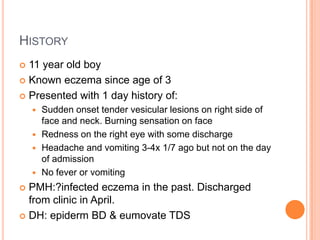
     Sudden onset tender vesicular lesions on right side of
      face and neck. Burning sensation on face
     Redness on the right eye with some discharge
     Headache and vomiting 3-4x 1/7 ago but not on the day
      of admission
     No fever or vomiting

 PMH:?infected eczema in the past. Discharged
  from clinic in April.
 DH: epiderm BD & eumovate TDS
EXAMINATION
EXAMINATION
 Obs stable (T: 37.1, P 101)
 Alert, well-hydrated, not in distress

 Eczematous rash on face, neck, elbows, hands and
  left ankle
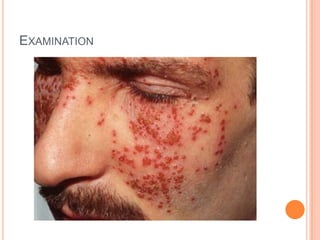
 Pustular, vesicular eruption in clusters over right
  side of face, neck and behind left ear. No lesion in
  the ear
 Right eye – swollen lid margins, red conjunctive,
  purulent discharge. No pain, normal eye
  movements and reactive to light
 Otherwise normal
DIAGNOSIS
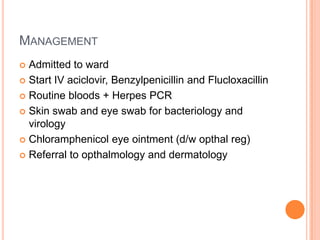
 Eczema herpeticum with secondary impetigo
 Right conjunctivitis


                   Impetigo
MANAGEMENT
 Admitted to ward
 Start IV aciclovir, Benzylpenicillin and Flucloxacillin

 Routine bloods + Herpes PCR

 Skin swab and eye swab for bacteriology and
  virology
 Chloramphenicol eye ointment (d/w opthal reg)

 Referral to opthalmology and dermatology
DERMATOLOGY REVIEW
 Continue IV treatment for 1 week
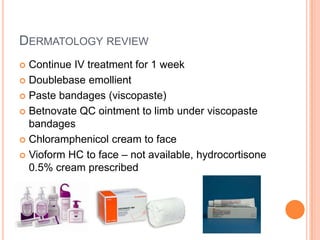
 Doublebase emollient

 Paste bandages (viscopaste)

 Betnovate QC ointment to limb under viscopaste
  bandages
 Chloramphenicol cream to face

 Vioform HC to face – not available, hydrocortisone
  0.5% cream prescribed
RESULTS
 Swabs – staphylococcus aureus
 Blood culture –ve

 Routine bloods normal

 PCR – HSV DNA type 1/2 not detected
DISCHARGE
 Discharge with dermatology follow up in one week
 Oral aciclovir five times/day (total 10 days)

 Oral flucloxacillin 1g QDS (total 7 day)

 Phenoxymethylpenicillin 500mg QDS (total 7 days)

 Chloramphenicol eye drops QDS for 1 week

 Doublebase gel

 Hydrocortisone 1% cream BD

 Betamethasone valerate 0.1% ointment under
  viscopaste bandages in the morning
ECZEMA HERPETICUM
 Acute disseminated herpes simplex infection, often
  associated with systemic symptoms, in patients
  with atopic dermatitis
 Commonly involve HSV type 1 or type 2

 Rarely vaccinia virus and Coxsackie A16 virus

 Infection may be from auto-innoculation or from
  infected contact
CLINICAL PRESENTATION
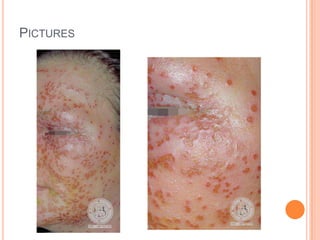
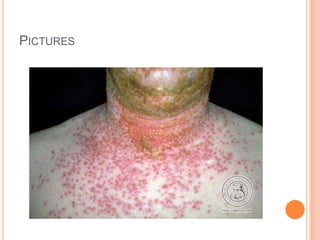
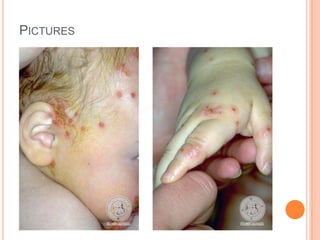
 Multiple clusters of vesicles in areas of pre-existing
  atopic dermatitis
 Spreading (to normal skin), haemorrhagic and
  crusted
 Painful punched out erosions, which may coalesce
  to form larger areas of erosions and crusting
 Majority of patients have fever and malaise

 Subclinical herpetic infection is quite common
PICTURES
PICTURES
PICTURES
IMPETIGO VS ECZEMA HERPETICUM
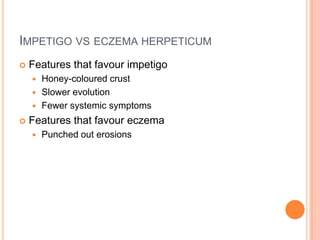
   Features that favour impetigo
     Honey-coloured crust
     Slower evolution
     Fewer systemic symptoms

   Features that favour eczema
       Punched out erosions
INVESTIGATION
 Swab for virology (PCR) and bacteriology from
  fresh vesicle
 Other investigations:
       Bloods: FBC, biochem (CRP & albumin)
   Other tests to diagnose viral infection:
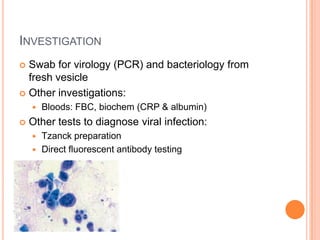
       Tzanck preparation
       Direct fluorescent antibody testing
MANAGEMENT
   Consider advising patient to discard previously used
    emmolient (esp if it is stored in tubs) or creams if
    contamination is suspected
   Initiate treatment on the same day (delay may increase
    length of hospital stay)
       IV or oral aciclovir
       IV or oral antibiotics (flucloxacillin & benzylpenicillin) for
        secondary bacterial infection
       Topical antibiotics cream if no evidence of bacterial infection
        (rarely used in UK due to bacterial resistance)
       Topical opthalmic antiviral may be added if there is evidence
        of periocular involvement (keratitis prophylaxis)
       Dermatology referral
   Opthalmology referral for periocular lesions
MANAGEMENT OF ECZEMA


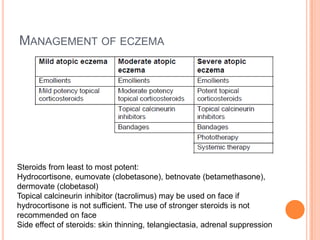
Steroids from least to most potent:
Hydrocortisone, eumovate (clobetasone), betnovate (betamethasone),
dermovate (clobetasol)
Topical calcineurin inhibitor (tacrolimus) may be used on face if
hydrocortisone is not sufficient. The use of stronger steroids is not
recommended on face
Side effect of steroids: skin thinning, telangiectasia, adrenal suppression
PROGNOSIS
 Very low mortality with the availability of effective
  antivirals
 Average duration of illness is 16 days, cases lasting
  as long as 6 weeks have been reported.
 Recurrent episodes tend to be milder and are not
  associated with systemic symptoms.
 Complications if untreated:
     Herpes hepatitis
     DIC
     Herpes keratitis, conjunctivitis
     In disseminated infection can involve brain, lung, GI and
      adrenal
CONCLUSION
 Although potentially life threatening, if eczema
  herpeticum is recognized early it is easily and
  effectively treated.
 Any patient with history of atopic dermatitis and
  acute "blistering" should be examined for eczema
  herpeticum.
REFERENCES
   Royal college of paediatrics and child health allergy care
    pathways for children eczema
   Aronson PL, Yan AC, Mittal MK, Mohamad Z, Shah
    SS Delayed acyclovir and outcomes of children hospitalized
    with eczema herpeticum. [Journal Article, Multicenter Study,
    Research Support, N.I.H., Extramural, Research Support,
    Non-U.S. Gov't]
    Pediatrics 2011 Dec; 128(6):1161-7.
   Brook, I., Frazier, E.H., & Yeager, J.K. (1998). Microbiology of
    infected eczema herpeticum. Journal of the Academy of
    Dermatology, 38, 627-629.
   Sais, G., Jucgla, A., Curco, N., & Peyri, J. (1994). Kaposi's
    varicelliform eruption with ocular involvement. Archives of
    Dermatology, 130, 1209-1210
   CG57 Atopic eczema in children: NICE guideline
   Mooney MA, Janniger CK, Schwartz RA. Kaposi's
    varicelliform eruption. Cutis. 1994;53:243-245.

Case presentation eczema herpeticum

  • 1.
    CASE PRESENTATION Benedictus WidajaFY1 Awesomemedicalnotes.wordpress.com
  • 2.
    HISTORY  11 yearold boy  Known eczema since age of 3  Presented with 1 day history of:  Sudden onset tender vesicular lesions on right side of face and neck. Burning sensation on face  Redness on the right eye with some discharge  Headache and vomiting 3-4x 1/7 ago but not on the day of admission  No fever or vomiting  PMH:?infected eczema in the past. Discharged from clinic in April.  DH: epiderm BD & eumovate TDS
  • 3.
  • 4.
    EXAMINATION  Obs stable(T: 37.1, P 101)  Alert, well-hydrated, not in distress  Eczematous rash on face, neck, elbows, hands and left ankle  Pustular, vesicular eruption in clusters over right side of face, neck and behind left ear. No lesion in the ear  Right eye – swollen lid margins, red conjunctive, purulent discharge. No pain, normal eye movements and reactive to light  Otherwise normal
  • 5.
    DIAGNOSIS  Eczema herpeticumwith secondary impetigo  Right conjunctivitis Impetigo
  • 6.
    MANAGEMENT  Admitted toward  Start IV aciclovir, Benzylpenicillin and Flucloxacillin  Routine bloods + Herpes PCR  Skin swab and eye swab for bacteriology and virology  Chloramphenicol eye ointment (d/w opthal reg)  Referral to opthalmology and dermatology
  • 7.
    DERMATOLOGY REVIEW  ContinueIV treatment for 1 week  Doublebase emollient  Paste bandages (viscopaste)  Betnovate QC ointment to limb under viscopaste bandages  Chloramphenicol cream to face  Vioform HC to face – not available, hydrocortisone 0.5% cream prescribed
  • 8.
    RESULTS  Swabs –staphylococcus aureus  Blood culture –ve  Routine bloods normal  PCR – HSV DNA type 1/2 not detected
  • 9.
    DISCHARGE  Discharge withdermatology follow up in one week  Oral aciclovir five times/day (total 10 days)  Oral flucloxacillin 1g QDS (total 7 day)  Phenoxymethylpenicillin 500mg QDS (total 7 days)  Chloramphenicol eye drops QDS for 1 week  Doublebase gel  Hydrocortisone 1% cream BD  Betamethasone valerate 0.1% ointment under viscopaste bandages in the morning
  • 10.
    ECZEMA HERPETICUM  Acutedisseminated herpes simplex infection, often associated with systemic symptoms, in patients with atopic dermatitis  Commonly involve HSV type 1 or type 2  Rarely vaccinia virus and Coxsackie A16 virus  Infection may be from auto-innoculation or from infected contact
  • 11.
    CLINICAL PRESENTATION  Multipleclusters of vesicles in areas of pre-existing atopic dermatitis  Spreading (to normal skin), haemorrhagic and crusted  Painful punched out erosions, which may coalesce to form larger areas of erosions and crusting  Majority of patients have fever and malaise  Subclinical herpetic infection is quite common
  • 12.
  • 13.
  • 14.
  • 15.
    IMPETIGO VS ECZEMAHERPETICUM  Features that favour impetigo  Honey-coloured crust  Slower evolution  Fewer systemic symptoms  Features that favour eczema  Punched out erosions
  • 16.
    INVESTIGATION  Swab forvirology (PCR) and bacteriology from fresh vesicle  Other investigations:  Bloods: FBC, biochem (CRP & albumin)  Other tests to diagnose viral infection:  Tzanck preparation  Direct fluorescent antibody testing
  • 17.
    MANAGEMENT  Consider advising patient to discard previously used emmolient (esp if it is stored in tubs) or creams if contamination is suspected  Initiate treatment on the same day (delay may increase length of hospital stay)  IV or oral aciclovir  IV or oral antibiotics (flucloxacillin & benzylpenicillin) for secondary bacterial infection  Topical antibiotics cream if no evidence of bacterial infection (rarely used in UK due to bacterial resistance)  Topical opthalmic antiviral may be added if there is evidence of periocular involvement (keratitis prophylaxis)  Dermatology referral  Opthalmology referral for periocular lesions
  • 18.
    MANAGEMENT OF ECZEMA Steroidsfrom least to most potent: Hydrocortisone, eumovate (clobetasone), betnovate (betamethasone), dermovate (clobetasol) Topical calcineurin inhibitor (tacrolimus) may be used on face if hydrocortisone is not sufficient. The use of stronger steroids is not recommended on face Side effect of steroids: skin thinning, telangiectasia, adrenal suppression
  • 19.
    PROGNOSIS  Very lowmortality with the availability of effective antivirals  Average duration of illness is 16 days, cases lasting as long as 6 weeks have been reported.  Recurrent episodes tend to be milder and are not associated with systemic symptoms.  Complications if untreated:  Herpes hepatitis  DIC  Herpes keratitis, conjunctivitis  In disseminated infection can involve brain, lung, GI and adrenal
  • 20.
    CONCLUSION  Although potentiallylife threatening, if eczema herpeticum is recognized early it is easily and effectively treated.  Any patient with history of atopic dermatitis and acute "blistering" should be examined for eczema herpeticum.
  • 21.
    REFERENCES  Royal college of paediatrics and child health allergy care pathways for children eczema  Aronson PL, Yan AC, Mittal MK, Mohamad Z, Shah SS Delayed acyclovir and outcomes of children hospitalized with eczema herpeticum. [Journal Article, Multicenter Study, Research Support, N.I.H., Extramural, Research Support, Non-U.S. Gov't] Pediatrics 2011 Dec; 128(6):1161-7.  Brook, I., Frazier, E.H., & Yeager, J.K. (1998). Microbiology of infected eczema herpeticum. Journal of the Academy of Dermatology, 38, 627-629.  Sais, G., Jucgla, A., Curco, N., & Peyri, J. (1994). Kaposi's varicelliform eruption with ocular involvement. Archives of Dermatology, 130, 1209-1210  CG57 Atopic eczema in children: NICE guideline  Mooney MA, Janniger CK, Schwartz RA. Kaposi's varicelliform eruption. Cutis. 1994;53:243-245.

Editor's Notes

  • #8 The type most commonly used is called PB7 or Viscopaste. This bandage is covered in a thick white zinc paste which acts as a moisturiser. The main benefits of these bandages is to moisturise the skin and save the skin from further damage from scratching, as well as allowing the skin to heal from previous scratching. These bandages are also very useful on the arms and legs for areas of eczema, which have become much thickened from scratching over a period of time. They cool and soothe the skin and can help to break the cycle of itching and scratching.
  • #11 Patients often contract the virus by direct contact with an infected person (eg, a kiss from a parent with herpes labialis).5 Eczema herpeticum can also occur in the setting of a primary HSV infection.
  • #12 Herpes simplex virus 1 — which usually causes herpes labialis or “cold sores,” and herpes simplex virus 2 — which usually causes genital herpes, can be transferred to the skin by direct contact from the patient or from another infected individual. Rarely, other viruses can cause EH and include vaccinia virus and Coxsackie A16 virus.
  • #17 Royal college of paediatrics and child health allergy care pathways for children eczemaCulture takes at least 48 hours for final results and may be negative if a swab is taken from a crusted site, often seen in older lesionshe quickest method of diagnosis is the time-honoredTzanck preparation. A #15 surgical blade should be used to open the top of a vesicle, scraping the underside of the vesicle as well as the base. The blade is then wiped across a glass slide, heat-fixed, and stained with toluidine blue. A positive prep reveals multinucleated giant cells with molded, jigsaw-puzzle nuclei in addition to acantholytic balloon cells (Mooney et al., 1994) (see Figure 4) A positive prep will confirm viral infection, but is not virus-specificDirect fluorescent antibody testing enables rapid identification of the virus. A slide is prepared as above but is not stained. It is sent to the laboratory for immunofluorescent examination with antibodies against HSV-1 and HSV-2 (Braun-Falco et al., 2000). Results are available within several hours.
  • #18 delay of acyclovir initiation by 1 day was associated with an 11% increased LOS (95% confidence interval [CI]: 3%-20%; P = .008), and LOS increased by 41% when acyclovir was started on day 3 (95% CI: 19%-67%; P < .001) and by 98% when started on day 4 to 7 (95% CI: 60%-145%; P < .001). Use of topical corticosteroids on day 1 of hospitalization was not associated with LOS.Delay of acyclovir initiation is associated with increased LOS in hospitalized children with eczema herpeticum. Use of topical corticosteroids on admission is not associated with increased LOS. The mortality rate of hospitalized children with eczema herpeticum is low. Aronson PL, Yan AC, Mittal MK, Mohamad Z, Shah SS Delayed acyclovir and outcomes of children hospitalized with eczema herpeticum. [Journal Article, Multicenter Study, Research Support, N.I.H., Extramural, Research Support, Non-U.S. Gov't]Pediatrics 2011 Dec; 128(6):1161-7.Patients on IV acyclovir require adequate fluid intake and monitoring to prevent acute renal failure due to crystalline nephropathy. Eczema herpeticum is usually managed on an outpatient basis. Inpatient treatment is reserved for patients with more severe cases (eg, high fever, poor oral intake, evidence of secondary infection). Acyclovir remains the most studied and frequently used treatment. The pyrophosphate analogfoscarnet is also effective and may be used in the rare case of acyclovir-resistant herpes.1When eczema herpeticum involves the skin around the eye, a topical ophthalmic antiviral may be added for keratitis prophylaxis. For the treatment of bacterial superinfection, an oral cephalosporin and topical antiseptic lotion may be adequate. Treatment with topical or systemic corticosteroids is still controversial: most clinicians avoid it
  • #19 Nice guidelinesHydrocortisone 1%Eumovate (clobetasoneBenovate (betamethasone)Dermovate (clobetasolTopical calcineurin inhibitors – protopic – tacrolimuss/e of corticosteroids: skin thinning, telangiectasia, adrenal suppression
  • #20 Mortality was 75%Mooney MA, Janniger CK, Schwartz RA. Kaposi's varicelliform eruption. Cutis. 1994;53:243-245.