CLERKSHIP CASE PRESENTATION
ON
PEMPHIGUS VULGARIS
BY
SALMATASNEEM
170310820020
Pharm-D 5th year
MESCO COLLEGE OF PHARMACY
SUBJECTIVE
 Name of patient: CH.Sheshirekha
 Age:85yrs
 Sex: Female
 DOA:24/3/15 Dept:DVL
 Complaints : H/o of fliud filled lesions all over the body.
 History of present illness:
Patient was apparently asymptomatic 20 days back then she developed
swelling over the face with erythema which gradually spread to lower limbs
oral mucosa.
Some of blisters ruptures with minimal trauma and developed erosions.
 Patient history: patient had taken treatment from outside after which
instead lesions subside and then she stopped for 4days later which
developed lesions all over the body 4days back.
 Drug History: she had taken homeopathic medications for 4 days.
 Past History: No h/o of similar complaints in the past.
 c/o :hypertension since 20yrs, on regular medication.
 c/o : chronic utricaria on symptomatic treatment.
 Personal History: Mixed diet
 sleep, appetite :normal
OBJECTIVE
 pt c/c/c
 Afebrile
 pedal edema (positive)
 PR :72/min
 BP:130/90mmhg
 Hb:13.5gm/dl
 WBC Count: 3,200
 N: 67 %
 L:28%
 M:03%
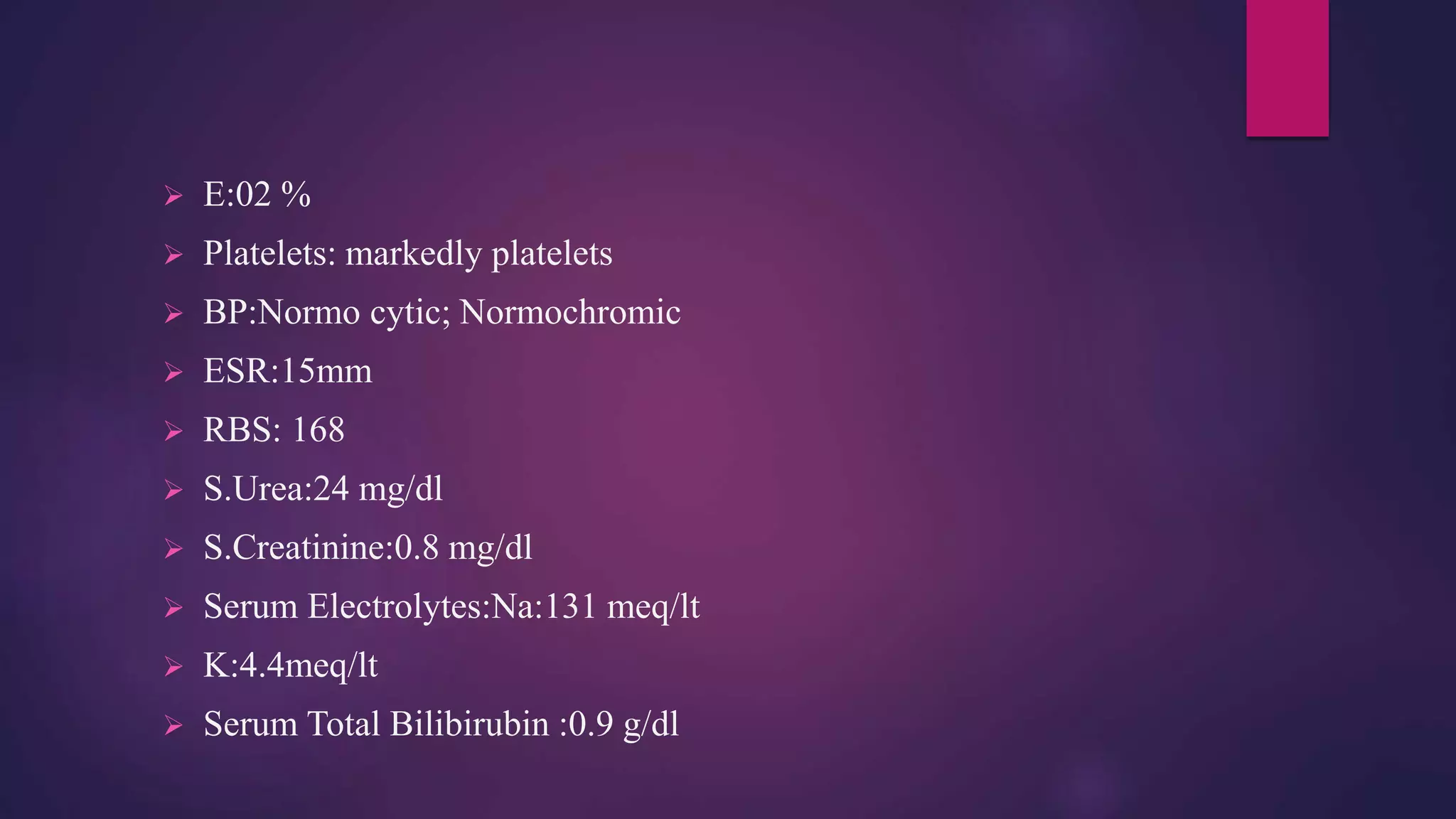
 E:02 %
 Platelets: markedly platelets
 BP:Normo cytic; Normochromic
 ESR:15mm
 RBS: 168
 S.Urea:24 mg/dl
 S.Creatinine:0.8 mg/dl
 Serum Electrolytes:Na:131 meq/lt
 K:4.4meq/lt
 Serum Total Bilibirubin :0.9 g/dl
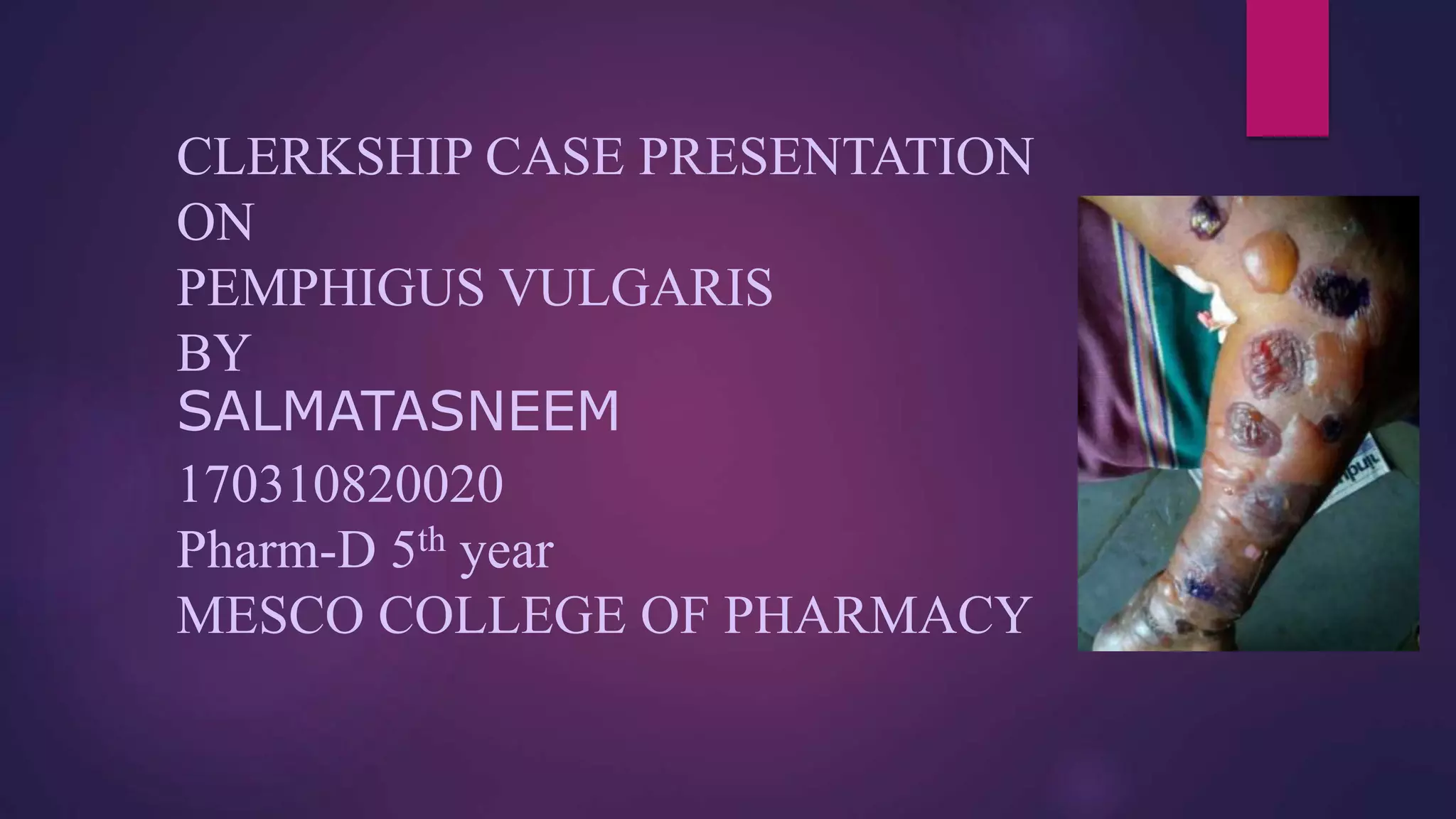
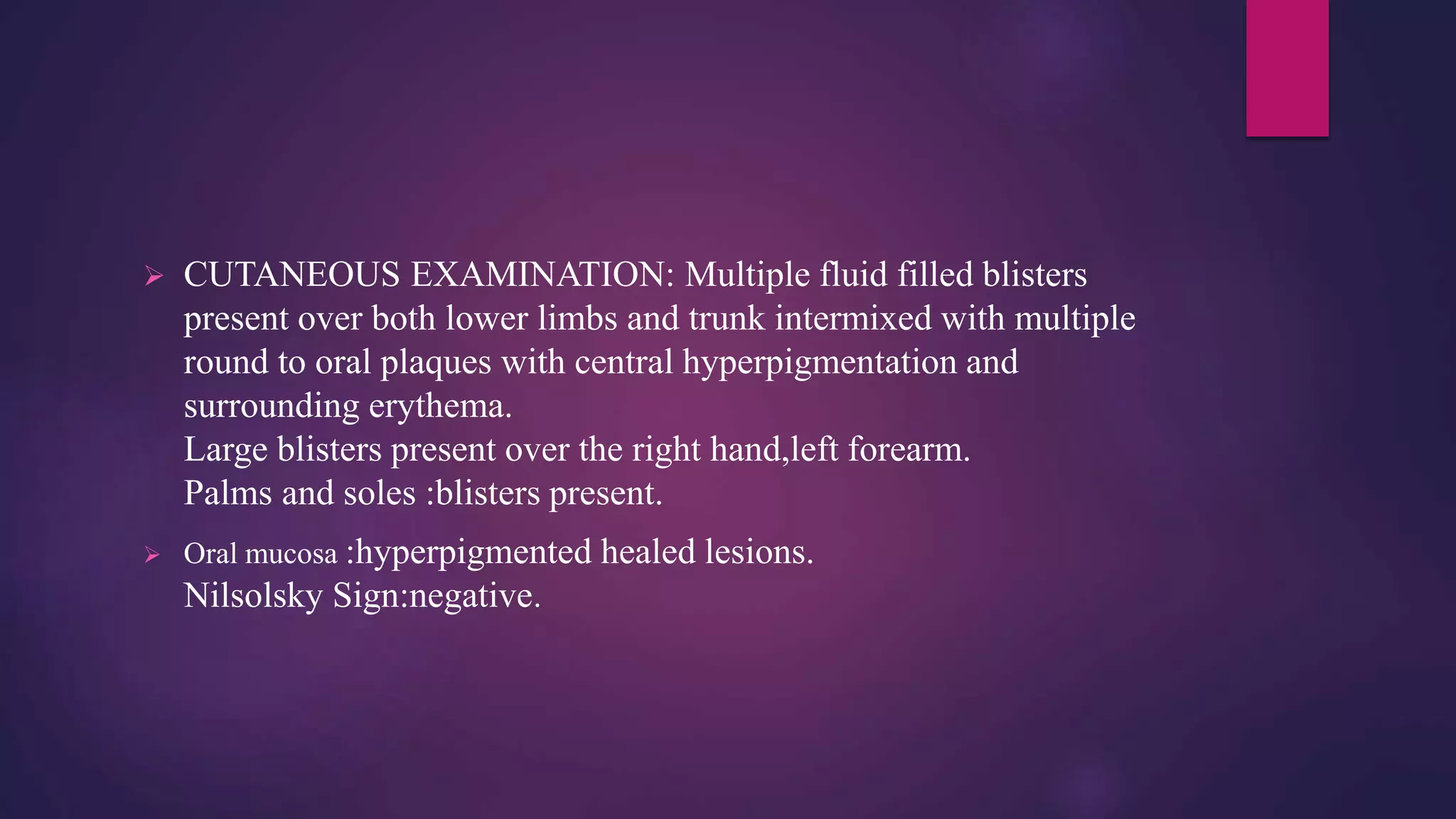
 CUTANEOUS EXAMINATION: Multiple fluid filled blisters
present over both lower limbs and trunk intermixed with multiple
round to oral plaques with central hyperpigmentation and
surrounding erythema.
Large blisters present over the right hand,left forearm.
Palms and soles :blisters present.
 Oral mucosa :hyperpigmented healed lesions.
Nilsolsky Sign:negative.
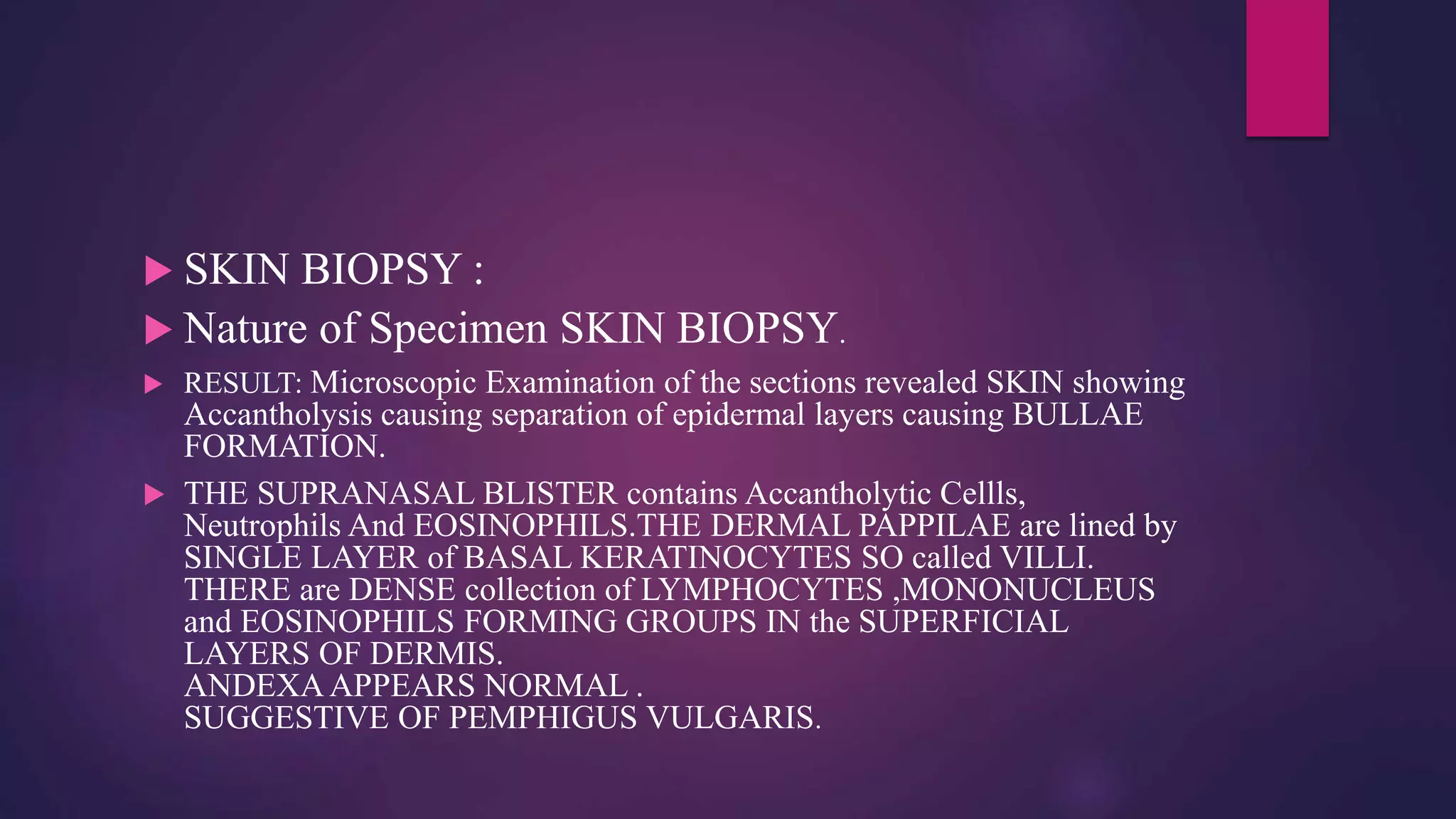
 SKIN BIOPSY :
 Nature of Specimen SKIN BIOPSY.
 RESULT: Microscopic Examination of the sections revealed SKIN showing
Accantholysis causing separation of epidermal layers causing BULLAE
FORMATION.
 THE SUPRANASAL BLISTER contains Accantholytic Cellls,
Neutrophils And EOSINOPHILS.THE DERMAL PAPPILAE are lined by
SINGLE LAYER of BASAL KERATINOCYTES SO called VILLI.
THERE are DENSE collection of LYMPHOCYTES ,MONONUCLEUS
and EOSINOPHILS FORMING GROUPS IN the SUPERFICIAL
LAYERS OF DERMIS.
ANDEXA APPEARS NORMAL .
SUGGESTIVE OF PEMPHIGUS VULGARIS.
ASSESMENT
 Based on the Above Investigations it is confirmed to be as
PEMPHIGUS VULGARIS.
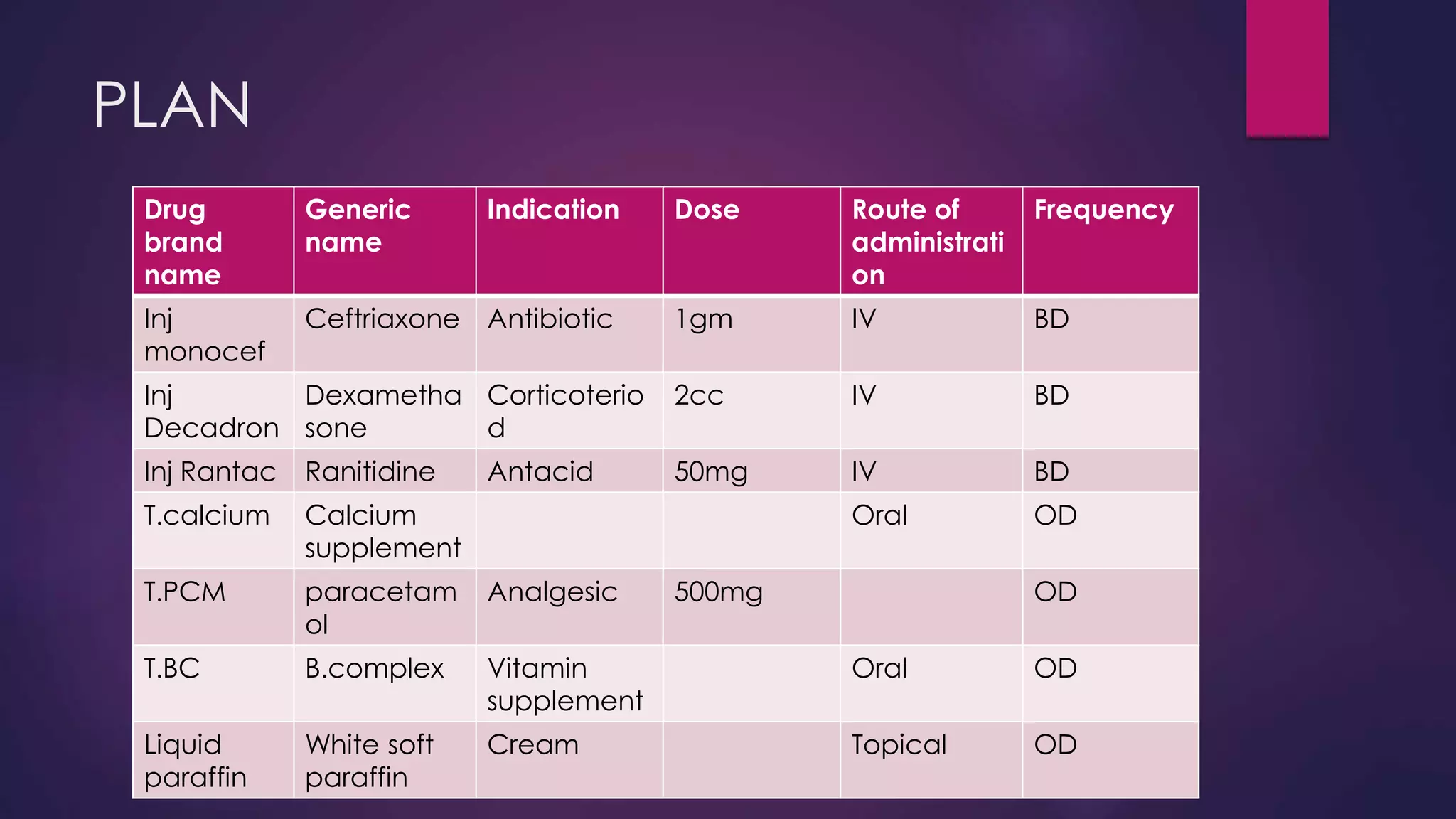
PLAN
Drug
brand
name
Generic
name
Indication Dose Route of
administrati
on
Frequency
Inj
monocef
Ceftriaxone Antibiotic 1gm IV BD
Inj
Decadron
Dexametha
sone
Corticoterio
d
2cc IV BD
Inj Rantac Ranitidine Antacid 50mg IV BD
T.calcium Calcium
supplement
Oral OD
T.PCM paracetam
ol
Analgesic 500mg OD
T.BC B.complex Vitamin
supplement
Oral OD
Liquid
paraffin
White soft
paraffin
Cream Topical OD
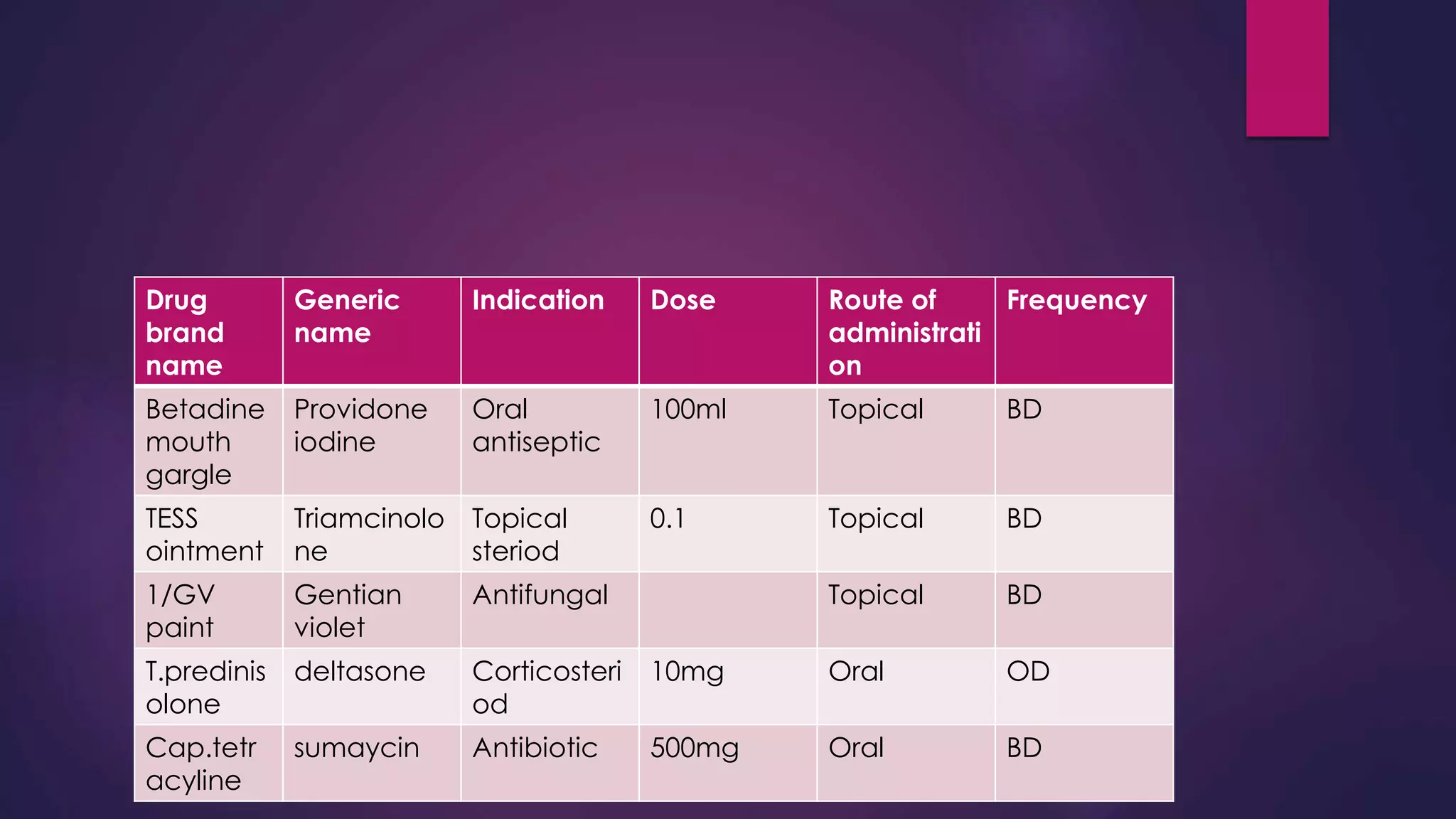
Drug
brand
name
Generic
name
Indication Dose Route of
administrati
on
Frequency
Betadine
mouth
gargle
Providone
iodine
Oral
antiseptic
100ml Topical BD
TESS
ointment
Triamcinolo
ne
Topical
steriod
0.1 Topical BD
1/GV
paint
Gentian
violet
Antifungal Topical BD
T.predinis
olone
deltasone Corticosteri
od
10mg Oral OD
Cap.tetr
acyline
sumaycin Antibiotic 500mg Oral BD
Patient Counselling
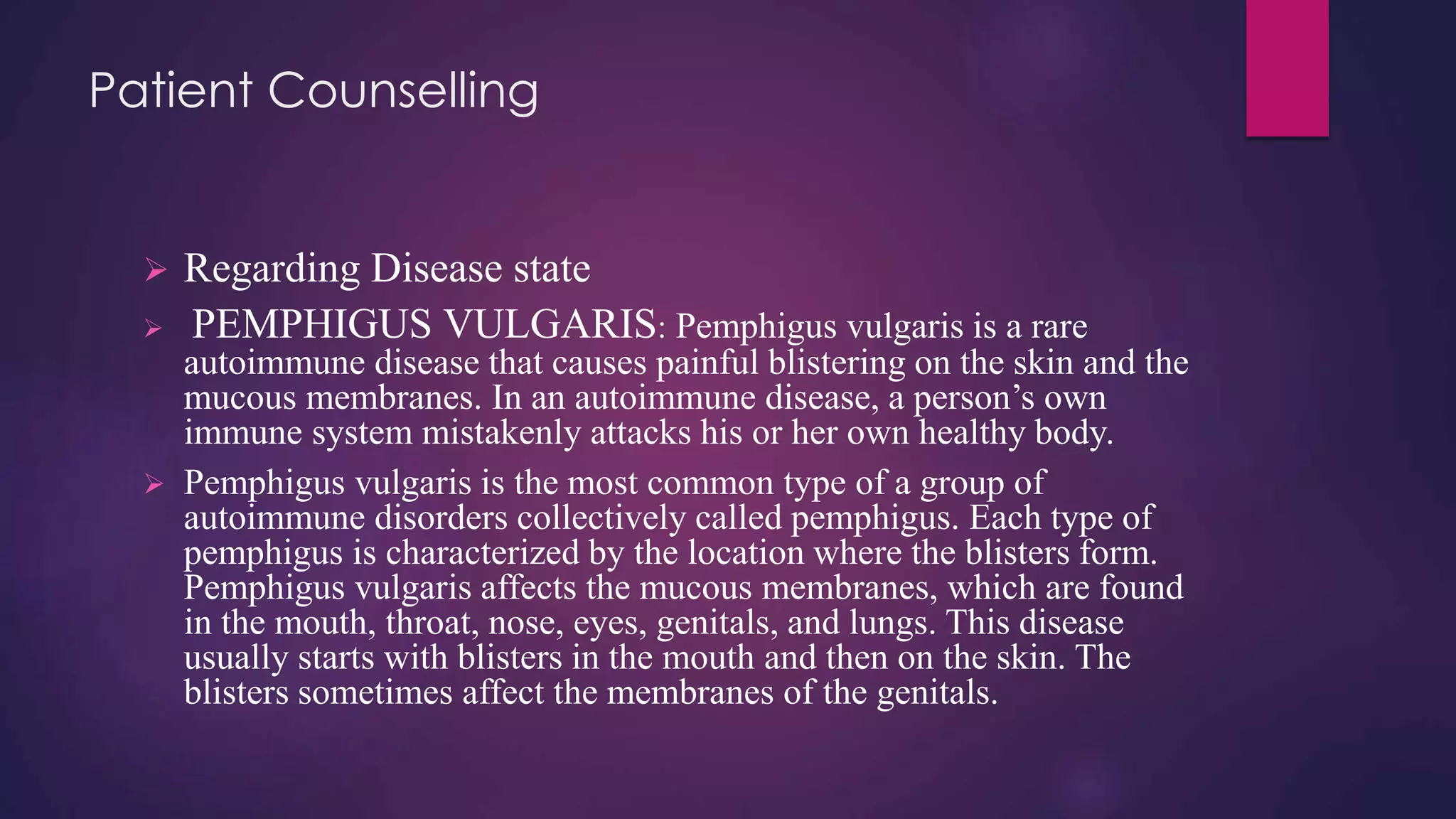
 Regarding Disease state
 PEMPHIGUS VULGARIS: Pemphigus vulgaris is a rare
autoimmune disease that causes painful blistering on the skin and the
mucous membranes. In an autoimmune disease, a person’s own
immune system mistakenly attacks his or her own healthy body.
 Pemphigus vulgaris is the most common type of a group of
autoimmune disorders collectively called pemphigus. Each type of
pemphigus is characterized by the location where the blisters form.
Pemphigus vulgaris affects the mucous membranes, which are found
in the mouth, throat, nose, eyes, genitals, and lungs. This disease
usually starts with blisters in the mouth and then on the skin. The
blisters sometimes affect the membranes of the genitals.
Patient counselling regarding
medication
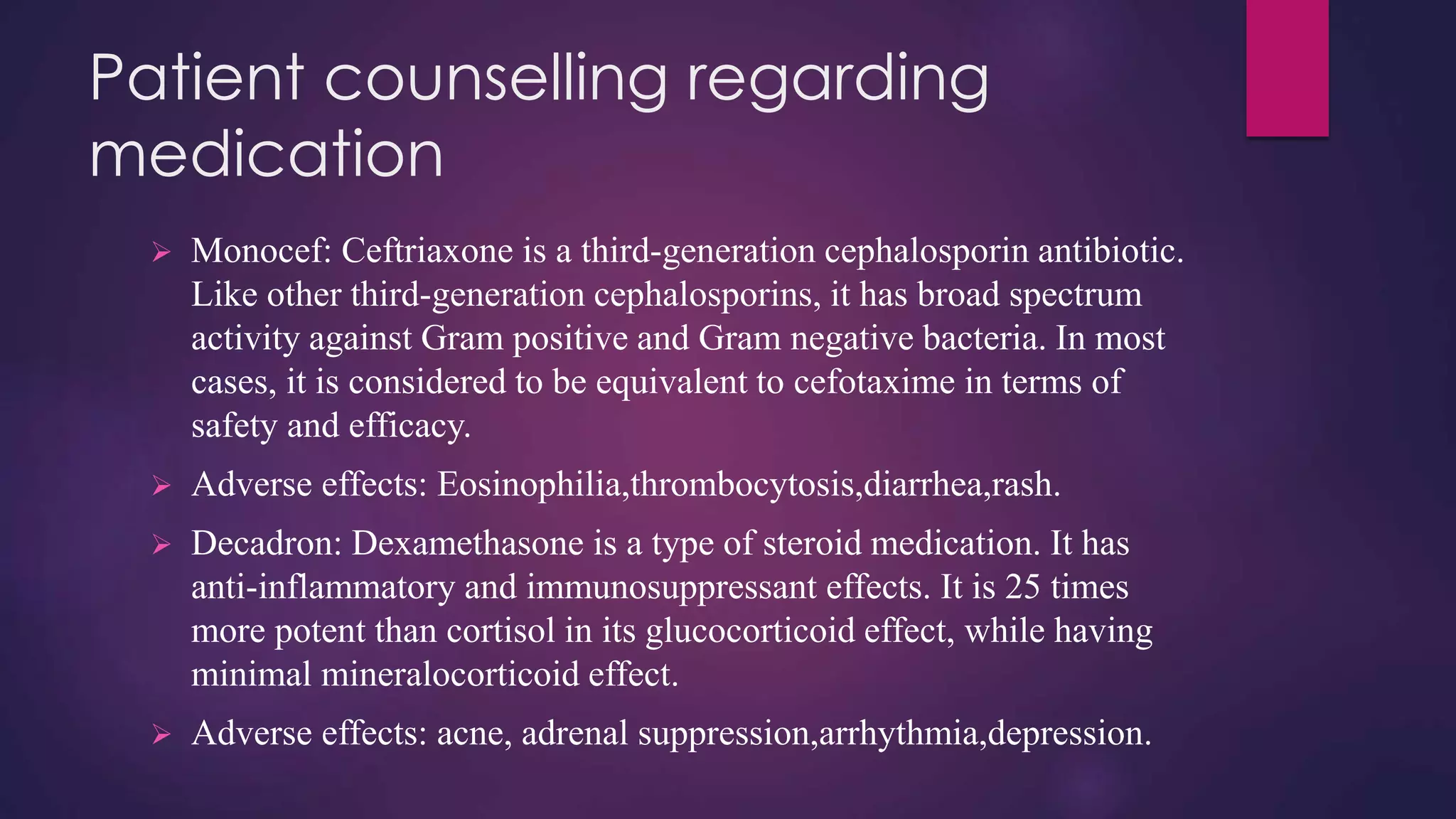
 Monocef: Ceftriaxone is a third-generation cephalosporin antibiotic.
Like other third-generation cephalosporins, it has broad spectrum
activity against Gram positive and Gram negative bacteria. In most
cases, it is considered to be equivalent to cefotaxime in terms of
safety and efficacy.
 Adverse effects: Eosinophilia,thrombocytosis,diarrhea,rash.
 Decadron: Dexamethasone is a type of steroid medication. It has
anti-inflammatory and immunosuppressant effects. It is 25 times
more potent than cortisol in its glucocorticoid effect, while having
minimal mineralocorticoid effect.
 Adverse effects: acne, adrenal suppression,arrhythmia,depression.
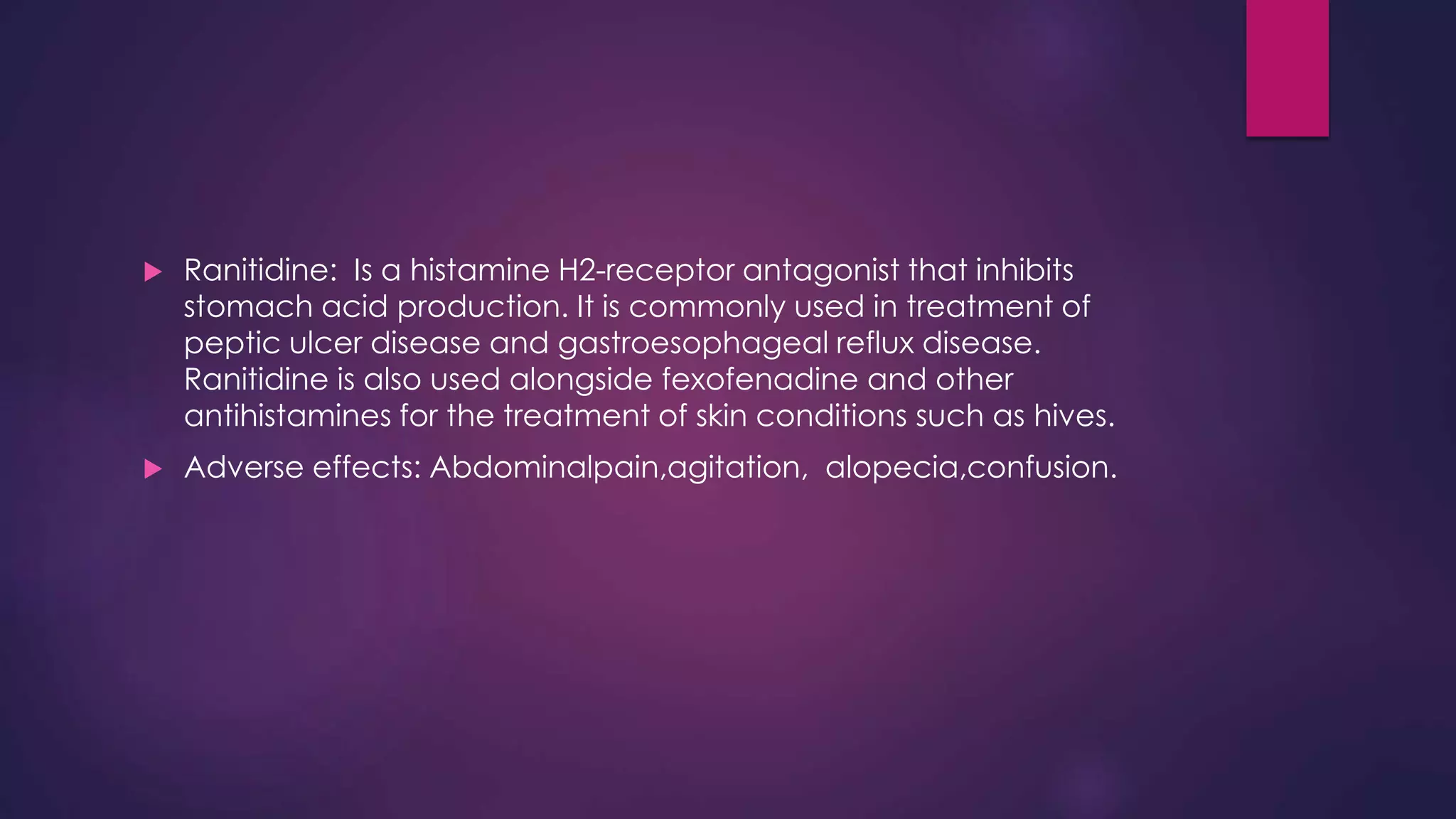
 Ranitidine: Is a histamine H2-receptor antagonist that inhibits
stomach acid production. It is commonly used in treatment of
peptic ulcer disease and gastroesophageal reflux disease.
Ranitidine is also used alongside fexofenadine and other
antihistamines for the treatment of skin conditions such as hives.
 Adverse effects: Abdominalpain,agitation, alopecia,confusion.
 Patient counselling regarding life style modification:
 The primary aim of treatment is to decrease blister formation,
prevent infections and promote healing of blisters and erosions.
 Taking good care of your wounds can help prevent infection and
scarring.
 Generously sprinkling talcum powder on your sheets may help keep
oozing skin from sticking.
 Avoid situations in which your skin could be touched or bumped,
such as contact sports.
 To ease discomfort, treat sores and blisters with soothing or drying
lotions or wet dressings. But, check with your doctor before using
lotions or wet dressings for the first time.
 Avoid spicy or acidic foods, as well as those containing garlic,
onions or leeks.
 These foods can irritate or even trigger blisters.
 Minimize sun exposure. Ultraviolet light may trigger new blisters.
 Talk with your dentist about maintaining good oral health. If you
have blisters in your mouth, it may be difficult to brush your teeth
properly. Ask your dentist what you can do to protect your oral
health.
 Ask your doctor if you need calcium and vitamin D supplements.
Corticosteroids can affect your calcium and vitamin D needs, so ask
your doctor if you need a calcium supplement or any other
additional nutrients.
DRUG INFORMATION QUERY
 What is Nikolsy sign?
 Nikolsky sign is a skin finding in which the top layers of the skin slip away
from the lower layers when slightly rubbed.
 Nikolsky's sign is a clinical dermatological sign, named after Pyotr
Nikolsky (1858–1940), a Russian physician who trained and worked in
Ukraine, which was part of the Russian Empire at that time. The sign is
present when slight rubbing of the skin results in exfoliation of the
outermost layer.
 Nikolsky's sign is almost always present in toxic epidermal necrolysis and
is associated with pemphigus vulgaris. It is useful in differentiating
between pemphigus vulgaris or mucous membrane pemphigoid
(where it is present) and bullous pemphigoid (where it is absent). The
Nikolsky sign is dislodgement of intact superficial epidermis by a
shearing force, indicating a plane of cleavage in the skin. Also present
in Scalded Skin Syndrome caused by the exfoliative toxin of S. aureus.
Drug interactions
 Dexamethasone+prednisolone:
 Dexamethasone will decrease the level or effect of prednisolone by
affecting hepatic/ intestinal enzyme CYP3A4 metabolism. Significant
interaction possible,monitor closely.
 Tetracyline +Ceftiaxone:
 Tetracyline decreases effects of ceftriaxone by pharmacodynamics
antagonism . Significant interaction possible,monitor
closely.bacteriostatic agents may inhibit the effects of bactericidal
agents.
THANKYOU

Case presentation on pemphigus vulgaris

  • 1.
    CLERKSHIP CASE PRESENTATION ON PEMPHIGUSVULGARIS BY SALMATASNEEM 170310820020 Pharm-D 5th year MESCO COLLEGE OF PHARMACY
  • 2.
    SUBJECTIVE  Name ofpatient: CH.Sheshirekha  Age:85yrs  Sex: Female  DOA:24/3/15 Dept:DVL  Complaints : H/o of fliud filled lesions all over the body.  History of present illness: Patient was apparently asymptomatic 20 days back then she developed swelling over the face with erythema which gradually spread to lower limbs oral mucosa. Some of blisters ruptures with minimal trauma and developed erosions.
  • 3.
     Patient history:patient had taken treatment from outside after which instead lesions subside and then she stopped for 4days later which developed lesions all over the body 4days back.  Drug History: she had taken homeopathic medications for 4 days.  Past History: No h/o of similar complaints in the past.  c/o :hypertension since 20yrs, on regular medication.  c/o : chronic utricaria on symptomatic treatment.  Personal History: Mixed diet  sleep, appetite :normal
  • 4.
    OBJECTIVE  pt c/c/c Afebrile  pedal edema (positive)  PR :72/min  BP:130/90mmhg  Hb:13.5gm/dl  WBC Count: 3,200  N: 67 %  L:28%  M:03%
  • 5.
     E:02 % Platelets: markedly platelets  BP:Normo cytic; Normochromic  ESR:15mm  RBS: 168  S.Urea:24 mg/dl  S.Creatinine:0.8 mg/dl  Serum Electrolytes:Na:131 meq/lt  K:4.4meq/lt  Serum Total Bilibirubin :0.9 g/dl
  • 6.
     CUTANEOUS EXAMINATION:Multiple fluid filled blisters present over both lower limbs and trunk intermixed with multiple round to oral plaques with central hyperpigmentation and surrounding erythema. Large blisters present over the right hand,left forearm. Palms and soles :blisters present.  Oral mucosa :hyperpigmented healed lesions. Nilsolsky Sign:negative.
  • 7.
     SKIN BIOPSY:  Nature of Specimen SKIN BIOPSY.  RESULT: Microscopic Examination of the sections revealed SKIN showing Accantholysis causing separation of epidermal layers causing BULLAE FORMATION.  THE SUPRANASAL BLISTER contains Accantholytic Cellls, Neutrophils And EOSINOPHILS.THE DERMAL PAPPILAE are lined by SINGLE LAYER of BASAL KERATINOCYTES SO called VILLI. THERE are DENSE collection of LYMPHOCYTES ,MONONUCLEUS and EOSINOPHILS FORMING GROUPS IN the SUPERFICIAL LAYERS OF DERMIS. ANDEXA APPEARS NORMAL . SUGGESTIVE OF PEMPHIGUS VULGARIS.
  • 8.
    ASSESMENT  Based onthe Above Investigations it is confirmed to be as PEMPHIGUS VULGARIS.
  • 9.
    PLAN Drug brand name Generic name Indication Dose Routeof administrati on Frequency Inj monocef Ceftriaxone Antibiotic 1gm IV BD Inj Decadron Dexametha sone Corticoterio d 2cc IV BD Inj Rantac Ranitidine Antacid 50mg IV BD T.calcium Calcium supplement Oral OD T.PCM paracetam ol Analgesic 500mg OD T.BC B.complex Vitamin supplement Oral OD Liquid paraffin White soft paraffin Cream Topical OD
  • 10.
    Drug brand name Generic name Indication Dose Routeof administrati on Frequency Betadine mouth gargle Providone iodine Oral antiseptic 100ml Topical BD TESS ointment Triamcinolo ne Topical steriod 0.1 Topical BD 1/GV paint Gentian violet Antifungal Topical BD T.predinis olone deltasone Corticosteri od 10mg Oral OD Cap.tetr acyline sumaycin Antibiotic 500mg Oral BD
  • 11.
    Patient Counselling  RegardingDisease state  PEMPHIGUS VULGARIS: Pemphigus vulgaris is a rare autoimmune disease that causes painful blistering on the skin and the mucous membranes. In an autoimmune disease, a person’s own immune system mistakenly attacks his or her own healthy body.  Pemphigus vulgaris is the most common type of a group of autoimmune disorders collectively called pemphigus. Each type of pemphigus is characterized by the location where the blisters form. Pemphigus vulgaris affects the mucous membranes, which are found in the mouth, throat, nose, eyes, genitals, and lungs. This disease usually starts with blisters in the mouth and then on the skin. The blisters sometimes affect the membranes of the genitals.
  • 12.
    Patient counselling regarding medication Monocef: Ceftriaxone is a third-generation cephalosporin antibiotic. Like other third-generation cephalosporins, it has broad spectrum activity against Gram positive and Gram negative bacteria. In most cases, it is considered to be equivalent to cefotaxime in terms of safety and efficacy.  Adverse effects: Eosinophilia,thrombocytosis,diarrhea,rash.  Decadron: Dexamethasone is a type of steroid medication. It has anti-inflammatory and immunosuppressant effects. It is 25 times more potent than cortisol in its glucocorticoid effect, while having minimal mineralocorticoid effect.  Adverse effects: acne, adrenal suppression,arrhythmia,depression.
  • 13.
     Ranitidine: Isa histamine H2-receptor antagonist that inhibits stomach acid production. It is commonly used in treatment of peptic ulcer disease and gastroesophageal reflux disease. Ranitidine is also used alongside fexofenadine and other antihistamines for the treatment of skin conditions such as hives.  Adverse effects: Abdominalpain,agitation, alopecia,confusion.
  • 14.
     Patient counsellingregarding life style modification:  The primary aim of treatment is to decrease blister formation, prevent infections and promote healing of blisters and erosions.  Taking good care of your wounds can help prevent infection and scarring.  Generously sprinkling talcum powder on your sheets may help keep oozing skin from sticking.  Avoid situations in which your skin could be touched or bumped, such as contact sports.  To ease discomfort, treat sores and blisters with soothing or drying lotions or wet dressings. But, check with your doctor before using lotions or wet dressings for the first time.
  • 15.
     Avoid spicyor acidic foods, as well as those containing garlic, onions or leeks.  These foods can irritate or even trigger blisters.  Minimize sun exposure. Ultraviolet light may trigger new blisters.  Talk with your dentist about maintaining good oral health. If you have blisters in your mouth, it may be difficult to brush your teeth properly. Ask your dentist what you can do to protect your oral health.  Ask your doctor if you need calcium and vitamin D supplements. Corticosteroids can affect your calcium and vitamin D needs, so ask your doctor if you need a calcium supplement or any other additional nutrients.
  • 16.
    DRUG INFORMATION QUERY What is Nikolsy sign?  Nikolsky sign is a skin finding in which the top layers of the skin slip away from the lower layers when slightly rubbed.  Nikolsky's sign is a clinical dermatological sign, named after Pyotr Nikolsky (1858–1940), a Russian physician who trained and worked in Ukraine, which was part of the Russian Empire at that time. The sign is present when slight rubbing of the skin results in exfoliation of the outermost layer.  Nikolsky's sign is almost always present in toxic epidermal necrolysis and is associated with pemphigus vulgaris. It is useful in differentiating between pemphigus vulgaris or mucous membrane pemphigoid (where it is present) and bullous pemphigoid (where it is absent). The Nikolsky sign is dislodgement of intact superficial epidermis by a shearing force, indicating a plane of cleavage in the skin. Also present in Scalded Skin Syndrome caused by the exfoliative toxin of S. aureus.
  • 17.
    Drug interactions  Dexamethasone+prednisolone: Dexamethasone will decrease the level or effect of prednisolone by affecting hepatic/ intestinal enzyme CYP3A4 metabolism. Significant interaction possible,monitor closely.  Tetracyline +Ceftiaxone:  Tetracyline decreases effects of ceftriaxone by pharmacodynamics antagonism . Significant interaction possible,monitor closely.bacteriostatic agents may inhibit the effects of bactericidal agents.
  • 18.