Case Presentation
Supervised by: Dr. Ahmad Al Tarawneh
Dr. Raed Al Rbata
Prepared by: Dr. Hiba Al Zghoul
Personal Data
Initials: A. Z.
Gender: Male
Age: 25 year old
Education: Bachelor’s degree
Occupation: Sergeant in JAF
Place of residence: Amman, Jordan
History
 Medical history: Denied any medical
history
 Dental history:
 Irregular dental attendant
 Previous upper and lower right
premolar extractions
 Habits: Smoker, 15 cigarettes/day
 Chief Complaint: My teeth are not
straight
Extraoral Examination
Macro Esthetics
Frontal:
Mild facial asymmetry:
Nose deviated to the left
Philtrum of the lip
deviated to the left
Chin slightly deviated to
the right
Macro Esthetics
 Frontal:
 Width of the nose slightly larger
than the intercanthal distance
 Width of the mouth slightly less
than the interpupillary distance
Macro Esthetics
 Frontal:
 Canting of the occlusal plane
downwards to the left
 Upper midline in shifted 2 mm to the
right, and the lower shifted 3 mm to
the right
Macro Esthetics
Anteroposterior:
 Slightly convex profile
 Slightly decreased LFH
 Lips competent
 Obtuse Nasiolabial angle
 Average Labiomental angle
 Short throat length
Macro Esthetics
Vertical :
Slightly increased lower
facial height
Short upper lip
Upper lip to lower lip = 1:4
Mini Esthetics
 Smile esthetics:
 Asymmetric smile
 Increased show on the left
 Acceptable incisal show
 Smile arc does not follow the
lower lip
 Upper midline shifted 2mm to the
right
 Narrow smile
Micro Esthetics
 Tooth proportions:
 Canine to central incisor
ratio= 40%
 Width of upper right central
incisor to its height = 75%
 Width of upper left central
incisor to its height = 90%
Micro Esthetics
 Connector length
Less between central incisor
and lateral incisor than between
lateral incisor and canine
 Roll:
Incisal line canted downwards
on the left
Intraoral Examination
 Teeth present:
8 7 6 3 C 1 1 C 3 4 6 7 8
8 7 6 4 3 2 1 1 2 3 4 6 7 8
Intraoral Examination
 Poor oral hygiene.
Calculus deposits on lower
anterior teeth and right posterior
teeth
 Caries:
Class III caries on the upper left
primary canine
 No abnormal mobility on
retained upper primary
canines
Intraoral Examination
 Central line:
Shifted in the upper arch to the
left by 2 mm
 Gingival line:
 Higher in the upper right
central incisor
 Lower gingival line on
retained primary canines and
upper right permanent canine
Intraoral Examination
 Incisor classification: Class I
 Overjet = 2 mm
 Overbite = 50 %, Complete
 Crossbite:
 Right side: upper primary
canine, permanent canine, first
molar
 Left side: upper first premolar
Intraoral Examination
 Molar relationships: Right > class II
Left: class III
 Canine relationships: Right: class I
Left: class III ¼ unit
Study Cast Examination
 Bolton Analysis:
Σ Lower anterior tooth widths = 78 %
Σ Upper anterior tooth widths
n= 77.2 +/- 1.65
Σ Lower all tooth widths = 90%
Σ Upper all tooth widths
n= 91.3 +/- 1.91
Study Cast Examination
 Upper Arch
 V- shaped upper arch
 Asymmetrical arch with the
right side narrower and shorter
than the left side
 The dental central line does not
follow the skeletal midline
 Intercanine width= 32 mm
 Intermolar width = 41 mm
Study Cast Examination
 Tooth alignment
 Mesiopalatally rotated upper right first molar
 Mesiolabially rotated upper right permanent
canine
 Mesiolabially rotated upper right primary canine
 Mesiolabially rotated upper left primary canine
 Mesiolabially rotated upper left permanent canine
 Mesiobuccally rotated upper left first premolar
Study Cast Examination
 Lower Arch
 U-shaped lower arch
 Asymmetrical
Study Cast Examination
 Tooth alignment
 Distolingually rotated lower right second molar
 Distobuccally rotated lower right first molar
 distolabially rotated lower right lateral incisor
 Mesiolabially rotated lower right central incisor
 Mesiolabially rotated lower left central incisor
 Mesiolingally rotated lower left canine
 Mesiolingually rotated lower left first premolar
Study Cast Examination
 Lower Arch
 Curve of Spee: 3mm depth
 Severely mesially tipped lower
first molars
IOTN- Esthetic Component
 6: moderate need
IOTN
 4.h (Great)
Less extensive hypodontia
requiring prerestorative
orhodontics or orthodontic space
closure to obviate the need for
prosthesis
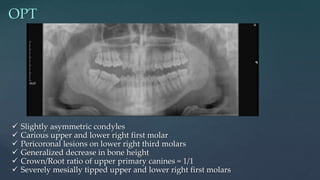
OPT
 Slightly asymmetric condyles
 Carious upper and lower right first molar
 Pericoronal lesions on lower right third molars
 Generalized decrease in bone height
 Crown/Root ratio of upper primary canines = 1/1
 Severely mesially tipped upper and lower right first molars
Lateral Cephalogram
SNA 77.5 °
SNB 74.5 °
ANB 3 °
Corrected ANB ---
UI-MX 106 °
LI-MN 86°
MMA 27 °
UI-LI 142 °
SN-MX 13 °
Wits Appraisal 2 mm
LFH 53%
Diagnostic Summary
 A. Z. is a 25 year old male, medically fit, complaining “my teeth
are not straight”. He presented with a class I incisor relationship
on a class I skeletal base with slightly reduced lower facial
height. He has a normal overjet of 2 mm, 50% complete overbite,
with missing upper lateral incisors, retained primary canines,
missing all second premolars and upper right first premolar. He
has narrow upper arch and moderate crowding in the lower
arch, and a shifted upper and lower midlines of 2, and 3 mm to
the right correspondingly. He has class II molar and class I
canine relationships on the right side, class III molar and class
III ¼ unit canine relationship on the left side.
Problem List
1. Poor oral hygiene and gingival inflammation
2. Carious upper left primary canine, right upper and lower first molars
3. Generalized decrease in bone height
4. Pericoronitis on lower third molars
5. Chief complaint: poor smile esthetics with malaligned teeth
6. Asymmetric face with nose and philtrum deviated to the left
7. Short upper lip
8. Obtuse nasiolabial angle
9. Slightly convex profile
10. Short throat length
11. Canted occlusal line and narrow smile
12. Missing upper lateral incisors, with retained primary canines
13. Missing second premolars and upper right first premolar
14. Crossbite on the right from primary canine to first molar and upper left first premolar
15. V-shaped narrow upper arch
16. Upper central line shift of 2 mm to the right
17. Lower central line shift of 3 mm to the right
18. Moderate crowding in lower arch
19. Severely mesially tipped upper and lower right first molars
20. Class II molar relationships on the right and class III on the left
21. Canine relationships of class III ¼ unit on the left
Treatment Aims
 Improve and maintain good oral hygiene throughout treatment
 Accept facial asymmetry and skeletal relationship
 Correction of crossbite
 Achieve Class I canine relationships, and molar relationship on the left
side
 Achieve full class II relationship on right side
 Correct tooth alignment and proper angulation and inclination
 Maintain overjet and overbite
Treatment Plan
1. Improvement of oral hygiene
2. Upper and lower fixed appliance
3. Space closure for missing premolars
4. Extraction of upper primary canine and prosthetic replacement with
implants to restore lateral incisors
5. Finishing
6. Retention
Treatment Mechanics
1. Roth prescription, .022” slot
2. Include upper and lower second molars
3. Start with alignment and leveling using NiTi wire sequence
4. Upper arch expansion with expanded SS wires
5. Distalize lower left molars and maintain upper left molars in position utilizing
micro implants and closing coil spring
6. Closure of lower space towards the left side to correct lower midline shift
7. Upright lower right second molar first then first molar utilizing micro implants
Retention Protocol
 Upper and lower Hawley retainers
 Maintain primary canine extraction space with acrylic teeth
until prosthetic replacement is carried out
 24 hours wear for 3 months, then 12 hours/day for 1 year
Justification
 Fixed appliance: due to the necessity of precise control of tooth movement in the
three dimensions
 Roth prescription slot .022”: due to use of sliding mechanics
 Upper arch expansion: to correct crossbite and provide space for space opening
 Space closure of the left upper and lower buccal segments: acceptable
angulation of upper and lower first molars, and midline shift
 Space closure for the right upper and lower buccal segments: due to acceptable
contact between teeth
 Extraction of upper primary canines: because of increased crown/root ratio and
poor prognosis and unacceptable esthetics. Extraction delayed to maintain bone
height.

Case presentation

  • 1.
    Case Presentation Supervised by:Dr. Ahmad Al Tarawneh Dr. Raed Al Rbata Prepared by: Dr. Hiba Al Zghoul
  • 2.
    Personal Data Initials: A.Z. Gender: Male Age: 25 year old Education: Bachelor’s degree Occupation: Sergeant in JAF Place of residence: Amman, Jordan
  • 3.
    History  Medical history:Denied any medical history  Dental history:  Irregular dental attendant  Previous upper and lower right premolar extractions  Habits: Smoker, 15 cigarettes/day  Chief Complaint: My teeth are not straight
  • 4.
  • 5.
    Macro Esthetics Frontal: Mild facialasymmetry: Nose deviated to the left Philtrum of the lip deviated to the left Chin slightly deviated to the right
  • 6.
    Macro Esthetics  Frontal: Width of the nose slightly larger than the intercanthal distance  Width of the mouth slightly less than the interpupillary distance
  • 7.
    Macro Esthetics  Frontal: Canting of the occlusal plane downwards to the left  Upper midline in shifted 2 mm to the right, and the lower shifted 3 mm to the right
  • 8.
    Macro Esthetics Anteroposterior:  Slightlyconvex profile  Slightly decreased LFH  Lips competent  Obtuse Nasiolabial angle  Average Labiomental angle  Short throat length
  • 9.
    Macro Esthetics Vertical : Slightlyincreased lower facial height Short upper lip Upper lip to lower lip = 1:4
  • 10.
    Mini Esthetics  Smileesthetics:  Asymmetric smile  Increased show on the left  Acceptable incisal show  Smile arc does not follow the lower lip  Upper midline shifted 2mm to the right  Narrow smile
  • 11.
    Micro Esthetics  Toothproportions:  Canine to central incisor ratio= 40%  Width of upper right central incisor to its height = 75%  Width of upper left central incisor to its height = 90%
  • 12.
    Micro Esthetics  Connectorlength Less between central incisor and lateral incisor than between lateral incisor and canine  Roll: Incisal line canted downwards on the left
  • 13.
    Intraoral Examination  Teethpresent: 8 7 6 3 C 1 1 C 3 4 6 7 8 8 7 6 4 3 2 1 1 2 3 4 6 7 8
  • 14.
    Intraoral Examination  Poororal hygiene. Calculus deposits on lower anterior teeth and right posterior teeth  Caries: Class III caries on the upper left primary canine  No abnormal mobility on retained upper primary canines
  • 15.
    Intraoral Examination  Centralline: Shifted in the upper arch to the left by 2 mm  Gingival line:  Higher in the upper right central incisor  Lower gingival line on retained primary canines and upper right permanent canine
  • 16.
    Intraoral Examination  Incisorclassification: Class I  Overjet = 2 mm  Overbite = 50 %, Complete  Crossbite:  Right side: upper primary canine, permanent canine, first molar  Left side: upper first premolar
  • 17.
    Intraoral Examination  Molarrelationships: Right > class II Left: class III  Canine relationships: Right: class I Left: class III ¼ unit
  • 18.
  • 19.
    Study Cast Examination Bolton Analysis: Σ Lower anterior tooth widths = 78 % Σ Upper anterior tooth widths n= 77.2 +/- 1.65 Σ Lower all tooth widths = 90% Σ Upper all tooth widths n= 91.3 +/- 1.91
  • 20.
    Study Cast Examination Upper Arch  V- shaped upper arch  Asymmetrical arch with the right side narrower and shorter than the left side  The dental central line does not follow the skeletal midline  Intercanine width= 32 mm  Intermolar width = 41 mm
  • 21.
    Study Cast Examination Tooth alignment  Mesiopalatally rotated upper right first molar  Mesiolabially rotated upper right permanent canine  Mesiolabially rotated upper right primary canine  Mesiolabially rotated upper left primary canine  Mesiolabially rotated upper left permanent canine  Mesiobuccally rotated upper left first premolar
  • 22.
    Study Cast Examination Lower Arch  U-shaped lower arch  Asymmetrical
  • 23.
    Study Cast Examination Tooth alignment  Distolingually rotated lower right second molar  Distobuccally rotated lower right first molar  distolabially rotated lower right lateral incisor  Mesiolabially rotated lower right central incisor  Mesiolabially rotated lower left central incisor  Mesiolingally rotated lower left canine  Mesiolingually rotated lower left first premolar
  • 24.
    Study Cast Examination Lower Arch  Curve of Spee: 3mm depth  Severely mesially tipped lower first molars
  • 25.
  • 26.
    IOTN  4.h (Great) Lessextensive hypodontia requiring prerestorative orhodontics or orthodontic space closure to obviate the need for prosthesis
  • 27.
    OPT  Slightly asymmetriccondyles  Carious upper and lower right first molar  Pericoronal lesions on lower right third molars  Generalized decrease in bone height  Crown/Root ratio of upper primary canines = 1/1  Severely mesially tipped upper and lower right first molars
  • 28.
    Lateral Cephalogram SNA 77.5° SNB 74.5 ° ANB 3 ° Corrected ANB --- UI-MX 106 ° LI-MN 86° MMA 27 ° UI-LI 142 ° SN-MX 13 ° Wits Appraisal 2 mm LFH 53%
  • 29.
    Diagnostic Summary  A.Z. is a 25 year old male, medically fit, complaining “my teeth are not straight”. He presented with a class I incisor relationship on a class I skeletal base with slightly reduced lower facial height. He has a normal overjet of 2 mm, 50% complete overbite, with missing upper lateral incisors, retained primary canines, missing all second premolars and upper right first premolar. He has narrow upper arch and moderate crowding in the lower arch, and a shifted upper and lower midlines of 2, and 3 mm to the right correspondingly. He has class II molar and class I canine relationships on the right side, class III molar and class III ¼ unit canine relationship on the left side.
  • 30.
    Problem List 1. Poororal hygiene and gingival inflammation 2. Carious upper left primary canine, right upper and lower first molars 3. Generalized decrease in bone height 4. Pericoronitis on lower third molars 5. Chief complaint: poor smile esthetics with malaligned teeth 6. Asymmetric face with nose and philtrum deviated to the left 7. Short upper lip 8. Obtuse nasiolabial angle 9. Slightly convex profile 10. Short throat length 11. Canted occlusal line and narrow smile 12. Missing upper lateral incisors, with retained primary canines 13. Missing second premolars and upper right first premolar 14. Crossbite on the right from primary canine to first molar and upper left first premolar 15. V-shaped narrow upper arch 16. Upper central line shift of 2 mm to the right 17. Lower central line shift of 3 mm to the right 18. Moderate crowding in lower arch 19. Severely mesially tipped upper and lower right first molars 20. Class II molar relationships on the right and class III on the left 21. Canine relationships of class III ¼ unit on the left
  • 31.
    Treatment Aims  Improveand maintain good oral hygiene throughout treatment  Accept facial asymmetry and skeletal relationship  Correction of crossbite  Achieve Class I canine relationships, and molar relationship on the left side  Achieve full class II relationship on right side  Correct tooth alignment and proper angulation and inclination  Maintain overjet and overbite
  • 32.
    Treatment Plan 1. Improvementof oral hygiene 2. Upper and lower fixed appliance 3. Space closure for missing premolars 4. Extraction of upper primary canine and prosthetic replacement with implants to restore lateral incisors 5. Finishing 6. Retention
  • 33.
    Treatment Mechanics 1. Rothprescription, .022” slot 2. Include upper and lower second molars 3. Start with alignment and leveling using NiTi wire sequence 4. Upper arch expansion with expanded SS wires 5. Distalize lower left molars and maintain upper left molars in position utilizing micro implants and closing coil spring 6. Closure of lower space towards the left side to correct lower midline shift 7. Upright lower right second molar first then first molar utilizing micro implants
  • 34.
    Retention Protocol  Upperand lower Hawley retainers  Maintain primary canine extraction space with acrylic teeth until prosthetic replacement is carried out  24 hours wear for 3 months, then 12 hours/day for 1 year
  • 35.
    Justification  Fixed appliance:due to the necessity of precise control of tooth movement in the three dimensions  Roth prescription slot .022”: due to use of sliding mechanics  Upper arch expansion: to correct crossbite and provide space for space opening  Space closure of the left upper and lower buccal segments: acceptable angulation of upper and lower first molars, and midline shift  Space closure for the right upper and lower buccal segments: due to acceptable contact between teeth  Extraction of upper primary canines: because of increased crown/root ratio and poor prognosis and unacceptable esthetics. Extraction delayed to maintain bone height.