Case Presentation
Done By: Dr. Jumana Al-Abbadi
3rd year orthodontic resident
Supervised By:
Dr. Ahmad Al-Tarawneh
Dr. Jumana Tbeishat
Dr. Raed AlRabta
Dr. Bashar Al-Momani
Dr. Anwar Rahamneh
Personal Data
Patient’s Name : A.M
Gender: M.
Age: 12 yrs.
Occupation: Student.
Nationality: Jordanian
History
Trauma:- No History of Trauma.
Habits :- No Habits .
Growth status: grower.
Medical and Dental History
 Medical History:
- Medically fit.
 Dental History :-
- Routine dental treatment.
Chief Complaint
“my upper teeth are sticking out
(pointing to his upper centrals)“
Extra – Oral photos
( Frontal View )
Extra – Oral photos
( Profile View )
Extra – Oral photos
( Oblique View )
Intra – Oral
photos
Extra – Oral Examination
A. Skeletal Assessment
Antero-posterior assessment:
Convex profile.
B. Vertical Assessment:
Average lower
anterior facial height.
C.Transverse Assessment
No gross facial
asymmetry .
Smile esthatic
- On full smile the whole length of maxillary incisors show.
- Gummy smile.
- Upper incisors edges do not run parallel to the lower lip
(improper smile arc ).
- Upper midline is coincident with the facial midline.
- Lower midline is coincident with the facial midline .
- Average Buccal corridor.
Soft tissue Examination:-
- The lower third is slightly shorter than the middle third
.
-Upper lip in the upper third of the lower part .
-Lower lip in the lower two thirds of the lower part.
13
23
Soft tissue Examination:-
- Nasal tip deviated
to the left side.
- Interpupillary
distance is not equal to
mouth width.
- The width of the nose is slightly
wider than the central fifth.
- Potentially Competent lips.
Soft tissue Examination:-
- Frontonasial angle : 149
“ normal 115 – 135 “
--Naso labial angle : 98
“normal 90 – 110“
-
-- Labiomental angle: 131 “
normal 114 – 140 “
Intra oral Examination
- Oral hygiene: poor.
- Oral Mucosa: NAD.
- Lower right E carious.
Teeth Present :-
654C21 12C4E6
6EC21 123456
Lower arch
- U-shaped arch and symmetric.
- Mild crowding in the lower labial segment.
- Partially erupted LT canine.
- Proclined lower incisors.
- Carious LR E.
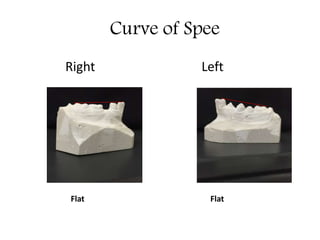
- flat curve of spee.
Upper arch:-
- U-shaped arch and symmetric.
- Spaced upper arch.
- rotated UL centaral &
lateral..
- rotated UR 5.
- Flat curve of spee.
Teeth in occlusion
- Incisor relationship: classII div 1.
- Overjet: 8 mm
- Overbite: on both sides : increased, complete to the tooth,
atraumatic.
- Upper & lower midlines are coincident with each other & with
the facial midline.
Buccal segment in occlusion
-Molars:-
Rt: full unit class II
Lt: ½ unit class II
-Canines:
Rt & Lt: can’t be determined.
-UR 4 overerupted.
-Displacements: None detected.
Study model analysis in occlusion
Anterioposterior:
OJ: 8 mm
Right Left
-Molar: full unit Class II
-Canine: can’t be determined.
-Molar: ½ unit Class II
-Canine: can’t be determined.
Transverse
Coincident upper & lower
midlines.
Vertical:
increased overbite
Curve of Spee
Right Left
Flat Flat
Upper arch
- U- shaped arch.
- symmetrical arch.
- Intermolar width :
.46mm (increased)
Lower Arch
- U shaped arch.
- Symmetrical.
- Intermolar width:
(45) increased.
Radiographical examination
R L
Orthopantomogram “OPT” Analysis
- No apperant pathology.
- All teeth are present but 7 3 3 5 7 still unerupted.
7 5 4 3 7
- The tooth buds of all 8 ‘s are present.
Cephalometric Analysis
Ceph- interpretationNormal valuePre-treatmentVariable
Prognathic maxilla81+- 385SNA
Normal mandible78+- 377SNB
Skeletal class II3+- 18ANB
Normally inclined maxilla8+- 37.4SN-Mx
6ANB*
Average MMPA27+- 428MMPA
Proclined upper incisors109+- 6125UI/Mx
Proclined lower incisors93+- 6113LI/Mn
135+- 1093.3IIA
Reduced LAFH55+- 252.5%LAFH %
0 +- 1.774Wits
appraisal
CVM
CVMS III
Space Analysis
Lower arch:
Space needed: 71 mm.
Space available: 71.5 mm.
Upper arch:
Space available: 85 mm
Space needed: 82 mm
Space Analysis ( continued )
53.5104117*79.5*89.59.589*7.5711
AnterOverall654321123456
439411.5779*66.56.569*7*7*11.5
Bolton Analysis:
Σ Lower anterior teeth widths = 43mm =80.37%
Σ Upper anterior teeth widths 53.5mm
normal= 77.2% +/- 1.65
Σ Lower all teeth widths = 94mm = 90.38%
Σ Upper all teeth widths 104mm
normal= 91.3% +/- 1.91
Pre – treatment (IOTN)
Aesthetic Component
( Grade 4 )
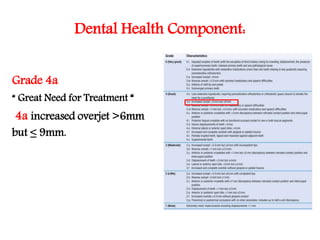
Dental Health Component:
Grade 4a
“ Great Need for Treatment “
4a increased overjet >6mm
but ≤ 9mm.
Diagnostic Summary :-
A.M is 12 years old male patient medically fit, C/O
( my upper teeth are sticking out “pointing to the
upper centrals”),
on examination he has class II div 1 incisor on
class II skeletal base, with increased
O.J(8mm),deep O.B, average LFH , convex profile,
complicated by: proclined upper incisors& lower
incisors, rotated (UL1, UL2,UR5), overerupted
UR4.
Problem List:-
Pathological Problem:-
1- poor oral hygiene.
2- carious LR E.
Patient’s concern:-
A.M. is complaining that “my upper teeth are sticking out “pointing to upper
incisors”
Skeletal Problems:-
1- Class II skeletal base.
Soft tissue problems :-
1- improper smile arc.
2- upper incisors are not close neither touching the lower lip.
3- obtuse frontonasal angle.
4- convex profile.
5- gummy smile.
Dental problems :
1- mild crowding in the lower labial segment.
2-rotated UL1, UL2, UR5.
3- proclined lower incisors.
4- proclined upper incisors.
5- overerupted UR4.
6- increased O.J
7- increased O.B
8- class II div 1 incisor relation.
9- full unit class II molar on the right side.
10- ½ unit class II molar on the left side.
Treatment Aims:-
• Improve oral hygiene.
• Stabilization of periodontal health.
• Restoraton of the carious LR E.
• Correct pt’s chief complaint ( protrusion ).
• Correct skeletal class II relationship.
• Correct slightly decreased LFH.
• Improve the pt’s smile.
• Improve facial profile.
• Achieve normal Overjet.(2-3 mm)
• Achieve normal Overbite.
• Achieve class 1 incisor relationship.
• Achieve class 1 molar relationship on both sides.
• Correct rotated teeth(UL1, UL2, UR5) .
• Correct the incisor inclination.
• Level and align the arches.
• Finishing and detailing of the occlusion.
• maintain the corrected results.
Treatment Plan
(option 1)
• Phase 1: growth modification (functional).
• Oral hygiene instructions
• Referral to periodontics clinic for maintenance of
periodontal condition.
• Medium Opening Activator.
• Phase 2: Re-evaluate the case after phase 1 .
• Upper and lower Fixed applinace MBT slot 0.022.
• Retention ( active retainer).
Retention Protocol
• After phase 1 : : inclined anterior bite plane (8
mm thickness , 70 degrees inclination.)
• After phase 2 :
• -Short term : upper & lower Hawley retainer
with inclined ABP,( full time wear for 6
months, night time wear for another 6
months).
• Long term: upper & lower bonded retainer from 3-3.
Treatment Plan
(option 2)
• PHASE 1: growth modification.
• Oral hygiene instructions
• Referral to periodontics clinic for maintenance of
periodontal condition.
• Straight pull headgear.
• PHASE 2: Re-evaluate the case after phase 1 .
• Upper and lower Fixed applinace MBT slot 0.022.
• Retention ( active retainer).
Retention Protocol
• After phase 1 : headgear night time wear
(250gm per side for 12 hours).
• After phase 2 :
• -Short term : upper & lower Hawley retainer
with inclined ABP, (full time wear for 6
months, night time wear for another 6
months).
• Long term: upper & lower bonded retainer.
MOA design
• • Lower incisal capping 3-3
• • Anterior palatal wire 3-3 in 1.0 mm S.S wire
• Adams crib 64/46 0.7 mm S.S wire
• • Acrylic connecting “sturts”/ vertical supports
• coffin spring 1.25 mm SS wire.
Justification
• Growth modification > functional appliance:
• growing patient.
• class II skeletal base.
• proclined upper incisors.
• Average MMPA with increased overbite.
• minimal crowded arches.
• Class II molar relationships.
• Increased overjet.
Justification
MOA :
1. Moderately displaces the mandible
2. Moderate bite opening
3. Robust.
4. Easy to repair
5. Can incorporate expansion screw
6. Capping lower incisors to prevent proclination
Justification
• Inclined anterior bite plane:
• to retain functional appliance results during
transition to fixed appliance .
• allow settling of the occlusion.
• Upper and lower Fixed applinace :
• We need 3D teeth movement.
• Alignment of rotated teeth.
• Closure of spaces.
• MBT prescription is preferred:
• It correct LLS and ULS inclination.
• Increased lingual crown torque of LLS which helps to
counteract the side effect of functional appliance.
• Zero degree tip of upper molars:
- prevent distal tipping of the root of the first molar against
the second molar which might cause root resorption when HG
is used.
- keep the molars upright while the future growth might
cause further mesial tip.
Treatment details
• Full records
• Take impression for MOA and functional bite
with 2mm separation at incisors (deep bite)
with the patient biting edge to edge.
• Delivery of the appliance and instructions.
• After finishing the functional phase deliver the
inclined anterior bite plane to retain
functional appliance results during transition
to fixed appliance.
• bonding of the fixed appliance MBT
prescription on the upper & the lower arch.
• Alignment with superelastic 0.016”niti wire.
The normal sequence of wires until reaching
rigid S.S 19*25 wires.
• TMA wire for finishing and settling of the
occlusion .
• Debonding and impression taking for upper
and lower Hawley retainer with inclined ABP.
• The delivary of upper and lower hawely
retainer.
Justification
• Growth modification (straight pull headgear):
• Growing patient.
• Class II skeletal.
• Normal MMPA.
• To restrain the maxillary growth ( prognathic
maxilla).
• Increased O.J (corrected by allowing autorotation
of mandible).
• Increased O.B ( corrected by allowing
autorotation of mandible).
Treatment details
• Full records.
• Separators around U6’s.
• Band selection & cementation.
• Fitting of facebow and headgear with
instructions.
• ( force 500-900 gm/ side for 12 - 14 hours).
• bonding of the fixed appliance MBT
prescription on the upper & the lower arch.
• Alignment with superelastic 0.016”niti wire.
The normal sequence of wires until reaching
rigid S.S 19*25 wires.
• TMA wire for finishing and settling of the
occlusion .
Case

Case

  • 1.
    Case Presentation Done By:Dr. Jumana Al-Abbadi 3rd year orthodontic resident Supervised By: Dr. Ahmad Al-Tarawneh Dr. Jumana Tbeishat Dr. Raed AlRabta Dr. Bashar Al-Momani Dr. Anwar Rahamneh
  • 2.
    Personal Data Patient’s Name: A.M Gender: M. Age: 12 yrs. Occupation: Student. Nationality: Jordanian
  • 3.
    History Trauma:- No Historyof Trauma. Habits :- No Habits . Growth status: grower.
  • 4.
    Medical and DentalHistory  Medical History: - Medically fit.  Dental History :- - Routine dental treatment.
  • 5.
    Chief Complaint “my upperteeth are sticking out (pointing to his upper centrals)“
  • 6.
    Extra – Oralphotos ( Frontal View )
  • 7.
    Extra – Oralphotos ( Profile View )
  • 8.
    Extra – Oralphotos ( Oblique View )
  • 9.
  • 10.
    Extra – OralExamination A. Skeletal Assessment Antero-posterior assessment: Convex profile.
  • 11.
    B. Vertical Assessment: Averagelower anterior facial height.
  • 12.
  • 13.
    Smile esthatic - Onfull smile the whole length of maxillary incisors show. - Gummy smile. - Upper incisors edges do not run parallel to the lower lip (improper smile arc ). - Upper midline is coincident with the facial midline. - Lower midline is coincident with the facial midline . - Average Buccal corridor.
  • 14.
    Soft tissue Examination:- -The lower third is slightly shorter than the middle third . -Upper lip in the upper third of the lower part . -Lower lip in the lower two thirds of the lower part. 13 23
  • 15.
    Soft tissue Examination:- -Nasal tip deviated to the left side. - Interpupillary distance is not equal to mouth width. - The width of the nose is slightly wider than the central fifth. - Potentially Competent lips.
  • 16.
    Soft tissue Examination:- -Frontonasial angle : 149 “ normal 115 – 135 “ --Naso labial angle : 98 “normal 90 – 110“ - -- Labiomental angle: 131 “ normal 114 – 140 “
  • 17.
    Intra oral Examination -Oral hygiene: poor. - Oral Mucosa: NAD. - Lower right E carious.
  • 18.
    Teeth Present :- 654C2112C4E6 6EC21 123456
  • 19.
    Lower arch - U-shapedarch and symmetric. - Mild crowding in the lower labial segment. - Partially erupted LT canine. - Proclined lower incisors. - Carious LR E. - flat curve of spee.
  • 20.
    Upper arch:- - U-shapedarch and symmetric. - Spaced upper arch. - rotated UL centaral & lateral.. - rotated UR 5. - Flat curve of spee.
  • 21.
    Teeth in occlusion -Incisor relationship: classII div 1. - Overjet: 8 mm - Overbite: on both sides : increased, complete to the tooth, atraumatic. - Upper & lower midlines are coincident with each other & with the facial midline.
  • 22.
    Buccal segment inocclusion -Molars:- Rt: full unit class II Lt: ½ unit class II -Canines: Rt & Lt: can’t be determined. -UR 4 overerupted. -Displacements: None detected.
  • 23.
    Study model analysisin occlusion Anterioposterior: OJ: 8 mm Right Left -Molar: full unit Class II -Canine: can’t be determined. -Molar: ½ unit Class II -Canine: can’t be determined.
  • 24.
  • 25.
  • 26.
    Curve of Spee RightLeft Flat Flat
  • 27.
    Upper arch - U-shaped arch. - symmetrical arch. - Intermolar width : .46mm (increased)
  • 28.
    Lower Arch - Ushaped arch. - Symmetrical. - Intermolar width: (45) increased.
  • 30.
    Radiographical examination R L Orthopantomogram“OPT” Analysis - No apperant pathology. - All teeth are present but 7 3 3 5 7 still unerupted. 7 5 4 3 7 - The tooth buds of all 8 ‘s are present.
  • 31.
  • 32.
    Cephalometric Analysis Ceph- interpretationNormalvaluePre-treatmentVariable Prognathic maxilla81+- 385SNA Normal mandible78+- 377SNB Skeletal class II3+- 18ANB Normally inclined maxilla8+- 37.4SN-Mx 6ANB* Average MMPA27+- 428MMPA Proclined upper incisors109+- 6125UI/Mx Proclined lower incisors93+- 6113LI/Mn 135+- 1093.3IIA Reduced LAFH55+- 252.5%LAFH % 0 +- 1.774Wits appraisal
  • 33.
  • 34.
    Space Analysis Lower arch: Spaceneeded: 71 mm. Space available: 71.5 mm. Upper arch: Space available: 85 mm Space needed: 82 mm
  • 35.
    Space Analysis (continued ) 53.5104117*79.5*89.59.589*7.5711 AnterOverall654321123456 439411.5779*66.56.569*7*7*11.5 Bolton Analysis: Σ Lower anterior teeth widths = 43mm =80.37% Σ Upper anterior teeth widths 53.5mm normal= 77.2% +/- 1.65 Σ Lower all teeth widths = 94mm = 90.38% Σ Upper all teeth widths 104mm normal= 91.3% +/- 1.91
  • 36.
    Pre – treatment(IOTN) Aesthetic Component ( Grade 4 )
  • 37.
    Dental Health Component: Grade4a “ Great Need for Treatment “ 4a increased overjet >6mm but ≤ 9mm.
  • 38.
    Diagnostic Summary :- A.Mis 12 years old male patient medically fit, C/O ( my upper teeth are sticking out “pointing to the upper centrals”), on examination he has class II div 1 incisor on class II skeletal base, with increased O.J(8mm),deep O.B, average LFH , convex profile, complicated by: proclined upper incisors& lower incisors, rotated (UL1, UL2,UR5), overerupted UR4.
  • 39.
    Problem List:- Pathological Problem:- 1-poor oral hygiene. 2- carious LR E. Patient’s concern:- A.M. is complaining that “my upper teeth are sticking out “pointing to upper incisors” Skeletal Problems:- 1- Class II skeletal base. Soft tissue problems :- 1- improper smile arc. 2- upper incisors are not close neither touching the lower lip. 3- obtuse frontonasal angle. 4- convex profile. 5- gummy smile.
  • 40.
    Dental problems : 1-mild crowding in the lower labial segment. 2-rotated UL1, UL2, UR5. 3- proclined lower incisors. 4- proclined upper incisors. 5- overerupted UR4. 6- increased O.J 7- increased O.B 8- class II div 1 incisor relation. 9- full unit class II molar on the right side. 10- ½ unit class II molar on the left side.
  • 41.
    Treatment Aims:- • Improveoral hygiene. • Stabilization of periodontal health. • Restoraton of the carious LR E. • Correct pt’s chief complaint ( protrusion ). • Correct skeletal class II relationship. • Correct slightly decreased LFH. • Improve the pt’s smile. • Improve facial profile. • Achieve normal Overjet.(2-3 mm) • Achieve normal Overbite. • Achieve class 1 incisor relationship. • Achieve class 1 molar relationship on both sides. • Correct rotated teeth(UL1, UL2, UR5) . • Correct the incisor inclination. • Level and align the arches. • Finishing and detailing of the occlusion. • maintain the corrected results.
  • 42.
    Treatment Plan (option 1) •Phase 1: growth modification (functional). • Oral hygiene instructions • Referral to periodontics clinic for maintenance of periodontal condition. • Medium Opening Activator. • Phase 2: Re-evaluate the case after phase 1 . • Upper and lower Fixed applinace MBT slot 0.022. • Retention ( active retainer).
  • 43.
    Retention Protocol • Afterphase 1 : : inclined anterior bite plane (8 mm thickness , 70 degrees inclination.) • After phase 2 : • -Short term : upper & lower Hawley retainer with inclined ABP,( full time wear for 6 months, night time wear for another 6 months). • Long term: upper & lower bonded retainer from 3-3.
  • 44.
    Treatment Plan (option 2) •PHASE 1: growth modification. • Oral hygiene instructions • Referral to periodontics clinic for maintenance of periodontal condition. • Straight pull headgear. • PHASE 2: Re-evaluate the case after phase 1 . • Upper and lower Fixed applinace MBT slot 0.022. • Retention ( active retainer).
  • 45.
    Retention Protocol • Afterphase 1 : headgear night time wear (250gm per side for 12 hours). • After phase 2 : • -Short term : upper & lower Hawley retainer with inclined ABP, (full time wear for 6 months, night time wear for another 6 months). • Long term: upper & lower bonded retainer.
  • 46.
    MOA design • •Lower incisal capping 3-3 • • Anterior palatal wire 3-3 in 1.0 mm S.S wire • Adams crib 64/46 0.7 mm S.S wire • • Acrylic connecting “sturts”/ vertical supports • coffin spring 1.25 mm SS wire.
  • 47.
    Justification • Growth modification> functional appliance: • growing patient. • class II skeletal base. • proclined upper incisors. • Average MMPA with increased overbite. • minimal crowded arches. • Class II molar relationships. • Increased overjet.
  • 48.
    Justification MOA : 1. Moderatelydisplaces the mandible 2. Moderate bite opening 3. Robust. 4. Easy to repair 5. Can incorporate expansion screw 6. Capping lower incisors to prevent proclination
  • 49.
    Justification • Inclined anteriorbite plane: • to retain functional appliance results during transition to fixed appliance . • allow settling of the occlusion.
  • 50.
    • Upper andlower Fixed applinace : • We need 3D teeth movement. • Alignment of rotated teeth. • Closure of spaces. • MBT prescription is preferred: • It correct LLS and ULS inclination. • Increased lingual crown torque of LLS which helps to counteract the side effect of functional appliance. • Zero degree tip of upper molars: - prevent distal tipping of the root of the first molar against the second molar which might cause root resorption when HG is used. - keep the molars upright while the future growth might cause further mesial tip.
  • 51.
    Treatment details • Fullrecords • Take impression for MOA and functional bite with 2mm separation at incisors (deep bite) with the patient biting edge to edge. • Delivery of the appliance and instructions. • After finishing the functional phase deliver the inclined anterior bite plane to retain functional appliance results during transition to fixed appliance.
  • 52.
    • bonding ofthe fixed appliance MBT prescription on the upper & the lower arch. • Alignment with superelastic 0.016”niti wire. The normal sequence of wires until reaching rigid S.S 19*25 wires. • TMA wire for finishing and settling of the occlusion .
  • 53.
    • Debonding andimpression taking for upper and lower Hawley retainer with inclined ABP. • The delivary of upper and lower hawely retainer.
  • 54.
    Justification • Growth modification(straight pull headgear): • Growing patient. • Class II skeletal. • Normal MMPA. • To restrain the maxillary growth ( prognathic maxilla). • Increased O.J (corrected by allowing autorotation of mandible). • Increased O.B ( corrected by allowing autorotation of mandible).
  • 55.
    Treatment details • Fullrecords. • Separators around U6’s. • Band selection & cementation. • Fitting of facebow and headgear with instructions. • ( force 500-900 gm/ side for 12 - 14 hours).
  • 56.
    • bonding ofthe fixed appliance MBT prescription on the upper & the lower arch. • Alignment with superelastic 0.016”niti wire. The normal sequence of wires until reaching rigid S.S 19*25 wires. • TMA wire for finishing and settling of the occlusion .