
Bimaxillary proclination
Done by : Dr. Sarah Qasim
Supervised by :
Dr . Bashar AlMomani
Dr . Anwar Alrahamneh
DEFENITION
Bimaxillary protrusion is a condition characterized by
protrusive and proclined upper and lower incisors and
an increased procumbency of the lips.
Prevelance :
• Most common in Afro-Caribbeans
• It is also common among Arab groups and Asians
(Hussein 2007)
• It is less prevalent in white Caucasian populations
(Keating 1985).
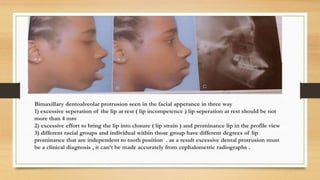
Bimaxillary dentoalveolar protrusion seen in the facial apperance in three way
1) excessive seperation of the lip at rest ( lip incompetence ) lip seperation at rest should be not
more than 4 mm
2) excessive effort to bring the lip into closure ( lip strain ) and prominance lip in the profile view
3) different racial groups and individual within those group have different degrees of lip
prominance that are independent to tooth position . as a result excessive dental protrusion must
be a clinical diagnosis , it can’t be made accurately from cephalometric radiographs .
Aetiology
A - Skeletal factors
B- Soft tissue factors
• Lip length
• Endogenous (primary) thrust
C- Dental
D- Habit
E- Pathological
• Skeletal factors with underlying genetic relationship.
• Soft tissue factors
• Lip length, activity, morphology and position :
in bimaxillary proclination cases, usually the lips are full, loose and everted, and the tongue
acts to mould the dental arches forward as they erupt. The effect of abnormality of soft
tissues at rest is more influential than that during function
• The teeth protrude excessively if two condition are met :
1- the lip are prominent and everted
2- the lip are seperated at rest by more than 4 mm
Endogenous (primary) thrust
Occasionally the tongue is very large and is the primary cause of the bimaxillary
proclination, usually occurs with AOB.
It is very rare & affects 1% of population. Usually associated with lack of
neuromuscular control e.g. Downs syndrome and characterized by:
• Usually associated with a lisp,
• bimaxillary proclination,
• Reverse COS in the lower and deep COS in the upper.
• high tendency to relapse after treatment.
• Dental
• Due to way of incisors eruption in a forward direction.
• Tooth size discrepancy has been associated
• Habit
• like tongue thrust
• Pathological
• Cancrum oris
• Cerebral palsy
• Haemangioma with swelling of the lips/tongue/cheeks produces a “new” zone of balance.
• Untreated cleft lip or palate swings forwards
Classification
• Classification
• From the dental perspective, the severity of the dentoalveolar protrusion is best characterised by the
interincisal angle.
• 125 degree 115 degree = mild
• 115 degree 105 degree = moderate
• <105 degree = severe.
Features :
Keating PJ , 1985 , bimaxillary protrusion in the caucasian : cepalometric study of morphological feature ,BJO
Skeletal features :
• Skeletal bimaxillary protrusion
• Long prognathic maxilla and mandible
• Short cranial base length
• Divergent facial plane
• mild skeletal Class II
• Increased FMPA
• Increased ANB.
Soft tissue
• Convex facial form.
• Acute NLA & LMA.
• Reduced lip length.
• Lips incompetency.
• Low lower lip line and high upper lip line (Keating, 1985).
• Holdaway angle was increased with prominent lips.
• Receded chin.
Dental
• Dental bimaxillary proclination with reduced Interincisal angle
• Proclined LLS compensates for ANB difference
• Larger dental arch length with spacing and diastema
• Normal or increased OJ
• Variable molar relationship but usually normal.
• Reduced OB or AOB
• Large teeth compared to normal population
Aims for treatment of bimaxillary proclination
• Normal aims for any orthodontic treatment including:
• Relieve of crowding
• Alignment and levelling
• Close diastema and spacing
• Normal OJ and OB
• Correct incisor relationship
• Normalization of buccal occlusion
• Maintain a stable result
• Improving facial aesthetics i.e. flatten profile.
• Enabling lip competence
Treatment
• Treatment
• Always start with lower incisor retraction to provide space for ULS retraction.
Mild cases
Better to accept because  
• Aging can mask the protrusion by down and forward growth of the nose and
chin
• The high risk of relapse.
Moderate cases
Space provision
• IPS ; Germeç 2008 showed that nonextraction therapies are effective treatment alternatives
for Class I borderline patients with good facial profile and moderate dental crowding
• Enmass retraction with or without extraction
• Extraction in both arches usually first premolars.
• If the condition is class 2 then it might be treated with extraction in the upper alone.
Type of anchorage:
• TADs or conventional anchorage?
Upadhyay in 2008 RCT compare treatment of bimaxillary protrusion with extraction of 4 premolars using
conventional anchorage or TAD with Enmass retraction and found that
- TAD is better anchorage and the reduction of protrusion was high in TAD group
- TADs group showed a reduction in the VH due to intrusive effect of the TADs.
- the soft-tissue response was variable, facial convexity angle, nasolabial angle, and lower lip protrusion
showed greater changes in TAD group.
• TADs or TPA?
Liu 2009 compared the use of TPA and TADs in he found that
• A better dental, skeletal and soft tissue changes could be achieved by minicrew implants especially in
hyperdivergent patients.
• Skeletal anchorage should be routinely recommended in patients with bialveolar dental protrusion.
• TADs or HG?
• Junqing in 2008 showed again a better result by TADs in comparison with HG.
• Elastic
• Avoidance of intermaxillary elastic is recommended to overcome the extrusive effect of the elastic
that result in clockwise rotation of the mandible and compromising the OB.
• AOB
• If AOB is present, the modalities to treat AOB can be with combined (high pull HG, TADs )
Appliance system
Lew 1989 recommended the use of Begg appliance in treating these problems & reported
that Begg appliance with extraction of 4 premolars resulted in:
- Reduce the protrusion and improve the soft tissue profile.
- The nasolabial angle became more obtuse increasing from 80.7° to 90.7°.
- The upper lip and lower lip lengthened by 1.9 mm and 1.2 mm, respectively.
- The lower lip to 'E' line reduced from 7.5 mm to 3.7 mm.
- The upper lip to upper incisor retraction was 1:2.2 while the lower lip to lower incisor
retraction was 1:1.4.
** Tip edge brackets or Begg bracket allow tipping and help in reducing proclination
easily.
In order to avoid the opening of the bite, it is better to swap lower canine bracket or it is
possible to use tip edge bracket on the canine only.
In severe cases
• Orthognathic surgery is required to correct significant skeletal problems using subapical
osteotomies with extraction and with or without Genioplasty.
• Differential intrusion of maxilla/maxillary segments with clockwise rotation of the
occlusal plane is a useful technique for treatment of anterior open bite and creation of a
consonant smile arc .
• Le Fort I osteotomy with setback sometimes provides an alternative to segmental
maxillary osteotomies but it is difficult to performed clinically.
Stability & Relapse
• Keating 1986 showed that II angle showed almost 30% relapse.
• Long-term stability is unpredictable, depends on lip adapting to incisor retraction, i.e.
lower lip becoming competent
• Permanent fixed retainer supported with VFR in both archs
• Buccal intercuspation is crucial
The aims for a good stability at the end of treatment should be:
• Interincisal angle and lower edge centroid should be normalized
• Lower lip should cover one third of upper incisor
• If the tongue is very large, then surgical reduction can be justified
Factors influencing position of the teeth
1 ) Intrinsic forces from tongue & lips
• Tongue and lip is High force for Short duration & Low importance
• Tongue pressure is always measured at a higher value than the lip
pressure.
2 ) Extrinsic forces: habits, orthodontic appliances.
• Orthodontics force disturbs the force equilibrium on the teeth.
• Swallowing & speech is high force for short duration and low importance
• Rest is low force for long duration and high importance
• Light forces over a long time will move teeth.
• Duration is far more important than the force.
3) Forces from dental occlusion.
• Force from occlusion is high force for short duration and low importance
• May be of importance in the vertical development of the occlusion.
• It is an adaptive mechanisim, example is when the maxilla is surgically impacted the
mandible will rotate closed and a new rest position will be established.
• Proprioceptive fibres in the PDL play apart in mandibular rest position.
4) Forces from the periodontal ligament:
• Pd ligament is very low for long duration and high importance
• Teeth erupt into the mouth to keep up with an increase in vertical dimension of the face
• Also when the opposing tooth is removed the now unopposed tooth will still continue to
erupt.
• Eruption force is between 2 - 10 grams
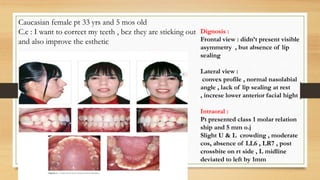
Dignosis :
Frontal view : didn’t present visible
asymmetry , but absence of lip
sealing
Lateral view :
convex profile , normal nasolabial
angle , lack of lip sealing at rest
, increse lower anterior facial hight
Intraoral :
Pt presented class 1 molar relation
ship and 5 mm o.j
Slight U & L crowding , moderate
cos, absence of LL6 , LR7 , post
crossbite on rt side , L midline
deviated to left by 1mm
Caucasian female pt 33 yrs and 5 mos old
C.c : I want to correct my teeth , bcz they are sticking out
and also improve the esthetic
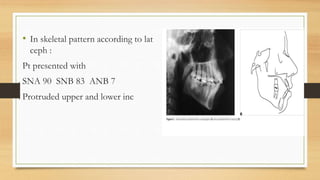
• In skeletal pattern according to lat
ceph :
Pt presented with
SNA 90 SNB 83 ANB 7
Protruded upper and lower inc
Treatment plan :
• Aims : Maintain canine occlusion; align and level the teeth; eliminate posterior
cross bites; reduce overbite and overjet; eliminate crowding on both arches; level
the Curve of Spee, close the spaces due to extraction of teeth LL6
• Tx plan : extractions of the first upper and lower right premolars , besides the
retraction of upper and lower anterior teeth, to reduce bimaxillary protrusion
and correct the lower midline.
• passive lip sealing would be expected and decrease of the lower anterior facial
height, in order to reach smile harmony.
• The treatment was performed with the Straight wire technique, Roth’s
prescription (0.022 x 0.028).
• Leveling and alignment were carried with a sequence of NiTi round
archwires, NiTi rectangular archwires 0.017 x 0.025-in and stainless steel
rectangular archwires 0.019 x 0.025, with loops for retraction of anterior
teeth.
• Bands were placed on the first and second upper molars, as well as on the
first, second and third lower molars, with a transpalatal bar on the first upper
molars and lip bumper on lower molars ( for anchorage ).
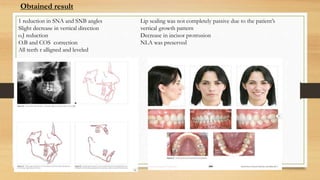
1 reduction in SNA and SNB angles
Slight decrease in vertical direction
o.J reduction
O.B and COS correction
All teeth r alligned and leveled
Lip sealing was not completely passive due to the patient’s
vertical growth pattern
Decrease in incisor protrusion
NLA was preserved
Obtained result
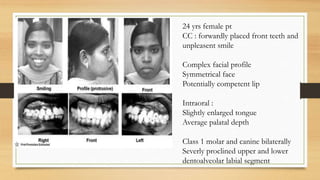
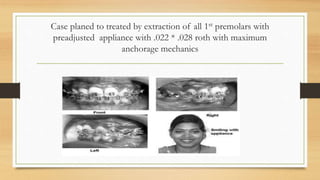
24 yrs female pt
CC : forwardly placed front teeth and
unpleasent smile
Complex facial profile
Symmetrical face
Potentially competent lip
Intraoral :
Slightly enlarged tongue
Average palatal depth
Class 1 molar and canine bilaterally
Severly proclined upper and lower
dentoalveolar labial segment
Case planed to treated by extraction of all 1st premolars with
preadjusted appliance with .022 * .028 roth with maximum
anchorage mechanics
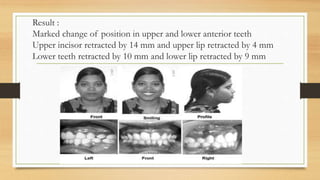
Result :
Marked change of position in upper and lower anterior teeth
Upper incisor retracted by 14 mm and upper lip retracted by 4 mm
Lower teeth retracted by 10 mm and lower lip retracted by 9 mm
• for 1 mm upper lip retraction  the upper incisor retracted 3.5 mm
Establishing the ratio of upper incisor to upper lip 3.5 : 1
• for 1mm lower lip retraction  the lower incisor retracted 1.1 mm
• Establishing the ratioo 1 : 1.1
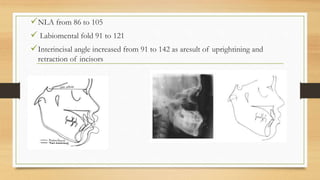
NLA from 86 to 105
 Labiomental fold 91 to 121
Interincisal angle increased from 91 to 142 as aresult of uprightining and
retraction of incisors
REFERENCES
 Bimaxillary Dentoalveolar Protrusion: Traits and Orthodontic Correction , Daniel A. Billsa; Chester S. Handelmanb;
Ellen A. BeGolec .
 keating pj 1985 ,Bimaxillary protrusion in the caucasian : cephalometric study of morphological feature , bjo
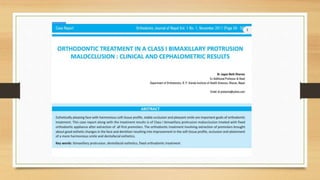
 Dr jagn sharma , case report , Orthodontic treatment in a class 1 bimaxillary protrusion malocclusion : clinical and
cephalometric result
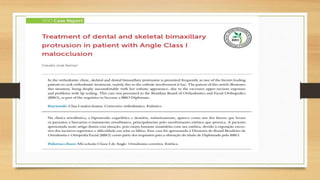
 Caloudio ramos , treatment of dental and skeletal bimaxillary protrusion in patient with angle class 1 malocclusion .
 Upadhyay , treatment of mini implant for en mass retraction of anterior teeth in bialveolar dental protrusion patient : a
randomized controlled trial .
 Postgraduate notes in orthodontics DDS/Morth programme 7th edition , bimaxillary proclinatin , p.70
 bimaxillary proclination , Mohd almuzian 1-2013
 orthodontic diagnosis : the problem – oriented approach , chapter 6 , Contemporary Orthodontic 5th edition – William
R. Proffit.
Bimaxillary proclination

Bimaxillary proclination

  • 1.
    Bimaxillary proclination Done by: Dr. Sarah Qasim Supervised by : Dr . Bashar AlMomani Dr . Anwar Alrahamneh
  • 2.
    DEFENITION Bimaxillary protrusion isa condition characterized by protrusive and proclined upper and lower incisors and an increased procumbency of the lips.
  • 3.
    Prevelance : • Mostcommon in Afro-Caribbeans • It is also common among Arab groups and Asians (Hussein 2007) • It is less prevalent in white Caucasian populations (Keating 1985).
  • 4.
    Bimaxillary dentoalveolar protrusionseen in the facial apperance in three way 1) excessive seperation of the lip at rest ( lip incompetence ) lip seperation at rest should be not more than 4 mm 2) excessive effort to bring the lip into closure ( lip strain ) and prominance lip in the profile view 3) different racial groups and individual within those group have different degrees of lip prominance that are independent to tooth position . as a result excessive dental protrusion must be a clinical diagnosis , it can’t be made accurately from cephalometric radiographs .
  • 5.
    Aetiology A - Skeletalfactors B- Soft tissue factors • Lip length • Endogenous (primary) thrust C- Dental D- Habit E- Pathological
  • 6.
    • Skeletal factorswith underlying genetic relationship. • Soft tissue factors • Lip length, activity, morphology and position : in bimaxillary proclination cases, usually the lips are full, loose and everted, and the tongue acts to mould the dental arches forward as they erupt. The effect of abnormality of soft tissues at rest is more influential than that during function
  • 7.
    • The teethprotrude excessively if two condition are met : 1- the lip are prominent and everted 2- the lip are seperated at rest by more than 4 mm
  • 8.
    Endogenous (primary) thrust Occasionallythe tongue is very large and is the primary cause of the bimaxillary proclination, usually occurs with AOB. It is very rare & affects 1% of population. Usually associated with lack of neuromuscular control e.g. Downs syndrome and characterized by: • Usually associated with a lisp, • bimaxillary proclination, • Reverse COS in the lower and deep COS in the upper. • high tendency to relapse after treatment.
  • 9.
    • Dental • Dueto way of incisors eruption in a forward direction. • Tooth size discrepancy has been associated • Habit • like tongue thrust • Pathological • Cancrum oris • Cerebral palsy • Haemangioma with swelling of the lips/tongue/cheeks produces a “new” zone of balance. • Untreated cleft lip or palate swings forwards
  • 10.
    Classification • Classification • Fromthe dental perspective, the severity of the dentoalveolar protrusion is best characterised by the interincisal angle. • 125 degree 115 degree = mild • 115 degree 105 degree = moderate • <105 degree = severe.
  • 11.
    Features : Keating PJ, 1985 , bimaxillary protrusion in the caucasian : cepalometric study of morphological feature ,BJO Skeletal features : • Skeletal bimaxillary protrusion • Long prognathic maxilla and mandible • Short cranial base length • Divergent facial plane • mild skeletal Class II • Increased FMPA • Increased ANB.
  • 12.
    Soft tissue • Convexfacial form. • Acute NLA & LMA. • Reduced lip length. • Lips incompetency. • Low lower lip line and high upper lip line (Keating, 1985). • Holdaway angle was increased with prominent lips. • Receded chin.
  • 13.
    Dental • Dental bimaxillaryproclination with reduced Interincisal angle • Proclined LLS compensates for ANB difference • Larger dental arch length with spacing and diastema • Normal or increased OJ • Variable molar relationship but usually normal. • Reduced OB or AOB • Large teeth compared to normal population
  • 14.
    Aims for treatmentof bimaxillary proclination • Normal aims for any orthodontic treatment including: • Relieve of crowding • Alignment and levelling • Close diastema and spacing • Normal OJ and OB • Correct incisor relationship • Normalization of buccal occlusion • Maintain a stable result • Improving facial aesthetics i.e. flatten profile. • Enabling lip competence
  • 15.
    Treatment • Treatment • Alwaysstart with lower incisor retraction to provide space for ULS retraction. Mild cases Better to accept because   • Aging can mask the protrusion by down and forward growth of the nose and chin • The high risk of relapse.
  • 16.
    Moderate cases Space provision •IPS ; Germeç 2008 showed that nonextraction therapies are effective treatment alternatives for Class I borderline patients with good facial profile and moderate dental crowding • Enmass retraction with or without extraction • Extraction in both arches usually first premolars. • If the condition is class 2 then it might be treated with extraction in the upper alone.
  • 17.
    Type of anchorage: •TADs or conventional anchorage? Upadhyay in 2008 RCT compare treatment of bimaxillary protrusion with extraction of 4 premolars using conventional anchorage or TAD with Enmass retraction and found that - TAD is better anchorage and the reduction of protrusion was high in TAD group - TADs group showed a reduction in the VH due to intrusive effect of the TADs. - the soft-tissue response was variable, facial convexity angle, nasolabial angle, and lower lip protrusion showed greater changes in TAD group. • TADs or TPA? Liu 2009 compared the use of TPA and TADs in he found that • A better dental, skeletal and soft tissue changes could be achieved by minicrew implants especially in hyperdivergent patients. • Skeletal anchorage should be routinely recommended in patients with bialveolar dental protrusion. • TADs or HG? • Junqing in 2008 showed again a better result by TADs in comparison with HG.
  • 18.
    • Elastic • Avoidanceof intermaxillary elastic is recommended to overcome the extrusive effect of the elastic that result in clockwise rotation of the mandible and compromising the OB. • AOB • If AOB is present, the modalities to treat AOB can be with combined (high pull HG, TADs )
  • 19.
    Appliance system Lew 1989recommended the use of Begg appliance in treating these problems & reported that Begg appliance with extraction of 4 premolars resulted in: - Reduce the protrusion and improve the soft tissue profile. - The nasolabial angle became more obtuse increasing from 80.7° to 90.7°. - The upper lip and lower lip lengthened by 1.9 mm and 1.2 mm, respectively. - The lower lip to 'E' line reduced from 7.5 mm to 3.7 mm. - The upper lip to upper incisor retraction was 1:2.2 while the lower lip to lower incisor retraction was 1:1.4. ** Tip edge brackets or Begg bracket allow tipping and help in reducing proclination easily. In order to avoid the opening of the bite, it is better to swap lower canine bracket or it is possible to use tip edge bracket on the canine only.
  • 20.
    In severe cases •Orthognathic surgery is required to correct significant skeletal problems using subapical osteotomies with extraction and with or without Genioplasty. • Differential intrusion of maxilla/maxillary segments with clockwise rotation of the occlusal plane is a useful technique for treatment of anterior open bite and creation of a consonant smile arc . • Le Fort I osteotomy with setback sometimes provides an alternative to segmental maxillary osteotomies but it is difficult to performed clinically.
  • 21.
    Stability & Relapse •Keating 1986 showed that II angle showed almost 30% relapse. • Long-term stability is unpredictable, depends on lip adapting to incisor retraction, i.e. lower lip becoming competent • Permanent fixed retainer supported with VFR in both archs • Buccal intercuspation is crucial The aims for a good stability at the end of treatment should be: • Interincisal angle and lower edge centroid should be normalized • Lower lip should cover one third of upper incisor • If the tongue is very large, then surgical reduction can be justified
  • 22.
    Factors influencing positionof the teeth 1 ) Intrinsic forces from tongue & lips • Tongue and lip is High force for Short duration & Low importance • Tongue pressure is always measured at a higher value than the lip pressure.
  • 23.
    2 ) Extrinsicforces: habits, orthodontic appliances. • Orthodontics force disturbs the force equilibrium on the teeth. • Swallowing & speech is high force for short duration and low importance • Rest is low force for long duration and high importance • Light forces over a long time will move teeth. • Duration is far more important than the force.
  • 24.
    3) Forces fromdental occlusion. • Force from occlusion is high force for short duration and low importance • May be of importance in the vertical development of the occlusion. • It is an adaptive mechanisim, example is when the maxilla is surgically impacted the mandible will rotate closed and a new rest position will be established. • Proprioceptive fibres in the PDL play apart in mandibular rest position. 4) Forces from the periodontal ligament: • Pd ligament is very low for long duration and high importance • Teeth erupt into the mouth to keep up with an increase in vertical dimension of the face • Also when the opposing tooth is removed the now unopposed tooth will still continue to erupt. • Eruption force is between 2 - 10 grams
  • 26.
    Dignosis : Frontal view: didn’t present visible asymmetry , but absence of lip sealing Lateral view : convex profile , normal nasolabial angle , lack of lip sealing at rest , increse lower anterior facial hight Intraoral : Pt presented class 1 molar relation ship and 5 mm o.j Slight U & L crowding , moderate cos, absence of LL6 , LR7 , post crossbite on rt side , L midline deviated to left by 1mm Caucasian female pt 33 yrs and 5 mos old C.c : I want to correct my teeth , bcz they are sticking out and also improve the esthetic
  • 27.
    • In skeletalpattern according to lat ceph : Pt presented with SNA 90 SNB 83 ANB 7 Protruded upper and lower inc
  • 28.
    Treatment plan : •Aims : Maintain canine occlusion; align and level the teeth; eliminate posterior cross bites; reduce overbite and overjet; eliminate crowding on both arches; level the Curve of Spee, close the spaces due to extraction of teeth LL6 • Tx plan : extractions of the first upper and lower right premolars , besides the retraction of upper and lower anterior teeth, to reduce bimaxillary protrusion and correct the lower midline. • passive lip sealing would be expected and decrease of the lower anterior facial height, in order to reach smile harmony.
  • 29.
    • The treatmentwas performed with the Straight wire technique, Roth’s prescription (0.022 x 0.028). • Leveling and alignment were carried with a sequence of NiTi round archwires, NiTi rectangular archwires 0.017 x 0.025-in and stainless steel rectangular archwires 0.019 x 0.025, with loops for retraction of anterior teeth. • Bands were placed on the first and second upper molars, as well as on the first, second and third lower molars, with a transpalatal bar on the first upper molars and lip bumper on lower molars ( for anchorage ).
  • 30.
    1 reduction inSNA and SNB angles Slight decrease in vertical direction o.J reduction O.B and COS correction All teeth r alligned and leveled Lip sealing was not completely passive due to the patient’s vertical growth pattern Decrease in incisor protrusion NLA was preserved Obtained result
  • 32.
    24 yrs femalept CC : forwardly placed front teeth and unpleasent smile Complex facial profile Symmetrical face Potentially competent lip Intraoral : Slightly enlarged tongue Average palatal depth Class 1 molar and canine bilaterally Severly proclined upper and lower dentoalveolar labial segment
  • 33.
    Case planed totreated by extraction of all 1st premolars with preadjusted appliance with .022 * .028 roth with maximum anchorage mechanics
  • 34.
    Result : Marked changeof position in upper and lower anterior teeth Upper incisor retracted by 14 mm and upper lip retracted by 4 mm Lower teeth retracted by 10 mm and lower lip retracted by 9 mm
  • 35.
    • for 1mm upper lip retraction  the upper incisor retracted 3.5 mm Establishing the ratio of upper incisor to upper lip 3.5 : 1 • for 1mm lower lip retraction  the lower incisor retracted 1.1 mm • Establishing the ratioo 1 : 1.1
  • 36.
    NLA from 86to 105  Labiomental fold 91 to 121 Interincisal angle increased from 91 to 142 as aresult of uprightining and retraction of incisors
  • 37.
    REFERENCES  Bimaxillary DentoalveolarProtrusion: Traits and Orthodontic Correction , Daniel A. Billsa; Chester S. Handelmanb; Ellen A. BeGolec .  keating pj 1985 ,Bimaxillary protrusion in the caucasian : cephalometric study of morphological feature , bjo  Dr jagn sharma , case report , Orthodontic treatment in a class 1 bimaxillary protrusion malocclusion : clinical and cephalometric result  Caloudio ramos , treatment of dental and skeletal bimaxillary protrusion in patient with angle class 1 malocclusion .  Upadhyay , treatment of mini implant for en mass retraction of anterior teeth in bialveolar dental protrusion patient : a randomized controlled trial .  Postgraduate notes in orthodontics DDS/Morth programme 7th edition , bimaxillary proclinatin , p.70  bimaxillary proclination , Mohd almuzian 1-2013  orthodontic diagnosis : the problem – oriented approach , chapter 6 , Contemporary Orthodontic 5th edition – William R. Proffit.